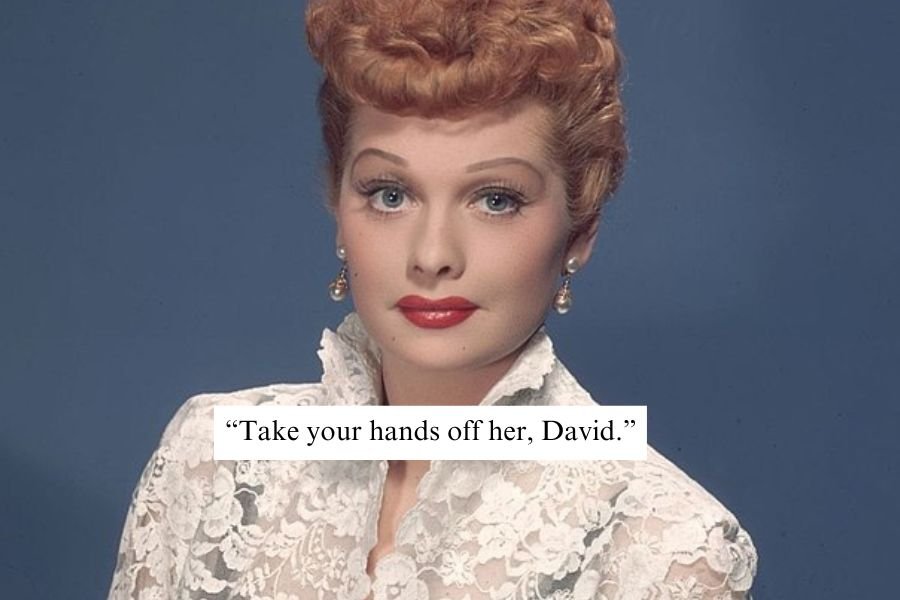
According to her daughter, Lucille Ball never considered herself a feminist, but there’s no question she blazed many a trail for women. A working mother in real life, she depicted issues facing housewives with her brilliant television comedy and became the first female studio head in Hollywood. She broke glass ceilings but wasn’t particularly outspoken about women’s rights. In fact, in a 1980 interview with “People,” she said, “They can use my name for equal rights, but I don’t get out there and raise hell because I’ve been so liberated, I have nothing to squawk about.”
Ball empowered women by example—and by speaking her mind. Carol Burnett shared a story on PBS about how Ball was unhappy with a script for her new show, but women at that time didn’t raise concerns about such things. Men could express criticism and demand changes, but women simply didn’t. Ball did—and firmly—despite being non-confrontational by nature. Later she told Burnett, “Kid, that’s when they put the ‘s’ at the end of my name.”
A video has been circulating on social media showing Ball’s no-nonsense way of speaking up when she felt the need to, and people are gushing over it.
In 1978, Ball participated in a Q & A session with UCLA theater arts students on the television program “America Alive!” The viral clip shows Ball repeatedly telling one of the hosts, David Sheehan, to take his hands off of female audience members when they were asking a question.
People laughed every time, but Ball didn’t so much as crack a smile during her clear, simple, repeated “hands off” admonitions. For 1978 especially, her advocacy for the women in the audience was extraordinary. Sheehan wasn’t touching these women in a lewd or sexual manner, but he was touching them in a way that he wouldn’t have touched a man who was asking a question. Most people wouldn’t have thought much of it at the time, but Lucille Ball immediately noted it and didn’t let it stand.
“I love that she didn’t even laugh when the room was,” shared one commenter. “She was not joking.”
“‘Take your hands off her, David,’ should be a sound AND a t-shirt,” wrote another.
“He kept trying. She kept telling him. Love her,” shared another.
“Lucille Ball always reminds me of my grandma,” offered another. “She hated to be seen as delicate, and she hated men that would touch her even more. She would say, stone-faced, ‘Get your paws off.’”
Even if Sheehan was casually touching those women out of habit and not ill intent, it’s laudable that Ball made a point of making him aware of it. Unfortunately, women are still having to deal with men touching them without being invited to, but seeing Lucille Ball’s serious face while calling it out is a good reminder that women have been fighting this battle for a long time. Good for her for using her microphone and the respect afforded her to speak up for the young women in her audience.
In a small village in Pwani, a district on Tanzania’s coast, a massive dance party is coming to a close. For the past two hours, locals have paraded through the village streets, singing and beating ngombe drums; now, in a large clearing, a woman named Sheilla motions for everyone to sit facing a large projector screen. A film premiere is about to begin.
It’s an unusual way to kick off a film about gender bias, inequality, early marriage, and other barriers that prevent girls from accessing education in Tanzania. But in Pwani and beyond, local organizations supported by Malala Fund and funded by Pura are finding creative, culturally relevant ways like this one to capture people’s interest.
The film ends and Sheilla, the Communications and Partnership Lead for Media for Development and Advocacy (MEDEA), stands in front of the crowd once again, asking the audience to reflect: What did you think about the film? How did it relate to your own experience? What can we learn?
Sheilla explains that, once the community sees the film, “It brings out conversations within themselves, reflective conversations.” The resonance and immediate action create a ripple effect of change.
MEDEA Screening Audience in Tanzania. Captured by James Roh for Pura
Across Tanzania, gender-based violence often forces adolescent girls out of the classroom. This and other barriers — including child marriage, poverty, conflict, and discrimination — prevent girls from completing their education around the world.
Sheilla and her team are using film and radio programs to address the challenges girls face in their communities. MEDEA’s ultimate goal is to affirm education as a fundamental right for everyone, and to ensure that every member of a community understands how girls’ education contributes to a stronger whole and how to be an ally for their sisters, daughters, granddaughters, friends, nieces, and girlfriends.
Sheilla’s story is one of many that inspired Heart on Fire, a new fragrance from the Pura x Malala Fund Collection that blends the warm, earthy spices of Tanzania with a playful, joyful twist. Here’s how Pura is using scent as a tool to connect the world and inspire action.
A partnership focused on local impact, on a global mission
Pura, a fragrance company that recognizes education as both freedom and a human right, has partnered with Malala Fund since 2022. In order to defend every girl’s right to access and complete 12 years of education, Malala Fund partners with local organizations in countries where the educational barriers are the greatest. They invest in locally-led solutions because they know that those who are closest to the problems are best equipped to solve and build durable solutions, like MEDEA, which works with communities to challenge discrimination against girls and change beliefs about their education.
But local initiatives can thrive and scale more powerfully with global support, which is why Pura is using their own superpower, the power of scent, to connect people around the world with the women and girls in these local communities.
The Pura x Malala Fund Collection incorporates ingredients naturally found in Tanzania, Nigeria, Pakistan, and Brazil: countries where Malala Fund operates to address systemic education barriers. Eight percent of net revenue from the Pura x Malala Fund Collection will be donated to Malala Fund directly, but beyond financial support, the Collection is also a love letter to each unique community, blending notes like lemon, jasmine, cedarwood, and clove to transport people, ignite their senses, and help them draw inspiration and hope from the global movement for girls’ education. Through scent, people can connect to the courage, joy, and tenacity of girls and local leaders, all while uniting in a shared commitment to education: the belief that supporting girls’ rights in one community benefits all of us, everywhere.
You’ve already met Sheilla. Now see how Naiara and Mama Habiba are building unique solutions to ensure every girl can learn freely and dare to dream.
Naiara Leite is reimagining what’s possible in Brazil
Julia with Odara in Brazil. Captured by Luisa Dorr for Pura
In Brazil, where pear trees and coconut plantations cover the Northeastern Coast, girls like ten-year-old Julia experience a different kind of educational barrier than girls in Tanzania. Too often, racial discrimination contributes to high dropout rates among Black, quilombola and Indigenous girls in the country.
“In the logic of Brazilian society, Black people don’t need to study,” says Naiara Leite, Executive Coordinator of Odara, a women-led organization and Malala Fund partner. Bahia, the state where Odara is based, was once one of the largest slave-receiving territories in the Americas, and because of that history, deeply-ingrained, anti-Black prejudice is still widespread. “Our role and the image constructed around us is one of manual labor,” Naiara says.
But education can change that. In 2020, with assistance from a Malala Fund grant, Odara launched its first initiative for improving school completion rates among Black, quilombola, and Indigenous girls: “Ayomidê Odara”. The young girls mentored under the program, including Julia, are known as the Ayomidês. And like the Pura x Malala Fund Collection’s Brazil: Breath of Courage scent, the Ayomidês are fierce, determined, and bursting with energy.
Ayomidês with Odara in Brazil. Captured by Luisa Dorr for Pura
Ayomidês take part in weekly educational sessions where they explore subjects like education and ethnic-racial relations. The girls are encouraged to find their own voices by producing Instagram lives, social media videos, and by participating in public panels. Already, the Ayomidês are rewriting the narrative on what’s possible for Afro-Brazilian girls to achieve. One of the earliest Ayomidês, a young woman named Debora, is now a communications intern. Another former Ayomidê, Francine, works at UNICEF, helping train the next generation of adolescent leaders. And Julia has already set her sights on becoming a math teacher or a model.
“These are generations of Black women who did not have access to a school,” Naiara says. “These are generations of Black women robbed daily of their dreams. And we’re telling them that they could be the generation in their family to write a new story.”
Mama Habiba is reframing the conversation in Nigeria
Centre for Girls' Education, Nigeria. Captured by James Roh for Pura
In Mama Habiba’s home country of Nigeria, the scents of starfruit, ylang ylang and pineapple, all incorporated into the Pura x Malala Collection’s “Nigeria: Hope for Tomorrow,” can be found throughout the vibrant markets. Like these native scents, Mama Habiba says that the Nigerian girls are also bright and passionate, but too often they are forced to leave school long before their potential fully blooms.
“Some of these schools are very far, and there is an issue of quality, too,” Mama Habiba says. “Most parents find out when their children are in school, the girls are not learning. So why allow them to continue?”
When girls drop out of secondary school, marriage is often the alternative. In Nigeria, one in three girls is married before the age of 18. When this happens, girls are unable to fulfill their potential, and their families and communities lose out on the social, health and economic benefits.
Completing secondary school delays marriage, and according to UNESCO, educated girls become women who raise healthier children, lift their families out of poverty and contribute to more peaceful, resilient communities.
Centre for Girls’ Education, Nigeria. Captured by James Roh for Pura
To encourage young girls to stay in school, the Centre for Girls’ Education, a nonprofit in Nigeria founded by Mama Habiba and supported by Malala Fund and Pura, has pioneered an initiative that’s similar to the Ayomidê workshops in Brazil: safe spaces. Here, girls meet regularly to learn literacy, numeracy, and other issues like reproductive health. These safe spaces also provide an opportunity for the girls to role-play and learn to advocate for themselves, develop their self-image, and practice conversations with others about their values, education being one of them. In safe spaces, Mama Habiba says, girls start to understand “who she is, and that she is a girl who has value. She has the right to negotiate with her parents on what she really feels or wants.”
“When girls are educated, they can unlock so many opportunities,” Mama Habiba says. “It will help the economy of the country. It will boost so many opportunities for the country. If they are given the opportunity, I think the sky is not the limit. It is the starting point for every girl.”
From parades, film screenings to safe spaces and educational programs, girls and local leaders are working hard to strengthen the quality, safety and accessibility of education and overcome systemic challenges. They are encouraging courageous behavior and reminding us all that education is freedom.
Experience the Pura x Malala Fund Collection here, and connect with the stories of real girls leading change across the globe.
For whatever reason, we love a good survival story. Whether it’s a Hollywood film about Tom Hanks stranded on a desert island or a reality TV show about a former special forces soldier foraging for food and shelter in the jungle, we can’t get enough.
Unfortunately, for many of us, our knowledge of survival and emergency situations doesn’t go much further than what we’ve seen on television. Worse, much of what we’ve learned and come to accept as good advice is actually wrong. Many of the techniques in question are either ineffective, dangerous, or exaggerated for entertainment value.
If you ever find yourself stranded, lost, or in a life-threatening situation, here are a few popular survival myths to be aware of:
1. Sucking venom out of a snakebite
If you get bitten by a venomous snake, the smart move is to get the venom out of the wound as soon as possible. The only problem? This doesn’t actually work. And neither do devices that claim to extract the venom.
“Snake venom rapidly diffuses into deep tissue—it’s not just pooled up under the skin ready to be suctioned out,” prepper Sean Gold tells Upworthy. “Being able to suck the venom back through the snake’s bite is also impossible, since the bite tracks immediately collapse when the fangs are removed.”
What to do instead: You need medical attention and antivenom. If you can’t get help, immobilize the wound and keep it below heart level.
2. Drinking cactus water
We all know that cacti thrive in the desert due to their incredible ability to store water. That makes the idea of cutting one open to quench your thirst pretty appealing. Unfortunately, the water stored in a cactus isn’t suitable for drinking.
“Most cactus species further protect their spongy flesh with acids and potent alkaloids. These chemicals are usually too acrid for most humans to tolerate and are taxing on the kidneys if ingested. The flesh of some cactus species can also cause vomiting, diarrhea, or temporary paralysis—none of which is conducive to your survival in an emergency situation.”
What to do instead: Your best bet is digging in a dry riverbed to find water, or following birds, bees, and trees to a better source. More importantly, don’t overexert yourself in the heat of the day in order to conserve hydration.
3. Counting on moss to navigate
Ever heard the old rule that moss only grows on the north side of a tree? The idea comes from the fact that moss prefers shady areas, which are more likely to face north. Some people believe you can use this concept to navigate your way out of being lost.
Sadly, moss will grow just about anywhere. It’s often found on north-facing surfaces, but not reliably enough to use as a compass.
What to do instead: Serious survivalists learn how to navigate using the stars and the sun. The easiest thing to remember is that the sun rises in the east and sets in the west, though not precisely.
“By drinking urine with higher concentrations of waste products (and/or if your kidneys are impaired), urea and other metabolic waste products can accumulate in your body. This can become toxic to cells, particularly those in the nervous system. This can lead to symptoms such as vomiting, muscle cramps, itching and changes in consciousness. Without treatment, this toxic state (known as uraemia) can be life-threatening.”
What to do instead: Finding fresh drinking water is one of the most difficult aspects of survival. Studying the topography of the area and heading downhill are usually your best bets for finding a stream.
5. Hiding in a tunnel from a tornado
A lot of people believe that if they encounter a tornado while driving, a highway overpass or tunnel is a good place to take shelter from flying debris.
On the contrary, a bridge or overpass can act as a wind tunnel, accelerating the force of the wind and flying debris. That’s even more dangerous. Depending on your head start and which direction the tornado is moving, you may be able to drive away from it, but it’s not usually recommended, as tornadoes can reach forward speeds of 75 miles per hour.
What to do instead: Missouri’s Storm Awarewebsite notes, “If you are in your vehicle and a tornado is approaching, you should pull your vehicle to the side of the road immediately, get out, and lay flat in a nearby ditch covering your neck and head.”
6. Drinking alcohol to warm up
It’s not out of the realm of possibility to imagine yourself in a broken-down car on the side of the road during a blizzard with nothing but an old bottle of whiskey that’s been rolling around in the back for months.
As tempting as it might be to drink it, experts say don’t do it. Drinking hard liquor can temporarily make your body feel warm, but it actually makes the situation worse.
Outdoor Life explains: “Although you may feel warmer, alcohol actually dilates skin-surface blood vessels and capillaries, which will chill your core even faster.”
What to do instead: Save the celebratory drink for after you’re rescued.
There are many survival techniques and myths that would require years of learning and practice to master. But a good general rule is that real survival is boring, not flashy. In most situations, the best thing to do is stay calm, seek shelter, and try to signal for help.
Kids of all ages can be cruel, but middle schoolers have a particularly savage sense of humor. Unfortunately, teachers often end up on the receiving end of it.
Thankfully, teachers are quite resilient and have their own sense of humor.
Insults turned inspo
Take middle-school teacher Amy McKinzie, who decided to take some of the ahem, questionable things her students have said to her and make faux inspirational posters out of them.
“What doesn’t kill you makes you humble,” quipped McKinzie in her Instagram caption. In the video, dreamy landscape photos serve as the backdrop for these gems:
“You look like you cry watching Hallmark movies.”
Screenshot
“It gives me the ick when you tell us to read our books.”
“You’re older than my grandma.”
“Will there be any math problems on our English test?”
“Did you mean to wear your hair like that?”
Screenshot
Ouch!
The format alone is comedy gold. Pairing brutally honest middle-school commentary with soft-focus sunsets and mountain vistas feels almost poetic. If you’ve ever spent time around 12- and 13-year-olds, you know that their observations come out fast, unfiltered, and usually with impeccable timing (not to mention zero mercy). Sometimes they mean it as a joke, but often they truly do not realize how devastating the comment might sound. Either way, the result is often unintentionally hilarious.
And sure enough, tons of viewers could instantly clock the insults as distinctly middle-school shade-throwing:
“Lol… my daughter is that age & i can totally hear her saying some of these to me! 😮😂”
“You teach middle school don’t you? Those kids are vicious hahaha.”
It prompted many other teachers to share their favorite jokes hurled at them by their students:
Screenshot
“My favorite- were you alive during the attack at Pearl Harbor? I’m in my 30s.”
“My favorite is, ‘frankly, don’t you think you’re a little old to be dating?’😮”
“Brings back great memories teaching high school English. ‘It’s time to touch up your roots.’”
“I wore a really cute blue and white horizontal shirt or so I thought .. the girls said ‘why do you have your pajamas on.’”
“I had a student tell me ‘You look nice today. You just need to get that hair under control.’ Yeah, still trying to figure it (my hair) out. 🤷♀️”
“After showing a photo of a telegraph: ‘Is this what you used?’”
“‘Why do you look so tired today?’ on a day I didn’t wear makeup or mascara.”
“What was it like watching black and white tv?”
This proves once again that teachers are made of stronger stuff.
Teachers, of course, develop a thick skin pretty quickly. When you spend your days with students who are still figuring out how the world works and where the line between observation and roast actually lies, you learn to laugh. And sometimes, the best way to survive the burn is to frame it—literally—and turn it into content. Because let’s face it, the burns are just gonna keep comin’.
As one of the first iconic villains to hit the big screen, the Wicked Witch of the West lives in our collective memory. Those who’ve seen the original 1939 film The Wizard of Oz can hear the witch’s high-pitched cackle. We can recite her menacing line: “I’ll get you, my pretty! And your little dog, too!”
Margaret Hamilton played the role in the film when she was 35 years old. Even though she was only on screen for 12 minutes, her performance was unforgettable. While speaking to a live audience in her later years (exact time and place unknown), Hamilton shared the story of how she was cast, showcasing her delightful personality in the process.
Hamilton said she had done about six pictures for MGM before the opportunity to appear in The Wizard of Oz came along. Then she shared the details of that conversation with the audience:
“One day, my agent called and said, ‘Maggie, they’re really kind of interested in you for a part in The Wizard of Oz.’ And I said, ‘Oh gosh. Think of that,’ I said, ‘I loved that story from the time I was four years old. What is it?’ And he said, ‘Well, the Witch.’ And I said, ‘The Witch?!’ Then he said the final thing, he said, ‘Yes, what else?’”
The audience burst out laughing.
“I thought, ‘Well, that’s kind of an exciting part.’ But jeez, I had my, you know, my eyes on something else. I don’t know what it was exactly, but I didn’t think about the Witch. However, I ought to because I’d had that nose quite a long while.”
The audience busted up again.
Margaret Hamilton wore a prosthetic nose tip and a prosthetic chin in the film. Photo credit: Public domain
The fact that she totally owned her prominent nose, a signature feature few in Hollywood would embrace today, is so refreshing. It’s especially notable considering the Wicked Witch was originally conceived as a bit more glamorous and beautiful in the film. Producer Mervyn LeRoy said he didn’t want the character to be hideous, as he didn’t want to “scare children away from the theatre.”
Hamilton is by no means hideous. But when LeRoy changed his mind about the character’s look, she fit it perfectly. When she tested for the role, she wore “the oldest, crummiest-looking clothes I could find, some dirty things that sort of hung on me like a Mother Hubbard, and then a little shawl.”
“There was no witch’s hat,” she said, “and I really looked more like an old hag. And I cackled and screamed and said a few lines from the script.”
The Wicked Witch of the West was born.
Margaret Hamilton as the Wicked Witch of the West in The Wizard of Oz (1939) didn’t just play a villain, she created the template. Every witch after her is either copying or reacting to what she did first. An entire archetype born from one performance. pic.twitter.com/nYXj6sbFeqhttps://t.co/NLAjPZ6vUw
And scare children she did. People in the comments shared how terrified they were of her when they were kids:
“This woman scared the absolute s__t out of me when I was a child.”
“Gave me nightmares. Her and those flying monkeys. Yow!”
“Her witch scared the hell out of me as a child, and even as a man I still found her frightening.”
“That scene in the tornado where she turns from Almira Gulch on the bicycle, into the witch on the broomstick was absolutely terrifying when I was 6 years old.”
“She made the witch utterly terrifying! Job well done no doubt.”
“She scared me so much as a little kid. I was amazed to discover later that she had been, of all things, a *kindergarten teacher*!”
That’s right, this terrifying witch was a kindergarten teacher when she wasn’t acting.
She frightened audiences for generations. In fact, Hamilton’s appearance as the Wicked Witch on Sesame Street in 1976 was prohibited from airing after parents complained that their children were frightened. (Though Hamilton’s appearance wasn’t nearly as scary as her character in the film, the Sesame Street audience was very young.)
However, she also appeared on Mister Rogers’ Neighborhood as herself. Talking to Fred Rogers, she explained how she viewed the character of the Wicked Witch of the West:
“Sometimes the children feel she’s a very mean witch, and she does seem that way. But I always think two things about her: She does enjoy everything she does, whether it’s good or bad, she does enjoy it. She also is what we sometimes refer to as ‘frustrated.’ She’s very unhappy because she never gets what she wants, Mr. Rogers. Most of us get something we want along the line, but as far as we know that witch has never got what she wanted…”
She also dressed up as the Witch, but without the green makeup, showing kids that it was really just a nice lady in a costume all along.
Despite the fear she evoked with her most famous role, people loved Hamilton’s real-life character. Patty Duke, who worked with her on The Patty Duke Show in the 1960s, called Hamilton “the gentlest soul you could ever meet” in her memoir.
Folks in the comments on her casting story shared the same sentiment:
“A friend of mine had the opportunity to meet and have lunch with Mrs. Hamilton in Manhattan in the mid – 70’s after she had retired. He told me she was one most humble, kind, and sweetest lady you could ever meet….and insisted on picking up the check for their meal.”
“My mother met her in the late 60’s. She said she was nicest, sweetest person she had ever met.”
“She was my mother’s kindergarten teacher.”
Margaret Hamilton in 1929 (left) and in 1973 (right). Photo credit: Public domain
“I met Margaret Hamilton while I was working at a drug store in Beverly Hills as a teenager in the early 1970s. The other young staff and I crouched down and marched around her chanting the Wicked Witch theme from the movie. Ms. Hamilton laughed and was so kind to us.”
“She’s so naturally charismatic. Not even acting, just being herself and telling a story and I was captivated. No wonder her performance was so mesmerizing. She’s just an awesome lady.”
“I remember her when I was a child and not just from the film. She was on Mr. Roger’s Neighborhood as herself to show everyone she was a nice person and that the witch was just a character she played. She seemed like such a kind person.”
Hamilton died in 1985 at age 82. She is remembered today both for the characters she portrayed on screen and for the character she exemplified in real life.
When it comes to villain songs, few are as instantly recognizable as “The Imperial March,” better known as Darth Vader’s theme from Star Wars. The G minor key, one of the darkest in classical music, plus the relentlessly steady rhythm, reminiscent of a military march…it’s all so bombastically, unapologetically evil-sounding. It also helps that composer…
When it comes to villain songs, few are as instantly recognizable as “The Imperial March,” better known as Darth Vader’s theme from Star Wars. The G minor key, one of the darkest in classical music, plus the relentlessly steady rhythm, reminiscent of a military march…it’s all so bombastically, unapologetically evil-sounding.
It also helps that composer John Williams used the Star Wars franchise to introduce the cinematic world to the Wagnerian leitmotif—a concept well known in opera, where recurring bits of music act as a character’s calling card. In Vader’s case, viewers would hear the tune whenever he slaughtered innocents and enforced the Empire’s tyranny, making it pretty much synonymous with bad guy behavior.
But composer and pianist Avishai Darash wondered what that dastardly march might sound like if things had played out a little differently—namely, if Vader had, as Darash put it, “gone to therapy,” done away with his imperial ways, and been the dad Luke and Leia deserved.
The result: a revamped theme song (using major keys, of course) that feels like it belongs more in the world of Jane Austen than sword fighting in space.
Instead of dread and looming danger, the melody suddenly feels light, warm, and oddly wholesome, like something you might hear while strolling through a sunlit garden rather than watching a galactic conquest unfold.
“Maybe Luke just wanted to hear ‘I’m proud of you, son,’” Darash quipped in the comments.
Viewers react
The clip, which racked up 92,000 views, inspired a ton of funny (and punny) comments from Star Wars fans:
“Episode V: The empire loves you back.”
“I bet this Vader knows how to French braid Leia’s hair.”
“The love is strong with this one.”
“It evokes images of Darth Vader skipping whimsically through a meadow.”
“Luke, I am your caregiver 😶🌫️”
“Well that’s a major plot twist 🍿”
“You are not a Jedi yet… but your journey is valid and I admire the hard work- keep going, I’ll always have your back, Mom’s getting Starbucks, what’s your order?”
“Luke, I am your emotionally and physically present father.”
A specialty for Darash
This isn’t the first time Darash has taken a well-known character song from a movie score and completely reimagined it. In fact, turning famous themes on their heads has become something of a specialty for him.
For instance, in this video he imagines Clark Kent as just your average Joe, with no Superman alter ego. Suddenly his life feels far more grounded and ordinary.
Or this one, where Vito Corleone “just ran a family restaurant” and “paid his taxes,” rather than being a mob boss, making him a “good father” instead of a “Godfather.”
Or this one, which imagines what would have happened if the Titanic had never sunk and Jack and Rose had lived happily ever after. Less tragedy and a lot more hope, but it still tugs at the heartstrings.
After seeing these, isn’t it nice to know that in this complicated life there are a few simple things we can rely on? Two plus two equals four. Blue and red make purple. Major chords sound happy; minor chords do not. You don’t have to be a music genius to understand that on a visceral level.
Now, what if the dinosaurs from Jurassic Park were actually cute and cuddly rather than wild and carnivorous? That’s the cover I’m waiting to hear.
Communication has always been a hit-or-miss reality, even before the Internet. Misunderstandings, misreadings, and misinterpretations happen. But the age of emojis and online-only acronyms has opened up even more opportunities for miscommunication, sometimes resulting in mortifying hilarity. A thread on X highlights misuses of modern acronyms and emojis, largely revolving around the letter “F.” (Fair…
Communication has always been a hit-or-miss reality, even before the Internet. Misunderstandings, misreadings, and misinterpretations happen. But the age of emojis and online-only acronyms has opened up even more opportunities for miscommunication, sometimes resulting in mortifying hilarity.
A thread on X highlights misuses of modern acronyms and emojis, largely revolving around the letter “F.” (Fair warning here that many of these contain f-bombs.) It starts with someone who thought “JFC” stood for “just for clarification.”
JFC ≠ Just For Clarification
Imagine putting JFC in a professional email without knowing that the common meaning is “Jesus F____ing Christ.” As in, “JFC, we’ll go over that at our meeting next week.” Has a whole different feel, doesn’t it?
Someone just told me about this woman on Instagram who genuinely thought "JFC" stood for "just for clarification." She'd been dropping it casually in professional emails for years.
It instantly reminded me of my own mom, who for the longest time was convinced "LOL" meant "lots…
A super common acronym confusion is LOL. In modern online usage, it means “laugh out loud.” However, the acronym predates texting and social media. Traditionally, LOL was used to say “lots of love” at the end of a letter.
Those two different usages create some very awkward interchanges, such as when a person responds with condolences: “So sorry for your loss. LOL”
My mom did this exact same thing with LOL. Her dad passed, my grandpa, while I was out boating and she texted me, “Grandpa passed away this morning. I will let you know about services. Call me when you get home. LOL, Mom”. As soon as I got to land, I called. She had sent a…
This one isn’t an acronym or emoji, but it has become a common slang term. In modern usage, “hard pass” means “Nope, nope, nopity nope. I immediately and absolutely do NOT want to do that thing.” So imagine how embarrassing it would be if you used “hard pass” to respond to a party invitation, thinking it meant, “It’s hard for me to pass on this, but I’m afraid I have to, so sorry.”
Hopefully, the person receiving the “hard pass” RSVP knew the person well enough to know they may be confused about the phrase, because ouch.
Read someone who’d thought “hard pass” meant “hard to turn it down but I have to, sorry” and had been saying it to party invitations. Obvious horrified when she found out.
Sometimes an acronym takes hold in a specific time period or subgroup of people, then later takes hold with a whole different meaning.
Enter “FTW.” Apparently, the punk rockers of the 80s and 90s would use FTW to mean “F___ The World.” But the acronym gained traction among online gamers to mean “For The Win.” The latter has since spilled over into popular culture, but for some folks, the older meaning still comes to mind first.
However, there’s another FTW (usually written as F.T.W.) for bikers. Even that has more than one meaning, as some use it to mean “Forever Two Wheels” and others use it for “Forever Together Wherever.”
WTF can be a minefield of misunderstanding
Rearrange the letters of FTW and we have WTF, which has been a great source of confusion. The commonly understood (and most vulgar) usage is “What The F___.” But people have misread it or misunderstood it to mean various things, including:
Why The Face?
Welcome To Facebook!
Where’s The Food?
Well That’s Fantastic!
WOW That’s Fantastic!
One person shared a hilarious tale about that last one:
LOL… seriously, that's funny
— NicoleTheCat random retweeter of interesting stuff (@NicoleTheCat4) March 10, 2026
“My kid told his 8th grade science teacher that WTF! written on his notebook was for ‘WOW! That’s Fantastic!’ The teacher was so excited to finally learn what it meant he was using it all the time! I swear this is the truth: he shouted ‘WTF!’ at a class tour at the Smithsonian. He graded tests & if kids got an A, he wrote WTF! At the top of their paper. He finally found out the other meaning and had to apologize to the whole school. My kid got a week detention.”
F/U ≠ follow up (though it could)
In a professional email, you can be pretty sure f/u stands for “follow-up.” But you can never be 100% sure…
Sometimes, one letter makes a world of difference. FFS is generally understood to mean “For F___’s Sake.” Add a C to make FCFS, and you have “First Come First Served.”
So yeah, using FFS instead of FCFS gives a Facebook Marketplace listing a whole different vibe.
Lol! A Facebook marketplace lady I knew from church was putting FFS instead of FCFS on all her garage sale leftovers. It was amazing. 🤣😇
It’s the “F” that really gets people in trouble with the acronyms, isn’t it? At this point, it’s probably best to assume that any acronym that uses an F is potentially vulgar to avoid something embarrassing.
For instance, it’s understandable that one might interpret GFY as “Good For YOU.” Wholesome and sweet and totally the opposite of the more commonly understood “Go F___ Yourself.” (Is there someone we can petition to change this one? Good For You is so much better.)
Reminds me of the lady who shared that she thought GFY meant Good For You and used it often in work emails. “My wife just gave birth to our first child.” “GFY!”
— No soup for you. Next! (@JeffHerndon33) March 11, 2026
Oh, the emojis
People also shared ways emojis have been misunderstood and misused. For instance, the poop emoji looks an awful lot like chocolate softserve ice cream. Apparently, more than a few people have thought that’s what it was and used it in texts accordingly. Imagine the possibilities there.
The tearful emojis have also been a source of confusion, with some people thinking the cry-laughing emoji is just crying. Imagine sending the cry-laugh emoji in a text expressing sorrow for someone’s loss.
The size of emojis can make deciphering them a little tricky, which is why a couple of people thought the middle finger emoji was simply a pointer finger. Woops.
Oh I used it in an advertisement once. It was a tragic day at work😂
And some emojis are simply confusing, period. No one seems to agree whether the two hands together emoji means praying hands or high five. And unfortunately, the search function doesn’t help because it comes up when you search “pray” and also when you search “high five.”
Considering that entire wars have begun over miscommunications, it’s kind of important that we are generally on the same page about what things mean. But at least in the fast-changing era of online communications, we understand such confusion is bound to occur on occasion and are able to laugh about it.
One of the most iconic movies from the 1980s is Ferris Bueller’s Day Off. The film premiered in 1986, and is the epitome of Gen X pop culture. Recently Gen Xers (those born between 1965 and 1980) have been re-watching the childhood classic with their Gen Z kids…and it’s not quite what they remembered. In…
One of the most iconic movies from the 1980s is Ferris Bueller’s Day Off. The film premiered in 1986, and is the epitome of Gen X pop culture.
Recently Gen Xers (those born between 1965 and 1980) have been re-watching the childhood classic with their Gen Z kids…and it’s not quite what they remembered. In a Reddit community of Gen Xers, member dilatanntedad shared his thoughts after a recent viewing, and it has Gen Xers passionately dissecting it.
“Ferris Bueller did not age well,” he wrote. “I (m53) watched Ferris Bueller’s Day Off this weekend with my kids, ages 9 and 10. Of course there are the iconic lines like ‘Life moves fast…’ and ‘Bueller, Bueller, Bueller…’ but the more I watched, the less fun it was.”
“To be honest, at the end I agreed with Ferris’ sister: why does he get away with all this shit when she never could? He’s a rich privileged white boy who punches down, tricking and taking advantage of pathetic school administrators, restaurant workers, younger kids at school, his parents, and even manipulates his best friend,” he wrote, before adding, “He has no empathy for others and does everything for his own enjoyment.”
He ended his post with a final thought: “I know I’m a grumpy old man yelling at clouds, but I’m no longer amused by his antics. And I don’t think Ferris Bueller could be the hero today that he was in the Reagan 80’s.” He then followed up with a comment about his kids’ thoughts: “To be clear, my kids laughed a lot. And I did too. I was just uncomfortable with the overall message.”
His fellow Gen Xers had a lot of opinions to add in, noting that it may not be the film that aged poorly…but them. “I think part of the charm is that at the time it was fun to watch and we could half-identify with the antics,” another Gen Xer wrote. “Watching it from today’s lens, it seems clear that he was likely peaking, destined for very little or mediocrity at best. His privilege came from his two very hard-working, square, corporate parents.”
Tthe comment got a meaningful reply: “This. It’s less that the movie aged poorly, it’s that we aged and see it from a totally different perspective. At 16 I wanted to be Ferris. Care free, everything works out, hot girlfriend, zero responsibilities. Looking back at people I went to high school [with] who were close to that, aren’t exactly successful in life. So we see what that behavior leads to and no longer idolize it.”
Many Gen Xers feel the movie is cinema gold to this day. “I still love it. Stop acting like a boomer ,” one wrote. Another added, “This movie is the GOAT. It aged like wine.” Another agreed: “The movie aged fine. We’re the ones that aged out of its target demographic.”
However, Gen Xers championed Cameron as the film’s most redeeming character. “My kids thought it was great. I’ve always considered Cameron to be the actual protagonist of the story – he’s the one who experiences character growth and conflict,” one commented.
A fellow Gen Xer added, “That is critically accurate. Without Cameron, this movie is a fable. Ferris learns nothing and does not change. He is the narrator—we know this because he talks to the audience and is definitely aware he’s in a movie. Someone else pointed out that Ferris is Cameron’s manic-pixie dream girl. That’s a good way to look at it. Another is that he is the wise mentor figure (like Ben Kenobi) and Cameron is following the heroes journey. We just don’t see his confrontation with his father as the REAL confrontation is internal.”
While Gen Xers may not all agree on the movie’s current-day relevance, many had fun theorizing where Ferris may be today, with one noting, “I bet Ferris would use AI to write his English papers :/.”
This article originally appeared last year. It has been updated.

Shawn Michaels stopped a performance in front of 13,000 to help a fan in need. – Photo credit: Mandy Coombes – Flickr: WWE – Birmingham 210695 (19), CC BY-SA 2.0 & David Seto, CC BY 2.0,
Professional wrestling in the 1990s was really something else. Dominated at the time by the WWF (now WWE), stars like Stone Cold Steve Austin, Bret “The Hitman” Hart, and The Undertaker were larger than life and some of the most popular public sports figures in the world well before The Rock and John Cena hit…
Professional wrestling in the 1990s was really something else. Dominated at the time by the WWF (now WWE), stars like Stone Cold Steve Austin, Bret “The Hitman” Hart, and The Undertaker were larger than life and some of the most popular public sports figures in the world well before The Rock and John Cena hit the scene.
And then there was Shawn “The Heartbreak Kid” Michaels, who was perhaps the biggest star of all during his heyday. Known for his extraordinarily cocky and vain character, Michaels was a terrific performer both in the ring and on the mic, making him a beloved fan favorite.
In one iconic moment from a 1997 match, Shawn Michaels stopped and left the ring mid-match when he noticed a security scuffle taking place just a few feet away.
The 1997 King of the Ring Pay Per View event featured Shawn Michaels taking on Stone Cold Steve Austin, pitting two of the sport’s biggest stars against each other for what would become a legendary showdown.
Just a minute or so into the match, Steve Austin stops to stare outside the ring at some kind of disturbance. Michaels quickly clocks what’s going on and slides out of the ring. He saunters over to a group of security personnel who seem to be roughly grabbing at and restraining a young boy. Michaels gently shoves them aside and offers comfort to the boy, who it becomes clear has Down syndrome.
It would have been the perfect heartwarming moment…if Steve Austin hadn’t run over and immediately started “punching” Michaels in the head! The performers resume their match in the ring for another minute before Michaels again exits and finds the boy. He waves off the security guards and gently escorts the boy down the aisle and safely away from the ring, effectively breaking character in front of the crowd of 13,000 stunned onlookers.
Once they’re a safe distance from the ring, Michaels hands the boy over to some other officials and a woman who comes running after him, and then returns to the match.
As a show of respect, Steve Austin holds the ropes open for his opponent to return to the regularly scheduled match, which went on to be an all-time classic.
Shawn Michaels breaks out of his heel character to help a child with Down Syndrome who tried jumping into the ring and was grabbed by security. Respect to HBK ? pic.twitter.com/AcXNM3O8Uh
In professional wrestling, there’s a concept called “kayfabe“— it means that at no point are the performers or the production to ever, ever indicate that what’s taking place isn’t real.
We all know that professional wrestling like WWE is staged and mostly scripted. While the athletic stunts are impressive (and the falls really do hurt), the wrestlers in the ring aren’t really fighting each other. It’s all a giant soap opera, with dramatic storylines written that build anticipation for the big showdown.
What’s so unique about pro wrestling is that this illusion is never broken—especially not in the 90s. Performers like Shawn Michaels were never to break character in interviews or fan interactions, and absolutely never during a live match, let alone one of the main events of a Pay Per View performance!
Think kayfabe is silly? Tell that to the wrestlers. In 1975, a trio of wrestlers were involved in a horrific plane crash. One of the wrestler’s, Mr. Wrestling, survived and made it to the hospital, where he proceeded to lie to the doctors:
“While lying in a hospital bed, and with no way of knowing if his compatriots were alive or dead, Mr. Wrestling provided his true name…and then lied about his job to preserve the illusion of wrestling. He knew that if word got out that a good guy, the owner of the company’s brother and three bad guys were all on the same plane, it could ruin that illusion forever,” according to Uproxx.
A wrestler named Junkyard Dog once became “blinded” during a match and wore dark glasses and a walking cane in public for months afterward, even claiming that he could not see his newborn son. One story goes that the “blind” Junkyard Dog was once sitting ringside at a match when a fan jumped the barrier with a gun close by, and JYD was legitimately torn about whether to stop the man and break kayfabe (luckily, police officers intervened first, but can you believe he really had to give this decision serious weight?!).
Junkyard Dog took kayfabe extremely seriously. Giphy
Kayfabe also means that, no matter what’s going on around the production, the show must go on. In 1999, a wrestler named Owen Hart died in the ring after some acrobatics equipment sadly malfunctioned. The others wrestlers were ordered to continue performing the rest of the show with Hart’s blood still drying on the mat.
For Michaels, and Austin to a lesser extend, to break that illusion of reality in order to help a fan showed a tremendous amount of compassion.
The match has over 12 million views on YouTube, striking a cord with viewers both for the performance and for the amazing display of integrity and warmth by Shawn Michaels. Commenters shared their admiration in droves:
“Shawn Michael protects the special kid like a caring father. Respect.”
“Shawn Michaels taking the time to make sure that young man got out of the ring side safely is one of the best things Ive ever seen in wrestling. A legend in the ring and out.”
“The way Shawn loving blanketed the boy with love to keep him out of the ring and content at the same time was so angelic”
“How great of shawn was it to break character and go help that disabled olympian kid. What a great guy.”
“Stone Cold holding the ropes for Shawn Michaels out of respect for what just happened is the greatest breaking kayfabe moment in the history of the WWE. … Stone Cold acknowledged what just happened and how much he had respect for what Michaels just did.”
Police and security personnel often have extremely poor training on dealing with people with disabilities, which can lead to unnecessary violence. When the young man at this WWF event hopped the railing, he unknowingly put himself in a lot of danger. Shawn Michaels stopping the live performance, breaking character, and helping the boy out with warmth and compassion may have prevented a tragic outcome.
This article originally appeared [time-difference] ago. It has been updated.
People are allowed to dislike whatever they want, but sometimes that comes with questions. Tyreak, who runs the Instagram account Tyreak Told You, has a peculiar beef that often leaves people laughing and scratching their heads. The New Yorker spends some of his free time disliking the universe, but the planets within our solar system…
People are allowed to dislike whatever they want, but sometimes that comes with questions. Tyreak, who runs the Instagram account Tyreak Told You, has a peculiar beef that often leaves people laughing and scratching their heads. The New Yorker spends some of his free time disliking the universe, but the planets within our solar system take the brunt of his disdain.
It’s unclear why he doesn’t like the planets, but he makes it his mission to roast them. No planet’s feelings are spared when Tyreak gets fired up about whatever new information he has just learned about them. His research into space and the deadpan delivery of his annoyance with the planets have people learning while laughing.
Some planets in his crosshairs take a little more heat than others. Parents may want to preview any video before showing it to their child to take note of any profanity. In his amusing takedown of Jupiter, he uses colorful language while trying to figure out what happens to the planets Jupiter eats. Yes, scientists have discovered that the large planet may be expanding after consuming smaller planets. That news just didn’t sit right with the space critic.
“Can you believe that Jupiter just gave me another reason to not like it? Look at this,” Tyreak says. “Jupiter may have grown by swallowing baby planets reveals a new study. I told y’all Jupiter was morbidly obese. Jupiter just overeats. Jupiter never gets full. You can’t satisfy Jupiter. Jupiter just eats everything around it. That’s why it’s so big. That’s why it looks like that. These are stretch marks.”
He goes on to talk about the 95 moons orbiting Jupiter before asking whether the planet poops. A logical question after finding out it eats other planets. But don’t worry, other unsuspecting planets aren’t escaping his amusingly nonsensical ire for their existence.
In another video, he petitions to exile Mercury from the solar system because it’s dead.
“We shouldn’t have dead planets just rotting away in our solar system. Isn’t that like some type of health code violation?” Tyreak asks. “You have dead planets just chilling out in the solar system? Like, what does it smell like? Do you think Mercury smells worse than Saturn? Cause Saturn has a bunch of ammonia crystals, so that whole planet probably smells like pee.”
He calls Saturn a “giant UTI” before moving on to explain Mercury’s distance from the Sun, the reason it may be shrinking, and information about its core.
Commenters can’t get enough of his series about why he dislikes the planets and the universe as a whole.
One person writes, “I love this series. It’s giving Tyreak DeGrasse Tyson.”
Another person adds, “My dude got beef with the Galaxy.”
“So Mercury is a planet but Pluto isn’t?? Feels racist somehow,” someone jokes.
One person conjures a horrifying image of Jupiter, saying, “I bet you Jupiter’s mouth is that red super hurricane! It just sucks those planets in. Horrifying!”
Jupiter is a honey badger, and honey badgers don’t care, says this person: “Jupiter is out here behaving like a Honey Badger.”
Someone else is proving that Tyreak is educating viewers one annoyed planet video at a time: “I haven’t been this invested in science since Miss Frizzle and Bill NYE.”
“Please never stop doing these. They bring me so much joy and laughter, for real,” one person swears. Another says the videos belong on TV: “This is PBS Science documentary worthy commentary.”