Dedicated volunteers rescue over 4,500 endangered sea turtles from frigid Texas waters

As record cold temperatures continue to impact Texas, causing power outages and water shortages across the state, a group of dedicated volunteers have taken it upon themselves to rescue thousands of endangered sea turtles from the waters of South Padre Island. The resort town in southern Texas rarely gets too cold long enough to threaten sea turtles, who need warm waters to survive. But with temps dipping down to freezing and still hovering in the 40s, something had to be done to keep the creatures warm.

So far, according to NPR, nearly 4,500 sea turtles have been brought indoors since Sunday by volunteers at organizations like Sea Turtle, Inc., a sea turtle rescue operation, and the South Padre Convention Center, where the overflow of turtles are being kept. Sea Turtle, Inc. lost power, but thanks to a commercial generator brought in by SpaceX, have been able to keep their facility warm enough for the rescued turtle patients who already resided there and the influx of new rescues before they got too full to take more.

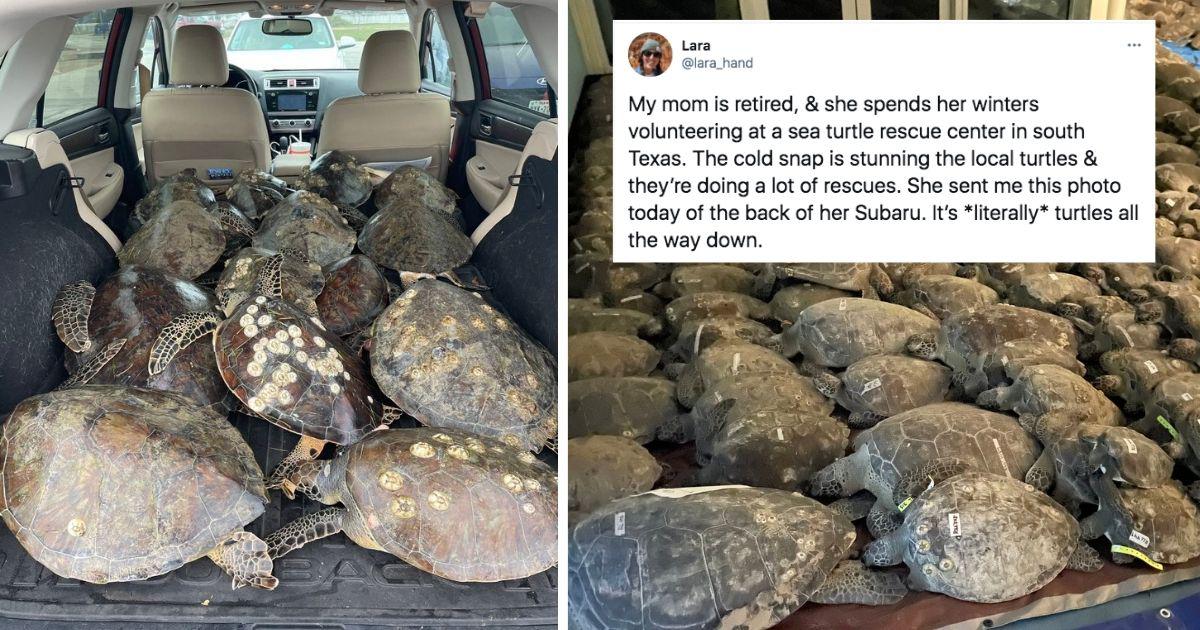
Volunteers have been working hard to save as many sea turtles as possible, even though many of these people are struggling with losing electricity, heat, and water themselves. Using their own cars and trailers, they have been transporting the turtles to safety a dozen or two at a time.

Lara (@lara_hand) on Twitter shared a thread about how her retired mother spends winters volunteering Sea Turtle, Inc. and how they're rescuing turtles during the cold snap. Her photo of the back of her Subaru filled with sea turtles drives home the dedication of the volunteers who are working to save these creatures.


Lara said her mom's team rescued more than 1,000 turtles on the 15th, one of which was over 100 years old and around 350 pounds.

Here's a video her mom shared from the convention center, showing how many turtles were being stored there already.

And more photos of the incredible rescue operation.

Sea Turtle, Inc. told the Washington Post that during a normal winter, volunteers might rescue from a few dozen to a few hundred cold-stunned turtles, so this week's effort is truly extraordinary. When a turtle gets too cold, its heart rate lowers and its body becomes paralyzed. The hypothermic shock causes them to float above the water, where they are at risk of being struck by boats, attacked by predators, or even drowning.

However, the 3,500 turtles are not out of the woods yet. The "dry dock" conditions in the convention center are not ideal, and the issue of maintaining power is vital to keep temperatures warm enough for the turtles.

Ed Caum, executive director of the South Padre Island Convention and Visitors Bureau, told the AP that he hesitates to call the effort a rescue because "we know we're going to lose some." Temperatures may not rise enough for the turtles to be returned to the water until the weekend.

"We're trying to do the best we can to save as many turtles as possible," he said.

The polar vortex that has swept through Texas and the southern U.S. has already claimed at nearly two dozen human lives in addition to an unknown number of animals. One animal sanctuary in North Bexar County, Texas has sadly lost more than a dozen animals including at least one chimpanzee as well as monkeys, lemurs, and tropical birds.

The combination of severe weather and an insufficient power grid cut off from the rest of the country has created a perfect storm of suffering in Texas this week. Seeing people helping people and animals weather that storm is heartening. Let's just hope they won't have to keep it up for much longer.

True

When Sue Hoppin was in college, she met the man she was going to marry. "I was attending the University of Denver, and he was at the Air Force Academy," she says. "My dad had also attended the University of Denver and warned me not to date those flyboys from the Springs."

"He didn't say anything about marrying one of them," she says. And so began her life as a military spouse.

The life brings some real advantages, like opportunities to live abroad — her family got to live all around the US, Japan, and Germany — but it also comes with some downsides, like having to put your spouse's career over your own goals.

"Though we choose to marry someone in the military, we had career goals before we got married, and those didn't just disappear."

Career aspirations become more difficult to achieve, and progress comes with lots of starts and stops. After experiencing these unique challenges firsthand, Sue founded an organization to help other military spouses in similar situations.

Sue had gotten a degree in international relations because she wanted to pursue a career in diplomacy, but for fourteen years she wasn't able to make any headway — not until they moved back to the DC area. "Eighteen months later, many rejections later, it became apparent that this was going to be more challenging than I could ever imagine," she says.

Eighteen months is halfway through a typical assignment, and by then, most spouses are looking for their next assignment. "If I couldn't find a job in my own 'hometown' with multiple degrees and a great network, this didn't bode well for other military spouses," she says.

She's not wrong. Military spouses spend most of their lives moving with their partners, which means they're often far from family and other support networks. When they do find a job, they often make less than their civilian counterparts — and they're more likely to experience underemployment or unemployment. In fact, on some deployments, spouses are not even allowed to work.

Before the pandemic, military spouse unemployment was 22%. Since the pandemic, it's expected to rise to 35%.

Sue eventually found a job working at a military-focused nonprofit, and it helped her get the experience she needed to create her own dedicated military spouse program. She wrote a book and started saving up enough money to start the National Military Spouse Network (NMSN), which she founded in 2010 as the first organization of its kind.

"I founded the NMSN to help professional military spouses develop flexible careers they could perform from any location."

"Over the years, the program has expanded to include a free digital magazine, professional development events, drafting annual White Papers and organizing national and local advocacy to address the issues of most concern to the professional military spouse community," she says.

Not only was NMSN's mission important to Sue on a personal level she also saw it as part of something bigger than herself.

"Gone are the days when families can thrive on one salary. Like everyone else, most military families rely on two salaries to make ends meet. If a military spouse wants or needs to work, they should be able to," she says.

"When less than one percent of our population serves in the military," she continues, "we need to be able to not only recruit the best and the brightest but also retain them."

"We lose out as a nation when service members leave the force because their spouse is unable to find employment. We see it as a national security issue."

"The NMSN team has worked tirelessly to jumpstart the discussion and keep the challenges affecting military spouses top of mind. We have elevated the conversation to Congress and the White House," she continues. "I'm so proud of the fact that corporations, the government, and the general public are increasingly interested in the issues affecting military spouses and recognizing the employment roadblocks they unfairly have faced."

"We have collectively made other people care, and in doing so, we elevated the issues of military spouse unemployment to a national and global level," she adds. "In the process, we've also empowered military spouses to advocate for themselves and our community so that military spouse employment issues can continue to remain at the forefront."

Not only has NMSN become a sought-after leader in the military spouse employment space, but Sue has also seen the career she dreamed of materializing for herself. She was recently invited to participate in the public re-launch of Joining Forces, a White House initiative supporting military and veteran families, with First Lady Dr. Jill Biden.

She has also had two of her recommendations for practical solutions introduced into legislation just this year. She was the first in the Air Force community to show leadership the power of social media to reach both their airmen and their military families.

That is why Sue is one of Tory Burch's "Empowered Women" this year. The $5,000 donation will be going to The Madeira School, a school that Sue herself attended when she was in high school because, she says, "the lessons I learned there as a student pretty much set the tone for my personal and professional life. It's so meaningful to know that the donation will go towards making a Madeira education more accessible to those who may not otherwise be able to afford it and providing them with a life-changing opportunity."

Most military children will move one to three times during high school so having a continuous four-year experience at one high school can be an important gift. After traveling for much of her formative years, Sue attended Madeira and found herself "in an environment that fostered confidence and empowerment. As young women, we were expected to have a voice and advocate not just for ourselves, but for those around us."

To learn more about Tory Burch and Upworthy's Empowered Women program visit https://www.toryburch.com/empoweredwomen/. Nominate an inspiring woman in your community today!

Need a break from the doom and gloom headlines? Of course you do. We all do.

Here's this week's round-up of fun, joyful, uplifting things to bring some peace to your heart and a smile to your face.

1. This mom sent a photocopy of her phone in the mail, which prompted a flood of endearing tech fail stories.

It's hard to call these stories "tech fails" when they're so fabulous. They're more like time capsule stories that remind us of the incredible advances our elders have seen during their lifetimes. Read them here.

2. A mom turning 50 next month shows off the skateboarding skills she's worked on for the past nine years.

How many people pick up a sport like skateboarding in their 40s? This is just awesome. Go, mama, go.

Keep Reading Show less
Photo courtesy of Macy's
True

Did you know that girls who are encouraged to discover and develop their strengths tend to be more likely to achieve their goals? It's true. The question, however, is how to encourage girls to develop self-confidence and grow up healthy, educated, and independent.

The answer lies in Girls Inc., a national nonprofit serving girls ages 5-18 in more than 350 cities across North America. Since first forming in 1864 to serve girls and young women who were experiencing upheaval in the aftermath of the Civil War, they've been on a mission to inspire girls to kick butt and step into leadership roles — today and in the future.

This is why Macy's has committed to partnering with Girls Inc. and making it easy to support their mission. In a national campaign running throughout September 2021, customers can round up their in-store purchases to the nearest dollar or donate online to support Girls Inc. and empower girls throughout the country.


Kaylin St. Victor, a senior at Brentwood High School in New York, is one of those girls. She became involved in the Long Island affiliate of Girls Inc. when she was in 9th grade, quickly becoming a role model for her peers.

Photo courtesy of Macy's

Within her first year in the organization, she bravely took on speaking opportunities and participated in several summer programs focused on advocacy, leadership, and STEM (science, technology, engineering and math). "The women that I met each have a story that inspires me to become a better person than I was yesterday," said St. Victor. She credits her time at Girls Inc. with making her stronger and more comfortable in her own skin — confidence that directly translates to high achievement in education and the workforce.

In 2020, Macy's helped raise $1.3 million in support of their STEM and college and career readiness programming for more than 26,000 girls. In fact, according to a recent study, Girls Inc. girls are significantly more likely than their peers to enjoy math and science, to be interested in STEM careers, and to perform better on standardized math tests.

Keep Reading Show less