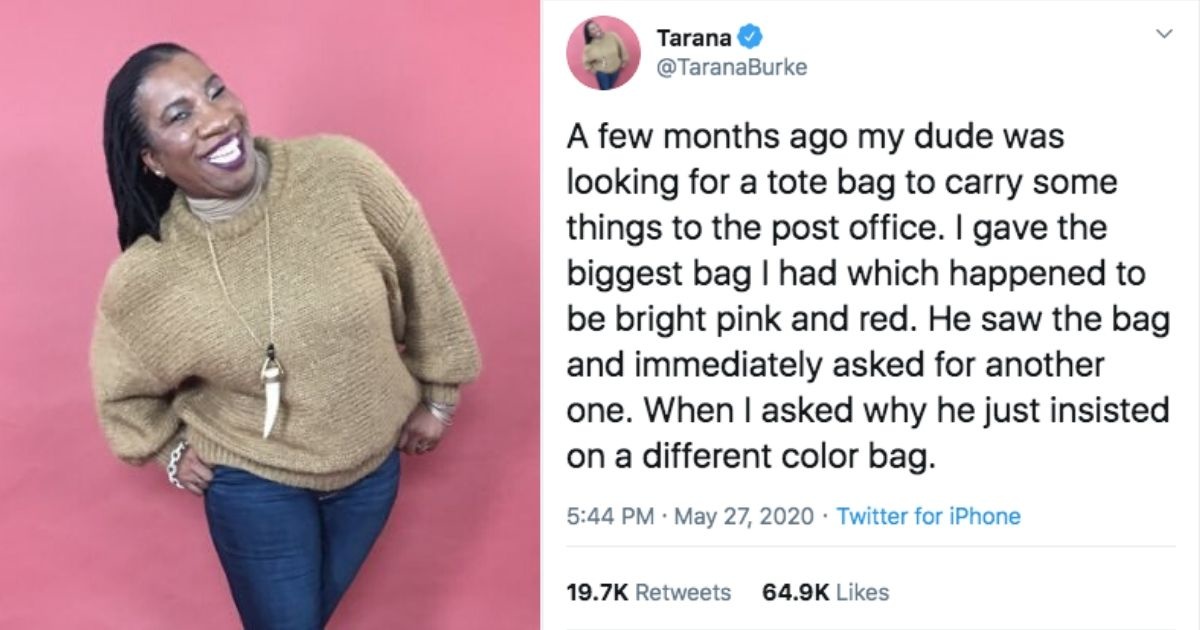
Tarana Burke shared an eye-opening story of why her partner wouldn’t carry a pink tote bag

Being a black man in America comes with its own baggage—literally and figuratively. Tarana Burke—the woman who coined the original #MeToo movement back in 2006—shared a story on Twitter that highlights one of the myriad things black men have to think about that most Americans do not. She wrote: “A few months ago my dude…

Array
Photo credit: Tarana Burke/TwitterArray

Being a black man in America comes with its own baggage—literally and figuratively.

Tarana Burke—the woman who coined the original #MeToo movement back in 2006—shared a story on Twitter that highlights one of the myriad things black men have to think about that most Americans do not.

She wrote:

“A few months ago my dude was looking for a tote bag to carry some things to the post office. I gave the biggest bag I had which happened to be bright pink and red. He saw the bag and immediately asked for another one. When I asked why he just insisted on a different color bag.”


https://twitter.com/TaranaBurke/statuses/1265806237834321921


“His insistence annoyed me and I started in on him fussing about it being sexist and homophobic, even to reject a bag based on thinking it’s too effeminate! He let me fuss at him for a minute and then finally he said ‘Baby, please stop. That’s not it!’

He said ‘I’m a 6’3 Black man. If I’m walking down the street with a bright pink bag I could look like I stole it from a woman – which could attract police attention. I’m never trying to give these cops a reason to stop me. Ever.’ Never occurred to me.”

https://twitter.com/TaranaBurke/statuses/1265806242192199681

It would never occur to me, either. If my white husband were walking around carrying a big pink tote bag, no one would assume he stole a woman’s purse. No one. They might giggle at him. They might think it was adorable, or even courageously feminist, for him to boldly carry a bright pink tote around. No way would there be a presumption of criminality in that image.

And yet black men in America have to think about how they might be viewed by everyone around them. They have to think about how their actions might make people feel uncomfortable, afraid, or suspicious in ways that others do not.

Burke also shared a second story that highlights the baggage of fear and careful calculation black men like her partner carry around with them. She wrote:

“A few years ago me and dude are out and come back to his car to find it vandalized. He parked by a driveway and partially blocked it and we concluded that the owners had vandalized the car. I get pissed and go knock on the door. They don’t answer so I’m yelling!

He’s telling me to calm down and forget it but I’m pissed! A few minutes later cop car rolls by and they stop and get out. I start to tell them what happened and they walk up on him and immediately start questioning him. I interrupt and say ‘excuse me HIS car was vandalized!’”

https://twitter.com/TaranaBurke/statuses/1265806244058746880


“The cops tell me to ‘be quiet’ and just as I’m about to turn all the way up on them he turns to me and says ‘Baby, please…’ firmly. Then he calmly answers the cops questions even though they are rude and invasive. They take his license and keep asking ridiculous questions..

‘What are you all doing here?’

‘Did you get into an altercation earlier tonight?’

‘If I knock on these people’s door what are they going to say?’

I was fuming. Now I’m nervous. They eventually stop and let us go. We ride back to my house silently. He goes home.”

https://twitter.com/TaranaBurke/statuses/1265806246076190720

“Later he calls and says ‘Please don’t do that again.’ I got it. I could hear the stress in his voice. I thought about both of these stories today. A lot. I know what’s it’s like worrying that my child, partner, brother or other loved ones will meet an Amy Cooper or worse…

…cops like George Floyd did.”

https://twitter.com/TaranaBurke/statuses/1265806248445988864

“I know my fears as a Black woman moving through the world,” Burke added. “Especially one who has been harassed and harmed by police. My deep sadness today is for Black men and all Black people who for whom this stress and anxiety never relents.

So many Black folks have died of Covid. So many of them Black men. It’s hard not to feel under siege one way or another and it’s all just too much. That’s all I’m saying I guess. I’m ranting my feelings right now because it’s all too much. #BlackLifeMatters

https://twitter.com/TaranaBurke/statuses/1265806250136264710

The terrible truth is that black men don’t have to be threatening to be seen as a threat. Black men don’t have to have committed a crime to be seen as criminal. Black men have to actively go out of their way to not look suspicious, even when they are doing normal, everyday things. And they have to do so knowing they could lose their life if they aren’t convincing enough in front of the wrong people.

We’ve seen it over and over and over again. Until we actively deprogram ourselves and actively demand change in our law enforcement and justice systems, black men will continue to be burdened by this baggage that they don’t deserve and didn’t ask for.

For a place to start with anti-racism work, here are some helpful resources.
  • Michael Jackson’s sounds engineer reveals the genius origins of ‘Annie’ from ‘Smooth Criminal’
    Photo credit: Anthony Marinelli Music/YouTubeMichael Jackson, left, and Matt Forger.

    With the latest Michael Jackson biopic taking the box office by storm, the late singer and his work are back in the pop culture zeitgeist. Now, even more lore has been added to the conversation, courtesy of Jackson’s longtime personal sound engineer, Matt Forger.

    In an interview with Anthony Marinelli, Forger revealed the inspiration behind the character Annie in “Smooth Criminal,” saying that while on tour with the Jackson 5, each of the brothers took a CPR class, where they practiced on a Resusci Anne doll. Part of the protocol was asking, “Annie, are you okay? Are you okay, Annie?” to check a patient’s condition.

    A nod to genius

    “That catchphrase sort of stayed in his memory,” Forger said, noting it as one of many examples of Jackson’s innate gift for songwriting. Like many of the greats, Jackson was able to expertly pinpoint hooks with the most emotional punch and build out full-blown stories from there.

    In the song lyrics, we get a story of a woman attacked in her apartment by a “smooth criminal,” who breaks in through the window and then violently strikes the victim. By the second verse, Annie is being resuscitated, seemingly to no avail.

    The doll has a fascinating, dark history

    Anne’s story began in France in the late 1880s, when the body of an unidentified teenage girl was found in the River Seine. Unlike the case in “Smooth Criminal,” there was no evidence of violence at the scene. Presumably, the girl had taken her own life. Death masks were still a common ritual, and one was created for her to immortalize the eerily calm expression she left behind, as some legends say. It became so popular that it was mass-produced.

    Fast forward to the late 1950s, when Norwegian toy maker and publisher Åsmund S. Laerdal was commissioned to create a realistic, life-sized manikin for training people in the new mouth-to-mouth resuscitation method. He recalled seeing one of these masks in his in-laws’ home and felt it was the perfect expression for the dummy.

    Today, Resusci Anne is also known as “the most kissed girl in the world”  since millions of trainees have performed mouth-to-mouth resuscitation on her over the decades. 

    Viewers react

    You would think this connection is well known among those who have learned CPR. But judging from the comments on Forger’s interview, it’s still a largely buried fact:

    “Wow, too many times I have said, ‘Annie are you ok” and proceeded to give compressions and then 3 breaths. I never made the connection.”

    “I studied CPR last year and the mannequin was called Annie but I thought it was because of the song, didn’t realise the mannequin Annie came first.”

    “I took CPR but never put that together about this song.”

    Whether you’re into obscure history, pop music, or fun explainers, this story has just what you’re looking for. It also goes to show just how deeply interconnected our world is. Thanks to a bit of human creativity, a tragic mystery from 19th-century France turned into a life-saving training tool, followed by one of pop’s most iconic songs. There really is an endless supply of inspiration.

  • Matthew Lillard had a surprisingly humble explanation for his recent Hollywood comeback
    Photo credit: Super Festivals/Wikimedia CommonsActor Matthew Lillard.
    ,

    Matthew Lillard had a surprisingly humble explanation for his recent Hollywood comeback

    The “Scooby-Doo” star is back in the limelight after the massive “Five Nights at Freddy’s” success.

    Actor Matthew Lillard can trigger Millennial nostalgia like few others. He was perfectly cast in the popular Scooby-Doo films of the early aughts as Norville “Shaggy” Rogers and appeared as Stu Macher in the original Scream (1996). He also had memorable roles in She’s All That (1999), Thirteen Ghosts (2001), and Without a Paddle (2004).

    Lillard’s career began to cool down in the late ‘00s. Although he never went away, he transitioned from a comedic performer to starring in dramatic roles, most notably in 2017’s Twin Peaks: The Return. However, now, after the lead role in the massive 2023 horror hit, Five Nights at Freddy’s, Lillard is in the midst of a comeback, starring in Five Nights at Freddy’s 2 (2025), The Life of Chuck (2024), and the Marvel series Daredevil: Born Again.

    Lillard talked about his recent success with a refreshing sense of gratitude and humility on a recent episode of the Phase Hero podcast, hosted by Brandon Davis.

    Scooby-Doo one and two are more popular now than they ever were when they came out,” Lillard said. “So I do think there’s a weird nostalgia thing happening in our industry and in the zeitgeist, because I think that people are longing for ye olde times.”

    “I think that’s one of the reasons I’m having this moment, to be honest, is because I was identified in that moment, so people are hiring me again,” he added. “That’s why I’m working. I don’t think anyone really likes me. They just missed the old times. ‘Who should we get? Who’s old and relatively warm and fuzzy feeling? Let’s get Matthew Lillard. Talented? No. But do we like him? Yes.’”

    The 56-year-old actor’s self-awareness was also on display in how he gracefully handled some very blunt criticism from director Quentin Tarantino. Last December, Lillard was brought up in a conversation in which Tarantino criticized actor Paul Dano’s performance in There Will Be Blood.

    “I’m not saying he’s giving a terrible performance,” Tarantino said. “I’m saying he’s giving a non-entity [performance]. I don’t care for him. I don’t care for Owen Wilson, I don’t care for Matthew Lillard.”

    The very public diss inspired many of Lillard’s colleagues to sing his praises.

    “It felt like I had died and was in heaven watching everyone send out their RIP tweets. I mean, it was really being a part of your own wake, sort of sitting there living through all the nice things people say after you die,” Lillard told People. “Everyone, from the people at the mall this weekend with my kids to George Clooney and James Gunn and Mike Flanagan, I mean, people have sort of been really generous with telling me how much they loved me and liked my work.”

    Lillard’s response to his sudden success is a great example of someone who has been in the industry for decades and has learned how to keep his head on his shoulders. There are going to be highs and lows, but when your feet are firmly planted in reality, you can make it through them all.

  • ‘Wow!’ may sound like a modern slang term, but it dates all the way back to the 1500s
    Photo credit: Canva"Wow" is a lot older than people might guess.

    Many old words, such as “fortnight” or “swashbuckle,” sound as archaic as they are. But some words that sound modern are surprisingly old.

    Scottish actor and writer Kenny Boyle shared that the word “wow” has been around a lot longer than people might think. While it may sound like slang from the 20th century, it actually dates back over 500 years to Scotland.

    “This is one of those anachronistic things,” Boyle said in a TikTok video. “If you were to read a historical fiction or something like that, and one of the characters were to say ‘Wow!’ you’d probably think, ‘Well, that’s weird. That’s a very modern word, isn’t it?’ The answer is actually no, at least not in Scotland.”

    We first see the written use of “wow” in 1513

    Boyle explained that “wow” dates to the 1500s and meant basically the same thing it does now: an expression of disbelief or surprise.

    Babbel notes that the first known written use of “wow” appeared in 1513 in a Scottish English translation of Virgil’s Aeneid. The exact quote is, “Out on thir wanderand spiritis, wow! thow cryis.” It was possibly a modification (or perhaps even a typo) of the exclamation “Vow!”, which was an intensified version of “I vow!”

    “Wow” doesn’t really have a meaning in and of itself, but is rather a natural exclamation. The “W” sound is one of the easiest sounds to make, so we find natural exclamations similar to “wow” across different languages.

    Facial expressions also play a role

    Babbel explains that many natural exclamations relate to the facial expressions people make. “The facial expression associated with shock or surprise is an open, rounded mouth, which happens to coincide with how a human pronounces ‘wow,’” the video states.

    Other exclamations (also known as emotive interjections) that seem to coincide with facial expressions include “Ow!” and “Ouch!”, as well as “Yay!” and “Hooray!”

    wow, facial expressions, surprise, surprised emoji
    When we say, “Wow!” it looks like we’re saying “Wow!” Photo credit: Canva

    “Hooray” and “hurrah” are thought to be modifications of “huzzah” or “huzza,” which we probably recognize as old terms. But interestingly enough, “wow” is even older than “huzzah.” (Not by much, but still surprising.)

    How “wow” became an everyday English exclamation

    According to Babbel, “wow” was commonly used by the 19th century, but it really took hold in the 1920s and 1930s. In 1920, however, “wow” was used as a noun, as in “This song is a wow.” Today, “wow” is rarely used as a noun but is often used as a verb. For example, “I was wowed by that song.”

    A more obscure meaning of “wow” from the 1930s referred to pitch distortions in audio recordings. But by far the most common usage today is simply the emotive interjection “Wow!”

    And then there’s always the sarcastic use of the word as well: “Wow. That’s really interesting.” Just changing the punctuation to periods instead of exclamation points gives it a whole different flavor.

    Thank you, 16th-century Scotland, for such a useful exclamation.

    You can follow Kenny Boyle on TikTok for more fun Scottish history and etymology.

  • 90s kids rejoice as Pizza Hut’s BOOK IT! program returns for a new generation of readers
    Photo credit: @AllThings1990s on YouTubeThe children of 90s kids can now get free pizza for reading books.

    In the 1990s, kids were given a tasty incentive to pick up a book and read. The mission, should they choose to accept it, was to read a certain amount each month to earn a button, stickers, and a free personal pan pizza. Now, ’90s kids can offer this same challenge to their own children, because Pizza Hut’s BOOK IT Summer Reading Program has officially returned.

    The BOOK IT program is a free reading incentive tool for parents and teachers to help encourage youngsters to read recreationally during the summer. While back in the day participants manually filled out forms to track their progress, parents today can do so on an app. The app can also redeem rewards for free pizza throughout the summer. Enrollment begins on May 1, 2026.

    Brief History of BOOK IT

    Per The Takeout, the history of the BOOK IT program begins in the mid-1980s with then-president of Pizza Hut Arthur Gunther and marketing executive Bud Gates. As President Ronald Reagan encouraged businesses to promote education, Gunther wanted to participate. He was inspired by his son’s struggle with literacy as a child. With that in mind, he developed the program to reward young kids for reading. Kids from pre-K through sixth grade would get a free personal pan pizza if they reached certain monthly reading benchmarks. This not only encouraged kids to read for free pizza, but also got their parents to order food for themselves while they were there.

    The program would continue in various forms for 40 years, and has had a lasting legacy with many Millennials. Many enjoy remembering finishing up a Goosebumps, Encyclopedia Brown, or other book series of their youth to get a free one-topping six-inch pie.

    There are critics of the Pizza Hut BOOK IT program, though. Many argue that reading should be encouraged for its own sake. There is also understandable concern about linking a child’s education to a national fast food pizza chain. Others argue that, in an age when children’s reading skills are declining nationally, such incentive programs can still help. After all, many adults on social media today credit BOOK IT for making them readers.

    How to get kids to read more (pizza optional)

    There are other ways to boost a child’s literacy without pizza (though pizza goes well with everything). Aside from continuing story time with younger kids, parents can still bond with their elementary-aged children by playing word games with them such as Scrabble or Boggle. 

    Another way to join your child is to share their interests. If they want to read a young adult book they’ve picked out, consider reading it too. It’ll create something to bond over as a “family book club.” After you both finish it, you can discuss the novel over a fun dinner out, whether at Pizza Hut elsewhere.

  • 100 people who’ve lived to 100 were asked the secret to a long, happy life. Here are their answers.
    Photo credit: CanvaThree older adults eat ice cream outside a store.
    ,

    100 people who’ve lived to 100 were asked the secret to a long, happy life. Here are their answers.

    The average 100-year-old surveyed only “feels” 68. That’s incredible.

    UnitedHealthcare (UHC) recently interviewed 100 centenarians, or people who have lived to the ripe age of 100.

    Fascinatingly, 100-year-olds feel younger than ever. The report reveals that the average centenarian only “feels” about 68. It’s a number that’s dropping dramatically. In 2015, when UHC conducted a similar survey, the average respondent said they felt 79. That’s incredible.

    What that ultimately means is that these folks can teach us an awful lot about how to live both a long and joyful life, how to feel decades younger, and how to keep living life to the fullest into our 100s and beyond. Here are some of their secrets:

    1. Staying up-to-date on tech keeps you young

    You might think of centenarians clinging to their rotary phones and the vinyl record players they had long before they were “cool.” You’d be wrong.

    UHC found that 100-year-olds are experimenting with ChatGPT and other AI—around 27% of them. And a stunning 40% of them regularly play video games.

    2. A strong body can go the distance

    Centenarians have changed their approach to longevity in the past decade. Compared to 2015, far more respondents today are doing regular strength training and monitoring their diet.

    Overall, they’re more active in almost every way. A higher percentage of 100-year-olds are doing cardio, gardening, and even meditating or practicing intentional stress relief. Meditation jumped from 29% of centenarians to 42% today.

    “Staying active keeps my heart strong, mind sharp, body moving, spirit high, and health steady every day,” one said.

    The only activity that declined was walking and hiking, and only by a small margin. But these busy seniors had to find the time to hit the gym somewhere.

    3. Finding humor in daily life is the best medicine

    It’s one thing when Joe Schmoe says “laughter is the best medicine.” It’s another when some of our oldest citizens are living proof that it’s true.

    It might be reading between the lines, but the cranky and miserly don’t seem as likely to make it to 100. Eighty-five percent of respondents said they laugh often and find that having a sense of humor comes easily to them.

    “A good belly laugh can make you feel better than any pill, I’ll tell you that,” one said.

    4. There’s something to look forward to at every age

    One of the most interesting questions asked of the participants was about their “best decade.”

    The answers from the 100 centenarians, who’ve lived through and seen it all, reveal that there’s so much good to find in every season of life. Life doesn’t go downhill after a certain age; you just have to learn to appreciate what it has to offer.

    Your 20s are for freedom and exploration. Your 30s and 40s are all about family. Your 50s and 60s are the best for community and friendship. Your 70s and beyond are about finding contentment and joy in the simple things.

    Even in the harder decades, the centenarians now have the perspective to know there was always light at the end of the tunnel:

    “I’d tell myself to embrace every messy moment because it all works out in the end. I really needed to hear that in my late teens when everything felt like such a big deal.”

    5. “Feeling old” has nothing to do with age and is sometimes out of your control

    Fascinatingly, the respondents were asked when they first started to “feel old.” Their answers had nothing to do with a specific age.

    It came down to the moments: giving up driving, the death of a spouse, and moving out of a beloved home and into a smaller place where they could age.

    There’s something peaceful about that. Some things may be in your control—keeping your body and mind sharp can delay certain events. Others are completely out of your control. But the overarching theme is that there’s no reason to fear a number.

    6. Family and friends are key to survival

    Being isolated and lonely is devastating for your health and longevity. Seventy-eight percent of the seniors in this report, thriving at the age of 100, credit a big part of their vigor to regularly spending time with friends and family.

    “They are everything to me. I try to spend as much time with my family as I can,” one of the 100-year-olds said. “Life is short; you never know when it’ll be the last day.”

    7. The advice they’d give their younger selves is what we all need to hear

    Centenarians say the secret to happiness is really no secret at all. It’s mind-numbingly simple: Don’t worry so much. Spend time with your loved ones. Move your body. Be true to yourself.

    The difference is that these 100-year-olds have the wisdom and urgency to really mean it. Don’t wait until you’re their age to start living like you know you should.

    “If you don’t ask, you don’t get,” one said, referring to getting a promotion at work, but more generally, anything you truly want. In other words, go for it.

    The overall trends identified in the report are surprising and hopeful.

    In 10 years, our centenarians will likely be even more focused on their physical and mental health, finding even more joy in their lives as they age, and, through it all, feeling younger than ever. We can learn a lot from watching what they’re doing right.

  • 19 viral photos show what happens after drinking 1, 2, and 3 glasses of wine
    Before and after photos of people who drank wine.

    Marcos Alberti’s “3 Glasses” project began with a joke and a few drinks with his friends.

    The photo project originally depicted Alberti’s friends drinking, first immediately after work and then after one, two, and three glasses of wine.

    But after Imgur user minabear circulated the story, “3 Glasses” became more than just a joke. In fact, it went viral, garnering more than 1 million views and nearly 1,800 comments in its first week. So Alberti started taking more pictures and not just of his friends.

    “The first picture was taken right away when our guests (had) just arrived at the studio in order to capture the stress and the fatigue after a full day after working all day long and from also facing rush hour traffic to get here,” Alberti explained on his website. “Only then fun time and my project could begin. At the end of every glass of wine, a snapshot, nothing fancy, a face and a wall, 3 times…by the end of the third glass several smiles emerged and many stories were told.”

    Why was the series so popular? Anyone who has ever had a long day at work and needed to “wine” down will quickly see why.

    Take a look:

    Drinking, wine, viral photos
    Drinking, wine, viral photos
    Drinking, wine, viral photos
    Drinking, wine, viral photos
    Drinking, wine, viral photos
    Drinking, wine, viral photos
    Drinking, wine, viral photos
    Drinking, wine, viral photos
    Drinking, wine, viral photos
    Drinking, wine, viral photos
    Drinking, wine, viral photos
    Drinking, wine, viral photos
    Drinking, wine, viral photos
    Drinking, wine, viral photos
    Drinking, wine, viral photos
    Drinking, wine, viral photos
    Drinking, wine, viral photos
    Drinking, wine, viral photos
    Drinking, wine, viral photos

     This article originally appeared ten years ago. It has been updated.

  • Two vacationing paramedics deliver a baby at 30,000 feet with a shoelace and borrowed blankets
    Photo credit: Canva PhotosA woman on a Delta flight unexpectedly went into labor. Two vacationing paramedics sprang into action.

    The best flights are uneventful. Timely, smooth, and relaxing. Even a little boring. However, that’s not always in the cards.

    A lot of things can happen in the air, including unforeseen medical emergencies. Thankfully, this one has a happy ending thanks to the help from two selfless strangers.

    Woman on Delta flight unexpectedly goes into labor minutes before landing

    Ashley Blair was pregnant and due in about two weeks, but really wanted to be with her mom in Oregon when the baby arrived. So, she hopped a Delta flight through Atlanta and was well on her way when things took an unexpected turn.

    Pregnant mothers are generally discouraged from flying this late into a pregnancy, and some airlines may forbid them entirely. But life happens. Sometimes, travel is unavoidable, and in Blair’s case, she still had a few weeks left before she was supposed to go into labor, making the risk relatively low.

    The baby had other ideas.

    CNN reports that Blair went into labor when her Delta flight was about 30 minutes away from landing at Portland International.

    Two hero paramedics step up to help

    A paramedic is never truly off the clock. Even though Tina Fritz and Kaarin Powell, two friends and emergency workers, were flying home from vacation in the Dominican Republic, they’d already been called to action not long after the plane took off.

    Fritz and Powell were attending to another passenger when flight attendants made an urgent announcement: Was there a doctor onboard?

    They rushed to Blair’s side and, with the help of flight attendants, began shuffling passengers around to make enough room to deliver the baby. Unfortunately, there were no medical tools or sterile equipment available on the plane, and the baby was coming fast, so there was no time to lose.

    delta, planes, airplanes, flying, airports, labor, babies, newborns, baby delivery, new mom, kind strangers, air travel, emergency, heartwarming
    150-some passengers, and the crew, all pitched in to help. Photo Credit: Edgar Zuniga Jr./Flickr

    Passengers work together to help

    Right as Blair was getting ready to start pushing, the pilots announced that the plane was about to begin its landing procedure. That usually means all passengers and crew must take their seats.

    This was going to have to happen fast.

    Fritz and Powell told flight attendants that they needed blankets, and lots of them. Passengers all over the plane passed theirs back so that Blair could be comfortable as she began pushing.

    They also needed shoelaces, of all things. One to use as a tourniquet for an IV, and another to tie off the umbilical cord. That is, before they cut it with a butter knife, which was all that was available.

    Truly an amazing MacGyver-like delivery. Just a few quick pushes and the baby was born. Some passengers barely even knew anything was happening outside of a few murmurs and folks standing up or moving around.

    According to all reports, Blair and baby girl Brielle were healthy and stable when the plane arrived.

    A beautiful irony in the teamwork

    Airplanes and airports are notorious for bringing out the worst in humanity. Passengers berate flight attendants, fight over seats, and throw etiquette and human decency into the wind over the most minor inconveniences.

    So, it’s amazing to see an example of 150-some odd strangers working together to tackle a true medical emergency. It wasn’t the smooth, convenient, and peaceful ride some passengers probably had in mind—but it’s one they won’t soon forget.

  • A baby was born landing at JFK. The pilot ran with the traffic controller’s name pick on the spot.
    Photo credit: CanvaA pregnant woman on an airplane and a pilot talking on his headphones.

    There’s a particular kind of magic that happens when professionals doing routine work get hit with a genuinely extraordinary situation. The instinct is usually one of two things: clinical efficiency or unexpected warmth. Sometimes, gloriously, both.

    That’s exactly what happened on April 4, 2026, when Caribbean Airlines Flight BW005 was descending into John F. Kennedy International Airport from Kingston, Jamaica. One of the passengers, a heavily pregnant woman, went into labor. The pilot calmly radioed Kennedy Tower with the situation and requested a direct routing in. Air traffic control lined everything up: clearance to land on Runway 4R, ground crew briefed, medical personnel arranged at the gate.

    Then, a few minutes after touchdown, ground control checked in.

    aviation, air traffic control, JFK, kindness, Caribbean Airlines
    An airplane pilot. talking to air traffic controller. Photo credit: Canva

    “Caribbean five, ground.”

    “Yes sir, go ahead.”

    “Is it out yet?”

    “Yes, sir.”

    “All right. Tell her she’s got to name it Kennedy.”

    “Ahh, Kennedy. Will do.”

    “All right. Have a good day.”

    That was it. The audio, which CBS Mornings shared on April 6, has been making the rounds online ever since, mostly because of the timing of the whole thing. A mother had just delivered a healthy baby on a Boeing 737 mid-descent. The pilot had just helped coordinate that situation while flying a plane. And the ground controller, having calmly walked the flight through one of the more unusual arrivals at JFK that week, decided the appropriate sign-off was a dad joke about naming the kid after the airport.

    According to Caribbean Airlines, the flight never even formally declared an emergency. The crew handled it within standard procedures, and upon landing the mother and newborn were attended to by medical personnel and received the care they needed. Everyone was fine.

    What’s stuck with people online isn’t really the medical drama, though. It’s the ground controller’s instinct to make a joke. There’s a version of this exchange that’s all clipped efficiency, and we’d never have heard about it. But this particular controller, in the middle of a shift at one of the busiest airspaces in the country, decided the moment called for a small human gesture. A pop of warmth on a frequency that’s usually nothing but headings and altitudes.

    It’s nice to see that the people running our infrastructure are people. They’re listening, they’re paying attention, and once in a while they’re trying to give a stranger they’ll never meet a little something to remember the day by.

    Whether the baby actually ends up named Kennedy is up to the family. But somewhere out there is a woman who can tell her child a true story that starts with “you were born on a plane, and the man on the radio who guided us in picked your name.”

    Hard to top that.

Generations

100 people who’ve lived to 100 were asked the secret to a long, happy life. Here are their answers.

Family

Dad is praised for his patient explanation of their mom’s period to his two young sons

Parenting

New study finds that ‘good enough’ parenting seems to be making a comeback and why that’s absolutely okay

Science

The 90-second emotional reset that’s changing lives and is backed by Harvard science