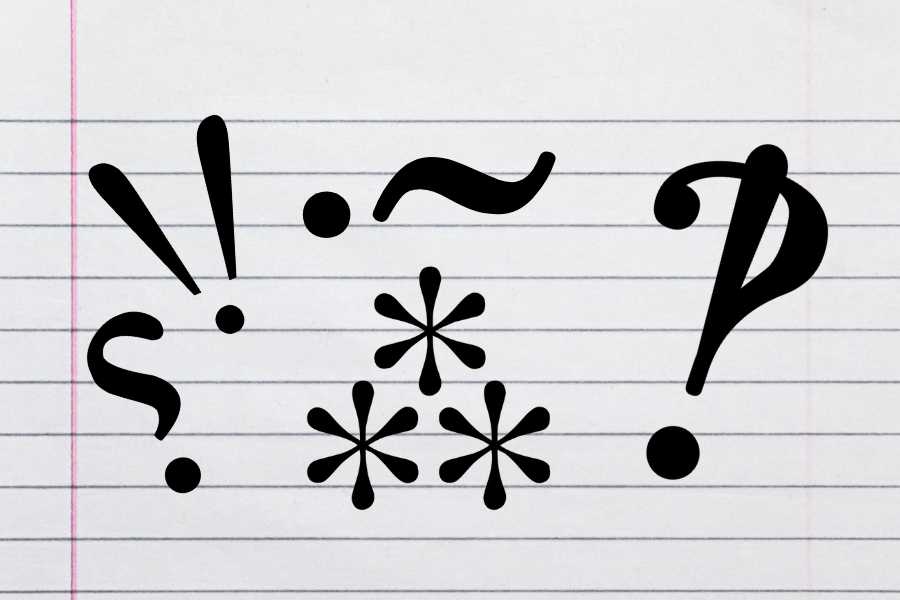
16 forgotten punctuation marks that we should definitely bring back
The "interrobang" is fun to say AND fun to use.
Which of these punctuation marks deserve a reboot?
If you look at any standard computer keyboard, you'll find a couple dozen punctuation marks, from the oft-used period and question mark to the lesser-used caret and backslash. Some lucky punctuation marks have seen a surge in usage in modern times, such as the @ (thanks to email) and the # (thanks to social media hashtags), but there are others so rarely used they won't be found on any keyboard.
For instance, are you familiar with the interrobang or the snark mark? What about an asterism or an acclamation point? Most of us have never even heard of these marks, much less used them, but seeing why they exist, there's a case to be made for bringing them back from obsolescence.
Etymology Nerd shared a post on Instagram featuring 16 rarely used punctuation marks, some old and forgotten and others newer but equally overlooked.
Let's look at some of these marks in detail.
Interrobang

In a magazine article in 1962, Madison Avenue executive Martin K. Speckter proposed combining the question and exclamation marks as a new symbol that combined excitement and doubt, which he called the interrobang. ("Interro" for the Latin interrogatio, meaning "questioning," and "bang" because that's what printers nicknamed the exclamation mark.) The idea took off, and for a handful of years the interrobang appeared in book titles and magazine articles; typewriter maker Remington Rand even created a replacement key featuring the mark.
However, its popularity was short-lived. Less than a decade later, the interrobang had essentially disappeared. We still use the components of it together to denote incredulity: "Are you serious?!" But wouldn't it be so much cooler to have a unique mark like ‽ instead?
Irony Mark and Percontation Point

How do you know in writing whether a question is serious or not? Sometimes it's obvious and sometimes it's not, but what if we had punctuation that told us straight up?
Two punctuation marks of old would have helped with that. The irony mark, which has seen off-and-on popularity over the centuries, was meant to let readers know that what followed was intended to be ironic or sarcastic. One iteration is the elevated, backwards question mark, which goes at the beginning of the sentence, not the end.
However, it appears that people rather enjoy having to decipher whether something is meant to be ironic, as none of the irony mark ideas have ever stuck around for long.
A similar mark, the percontation point, has a related purpose. Placed like a normal question mark at the end of a sentence, it's meant for questions that are rhetorical in nature. It, too, is a mirrored question mark, and has been around for hundreds of years. But alas, it also has not stuck around.
SarcMark™ and Snark Mark

Sarcasm can be overt or it can be subtle, and in writing it's not always clear what a person's intent is. Similar to attempts at the irony mark, punctuation meant to denote sarcasm has been deemed necessary enough that people have tried to create it.
The SarcMark (a trademarked name, apparently) was invented by Douglas Sak, who was writing an email to a friend and wanted to show that he was being sarcastic. In 2006, Sarcasm, Inc. was founded to spread the SarcMark far and wide, and there are even apps you can get to add the SarcMark to your devices.
Another idea someone came up with is to type a period followed by a tilde to denote sarcasm. Not quite as cool, frankly. We also have the upside-down face emoji that basically does the same thing.
Will these or any of the other rarely used punctuation marks actually make it? Time will tell. Language is always evolving. Fifty years ago, no one knew the pound sign would be called a "hashtag" by millions of youngsters and used the way it is today, so we may very well see some of these symbols used in some way we can't imagine now.