Florida student uses a clever metaphor in graduation speech to advocate for LGBTQ rights
It's okay to have "curly hair."

Moricz was banned from speaking up about LGBTQ topics. He found a brilliant workaround.
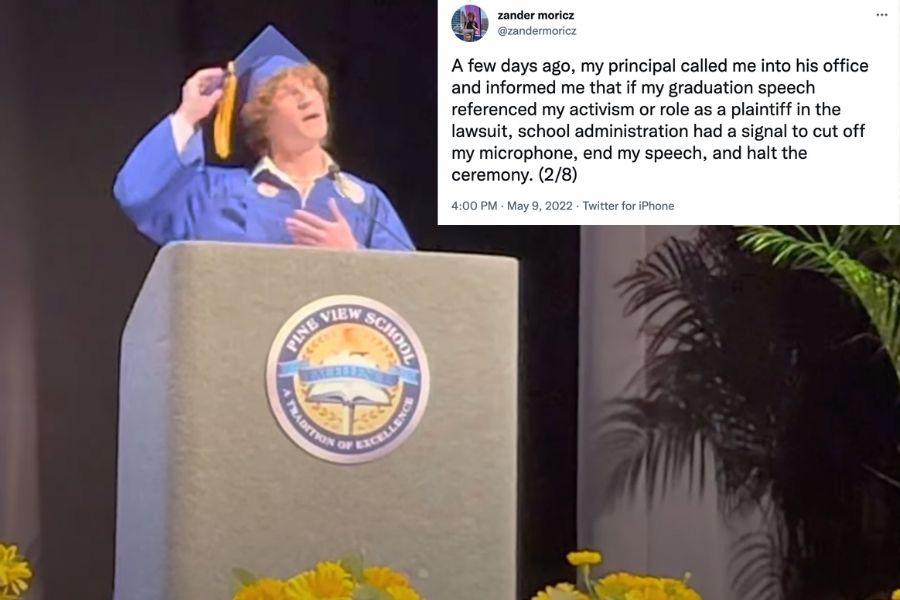
Senior class president Zander Moricz was given a fair warning: If he used his graduation speech to criticize the “Don’t Say Gay” law, then his microphone would be shut off immediately.
Moricz had been receiving a lot of attention for his LGBTQ activism prior to the ceremony. Moricz, an openly gay student at Pine View School for the Gifted in Florida, also organized student walkouts in protest and is the youngest public plaintiff in the state suing over the law formally known as the Parental Rights in Education law, which prohibits the discussion of sexual orientation or gender identity in grades K-3.
Though well beyond third grade, Moricz nevertheless was also banned from speaking up about the law, gender or sexuality. The 18-year-old tweeted, “I am the first openly-gay Class President in my school’s history–this censorship seems to show that they want me to be the last.”
However, during his speech, Moricz still delivered a powerful message about identity. Even if he did have to use a clever metaphor to do it.
Moricz told the audience, “I must discuss the very public part of my identity. This characteristic has probably become the first thing you think of when you think of me as a human being…”
“As you know, I…have curly hair,” he quipped, nonchalantly taking off his grad cap as the crowd began to clap.
If it’s not obvious now, it will soon become clear that “curly hair” is a euphemism for being gay. But it’s also about so much more.
“I used to hate my curls,” he continued. “I spent mornings and nights embarrassed of them, trying to desperately straighten this part of who I am. But the daily damage of trying to fix myself became too much to endure.”
A major criticism of Florida’s new law is that it potentially further discriminates against an already marginalized group. This can be especially damaging to mental health, and for young people in particular. It can be confusing to have a part of one’s reality so heavily politicized, not to mention at a time when that reality isn’t fully understood.
Moricz proceeded to praise a teacher who answered his questions when he didn’t have “other curly haired people to talk to,” highlighting the important role that an accepting community plays in shaping our identity and self-esteem.
“So, while having curly hair in the state of Florida can be difficult, due to the humidity, I decided to be proud of who I was, and started coming to school as my authentic self,” he shared.
Getting emotional, Moricz lamented, “There are going to be so many kids with curly hair who need a community like Pine View and they will not have one. Instead, they’ll try to fix themselves so that they can exist in Florida’s humid climate.”
The use of code words is sadly not a new concept for the LGBTQ community. And while Moricz made good use of clever wordplay, he still found the experience to be “dehumanizing.” Luckily, his speech was met with an outpouring of love from fellow students, who gave him a standing ovation.
Despite the disheartening challenge, Moricz considered the speech a “great finale” to his high school years and is more determined than ever to continue his advocacy by studying government at Harvard. Sometimes when you have something important to say, silence isn’t an option.

- Taylor Swift gives graduation speech - Upworthy ›
- Pete Buttigieg criticizes the 'don't say gay' bill - Upworthy ›
- Kate McKinnon blasts 'Don't say gay' bill on 'SNL' - Upworthy ›
- Trans rights advocate skewers Texas Lt. Governor with bathroom prank - Upworthy ›
- Teacher simulates an authoritarian dictatorship in her classroom, but the students crushed her - Upworthy ›


A woman is getting angry at her coworker.via
A man with tape over his mouth.via
A husband is angry with his wife. via 
a man sitting at a desk with his head on his arms Photo by
Can a warm cup of tea help you sleep better? If you believe it, then yes. Photo by 
Three women sit on a blanket in the park. 
Two women engaging in a pleasant conversation inside a coffee shop
Two men engaging in a peaceful disagreement.
Resurfaced video of French skier's groin incident has people giving the announcer a gold medal
"The boys took a beating on that one."
Downhill skiing is a sport rife with injuries, but not usually this kind.
A good commentator can make all the difference when watching sports, even when an event goes smoothly. But it's when something goes wrong that great announcers rise to the top. There's no better example of a great announcer in a surprise moment than when French skier Yannick Bertrand took a gate to the groin in a 2007 super-G race.
Competitive skiers fly down runs at incredible speeds, often exceeding 60 mph. Hitting something hard at that speed would definitely hurt, but hitting something hard with a particularly sensitive part of your body would be excruciating. So when Bertrand slammed right into a gate family-jewels-first, his high-pitched scream was unsurprising. What was surprising was the perfect commentary that immediately followed.
This is a clip you really just have to see and hear to fully appreciate:
- YouTube youtu.be
It's unclear who the announcer is, even after multiple Google inquiries, which is unfortunate because that gentleman deserves a medal. The commentary gets better with each repeated viewing, with highlights like:
"The gate the groin for Yannick Bertrand, and you could hear it. And if you're a man, you could feel it."
"Oh, the Frenchman. Oh-ho, monsieurrrrrr."
"The boys took a beating on that one."
"That guy needs a hug."
"Those are the moments that change your life if you're a man, I tell you what."
"When you crash through a gate, when you do it at high rate of speed, it's gonna hurt and it's going to leave a mark in most cases. And in this particular case, not the area where you want to leave a mark."
Imagine watching a man take a hit to the privates at 60 mph and having to make impromptu commentary straddling the line between professionalism and acknowledging the universal reality of what just happened. There are certain things you can't say on network television that you might feel compelled to say. There's a visceral element to this scenario that could easily be taken too far in the commentary, and the inherent humor element could be seen as insensitive and offensive if not handled just right.
The announcer nailed it. 10/10. No notes.
The clip frequently resurfaces during the Winter Olympic Games, though the incident didn't happen during an Olympic event. Yannick Bertrand was competing at the FIS World Cup super-G race in Kvitfjell, Norway in 2007, when the unfortunate accident occurred. Bertrand had competed at the Turin Olympics the year before, however, coming in 24th in the downhill and super-G events.
As painful as the gate to the groin clearly as, Bertrand did not appear to suffer any damage that kept him from the sport. In fact, he continued competing in international downhill and super-G races until 2014.
According to a 2018 study, Alpine skiing is a notoriously dangerous sport with a reported injury rate of 36.7 per 100 World Cup athletes per season. Of course, it's the knees and not the coin purse that are the most common casualty of ski racing, which we saw clearly in U.S. skier Lindsey Vonn's harrowing experiences at the 2026 Olympics. Vonn was competing with a torn ACL and ended up being helicoptered off of the mountain after an ugly crash that did additional damage to her legs, requiring multiple surgeries (though what caused the crash was reportedly unrelated to her ACL tear). Still, she says she has no regrets.
As Bertrand's return to the slopes shows, the risk of injury doesn't stop those who live for the thrill of victory, even when the agony of defeat hits them right in the rocks.