upworthy
Add Upworthy to your Google News feed.
Google News Button
Identity

Preschooler had the perfect response to a boy who called her hair 'crazy'

Now, that's confidence.

leila danai, mildred munjanganja, confidence

Leila Danai doesn't need you to approve of her hair.

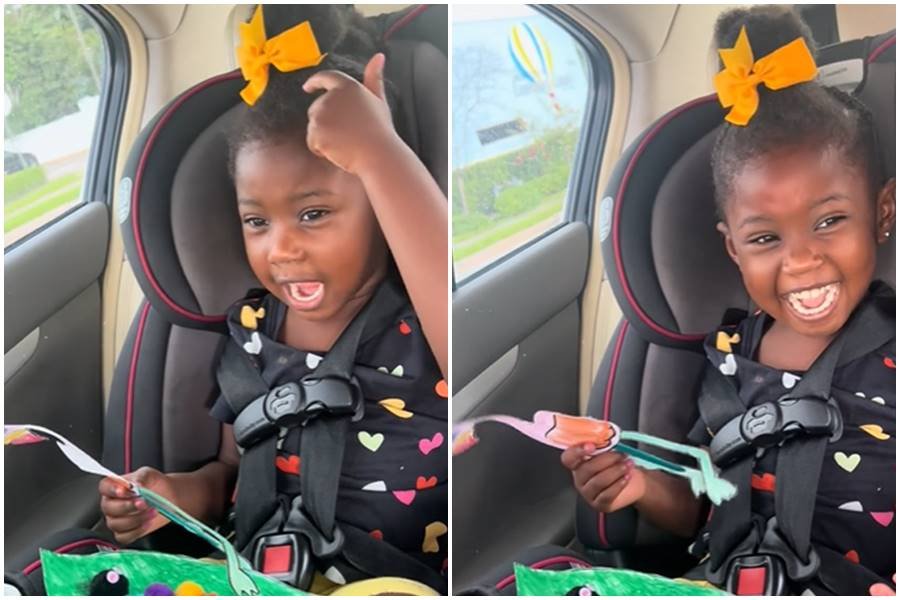
A video of a preschool-age girl is capturing hearts because of the incredibly confident way she responded to a boy who didn’t like her hair. Leila Danai, who was 3 and a half when the video was taken, is one of the only Black children in her school, and her mother, Mildred Munjanganja, prepared her for comments people might make about her hair.

In the video, Leila tells her mother that a boy in school said he didn’t like her hair, "I said, 'I like it!'" she responded. “He said, ‘I don’t like that hair — it’s crazy.’ And I said, ‘My mommy made it. And if you don’t like it, I’ll keep it for myself,” she continued.


Leila then showed off her beautiful smile.

“Oh, baby! I’m so proud of you,” her mother exclaimed. “You stood up for yourself. That’s what matters. What matters is that you like it — it’s your hair.”

@leiladanai

I love hearing about Leila’s day! Today she shared how her classmate didn’t like her hair and she replied ‘well I like it!’ - I have never been more proud! I am glad she didnt need anyone’s validation to feel complete, she knew she loved her hairstyle and that’s what mattered. She stood up for herself, she confidently and honestly communicated her point of view and she didn’t allow someone else to affect her self confidence. I am so proud of her - at 3.5years she stood up for herself and didn’t allow the ent to affect her. We will continue to have a democratic household where her opinion matters! We will continue not forcing to do things she does not want to do and allowing her to speak her mind. I will continue to listen, to guide and be an excellent example. I am so proud of Leila! Strong women, may we be them, may we know them, may we raise them! . . . . . . . . . #kidsselfconfidence #diversity #blackhair #blackkidshairstyles #toddler #momanddaughter #toddlerlife #modelface

Munjanganja explained her parenting philosophy in the video’s caption.

“I am glad she didn't need anyone’s validation to feel complete. She knew she loved her hairstyle, and that’s what mattered,” Munjanganja wrote. “She stood up for herself, she confidently and honestly communicated her point of view and she didn’t allow someone else to affect her self-confidence. I am so proud of her. At 3.5 years, she stood up for herself and didn’t allow the [comment] to affect her.”

Mother and daughter were applauded in the comments.

"We should all have this type of self-esteem. A beautiful young lady. I love her hair!" Armando Lopez wrote. "She is beautiful and will be a fierce force as she grows! Go Momma!!!" Rugby added.

ideas, homelessness, prodigy, social work, solutions
Photo credit: @ribalzebian on Instagram

Ribal Zebian is going to test a house he designed by living in it for a year.

Ribal Zebian, a student from the city of London in Ontario, Canada, already made headlines last year when he built an electric car out of wood and earned a $120,000 scholarship from it. Now, he's in the news again for something a little different. Concerned with homelessness in his hometown, Zebian got to work creating a different kind of affordable housing made from fiberglass material. In fact, he’s so confident in his idea that the 18-year-old plans on living in it for a year to test it out himself.

Currently an engineering student at Western University, Zebian was concerned by both the rising population of the unhoused in his community and the rising cost of housing overall. With that in mind, he conjured up a blueprint for a modular home that would help address both problems.


Zebian’s version of a modular home would be made of fiberglass panels and thermoplastic polyethylene terephthalate (PET) foam. He chose those materials because he believes they can make a sturdy dwelling in a short amount of time—specifically in just a single day.

“With fiberglass you can make extravagant molds, and you can replicate those,” Zebian told CTV News. “It can be duplicated. And for our roofing system, we’re not using the traditional truss method. We’re using actually an insulated core PET foam that supports the structure and structural integrity of the roof.”

Zebian also believes these homes don’t have to be purely utilitarian—they can also offer attractive design and customizable features to make them personal and appealing.

“Essentially, what I’m trying to do is bring a home to the public that could be built in one day, is affordable, and still carries some architecturally striking features,” he said to the London Free Press. “We don’t want to be bringing a house to Canadians that is just boxy and that not much thought was put into it.”

Beginning in May 2026, Zebian is putting his modular home prototype to the test by living inside of a unit for a full year with the hope of working out any and all kinks before approaching manufacturers.

“We want to see if we can make it through all four seasons- summer, winter, spring, and fall,” said Zebian. “But that’s not the only thing. When you live in something that long and use it, you can notice every single mistake and error, and you can optimize for the best experience.”

While Zebian knows that his modular homes aren't a long-term solution to either the homeless or housing crisis, he believes they could provide an inexpensive option to help people get the shelter they need until certain policies are reformed so the unhoused can find affordable permanent dwellings.

@hard.knock.gospel

What to buy for the homeless at the grocery store. 🛒 Most people get it wrong. After being there myself, these are the survival items that actually matter 💯 The 2nd to last one is about more than survival—it’s about DIGNITY. We are all one circumstance away from the same shoes 🙏 SAVE this for your next grocery run. 📌 IG@hardknockgospel Substack@ Outsiders_Anonymous #homelessness #helpingothers #kindness #payitforward #learnontiktok

Zebian’s proposal and experiment definitely inspires others to try to help, too. If you wish to lend a hand to the unhoused community in your area in the United States, but don’t know where to look, you can find a homeless shelter or charity near you through here. Whether it’s through volunteering or through a donation, you can help make a difference.

graduation, dementia, alzheimer's, grandmother, grandchild

A granddaughter received an incredible graduation gift from her grandmother, who has Alzheimer’s disease.

Those whose lives have been affected by Alzheimer's know the pain of slowly losing a loved one long before they're actually gone. Dementia is a cruel diagnosis, and it's hard to overstate how difficult it is to endure someone you know well forgetting who you are.

So when a family gets a glimpse of clarity, a moment of lucidity when their loved one remembers and is present with them, it's a gift beyond compare. That's why a viral video of a woman and her granddaughter on graduation day, when her Alzheimer's seemingly "disappeared" for five minutes, has left everyone a teary mess.


@paige.lake

a moment I won’t ever forget 🩶 #alzheimersawareness #alzheimersdisease #grandparents #fyp #graduation


TikTok user @paige.lake shared that it was a moment she'd never forget, as her grandmother saw her in graduation regalia and knew exactly who she was. With Paige in tears, her grandmother tells her she likes her jewelry and says she looks "fantastic." As she hugs Paige, she says, "Don't get so upset!"

People requested the video without the music so they could hear her more clearly, and Paige obliged.

@paige.lake

Replying to @Tabitha Redding I can’t quite believe all the love and support we received from the first video!! She would be over the moon to see all the lovely comments❤️ No sound as requested 🥺 #alzheimersawareness #fyp #grandparents #graduation #alzheimer

Some people said they should have stuck with the version with music, because phew.

"Crying even HARDER now hearing her words clearly 😭 bless you both. 🤍"

"I cried when I couldn't hear what she said and now I can't stop crying.. my mom had dementia and I know those moments she remember was the most precious moments so I understand how you feel. God bless 🥺"

"I literally have no tears left in my body right now, my grandma has suffered from Alzheimer for almost 10 years now, so this video got me extremely emotional. I am so so happy for you. 🥹"

"Me balling my eyes out because I also got those five minutes with my nana who passed of the same 🥹 God bless you guys. ❤️"

"Stop it 🥺🥺🥺🥺 she's never ever forgotten how much she loves you ❤"

dementia, alzheimer's, grandmother, grandparents, grandchild The love of a grandparent is a gift.Photo credit: Canva

People with experience caring for dementia patients shared their own stories, as well as insights into what was happening in Paige's video, making the moment all the more meaningful.

"Dementia worker here! That's 'cause this isn't just her short term memory. She's been dreaming about your future for a long time love. This is a moment she's been waiting to see. She'd never forget that.💗"

"You know that's moment she always wanted to be there for. Her brain gave her a reprieve."

"It's because she has dreamt about this moment for SO LONG. Alzheimers affects short term memory. Shes seen you in that gown since you were a little girl. You fulfilled 2 people's dreams that day 🥺"

"Mine did that on my wedding day. She walked over and said, 'When did you grow up and become a beautiful bride, Kandi?'"

"I just remembered when my grandpa also broke through Alzheimer's for 5 mins and said I looked beautiful on my hs graduation. 😭"

dementia, alzheimer's, aging, research, senility Scientists are trying to find a cure for Alzheimer's disease.Photo credit: Canva

What's the latest in Alzheimer's research?

According to the Alzheimer's Association, there are approximately 7.2 million Americans with Alzheimer's disease, which means many more millions of people are affected by it. The University of California reports that Alzheimer's affects 10 percent of people over age 65 and kills more people annually than breast and prostate cancer combined.

However, after decades of research into treatment and prevention, researchers are beginning to see promising results that offer hope for the future.

"We've had thousands of failed clinical trials and made very little progress against this devastating disease for decades," said Martin Kampmann, professor of biochemistry and biophysics who studies the molecular aspects of dementia at UC San Francisco. "But just over the last five or so years, we've hit an inflection point. We're starting to get traction."

There are two FDA-approved drugs that target the underlying causes of Alzheimer's disease and can delay cognitive impairment by up to seven months. But those drugs don't reverse or cure the disease, and significant side effects may give some families pause.

However, the discovery of a compound that increases gamma oscillations, brain signals that regulate connectivity between different brain regions and affect cognitive processes like working memory, offers the potential not just for treatment but for the reversal of cognitive decline. In a 2024 study led by Istvan Mody, a professor of neurology and physiology at UCLA Health, the compound was given to mice with Alzheimer's disease. Prior to treatment, the mice couldn't remember how to navigate a maze. Afterward, they were nearly as good at getting through it as mice without Alzheimer's.

"We've shown that this works in mice," said Mody. "If we can develop a therapy that's safe and effective for people, we may be able to restore cognitive function. That's the ultimate hope."

Additionally, a 2025 study from Case Western University tested a pharmaceutical intervention in mice with advanced Alzheimer's. The research showed that the brain’s failure to maintain normal levels of NAD+, a central cellular energy molecule, is a major driver of Alzheimer's disease. The study used a pharmacological agent to maintain proper NAD+ balance, resulting in a recovery of cognitive function in the mice. It's another glimpse of hope, especially if those results carry over to human clinical trials.

Many scientists are working on dementia-related diseases and making progress. In the meantime, families like Paige's will take whatever moments they can get with loved ones who have Alzheimer's.

kids, school, school days, school week, schedule, 4 day week
Unsplash

Many school districts are moving to a 4-day week, but there are pros and cons to the approach.

American kids have fewer school days than most other major countries as it is, which poses a big challenge for families with two working parents. In a system designed for the "classic" stay-at-home mom model, it's difficult for many modern families to cover childcare and fulfill their work obligations during the many, many holidays and extra days off American children receive in school.

Some school districts, in fact, are ready to take things one step further with even fewer instructional days: for better or for worse.


Whitney Independent School District in Texas recently made news when it decided to enact a four-day week heading into the 2025 school year. That makes it one of dozens of school districts in Texas to make the change and over 900 nationally.

The thought of having the kids home from school EVERY Friday or Monday makes many parents break out in stress hives, but this four-day school week movement isn't designed to give parents a headache. It's meant to lure teachers back to work.

Yes, teachers are leaving the profession in droves and young graduates don't seem eager to replace them. Why? For starters, the pay is bad—but that's just the beginning. Teachers are burnt out, undermined and criticized relentlessly, held hostage by standardized testing, and more. It can be a grueling, demoralizing, and thankless job. The love and passion they have for shaping the youth of tomorrow can only take you so far when you feel like you're constantly getting the short end of the stick.

School districts want to pay their teachers more, in theory, but their hands are often tied. So, they're getting creative to recruit the next generation of teachers into their schools—starting with an extra day off for planning, catch-up, or family time every week.

Teachers in four-day districts often love the new schedule. Kids love it (obviously). It's the parents who, as a whole, aren't super thrilled.

- YouTube www.youtube.com

So far, the data shows that the truncated schedule perk is working. In these districts, job applications for teachers are up, retirements are down, and teachers are reporting better mental well-being. That's great news!

But these positive developments may be coming at the price of the working parents in the communities. Most early adopters of the four-day week have been rural communities with a high prevalence of stay-at-home parents. As the idea starts to take hold in other parts of the country, it's getting more pushback. Discussions on Reddit, Facebook, and other social media platforms are overrun with debate on how this is all going to shake up. Some parents, to be fair, like the idea! If they stay-at-home or have a lot of flexibility, they see it as an opportunity for more family time. But many are feeling anxious. Here's what's got those parents worried:

The effect on students' achievement is still unclear.

The execution of the four-day week varies from district to district. Some schools extend the length of each of the four days, making the total instructional time the same. That makes for a really long day, and some teachers say the students are tired and more unruly by the late afternoon. Some districts are just going with less instruction time overall, which has parents concerned that their kids might fall behind.

A study of schools in Iowa that had reduced instructional days found that five-days-a-week students performed better, on average.

Four-day school weeks put parents in a childcare bind.

Having two working parents is becoming more common and necessary with the high cost of living. Of course—"school isn't daycare!" But it is the safe, reliable, and educational place we send our kids while we we work.

Families with money and resources may be able to enroll their kids in more academics, extracurriculars, sports, or childcare, but a lot of normal families won't be able to afford that cost. Some schools running a four-day week offer a paid childcare option for the day off, but that's an added expense and for families with multiple kids in the school system, it's just not possible.

kids, school, school days, school week, schedule, 4 day week In a 4-day model, kids often (but not always) receive less instructional time. Photo by Ivan Aleksic on Unsplash

This will inevitably end with some kids getting way more screentime.

With most parents still working five-day weeks, and the cost of extra activities or childcare too high, a lot of kids are going to end up sitting around on the couch with their iPad on those days off. Adding another several hours of it to a child's week seems less than ideal according to expert recommendations.

Of course there are other options other than paid childcare and iPads. There are play dates, there's getting help from family and friends. All of these options are an enormous amount of work to arrange for parents who are already at capacity.

Working four days is definitely a win for teachers that makes the job more appealing. But it doesn't address the systemic issues that are driving them to quit, retire early, or give up their dreams of teaching all together.

@5th_with_ms.y

Replying to @emory here are my thoughts on my 4day work week as a teacher✨ #foryou #fyp #fypシ #foryoupage #foryoupageofficiall #teachersoftiktokfyp #teachersoftiktok #teachertok #teachersbelike #teachertiktok #tik #tiktok #viralllllll #teachertoks #teaching #teacher #tok #viralvideo #teacherlife #viral #trendy #teacher #teaching #worklifebalance #worklife #publicschool #publiceducation #school #student

A Commissioner of Education from Missouri calls truncated schedules a "band-aid solution with diminishing returns." Having an extra planning day won't stop teachers from getting scapegoated by politicians or held to impossible curriculum standards, it won't keep them from having to buy their own supplies or deal with ever-worsening student behavior.

Some teachers and other experts have suggested having a modified five-day school week, where one of the days gets set aside as a teacher planning day while students are still on-site participating in clubs, music, art—you know, all the stuff that's been getting cut in recent years. Something like that could work in some places.

In any case, the debate over a shortened school week is not going away any time soon. More districts across the country are doing their research in preparation for potentially making the switch.

Many parents don't theoretically mind the idea of their busy kids having an extra day off to unwind, pursue hobbies, see friends, catch up on projects, or spend time as a family. They're also usually in favor of anything that takes pressure off of overworked teachers. But until we adopt a four-day work week as the standard, the four-day school week is always going to feel a little out of place.

This article originally appeared in February. It has been updated.

party, chatting, likable, drinks small talk, men and women

A woman speaking with two men at a party.

When we think of someone likable, we often imagine a person with a big personality who's the life of the party. We conjure up images of social butterflies and people who keep everyone at the dinner party glued to their every word when they tell a story. The funny thing is, according to research, that's not really the case.

Studies show that the easiest way to make someone like you is to show interest by asking questions during the conversation and making it clear that you like them. People also really love those who come off as genuine.


Michael Gendler, a co-founder of Ultraspeaking, a platform that helps people master the art of public speaking, recently shared three "magic" phrases that make you more likable, all of which align with what science tells us.

Three phrases that make you more likable

Phrase 1: "Here's what really scares me..."

This phrase resonates with people because it shows you're genuine by admitting your vulnerability. "Man, talk about your feats, real fears, not like 'Oh, I'm scared I'm going to be too successful.' Tell us about something that actually scares you. Don't be guarded. Be open, and other people will appreciate that," Gendler says.

Phrase 2: "You know what I really like about you?"

This phrase makes people like you because it counters a psychological phenomenon known as signal amplification bias, which suggests we tend to overestimate how clearly we express our feelings to others. This means that, many times, when we think others know we like them, they may not be so sure. So a little assurance goes a long way toward showing them the feeling is mutual. "People love being complimented as long as it is genuine," Gendler says.


Phrase 3: "Tell me more"

As Dale Carnegie wrote in How to Make Friends and Influence People, the key to interacting with others is focusing on being interested in them rather than trying to impress them by being interesting. "Be interested, not interesting," Carnegie writes.

A Harvard study supports this, showing that when you first start speaking with someone, you should follow your first question with two more. People who do this are rated as much more likable than those who, after one question, shift the conversation to themselves. "People love feeling like what they're saying is interesting. So invite them to speak more," Gendler continues.


Don't forget to be genuine

Ultraspeaking's post is a breath of fresh air for those who aren't comfortable trying to impress others at parties, on dates, or in the office. The video shows that if you make people feel important, they're much more likely to like you in return. The key is that it has to come from the heart.

"Remember, don't just use these phrases and expect them to work," Gendler says. "They have to be genuine and open. That's what makes people likable."

VHS, VCR, Tape player, 1970s, 1980s, Gen X, Boomer
Photo Credit: Canva

A few VHS tapes on a table.

There are certain words, expressions, and references that, when used, can absolutely give away a person's generation. If someone hears "Leave a message on my machine," they might assume they're dealing with a Boomer. On the other end of the spectrum, if someone says, "Hit me up on Snapchat," one could place bets that it's not a Boomer or even a Gen X-er talking.

So when @Bittenhand19 took to Threads to state, "If I hear a person say 'VHS player' I know for a fact that person was born after 1995," it got quite a lot of people weighing in.


But let's rewind for a quick technological history lesson.

A brief history of the VCR. www.youtube.com, 21st Century Entertainment

Way back in the 1950s (1956, to be exact), the first VCR, or Video Cassette Recorder, was released to the public. According to Christian Roemer's article on the history of the VCR, "The first widely available VCR-like device was mainly intended for television networks, and it was incredibly expensive. Its 1956 price tag was $55,000, which converts to about half a million dollars in 2022. That's right: the first VCR analogue was more expensive than a house!"

Over the decades, the price tag dropped, and by the early 1970s, the first VCRs were hitting store shelves for consumers. But here's where the confusion might come in for some. "The problem was that VCRs didn't all use the same tapes at that point," Roemer wrote. "Sony had Betamax, JVC had VHS, and a couple other stragglers bounced around too. Sort of like different video game systems, the different home video formats vied for market share and duked it out for a while. By the late 1970s, the public had spoken with their wallets, and VHS won the day. VCRs would eventually be in practically every home worldwide."

VCR, VHS, Tapes, 80s, 90s A VHS tape is pulled out of a VCR. Giphy Video VHS GIF

Interestingly, a post titled "The Rise and Fall of the VCR: A Comprehensive History" on the DiJiFi website further explains:

"Despite incorporating state-of-the-art sound and audio quality at the time, Betamax and VHS were at war. JVC developed and released the VHS in Japan in 1976, then released the product in the U.S. market a year later. While Sony's Betamax machine was the first form of videotape hardware to host home videos, it was no match for JVC for several reasons.

The VHS has a lighter build, resulting in cheaper manufacturing. The rectangular box could hold twice the amount of film tape, allowing it to play longer features that Betamax could not. While Sony's Betamax had superior picture quality, the VHS took first place in terms of cost-effectiveness and convenience, making it the preferred home videotaping format."

Which brings us back to the Threads post. With nearly 2,000 likes and more than 300 comments, people most definitely had their own takes. Some jumped in to say the correct term was "tape player," with one person specifically writing, "tape player, if you're nasty."

Betamax, Sony, 1980s, Gen X, Boomer A Betamax sits on the floor. commons.wikimedia.org, File:Sony Betamax SL-C7E.jpg - Wikimedia Commons

Many seem to know that the correct term is VCR, since VHS was merely a brand name (not unlike the way "tissues" and "Kleenex" are often used interchangeably).

Another commenter went into greater detail, while also pointing out that someone born in 1995 understands the distinction: "1995 here. Wrong. All VCRs played VHS tapes, but not all VHS players were VCRs. There were dedicated VHS players that could only play tapes, but couldn't record onto those tapes."

This commenter goes deep into the weeds: "You do not know this for a fact. They could possibly be someone who thought Betamax was a superior format for video cassette recorders. Or differentiating from their regular VHS VCR and one that did S-VHS, Video8, VHS-C, Hi8, PXL-2000, etc. etc. etc. Sometimes people have to make a distinction."

Some went the humorous route: "VHS player? That's a VCR. Stands for…video…crambobulating…robot."

Perhaps even more interestingly, some claim it's not a generational thing at all, but a geographical one: "Funny, if I hear a person say 'VCR,' I know they're American."