upworthy
Add Upworthy to your Google News feed.
Google News Button
Joy

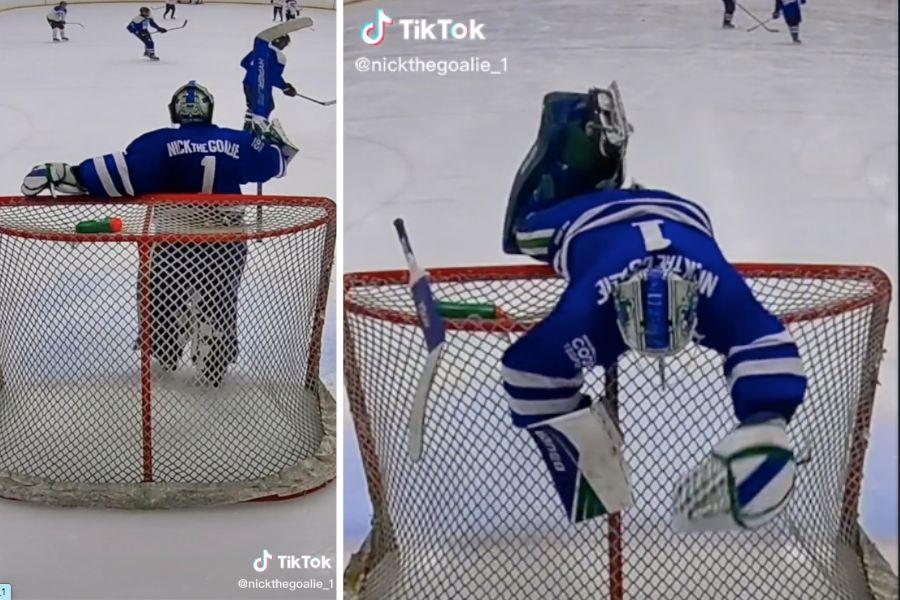
Mic'd-up hockey goalie's hilarious self-talk during games has people in stitches

Nick the Goalie's monologuing is just delightful.

screenshot of hockey goalie

You don't have to watch hockey to enjoy Nick the Goalie's running commentary.

Goalkeepers and goaltenders in all kinds of sports play a unique role on a team. While other players have to communicate and strategize with one another as they play, a goalie just has one job—keep the ball/puck/etc. out of the goal. It's a hugely important job, but pretty straightforward.

When their team is on the other side of a field or rink, goalies watch and wait. Since their teammates know and trust that they're watching the action, they don't really have to interact with anyone most of the time. And while they can't totally zone out, they have all kinds of time to themselves while the action is happening far away.

Have you ever seen what happens when a person—especially someone who likes to talk—has a whole lot of time to themselves and no one to talk to?

Meet Nick Weston, who is giving everyone a glimpse into a world most of us only watch from afar and never get to hear. Weston is an amateur hockey player from Vancouver, Canada, who has become a TikTok sensation with his mic'd-up goalie videos under his nickname, Nick the Goalie.

Do you remember the snowboarding 4-year-old in a dinosaur costume who coined the phrase "I'm a stuck-a-saurus!" and won hearts with her adorably entertaining monologuing? Nick the Goalie is like that, only as a grown man playing a team sport.

People love Nick the Goalie's wholesome self-talk as he performs his goalie duties with gusto. (Though he often wears a Vancouver Canucks jersey, he doesn't play for a National Hockey League team. As he explained to CTV, he gets brought in to play goaltender on various local league teams.)

His videos have even been shared by ESPN and the NHL, and the comments on his videos are as fabulous as his running commentary.

Watch:

@nickthegoalie_1

Mine! #hockey #goalie #nhl #hockeyboys

"This is how I imagine a golden retriever's internal monologue. He's SO excited, I love it," wrote one commenter on Reddit.

"Only reason I gravitated towards the goalie position, other than my hatred of running, was my need to constantly sing to myself. Can relate so hard," wrote another.

A whole thread of soccer, field hockey, and lacrosse goalkeepers, as well as baseball catchers and outfielders, confirmed that this is exactly what they do—monologue, monologue, monologue.

@nickthegoalie_1

I COULD’VE DROPPED MY CROISSANT 🥐 #hockey #goalie #nhl #hockeyboys

It's hard not to smile at the the wholesomeness and hilarity of his self-talk. The singing, the squealing, the trash talk to no one in particular—it's all just so delightful.

@nickthegoalie_1

This video is a lot to take in #hockey #goalie #hockeyboys #nhl

Even people who aren't that into ice hockey are commenting with how much they enjoy his videos. As one person wrote, "Ok fine I’ll watch sports if I can get this insider commentary for every game."

So much fun. Recently, Weston has been using his social media fame to raise money for the Canucks Autism Network in addition to sharing the sport he loves. As of 2024, over 1.1 million has been raised.

Keep following Nick the Goalie on TikTok, YouTube, or Instagram.


This article originally appeared three years ago.

Once a refugee seeking safety in the U.S., Anita Omary is using what she learned to help others thrive.
Pictured here: Anita Omary; her son, Osman; and Omary’s close friends
True

In March 2023, after months of preparation and paperwork, Anita Omary arrived in the United States from her native Afghanistan to build a better life. Once she arrived in Connecticut, however, the experience was anything but easy.

“When I first arrived, everything felt so strange—the weather, the environment, the people,” Omary recalled. Omary had not only left behind her extended family and friends in Afghanistan, she left her career managing child protective cases and supporting refugee communities behind as well. Even more challenging, Anita was five months pregnant at the time, and because her husband was unable to obtain a travel visa, she found herself having to navigate a new language, a different culture, and an unfamiliar country entirely on her own.


“I went through a period of deep disappointment and depression, where I wasn’t able to do much for myself,” Omary said.

Then something incredible happened: Omary met a woman who would become her close friend, offering support that would change her experience as a refugee—and ultimately the trajectory of her entire life.

Understanding the journey

Like Anita Omary, tens of thousands of people come to the United States each year seeking safety from war, political violence, religious persecution, and other threats. Yet escaping danger, unfortunately, is only the first challenge. Once here, immigrant and refugee families must deal with the loss of displacement, while at the same time facing language barriers, adapting to a new culture, and sometimes even facing social stigma and anti-immigrant biases.

Welcoming immigrant and refugee neighbors strengthens the nation and benefits everyone—and according to Anita Omary, small, simple acts of human kindness can make the greatest difference in helping them feel safe, valued, and truly at home.

A warm welcome

Dee and Omary's son, Osman

Anita Omary was receiving prenatal checkups at a woman’s health center in West Haven when she met Dee, a nurse.

“She immediately recognized that I was new, and that I was struggling,” Omary said. “From that moment on, she became my support system.”

Dee started checking in on Omary throughout her pregnancy, both inside the clinic and out.

“She would call me and ask am I okay, am I eating, am I healthy,” Omary said. “She helped me with things I didn’t even realize I needed, like getting an air conditioner for my small, hot room.”

Soon, Dee was helping Omary apply for jobs and taking her on driving lessons every weekend. With her help, Omary landed a job, passed her road test on the first attempt, and even enrolled at the University of New Haven to pursue her master’s degree. Dee and Omary became like family. After Omary’s son, Osman, was born, Dee spent five days in the hospital at her side, bringing her halal food and brushing her hair in the same way Omary’s mother used to. When Omary’s postpartum pain became too great for her to lift Osman’s car seat, Dee accompanied her to his doctor’s appointments and carried the baby for her.

“Her support truly changed my life,” Omary said. “Her motivation, compassion, and support gave me hope. It gave me a sense of stability and confidence. I didn’t feel alone, because of her.”

More than that, the experience gave Omary a new resolve to help other people.

“That experience has deeply shaped the way I give back,” she said. “I want to be that source of encouragement and support for others that my friend was for me.”

Extending the welcome

Omary and Dee at the Martin Luther King, Jr. Vision Awards ceremony at the University of New Haven.

Omary is now flourishing. She currently works as a career development specialist as she continues her Master’s degree. She also, as a member of the Refugee Storytellers Collective, helps advocate for refugee and immigrant families by connecting them with resources—and teaches local communities how to best welcome newcomers.

“Welcoming new families today has many challenges,” Omary said. “One major barrier is access to English classes. Many newcomers, especially those who have just arrived, often put their names on long wait lists and for months there are no available spots.” For women with children, the lack of available childcare makes attending English classes, or working outside the home, especially difficult.

Omary stresses that sometimes small, everyday acts of kindness can make the biggest difference to immigrant and refugee families.

“Welcome is not about big gestures, but about small, consistent acts of care that remind you that you belong,” Omary said. Receiving a compliment on her dress or her son from a stranger in the grocery store was incredibly uplifting during her early days as a newcomer, and Omary remembers how even the smallest gestures of kindness gave her hope that she could thrive and build a new life here.

“I built my new life, but I didn’t do it alone,” Omary said. “Community and kindness were my greatest strengths.”

Are you in? Click here to join the Refugee Advocacy Lab and sign the #WeWillWelcome pledge and complete one small act of welcome in your community. Together, with small, meaningful steps, we can build communities where everyone feels safe.

This article is part of Upworthy’s “The Threads Between U.S.” series that highlights what we have in common thanks to the generous support from the Levi Strauss Foundation, whose grantmaking is committed to creating a culture of belonging.

sleep, sleep tricks, sleeping techniques, science, scientific research, placebo effect, placebo

Tired man (left); energized man (right)

The benefits of getting a good night's sleep are too vast to name. Sleep is as essential for our brains as food and water are for our bodies. If you're not getting enough, sleeping better has been shown to elevate your mood, improve your memory, and even boost your physical health. And then there's the obvious: when you don't sleep well, you'll have less energy and generally perform worse on tasks that require any kind of effort or thought.

However, we're all human, and, sometimes, humans sleep terribly. Your infant might wake you up, or a car alarm might go off outside, interrupting your regularly-scheduled REM. It's not always our fault when we don't sleep well, but there might be an interesting way to fix it.


A study from 2014 may have demonstrated the existence of something called "placebo sleep," or tricking your brain into believing you slept better than you did.

sleep, sleep tricks, sleeping techniques, science, scientific research, placebo effect, placebo a man sitting at a desk with his head on his arms Photo by Vitaly Gariev on Unsplash

The placebo effect, of course, has been studied relentlessly over the years and has shown that the human body can do amazing, almost impossible things, when the brain gets on board. The classic example is when symptoms of disease get measurably better after a patient takes a "fake" pill. Another study out of Harvard showed that people who were told their jobs qualified as exercise showed improved health and fitness markers compared to people who did the same job. Placebos even work when the person knows they're taking a placebo. It's called an "honest placebo" and is considered a legitimate, ethical treatment method for many ailments.

The researchers in 2014 wanted to find out if the placebo effect could also apply to sleep. So, they lectured a group of participants about the importance of REM sleep and how it can effect cognitive functioning. The participants were then split into two groups and monitored overnight while they slept. The next morning, one group was told they achieved 28.7% REM sleep, which is terrific, and the other group was told they only spent 16.2% of their sleep time in REM, which is below average. The numbers, however, were complete fiction.

Stunningly, the participants who believed they achieved top quality sleep performed better the next day on a series of arithmetic and word association tests compared to the other groups.

In their conclusion, the authors wrote, "These findings supported the hypothesis that mindset can influence cognitive states in both positive and negative directions, suggesting a means of controlling one's health and cognition."

According to Smithsonian Magazine, follow up experiments confirmed the findings.

The key to feeling great and performing as if you had a great night's sleep may lie in simply believing that you did.

There are a lot of ways to "placebo your sleep" in order to generate that belief. For starters, you can adopt a new routine or technique or even supplement in order to prime your brain.

John Cline Ph.D. asserts for Psychology Today that the popularity of sleeping aids like melatonin may be tied less to the fact that they work, and more to the fact that people believe they work. But you don't need to take any supplements or medications. Having a slow evening wind down with a book and an herbal tea, trying a new sleeping position, or practicing some measured breathing might work just as well. Or, rather, they might work precisely because you believe they will.

sleep, sleep tricks, sleeping techniques, science, scientific research, placebo effect, placebo Can a warm cup of tea help you sleep better? If you believe it, then yes. Photo by Dana Ciurumelea on Unsplash

You could take the concept a step further and alter your morning routine on nights you know for a fact you didn't sleep well. Perhaps it's by using a new coffee brand, doing some stretches before getting out of bed, or meditating before starting your day. Anything that you truly believe might help make you more alert and focused may just work.

One viral social media sleep trend capitalizes on this research perfectly. Researchers have shown that forcing your mouth into a smile has been shown to improve your mood. Turns out, similarly, you may be able to get sleepy by pretending to be super tired. Psychologist Erica Terblanche calls it the "alpha bridge," and it involves gently closing your eyes, fluttering them open just a tad, and then closing them again as you relax and breath. It simulates the feeling of "nodding off" and is said to create the alpha brainwaves that transition your brain from wakefulness to sleep. It's another clever way of tricking your own brain.


@erica.terblanche

Here's a skill to help you fall asleep on an airplane or anywhere else for that matter. . Its called going over the Alpha Bridge. #EricaTerblanche #ThriveGuru #motivation #sleeping

It sounds cheesy, but the power of mindset and positive thinking is truly tremendous. Our beliefs and thought patterns can greatly influence our body, our behavior, and our mood. Sometimes, our mindset can even be stronger than actual reality. Now we have the data to prove that it applies to our precious sleep, too.

teen, first paycheck, work, McDonalds, working, teens, mom, heartwarming moment
u/ExactlySorta/Reddit
A teen was elated getting his first paycheck from McDonald's.

Getting a first job is undoubtedly one of the most drastic steps that teenagers make into full-blown adulthood. It can be a shock to the system doing hard work outside of a school environment, having a boss instead of a teacher, and having real money on the line. However, one thing all adults remember fondly is the time they opened their very first paycheck, and all that hard work (at least for a moment) felt worth it.

One mom recently captured one of those moments on video as her teen son opened his first paycheck from his job at McDonald's. The video shared on Reddit shows a teen in a McDonald's hat sitting in the passenger seat of a car opening an envelope that contained his paycheck.


teen, first paycheck, work, McDonalds, working, teens, mom, heartwarming moment Everyone loves payday.Photo credit: Canva

His mom said it should be "200-and something" dollars, and after a hilariously long struggle to open the envelope (Gen Z have rarely, if ever, snail mailed, so no judgment), he looks over the check stub to get the full picture.

"That's $283," he says in astonishment. To his credit, he asks "After tax, what's that?" not realizing that the amount of the check is the after-tax take home amount. It may not sound like much to adults, but it's likely the most money this teenager has ever truly been able to call his. And he earned every penny. His smile and laughter says it all.

Watch:

"Let's take it to the bank, then!" Heck yeah, kid.

People in the comments are fondly remembering their own first paychecks

Many viral videos of first paycheck reveals include complaints about how much is taken out in taxes, so it's refreshing to see this young man's joy at his after-tax pay. It was a beautiful moment to capture on film, as most of us remember that feeling of empowerment that came with our own first real paychecks.

People in the comments are feeling the nostalgia:

"I remember that feeling - pretty sweet to see money you earned yourself. Feels good earning your own cash."

"God that first paycheck felt so unreal. I will never forget you ace hardware."

"I remember my first paycheck was for like $300 after two weeks of being a counselor and I felt RICH. I immediately spent it all on a guitar that I still have 20 years later."

"I remember mine - from my first proper job. £64.29 in a little brown packet with holes in it to see the cash inside. 1980. 😂"

"My first “paycheck” was like $65, I was so proud. I took my mom to pizzeria to treat her and she was very very touched."

"Man… I remember my first paycheck… 23 years ago now. For two weeks of what limited hours I could work being 14 years old… that baby was $96.19! HO-LY smokes was I on cloud 9. Cashed it right there at work and bought myself a bag of Skittles. It was a good day."

"No matter how much we earn later in life, that very first pay check is everything!"

"Man, I swear I had to watch this video like 20 times. There is hope for the future of America, love this kid!!!!

Ah, to be young and unencumbered by adult expenses. Part of what makes this endearing is the innocence of it. As a teen, he's not worried about affording a mortgage or groceries or diapers or retirement savings. His elation over making $283 is adorable because he's just starting down the path of adulthood. Soon enough, that paycheck will seem small, but he's not there yet.

Such is the "first paycheck joy," that TikTok is rife with adorable videos of young people opening their first paychecks after working their first real jobs.

@fuck3n_andre

Taco Bell on me 😭 I was fully expecting like $200😂 #fypage #firstjob #job #first #firstpaycheck #fyp #foryoupage #viral

When you're a kid, money is kind of an abstract concept. Maybe you get a small allowance or get paid a few bucks for odd jobs, and opening a birthday card with some cash in it is exciting. It's not until you're fully into the working world for a while that the regular flow of money and what it means for your life really sinks in.

It's not until you're a fully independent adult that you really grasp how relative your feelings about your paycheck can be. There's a big difference between being a 16-year-old getting your first paycheck and being a 30-year-old trying to raise a family on wages that don't cover all your needs. Things like cost-of-living and inflation start to actually mean something as you get older and experience their impact. You might find that you can make a lot more money and yet feel poorer than ever as expenses pile up into adulthood.

Don't we all wish we could go back to the hopeful, happy days of making our first real chunk of money before all of those grown-up concerns arose? That simple sense of pride in having worked hard and earned something. The excitement of being able to pay for something you want yourself. The sense of freedom that comes with those early earnings. We see and feel all of that in this teen's bright smile, and it's glorious.

He'll have plenty of time to learn, in the very near future, the importance of budgeting, saving, and smart spending. And luckily, he'll have plenty of resources in the modern media and social media landscape to learn from; far more than his parents ever had:

- YouTube www.youtube.com

He may not realize how different he might feel opening his paychecks down the road, but there's no need to tell him yet. He'll find out soon enough, as we all have, so let's just let him enjoy this moment of bliss. He's earned it.

This article originally appeared two years ago. It has been updated.

quiet, finger over lips, don't talk, keep it to yourself, silence

A woman with her finger over her mouth.

It can be hard to stay quiet when you feel like you just have to speak your mind. But sometimes it's not a great idea to share your opinions on current events with your dad or tell your boss where they're wrong in a meeting. And having a bit of self-control during a fight with your spouse is a good way to avoid apologizing the next morning.

Further, when we fight the urge to talk when it's not necessary, we become better listeners and give others a moment in the spotlight to share their views. Building that small mental muscle to respond to events rather than react can make all the difference in social situations.


argument, coworkers, angry coworkers, hostile work enviornment, disagreement A woman is getting angry at her coworker.via Canva/Photos

What is the WAIT method?

One way people have honed the skill of holding back when they feel the burning urge to speak up is the WAIT method, an acronym for the question you should ask yourself in that moment: "Why Am I Talking?" Pausing to consider the question before you open your mouth can shift your focus from "being heard" to "adding value" to any conversation.

The Center for The Empowerment Dynamic has some questions we should consider after taking a WAIT moment:

  • What is my intention behind what I am about to say?
  • What question can I ask to better understand what the other person is saying?
  • Is my need to talk an attempt to divert the attention to me?
  • How might I become comfortable with silence rather than succumb to my urge to talk?

tape over muth, sielnce, be quiet, mouth shut, saying nothing A man with tape over his mouth.via Canva/Photos

The WAIT method is a good way to avoid talking too much. In work meetings, people who overtalk risk losing everyone's attention and diluting their point to the extent that others aren't quite sure what they were trying to say. Even worse, they can come across as attention hogs or know-it-alls. Often, the people who get to the heart of the matter succinctly are the ones who are noticed and respected.

Just because you're commanding the attention of the room doesn't mean you're doing yourself any favors or helping other people in the conversation.

The WAIT method is also a great way to give yourself a breather and let things sit for a moment during a heated, emotional discussion. It gives you a chance to cool down and rethink your goals for the conversation. It can also help you avoid saying something you regret.

fight, spuse disagreement, communications skills, upset husband, argument A husband is angry with his wife. via Canva/Photos

How much should I talk in a meeting?

So if it's a work situation, like a team meeting, you don't want to be completely silent. How often should you speak up?

Cary Pfeffer, a speaking coach and media trainer, shared an example of the appropriate amount of time to talk in a meeting with six people:

"I would suggest a good measure would be three contributions over an hour-long meeting from each non-leader participant. If anyone is talking five/six/seven times you are over-participating! Allow someone else to weigh in, even if that means an occasional awkward silence. Anything less seems like your voice is just not being represented, and anything over three contributions is too much."

Ultimately, the WAIT method is about taking a second to make sure you're not just talking to hear yourself speak. It helps ensure that you have a clear goal for participating in the conversation and that you're adding value for others. Knowing when and why to say something is the best way to make a positive contribution and avoid shooting yourself in the foot.

skiing, skier, downhill ski race, alpine skiing, super-g
Representative photo credit: Canva

Downhill skiing is a sport rife with injuries, but not usually this kind.

A good commentator can make all the difference when watching sports, even when an event goes smoothly. But it's when something goes wrong that great announcers rise to the top. There's no better example of a great announcer in a surprise moment than when French skier Yannick Bertrand took a gate to the groin in a 2007 super-G race.

Competitive skiers fly down runs at incredible speeds, often exceeding 60 mph. Hitting something hard at that speed would definitely hurt, but hitting something hard with a particularly sensitive part of your body would be excruciating. So when Bertrand slammed right into a gate family-jewels-first, his high-pitched scream was unsurprising. What was surprising was the perfect commentary that immediately followed.


This is a clip you really just have to see and hear to fully appreciate:

- YouTube youtu.be

It's unclear who the announcer is, even after multiple Google inquiries, which is unfortunate because that gentleman deserves a medal. The commentary gets better with each repeated viewing, with highlights like:

"The gate the groin for Yannick Bertrand, and you could hear it. And if you're a man, you could feel it."

"Oh, the Frenchman. Oh-ho, monsieurrrrrr."

"The boys took a beating on that one."

"That guy needs a hug."

"Those are the moments that change your life if you're a man, I tell you what."

"When you crash through a gate, when you do it at high rate of speed, it's gonna hurt and it's going to leave a mark in most cases. And in this particular case, not the area where you want to leave a mark."

Imagine watching a man take a hit to the privates at 60 mph and having to make impromptu commentary straddling the line between professionalism and acknowledging the universal reality of what just happened. There are certain things you can't say on network television that you might feel compelled to say. There's a visceral element to this scenario that could easily be taken too far in the commentary, and the inherent humor element could be seen as insensitive and offensive if not handled just right.

The announcer nailed it. 10/10. No notes.

The clip frequently resurfaces during the Winter Olympic Games, though the incident didn't happen during an Olympic event. Yannick Bertrand was competing at the FIS World Cup super-G race in Kvitfjell, Norway in 2007, when the unfortunate accident occurred. Bertrand had competed at the Turin Olympics the year before, however, coming in 24th in the downhill and super-G events.

As painful as the gate to the groin clearly as, Bertrand did not appear to suffer any damage that kept him from the sport. In fact, he continued competing in international downhill and super-G races until 2014.

skiing, skier, downhill ski race, alpine skiing, super-g Alpine skiing is a notoriously dangerous sport. Photo credit: Canva

According to a 2018 study, Alpine skiing is a notoriously dangerous sport with a reported injury rate of 36.7 per 100 World Cup athletes per season. Of course, it's the knees and not the coin purse that are the most common casualty of ski racing, which we saw clearly in U.S. skier Lindsey Vonn's harrowing experiences at the 2026 Olympics. Vonn was competing with a torn ACL and ended up being helicoptered off of the mountain after an ugly crash that did additional damage to her legs, requiring multiple surgeries (though what caused the crash was reportedly unrelated to her ACL tear). Still, she says she has no regrets.

As Bertrand's return to the slopes shows, the risk of injury doesn't stop those who live for the thrill of victory, even when the agony of defeat hits them right in the rocks.

Health

Psychologists say there are 4 types of introverts. These are the personality traits of each one.

The four types of introverts: Social, Thinking, Anxious, and Restrained.

introvert, introvers, types of introverts, introverted, introvert types, 4 introvert types

A woman sits in a chair reading a book.

Introverts can have many personality stereotypes. Many people assume they are quiet homebodies who prefer alone time, but not all introverts are the same.

Psychologist Jonathan M. Cheek, along with his colleagues Jennifer Grimes and Julie Norem at Wellesley College, presented findings in a 2011 study identifying four types of introverts: Social, Thinking, Anxious, and Restrained (STAR).


"Many people assume introversion is fixed, but introversion is on a spectrum," Chloë Bean, a somatic trauma therapist in Los Angeles, told Upworthy.

- YouTube www.youtube.com

Essentially, there is no one-size-fits-all type of introvert.

"It can shift depending on life phase, your stress level, burnout, support system, and trauma history," Bean said. "What looks like 'being introverted' is sometimes the nervous system doing it's job, protecting you especially when you're feeling overwhelmed or need to connect with yourself more."

Four types of introverts

In an interview with The Cut, Cheek explained that these introvert "types" are more like "shades," and that introverts are often a mix of each one. Here's what you need to know about each type of introvert:

introvert, introverts, being introverted, social introvert, introverts hanging out Three women sit on a blanket in the park. Photo credit: Canva

Social introverts

Bean noted that social introverts may be selective about who they connect with. They enjoy spending time with others but need downtime to recover.

"They prefer to stay home with a book or a computer, or to stick to small gatherings with close friends, as opposed to attending large parties with many strangers," Cheek explained.

How to tell if it's you:

"You may tend to lose a lot of energy when socializing in large groups even when they're fun and prefer one-on-one time," said Bean. "You may feel more regulated with one person at a time, as you can feel overstimulated with more than one person at a time."

Thinking introverts

Thinking introverts are internally rich, deep, and active but appear quiet on the outside, Bean noted. They spend a lot of time reflecting, imagining, creating, or analyzing.

"You're capable of getting lost in an internal fantasy world," Cheek said. "But it's not in a neurotic way, it's in an imaginative and creative way."

How to tell if it's you:

"You feel energized and excited by ideas but you feel exhausted when there is constant feedback and stimulation externally," Bean explained. "You need time to be with your thoughts to come to your conclusion so staying with your inner voice and process is supportive because you can get easily distracted by others' thoughts and opinions."

@onlyjayus

The 4 Types Of Introverts

Anxious introverts

Bean said that anxious introverts deal with anxiety and avoidance driven by fear, as the body anticipates rejection or not being accepted socially.

How to tell if it's you:

"You might replay conversations, dread upcoming plans and cancel them when the tension and anxiety gets too strong," Bean shared. "This is often less about your personality and more about your nervous system feeling dysregulated by thoughts about socializing."

Restrained introverts

Restrained introverts are highly observant, take time to warm up to others, and are cautious about who they spend their energy with, Bean explained.

How to tell if it's you:

"It might take you some time to feel like you can trust others and feel safe enough to speak up," Bean said. "You might also avoid being put on the spot or being the center of attention."