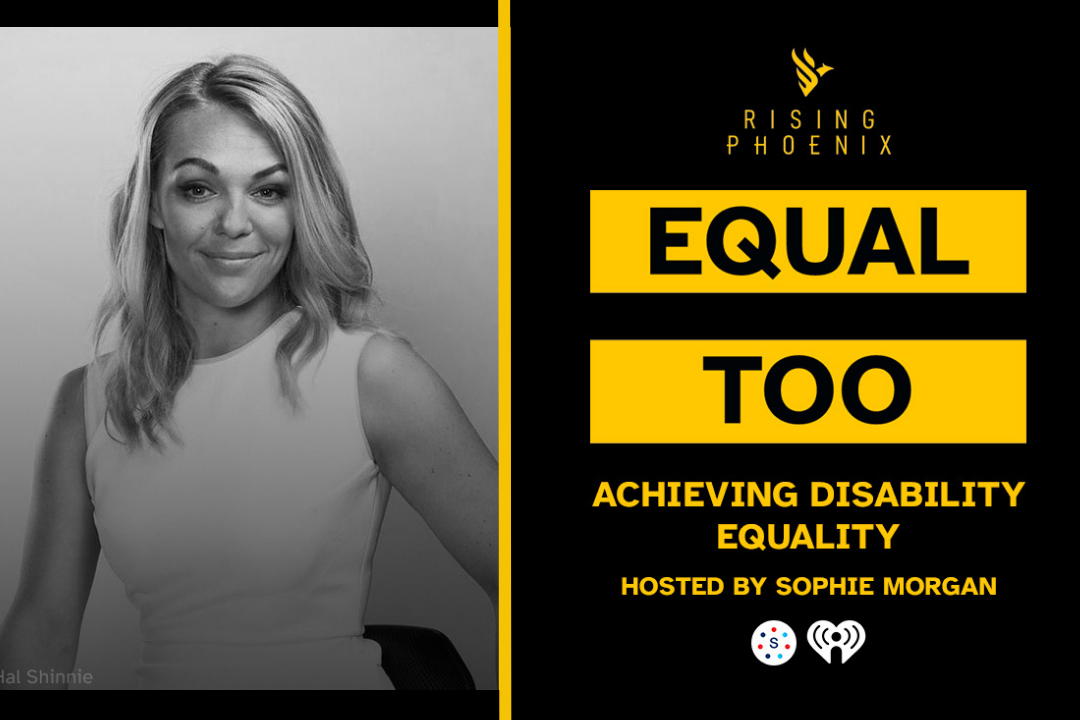
New podcast is an in-depth look at the challenges and opportunities facing the disabled community
Made by P&G Studios and Harder Than You Think, the team behind Netflix's documentary Rising Phoenix.

Sophie Morgan
Over the past few years, there has been an incredible rise in global consciousness about social justice. But there's been one exceptionally large group that's been mostly absent from the conversation, people with disabilities.
The World Health Organization estimates there are 1.2 billion people with disabilities across the globe, which accounts for 15% of the total human population.
"To truly create an accessible and equitable world, a place where everyone feels safe and has the courage to be themselves, we have work to do," Sophie Morgan, British Television Presenter, and disability advocate says on the first episode of the "Equal Too" podcast. "We have to change the law. Transform culture. Rebuild our cities. Increase visibility. And to do so we must empower everyone to be involved."
As activists such as Morgan work to change public consciousness surrounding the issues facing 1.2 billion people with disabilities, they face a major question. What are the biggest challenges and what work is needed to drive equality?
To address these pressing concerns, Harder Than You Think, the team behind the Emmy-award winning Netflix documentary Rising Phoenix, and P&G Studios launched "Equal Too: Achieving Disability Equality" a 6-part podcast that aims to answer these pressing questions by talking to disability activists, athletes, politicians, and those working to make the world more accessible.
What's unique about this podcast is that 61% of its team of producers, guests, and contributors identify as disabled.
The podcast recently wrapped up its sixth and final episode so now is a great time to binge-listen to this compelling podcast that attempts to create a cohesive agenda for people with disabilities in the wake of one of the most successful Paralympic Games to date.
The show is hosted by Morgan who sustained a T6 spinal cord injury in a traffic accident in 2003, resulting in paralysis from the chest down.
Morgan was a lead host for Channel 4's Paralympics coverage.
Throughout the six episodes, Morgan took a look back at the history and the legacy of the Paralympic movement and the impact it's had on host cities and beyond. She also spoke with actress Jameela Jamil ("The Good Place") who has Ehlers-Danlos Syndrome, a group of disorders that affect connective tissue, about ableism in Hollywood.
"For someone who maybe has just found that they have a disability, that someone they love does, or they want to be an ally for people with disabilities, this is a perfect series for you," Jamil says. "It's full of very real conversations, but they're incredibly entertaining, too."
Morgan also had a conversation with Keely Cat Wells who runs a talent agency for disabled talent and Yoshihiko Kawauchi, an architect and wheelchair user who advised Paralympic Games Tokyo 2020 on venue construction.
After six episodes, the show's co-producer, Sinead Burke, is proud that she and Morgan were able to achieve the show's ultimate goal of inclusivity.
"I think it's been so brilliant to have six different threads of conversations under the umbrella of disability," she said on episode 6, "The Decade Ahead." "When we began this podcast we had lots of conversations back and forth about who the audience was. Was it non-disabled people? Was it disabled people? Or was it allies? Was it athletes? One of the things we've been really considerate around is making sure that across these six episodes that we appeal to listen to amplify and bring questions to each of those audiences."
Morgan boiled the far-reaching effort down to one big takeaway. People with disabilities need greater representation in the places where decisions are being made.
"I feel that the next part of this journey to take that giant leap forward, not slowly incremental changes, we need to see disabled people in decision-making roles," she said in episode 6.
"We need to see disabled people across the board because then we don't need to present our argument for why you need to be represented or why you should be in the room," she added. "Somebody will get it already. The paradigm shift will happen organically."
To be a part of the new push towards equality for the 15% of humanity living with a disability, listen to 'Equal Too: Achieving Disability Equality' now on iHeart Radio or wherever you get your podcasts.
- A must-read thread shows how assistance programs keep disabled ... ›
- The pope treats disabled boy with humanity - Upworthy ›
- Shopping can be stressful for disabled people. These 6 tips can help ... ›
- Dictionary.com's 'word of the year for 2021' is here, and it's surprisingly perfect ›
- Dictionary.com's 'word of the year for 2021' is here, and it's surprisingly perfect - Upworthy ›
- Upworthy podcast 21 11 21 - Upworthy ›
- Upworthy Weekly podcast for January 22, 2022 - Upworthy ›
- New isntrument allows disabled people to play with their eyes ›
- New isntrument allows disabled people to play with their eyes - Upworthy ›
- Upworthy - Podcast ›
- Upworthy Weekly podcast for May 28, 2022 - Upworthy ›
- A mom's call for 'intentional kindness' helps disabled daughter - Upworthy ›


A woman is getting angry at her coworker.via
A man with tape over his mouth.via
A husband is angry with his wife. via 
a man sitting at a desk with his head on his arms Photo by
Can a warm cup of tea help you sleep better? If you believe it, then yes. Photo by 
Three women sit on a blanket in the park. 
Two women engaging in a pleasant conversation inside a coffee shop
Two men engaging in a peaceful disagreement.
Resurfaced video of French skier's groin incident has people giving the announcer a gold medal
"The boys took a beating on that one."
Downhill skiing is a sport rife with injuries, but not usually this kind.
A good commentator can make all the difference when watching sports, even when an event goes smoothly. But it's when something goes wrong that great announcers rise to the top. There's no better example of a great announcer in a surprise moment than when French skier Yannick Bertrand took a gate to the groin in a 2007 super-G race.
Competitive skiers fly down runs at incredible speeds, often exceeding 60 mph. Hitting something hard at that speed would definitely hurt, but hitting something hard with a particularly sensitive part of your body would be excruciating. So when Bertrand slammed right into a gate family-jewels-first, his high-pitched scream was unsurprising. What was surprising was the perfect commentary that immediately followed.
This is a clip you really just have to see and hear to fully appreciate:
- YouTube youtu.be
It's unclear who the announcer is, even after multiple Google inquiries, which is unfortunate because that gentleman deserves a medal. The commentary gets better with each repeated viewing, with highlights like:
"The gate the groin for Yannick Bertrand, and you could hear it. And if you're a man, you could feel it."
"Oh, the Frenchman. Oh-ho, monsieurrrrrr."
"The boys took a beating on that one."
"That guy needs a hug."
"Those are the moments that change your life if you're a man, I tell you what."
"When you crash through a gate, when you do it at high rate of speed, it's gonna hurt and it's going to leave a mark in most cases. And in this particular case, not the area where you want to leave a mark."
Imagine watching a man take a hit to the privates at 60 mph and having to make impromptu commentary straddling the line between professionalism and acknowledging the universal reality of what just happened. There are certain things you can't say on network television that you might feel compelled to say. There's a visceral element to this scenario that could easily be taken too far in the commentary, and the inherent humor element could be seen as insensitive and offensive if not handled just right.
The announcer nailed it. 10/10. No notes.
The clip frequently resurfaces during the Winter Olympic Games, though the incident didn't happen during an Olympic event. Yannick Bertrand was competing at the FIS World Cup super-G race in Kvitfjell, Norway in 2007, when the unfortunate accident occurred. Bertrand had competed at the Turin Olympics the year before, however, coming in 24th in the downhill and super-G events.
As painful as the gate to the groin clearly as, Bertrand did not appear to suffer any damage that kept him from the sport. In fact, he continued competing in international downhill and super-G races until 2014.
According to a 2018 study, Alpine skiing is a notoriously dangerous sport with a reported injury rate of 36.7 per 100 World Cup athletes per season. Of course, it's the knees and not the coin purse that are the most common casualty of ski racing, which we saw clearly in U.S. skier Lindsey Vonn's harrowing experiences at the 2026 Olympics. Vonn was competing with a torn ACL and ended up being helicoptered off of the mountain after an ugly crash that did additional damage to her legs, requiring multiple surgeries (though what caused the crash was reportedly unrelated to her ACL tear). Still, she says she has no regrets.
As Bertrand's return to the slopes shows, the risk of injury doesn't stop those who live for the thrill of victory, even when the agony of defeat hits them right in the rocks.