upworthy
Add Upworthy to your Google News feed.
Google News Button
Joy

Millennial's funny attempts to teach her boomer mom gentle parenting has people rolling

This clip has struck a chord, along with a few funny bones.

millennial parenting, parenting, boomer parent, generational humor, gentle parenting, parenting humor, millennial humor
@thedailytay/TikTok

“I don’t even know my plan! Do you know your plan?!”

Gentle parenting has been the anxious millennial antidote to the trauma caused by their boomer parent’s not-so-gentle approach to raising kids. This new wave of parents have become determined to not let history repeat itself, to usher in a kinder, more emotionally secure, more confident generation of humans.

And while that intention is certainly admirable, perhaps we millennials, with all our self-deprecating humor, can also laugh at ourselves a bit with just how gentle we strive to be.

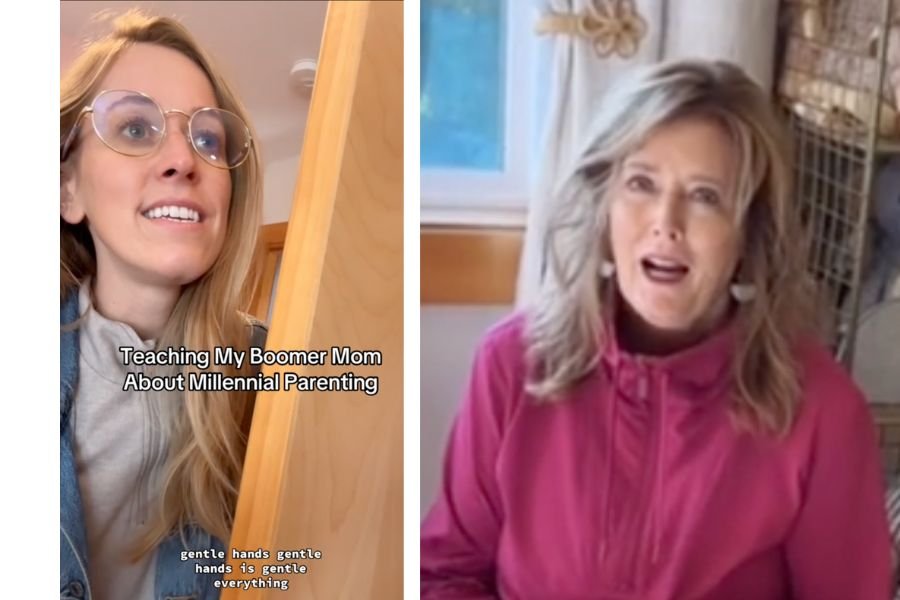
A fun, tongue-in-cheek and instantly viral video created by 37-year-old mom of two Taylor Wolfe can help with that.

The clip, which racked up 5.8 million views in less than 24 hours, shows Taylor trying to teach her boomer mother Sandy Wolfe all the ins-and-outs of gentle parenting so that she may use these more compassionate tactics on her grandkids.

Let’s just say, many found her failed attempt completely relatable, not to mention hilarious.

Sandy’s well intentioned “Be careful!” to her granddaughter gets met with Taylor saying, “We don’t say ‘Be careful!’ anymore. Instead say, ‘What’s your plan here?’”

“I don’t even know my plan! Do you know your plan?!” Sandy retorts.

Cut to: Sandy says “Stop. Don’t hit your sister.” Suddenly Taylor pops up from behind a corner to instruct: “Don’t say, ‘Stop,’ say, ‘Gentle.’”

“‘Gentle’…what?” asks a confused Sandy.

“‘Gentle hands,’” quips Taylor, adding. “‘Gentle’ everything.”


@thedailytay

GENTLE HANDS. 🙃🫶🏻🤭❤️ #fyp #millennialsoftiktok #momsoftiktok #gentleparenting #parentsoftiktok #foryoupag #comedyvideo

Sandy can’t even catch a break when she says “I’m so proud of you.” because, as Taylor explains, “you’re not supposed to tell kids you’re proud of them anymore. That’s putting the focus on you.”

Then a classic comedy of errors ensues as Taylor advises Sandy to say “you should be so proud” and Sandy replies “I AM so proud!”

Viewers could help but laugh at their own perhaps overzealous attempts to bring gentle parenting into their life.

“I tried to gentle parent this morning but it turned into ‘OMG GET YOUR FORKING SHOES ON,”” one person wrote, while another added, “I always started with the Mary Poppins approach but sometimes you need to elevate to Judge Judy.”

Others felt like this perfectly depicted how gentle parenting sometimes misses the mark.

“I’m feeling anxious after observing gentle parenting,” one person wrote.

Another simply said, “I stand with grandma.”

This isn’t the first time Taylor and Sandy have given us a good chuckle comparing their different parenting styles. Here’s another funny video from August of 2023 where Taylor is flabbergasted to hear how her mother managed without Google:

Listen, gentle parenting is great for providing parents more mindful, less reactive responses to their kids, which can do wonders for everybody. But there’s also something to be said for not getting so wound up in the minutia of every parent-child interaction, thinking anything and everything could be threatening to a child’s development. As with anything, balance—and a sense of humor—is always key.

Follow along on more of Taylor’s fun and relatable content on TikTok.

This article originally appeared last year.

Gen Z; Millennials; technology; cell phones; social media; teens and technology; teens social media

Gen Z is the first generation less cognitively capable than their parents. Denmark has the solution.

Nearly every parent hopes their child will be better off than they are: smarter, more secure, and more well-adjusted. Many parents see this as a stamp of successful parenting, but something has changed for children growing up today. While younger generations are known for their empathy, their cognitive capabilities seem to be lagging behind those of previous generations for the first time in history.

Dr. Jared Cooney Horvath, a teacher turned cognitive neuroscientist who focuses on human learning, appeared before Congress to discuss concerns about cognitive development in children. In his address to the members of Congress, he says, "A sad fact that our generation has to face is this: our kids are less cognitively capable than we were at their age. Since we've been standardizing and measuring cognitive development since the late 1800s, every generation has outperformed their parents, and that's exactly what we want. We want sharper kids."


kids, intelligence, sharp kids, generations, education, cognitive abilities Student smiling in a classroom, working on a laptop.Photo credit: Canva

Horvath explains that the reason this happens is that each generation has gone to school longer than the previous generation. Gen Z is no exception to the longer duration of time spent in school, but they're the first ones who aren't meeting this normal increase in cognitive development. According to the cognitive neuroscientist, the decline is due to the introduction of screens in the classroom, which started around 2010.

"Across 80 countries, as Jean was just saying, if you look at the data, once countries adopt digital technology widely in schools, performance goes down significantly. To the point where kids who use computers about five hours per day in school for learning purposes will score over two-thirds of a standard deviation less than kids who rarely or never touch tech at school," Horvath reveals.

In most cases, the decline in performance doesn't result in better strategies. The neuroscientist shares that the standardized testing has been adjusted to accommodate lower expectations and shorter attention spans. This is an approach that educators, scientists, and researchers went to Capitol Hill to express wasn't working. But not every country is taking the approach of lowering standards to meet lowered cognitive ability. Denmark went in the opposite direction when it realized their students were slipping behind.

France24 recently interviewed educators in Denmark following their seemingly novel approach to students struggling with cognitive development. Since the beginning of the 2025/2026 school year, Denmark has not only been having students turn in their cellphones, but they've also taken tablets, laptops, and computers out of the classroom. No more digital learning for the majority of the school day. Danes went old school by bringing back physical textbooks, workbooks, and writing assignments. The results have been undeniable. Even the students can't seem to deny the success of the countrywide shift in educational approach.

"I think the biggest issue has been that, because we kind of got rid of the books and started using screens instead, that we've noticed that a lot of the kids have trouble concentrating, so it's pretty easy to swipe with three fingers over to a different screen and have a video game going, for example, in class," Copenhagen English teacher, Islam Dijab tells France24.

Now, instead of computers being part of every lesson, Denmark uses computers very sparingly and with strict supervision. One student says that it has been nice not having screen time at school because she loves to read and write. But it wasn't just the lack of attention span children were developing, they were also developing low self-esteem and poor mental health due to the amount of time spent on devices.

kids, intelligence, sharp kids, generations, education, cognitive abilities Students focused and ready to learn in the classroom.Photo credit: Canva

The data showing the negative impact of screens on teens' brains has prompted a nationwide change in Denmark that extends outside of the classroom. Afterschool activities are eliminating or extremely limiting electronic use. There is also a national No Phone Day that encourages everyone to put away their devices for the day, and Imran Rashid, a physician and digital health expert, is petitioning parliament to ban social media use for children under the age of 15. The no phone movement in Denmark is a nationwide effort that hopes to right the ship before another generation feels the effects.

Identity

Woman who lost her 'pretty privilege' reveals how it changed her perspective on life

" I instantly felt sad and horrified, because of the cosmic unfairness of life."

smiling, woman, pretty, privilege, looks, attraction, beauty

A smiling blonde woman.

There is something extremely unfair about people born with great genetics who are extremely attractive. Sure, folks can improve their looks after putting in some work at the gym or learning how to present themselves. But many people we consider conventionally good-looking hit the jackpot by simply being born that way.

With little effort, these people have an incredible social advantage in life. They are seen as morally virtuous, receive random favors, are always the center of attention, and are more likely to get raises and promotions at work. The funny thing is that many people with pretty privilege don’t realize the incredible advantage they have until it's gone.


People with pretty privilege get the social advantage that comes with a lot of people wanting to date them. They also have the advantage of the "halo effect," where people take one trait, their attractiveness, and use that to make blanket positive assumptions about their intelligence, kindness, and integrity without much evidence.

What happens when people lose their pretty privilege?

In a since-deleted post, a woman on Reddit shared how she realized the power that comes with pretty privilege when she gained a lot of weight, and the world immediately began treating her differently.

“Whether we want to admit it or not, pretty privilege is a thing. And it’s something that I now realize I had for the majority of my life,” the woman wrote in a viral post. “People were usually very nice to me. I got offered perks like drinks at bars and extra attention when I went out. And I was stared at a lot.”

smiling, woman, pretty, privilege, looks, attraction, beauty An attractive woman at a bar.via Canva/Photos

Things changed for the woman after she had a health condition that required her to take a medication that slowed her metabolism, which resulted in rapid weight gain.

“The fatter I got, the less attention was paid to me," the woman continued. "I didn’t notice it at first, but I began to have to ask for customer service at places instead of being offered, and I started to feel invisible, because no one looked at me. No one. People would walk right by and not even acknowledge my existence. It was strange at first, then incredibly humbling. I thought, well, this is the new normal.”

The power of thin privilege

It’s important to note that being a certain weight doesn’t automatically make you good-looking. People can look good at any weight. However, it would be naive to believe that thin people don’t have an advantage in this world.

thin, fitness, measuting tape, waist, thin woman, A woman measring her waist.via Canva/Photos

The drastic fluctuation in the woman’s weight made her conscious of what other people who don’t have the privilege of being pretty or thin go through in life. It allowed her to have greater compassion for people, regardless of how they look.

“My personality started to change a little," she wrote. "I began being thankful for any small interaction someone had with me, and responded to any small act of kindness with gratefulness. I noticed other not conventionally pretty people, and other overweight people, and made an effort to talk to them and treat them like they mattered. I became a better person. Not that I wasn’t a good person before, but I was now more aware and empathetic to those around me.”

The woman soon went off the medication and, just like that, she lost weight, and people began to treat her as they had before.

Realizing the inequity of pretty privilege

“The first time I noticed it was when I was in a store looking for something, and a handsome male worker came up to me and asked if I needed help. He looked me in the eyes. I felt like I mattered again,” she continued. “Then I instantly felt sad and horrified, because of the cosmic unfairness of life, that how we look really does determine how people treat us, even though it shouldn’t.”

smailing man, ahppy man, good-looking man, man in sweater, man holding chin A good-looking man holding his chin.via Canva/Photos


After the woman lost her privilege, she better understood what other people go through. On one hand, she probably enjoys the privilege, but on the other, she feels that the world is much less fair than she once imagined. At least, in the end, it’s taught her to be more empathetic to everyone she meets.

“And also, when someone looks at me and smiles, no matter who they are, I give them a huge smile back,” she finished her post.

This article originally appeared last year. It has been updated.

Science

Helicopters dump 6,000 logs into rivers in the Pacific Northwest, fixing a decades-old mistake

Forty years ago, restoration workers thought logs were the problem. They were wrong.

river restoration, washington, river fish, restoration, Yakama Nation, indigenous land, indigenoues tribes, salmon, trout, pacific northwest

Restoration workers now see how "critical" wood is to the natural habitat.

For decades, river restoration in the Northwestern United States followed a simple rule: if you saw logs in the water, take them out. Clean streams were seen as healthy streams, fast-moving water was seen as optimal, and wood was treated like a "barrier" to natural processes, particularly those of the local fish.

Now, helicopters are flying thousands of tree trunks back into rivers to undo that thinking.


In central Washington, one of the largest river restoration efforts ever attempted in the region is underway. More than 6,000 logs are being placed along roughly 38 kilometers, or 24 miles, of rivers and streams across the Yakama Reservation and surrounding ceded lands.

Nearly 40 years ago, Scott Nicolai was doing the opposite kind of work, all in the name of restoration.

"(Back then) the fish heads — what I call the fisheries folks — we stood on the banks, and we looked at the stream," Nicolai, a Yakama Nation habitat biologist, told Oregon Public Broadcasting. "If we saw a big log jam, we thought, 'Oh, that's a barrier to fish. We want the stream to flow.'"

river restoration, washington, river fish, restoration, Yakama Nation, indigenous land, indigenoues tribes, salmon, trout, pacific northwest Fish find shelter for spawning in the nooks and crannies of wood. Photo credit: Canva

At the time, logs were removed in an effort to simplify the habitat. However, it soon became clear that wood provided vital "complexity," creating sheltered pockets for salmon and bull trout to spawn and supporting algae that feed aquatic insects. Logs also slow water, spread it across floodplains, and allow it to soak into the groundwater. That water is then slowly released back into streams, helping keep them flowing and cooler during hot, dry periods.

The consequences of removing this "critical part of the system" (in addition to overgrazing, railroad construction, and splash dam logging) were made all too clear over the years as the rivers dried up and wildlife populations declined.

"We're trying to learn from our mistakes and find a better way to manage," said Phil Rigdon, director of the Yakama Nation Department of Natural Resources.

That's why Nicolai is now helping lead a project for the Yakama Nation aimed at rebuilding river complexity by returning logs to their rightful place. Many of these streams are now unreachable by road, which is why helicopters are used. Logs are flown from staging areas and carefully placed at precise drop locations marked with pink and blue flagging tape.

river restoration, washington, river fish, restoration, Yakama Nation, indigenous land, indigenoues tribes, salmon, trout, pacific northwest Many of these streams are now unreachable by road, which is why helicopters are used.Photo credit: Canva

The wood comes from forest-thinning projects led by The Nature Conservancy and includes species such as Douglas fir, grand fir, and cedar. Although some of the timber could have been sold, it is instead being used as river infrastructure.

For tribal leaders, the work carries even deeper meaning. During the helicopter flights, they gathered along the Little Naches River for a ceremony and prayer.

river restoration, washington, river fish, restoration, Yakama Nation, indigenous land, indigenoues tribes, salmon, trout, pacific northwest Tribal leaders gathered by the Little Naches River for a ceremony and prayer.Photo credit: Canva

"It was very simple: to bring what was rightfully part of this land back to us," said former tribal chairman Jerry Meninick.

The aftermath of the original restoration project illustrates how human concepts, such as the belief in the superiority of "cleanliness," can be limited and sometimes cause more harm than good. The miracle of nature, however, is that when left to her own devices, she can heal herself.

upset woman, rude comment, coworkers, conflict, insult

A woman is insulted at her job.

It came out of nowhere. A coworker made a rude comment that caught you off guard. The hair on the back of your neck stands up, and you want to put them in their place, but you have to stay tactful because you're in a professional setting. Plus, you don't want to stoop to their level.

In situations like these, it helps to have a comeback ready so you can stand up for yourself while making making sure they don't disrespect you again.


Vince Xu, who goes by Lawyer Vince on TikTok, is a personal injury attorney based in Torrance, California, where he shares the communication tips he's learned with his followers. Xu says there are three questions you can ask someone who is being rude that will put them in their place and give you the high ground:

@howtoconvince

3 comebacks to gracefully shutdown disrespect #comeback #clapback #emotionalintelligence #communicationskills

Question 1: "Sorry, can you say that again?"

"This will either make them have to awkwardly say the disrespectful remark one more time, or it'll actually help them clarify what they said and retract their statement," Xu shares.

Question 2: "Did you mean that to be hurtful?"

The next step is to determine if they will repeat the disrespectful comment. "This calls out their disrespect and allows you to learn whether they're trying to be disrespectful or if there's a misunderstanding," Xu continues.

Question 3: "Are you okay?"

"What this does, is actually put you on higher ground, and it's showing empathy for the other person," Xu adds. "It's showing that you care about them genuinely, and this is gonna diffuse any type of disrespect or negative energy coming from them."

confused woman, what, woman upset, insulted women, stunned woman A woman throws her hands up in despair.via Canva/Photos

The interesting thing about Xu's three-step strategy is that by gracefully handling the situation, it puts you in a better position than before the insult. The rude coworker is likely to feel diminished after owning up to what they said, and you get to show them confidence and strength, as well as empathy. This will go a lot further than insulting them back and making the situation even worse.

Xu's technique is similar to that of Amy Gallo, a Harvard University communications expert. She says that you should call out what they just said, but make sure it comes out of their mouth. "You might even ask the person to simply repeat what they said, which may prompt them to think through what they meant and how their words might sound to others," she writes in the Harvard Business Review.

no, insulted, stop, wagging finger, angry woman, no way stop A woman wagging her finger.via Canva/Photos

More of Gallo's suggested comebacks:

“Did I hear you correctly? I think you said…”

“What was your intention when you said…?”

“What specifically did you mean by that? I'm not sure I understood.”

“Could you say more about what you mean by that?”

Ultimately, Xu and Gallo's advice is invaluable because it allows you to overcome a negative comment without stooping to the other person's level. Instead, it elevates you above them without having to resort to name-calling or admitting they got on your nerves. That's the mark of someone confident and composed, even when others are trying to take them down.

likable, likable person, likable people, conversation, conversation tips

Likable people say these things during conversations to build better relationships.

Making friends and developing deeper, stronger relationships starts with good conversation. Sometimes that means small talk at work, while other times it's the kind of conversation that really takes off at a party.

Some people are naturals when it comes to easy, flowing conversation—especially highly likable people, who tend to attract others and often hold the key to mastering genuine conversation. From their gestures to the way they articulate questions, there's a lot others can learn from them.


Communication experts who spoke to Upworthy say there are 10 things highly likable people do during conversations to build stronger relationships.

- YouTube www.youtube.com

1. They listen without distraction

Listeners often make the best conversationalists.

"That means not looking at your phone or scanning around the room to see who you want to talk to next," says Kerri Garbis, CEO and founder of Ovation Communication. "Focus on the person in front of you only. Make eye contact. This fosters a relationship because when you are fully present, it signals respect, interest, and helps others feel valued versus like they are competing for your attention."

2. They collect data

Being inquisitive about what people need during conversations is key to building stronger relationships.

"If you take a moment to ask your colleague or even friend, 'What are you worried about? What's the biggest concern facing you right now?' you can get great data on how you can help them - in a way that taps into something urgent and top of mind for them," says Kate Mason, PhD, an executive communications coach and author of Powerfully Likeable: A Woman's Guide to Effective Communication. "They'll remember your thoughtfulness and the actions you took."

3. They balance the conversation

Highly likable people never make it all about themselves.

"Sometimes conversations can be 'lopsided' where it's more about the other person than about you," says Rob Volpe, a communication expert and author of Tell Me More About That: Solving the Empathy Crisis One Conversation at a Time. "While that can be okay, you aren't there to be their therapist. Sometimes the context and topic may make it off balance, but if it continues and you aren't feeling seen yourself, feel free to say something like 'I'd love to share my thoughts on this' or 'May I share something I'm dealing with at the moment?'"

4. They mirror their conversation partner

Taking cues from body language can foster deeper relationships.

"It's a subtle way to make someone comfortable because they recognize themself in your actions," says Jennifer Anderson, a communication expert who works with entrepreneurs. "Your energy should match the energy of your counterpart. Think relaxing-in-lounge-chair energy vs. about-to-deliver-a-presentation energy. Those are two very different conversations. If you paired them up, there's definitely about to be some awkwardness."

- YouTube www.youtube.com

5. They skip pre-planned questions

While coming to conversations prepared with questions may help you feel less anxious, highly likable people usually don't use them.

"Often people have questions in their back pocket, like about the weather or sports, but the most likeable people in the room are those who can be present in conversations and ask follow-ups based on what someone is talking about," Garbis says. "This builds a relationship by making conversations feel relational and not transactional."

6. They are self-aware

Highly likable people are masters of self-awareness, especially during conversations.

"Self-awareness of your judgment is key to building relationships," Volpe says. "We all carry biases which can block our view of the person standing in front of us. When you catch yourself being judgmental, have some grace with yourself and get curious about the other person as well as where your judgment is coming from. This clears one of the biggest obstacles to having empathy with others."

7. They respond with affirmation

Highly likable people make others feel seen and heard.

"No matter what is coming out of the person's mouth, make it clear that you're not judging or competing with them," Garbis notes. "If they say: 'I went skiing this weekend,' don't jump in and say that you also went skiing. Say something like, 'Wow, that sounds exciting, tell me more about that.' You can respond with validating statements like: 'That makes sense, or I can see why you're so good at that, or I can see why that matters to you.' This reduces defensiveness and nervousness, and it makes people feel safe to be themselves and creates relationships faster."

@justaskjefferson

it’s been great catching up! #communicationtips #communicationskills

8. They remain calm

Bringing a sense of calm rather than chaos to a conversation can put everyone at ease.

"Calm is the most powerful communication flex you can do," Mason says. "If you can stay calm, especially in a heated conversation, you actually end up looking trustworthy, reliable and unruffled - all very powerful things to be remembered for."

9. They remember names

Highly likable people personalize conversations by using the other person's name.

"Never ever tell people you are terrible at remembering names," Garbis explains. "This will tank the conversation because it signals you don't matter, nothing you say matters, and that you aren't worth remembering. It makes a person mentally check out of the conversation. Use good tricks like repeating a person's name at the beginning and again at the end. If you forgot by the end, say something like, 'It was so fun to hear about your skiing adventure. By the way, I'm Kerri, it was so nice to meet you, and can you remind me of your name? I don't want to forget it?' They'll be so grateful you repeated your name too!"

10. They use humor where they can

Finally, highly likable people make sure to infuse conversations with laughter.

"It's a great connector," Anderson notes. "Don't try to be a standup comic, just find the lighthearted observations and details that you can share in conversations. Humor is never a weapon; judgy and mean-spirited comments convey weakness, not confidence. You'll risk alienating your conversation partner if you come in with a full roast of your friends or coworkers. If all else fails, everyone loves a Dad Joke."