+
Democracy

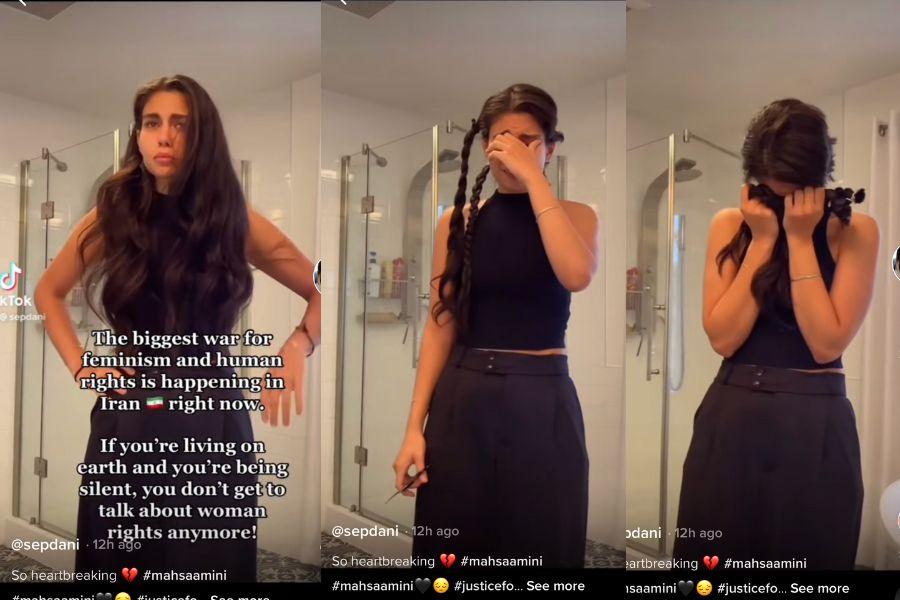
Iranian women cut their hair in a heartbreakingly moving protest of the death of Mahsa Amini

This dangerous act of defiance is gaining momentum and could help make an impact.

Mahsa Amini; Iran; Iran protests; Muslim women
Screenshots from @sepdani TikTok

Iranian women cut their hair in protest.

Sometimes a movement brings you to tears; tears that are mixed with pride, solidarity and sorrow, and that's exactly what this movement is doing across social media. A 22-year-old Kurdish woman, Mahsa Amini, was arrested recently by the morality police in Iran for not fully covering her hair with her hijab. While in police custody, where she was supposed to be reprimanded and educated about the proper way to wear a hijab, Amini was severely beaten before falling into a coma and passing away. The untimely death of Amini ignited a movement that is taking over Iran.


After the 22-year-old's funeral, protests broke out in the streets where women pulled off their hijabs and burned them. Since the news of her death spread, Iranian women have been removing their hijabs and cutting their hair in a moving display of protest and solidarity. Many of the women who have uploaded videos of themselves cutting off their hair to TikTok have been in tears. Women revealing their hair in public and online is extremely risky. In 1983, the religious revolutionary leader Ayatollah Ruhollah Khomeini began enforcing a modesty law that required women to cover their hair or face 74 lashes.

Since 1995, women caught without their hair covered in public can also face up to 60 days in jail as well as fines. Seeing women in Iran defiantly cut, burn or rip their hijab in public is truly awe-inspiring because the risks are so great. But the women are not alone in their fight to abolish the morality police and hold them accountable for the death of Amini. Men in Iran are not only showing solidarity by shaving their heads, they're showing up in the streets, seemingly acting as protectors and accomplices.

@sepdani So heartbreaking 💔 #mahsaamini#mahsaamini🖤😔#justiceformahsa#humanrights#iraniantiktok#iraniangirl#farsitiktok#نه_به_حجاب_اجباري#مهسا_امینی♬ Ali Zandevakili - ﮼نالی

In one video, a girl with beautiful long dark hair sections her hair off before taking small scissors and cutting it close to her scalp. She begins to break down with the first cut, but she finishes before crying into her hands. Music plays in the background and words are displayed over the video explaining why the unknown woman is cutting her hair.

This isn't the first time Iranian's have protested the hijab. When the idea of a national modesty dress code was introduced in 1979, people protested, which temporarily caused the country's leader to walk back on publicly pushing it before it became law a few years later. According to U.S. News, there has been a steady push back against the hijab rule since 2014 after the creation of an online campaign called My Stealthy Freedom. The campaign collected pictures of Iranian women without their hair covered.

@mhd__ahmadi

They Killed her,But Mashsa Amini is alive in our mind🖤 #mahsaamini #viral #protest #hijab #freedom #مهسا_امینی #گشت_ارشاد #مهساامینی #ایران @selenagomez @taylorswift @dailymail @amandacerny @samsmith @brodywellmaker

The protests going on today are large in number and happening despite the country shutting down internet and social media channels in an effort to control the narrative and reduce coverage of the protests. But videos continue to pop up online showing things burning and people filling the streets chanting. One video that has more than 900,000 views and more than 200,000 likes shows a crowd gathered while women burn their hijabs.

Videos are appearing on TikTok claiming to show the continued unrest in the streets. The hashtag #MahsaAmini on TikTok is filled with videos of people cutting their hair, crowds gathered in the streets and stories of the 22-year-old whose death may have spurred a revolution.

Events are still unfolding in Iran and with internet access being cut, the information about continued protests may become more difficult to come by. But the videos that are making their way to social media are as inspiring as they are heartbreaking. Hopefully protests on this scale will bring about real change for the women in Iran.


All photos courtesy of Biofinity Energys®

True

The human eye reveals so much about who we are. One look can convey love, annoyance, exhaustion, or wisdom.

Our eyes tell the world if we are getting enough sleep, if we’ve been crying, or whether we are truly happy (or just faking it). When looking at the face, the eyes dominate emotional communication—after all, they’ve long been known as the “window to the soul.”

Keep ReadingShow less

Author, educator and mother Esther Wojcicki.

Esther Wojcicki has earned the right to tell people how to raise their kids. She’s an educator, journalist and bestselling author of "How to Raise Successful People" who has raised three daughters—two are CEOs and the other a doctor.

Susan Wojcicki is the CEO of YouTube, Anne Wojcicki is the co-founder and CEO of 23andMe and Dr. Janet Wojcicki is an anthropologist and epidemiologist who works on HIV progression and obesity risk in children.

In "How to Raise Successful People" Esther Wojcicki says the secret to success is the result of “TRICK”: trust, respect, independence, collaboration and kindness. In a new article she wrote for NBC Chicago, she boiled that down to one rule, “Don't do anything for your kids that they can do for themselves.”

Keep ReadingShow less
Sponsored

This is the most important van in NYC… and it’s full of socks.

How can socks make such a huge difference? You'd be surprised.

all photos provided by Coalition for The Homeless

Every night, the van delivers nourishment in all kinds of ways to those who need it most

True

Homelessness in New York City has reached its highest levels since the Great Depression of the 1930s. Over 50,000 people sleep each night in a shelter, while thousands of others rely on city streets, the subway system and other public locations as spaces to rest.

That’s why this meal (and sock) delivery van is an effective resource for providing aid to those experiencing homelessness in New York City.

Every night of the year, from 7pm to 9:30, the Coalition for the Homeless drives a small fleet of vans to over 25 stops throughout upper and lower Manhattan and in the Bronx. At each stop, adults and families in need can receive a warm meal, a welcoming smile from volunteers, and a fresh, comfy new pair of Bombas socks. Socks may be even more important than you think.

Bombas was founded in 2013 after the discovery that socks were the #1 most requested clothing item at homeless shelters.

Access to fresh, clean socks is often limited for individuals experiencing homelessness—whether someone is living on the street and walking for much of the day, or is unstably housed without reliable access to laundry or storage. And for individuals experiencing or at risk of homelessness —expenses might need to be prioritized for more critical needs like food, medication, school supplies, or gas. Used socks can’t be donated to shelters for hygienic reasons, making this important item even more difficult to supply to those who need it the most.

Bombas offers its consumers durable, long-lasting and comfortable socks, and for every pair of Bombas socks purchased, an additional pair of specially-designed socks is donated to organizations supporting those in need, like Coalition for the Homeless. What started out as a simple collaboration with a few organizations and nonprofits to help individuals without housing security has quickly become a bona fide giving movement. Bombas now has approximately 3,500 Giving Partners nationwide.

Though every individual’s experience is unique, there can frequently be an inherent lack of trust of institutions that want to help—making a solution even more challenging to achieve. “I’ve had people reach out when I’m handing them a pair of socks and their hands are shaking and they’re looking around, and they’re wondering ‘why is this person being nice to me?’” Robbi Montoya—director at Dorothy Day House, another Giving Partner—told Bombas.

Donations like socks are a small way to create connection. And they can quickly become something much bigger. Right now over 1,000 people receive clothing and warm food every night, rain or shine, from a Coalition for the Homeless van. That bit of consistent kindness during a time of struggle can help offer the feeling of true support. This type of encouragement is often crucial for organizations to help those take the next difficult steps towards stability.

This philosophy helped Bombas and its abundance of Giving Partners extend their reach beyond New York City. Over 75 million clothing items have been donated to those who need it the most across all 50 states. Over the years Bombas has accumulated all kinds of valuable statistics, information, and highlights from Giving Partners similar to the Coalition for the Homeless vans and Dorothy Day House, which can be found in the Bombas Impact Report.

In the Impact Report, you’ll also find out how to get involved—whether it’s purchasing a pair of Bombas socks to get another item donated, joining a volunteer group, or shifting the conversation around homelessness to prioritize compassion and humanity.

To find out more, visit BeeBetter.com.

Pop Culture

AI technology helps render portraits from the Victorian era that are 'moving' in every way

The artists at Mystery Scoop breathe new life into old photographs using color restoration and facial movement.

Mystery Scoop creates all kinds of moving portraits based on historical figures.

For better or worse, AI technology has opened up a whole new genre of art. Artists who use it have been able to create some truly remarkable works—whether that’s bringing back beloved icons or bringing cartoon characters to life in a hyper-realistic way.

The creators behind Mystery Scoop have also blended some digital art wizardry and AI programs to render portraits from the late Victorian era that not only have stunning color, but lifelike movements. And the results are mesmerizing.

A video posted to their YouTube channel titled “19th Century Portraits Brought To Life” shows Victorian men and women as they undergo a full restoration, thanks to colorists Klimbim and Lorenzo Folli. But the magic doesn’t stop there. The “labor of love” also incorporates the “latest tools in AI technology" to bring facial movements to the photo. These static, black-and-white portraits quickly become breathing, blinking, smirking seemingly living beings.
Keep ReadingShow less

This article originally appeared on 12.07.17


George Yionoulis is pretty much your typical 9-year-old.

The fourth-grader from Raleigh, North Carolina, loves "Harry Potter," making art, and eating tacos.

Oh, and he loooooooves dancing. The kid has some serious moves.

Keep ReadingShow less