Interracial and intercultural couples share the biggest things they had to get used to

Love unites people across cultures, creating some unexpected but valuable learning experiences.

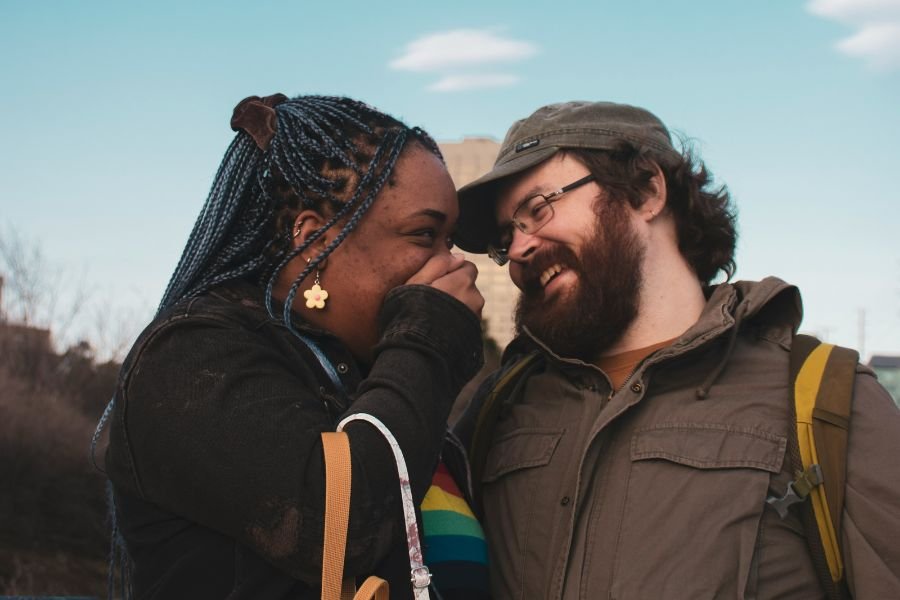
interracial couple smiling and laughing together
Photo credit: Photo by Jennifer Lim-Tamkican on UnsplashInterracial relationships can have unexpected learning opportunities.

Humanity in general has come a long way when it comes to interracial relationships. It used to be that interracial marriage was deemed wrong and even illegal in some U.S. states, but with the world continually shrinking due to transportation and technology advances, we increasingly see more interracial and intercultural relationships more often.

But the broad social embrace of cross-cultural love doesn’t mean it’s challenge-free. Norms, expectations and traditions can vary widely between people from different backgrounds, and sometimes those differences can create some surprising—and sometimes hilarious—misunderstandings. Interracial and intercultural relationships come with some specific challenges, but navigating those challenges successfully can help build unity and understanding between individuals, families and ultimately society.

A Reddit user asked, “Interracial couples of Reddit, what was the biggest difference you had to get used to?” and people shared stories that celebrate the unexpected elements of their partners’ racial and cultural realities that they learned to adjust to.


The dishwasher that isn’t used to wash dishes

“The dishwasher being used as a drying rack and not to actually wash dishes.”Lucky_Extent8765

“Dude wtf Latina girlfriend just dropped this bomb on me.

‘We don’t trust machines like that’

‘Ok but you just put our clothes in the washing machine and started it though…’”Worldly_Collection27

“Had a Latina friend who I was ‘talking to’ but never actually ended up dating, had her, her friend, and a couple of others over for dinner and her and her friend offered to help with the dishes, they ended up hand washing everything and drying it in the dishwasher. I told them the dishwasher works fine and they were like ‘we don’t do that in South American families.’ “– Particular_Fan_3645

The intricacies of hair care

“I’m a white dude married to a black woman. I had no idea about the whole culture of hair upkeep for black women. How much it costs. How much time it takes. How much it’s a connection point for her and other women.

Interestingly, what was a bigger adjustment had nothing to do with race. I’m an only child and she is one of five so obviously the family dynamics are quite different.

Next month we will be married for 24 years so I guess it’s all good.”loudnate0701

“When I met my wife she had short straight hair and had been relaxing/straightening it pretty much her whole life. 6 years ago she decided she wanted to go natural and started to grow it out. She started getting it braided professionally and whenever she’d get new braids I’d basically have an entire weekend day to myself, it would take 8-10 hours. But eventually she wanted to do natural locs and wanted to do them herself. It was a challenge for a while but now her natural hair is down to her shoulders & locked. She washes her hair every 2-3 weeks and when she decides to do that it’s literally a 6 hour process between washing, re-twisting & drying.

But yeah, the time spent when she was getting it braided and the money spent on different products/bonnets was wild to me lol.”Zealousideal-Life868

“My story is how this could’ve gone awry:

We went on our first date and hit it way off. She had kind of a shorter bob thing going, relaxed/straightened. Super cute. Anyway, I ask her for a second date and she tells me she has a hair appointment that day. I go okay well, so how about after…if it’s at noon, surely we can have dinner?

Long story short, I was butthurt thinking she was blowing me off with a cheap excuse because I was entirely unaware of getting her hair done means PTO at work. She, on the other hand, naturally never considered I wouldn’t really know about that and was baffled and annoyed when I wrote her a slightly sulky “well it’s fine I just thought we…bla bla” message.

We somehow ended up landing on mutual ground and after about a two hour conversation explaining the colossal undertaking that is getting braids laterI felt like a straight jackass ?.

We’re still together and happy and I’ve named her head scarf Toni.”NosferatuCalled

The social expectations at family gatherings

An ex was Latina, and while there really weren’t any “social” things that were new getting used to her family dynamic took some adjusting because they were very close and involved in each other’s lives so it was normal for the weekends inevitable BBQ to be something I was expected to be present for if she was going, because otherwise 16+ people would grill her about me not coming.” blahbabooey

“Yes! My husband is Dominican and I’m white and his family NEEDS me at every function, no matter what. Or when his mom calls, I can always hear her asking if I’m close by. And my husband is kinda like that too, he doesn’t wanna do anything without me and I’m more okay with being solo and staying home once in awhile.”Both_Dust_8383

“Have ever tried refusing food? Or that one shot of tequila being passed around? How about that “one more dance”? Have you ever forgotten to say good bye to everyone individually at least twice before leaving? Cause it sounds like you’re me lol. Married 20 years to my wife though. It never changes.”JnyBlkLabel

“I didn’t eat at my husband’s grandma’s house once (in the Dominican Republic) cuz there was no ac, it was summer, and I had just broken a rib 5 days before our trip. I was in bad pain and sooooooo hot, I could not eat!!! But did it break abuelas heart??? Absolutely. It was tough.”Both_Dust_8383

When no means yes and you’re supposed to keep asking

“I was born and raised in the Netherlands (I’m half Italian half Indonesian but did not grow up with those cultures at home except a little). My girlfriend is Persian.

In the Netherlands, or at least in my experience, when people say no to something, then they mean no. While apparently for persians it’s seen as polite to decline at least the first offer, often also the second even if you actually really want.

So for example, If she would offer me a cookie and i’d say no, She would ask another 3 times before letting it go, which was cute but also annoying. Meanwhile when i offer her a cookie and she says no. I just quit asking and then she gets a little mad that i didn’t ask her a couple of times more.

It’s not like the biggest difference or anything but it’s a cute, and in the beginning, a very confusing difference.”LokMatrona

“Haha, we have the same thing in Ireland – if you’re offered food, drink, etc, you’re expected to say no the first couple of times. My mother in law thought her English nieces and nephews were ‘a bit forward’ because if she’s offer them a cup of tea they’d say ‘Yes please, that would be lovely.’” MichaSound

“My wife is Persian and I’m English. The craziest thing she told me is if you’re a guest in your host’s house and you compliment some object in their house, the rules of hospitality require them to offer it to you. So you may say, ‘Wow I love that mirror!’ and they will say ‘Please, have it!’ You will of course refuse, but they will vehemently insist that you take it. This back-and-forth can go on for some time (despite the ironic truth that you absolutely do not want to take it, and they absolutely do not want to give it to you).” th1sishappening

Learning about one another’s popular culture

“My partner is from California, I’m from Singapore. I think the biggest difference is popular culture — everything from your childhood tv shows, the iconic music of your teens, even your education system, is going to be different. You cannot expect your partner to know what Mr. Rogers is/have watched XYZ cartoon. All assumptions have to be thrown out of the window.

I think it’s a good thing tbh, you start from zero. It makes you completely aware of how vast the world around you is, and I keep learning new things everyday. Just yesterday I learned that in California, there’s a mascot called Smokey Bear that taught kids about forest fires. In turn, I told her about Singa the Courtesy Lion, which is a mascot to teach people courtesy/good manners. We had an entire discussion about mascots and teaching populations, and it was so fascinating. This happens so much that sometimes we can’t stop talking to each other lol”kafetheresu

“Bit of that with my wife. She was born in China but moved to Canada from age 9 to 19, then back to China again. So there’s some overlap for that middle period, but that early childhood stuff is very different. Was fun though when she met my brother’s girlfriend from Ukraine and they bonded over having both watched the same old Soviet cartoons as kids.”Cinquedea19

“I’m from Texas and my wife is from Nigeria. We also have this dynamic!! It’s pretty beautiful to learn about a whole other culture/way of life. One challenge is our families are across the world from each other.”PositionLogical2342

  • Older man on tram called a young woman “disgusting” for wearing a dress. A stranger on board had something to say about that.
    Photo credit: CanvaOld man looks disapprovingly at woman in skirt

    Renee Buckingham was on a tram in Melbourne when an older man started calling a young woman “disgusting.”

    The woman was with friends, wearing a dress. The man told her she should be embarrassed for dressing that way in public, in front of older people like him, he said. He kept going.

    She couldn’t stay quiet

    Buckingham, a Melbourne-based content creator, said she felt her heart rate climb as she watched. She doesn’t usually look for confrontation. For a moment she hesitated, worried the man might turn aggressive if she intervened.

    Then she spoke up anyway.

    “I said to him, ‘Don’t you dare speak to women like that,’” she explained in an Instagram post shared on January 19, 2026. She told him that if he felt uncomfortable looking at the woman’s outfit, that was his problem, not hers. She told him a woman’s clothing choices have nothing to do with her worth.

    He didn’t have much to say after that.

    Putting the shame on the shamer

    Buckingham posted about the incident and it spread quickly, drawing thousands of responses from people who recognized the moment, the calculation that happens in real time when you witness something wrong in a public space and have to decide whether the cost of speaking up is worth it.

    For the young woman on the tram, Buckingham had a direct message: “Never change who you are for any man.”

    Her message resonated

    The comments on her post filled with people who’d been in similar situations on both sides of it, the ones who’d been shamed, the ones who’d watched and said nothing and still thought about it, and the ones who’d spoken up and found it went differently than they feared. “Thank you for advocating for that young woman,” wrote one commenter. “We need to keep speaking up.”

    Buckingham’s point, boiled down: the discomfort belongs to the person doing the shaming, not the person being shamed.

  • Indigenous woman cries tears of joy after hairdresser discovers ‘unruly’ grey hairs
    Photo credit: CanvaIndigenous woman cries tears of joy after hairdresser discovers 'unruly' grey hairs

    Grey hair has been a concern for people since before hair dye was invented. Some people pluck them and dye them as soon as they see them growing in, while others embrace the silvery hairs. Chiara Do’wal Sehi (Sunshine) Enriquez, an Indigenous woman from the Karankawa Tribe, recently shared her excitement about learning she had grey hair.

    For a brief period of time, people were actually dyeing their hair grey prematurely. It wasn’t uncommon to meet a 20-something with “granny grey” purplish-silver hair, but the popularity faded nearly as fast as it started. But for Enriquez, grey hair isn’t a fad or something to hide. It’s a right of passage to celebrate.

    indigenous, grey hair, getting older, culture and humanity, going grey
    Indigenous woman with long braids.
    Photo Credit: Canva

    During the colonization of the Texas Gulf Coast where the Karankawa originated, the Indigenous tribe was nearly eliminated. According to the Texas State Historical Association, the Karankawa people fought to maintain their land from 1685 until 1858 from French and Spanish settlers. Due to this multi-century, on-and-off battle for their territory, the tribe’s numbers became so small that they were considered “extinct.”

    Enriquez is a descendant of the small number of Karankawa that survived. To her, living long enough to experience the growth of grey hair is a gift. The woman shares how much her “unruly” greys mean to her in a video uploaded to her Instagram page.

    indigenous, grey hair, getting older, culture and humanity, going grey
    Indigenous woman standing in sunshine.
    Photo credit: Canva

    “I got my hair styled today. I don’t get it cut. It’s a cultural belief that I was taught by my mother. We don’t cut our hair, we let it grow. We save the cut for very, very serious and important moments in our lives,” she says while sitting in her car.

    The woman explains that while she was having her hair styled, she asked the hairdresser about the texture of her hair. This is when she learned of her wiry new strands. She surprised hairdresser with her delighted response. “She said to me that it was because I had many little greys, and the unruly ones that were pushing up my other hair that weren’t grey were causing it to be a little bit frizzy.”

    Enriquez lights up and smiles while recalling the moment in her hairdresser’s chair. She reveals, “And that felt so incredible. What an honor, and I was…I’ve only ever seen my head grow one grey hair, and even when I knew I had one grey hair, I was incredibly thankful. When she saw that I was smiling and so happy, she said, ‘Oh wow, you really must come from a different culture.’”

    indigenous, grey hair, getting older, culture and humanity, going grey
    Elderly indigenous woman.
    Photo credit: Canva

    She later adds while tearing up, “I’m very happy to report that not only do I have for sure one grey hair, I have many. A plethora of grey hair. What an honor. What a fantastic gift to be lucky enough to see myself grow grey hair. That is so incredible. I am so lucky. What a life it has been. What a life it continues to be.”

    Enriquez wipes away tears as she encourages others to embrace their grey hair. Viewers were moved by her joyfully emotional response to finding out she has a head full of grey hairs pushing their way through.

    One person shares, “As a chemo patient I am always surprised when people are upset about their grey hair. I have come to see it as a privilege and dream of the day I might have greys, though my mom’s hair has never changed colors, and neither did her dads. Their hair has always stayed brown for some reason. Since my hair has begun growing again I have decided not to cut it for as long as possible. So I can say, I’ve been cancer free for this long, and show people my hair for reference.”

    Someone else writes, “This had me in tears because i’ve loss so many people and im only 30 and the day i get grey hairs i will celebrate with them!”

    Another person says, “i’m so happy to hear this expression of delight regarding your grey hair~ i am only just now getting greys & my own natural reaction was very different from my mom’s & grammom’s reactions~ i was surprised to find that i like seeing them appear~ hearing your perspective makes me think that it’s because i am not as tethered to the usa culture as they…
    so thank you for sharing your experience & offering food for thought~ & congratulations.”

    “I have been allowing my greys to come in naturally and have stopped dyeing my hair and it’s very liberating and in a society where ageism is everywhere it feels like resistance. And I love that! I have more greys than my mom. :),” someone else shares.

    indigenous, grey hair, getting older, culture and humanity, going grey
    Elderly Indigenous woman with hair covered.
    Photo credit: Canva

    “What a sacred and healthy perspective,” one person says.

    Another reveals, “I love this so much! Thank you for sharing your joy and gratitude with us. I’m getting grey and have been oscillating between feeling happy about it and feeling like I’m not sure i feel “ready” to have grey hair.”

    Enriquez says, “I’ve always been of the personal belief that humans take the longest to change the color of their foliage in observation of their reconnection with Mother Earth and the cyclicity of her seasons and transitions.” She then explains that trees change with the seasons, grass goes through a cyclical change, and even animals turn grey and calm with age. “And it has always been representative that you have lived a full life. Do you know how many people didn’t get to grow grey hair? Didn’t get to see the hair change? What a gift,” she adds.

  • Gay man learning how to say goodbye ‘like a straight man’ is pure comedy gold
    Photo credit: Canva PhotosA gay man's 30-day challenge to learn how to do things "straight" is going super viral.

    It’s no secret that there are certain mannerisms and speech patterns we often associate with being gay. The phenomenon of so-called “gay mannerisms” and voice has actually been the subject of quite a bit of scientific research. One study from 2002 found that people were able to accurately predict the sexual orientation of a speaker just by hearing their voice about 62% of the time. Researchers theorize that some, but certainly not all, gay men may adopt more feminine mannerisms and voice patterns as a form of subconscious social signaling.

    It’s much more complicated than that, though. The way gay men speak and behave is as diverse and varied as the community itself: which is to say, very.

    But one more pressing question remains: If “gay mannerisms” can be categorized and studied, can those of the heterosexual male be quantified? And, more importantly, can they be learned?

    Comedic experiment ensues

    Content creator Kai Cameron was up to the challenge. The openly gay TikTok star recently launched a tongue-in-cheek 30-day challenge where he attempts to learn how to do and say things “like a straight man.”

    On Day 1, Cameron’s brother teaches him how to sit down like a straight man. On Day 4, they move onto answering the phone. Day 7 features more advanced material: entering a party the way a straight man would. Cameron learns to sway his hips less, talk in a deeper tone of voice, and suppress any hint of enthusiasm.

    On Day 11, Cameron was ready to tackle the simple but crucial task of saying “Goodbye,” to a friend. His instructor in the clip, this time actor and filmmaker Peter Falls, demonstrates a textbook, nonchalant “Alright, see ya later,” with a barely perceptible hand-gesture-wave-kind-of-thing. Straight guys will instantly recognize it and notice Falls’ impeccable form.

    The words come easily enough for Cameron, but he gets stuck on the hand movements. “Can you do the finger thing again?” he asks, before trying it with a dramatic wave. “That’s way too much,” Falls says.

    After a little more practice, though, Cameron’s mostly got it. He confidently walks forward, chest puffed out, body stiff, and drops his voice a few octaves before muttering “See ya, man,” with a small (for him) flick of the wrist.

    Close enough!

    Viewers find the videos hilarious but revealing

    Does the video series mine humor at the expense of people who exhibit “gay mannerisms?” On the contrary: thousands of commenters say that it’s rare to see such a brilliant dissection of the straight man.

    Many noticed that so much of the demeanor comes from the eyes:

    “U just have to lose the light in your eyes,” one commenter wrote.

    “I love how the light leaves your eyes everytime and then comes right back,” said another.

    “It’s the dead eyes when channeling straight man,” another echoed.

    Other viewers went even deeper and more philosophical:

    “No whimsy, no enthusiasm, nothing,” someone said.

    “Watching [your] content has taught me a lot about what it looks like from the outside to be a straight guy. Just beat up by life. Body language which clearly indicates no one cares about you, so you stay reserved,” one commenter noted.

    “I think some cultures have done a ton of damage by brainwashing boys and men into hiding vulnerability, sensitivity or even just being themselves. That takes a psychological toll. A lot of men don’t stay reserved because no one cares but because society (other men) teach them that tough men have to keep it all in. It is not healthy for you,” another said.

    A third summed it up: “Basically just act depressed while doing all things and you got it!

    The fascinating origins of voice, body language, and mannerisms

    Cameron’s social media video series is incredible comedy and entertainment, but it’s also a brilliant educational demonstration.

    “Straight voice” isn’t just the absence of the more feminine qualities of “gay voice.” It is, itself, a learned and socially constructed behavior.

    “When men enjoy doing things that are typically associated with women or femininity such as shopping, grooming their nails, giggling, etc., they are often quickly labeled as gay or soft and are negatively evaluated by many members of society,” Ayana Ali, a clinical social worker and therapist, told AskMen.

    Even many gay men feel self-conscious about their voice and mannerisms, and may even mask them to adopt more traditionally masculine qualities in certain situations.

    It’s an incredibly complex web of social conditioning, how we’re raised, biology, sociology, culture, gender norms, and more.

    But it’s never been more hilariously deconstructed than in Cameron’s 30-day challenge.

  • Woman who moved from Ireland to Boston shares why the American dream is ‘all a lie.’
    Photo credit: via Kayleigh Donahue/TikTok and Zeeshan Kundi/PexelsKayleigh Donahue explains the differences between the U.S. and Europe.

    Living abroad is a dream many people have, whether it’s spending a summer in a foreign country or packing up their entire life to make the permanent move. In fact, according to a 2025 Harris Poll, more than half of Americans believe they could have a higher quality of life abroad, and many say they’d move if they had the means. Some estimates show that an estimated 5.5 million Americans live abroad, according to the Association of Americans Resident Overseas.

    But life is funny, and sometimes these expats come back to the United States for a variety of reasons like family or career, which gives them an extremely interesting perspective when they begin their re-entry.

    Take American-born TikTok user Kayleigh Donahue, for example. She’s going viral on the platform because of her unflinching take on why it was a mistake for her to move back to the U.S. after spending 4 years in Ireland.

    Moving to the U.S. was a step backwards

    Kayleigh moved back to the Boston area from Ireland to make more money, but that didn’t go as planned.

    Even though she got paid more, the cost of living was so much higher that she saved less money than she did in Ireland. She also missed the generous number of vacation days she got in Europe as compared to America.

    “I have been bamboozled,” she begins in the now viral clip with over 600 thousand views.

    Many people like Kayleigh move abroad, especially to European countries, for a slower way of life, better work-life balance, more opportunity for travel, or just to see something different. But America is the land of opportunity, right? For some, that promise always beckons, no matter where they go. So even though Kayleigh had an amazing life in Ireland, she wound up moving home to advance her career and make more money.

    The real cost of the American Dream

    “Basically, I really got sucked into the American Dream way of living when I was abroad, which is funny because I loved living abroad,” Kayleigh said. “But you know, making more money, that’s enticing. Good job, that’s enticing. It’s not true. It used to be. It definitely used to be. You could come here and make a ton of money, make a great life for yourself. But the younger generation today, in this country – screwed. It’s literally all a lie that is sold to you. It’s such a struggle, and the older generation doesn’t seem to see how much of a struggle it is for the younger generation here.”

    In the end, who wants to work harder for a lower quality of life?

    “Needless to say, I will most likely be moving back to Europe where 20-plus days of paid vacation a year is literally the law, and I will make less money, but somehow, you know, the cost of living is lower there and I can save more,” Kayleigh concluded the video.

    The comments support Kayleigh

    Viewers applauded Kayleigh for coming to the realization:

    “Yep, I made the same mistake. Then I realized that people and quality of life are more important than income. Enjoy life!” one wrote.

    “Get that. We moved back to US and it was horrible. We moved back to the UK. Happier now was 6 weeks off a year” said another.

    “I think there are actually very few people who derive their enjoyment and self-worth from their job. Quality of life is so much more important,” another user added.

    Kayleigh made good on her promise. As of January 2025, she now lives in Amsterdam with her Dutch husband, and they seem to be loving their life abroad.

    A Mercer survey in 2024 put Amsterdam as the sixth best city in the world for quality of life. It’s a place with rich culture, amazing public transportation, and a reasonable cost of living to earning potential ratio.

     Young Americans really aren’t asking for that much. They just want to be able to afford and enjoy their life, and they’re willing to work hard for it. America should be giving them those opportunities instead of losing more and more talented young people to other countries.

    This article originally appeared two years ago. It has been updated.

  • Man explains the counterintuitive reason Norwegians love fishnet underwear
    Photo credit: CanvaFishnet stockings have multiple purposes.

    When you think of mesh shirts and fishnet stockings, you might picture a goth, punk, or other brands of night club fashion. Most wouldn’t associate fishnet garments with hiking, skiing, or dogsledding.

    But as Michael Kristy from The Iron Snail Clothing Co. explains, fishnets are the underwear of choice for many. In particular, Norwegians who want to enjoy the great outdoors in all temperatures wear them. It may seem counterintuitive to wear something holey to stay warm, but there’s a reason it works better than most base layers.

    Kristy explains that Norwegians have been wearing fishnets under their clothes for over 100 years. And they’re not the only ones. The first people who summited Mt. Everest wore a fishnet layer under their clothing to stay warm.

    Mesh undergarments were popular around the 1950s, but they weren’t called fishnets. They were called “health vests” or “string vests” and they were touted as being “recommended by medical professionals.”

    What’s the big deal with mesh? It’s all about the air layer it creates. Wearing it under clothing serves as both an insulating layer and a moisture wicking layer.

    “It really helps regulate your overall body temperature and makes you feel a lot more comfortable when you don’t have wet, clammy clothes sticking to you at all times,” says Kristy.

    The Norwegian company Brynje manufactures mesh under layers and claims they are four to six times warmer than other base layers.

    So under other clothing, the fishnet fabric keeps you warmer. But conversely, if you get too hot, stripping down to only the mesh layer will quickly cool you down.

    In addition to plenty of punk/goth approvals, the comments included corroboration from Norwegians and others who have first-hand experience with the magic of mesh base layers:

    “Norwegian here, and proud wearer of «netting» as we call it in the military!”

    “Can confirm, most Norwegians (and neighbours) that do outdoors stuff use ullnetting/woolnet. It’s basically a cheatcode for staying warm, so I have a ton of these. The words fishnets or health/stringvests is never used. You can find very old farmers that use the word healthvest/helsetrøye, mostly people just call them ullnetting or netting if talking to outdoors people.”

    “I’m a veteran. I did training with the Norwegian army on a base north of Norway. I had so many layers and was constantly freezing my ass off. I noticed the Norwegian army guys had these fishnets as their first layer. And asked em why they all had that. He told me it was to keep them warm. Luckily i have not been in that kind of cold since. But getting those fishnet layers has been on my mind since.”

    fishnets, leggings, clothing
    Fishnet leggings add a surprising amount of warmth as an underlayer. Photo credit: Canva

    “Our guide on a glacier tour in Norway had these and told me about them, so I decided to give them a go for a recent vacation to go figure skating on wild ice in northern Sweden. I wore these nets under a merino wool baselayer and a thick Norwegian wool sweater (plus an outer synthetic hard shell to keep out the wind) and it was fantastic. Spent all day outdoors at -20°C combining intense workouts with picnic breaks and never got cold thanks to my base layer always being dry. 11/10 would recommend, I haven’t shut up about these since then.”

    “Yeah, it’s absolutely true too. I’m an avid outdoorsmen, so I’ve watched lots of tests on this. Fishnets outperform even the best wool base layers in absolutely every single category except for odor. Unless we’re talking niche applications there’s nothing better than the fishnets.”

    “I’ve been wearing mesh shirts under my normal clothes for about a year now—and without knowing this was exactly what they were used for, I found it helped me keep cool in the summer and warm in the winter. Imagine my surprise when this video teaches me I’ve been continuing a longstanding Norwegian tradition as a necessity for working in a warehouse (and for punk fashion lol).”

    With as many advancements as we’ve made, sometimes the traditional methods still work best.

    You can follow The Iron Snail on YouTube for more fun clothing facts.

  • President Jimmy Carter’s thoughts about the Bible and homosexuality resurfaces
    Photo credit: Commonwealth Club via Wiki CommonsJimmy Carter at the Commonwealth Club

    Jimmy Carter was the 39th president of the United States (1977 to 1981). Looking back on his achievements both in and out of office, it’s easy to say that he was a man ahead of his time. He was far ahead of the mainstream when it came to advocating for social justice, human rights, and the environment.

    Carter famously installed solar panels on the White House in 1979, only to have them removed by Ronald Reagan.

    The former peanut farmer and Navy Lieutenant from Plains, Georgia, was also far ahead of his time when supporting gay rights. In 1976, while running for president, he said he would sign the Equality Act, an amendment to the 1964 Civil Rights Act that would prohibit discrimination based on sexual orientation. “I will certainly sign it, because I don’t think it’s right to single out homosexuals for special abuse or special harassment,” he said.

    He continued to advocate for gay rights as president. In 1977, the first gay delegation visited the White House. He also campaigned against California’s Proposition 6, which would have barred gays and lesbians from teaching in the state’s schools and was the first Democratic president to endorse gay rights in the party’s platform in 1980.

    It may seem unusual for Carter, a confessed born-again Christian, to be a staunch advocate for gay rights. But he has publicly said that he believes that being pro-gay is wholly aligned with the teachings of Jesus Christ. Carter’s advocacy found itself in the spotlight once again after a meme featuring his thoughts about Christ and homosexuality from 2012 went viral on Reddit’s MadeMeSmile forum on April 8, 2024.

    The viral quote was taken from an interview with the Huffington Post in 2012, during which Carter promoted his book, NIV, Lessons from Life Bible: Personal Reflections with Jimmy Carter. At the time, LGBTQ rights were the subject of heated debate in Washington, and President Obama had just “evolved” and began publicly supporting same-sex marriage.

    “A lot of people point to the Bible for reasons why gay people should not be in the church or accepted in any way,” the interviewer Rev. Paul Brandeis Raushenbush said. But Carter responded by correctly noting that Jesus Christ never said anything about homosexuality.

    “Homosexuality was well known in the ancient world, well before Christ was born and Jesus never said a word about homosexuality. In all of his teachings about multiple things—he never said that gay people should be condemned. I personally think it is very fine for gay people to be married in civil ceremonies,” Carter said. “I draw the line, maybe arbitrarily, in requiring by law that churches must marry people. I’m a Baptist, and I believe that each congregation is autonomous and can govern its own affairs.

    “So if a local Baptist church wants to accept gay members on an equal basis, which my church does, by the way, then that is fine. If a church decides not to, then government laws shouldn’t require them to,” he continued.

    Jimmy Carter, LGBTQ rights, gay rights history, Christian faith and homosexuality, US presidents
    Jimmy Carter in the White House.

    Three years later, Carter shared the same sentiments in another interview with the Huffington Post, this time shortly after the U.S. Supreme Court legalized same-sex marriage. “I think Jesus would encourage any love affair if it was honest and sincere and was not damaging to anyone else, and I don’t see that gay marriage damages anyone else,” Carter said.

    Jimmy Carter’s belief in gay rights stems from his faith as a Christian, but it’s also in complete alignment with his values as an American. Carter believed that the United States was a “beacon” for human rights, and in his 1981 presidential farewell address, he reminded the nation that the job was an ongoing struggle.

    “The battle for human rights–at home and abroad–is far from over,” Carter said. “If we are to serve as a beacon for human rights, we must continue to perfect here at home the rights and values which we espouse around the world: A decent education for our children, adequate medical care for all Americans, an end to discrimination against minorities and women, a job for all those able to work, and freedom from injustice and religious intolerance.”

    Jimmy Carter passed away on December 29, 2024, at the age of 100 years old. He was the longest-lived U.S. president. After his passing, President Joe Biden wrote that Carter, “stands as a model of what it means to live a life of meaning and purpose, a life of principle, of faith and humility. His life was dedicated to others.” He will forever be remembered as a man who fought for human rights both at home and abroad.

    This article originally appeared two years ago. It has been updated.

  • Canadian astronaut shares ‘Seven Sacred Laws’ Indigenous elders sent with him to space
    Photo credit: NASAJeremy Hansen, right, is the lone Canadian on the Artemis II mission.
    ,

    Canadian astronaut shares ‘Seven Sacred Laws’ Indigenous elders sent with him to space

    The seven animals on his personal patch each represent specific attributes.

    Like the space flights before it, the Artemis II mission revolves around hard science and data. But what has captivated us most here on Earth is the beauty and humanity it reveals. We’ve enjoyed the astronauts’ joyful camaraderie as they reach farther into space than any humans have gone before. We’ve been touched by the reminder that we are all one people. And we’ve wept at the naming of a moon crater after Commander Reid Wiseman’s late wife.

    And now, we’re hearing from the lone Canadian onboard, sharing how Indigenous elders’ wisdom has helped guide him through this mission.

    In preparation for the Artemis II launch, mission specialist Jeremy Hansen said he sought advice that led him to Indigenous wisdom. Asked what he learned from Indigenous elders, Hansen shared his response from space.

    “I’ve had many Indigenous elders spend time with me in my travels across the country, and I’ve always enjoyed it,” he said. “If I can give you one piece of advice, sit with your elders and ask questions. But listen intently. Every time I’ve stopped to listen, I’ve just learned these amazing things.”

    Hansen pulled out the personal mission patch he carried onboard.

    ‘This encompasses a few of the things I learned from the elders,” he said. “But when I left the vision quest, I had a better understanding of it. These animals in this patch, that was created by Anishinaabe artist Henry Guimond from the Turtle Lodge, these animals represent some things that I try to think about every day. My mantra when I wake up is I am just going to try to spend my day walking with these attributes. And so I start with courage, humility, respect, love, honesty, wisdom, and truth.”

    Hansen said the crew named their Orion spacecraft “Integrity,” which he says encapsulates those attributes.

    “For me, being ‘in integrity’ is walking in accordance with these seven sacred laws, and it’s just something that helps guide me through life,” he said.

    The Canadian Space Agency (CSA) explains the “Seven Sacred Laws” represented by the animals on Hansen’s patch. The following descriptions come from Sabe, Leader of Turtle Lodge, and have been edited for concision by the CSA:

    Buffalo – Respect

    The buffalo represents respect. It gives its entire being to feed the people, for them to live. Elders teach that when you respect others, you give of yourself, you give your life to help people around you to create a better existence for all.

    Eagle – Love

    The eagle represents love. Grandmothers say that one of the most powerful medicines we have is love, that love is a powerful healer. The eagle also symbolizes vision and sight. It is important to see ahead, to have a vision of one’s purpose and to work towards it. Elders teach that one’s true purpose is always rooted in love and in support of others.

    Bear – Courage

    A very physically powerful animal, the bear represents courage. A mother bear is fearless in the protection of her cubs. It is natural for her to display courage and strength, to do what is right in life. It is not always easy to face challenges, follow one’s purpose and do the right thing. Only with the courage and resilience of the bear will you be able to face and overcome the challenges that could prevent you from living out your life’s purpose.

    Sasquatch – Honesty

    Sasquatch or Bigfoot – Sabe or ‘giant’ in the Ojibway language – represents the importance of honesty and being true to one’s word. Say what you mean and be honest with yourself and others. Elders often exemplify this trait; when they say something, their word is a commitment and can be counted upon. Honesty is also speaking true and good words about others and avoiding gossip.

    Beaver – Wisdom

    The beaver represents wisdom. It has an incredible gift to build and create, as well as the wisdom of how to use this gift. The beaver’s creation harnesses life-giving water to create important ecosystems that support and enable life. It can even channel water back into an area following a devastating forest fire, renewing and revitalizing that ecosystem.

    Like the beaver, we all have a special gift to offer others. Use the wisdom of the beaver to acknowledge your gifts and put them to use in the service of others: this is the source of life satisfaction and happiness.

    Wolf – Humility

    The wolf represents humility, acknowledging that there is a higher power and natural laws governing the universe. Showing gratitude for our life and our existence, while acknowledging that we are all equal is a sign of humility. The sun shines on us all equally, and no one is better or less than others.

    Turtle – Truth

    The turtle is truth. The Elders say that in order to know and understand truth, we have to learn to understand the six other teachings: respect, love, courage, honesty, wisdom, humility. The turtle leaves a trail, truth, for us to follow. As we are constantly faced with challenges, we should do our best to follow that trail and live truthfully.

    The patch has some obvious symbols, such as the Big Dipper, the North Star (with five points to represent Hansen’s five family members), the Canadian flag, and the Royal Canadian Air Force astronaut wings.

    But it holds other symbolism as well, the CSA explains. The bow represents Artemis, the twin sister of Apollo and the goddess of the moon and the hunt. She launches her arrow with the astronauts, taking off from Turtle Island—the Indigenous name for the Americas—toward Grandmother Moon. The silver border represents the Orion spacecraft. The blue border beneath it represents the light, or spirit, in all living things that travels with the crew through space.

    What a beautiful reminder of our connection to Earth, and of the meaningful lessons we carry with us when we leave it.

  • Fascinating study reveals the beginnings of an Antarctic accent
    Photo credit: CanvaTwo researchers looking at an iceberg.
    ,

    Fascinating study reveals the beginnings of an Antarctic accent

    The findings provided greater insight into how dialects form in the first place.

    Antarctica has no permanent residents or Indigenous populations. The only people who live there do so temporarily, either to conduct research or to serve as support staff. And yet, even in the most isolated place in the world, an accent could be forming.

    At least, that was the conclusion of a 2019 study in which 11 participants, known as “the winterers,” were recorded saying common, everyday words every few weeks. The group consisted of eight Brits, one American, one German, and one Icelandic participant. Most of the words were ones they used regularly in daily life and contained vowel sounds known to vary across English accents, including “food,” “coffee,” “hid,” and “airflow.”

    The researchers found that, over their six-month stay, the winterers began shifting their vowel pronunciations, gradually sounding more similar to one another.

    How the Antarctic accent came to be

    Part of this phenomenon has to do with accommodation, a linguistic term describing how we adjust our speech to be as clear as possible to the person we are speaking to, often adopting their pronunciation. That person, in turn, instinctively does the same, and a new dialect can begin to take shape, often through what’s known as a vowel merger. Vowel mergers occur when two distinct vowel sounds merge into one, causing words that historically sounded different to be pronounced identically (think: “Mary,” “marry,” and “merry”—which once had slightly different pronunciations).

    The study’s researchers also found that the “ou” vowel sound (as in “sew,” “flow,” and “code”) began “fronting,” meaning it was pronounced farther forward in the mouth. This finding was particularly interesting because none of the speakers’ native accents featured this trait, suggesting it did not arise from accommodation. In other words, they developed it spontaneously.

    Scientists call this linguistic innovation, the process by which social interaction, technology, and cultural shifts create new language patterns. Slang falls into this category.

    language, antarctic slang, science
    Man looking at “hello” in different languages. Photo credit: Canva

    Why you won’t be seeing an Antarctic accent anytime soon

    There are, however, a few caveats. For one, Jonathan Harrington, a professor of phonetics and speech and an author of the study, told the BBC that the accent shift was “very subtle” and couldn’t technically be heard. Instead, researchers observed the change in recorded acoustic waves.

    Second, Harrington noted that “for accents to develop to the point where they are noticeable, it really takes a generational change.” Considering that people stay in Antarctica for only six months at most, any accent that forms is likely short-lived.

    The bigger takeaway

    Still, this experiment provides larger insight into how new accents, dialects, and even languages develop when communities grow in isolation. It also helps explain why American English has diverged so much from British English.

    And if you really want to sound Antarctic, it’s all in the slang, apparently. Here are a few examples of words known among those who live on “the ice” (as dwellers call it, rather than Antarctica), courtesy of Bernadette Hince’s The Antarctic Dictionary and the Cool Antarctica website:

    science, language, linguistics
    Researcher photographing a penguin. Photo credit: Canva

    Dingle

    A sunny, bright, and clear day.

    Fod Plod

    Picking up rubbish or debris to keep the airfield and base safe.

    Big Eye

    Insomnia caused by a lack of sunlight disrupting one’s circadian rhythms.

    Toasty

    Brain fog caused by perpetual darkness, as well as low temperatures and discombobulating altitudes. The term can also be used for other general misdemeanors committed around camp.

    Ice Shock

    As one Antarctica-based blogger put it, this is what happens when “you get back to the rest of the world and realize that no matter how insane Antarctica is, the real world is FAR nuttier, and that you can no longer function in it.”

    Greenout

    A riff on “whiteout.” As The Antarctic Dictionary defines it, “greenout” is “the overwhelming sensation induced by seeing and smelling trees and other plants after spending time in Antarctic regions.”

    Beaker

    Scientist. There are also nicknames for specialists, including “fuelies” (in charge of fueling equipment) and “wasties” (who deal with, well, waste).

    City Mice/Country Mice

    Personnel who work at main research stations, as opposed to crews who move among different camps across the continent.

    Freshies

    Shipments of fresh fruits and vegetables that provide a welcome culinary respite for those on the ice.

    Poppy

    Alcohol served over Antarctic ice, which makes a satisfying popping sound as it releases long-pressurized gas.

    All of this goes to show that even at the very edges of the world, humans will continue to reshape the way they connect with one another.

Culture

Older people agree that no one is ‘prepared’ for these 17 harsh truths about aging

Culture

American woman moves to Australia and discovers embarrassing double-meaning of her name

Culture

Gen Xers and Boomers share outrageous behaviors that used to be considered ‘normal’

Communication

Hostage negotiator shares her 5 keys to resolving conflict in our everyday lives