Dad reveals how he uses brilliant HALT addiction technique to avoid lashing out at his kids
It was pioneered to help recovering addicts.

Dad uses HALT method from addiction recovery for better parenting.
Disciplining kids is a bona fide part of parenting. Redirecting kids when they are misbehaving takes tact and patience.
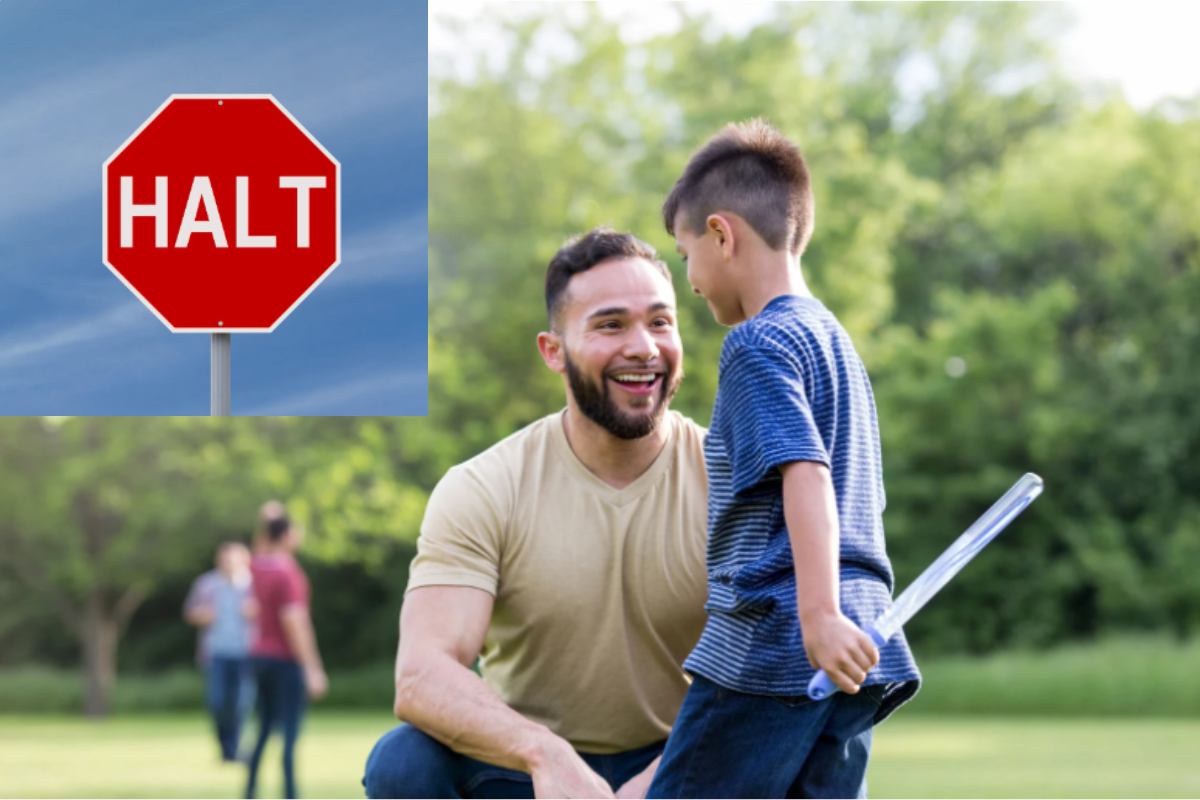
TikToker Justin (@abetterdad), a dad of three boys, shared in a new video how a slogan from Alcoholics Anonymous has helped him be more patient and understanding with his kids when they're acting out of line. By taking stock of his kids by using the acronym HALT (which stands for Hungry, Angry, Lonely, Tired), he shares that parents can better assess the 'why' behind a child's misbehavior, which in turn can lead to more patient and understanding reaction in parenting.
"When my kids act out, I challenge myself to ask what I missed instead of blaming them and getting frustrated at their behavior," he wrote in the video's caption. "I use the HALT method (Hungry, Angry, Lonely, Tired) to assess what's wrong."
@abetterdad #creatorsearchinsights
In the video, his three sons can be seen playing on a playground and Justin continues to explain why the HALT method works to prevent him from lashing out at his kids when they are misbehaving. "Most are obvious, but Lonely sneaks up on you. Kids crave connection and often act out when they don't get it."
HALT is an acronym created by Alcoholics Anonymous that is meant to help those in recovery learn to address their most basic needs in order for them to live a healthy and balanced life with the goal of maintaining sobriety. According to the Substance Abuse and Mental Health Services Administration (SAMHSA), HALT should be used "when feeling stressed and then take appropriate action before the impulse to use or reengage in risk behaviors becomes overwhelming." HALT can be defined as:
- Don't get too Hungry can include an awareness—not only of avoiding being too hungry, but also focusing on healthy eating.
- Don't get too Angry is a reminder to understand the causes of your anger and find healthy ways to feel and express that anger.
- Don't get too Lonely is a reminder to connect with safe people, engage in social and recreational activities with others, and attend recovery support groups.
- Don't get too Tired is a reminder to get enough sleep and rest when fatigued.
Psychiatrist and addiction specialist David Streem, MD, with Cleveland Clinic, also adds, “HALT has two physical states — hunger and tired — and two emotional states — anger and lonely. It’s a good balance because you’re taking care of yourself physically and emotionally."
In parenting, Justin encourages parents to implement the slogan in a similar way to better understand why kids may be behaving the way they are, and to address any unmet needs they have before reacting.
@abetterdad #creatorsearchinsights #parentingtips #momlife #dadlife #toddlertips #childhood
Fellow parents are loving his use of the HALT method to become better parents.
"Is their cup filled? Did they have enough time with you today? That's what I ask myself. They need their cups filled with mom and dad time. Going through the checklist is the best way to go!" one viewer commented.
Another added, "This is going to be of tremendous help. From one dad (whose dad was emotionally distant/abusive/neglectful/etc.) to another, thank you."
Another commented, "What a beautiful time to raise children - we love them so fiercely we find a special determination to HELP rather than push perfection."


A woman is getting angry at her coworker.via
A man with tape over his mouth.via
A husband is angry with his wife. via 
a man sitting at a desk with his head on his arms Photo by
Can a warm cup of tea help you sleep better? If you believe it, then yes. Photo by 
Three women sit on a blanket in the park. 
Two women engaging in a pleasant conversation inside a coffee shop
Two men engaging in a peaceful disagreement.
Resurfaced video of French skier's groin incident has people giving the announcer a gold medal
"The boys took a beating on that one."
A good commentator can make all the difference when watching sports, even when an event goes smoothly. But it's when something goes wrong that great announcers rise to the top, and there's no better example of a great announcer in a surprise moment than when French skier Yannick Bertrand took a gate to the groin in a 2007 super-G race.
Competitive skiers fly down runs at incredible speeds, often exceeding 60 mph. Hitting something hard at that speed would definitely hurt, but hitting something hard with a particularly sensitive part of your body would be excruciating. So when Bertrand slammed right into a gate family-jewels-first, his high-pitched scream was unsurprising. What was surprising was the perfect commentary that immediately followed.
This is a clip you really just have to see and hear to fully appreciate:
- YouTube youtu.be
It's unclear who the announcer is, even after multiple Google inquiries, which is unfortunate because that gentleman deserves a medal. The commentary gets better with each repeated viewing, with highlights like:
"The gate the groin for Yannick Bertrand, and you could hear it. And if you're a man, you could feel it."
"Oh, the Frenchman. Oh-ho, monsieurrrrrr."
"The boys took a beating on that one."
"That guy needs a hug."
"Those are the moments that change your life if you're a man, I tell you what."
"When you crash through a gate, when you do it at high rate of speed, it's gonna hurt and it's going to leave a mark in most cases. And in this particular case, not the area where you want to leave a mark."
Imagine watching a man take a hit to the privates at 60 mph and having to make impromptu commentary, straddling the line between professionalism and acknowledging the universally understood reality of what just happened. There are certain things you can't say on network television that you might feel compelled to say. There's a visceral element to this scenario that could easily be taken too far in the commentary, and the inherent humor element could be seen as insenstive and offensive if not handled just right.
The announcer nailed it. 10/10. No notes.
The clip frequently resurfaces during the Winter Olympic Games, though the incident didn't happen during an Olympic event. Yannick Bertrand was competing at the FIS World Cup super-G race in Kvitfjell, Norway in 2007, when the unfortunate accident occurred. Bertrand had competed at the Turin Olympics the year before, however, coming in 24th in the downhill and super-G events.
As painful as the gate to the groin clearly as, Bertrand did not appear to suffer any damage that kept him from the sport. In fact, he continued competing in international downhill and super-G races until 2014.
Alpine skiing is a notoriously dangerous sport, with a reported injury rate of 36.7 per 100 World Cup athletes per season, according to a 2018 study. Of course, it's the knees and not the coin purse that are the most common casualty of ski racing, which we saw clearly in U.S. skiier Lindsey Vonn's harrowing experiences at the 2026 Olympics. Vonn was competing with a torn ACL and ended up being helicoptered off of the mountain after an ugly crash that did additional damage to her legs, requiring multiple surgeries (though what caused the crash was reportedly unrelated to her ACL tear). Still, she says she has no regrets.
As Bertrand's return to the slopes shows, the risk of injury doesn't stop those who live for the thrill of victory, even when the agony of defeat hits them right in the rocks.