Germany's most famous castle isn't a real castle. It's an elaborate 'work of fan fiction.'
Though it looks medieval, it was built in the 19th century by an eccentric "fairy tale king" who spent much of his life constructing his own elaborate fantasy world.

Neuschwanstein Castle sits atop a rock ledge in the Bavarian Alps.
Even if you haven't heard of Neuschwanstein Castle, there's a good chance you've at least seen pictures of it. Set atop a tree-covered rock ledge in the Bavarian Alps, the picturesque castle looks like it was conjured straight out of a fairy tale. In fact, it served as inspiration for Disney Imagineers as they designed "Sleeping Beauty's Castle" in Disneyland, and it's regularly named the top castle to visit in Germany.
There are estimated to be around 25,000 castles in Germany, but Neuschwanstein is unique among them. Most notably, it's not a real castle and never was. While it bears the look and feel of a well-preserved medieval castle, it was actually built in the 19th century, and rather than serving as a fortress, it served as the fantasy castle of an eccentric king obsessed with Richard Wagner's operas and medieval mythology.
Ludwig II came to the Bavarian throne in 1864 at age 18 with no experience in government or politics. Two years later, Prussia conquered Austria and Bavaria, and Ludwig's powerful status as king was greatly diminished. Not that he was particularly interested in governance anyway; he was more drawn to the romantic idea of having his own kingdom.
According to Encyclopedia Britannica, "The king worshiped the theatre and the opera, and henceforth concerned himself almost exclusively with his artistic endeavors, developing an extravagant mania for building in the Bavarian mountains that he loved." He essentially spent much of his reign constructing an elaborate fantasy world in which he could be the king he imagined himself to be.
Hence the idea for Neuschwanstein Castle, which Ludwig wished to be built "in the authentic style of the old German knights' castles." The foundation for the structure was laid in 1869, but it took until 1892 for the 65,000 sq. ft. "castle" to be completed. Ludwig himself would only ever see it as an incomplete building site, as he drowned himself in a lake in 1886, a few days after being declared insane. (Though his death was officially ruled suicide by drowning, some sources point to some mystery surrounding his death, as the psychiatrist who diagnosed him also drowned at the same time.)
The tragedy of Ludwig's final years stands in sharp contrast to the extravagant beauty of the castle he created, which The Cultural Tutor referred to as "the world's biggest work of fan fiction."
The Throne Room serves as a symbol of how Ludwig saw kingship. The grand hall was built in the style of a Byzantine church, pointing to how Ludwig saw kings as being intermediaries between God and the world.

The throne room in Neuschwanstein Castle.
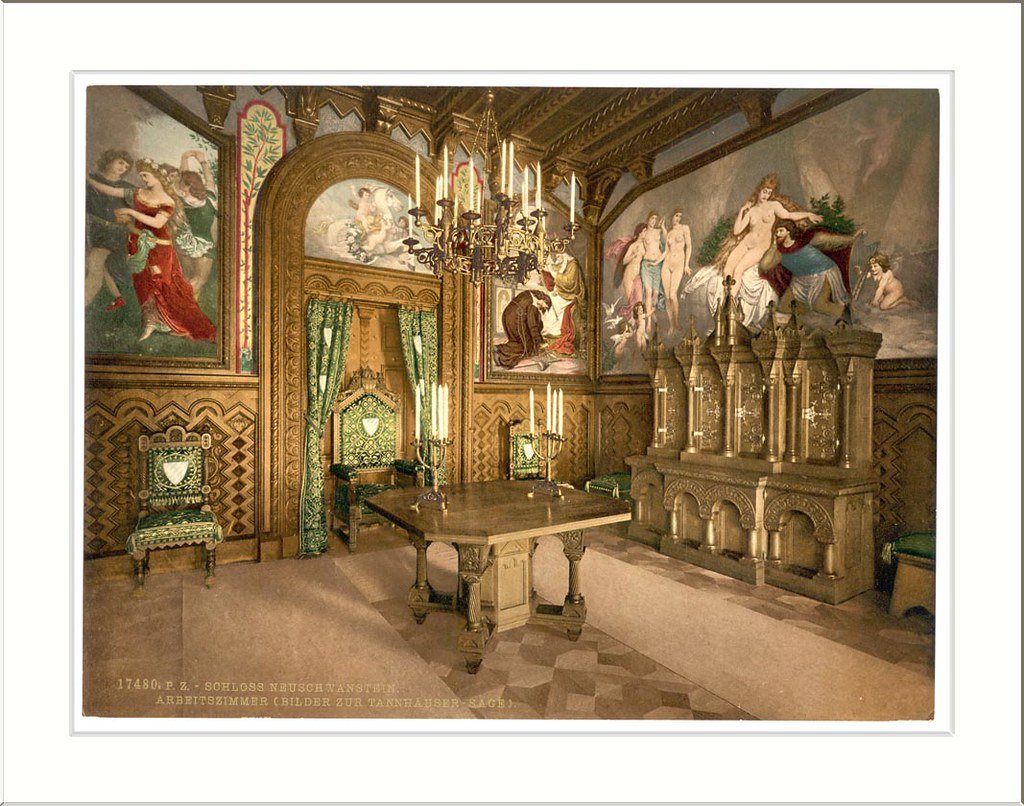
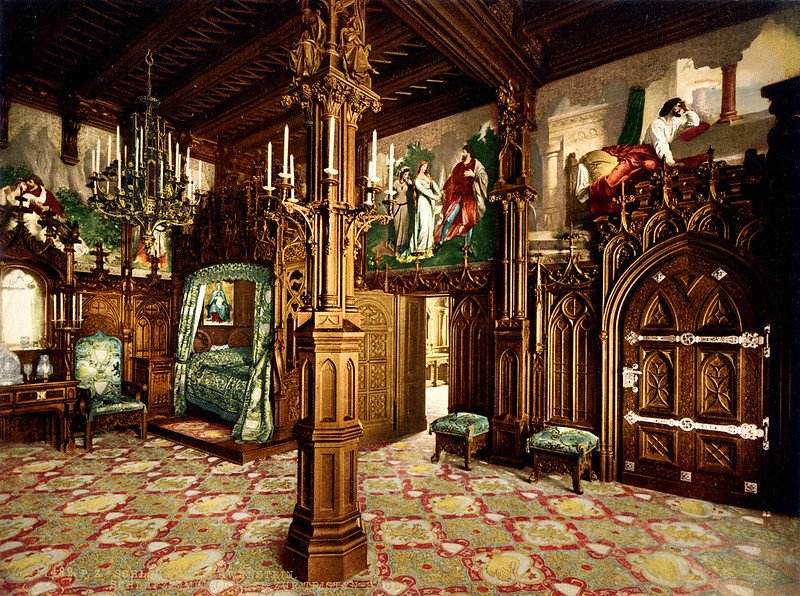
Where fan fiction comes in is in how much of the castle is an artistic shrine to Wagner's operas. In many rooms, the walls are covered in paintings depicting the German legends as told in Wagner's works, such as his 1845 "Tannhäuser" opera and his 1859 "Tristan and Isolde."

Bedroom depicting the Tristan story
In Neuschwanstein's early stages, Ludwig wrote to Wagner describing his vision for the castle, telling the composer he looked forward to moving in and having Wagner come visit:
"There will be several cosy, habitable guest rooms with a splendid view of the noble Säuling, the mountains of Tyrol and far across the plain; you know the revered guest I would like to accommodate there; the location is one of the most beautiful to be found, holy and unapproachable, a worthy temple for the divine friend who has brought salvation and true blessing to the world."
Ultimately, Ludwig and Wagner's friendship would be complicated by money, differing artistic visions and Ludwig's clear romantic feelings for Wagner, but if it weren't for Ludwig's support, Wagner would likely never have risen to the fame he ultimately enjoyed.
The "mad king" may have had some issues ranging from quirky to concerning, but he can fairly be credited with the making of Richard Wagner, as well as creating an architectural masterpiece that millions of people from around the globe travel to enjoy.
Check out the gorgeous Neuschwanstein Castle from all angles here:








A woman is getting angry at her coworker.via
A man with tape over his mouth.via
A husband is angry with his wife. via 
a man sitting at a desk with his head on his arms Photo by
Can a warm cup of tea help you sleep better? If you believe it, then yes. Photo by 
Three women sit on a blanket in the park. 
Two women engaging in a pleasant conversation inside a coffee shop
Two men engaging in a peaceful disagreement.
Resurfaced video of French skier's groin incident has people giving the announcer a gold medal
"The boys took a beating on that one."
Downhill skiing is a sport rife with injuries, but not usually this kind.
A good commentator can make all the difference when watching sports, even when an event goes smoothly. But it's when something goes wrong that great announcers rise to the top. There's no better example of a great announcer in a surprise moment than when French skier Yannick Bertrand took a gate to the groin in a 2007 super-G race.
Competitive skiers fly down runs at incredible speeds, often exceeding 60 mph. Hitting something hard at that speed would definitely hurt, but hitting something hard with a particularly sensitive part of your body would be excruciating. So when Bertrand slammed right into a gate family-jewels-first, his high-pitched scream was unsurprising. What was surprising was the perfect commentary that immediately followed.
This is a clip you really just have to see and hear to fully appreciate:
- YouTube youtu.be
It's unclear who the announcer is, even after multiple Google inquiries, which is unfortunate because that gentleman deserves a medal. The commentary gets better with each repeated viewing, with highlights like:
"The gate the groin for Yannick Bertrand, and you could hear it. And if you're a man, you could feel it."
"Oh, the Frenchman. Oh-ho, monsieurrrrrr."
"The boys took a beating on that one."
"That guy needs a hug."
"Those are the moments that change your life if you're a man, I tell you what."
"When you crash through a gate, when you do it at high rate of speed, it's gonna hurt and it's going to leave a mark in most cases. And in this particular case, not the area where you want to leave a mark."
Imagine watching a man take a hit to the privates at 60 mph and having to make impromptu commentary straddling the line between professionalism and acknowledging the universal reality of what just happened. There are certain things you can't say on network television that you might feel compelled to say. There's a visceral element to this scenario that could easily be taken too far in the commentary, and the inherent humor element could be seen as insensitive and offensive if not handled just right.
The announcer nailed it. 10/10. No notes.
The clip frequently resurfaces during the Winter Olympic Games, though the incident didn't happen during an Olympic event. Yannick Bertrand was competing at the FIS World Cup super-G race in Kvitfjell, Norway in 2007, when the unfortunate accident occurred. Bertrand had competed at the Turin Olympics the year before, however, coming in 24th in the downhill and super-G events.
As painful as the gate to the groin clearly as, Bertrand did not appear to suffer any damage that kept him from the sport. In fact, he continued competing in international downhill and super-G races until 2014.
According to a 2018 study, Alpine skiing is a notoriously dangerous sport with a reported injury rate of 36.7 per 100 World Cup athletes per season. Of course, it's the knees and not the coin purse that are the most common casualty of ski racing, which we saw clearly in U.S. skier Lindsey Vonn's harrowing experiences at the 2026 Olympics. Vonn was competing with a torn ACL and ended up being helicoptered off of the mountain after an ugly crash that did additional damage to her legs, requiring multiple surgeries (though what caused the crash was reportedly unrelated to her ACL tear). Still, she says she has no regrets.
As Bertrand's return to the slopes shows, the risk of injury doesn't stop those who live for the thrill of victory, even when the agony of defeat hits them right in the rocks.