I haven’t seen “Inequality for All” yet, but it’s been really well-reviewed. I just bumped it to the top of my Netflix queue.
Tags
More for You
-
Once a refugee seeking safety in the U.S., Anita Omary is using what she learned to help others thrive.
Even in divided times, small acts of friendship help create vibrant communities where everyone feels safe.
In March 2023, after months of preparation and paperwork, Anita Omary arrived in the United States from her native Afghanistan to build a better life. Once she arrived in Connecticut, however, the experience was anything but easy.
“When I first arrived, everything felt so strange—the weather, the environment, the people,” Omary recalled. Omary had not only left behind her extended family and friends in Afghanistan, she left her career managing child protective cases and supporting refugee communities behind as well. Even more challenging, Anita was five months pregnant at the time, and because her husband was unable to obtain a travel visa, she found herself having to navigate a new language, a different culture, and an unfamiliar country entirely on her own.
“I went through a period of deep disappointment and depression, where I wasn’t able to do much for myself,” Omary said.
Then something incredible happened: Omary met a woman who would become her close friend, offering support that would change her experience as a refugee—and ultimately the trajectory of her entire life.
Understanding the journey
Like Anita Omary, tens of thousands of people come to the United States each year seeking safety from war, political violence, religious persecution, and other threats. Yet escaping danger, unfortunately, is only the first challenge. Once here, immigrant and refugee families must deal with the loss of displacement, while at the same time facing language barriers, adapting to a new culture, and sometimes even facing social stigma and anti-immigrant biases.
Welcoming immigrant and refugee neighbors strengthens the nation and benefits everyone—and according to Anita Omary, small, simple acts of human kindness can make the greatest difference in helping them feel safe, valued, and truly at home.
A warm welcome

Dee and Omary's son, Osman Anita Omary was receiving prenatal checkups at a woman’s health center in West Haven when she met Dee, a nurse.
“She immediately recognized that I was new, and that I was struggling,” Omary said. “From that moment on, she became my support system.”
Dee started checking in on Omary throughout her pregnancy, both inside the clinic and out.
“She would call me and ask am I okay, am I eating, am I healthy,” Omary said. “She helped me with things I didn’t even realize I needed, like getting an air conditioner for my small, hot room.”
Soon, Dee was helping Omary apply for jobs and taking her on driving lessons every weekend. With her help, Omary landed a job, passed her road test on the first attempt, and even enrolled at the University of New Haven to pursue her master’s degree. Dee and Omary became like family. After Omary’s son, Osman, was born, Dee spent five days in the hospital at her side, bringing her halal food and brushing her hair in the same way Omary’s mother used to. When Omary’s postpartum pain became too great for her to lift Osman’s car seat, Dee accompanied her to his doctor’s appointments and carried the baby for her.
“Her support truly changed my life,” Omary said. “Her motivation, compassion, and support gave me hope. It gave me a sense of stability and confidence. I didn’t feel alone, because of her.”
More than that, the experience gave Omary a new resolve to help other people.
“That experience has deeply shaped the way I give back,” she said. “I want to be that source of encouragement and support for others that my friend was for me.”
Extending the welcome

Omary and Dee at the Martin Luther King, Jr. Vision Awards ceremony at the University of New Haven. Omary is now flourishing. She currently works as a career development specialist as she continues her Master’s degree. She also, as a member of the Refugee Storytellers Collective, helps advocate for refugee and immigrant families by connecting them with resources—and teaches local communities how to best welcome newcomers.
“Welcoming new families today has many challenges,” Omary said. “One major barrier is access to English classes. Many newcomers, especially those who have just arrived, often put their names on long wait lists and for months there are no available spots.” For women with children, the lack of available childcare makes attending English classes, or working outside the home, especially difficult.Omary stresses that sometimes small, everyday acts of kindness can make the biggest difference to immigrant and refugee families.
“Welcome is not about big gestures, but about small, consistent acts of care that remind you that you belong,” Omary said. Receiving a compliment on her dress or her son from a stranger in the grocery store was incredibly uplifting during her early days as a newcomer, and Omary remembers how even the smallest gestures of kindness gave her hope that she could thrive and build a new life here.
“I built my new life, but I didn’t do it alone,” Omary said. “Community and kindness were my greatest strengths.”
Are you in? Click here to join the Refugee Advocacy Lab and sign the #WeWillWelcome pledge and complete one small act of welcome in your community. Together, with small, meaningful steps, we can build communities where everyone feels safe.
This article is part of Upworthy’s “The Threads Between U.S.” series that highlights what we have in common thanks to the generous support from the Levi Strauss Foundation, whose grantmaking is committed to creating a culture of belonging.
-
Lawyer explains why everyone should do ‘mandatory hospice volunteering’ when they turn 18
“It would change their entire way of viewing the world.”
In a recent, thought-provoking episode of the Impact Theory podcast with Tom Bilyeu, renowned divorce attorney and author James Sexton shared how being a hospice volunteer changed his perspective on life so drastically that he thinks it should be “mandatory” at the age of 18.
“I think it would change your entire way of viewing the world. It did mine,” he told Bilyeu.
Sexton recalled that while death itself wasn’t necessarily the prime source of conversation—most of his volunteer work involved doing little odds and ends for folks— its presence was still palpable. And because of that, he walked out of each visit “feeling like a samurai” as all the things he thought were “so important five minutes ago” fell to the wayside.
Death gives us perspective on what really matters
“Spend time with people that are dying. They don’t really…all their stuff is a great big pile of nothing. Like, all that they can talk about is the people that they love, the connections that they made, and the experiences that they had that were beautiful or painful,” he said.
That realization became even more apparent when he learned that his own mother was terminally ill with cancer, and past the point that any doctor could help her.
“In that moment, all of the other things that I was stressed about and worried about, the volume was turned so far down on all those things because my mom was gonna die. All that became important was how I could spend a little more time with her. How can I make sure she knows that I love her? How can I savor these wonderful things?”
Hospice volunteering could help us navigate anti-death culture
Developing an awareness of death during early adulthood, Sexton argued, would help people not get “distracted” by a society that constantly tries make you forget that death is inevitable. Therefore, they wouldn’t pay attention to the “meaningless shit that keeps the machine moving,” and instead focus on what really matters.
And what really matters? Important things like kissing our spouse, for example, which Sexton reminded Bilyeu (and, conversely, all of us) is a finite number of times. You won’t know what that finite number is “until you’ve passed it,” he warned.

Photo credit: Canva “If you don’t keep that in your line of sight, then you’re a fool. You’re gonna think you’re gonna get to do that forever. You don’t. That’s the most beautiful thing in the world. It’s what makes that so special.”
For Sexton, being a hospice volunteer cemented this perspective, and since then, “nothing has been the same.” It didn’t mean suddenly “living life like a monk,” but it did mean sharing his love a little more freely, and appreciating that “things have to end.”
Between hospice volunteering and working as a divorce lawyer, Sexton has become an expert of sorts with “endings,” he noted with Bilyeu. And he argues that we must look at life through this lens because the one constant is that “everything is ending all the time,” and ignoring that fact “does a great disservice.”
A death ritual for the modern day
American culture generally treats death with avoidance, viewing it as a taboo topic or a medical failure rather than a natural life stage. It is highly clinical and sanitized, with many dying in hospitals away from family and loved ones. While shifting toward more home-based hospice care, US society remains heavily influenced by “death-denying” attitudes, emphasizing quick, efficient mourning. Compare that to other cultures that have consistent mourning rituals, like Mexico’s Dios De Los Muertos and Japan’s Obon. Perhaps Sexton’s hospice volunteering concept could act as something similar to these traditions…a rite of passage that doesn’t have us avoiding death, but walking alongside it.
You can watch the full Impact Theory episode here:
-
Millennials complain that their Boomer parents won’t throw anything away. A psychologist explains why.
“3 car garage…cannot fit a single car in there.”
Millennials with Baby Boomer parents have not been shy about airing their complaints about the older generation. Millennials have previously noted that their parents tend to hoard food—and now Millennials are airing their grievances about Boomer “stuff avalanche”.
On Reddit, Millennials discussed their frustrations about their Boomer parents and the insane amount of junk they have in their homes that (allegedly) will one day be passed down to them one day. Many Millennials shared that it is a source of contention for them, and that they wish their parents would just throw things out.
“3 car garage…cannot fit a single car in there,” one commented. And another stated, “I am very concerned with the amount of junk my parents are holding onto.”
A fellow peeved Millennial added, “The worst part is that our parents think this is all worth lots and lots of money. Don’t worry kids, these three sets of china I’m saving for you will be worth millions!”
Another had laid down the law: “My mom kept joking about all the ‘stuff’ being my inheritance. After a few times I was tired of it, I looked her dead in the face and said in the most monotone I could get. ‘I will get the biggest dumpster I can, and it will all go in the trash.’ She stopped making that joke, and my parents have been slowly throwing out their junk ever since.”

A Baby Boomer garage that is filled with stuff. – Photo credit: Canva Why Boomers struggle to throw things away
The Boomer generation grew up in the post-war era shaped by rationing and economic rebuilding,” Daniel Glazer, clinical psychologist and co-founder of US Therapy Rooms, tells Upworthy.
He adds that the Boomer inability to let stuff go is often criticized, when you look at the psychology of their attachment to objects, their behavior makes much more sense.
“Not so long ago, saving things was an adaptive habit. ‘That might come in handy’ was a common refrain in households in which replacing something was not so easy, or affordable,” says Glazer. “There is also an element of emotional security that comes from the things that have surrounded us through decades of life events, or even across a lifetime.”
And for many Boomers, getting rid of stuff can signify an even bigger mental battle.
“As people age, there can also be an increased awareness of mortality,” Esin Pinarli, Founder & Holistic Psychotherapist at Eternal Wellness Counseling. “Letting go of objects can feel symbolic, almost like letting go of chapters of their life. If no one is asking about those chapters anymore, those objects become the tangible proof that those experiences mattered. So it’s not stubbornness. It’s often about attachment, meaning-making, and a fear of losing relevance or erasing parts of their story.”
How to help Boomers declutter
Starting the conversation with Boomer parents in an empathetic and understanding way may help the process go more smoothly and deepen the relationship with them. Here are a few examples of conversation starters Millennials can use when talking to their Boomer parents about throwing things away:
Conversation Starter #1: “I know these things mean something to you. I’d love to hear the story behind a few of them.”
“This shifts the focus from getting rid of objects to honoring the meaning behind them,” says Pinarli. “When a parent feels seen and understood, they’re often more open to eventually letting go. It validates that the attachment is about memory and identity, not just stuff.”
Conversation Starter #2: “What would feel good for you to keep, and what feels like it’s just taking up space now?”
“This gives them agency,” Pinarli explains. “Instead of telling them what to throw away, it invites them to reflect on what still feels meaningful versus what might no longer serve them. That sense of control reduces defensiveness.”
Conversation Starter #3: “Would it help to go through this together so we can make sure the important things are preserved?”
“This frames decluttering as a collaborative and supportive process, not a demand,” Pinarli shares. “It reassures them that their memories and legacy won’t be dismissed or erased, which can lower the emotional intensity around letting go.”
-
Scientists discover method for sleeping on tough problems to solve them creatively
Why not let your brain go to work while you sleep?
We spend a third of our lives asleep, and during that time, our bodies and minds are restored. But wouldn’t it be great if we could also use that time to think brilliant thoughts that help us when we wake? Imagine if, while you sleep, your mind could solve problems, come up with creative ideas, and recall long-forgotten memories.
A new study by neuroscientists at Northwestern University has taken the first step toward making this possible by training people to solve difficult puzzles in their sleep.
The researchers conducted a sleep study with 20 participants with prior experience with lucid dreaming. Participants were given a series of tough brainteasers to work on for three minutes, with each one paired with its own musical soundtrack.
The brainteasers were difficult enough that most went unsolved. As participants went to bed in the lab that night and entered REM sleep, researchers played the soundtracks from the unsolved puzzles to encourage them to dream about them. When participants woke up the next morning, the findings were remarkable.
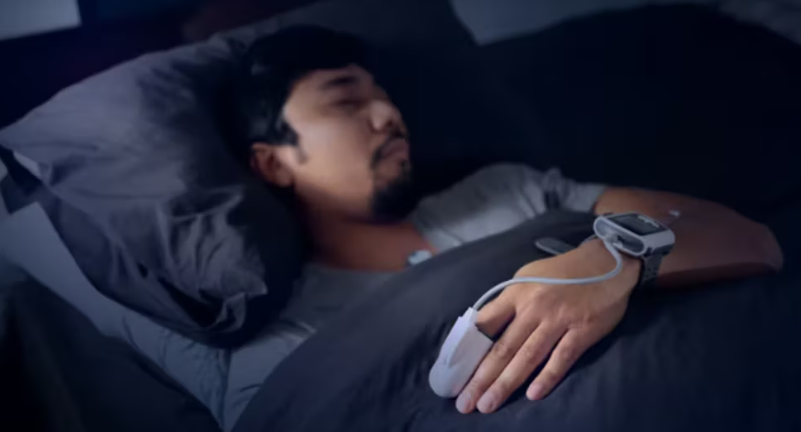
A man in a sleep study. via Canva What the sleep study found
Sixty percent of the participants had dreams that referenced the specific puzzles they couldn’t solve while awake. Those who dreamed about the unsolved puzzles increased their problem-solving ability from 20% to 40%.
Karen Konkoly, a post-doctoral researcher in Paller’s Cognitive Neuroscience Laboratory, explained the findings in a press release:
“Even without lucidity, one dreamer asked a dream character for help solving the puzzle we were cueing. Another was cued with the ‘trees’ puzzle and woke up dreaming of walking through a forest. Another dreamer was cued with a puzzle about jungles and woke up from a dream in which she was fishing in the jungle, thinking about that puzzle. These were fascinating examples to witness because they showed how dreamers can follow instructions, and dreams can be influenced by sounds during sleep, even without lucidity.”
The study shows incredible potential for using our dreams to solve complex problems and increase creativity.
“My hope is that these findings will help move us towards stronger conclusions about the functions of dreaming,” Konkoly said. “If scientists can definitively say that dreams are important for problem solving, creativity, and emotion regulation, hopefully people will start to take dreams seriously as a priority for mental health and wellbeing.”

A woman in a sleep study. via Canva How to lucid dream using the MILD technique
Wouldn’t it be incredible if you could tap into the power of your dreams to solve problems or generate new ideas, as the participants did in the laboratory? Even though it may sound too good to be true, there are research-backed ways to learn how to control your dreams. One of the most popular is the MILD (Mnemonic Induction of Lucid Dreams) technique.
Here are some steps to achieve lucidity, according to lucid dreaming instructor Daniel Love:
Step 1: Prepare for lucidity
Before you fall asleep, tell yourself that you will wake up and remember your dreams during each period of the night.
Step 2: Remember your dream
When you awaken from a dream period, do your best to recall every possible detail. Stay awake until you’ve remembered all you can.

A lucid dream. via Canva Step 3: Create your intent
As you prepare to fall back asleep, focus on the following intention: “The next time I am dreaming, I will remember to recognize that I’m dreaming.”
Love says to think about it the same way you would think about a product you want to buy at the store.
Step 4: See yourself as lucid
As you focus on step three, imagine yourself back in the dream noticing that you are lucid, and rewrite the dream as if you are now in control.
Step 5: Repeat as necessary
Repeat steps three and four until you fall asleep. If your mind wanders from your intention, simply repeat it again.
-
Experts share how to get that dreaded orange stain out of shower liners without tossing them
People may not need to wash their liners as frequently as they think.
Shower liners are like any other piece of fabric; they need to be washed. As people become more environmentally conscious, fewer plastic shower liners are ending up in the trash. Instead, people have been investing a few extra dollars into reusable shower liners, but are finding that the dreaded orange stain is still showing up after a washing.
The orange stain seems to start creeping up, not long after hanging the bright white liner behind your shower curtain. What is this stain, and how can you get it out without having to replace the entire liner? According to experts, the orange stain can be caused by different things, but ruling out dye from a shower curtain, the likely culprits are hard water or bacteria.
“If you live in an area prone to hard water, then there’s a good chance that the orange stains in your shower curtains are caused by mineral buildup,” Allie Ogletree writes for Angi before later sharing the other culprit. “If your shower curtains are orange and slimy, then bacteria called Serratia marcescens could be the reason behind your orange shower curtains.”
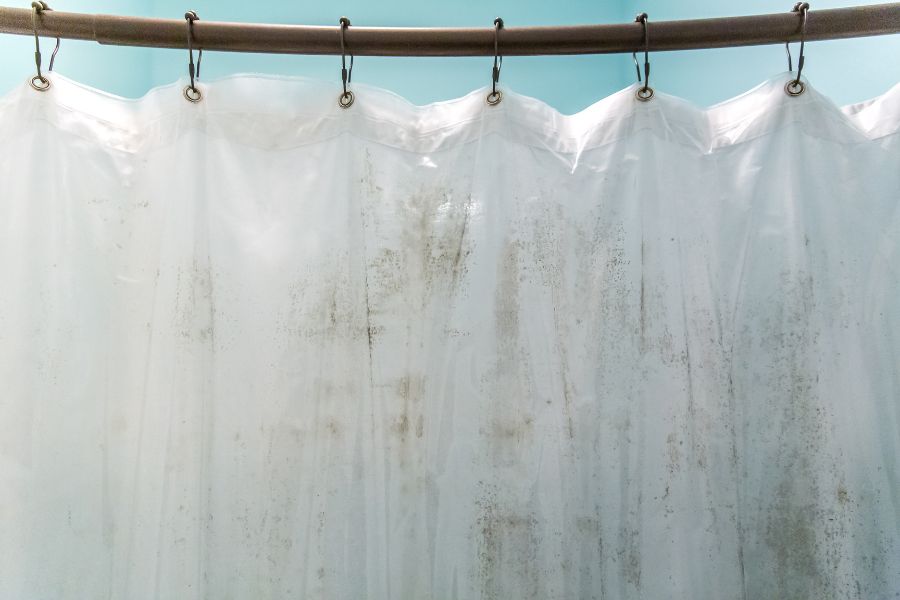
Moldy shower curtain/Canva While hard water is more of an annoyance than a health hazard, an orange stain caused by bacteria may be a bigger concern, making it a priority to keep it off your shower liner.
The Cleveland Clinic notes that this particular bacteria, often found on shower curtains, can cause unpleasant health issues. They write, “Serratia marcescens is bacteria that sometimes causes infections, including UTIs and pneumonia. You’re at higher risk for infection if you’re in the hospital or at a long-term care facility, have a weakened immune system or a medical device in your body. S. marcescens can be hard to treat because it’s often resistant to many antibiotics.”
Tossing the shower curtain into the washer may kill the bacteria, but it doesn’t always get the stain out. Cleaning experts have a solution.
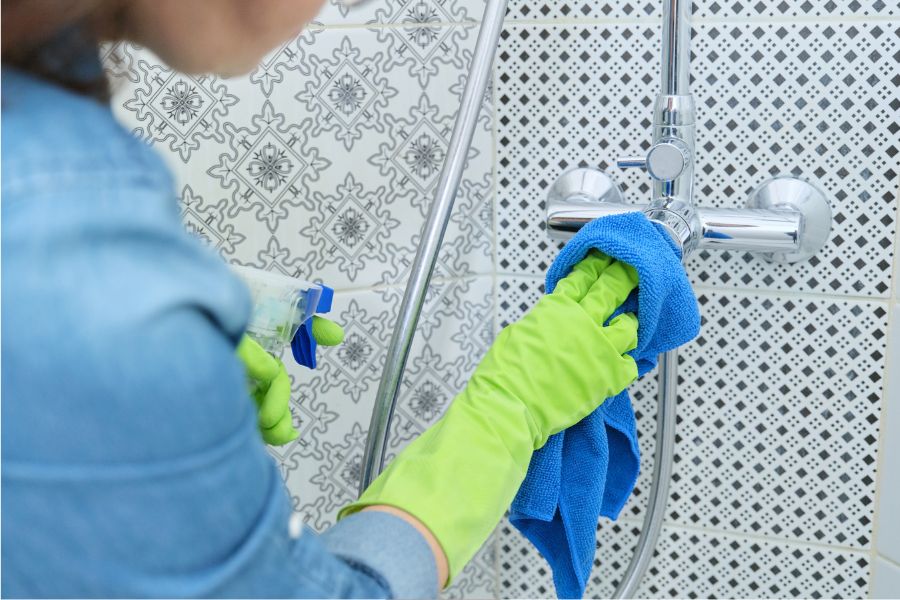
Woman cleaning shower/Canva Method One
Spray down the orange parts of the liner with an enzyme stain remover spray, then soak it in OxyClean and scrub with a soft brush. Once the first few steps are done, toss it in the washing machine with a half cup of baking soda. When the washer reaches the rinse cycle, add a half cup of vinegar. According to Real Simple, following these steps will have your shower liner looking good as new.
If you have a plastic liner, you can wash it by hand and skip a few of the steps, but you may still want to scrub any residue off with a scrub brush. Cleaning enthusiast Jeneva Aaron tells Real Simple, “You can soak a plastic liner in a baking soda and vinegar solution to remove soap residue.”
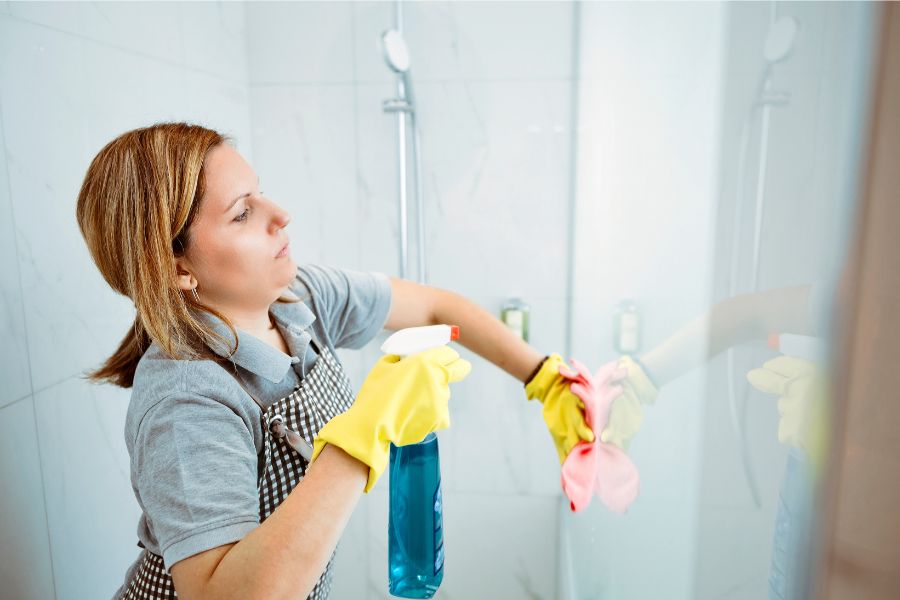
Woman cleaning glass shower/Canva Method Two
Going back to basics just may be what works. Angi touts using a simple vinegar and water mixture on the stain, allowing it to sit for 15 minutes before scrubbing, which can do the job. But you can take it one step further by adding baking soda to a few drops of white vinegar to create a paste to spread onto the grime, then scrub off.
According to the experts at Angi, “If your shower curtain still has discoloration after cleaning it, you can toss the shower curtain in the washing machine on the delicate setting to try to remove any remaining bacteria and then soak it in bleach to remove the orange. Just be sure to wear PPE, have good ventilation, and avoid mixing bleach and vinegar, as this creates a hazardous gas.”
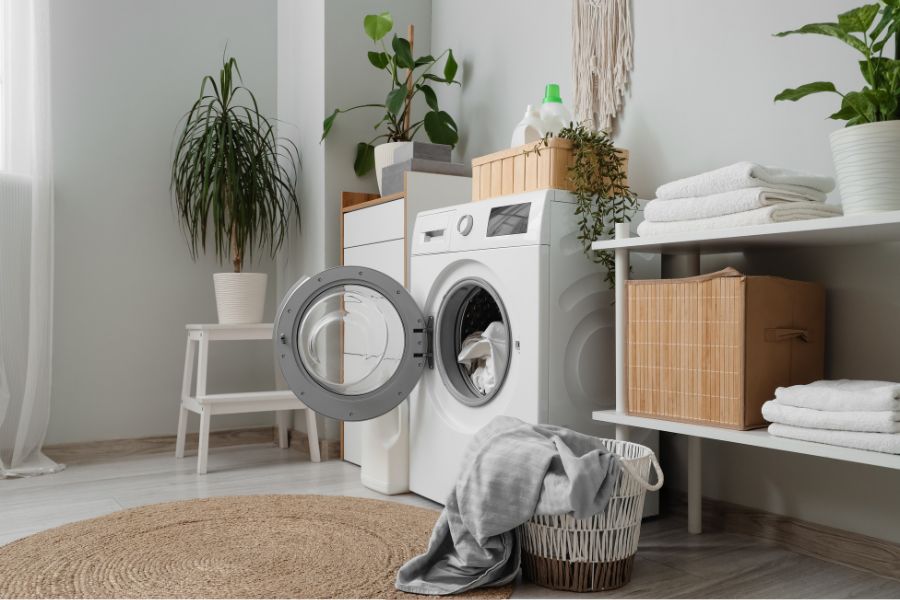
Laundry room/Canva How to keep the orange away
One of the reasons bacteria builds up is due to the moisture in the bathroom, so ventilating the bathroom will help cut down on how often the liner needs to be washed. In addition to ventilating the bathroom, close the shower curtain and place it on the outside of the bathtub where it’s dry. Closing the shower curtain after getting out of the shower will allow the liner to dry completely, as it will not be folded onto itself.
Surprisingly, there’s no need to wash the shower liner weekly to aid in keeping the bacteria from discoloring it. Cleaning experts at Real Simple say that a fabric shower curtain should be washed once every three months, as long as a shower liner is used. The liner should be washed monthly to interrupt bacterial growth.
-
Watch Colin Jost try Olympic bobsledding and gain a whole new level of respect for the sport
“I swear to God, I thought I was going to die. I thought my back was gonna snap in half.”
Some Olympic sports are obviously difficult and, clearly, inherently dangerous. You can’t watch a snowboarder twirl upside down in mid-air, 17 feet above a 22-foot halfpipe wall, and not admire the heck out of the effort it takes to reach that level of courage, skill, and athleticism. Watching skiers barreling down a mountain at 60 to 80 mph with nothing but a thin suit between them and the ground, expertly avoiding obstacles as they do it, is objectively impressive to the average person.
But the challenge of other sports isn’t as immediately appreciated. Curling may be hard, but it doesn’t look that hard.
And bobsledding might take some level of athletic ability, but other than a 5-second run before you jump into the sled, it’s really just about momentum and steering, right? Sure, they go fast, but bobsledders sit inside a protective metal casing, so it looks more like a thrilling roller coaster ride than a physically challenging and dangerous sport, right?
That’s what Saturday Night Live‘s Colin Jost thought. Then he tried it, and thankfully, he took us all along with him.
In a clip from NBC Sports, Jost describes his bobsled ride in Lake Placid, New York, as “by far, the scariest experience I’ve ever had in my life.”
First, watch his full run here:
Jost rode along with an experienced driver and didn’t even have to do anything but feel it. And, boy, did he feel it. We can see how his body was violently jostled from the physics of flying down the track. As the driver said, astronauts take off in a space shuttle at about three Gs. In the bobsled, they did about 5 Gs, which means he was feeling five times his body weight pushing down on him.
We can see and hear the shift from “Wow!” to “Holy ____!” as Jost’s thrill turned to terror on the track.
“I was in no way prepared for that,” Jost said. “I truly thought my body was going to break apart. I’m not exaggerating. It was so much more intense than I expected.”
Jost told NBC’s Mike Tirico that he was “not prepared for the level of terror of this bobsled.”
“I swear to God, I thought I was going to die,” he said. “I thought my back was gonna snap in half. I thought my bones were gonna fly off my body and be littered all up and down the bobsled track.”
People loved seeing an average person partake in an Olympic event, especially someone as honest about the experience as Jost was, as evidenced in the comments:
“Now THIS is the kind of commentary I want!”
“Huge thank you to whoever put Colin Jost in a bobsled.”
“Can we have him do every event for a reference point?”
“This is what we’ve been asking for – an average person participating so we can get a real account! Thank you for your service, Colin Jost!”
“He was so horrified he couldn’t even be hilarious about it 💀”
“He completely lost his composure, 😂 you could tell he was scared, and it did look like the fastest thing anyone would ride.”
“You know what… his explanation really helped me understand how scary bobsledding is and now I’m more interested in watching. Keep this guy on the air. That second scream shows me he’s telling the truth 😂“
The video really does offer a whole different perspective on how difficult bobsledding actually is.
Jost was just trying to keep his body together. Imagine having to focus and steer on top of handling those G-forces.
Retired NFL player and popular podcaster Jason Kelce also tried out the bobsled in Park City, Utah, and had a similar “holy ____” experience. He seemed to enjoy it a little more than Jost did, perhaps more accustomed to his body taking a beating as a professional football player, but he said it was far more intense than it looked. It didn’t feel like a roller coaster, he said. The 1,400 pounds of pressure pushing him into the metal bars of the sled bruised his hips, and, at one point, it got so loud he couldn’t hear his own screams.
Seeing how careening down an ice track in an aerodynamic sled feels really does lend a whole new level of wow to a sport that some might mistakenly see as glorified sledding. It also lends more weight to 41-year-old Elana Meyers Taylor’s monobob (single-person bobsledding) run that earned her her first Olympic gold medal in her sixth Olympic Games in Milano Cortina. She had earned three silver medals and two bronze medals, making her the most decorated U.S. female bobsledder of all time.
Seriously, nothing but respect for the bobsledders from here on out.
-
26 words that have gone nearly ‘extinct’ in the English language
“Comely (meaning beautiful) and homely (meaning ugly).”
Our vernacular is always changing. Every generation has its own slang words, from Xennials to Millennials and Gen Z.
In 2025, Dictionary.com deemed ‘67‘ as the word of the year, the Oxford University Press claimed the word of the year was “rage bait,” and Merriam-Webster claimed it was “slop.”
In an interview with the BBC, host Kate Colin offered an example of words that have disappeared in English when she opened a segment for the broadcasting network with this greeting: “Good morrow! I beseech thee, whence comest thou?” (Translation: “Good morning. Where do you come from?”)
Colin noted that this phrase was “Old English” used hundreds of years ago, and a great example of “disappearing words.” Colin’s co-host Jackie Dalton added, “Yes, English is a language which is evolving all the time. So this mean there are new words continuously appearing, and older words are disappearing.”
In English, words are here today and will likely be gone tomorrow. Language lovers on Reddit shared their favorite old-fashioned words that have gone nearly “extinct” in English today (and many they wish would make a comeback).
26 disappearing words
“Overmorrow. It means ‘the day after tomorrow’.” – TheGloveMan
“I remember the word ‘grody’ from the 90s. It meant gross or yucky.” – Glittering_Age_5591
“Comely (meaning beautiful) and homely (meaning ugly).” – oddwithoutend, Suspicious_Art9118
“Rolodex. There was something great about those. My own was a desk model with a lockable closing cover. Something about the tangibleness, the physicality and the control. Having the different kinds of cards and card covers, hearing them click when you spun it. I was sad to let it go.” – Matsunosuperfan, BASerx8
“Bitchin’ (meaning excellent).” – fox3actual
“Yellow pages.” – Matsunosuperfan
“Forsooth.” – fingermagnets459
Merriam-Webster notes that the definition of forsooth is “in truth : indeed —often used to imply contempt or doubt; now usually used to evoke archaic speech.” It comes from Middle English and dates back to the 12th century.
“Lunting: walking while smoking a pipe.” – RainbowWarrior73
“Only a ‘square’ would remember things like that.” – EighthGreen
“‘Cattywampus’ also sometimes known as ‘catawampus’. A cool word that you don’t hear much anymore.” – Dead_Is_Better
“I use finagle and my high school students think I’m so weird. I’m 47. This word is normal.” – MLAheading
“Frippery, at least in American English (think it’s used in France for thrift shops?)” – KobayashiWaifu
Merriam-Webster notes that the definition of frippery is “finery, also an elegant or showy garment; something showy, frivolous, or nonessential.” Its origins are Old French and date back as far as 1568.
“Handsome (when describing a woman).” – Odd-Scheme6535, Popular-Solution7697
“I love the word ‘scrimshaw.’ I don’t hear it enough.” – nocatleftbehind420
“Maybe not extinct but it’s meaning completely obliterated: nonplussed.” – LeFreeke
“Oblige. Rarely hear it except in old westerns.” – ReadySetGO0
“Druthers.” – Embarrassed_Wrap8421
“Bogart. Monopolizing something that’s meant to be shared.” – CoderJoe1
Merriam-Webster notes that “bumbershoot” is an American nickname for an umbrella that was first used in 1856.
“Ne’er-do-well. From the early 20th century, basically some who never-does -well, implying a slacker or underachiever. Although people never said it even when I was growing up, I still think it’s a cool word.” – fabgwenn
“Whippersnapper – a young and inexperienced person considered to be presumptuous or overconfident. I’ve heard people on TV say it, (maybe Dennis the Menace, or some other 50s show). I heard a 90 year old woman say it IRL and I laughed so hard.” – JazzFan1998
“Xeroxing a document.” – C-ute-Thulu
“Blatherskite.” – Biff_Bufflington
Merriam-Webster notes that the definition of “blatherskite” is “a person who blathers [talks foolishly at length] a lot; nonsense.” Its first known use dates back to 1650.
“I don’t seem to hear penultimate much anymore.” – TakeMetoLallybroch
“I’m quite fond of the word slubberdegullion, meaning ‘dirty scoundrel’. I use it frequently when I talk to my senior, who is a rather clean upstanding citizen. We laugh and then he tells me to get back to work.” – r-pics-sux
-
Professional speaker explains how voice messages can improve public speaking skills
Hit record and listen to yourself.
Many people are looking to improve their public speaking skills, whether for work or to feel more comfortable in social situations. While taking classes and getting advice from speech coaches can help, some people have difficulty finding either the money or the time to access professional help. But one speech expert believes you can significantly improve your verbal communication skills just by using your phone.
In a YouTube video, communication professional and speaker Vinh Giang offers a daily exercise that can help improve public speaking: sending voice messages instead of texts. Giang notes that one benefit of texting is being able to review a message before sending it to fix potential communication issues or miscues—and argues that you can do the same with voice messages.
Recording a voice message lets you hear yourself in a low-stakes situation, with the option to re-record again and again if necessary. Each time you listen back, you can pick up on your volume, speed, clarity, and word choice and be more mindful in the next one. You’ll be able to see (well, technically hear) where you’re lacking and what to improve, whether that means fixing an issue right away or identifying exactly what you need to work on in your speech.
Speech professionals agree voice notes help improve speaking abilities
Other professionals in public speaking and speech therapy spoke to Upworthy about voice messages and how they can help people improve their speaking skills.
“In the speech therapy world, the process of using voice messaging to improve public speaking would be considered a method called self-monitoring through biofeedback,” said speech pathology expert Ryann Sutera. “Rehearsing running speech through the use of recordings can help assess intelligibility, rate of speech, and word choice.”
“Using voice memos as a low-stakes tactic to improve communication and public speaking skills is something we find helps prep our clients for media opportunities,” said public relations director Lauren Guess. “Most of our clients are on the go, and sending a voice memo back in response to the reporter’s question is a great practice for creating usable, digestible sound bites.”
Guess said voice messages not only help communication with media outlets, but also help refine clients’ public speaking skills and sharpen their talking points.
“We prefer this approach because we find it quickly strengthens confidence in speaking on their subject matter and enhances their ability to nail their key messages, compared to submitting quotes via email or text,” Guess said.
Whether you want to improve your public speaking for professional reasons, like giving a presentation at work or running for political office, or to get better at conversations and connecting with friends, it might be worth recording a voice note instead of talking through your fingertips.
-
Florida man finds genius way to prevent family from hearing his bathroom ‘noises’
“Well, that’s using your noodle.”
Nobody wants to hear anyone using the restroom. Still, sometimes, if you live or work in close quarters, it can be hard to go discreetly without anyone hearing the splashing, grunting, toilet paper ripping, and flushing that goes on while you’re on the throne. Some try to mask the noise with strategic flushing, while others let the tap run—but that can be a big water waste.
A Florida father found a way to put a silencer on his bathroom door by strategically adding a pool noodle to the bottom, and people are applauding his ingenuity. He sliced the noodle down the center and affixed it to the bottom of the door so no sound could escape. It probably helps keep the smells out as well.
Brilliant dad soundproofs his bathroom
A picture of the invention was shared by one of his children on Reddit. “Florida man adds pool noodle feature to a bathroom door *for ‘noises,’*” they captioned the image.
“Well, that’s using your noodle,” one commenter wrote.
The man’s brilliant solution to a problem that affects all of humanity inspired others on Reddit to share their favorite pool noodle hacks. Here are some of the best:
1. Keep toys from going under the couch
“We use pool noodles under the edges of the couch and table so toys don’t get knocked underneath them. The dogs appreciate it more than our son does.”
“We had to trim a little off the noodle for the couch because it sat lower, but we used whole noodles for the coffee table. The important part is that it’s a tight enough fit to wedge into place.”
“This will be huge for the dogs, cats, kids, and Roomba.”
2. Keep your records in place
“I use a piece of noodle at the back of my IKEA KALLAX shelving to keep vinyl records from sliding too far back and stay evenly faced up front. If you want black instead of colorful, use pipe insulation—it’s basically the same though not as cheap.”
3. Stop drafts
“I use mine wrapped with T-shirts to block the draft under my front door. I love how you can cut it to fit perfectly to fit the doorframe.”
4. Perfect cat door jam
“I use a piece of one on top of my bedroom door to keep it open just a little bit so the cat can get out, otherwise the air pressure tends to push it shut.”
5. Protect your noggin with a noodle
“Slit a pool noodle and wrapped it the length of a shelf’s edge in my pool cabana. I no longer crack my forehead on the sharp edge when I lean in to crank the pool filter setting.”

Pool noodle aerobics. via Canva The Florida father who used a pool noodle to prevent unwanted sounds—and probably scents—from escaping his bathroom is further proof that the pool noodle has countless uses. It’s fair to say pool noodles have now joined the ranks of zip ties, Pedialyte, and binder clips as accidental multipurpose objects that can really get you out of a jam (or fill a door jam) when you need help around the house.







Nostalgia
A Millennial dad ordered his Gen Alpha daughter a ‘Skip-It’ toy from the ’90s and playfully ribs her for struggling




Get stories worth sharing delivered to your inbox.
Advertisement