upworthy
Add Upworthy to your Google News feed.
Google News Button
Politics

It's time for every American to take a deep breath, step back, and have a long look in the mirror

Yes, every single one of us, whatever our political persuasion.

america, united states, polarization, political division, partisanship

Political polarization is out of control. It doesn't have to be this way.

What I'm going to share here may well be futile, and many people who need to hear this message and take it to heart probably won't. But America is at a precipice we've been hurtling toward for years, and if we don't do something now to slow the momentum, I fear we'll soon find ourselves plummeting over a proverbial cliff, one and all. It's worth an attempt to pull us back from the brink.

We all know that political polarization in the U.S. is reaching a fever pitch. What many people don't seem to recognize is how they individually play a role in it, especially those who are adamant that the "other side" is to blame for the division. As a lifelong political independent, it's been terrifying to watch my fellow Americans become more and more entrenched in hyper-partisanship, seemingly unaware of how they themselves are contributing to the problem, simply by allowing themselves to be pulled further into the partisan binary.
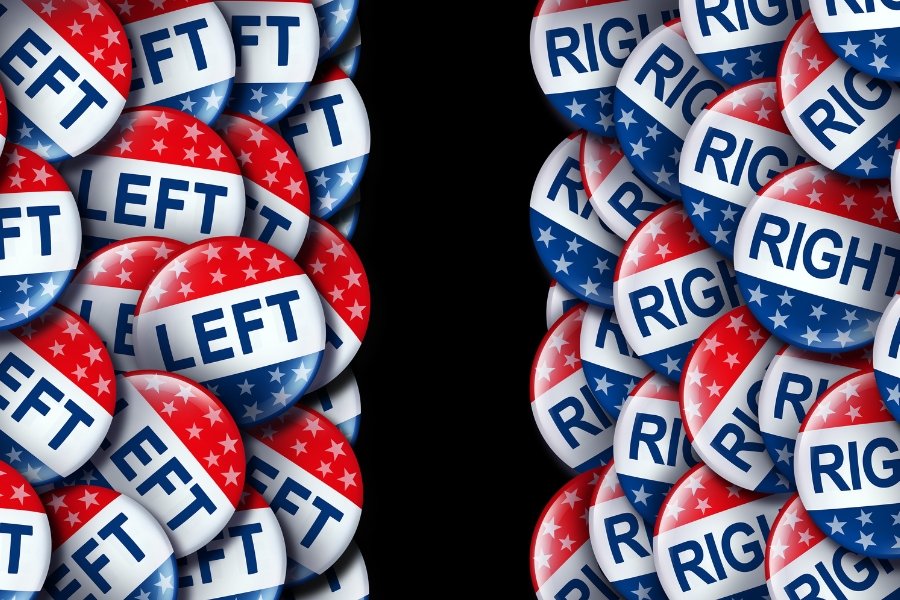
left, right, politics, partisanship, political ideology We can't divide America into "left" and "right." Photo credit: Canva

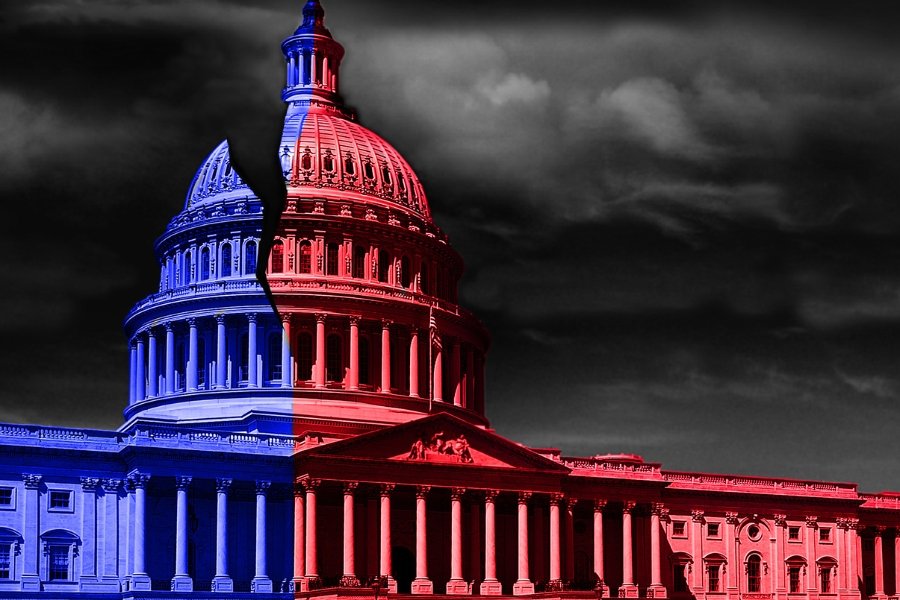
Democrats say Republicans are the problem. Republicans say Democrats are the problem. The vast majority of us absentmindedly use black-and-white ideological terminology that line up with our political parties to describe our fellow Americans—liberal or conservative, left or right, red or blue—as if 342 million people fit neatly into two political/ideological boxes. As a result, many Americans have found a home and an identity in those boxes, and unfortunately, some have built them into fortresses from which to shoot at the other side—figuratively and literally.

But no matter how people feel about one box or the other, neither of them is really the problem that brought us here. The problem is the premise that they are built on, which is that there are two opposing sides in the first place. It was inevitable that partisanship in a two-party system would eventually lead to an intractable division featuring extreme, binary thinking pushed by those who benefit from that polarization. The "other side" isn't just different, it's depraved. The “other side" isn't just misguided, it's malicious. The "other side" isn't just wrong, it's evil. This kind of thinking is a feature, not a bug.

george washington, party politics, two-party system, farewell address, partisanship George Washington tried to warn us about the perils of partisanship. Giphy

George Washington tried to warn us about this in 1796 when he said that the "spirit of party" was America's "worst enemy" and would eventually lead us to our demise. We're right there, right now. Partisanship has been fully weaponized by those seeking and wielding power, pitting Americans against Americans, convincing them that the "other side" isn't just wrong, but evil. ("But the other side really is evil!" you might be thinking. Thank you for proving the point. The "other side" says exactly the same thing.) The walls of those political and ideological boxes have gotten so high and so thick that we've lost the ability to see one another's humanity.

Many things have gone into how we got here, of course, and there's plenty of blame to be tossed around. But instead of finger pointing when we talk about our polarization problem, what if we were to look inward and own our own individual part in it, whatever that might be?

I would love to invite every American of every persuasion to take a pause, zoom out, and honestly engage with these self-reflection questions:

Do I tend to label people as liberal/left or conservative/right based on what I know about their beliefs?

Do I assume a certain political party affiliation based on what someone looks like/how they dress/where they live?

Do I describe states and cities as "blue" or "red" and make judgments about those places based on those labels?

Do I use generalized terms like "the left" or "the right" to describe large swaths of the American population?

Does the media I watch or listen to speak in those binary terms? Is one used positively and one used negatively?
politics, political divide, polarization, division, party politics Partisanship is divisive in its very nature.Photo credit: Canva

Do I check multiple sources to find what's true before I react or form an opinion about something I see on social media?

Do I seek out a variety of commentary to genuinely try to understand different perspectives?

Do I contact my legislators when I want to see a change in policy, or do I just argue with people on social media about it?

Do I recognize when people are debating in an effort to seek truth and when they're using rhetorical tricks to "win" an argument?

Am I spending more time engaging with people online than I am in real life?

Do I pay more attention to the extreme voices on the political spectrum than to the moderate ones?

Am I aware of how social media algorithms affect what I see and am exposed to?

Do I see how the extreme element of the "side" I most align with is being used to paint my political persuasion in a negative light?

Do I see how the same thing is being done with the extreme element on the other "side"?

Do I acknowledge when someone from my "side" shares misinformation? Do I call it out?

misinformation, b.s., fake news, falsehood, calling out There''s b.s. all over the political spectrum. Giphy

Do I think of a large portion of my fellow Americans as enemies or adversaries? Why do I view them that way?

Do I want to see my fellow Americans as enemies or adversaries? How can I see them differently?

Am I suggesting we stop using labels like left/right, liberal/conservative, etc. altogether? As much as possible, yes. These labels barely help us understand one another anymore—most often they are used to stereotype people or to take one person's objectionable action and ascribe it to the entire "side." So much of our current situation is a result of the extreme generalization of Americans into two groups, when in reality, very few people actually think, believe, live, and act within the confines of however those group labels are defined. Most of us know this intellectually, of course, but it's so easy to be pulled by language to one extreme or the other in a polarized political climate, especially via social media.

That polarization is purposeful, by the way. Giving people a political identity and an "other side" to fight against is one of the easiest ways to gain political power. Unfortunately, it's also playing with fire. (And if you think only one party does it, think again. It's just much easier to spot when it's done by people we disagree with.)

We can't solve our problems using the same means by which they were created. We can't change the politics that weaponizes partisanship if we ourselves are furthering and fueling it with partisanized thinking and rhetoric. We can't respond to political and ideological extremism with more extremism, even if we think our extremism is justified. Literally every extremist thinks their extremism is justified. Black-and-white, us vs. them thinking is extremism. It's becoming so common, we're getting numb to it.

None of us is immune here—this stuff is designed to tap our most primal instincts—but we have to fight it in ourselves. When we feel a push or pull toward binary extremes (which is easily mistaken for believing we're on the righteous side of things) we can consciously pull ourselves back to a place where we see one another's humanity before everything else.

I'm not both-sidesing here or implying that there aren't any legitimate issues with any particular party/side/ideology. What I'm saying is that partisanized discourse has become a zero sum game and too many Americans are willingly being used as pawns in it. While we can't control what other people do, we can reflect on the part we as individuals play and dedicate ourselves to being part of the solution instead of contributing to the problem.

Of course, stepping away from political labels and partisanzied discourse won't instantly solve all of our issues as a nation. But if enough Americans refuse to play the partisan game and reject the binary rhetoric of left/right, liberal/conservative, red/blue, Democrat/Republican, perhaps we can help prevent the U.S. from plunging into the dark, dangerous chasm we've found ourselves at the brink of.

It's worth a shot, at least.

crowd, unique, personality type, nonconformist
Photo Credit: Canva

A person stands out in a crowd.

So many of us have the desire to compartmentalize our personality traits into neat little boxes. "Oh, she's such an INFJ. Oh, he's such a Gemini." Some of it is rooted (well sort of) in psychology, such as the Myers-Briggs Type Indicator, based loosely on Jungian ideas. Others rely on arguably less scientific data like stars and "rising signs." Humans aren't usually that simple.

That said, there's still value in understanding one's own personality and inclinations. Here's a confession: I've taken countless personality tests because I just couldn't figure out if I was an extrovert or an introvert. Neither description quite fit, and as someone constantly trying to understand what makes me tick, this has been frustrating.


Turns out, there are other options. The term "ambivert" got popularized in the 1930s (after being coined by Edmund S. Conklin in 1923), and it refers to a person "who has features of both an introvert (someone who prefers to spend time alone) and an extrovert (someone who prefers to be with other people) in their personality."

@tedtoks

Replying to @Factura🛄 now knowing what an ambivert is, how would you describe yourself? #ambivert #introvert #extrovert #adamgrant #psychology #TEDTalk #worklife

But for those who still don't quite relate, meet the otrovert. Just recently, psychiatrist Rami Kaminski published The Gift of Not Belonging, in which he discusses his coined term to describe a whole new type of personality. In an Insta-reel captioned "What is an Otrovert?" Kaminski mentions the polarization of introverts and extroverts. "When Jung invented the terms extrovert and introvert, he saw them as two fundamental orientations of the personality. I see the otrovert in the same way. A personality trait that faces away from the group."

He continues, "Extroverts and introverts are inherently communal, while the otrovert is an outsider to the group. In itself, it is not a problem or condition, nor is it a diagnostic label. It simply means that while most people learn to develop a sense of belonging to a specific group through social conditioning, otroverts remain social but not communal."

In writer Sarjna Rai's piece, "Struggle to Fit the Mold? The 'Otrovert' Personality Explains Why" for Business Standard, they write: "Unlike introverts or extroverts, otroverts are not defined by where they draw their social energy. Instead, the concept captures people who constantly feel like outsiders, and tend to look in a different direction altogether, not necessarily aligned with the rest of the group."

While it's impossible to group people into perfect categories, Rai explains that Kaminski claims the main thing that sets otroverts apart is their "reluctance to conform to group norms."

Writer Avery White lists signs one might be an otrovert in the article "7 Signs You Might Be an Otrovert" for VegOut. Among them is preferring "high-signal conversations and low-maintenance relationships." They give this as an example: "You’ll happily spend three hours exploring one idea with one person—and then not speak for weeks without either of you taking it personally. In other words, low pressure, low expectations, high connection.

Another on the list—and this is a big one according to Kaminski—is: "You can look extroverted in public—yet feel fundamentally 'other.'" This is actually the crux of the term, and in fact, what Kaminski formed The Otherness Institute for: as their website says, "those who feel they don't belong."

The site also shares that recognizing aspects of this type in yourself and others (if it applies) will help "balance between your individuality and your function as part of the social matrix that determines your well-being. The experience of otherness in a togetherness-minded world can be emotionally bruising. Often misunderstood and misdiagnosed, otherness may lead individuals to feel strange, lonely, and unwelcome in groups. Left unidentified, otroverts' non-belonging can result in a frustrating, futile lifetime effort of trying to 'fit in.'"

Some Redditors are scrambling to figure out if they fit into this category. In the subreddit r/INTP (referencing one of the Myers-Briggs personality types), the OP asks, "Maybe I am an 'otrovert?'" Under this, they write, "Dr. Kaminski described the otrovert child as 'neurotypical, friendly, curious, well-adjusted, and often popular' yet 'they resist being pressured into group activities.'"

While this can seem inconsequential in childhood, joining the peer group "becomes critically important" in adolescence, said the psychiatrist, and teens "start to gauge their self-worth based on the group’s ranking of popularity (or unpopularity).'

"Membership in a group, no matter how lowly, is better than being an outsider," he added. "Otroverts, however, are comfortable with being outsiders and find it impossible to feel like insiders, regardless of how welcome they are.'

There are a handful of commenters who feel seen, but many push back, claiming the term could easily apply to other personality traits. One writes, "I think it's easy to resonate with this description... but as some warning noted, there aren't enough studies done about this term that people should be running to adopt it. I resonated with it after reading about it... But I have ADHD and persistent depressive disorder... both of which coincide with the descriptions of an otrovert."

Time will tell if this new term sticks, but for now, it's helping a lot of people feel more understood.

This article originally appeared last year.


cats; pets; cat lovers; cat parents; cats on counters; cat butts, pets, animals, humor, funny, science

Do cat buttholes touch every surface they sit on? Science answers.

Cat owners are a special breed. Sometimes when dealing with feline friends, they have unique questions that even Google can't seem to answer. This is probably the sole reason cat forums exist, but in 2021, one kid who needed a 6th grade science project decided to skip the cat forums for answers and instead use the scientific method. Kaeden Henry, then a sixth grader, bravely pondered a question few (if any) have been brave enough to ask: do cat buttholes touch every surface they sit on?

Since cats do whatever the heck they want, training them not to jump on kitchen counters is a feat even Hercules struggles to complete. These fierce felines don't care if you're cooking dinner or trying to get comfy in bed. If they want to sit somewhere, they're going to do it. The thought of cat butts on that expensive Serta pillow designed to feel like you're sleeping on a cloud can gross people out, but thanks to Kaeden, you no longer have to wonder if the butthole itself is also making contact.


cats; pets; cat lovers; cat parents; cats on counters; cat butts, pets, animals, humor, funny, science The scientific method as it was meant to be used. Courtesy of Kerry Hyde

The curious sixth grader was homeschooled and well-versed in the scientific method thanks to his mother's PhD in animal behavior with a concentration in feline behavior. And, since they own cats, the science experiment was pretty straightforward (and directly impactful).

The experiment

To complete the experiment, Henry and his mom, Kerry Hyde, bought non-toxic lipstick and applied it to each of their cat's anuses. Then, the cats were given commands.

cats; pets; cat lovers; cat parents; cats on counters; cat butts, pets, animals, humor, funny, science What are you planning on doing with that lipstick?Courtesy of Kerry Hyde

"Non-toxic lipstick was applied to their bum-bums, they were then given a series of commands (sit, wait, lie down, and jump up. Side note: Both cats have been trained since kittenhood with a variety of commands, they also know how to high-five, spin around, and speak.), they were compensated with lots of praise, pets, and their favorite treats, and the lipstick was removed with a baby wipe once we collected our data in just under 10 minutes," Hyde wrote in a Facebook post.

The results? Turns out that, no, cat buttholes do not touch every surface cats sit on

Now, let's all take a collective sigh of relief while we go over the details. Kaeden's experiment covered long-haired, short-haired, and medium-haired cats (if your cat is hairless, you better stock up on Clorox wipes just in case).


"His results and general findings: Long and medium haired cat’s buttholes made NO contact with soft or hard surfaces at all. Short haired cats made NO contact on hard surfaces. But we did see evidence of a slight smear on the soft bedding surface. Conclusion, if you have a short haired cat and they may be lying on a pile of laundry, an unmade bed, or other soft uneven surface, then their butthole MAY touch those surfaces!" Hyde shares.

Now every curious cat owner can rest easy knowing that, as long as their cat has hair, their bare bottom balloon knot is not touching the majority of surfaces in their home.

Huzzah, science!

cats; pets; cat lovers; cat parents; cats on counters; cat butts, pets, animals, humor, funny, science You want me to sit on that?Courtesy of Kerry Hyde

The amusing experiment caught the Internet's attention. People laughed and commented, with one person writing, "This is probably the most useful information I’ve learned from a science fair project."

"Good to know!...I can now eat my sandwich left on the counter with confidence!" another writes.

cats; pets; cat lovers; cat parents; cats on counters; cat butts, pets, animals, humor, funny, science High five for an A+! Courtesy of Kerry Hyde

"A+++!!! Whew!! I am very grateful for your sciencing on this subject. My fears from walking in on my cat sitting on my laptop keyboard and subsequently being grossed out and cleaning furiously in a hyper-ocd manner have been somewhat allayed and now maybe I won’t have to use QUIIITE so many wipes." someone chimes in.

"Finally.. Someone answers the important questions!!"

The best part of the story? Even with her Ph.D. in animal behavior, specializing in feline behavior, Kerry learned something new. The power of science!

This article originally appeared last year. It has been updated.

ups, ups driver, delivery driver, ups deliveries, cookout, family, food, hospitality, kindness
Relaxed008/YouTube
UPS driver invited to family's cookout.

UPS drivers are always on the grind delivering packages around the clock—even on holidays. And one family took notice of the hard-working UPS driver in their neighborhood who had his nose to the grindstone as they enjoyed a cookout together. Rather than simply let him pass by, they decided to flag him down and extend an invite to join them in a move that proved community and hospitality are still alive and well.

TikToker @1fanto shared a touching video with his followers from Easter weekend where his family invited a UPS driver making rounds in their neighborhood to come to their cookout and 'make a plate.'


"Everybody family around here 😭," he captioned the video. "Everybody invited to the cookout.😂"

@1fanto

Everybody family around here 😭 #easter #cookout #wherethefunction

In the video, the UPS driver is seen standing in the family's driveway, and a group of cookout attendees warmly welcome him to join them. The uncle of @1fanto says to the driver, "You've been working hard all day man, you can go on in there!" He calls out for a woman named Stephanie to "take care of him!"

The UPS driver walks up the driveway, and they encourage him to go inside and get his fill as he enters the garage. After securing a plate of food and a drink, the driver walks back outside to mingle with guests, shaking hands with the uncle who invited him.

"You good?" the uncle asks, and the driver responds, "Yeah I'm good. They hooked me up. Thank you so much. Appreciate y'all for inviting me out." On his way back to his truck, the uncle encourages the driver to invite other workers to stop by as well.

- YouTube www.youtube.com

In a follow up video, @1fanto explained more about how the invite went down. He shares that the UPS driver was driving by the family's house on the Saturday before Easter, and at the time the family was enjoying a big fish fry cookout together. His uncle flagged the driver down, and he pulled over.

He shares that his uncle told the driver, "Go inside and get you a plate!" The driver asked him, "Are you sure?" But he reassured him, adding that the family made sure to ask the driver what he wanted and didn't want on his plate to "make sure he was good and got everything he needed".

"I saw it had a positive impact. That's what my family do. That's not something that we just do for social media," @1fanto shared. "That's something that we do on a regular basis that doesn't just happen when the camera's on. It happens when the camera's off, too. We're all equal. We all bleed the same."

ups, ups truck, united parcel service, ups delivery, ups deliveries, ups driver A UPS truck with package deliveries.Image via Wikipedia

Viewers had lots of positive things to say in the comment section.

"I am a UPS driver and that makes our day. People showing love to us"

"Your family represents the best of America🫶🏼 Your uncle is now all of our uncle."

"Working the holidays suck. But they made that man’s entire day. Love it."

"I love when people are nice for no reason. You’re so real ♥️thank you for being so kind."

"Being a delivery driver is grueling, often thankless work. It's awesome to see a family that remembers those hardworking folks are essential parts of our communities."

This article appeared last year. It has been updated.

figure skating, skater, ice skating, plus size, inspiration, girls
Canva Photos

Figure skater Laine Dubin doesn't fit the stereotypical mold, and that's why young skaters love her.

The winter Olympic viewership numbers don't lie: Figure skating is one of the most beloved sports in the world. Honestly, is there anything more beautiful and graceful? It's got the gorgeous aesthetics of gymnastics and dance combined with an almost other-worldliness as the skaters glide and fly around the ice. There's a reason people can't seem to look away from the rink when the Olympics roll around every couple of years.

However, the sport of ice skating comes with certain expectations or even stereotypes of what the skaters body should look like. For women, most high level skaters are almost always extremely petite and slight. It stands to reason that this body type must be a requirement to perform at a high level, right?


Wrong. Laine Dubin is one skater who's out to prove that there's no "right way" for an athlete to look.

figure skating, skater, ice skating, plus size, inspiration, girls There's no one right way for an athlete to look. Photo by Kelli McClintock on Unsplash

Dubin, most recently a student at Quinnipiac University where she was a standout on the skating team, began posting videos of her routines online in 2018. Believe it or not, she didn't set out to start a body-positive revolution—she just wanted to document her progress and free up some space on her phone.

But almost instantly, she began to develop a following. No one had ever seen anyone like her pulling off the moves that she could, all with so much personality and showmanship that sucked people in. Not only that, but Dubin displays outstanding power and grace on the ice. If you've only ever watched the "prototypical" Olympic skaters perform, what Dubin does almost looks impossible. It's really amazing to behold.

One clip in particular recently went mega viral to the tune of over 30 million views:

@lainedubin

THE WINNER TAKES IT ALLLLLLLLL🏆🥇 🎥 @Emma #figureskating #figureskatingtiktok #iceskating #iceskatingtiktok #plussizefigureskater #figureskatingtiktoks #iceskater #figureskater #adultfigureskater #adultsskatetoo

Dubin has undoubtedly found her people on social media. The responses to her videos could bring tears to your eyes. Not only are viewers in awe of her skill on the ice, they find so much hope and inspiration in what Dubin is doing:

"Ok but as a bigger Asian girl who has always dreamed of ice skating this made me tear up 😭 so proud of you"

"I NEVER see plus sized rep in figure skating, YOU ARE INCREDIBLE THIS IS SO COOL!!"

"the fact no one knows how absolutely impressive this is especially with girls our size I love ice skating I've been a fan forever the power and strength you need to pull your up and spin like that"

"wait! someone with my body type figure skating?!!! like a GODDESS may I add, this makes me feel so seen, and like, maybe I could do this with some practice as well!!!!!???"

"As a plus sized girl who had the idea of figure skating shot down, thank you for making the lil girl in me happy and I'm so damn proud of you. You're awesome."

Comments just like these roll in on Dubin's videos every single day. But that doesn't mean that general attitudes across the sport are ready to change.

Women skaters, especially, are mercilessly mocked, fat-shamed, and picked apart by viewers, coaches, and even judges of the sport. Five-time Olympic medalist Tessa Virtue has dealt with people nitpicking her body her entire career, calling her either too fat or too muscular. Bronze medalist and two-time US National Champion Gracie Gold had to take a hiatus from the sport to get help with an eating disorder. One of the most promising young figure skaters in recent memory, Yulia Lipnitskaya, was forced to retire at just 19 due to anorexia along with injuries.

There are a lot of factors that contribute to this major problem. The norm is for female skaters in competition to wear incredibly skimpy dresses and outfits that accentuate their form and technique, which would make anyone self-conscious about their body. Canadian skater Kaetlyn Osmond adds that less body mass also helps them achieve sky-high jumps on the ice.

@lainedubin

my first rain skate but it was in my coaching skates😪 #figureskating #iceskating #adultfigureskater #plussize #figureskater 🎥 bry

Dubin is living proof, though, that a plus-sized body can be athletic, graceful, and beautiful. It means so much to all the kids who think they shouldn't bother pursuing their love of the sport because their own body type will never allow them to fit in.

“It’s just people seeing representation in the media of themselves being represented first,” Dubin told US Figure Skating in 2023. “That’s what will make people feel validated and that’s what will lead to change with body inclusivity in the skating space.”

The way she's racking up millions and millions of views, it's fair to say she—along with other plus-sized skaters—could have a real, tangible impact on the next generation of skating athletes. The official Olympics Facebook page even shared one of her clips, exposing her moves and her message to a new, massive audience. She was also interviewed on Behind the Skates on YouTube:

- YouTube www.youtube.com

Keep up with Dubin and watch her progress, play, and fashion on TikTok and Instagram and visit her Linktree for even more.

This article originally appeared in April. It has been updated.

Popular

Gen Xers and Boomers discuss the eye-opening signs about aging no one warned them about

"That eventually you will end up in that CVS aisle you always skipped because it didn’t pertain to you."

aging, gen x, boomer, getting older, aging signs

Our bodies change as we get older, but that's not all.

Even though we all know it's inevitable, aging has a way of sneaking up on us, and often in ways we don't expect. The best people to speak on the truths about aging, of course, are Boomers (those born 1946 to 1964) and Gen Xers (those born 1965 to 1980). With decades of life under their belt, these folks possess wisdom and insight into what it's actually like to grow old that they can share with younger generations.

A Reddit user posed the following question to Boomers and Gen Xers on the hilariously named /AskOldPeople channel: "What’s something about aging that no one warned you about, but you wish they had?" Folks did not hold back. Gen Xers and Boomers opened up about their first-hand experiences and let their good, bad, and ugly experiences fly.


aging, gen x, boomer, getting older, aging signs Aging comes with ups and downs.Photo credit: Canva

Here are the best responses to the warning signs about aging from Gen Xers and Boomers:

"The slow loss of everything, your abilities, your health, your friends, relatives, places you loved, etc. Just the eroding away of everything." —@ BreadfruitOk6160

"All the loss you endure." —@southerndude42

"I wish they had warned me that it's OKAY 'not to do anything' when you retire. My husband and I have been retired about two years now, and it's been wonderful. But we're not jetting around the world. We are just relaxing, enjoying being home. And that's okay, it doesn't mean we have a worse life now." —@slenderella148

aging, gen x, boomer, getting older, aging signs You may want to just chill at home, and that's okay.Photo credit: Canva

"The invisibility." —@TimeSurround5715

"Aches and pains don’t go away in a day. Sometimes it takes a week." —@OscarTravolta

"Start appreciating the smallest things… like a quiet morning, or when a friend texts u a meme outta nowhere. those tiny moments hit diff now." —@quietswoon

"It’s so much harder to gain muscle once you age." —@GroundAndSound

"That eventually you will end up in that CVS aisle you always skipped because it didn’t pertain to you." —@IntentionAromatic523

"How fast time goes by. I was 21 yesterday. Now I'm 69. Time went by way to quickly." —@Dry-Cause2061

aging, gen x, boomer, getting older, aging signs There's a freedom that comes with getting older, too.Photo credit: Canva

"That I would feel this great. And content. And so much more in love with my SO, decade after decade. That there would be as much joy in walking fast laps as there was in running full court basketball. That for all the travail I've had a wonderful life. That it would become so easy to understand Robinson Jeffers:"

Still the mind smiles at its own rebellions,
Knowing all the while that civilization and the other evils
That make humanity ridiculous, remain
Beautiful in the whole fabric, excesses that balance each other
Like the paired wings of a flying bird."

—@Own-Animator-7526

"All the napping! I've never needed so many naps..." —@Familiar_Collar_78

"Menopause. I knew so little about it beyond hot flashes, but what absolutely NOBODY told me was: after 40+ years of mostly painful, heavy periods, it is a GLORIOUS feeling not to have a period anymore. 🙌 I especially love the freedom of being able to travel without having to calculate whether I’d need to pack extra products and underwear. (Thank God my agony came pretty much like clockwork every 28 days. 🙄)." —@Technical-Bit-4801

"Death, there are fewer & fewer people that know who you really are & where you came from. I've these parts of my life I shared with friends, & they're dead now. It's a strange feeling, when I'm gone it'll be like those moments never happened. The loss of shared experiences, I guess. It's nothing terribly important, or even very impactful, it's just slightly sad." —@Inside_Ad_7162

aging, gen x, boomer, getting older, aging signs Aging also come with loss. Photo credit: Canva

"How precious time will feel. Every moment matters to me now and I have no patience for squandering it. I consider myself very laid back but if there is anything that will trigger me, it's someone wasting my time. Feels like they're stealing my most precious resource." —@PicoRascar

"As a male. The crazy ear and nose hairs that grow." —@Mikethemechanic00

"Late sixties. ....something about aging no one warned about? Sounds like it's gotta be something bad. I wasn't warned about how independent, footloose and fancy free I'd feel once all work and family commitments and obligations were fulfilled. And I can be cantankerous whenever I wanna be. Most folks get warned about long term health consequences but it is difficult to overcome the insidious long-term ill-health consequences of commercial, corporate, processed, fast food pressures and convenience. way too much is spent on consequences of poor health and not enough on prevention and education --- imho." —@Buzzhoops

"The sensitivity. I have always been a very sensitive person who feels things deeply. But I'm also GenX so calloused, but lord a mercy if middle-age hasn't turned me into a crybaby. I swear I never used to cry so much." —@earthgarden

"That regularly putting money into savings or a retirement account is as important as brushing your teeth every day." —@InternalAcrobatic216

"When you hear a song or band from your youth that you absolutely hated because they were so cheesy and god-awful bad, but now when you hear it.. it brings back smiles and memories…. that’s the cleansing power of Nostalgia!" —@Hillman314

It's easy to forget that growing old is a privilege, one that comes with both upsides and downsides. Knowing what's coming might be helpful, but time will tell if it's something we can ever truly prepare for.

This article originally appeared last year. It has been updated.