A ‘Daily Show’ correspondent asks a millionaire about inequality and gets an unexpected response.

Wealth inequality has never been funnier.

economics, poverty, The Daily Show
This could be the guest house.Photo credit: Photo by Laurel and Michael Evans on Unsplash

Inequality has gotten worse than you think.

An investigation by former “Daily Show” correspondent Hasan Minhaj is still perfectly apt and shows that the problem isn’t just your classic case of “the rich get richer and the poor get poorer.”


As much as we hear about wealth inequality these days, one disparity remains mostly ignored: the gap between the wealthy and the ridiculously wealthy.

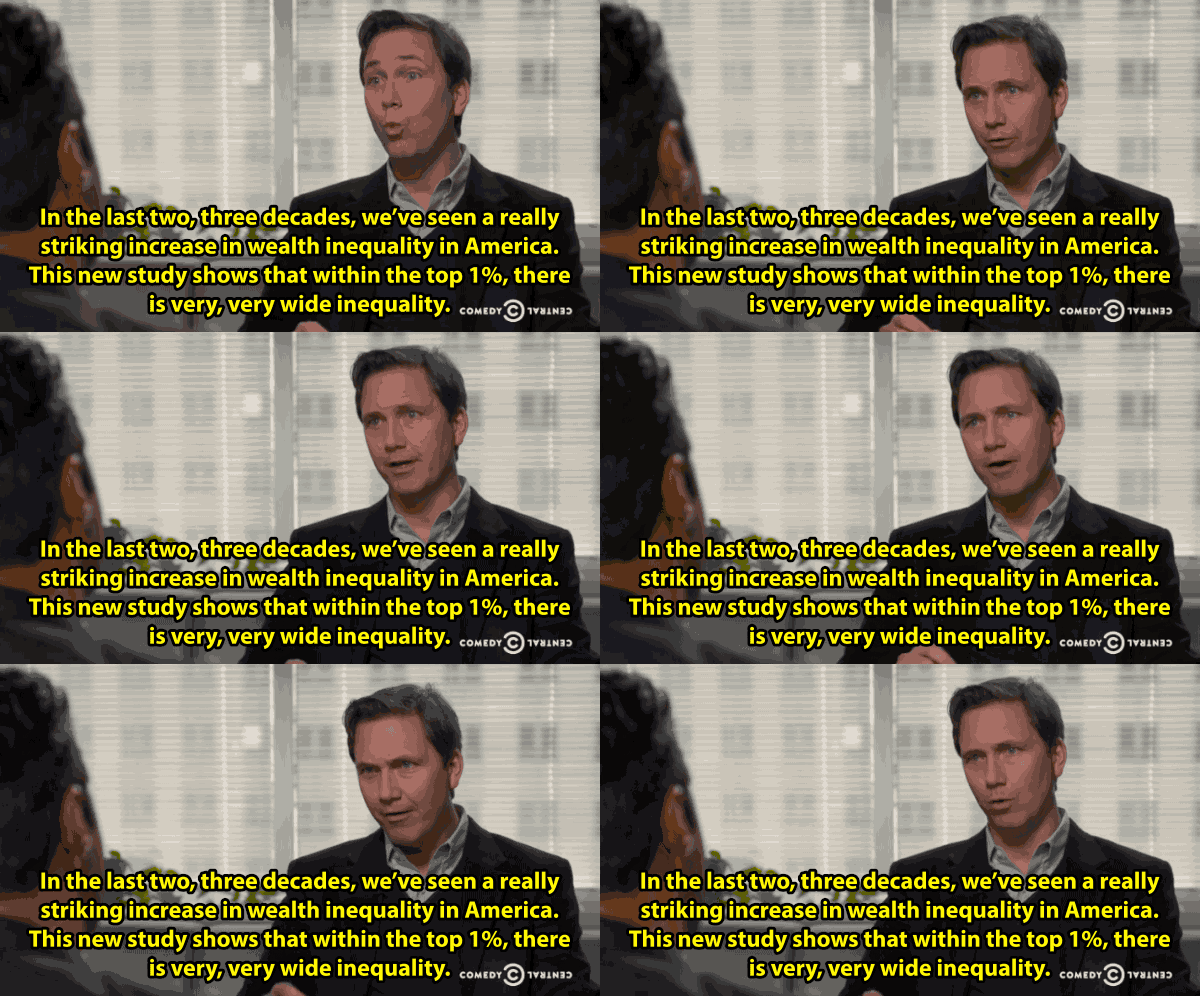
Minhaj spoke to Richard Reeves, an economist with the Brookings Institute, who painted a dark picture:
wealth, comedy, Hasan Minhaj
Wealth inequality on the rise. All GIFs via Comedy Central.

The study Reeves refers to points to the growing wealth of the top 10th of the top 1%:

“The rise of wealth inequality is almost entirely due to the rise of the top 0.1% wealth share, from 7% in 1979 to 22% in 2012 — a level almost as high as in 1929. The bottom 90% wealth share first increased up to the mid-1980s and then steadily declined.”

And no one’s paid any attention.

Between the cries of the 45.3 million people in poverty and a dwindling middle class in every state, the voice of the average millionaire is all but drowned out.
the one percent, inequality, investment
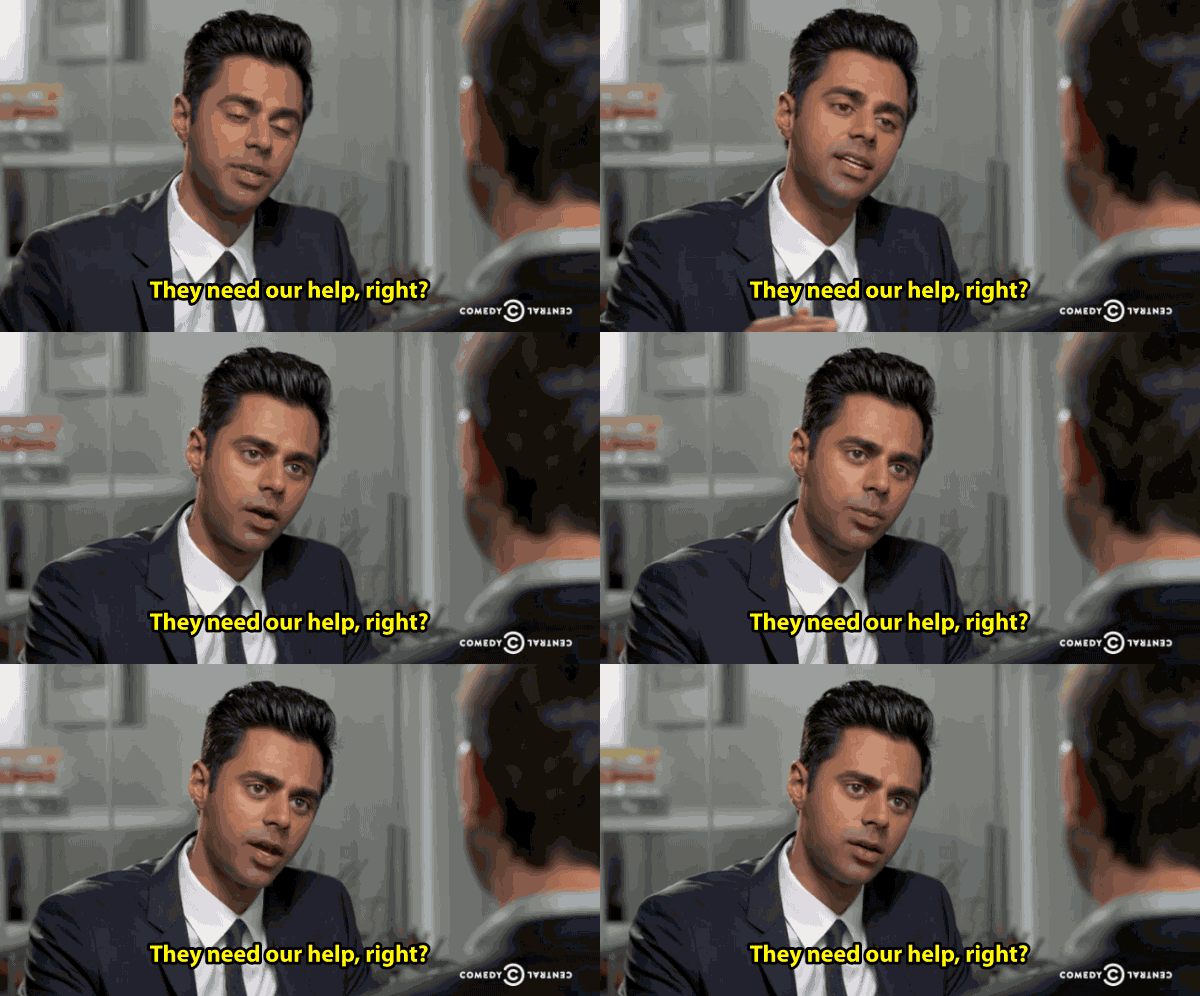
Millionaires unconcerned with financial disparity. All GIFs via Comedy Central.

But not all millionaires are worried about growing inequality in the top 1%.

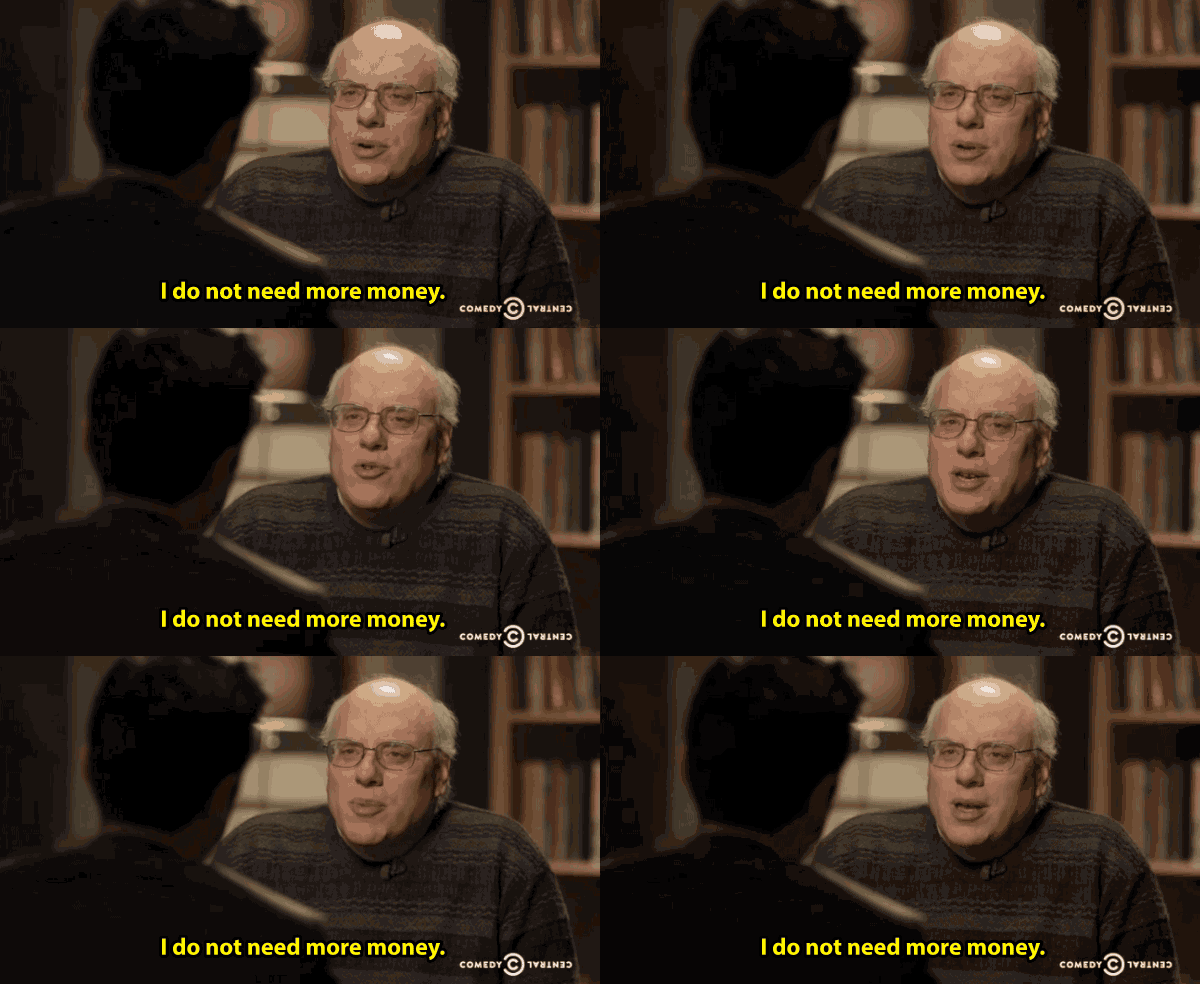
In his search for a concerned millionaire, Minhaj met Morris Pearl, a retired investment banking director and member of an organization called The Patriotic Millionaires. Minhaj was baffled by what Pearl had to say:
resources, rich, Ronald Reagan
Investment banking pays well. All GIFs via Comedy Central.

What about trickle-down economics?

Trickle-down theory was popularized under Ronald Reagan’s presidency. The idea was that clearing a path for the rich to make more money would spur more private investment, which would lead to more jobs and higher wages for all workers.

tax breaks, income, classism
Attempting the preach the reverse. All GIFs via Comedy Central.

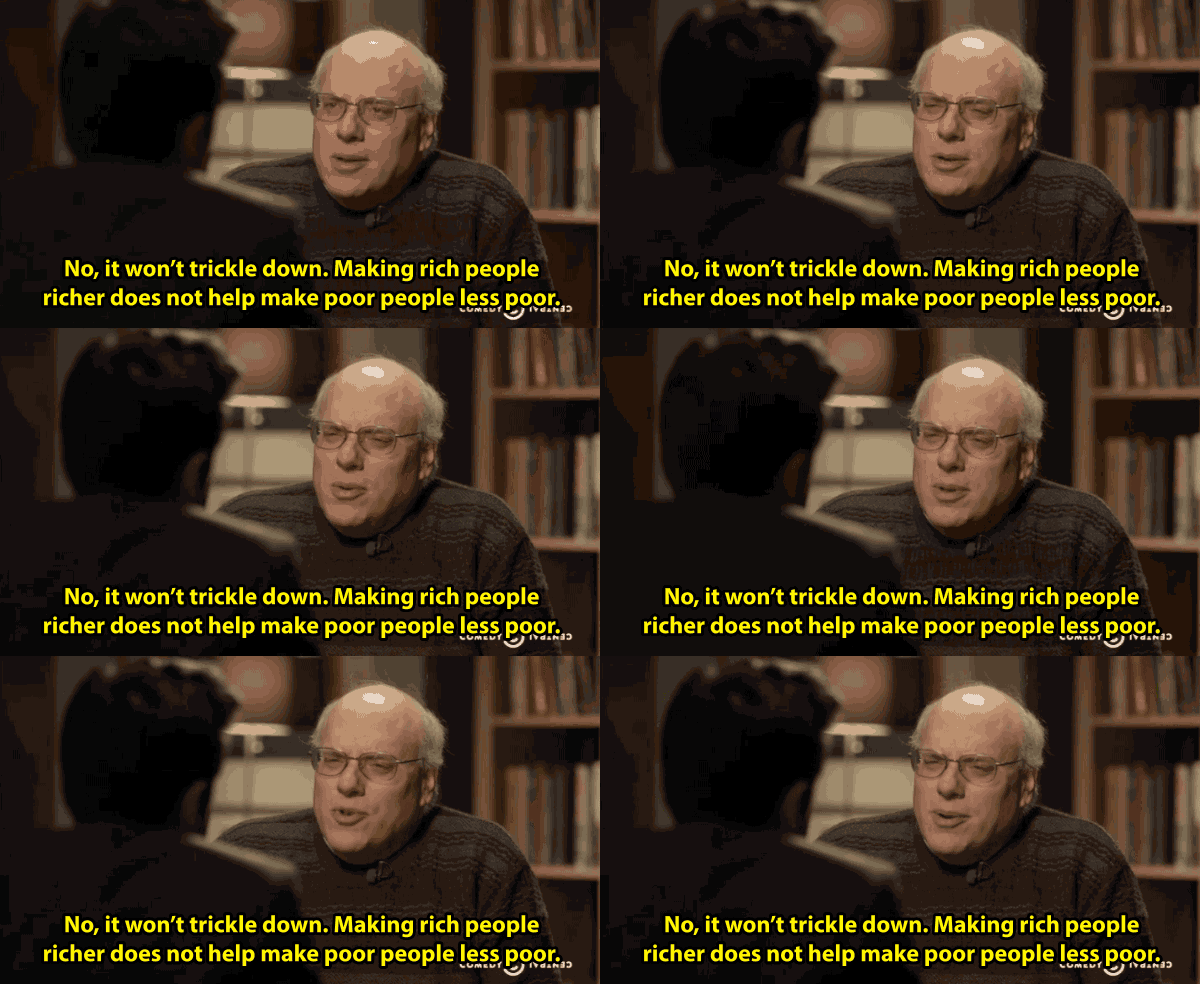
Reagan put trickle-down theory into practice in two basic ways: by lowering taxes for the wealthy and by freezing wages for the poor.

In 1981, he cut the top marginal income tax rate — which only applies to the highest-income households — from 70% to 50%. Then in 1986, he more than doubled-down by slashing the rate to 28%. (The current rate is 39.6%.) And under Reagan’s leadership, the minimum wage was frozen, even as costs of living were rising.

Pearl and other so-called Patriotic Millionaires think top one-percenters like themselves should pay more taxes.
trickle-down theory, financial institutions, comedy show
Making rich people richer. All GIFs via Comedy Central.

Not only that, they believe raising the minimum wage is critical to reducing inequality.

OK, maybe not everyone — including millionaires — are convinced that giving more money to the rich will fix the economy. So why do our policies do just the opposite?


This article originally appeared on 3.23.15

  • Video of two brothers Irish step dancing to Beyoncé’s country hit ‘Texas Hold ‘Em’ is pure delight
    The Gardiner Brothers stepping in time to Beyoncé's "Texas Hold 'Em."Photo credit: Gardiner Brothers/TikTok (with permission)

    In early February 2024, Beyoncé rocked the music world by releasing a surprise new album of country tunes. The album, Renaissance: Act II, includes a song called “Texas Hold ‘Em,” which shot up the country charts—with a few bumps along the way—and landed Queen Bey at the No.1 spot.

    As the first Black female artist to have a song hit No. 1 on Billboard’s country music charts, Beyoncé once again proved her popularity, versatility, and ability to break barriers without missing a beat. In one fell swoop, she got people who had zero interest in country music to give it a second look, forced country music fans to broaden their own ideas about what country music looks like, prompted conversations about bending and blending musical genres and styles, and gave the Internet a crash course on the Black roots of country music.

    And she inspired the Gardiner Brothers to add yet another element to the mix—Irish step dance.

    In a TikTok that’s been viewed over 42 million times, the Gardiner Brothers don cowboy hats while they step in time to “Texas Hold ‘Em,” much to the delight of viewers everywhere.

    Watch:

    Michael and Matthew Gardiner are professional Irish-American step dancers and choreographers who have gained international fame with their award-winning performances. They’ve also built a following of millions on social media with videos like this one, where they dance to popular songs, usually in an outdoor environment.

    The melding of Irish dance with country music sung by a Black American female artist may seem unlikely, but it could be viewed merely as country music coming back to its roots. As mentioned, country music has roots in Black culture and tradition. One major staple of the country music genre, the banjo, was created by enslaved Africans and their descendants during the colonial era, according to The Smithsonian. The genre also has deep roots in the ballad tradition of the Irish, English and Scottish settlers in the Appalachian region of the U.S. Despite modern country music’s struggle to break free from “music for white people” stereotypes, it’s much more diverse than many realize or care to admit, and Queen Bey is simply following tradition.

    banjo, country music, country, roots, genre
    Man playing banjo. Canva Photos

    People are loving the blending of genres and culture that the TikTok exemplifies.

    “Never thought I’d see Irish step dancing while Beyoncé sings country,” wrote on commenter. “My life is complete. ♥️”

    “So happy Beyoncé dropped this song and exposed my timeline to diversified talent ,” wrote another.

    “Beyoncé brought the world together with this song ,” offered another person.

    “Ayeeee Irish Dancing has entered the BeyHive chatroom… WELCOME!! ” exclaimed another.

    “I don’t think I can explain how many of my interests are intersecting here,” wrote one commenter, reflecting what several others shared as well.

    The Beyoncé/Gardiner Brothers combo and the reactions to it are a good reminder that none of us fit into one box of interest or identity. We’re all an eclectic mix of tastes and styles, so we can almost always find a way to connect with others over something we enjoy. What better way to be reminded of that fact than through an unexpected mashup that blends the magic of music with the delight of dance? Truly, the arts are a powerful uniting force we should utilize more often.

    And for an extra bit of fun, the Gardiner Brothers also shared their bloopers from filming the video. Turns out stepping in the rain isn’t as easy as they make it look.


    This article originally appeared last year. It has been updated.

  • Romeo is ‘cringe’: English teacher shares what Gen Z thinks about ‘Romeo & Juliet’
    A high school teacher shares the unhinged things her students have said about 'Romeo & Juliet.'Photo credit: @miss.dugan1/Instagram

    Shakespeare is a staple of any high school English curriculum. Yet, getting young folks to actually understand, let alone appreciate, the Good Bard’s work has always been a bit of a challenge. Unless you’re teaching it to a room full of theatre kids, that is.

    Recently, a high school teacher named Molly Dugan shared some of her current students’ reactions to one of Shakespeare’s most notable works, Romeo & Juliet. Spoiler alert: they weren’t fans. Nonetheless, their remarks were comedy gold.

    High schoolers react to Romeo & Juliet

    Some of the comments reflected the same counterpoints many younger generations have had about well-received works of yesteryear (looking at you, ’90s rom-coms).

    For instance, one student said, “Romeo is hella cringe, get him off my screen.”

    Meanwhile, two other students accused him of being a “hella stalker” with “bad rizz” who just “wants the huzz,” a.k.a. a girl, a woman, or, to really make it feel dated, a “boo.”

    Folks in the comments didn’t really disagree with these points. 

    “‘Bro’s a hella stalker’ oddly accurate take😂,” one viewer wrote. 

    Another echoed, “Bro actually was a hella stalker and arguably was hella cringe.”

    Another teacher even shared, “Directed it last year. Best response: ‘where are their parents?!’”

    Distinct brand of savage high school sarcasm on full display

    “Oh, so you actually hate us,” one student said, apparently after Dugan asked the class to get their notebooks out.

    Another delivered a rather low blow, saying, “We don’t need subtitles. We’re not old.”

    But then some genuinely baffling questions left many wondering if this generation is, in fact, “cooked”:

    “Was there time back then? Like, did it exist when Romeo and Juliet were alive?”

    “Is Shakespeare a real person? Because I thought he was one of those Greek gods. So I’ve been confused.” 

    Woof. That’s…something.

    Apparently, a few other teachers have had very similar experiences

    “One year I got ‘What’s Shakespeare’s last name?’” one commented. 

    Another shared, “At the beginning of teaching the Anne Frank unit, I asked my 8th graders what they knew about her…’Isn’t she a rap star?’ 😳”

    Who knows—perhaps the kiddos would have appreciated this Gen Z–ified version of Romeo & Juliet

    Shakespeare’s work has always been a bit of a hurdle for students

    His plays were written more than 400 years ago, after all, and can sometimes feel as though they’re in an entirely different language. On top of that, Shakespeare wrote in verse, using rhythm and poetic devices that were meant to be heard onstage rather than quietly analyzed in a classroom. When those lines are lifted from the stage and dropped into a worksheet or textbook, it can take a lot more effort for students to connect with what’s actually happening in the story.

    Cultural references can also add another layer of confusion. Jokes, social norms, and expectations around love, family, and marriage were very different in Elizabethan England than they are today. Without that context, characters’ actions can seem strange, exaggerated, or downright problematic to modern readers.

    That’s part of what makes teaching Shakespeare such a unique challenge. Teachers often have to act as translators, guiding students through unfamiliar vocabulary and historical context while also trying to reveal the very human stories beneath it all.

    Once you get past the old-fashioned phrasing, the themes are surprisingly relatable

    Romeo & Juliet is about power dynamics, rivalry, and impulsive decisions that spiral out of control (and love, I guess). Those ideas are still easy to recognize, even if the characters express them in dramatically poetic language. It’s what gives Shakespeare such staying power and explains why he continues to show up in classrooms century after century, much to the bemoaning of high schoolers.

  • In 1893, a popular magazine predicted how fashion would change over the next 100 years. It is wild.
    Imagined outfits of the 1980s by a man in 1893.Photo credit: Public Domain

    If we look back over the last 100 years of fashion, we can see how much has changed. The 1920s were famous for loose, square-cut flapper dresses and pinstripe suits with wide-legged trousers. The ’50s saw fitted shirts, poodle skirts, and the “greaser” in his jeans, T-shirt, and leather jacket. The ’70s brought us bell-bottoms. The ’80s lit up with neon, and the ’90s grunge craze had us all in flannels.

    Just hold those images in your mind real quick as we make our way back to the 1890s. Victorian-era fashion was marked by corsets, bell-shaped skirts, and three-piece suits. Against that backdrop, in 1893, The Strand Magazine published predictions of what people would wear in the coming century. And, well, you just have to see it.

    The magazine feature by W. Cade Gall was called “Future Dictates of Fashion.” Gall framed his piece as a fictional story about an old man mysteriously finding a book published in 1993 called The Past Dictates of Fashion.

    Fashion, according to the made-up 1993 author of the made-up book, was governed by “immutable laws.” But according to Gall, those laws were unknown in 1893, when people thought of fashion as “a whim.” By the 1940s, however, fashion would assume “the dignity of a science.” It would even be taught in universities from the 1950s onward.

    Whatever those immutable laws of fashion were supposed to be, they must have been wild to explain the hilariously wrong predictions of what people would wear in the 20th century.

    You still have those 1920s fashion images in your head, right? Compare them to these drawings:

    Sketches of imaginary outfits from 1922, 1926, and 1929
    The 1920s predictions were a far cry from the roaring ’20s. Photo credit: Public domain

    To add to the hilarity, here’s the commentary on the skirt length in the first drawing:

    “The skirt, it is true, is short enough to alarm prim contemporary dames, and it is scarcely less assuring to find in the whole of the remaining plates only three periods when it seems to have got longer.”

    Imagine if they’d seen the knee-length flapper dresses of the actual 1920s, followed by the miniskirts of the ’60s. The sheer horror.

    The style sketches for each decade provide laugh after laugh. What in the Shakespearean Strawberry Shortcake–Bo Peep is happening here in the 1930s?

    Sketches of imaginary outfits from the 1930s
    There’s a lot going on here, and none of it looks like the actual 1930s. Photo credit: Public domain

    The 1950s weren’t much better. Apparently, there was a trend toward a court-jester look in the mid-’50s?

    Sketches of imaginary outfits from the 1950s
    The 1950s: Puritan clowns or Shakespearean court jesters? Photo credit: Public domain

    The ’70s got a couple of things closer-ish to reality, kind of. Those collars could hint at butterfly collars, perhaps? And that 1978 outfit almost looks like bell-bottoms. Can we imagine people showing up to the disco in these digs?

    Sketches of imaginary outfits from the 1970s
    At least the 1970s had bell-bottoms, sort of. Photo credit: Public domain

    How about the ’80s? Do we see acid-washed jeans? Parachute pants? A preppy sweater tied around the shoulders, perhaps? Mmm, not exactly. More like The Wizard of Oz meets Alice in Wonderland.

    Sketches of imaginary outfits from the 1980s
    Imagined outfits of the 1980s by a man in 1893.Photo credit: Public Domain

    If you look at what models wear on haute couture runways, you might see clothing that aligns somewhat with these sketches. But we certainly don’t see it in the daily wear of ordinary people.

    Imagine showing the folks in 1893 today’s kids in hoodies and jeans. Or moms in yoga pants and cropped tees. It would blow their Victorian minds.

    Of course, no one can predict the future, and Mr. Gall in 1893 didn’t have the benefit of seeing the drastic shifts in clothing that we’ve witnessed over the past several generations. It’s hard to look outside of our own experience and timeline and imagine something totally different. Could we predict the next century of fashion? Would we even dare to try?

    Perhaps someone should, if only to provide some chuckles to our descendants 100 years from now.

  • Man who raised and released an orphaned otter films her swimming to his kayak for cuddles
    Leya comes up to Mats Janzon on his kayak for cuddles. Photo credit: Courtesy of Mats Janzon /TikTok

    When Mats Janzon found Leya, she was just a tiny baby curled up alone in the grass near his home in Sweden. Janzon was out on a quiet walk in the woods when he heard a soft peeping sound and saw it was a baby otter. He kept his distance for several hours, hoping her mother would return. When no one came, he searched the area and found that her mother had been killed on a major road nearby. Leya appeared to be starving and barely breathing, and he knew she wouldn’t make it without help.

    Janzon had volunteered with animal rescues while working as a pilot in Cyprus, but after moving back to Sweden several years ago, he felt a pull to leave his job and spend more time in nature. “This shift led me to focus on helping wildlife,” Janzon tells Upworthy. “I’ve cared for various animals, mostly birds, that seemed to find me. Huginn, a crow I rescued, stayed with me for three years before he was ready to join his own flock in the wild.”

    However, Janzon had never raised an otter before and didn’t know what to do. He was scared, as Leya needed care around the clock, but she began to thrive and quickly bonded with him. She would cry when he left the room and curl up in his lap to feel safe.

    “The first time she let me pet her, I remember thinking this can’t be real,” Janzon told the TikTok account SoulPaws Tails. “It felt like a dream, this wild, free otter choosing to trust me.”

    Still, Janzon kept second-guessing himself, wondering if he was doing the right thing. Otters are wild animals, and he knew Leya couldn’t stay indoors forever. So, starting with a plastic kiddie pool in the backyard, Janzon helped Leya learn to swim. She was awkward in the water at first, but little by little, day by day, she grew more confident.

    @matsjanzon

    Two years ago, our sweet otter pup Leya took her very first splash in a cozy baby pool, a moment that still melts our hearts! At just a few weeks old, tiny Leya was all curiosity and wobbly paws as she explored the shallow water filled with colorful floating toys. ?✨ Her first cautious pats at the surface turned into excited splashes as she chased the toys. Watching her dive and twirl, already showing off her natural otter grace, was pure magic. Now, at 2 years old, Leya’s likely out in the wild, thriving and possibly finding a safe territory for her own pups. ? We’re so proud of the strong, playful otter she’s become, and we’ll always cherish those early days of her splashing adventures in that little pool. ? Here’s to Leya, ruling the rivers and raising her own little swimmers! ?? #Throwback #FirstSwim #OtterMemories #WildAndFree #fyp #foryourpage

    ♬ The Moment of Love – Seok Jeong Ran

    Leya followed Janzon everywhere. Soon she became part of the family, which included another rescued crow and a cat. The animals would play hide and seek, chasing one another around the bushes. Janzon says it was like something out of a children’s storybook.

    Once Leya was totally comfortable in the water, he took her down to the lake. She looked up at Janzon as if to ask, “What now?” He nodded at her, and she jumped into the water. He realized that in some way he’d become a father to her.

    “I named Leya while sitting with her on my lap, gazing out over the lake in a near-meditative state,” Janzon tells Upworthy. “I quietly asked her, ‘Who are you? What should I call you?’ The name Leya popped into my mind, and when I said it aloud, she instantly looked up at me. That’s when I knew it was the name meant for her.”

    But as Leya grew, so did her wild instincts. She began to wander farther and stay out longer, and Janzon knew it was time to let her go. He describes it as “a strange kind of love—part pride, part heartbreak” but she started living the life she was meant to live.

    @soulpaws_tails

    This Otter Hope Into My Kayak Every Morning Just To Say “Hello”. Beautiful And Heartwarming Story of Leya The Otter #animals #animalsoftiktok #tiktok #otter #tiktok

    ♬ original sound – SoulPaws Tails

    “Leya is an old soul, brimming with energy and positivity, always finding opportunities in everything,” Janzon says. “Nothing seems impossible for her. She’s been a true inspiration and a dear friend during my transition from a conventional career to a life focused on something greater, not just working to pay bills, but making a difference by helping all living beings in our community.”

    At some point, Leya started staying away for days at a time. But even then, when Janzon was out for a morning kayak ride on the lake, he’d see her nose pop out of the water and start moving towards him. Leya knew he was there and would swim up and climb into the kayak for cuddles and a ride.

    Sometimes she’d even bring a snack with her:

    And sometimes she’d return after nearly a week away for a little snuggle time:

    People love seeing Leya’s bond with her human and Janzon’s peaceful videos that seem like something out of a dream:

    “Sorry, which fantasy world is this and can I have the Google maps link to get there?”

    “I wish the world could be like this.”

    “She’s your significant otter.

    “You are so lucky to be friends with a cute otter who also gets to live her own life. She chooses to be with you.

    “She’s just living her best life and I think you are too – good luck to you and enjoy it.

    otter, leya the otter, otter rescue, mats janzon, tame otter
    Leya and Mats hanging out in his kayak. Courtesy of Mats Janzon

    Mats says Leya is officially living her wild life now.

    “I last saw Leya at the end of May,” Janzon tells Upworthy. “Initially, we thought she’d find her own territory before winter, but after several long trips, she chose to stay under the house while the lake was frozen. When spring arrived, she resumed her search, staying away for up to 10 days before returning for brief visits, lasting a few hours to a day. Her last visit was unusually long, over a week. I suspect she may have been pregnant, eating heartily to prepare for a longer stay in a new territory farther away.”

    Janzon wants people to know that as much as he loves Leya, she’s not a pet. “When an animal trusts you, it creates a bond deeper than words can explain,” he told SoulPaws Tails. “If you’re thinking of adopting or rescuing an animal, especially a wild one, please do it with your whole heart and full responsibility. Do your homework, talk to professionals, ask questions, learn everything you can about animals like Leya. They aren’t pets. They’re living, feeling souls that deserve to be loved and respected for who they are.”

    You can follow Mats Janzon and see more videos of Leya on TikTok.

    This article originally appeared last year. It has been updated.

  • Chinese teacher shares 18 American names with delightfully awkward meanings in Mandarin
    Some American names sound really funny to Mandarin speakers.Photo credit: Canva

    When you see a list of the year’s most popular baby names, what you’re really looking at are the most common baby names in a specific country or culture. If you live in the U.S., you likely know a whole lot of kids named Olivia, Emma, Liam, and Noah, but if you live in Thailand or Kyrgyzstan or Botswana, you probably don’t.

    Simply saying common names in different countries can sometimes result in hilarity. A name that sounds beautiful and has a lovely meaning in one language might sound odd and mean something very different in another. For instance, Odd is a common name in Norway, but it sounds…well, odd to and English ear. The former president of Vietnam had the last name Phuc, which surely led to some awkward moments for Americans who had to address “President Phuc.” (The “u” is pronounced more like the “oo” sound, but if you’d never heard it said, you wouldn’t know.)

    Chinese language and culture instructor Dr. Candise Lin is sharing American names that sound funny to Mandarin speakers because of what they mean when pronounced with Chinese phonetics, and it’s a hoot.


    1. Robin (pronounced Luo ben) = Running Naked

    2. Robinson (pronounced Luo ben shen) = God of Running Naked

    3. Nelson (pronounced Niao shen) = God of Pee

    4. Benson (pronounced Ben shen) = God of Dumb

    5. Mason (pronounced Mei shen) = God of Beauty

    6. Nicholas (pronounced Ni kou si le) = You Are So Stingy

    nicholas cage, names, surprised, language, translations
    Surprised Nicolas Cage GIF Giphy

    7. Isabella (pronounced Yi sheng bei la) = The Doctor Got Arrested

    8. Dylan (pronounced Di neng) = Low IQ

    9. Nancy (pronounced Nan si) = Difficult to Die

    10. Robert (pronounced Luo bo) = Carrot

    11. Ashley (pronounced Ao si ni) = Wear You Down to Death

    12. Logan (pronounced Nao geng) = Brain Stroke

    13. Tiffany (pronounced Ti fa ni) = Kick Your Ass

    tiffany, names, translations, chinese, mandarin

    Tiffany Darwish GIF by New Kids On The Block Giphy

    14. Martha (pronounced Ma hua) = Fried Dough Twist

    15. Jeff (pronounced Jie fu) = Brother-in-law

    16. Daniel (pronounced Da niu) = Big Shot

    17. Gordon (pronounced Gou dan) = Dog Balls

    18. Melanie (pronounce Mei ren li) = Nobody Cares

    A few of these names actually seem pretty rockstar in Mandarin. Mason as “God of Beauty’? Nothing wrong with that. Nancy being “Difficult to Die?” Heck yeah. But some are particularly unfortunate. God of Pee? Yeesh. Low IQ? Ouch.

    Of course, the names in Chinese are based on transliterations that aren’t exact. English and Mandarin have different sounds, so many of them are just the closest approximations that there are in terms of pronunciation. (But then along comes Tiffany, kicking ass as clear as day.)

    chinese characters, china, mandarin, language, english

    Chinese characters aren’t phonetic in the way that English letters are. Photo credit: Canva

    Naturally, people who have some beef with people who bear some of these names are having a heyday, with comments like “Ashley actually makes a lot of sense,” or “Not Gordon Ramsay actually being called Dog Ballz Ramsay.” But mostly people are just delighted to see how names they see as totally “normal” mean hilarious things in Chinese.

    As one person wrote, “This was awesome and about time! Chinese names get a lot of humor attention in English circles. It’s nice to know English names can also be a bit ridiculous in Chinese.” It’s likely that many of us have never thought about how American names might sound in other countries.

    But names not translating well is truly a universal phenomenon, and as long as we’re all laughing about it together, finding the funny when things—even our names—get lost in translation can be a fun way to connect across cultures.

    This article originally appeared last year. It has been updated.

  • Adults who lived through the 90s share 15 things we all misremember about the decade
    It wasn't all a grunge-filled barrel of laughs. Photo credit: The Everett Collection

    The ‘90s are often depicted as a golden age. A time of less violence, more money, better music, equal rights, unprecedented technological progress, and Beanie Babies instead of Labubus. A time of peace throughout the land.

    However, take a quick romp through actual history and we see that when we take the rose-colored glasses off, the ’90s weren’t without its less-that-stellar moments. Furthermore, there was a lot more nuance to it than teens wearing a bunch of flannel and listening to grunge music.

    Across several Reddit threads, people who actually lived through the ’90s have shared some prime examples of how we get the ’90s wrong and elements we have completely forgotten about, from recalling society’s very unhealthy obsession with thinness, to police brutality, to the questionable hunter green/maroon craze (remember that?).

    Take a scroll down memory lane with our 15 favorites:

    1.”The early 90s and late 90s were two very different times culturally. I can’t stand it when I see a picture of the spice girls with a ‘So 90s!’ caption.”

    “There’s a HUGE difference between the early 90’s and late 90’s. After 1996 it was more millennial, Pokémon, Britney Spears vs the early 90’s which was more grunge and smooth RnB.”

    2. “Not all Gen Xers were disinterested slackers in the 90s.”

    “I graduated from university in 1991. I spent the 1990s trying to get a decent job, pay rent and generally just getting my shit together. Most other people my age seemed to be doing pretty much the same thing, unless they had rich parents.”

    3. “Nobody seems to talk about all the maroon and hunter-green wallpaper strips that were added to the top of the walls in houses. Maroon and hunter-green everywhere. From cars to vacuums and beyond.”

    “My comforter set for my freshman dorm (Fall 1994) was maroon on one side, hunter green on the other. I realized it was dark and depressing so I got a girlie daisy print bedspread for the rest of college.”

    4. “Money was tight then, too. People were happy with fewer luxuries, because we could get by. And the very idea of giving a child a device worth hundreds of dollars was ludicrous! I still feel this way.”

    5. “A lot of people talk about the 90s like it was a utopian decade. Sure, a lot of stuff was awesome. But there was also the AIDS epidemic, the crack epidemic, the heroin epidemic, lots of police brutality, the sharp uptick in domestic terrorism, etc. plus the casual sexism, racism, & homophobia. The hope for the future that started in late 1989 with the fall of the Berlin Wall and the heating up of our economy in the mid-90s only lasted until 2000. It was a very brief window, in retrospect.”

    6. “Female celebrities were shrinking to child sizes and getting praised for it. ‘Thinspo’ was a thing. ALL my friends group from high school and college, including myself, had eating disorders — Marlboro Light and Diet Coke for every meal. Our idea of sports was extreme cardio only. We were SO unhealthy. Thank God we were young enough to bounce back to normal without major issues.”

    7. “That Nirvana ruled the 90s, and killed off all other forms of hard rock. They hit hard for about two and a half years, and then we were stuck with Tonic and the goddamn Spin Doctors.”

    “A lot of people mention grunge and gangsta rap, but country was very hot too. Country line dancing became a big thing, Branson, Missouri became a big tourist destination with its theaters, and artists like Garth Brooks and Shania Twain made tons of money.”

    “I don’t think the Riot Grrrl movement gets enough recognition and acknowledgment as an extremely significant 90s cultural event.”

    8. “I think one idea that’s misrepresented is that we were already online, all the time.”

    “I mean, I was STOKED when I got into the dorm with LAN connections in 1993, but I was an outlier. Lots of kids at my college barely understood using computers, much less anything internet-related beyond maybe an AOL/AIM. Obviously this was an evolution of ten very fast moving years.”

    9. “That mom Jeans were cool. No one under 35 wore them.”

    10. “Not everyone wore Doc Martens back in the 1990s. Many people wore military boots as a fashion statement that were often mistaken for Doc Martens, while others wore sneakers every day, even in venues where they should have been wearing more formal shoes.”


    11. “Cellphones were considered tacky and unnecessary unless you were a doctor.”

    12 .”Not everyone got around on rollerblades.”

    13. “Property was cheaper, not cheap as in affordable to all.”

    14. “If your family lived in a rural area and wasn’t rich enough to immediately buy a computer, you could be lonely in a way that people can’t even comprehend now. I spent the last two years of high school doing nothing, watching TV and playing 16-bit RPGs repeatedly because I couldn’t get anywhere or do anything.”

    15. “Drunk driving didn’t have the stigma it does today. It took a long campaign waged by MADD (Mothers Against Drunk Driving) to shift public perception on how dangerous drunk driving is.”

    This article originally appeared last year. It has been updated.

  • 6 super-popular survival and safety myths that are in dire need of busting
    A snake and a cactus. Photo credit: Canva

    For whatever reason, we love a good survival story. Whether it’s a Hollywood film about Tom Hanks stranded on a desert island or a reality TV show about a former special forces soldier foraging for food and shelter in the jungle, we can’t get enough.

    Unfortunately, for many of us, our knowledge of survival and emergency situations doesn’t go much further than what we’ve seen on television. Worse, much of what we’ve learned and come to accept as good advice is actually wrong. Many of the techniques in question are either ineffective, dangerous, or exaggerated for entertainment value.

    If you ever find yourself stranded, lost, or in a life-threatening situation, here are a few popular survival myths to be aware of:

    1. Sucking venom out of a snakebite

    If you get bitten by a venomous snake, the smart move is to get the venom out of the wound as soon as possible. The only problem? This doesn’t actually work. And neither do devices that claim to extract the venom.

    “Snake venom rapidly diffuses into deep tissue—it’s not just pooled up under the skin ready to be suctioned out,” prepper Sean Gold tells Upworthy. “Being able to suck the venom back through the snake’s bite is also impossible, since the bite tracks immediately collapse when the fangs are removed.”

    What to do instead: You need medical attention and antivenom. If you can’t get help, immobilize the wound and keep it below heart level.

    2. Drinking cactus water

    We all know that cacti thrive in the desert due to their incredible ability to store water. That makes the idea of cutting one open to quench your thirst pretty appealing. Unfortunately, the water stored in a cactus isn’t suitable for drinking.

    According to the Encyclopedia Britannica:

    “Most cactus species further protect their spongy flesh with acids and potent alkaloids. These chemicals are usually too acrid for most humans to tolerate and are taxing on the kidneys if ingested. The flesh of some cactus species can also cause vomiting, diarrhea, or temporary paralysis—none of which is conducive to your survival in an emergency situation.” 

    What to do instead: Your best bet is digging in a dry riverbed to find water, or following birds, bees, and trees to a better source. More importantly, don’t overexert yourself in the heat of the day in order to conserve hydration.

    3. Counting on moss to navigate

    Ever heard the old rule that moss only grows on the north side of a tree? The idea comes from the fact that moss prefers shady areas, which are more likely to face north. Some people believe you can use this concept to navigate your way out of being lost.

    Sadly, moss will grow just about anywhere. It’s often found on north-facing surfaces, but not reliably enough to use as a compass.

    What to do instead: Serious survivalists learn how to navigate using the stars and the sun. The easiest thing to remember is that the sun rises in the east and sets in the west, though not precisely.

    survival, survival myths, prepping, wilderness, lost, television, movies, bear grylls, survivor man, desert
    Moss doesn’t only grow on the north side. Photo credit: Wimbledonian/Flickr

    4. Drinking your own urine

    It may have made for an entertaining set piece for Bear Grylls, but experts agree that drinking your own urine is not a good survival strategy.

    One reason is that in a true survival situation, you’ll be poorly hydrated and your urine will have a higher concentration of waste products.

    The Conversation writes:

    “By drinking urine with higher concentrations of waste products (and/or if your kidneys are impaired), urea and other metabolic waste products can accumulate in your body. This can become toxic to cells, particularly those in the nervous system. This can lead to symptoms such as vomiting, muscle cramps, itching and changes in consciousness. Without treatment, this toxic state (known as uraemia) can be life-threatening.”

    What to do instead: Finding fresh drinking water is one of the most difficult aspects of survival. Studying the topography of the area and heading downhill are usually your best bets for finding a stream.

    5. Hiding in a tunnel from a tornado

    A lot of people believe that if they encounter a tornado while driving, a highway overpass or tunnel is a good place to take shelter from flying debris.

    On the contrary, a bridge or overpass can act as a wind tunnel, accelerating the force of the wind and flying debris. That’s even more dangerous. Depending on your head start and which direction the tornado is moving, you may be able to drive away from it, but it’s not usually recommended, as tornadoes can reach forward speeds of 75 miles per hour.

    What to do instead: Missouri’s Storm Aware website notes, “If you are in your vehicle and a tornado is approaching, you should pull your vehicle to the side of the road immediately, get out, and lay flat in a nearby ditch covering your neck and head.”

    6. Drinking alcohol to warm up

    It’s not out of the realm of possibility to imagine yourself in a broken-down car on the side of the road during a blizzard with nothing but an old bottle of whiskey that’s been rolling around in the back for months.

    As tempting as it might be to drink it, experts say don’t do it. Drinking hard liquor can temporarily make your body feel warm, but it actually makes the situation worse.

    Outdoor Life explains: “Although you may feel warmer, alcohol actually dilates skin-surface blood vessels and capillaries, which will chill your core even faster.”

    What to do instead: Save the celebratory drink for after you’re rescued.

    There are many survival techniques and myths that would require years of learning and practice to master. But a good general rule is that real survival is boring, not flashy. In most situations, the best thing to do is stay calm, seek shelter, and try to signal for help.

  • Middle-school teacher makes fake ‘inspirational’ posters out of the unhinged things her students say
    Middle school teacher Amy McKinzie decided to have fun with some of the things her students have told her. Photo credit: @amymacgetslit/Instagram

    Kids of all ages can be cruel, but middle schoolers have a particularly savage sense of humor. Unfortunately, teachers often end up on the receiving end of it.

    Thankfully, teachers are quite resilient and have their own sense of humor. 

    Insults turned inspo

    Take middle-school teacher Amy McKinzie, who decided to take some of the ahem, questionable things her students have said to her and make faux inspirational posters out of them.

    “What doesn’t kill you makes you humble,” quipped McKinzie in her Instagram caption. In the video, dreamy landscape photos serve as the backdrop for these gems:

    “You look like you cry watching Hallmark movies.”

    funny, middle school, teachers
    Screenshot

    “It gives me the ick when you tell us to read our books.”

    “You’re older than my grandma.”

    “Will there be any math problems on our English test?”

    “Did you mean to wear your hair like that?”

    funny, middle school, teachers
    Screenshot

    Ouch! 

    The format alone is comedy gold. Pairing brutally honest middle-school commentary with soft-focus sunsets and mountain vistas feels almost poetic. If you’ve ever spent time around 12- and 13-year-olds, you know that their observations come out fast, unfiltered, and usually with impeccable timing (not to mention zero mercy). Sometimes they mean it as a joke, but often they truly do not realize how devastating the comment might sound. Either way, the result is often unintentionally hilarious.

    And sure enough, tons of viewers could instantly clock the insults as distinctly middle-school shade-throwing:

    “Lol… my daughter is that age & i can totally hear her saying some of these to me! 😮😂” 

    “You teach middle school don’t you? Those kids are vicious hahaha.”

    It prompted many other teachers to share their favorite jokes hurled at them by their students:

    funny, middle school, teachers
    Screenshot

    “My favorite- were you alive during the attack at Pearl Harbor? I’m in my 30s.”

    “My favorite is, ‘frankly, don’t you think you’re a little old to be dating?’😮”

    “Brings back great memories teaching high school English. ‘It’s time to touch up your roots.’”

    “I wore a really cute blue and white horizontal shirt or so I thought .. the girls said ‘why do you have your pajamas on.’”

    “I had a student tell me ‘You look nice today. You just need to get that hair under control.’ Yeah, still trying to figure it (my hair) out. 🤷‍♀️”

    “After showing a photo of a telegraph: ‘Is this what you used?’”

    “‘Why do you look so tired today?’ on a day I didn’t wear makeup or mascara.”

    “What was it like watching black and white tv?”

    This proves once again that teachers are made of stronger stuff.

    Teachers, of course, develop a thick skin pretty quickly. When you spend your days with students who are still figuring out how the world works and where the line between observation and roast actually lies, you learn to laugh. And sometimes, the best way to survive the burn is to frame it—literally—and turn it into content. Because let’s face it, the burns are just gonna keep comin’.

Education

Mortified teacher accidentally called a student ‘sweetie,’ and folks swooped in to fix the damage

Culture

In 1893, a popular magazine predicted how fashion would change over the next 100 years. It is wild.

Wholesome

Dedicated teacher gave his student $500 for a trip to Uganda. She showed up years later with a surprise.

Pop Culture

Man who raised and released an orphaned otter films her swimming to his kayak for cuddles