upworthy
Add Upworthy to your Google News feed.
Google News Button
Health

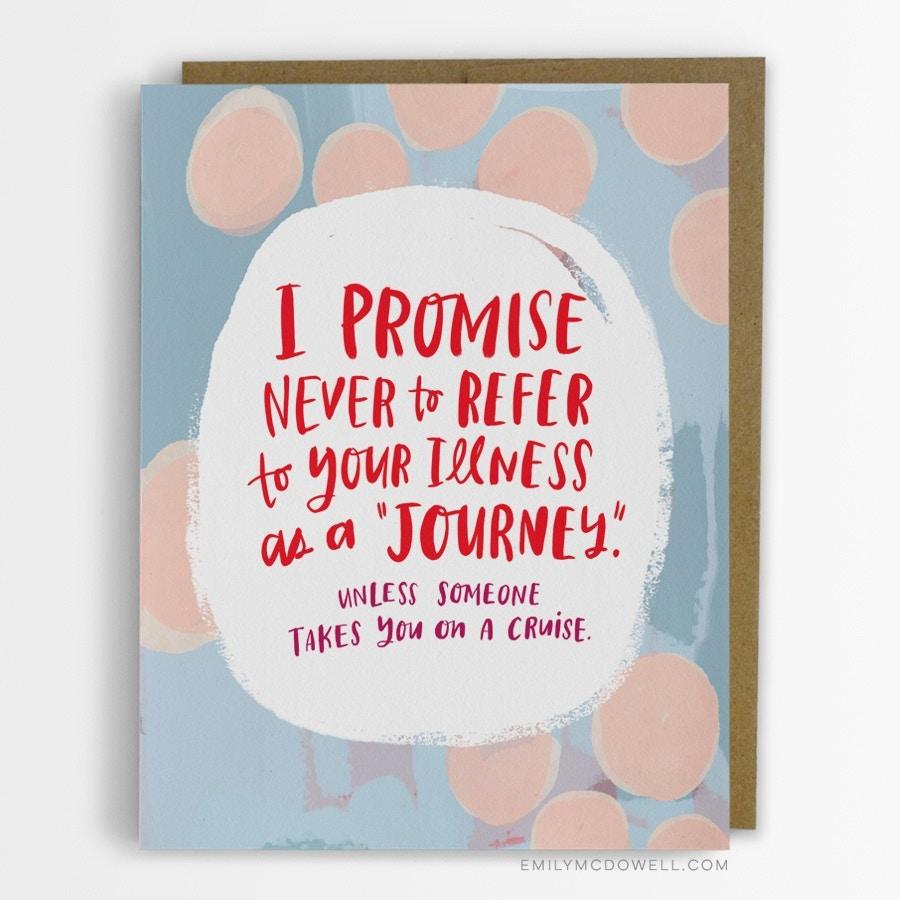
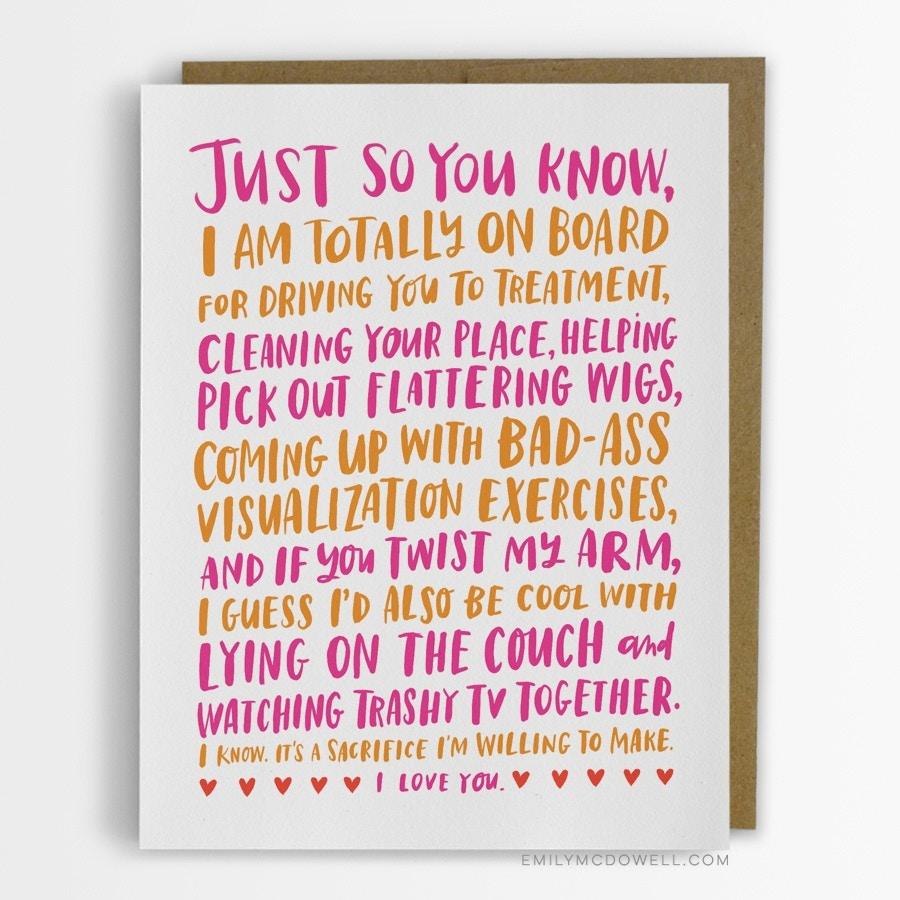
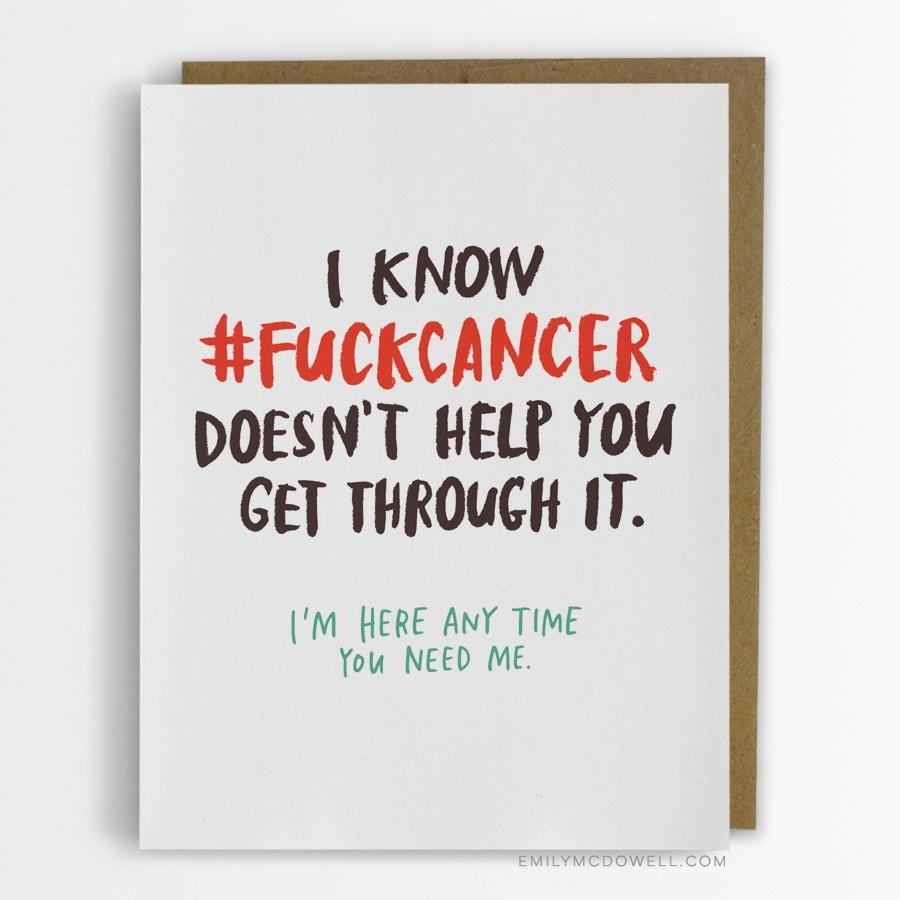
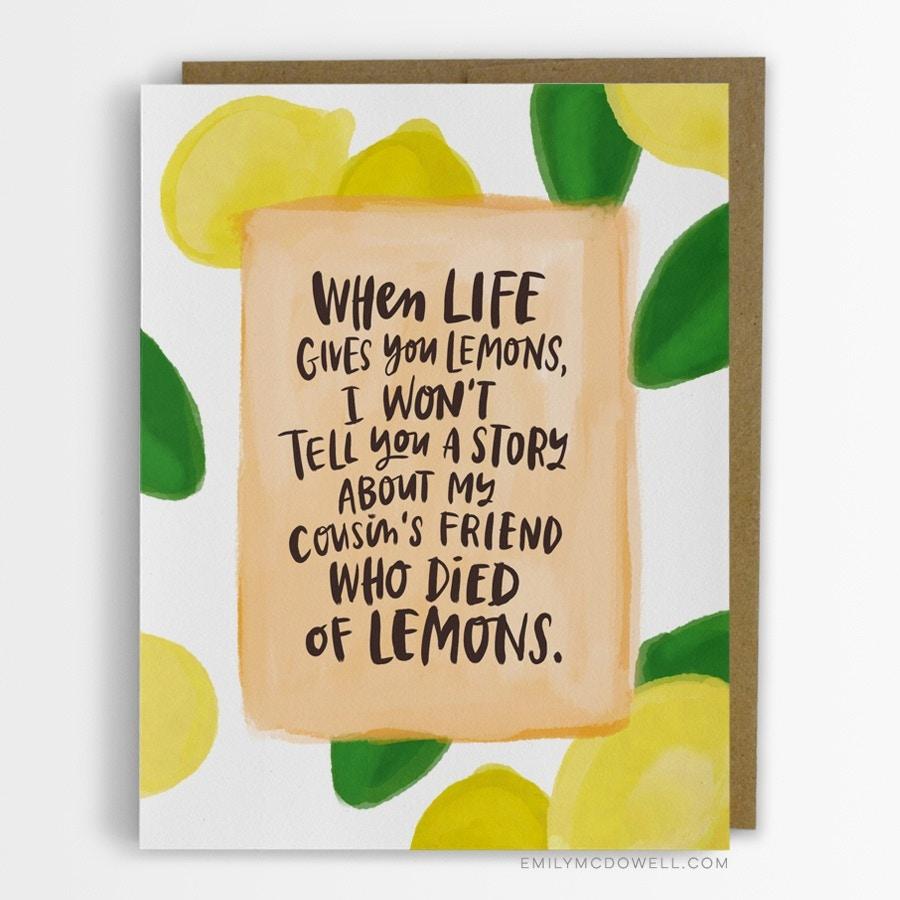
8 nontraditional empathy cards that are unlike any you've ever seen. They're perfect!

Because sincerity and real talk are important during times of medical crisis.

compassion, sympathy cards, empathy cards

True compassion.

When someone you know gets seriously ill, it's not always easy to come up with the right words to say or to find the right card to give.

Emily McDowell — a former ad agency creative director and the woman behind the Los Angeles-based greeting card and textile company Emily McDowell Studio — knew all too well what it was like to be on the receiving end of uncomfortable sentiments.

At the age of 24, she was diagnosed with Stage 3 Hodgkin's lymphoma. She went into remission after nine months of chemo and has remained cancer-free since, but she received her fair share of misplaced, but well-meaning, wishes before that.

On her webpage introducing the awesome cards you're about to see, she shared,

"The most difficult part of my illness wasn't losing my hair, or being erroneously called 'sir' by Starbucks baristas, or sickness from chemo. It was the loneliness and isolation I felt when many of my close friends and family members disappeared because they didn't know what to say or said the absolute wrong thing without realizing it."

Her experience inspired Empathy Cards — not quite "get well soon" and not quite "sympathy," they were created so "the recipients of these cards [can] feel seen, understood, and loved."

Scroll down to read these sincere, from-the-heart, and incredibly realistic sentiments.


Emily McDowell Studio

Pretty great, right? If you know someone who's in the less-than-ideal position of dealing with a serious illness, you can purchase any of these eight cards to share with them.

Visit Emily McDowell Studio's shop to select the card(s) you need. They're $5.00 each.

(We're not being paid to share these, nor were we asked to do so. We came across the cards and I loved them, so I reached out to Emily McDowell Studio and asked if I could share them with you. Unfortunately, a lot of us know someone who could use a card like one of these.)


This article originally appeared on 05.06.15



black lab, dog walker, dog walker near me, dog walker ap, neighbors, good news, pets, feel good news

black lab (left. Handwritten letter (right)

If you've lived your whole life with a dog, a home has to feel pretty empty without one. Your heart has to feel like there's something missing as well. When Jack McCrossan, originally from Scotland, moved to Bristol, England with his three friends, they were bummed out to learn that their landlord didn't allow dogs.

So when they saw a beautiful black Sheprador (a German Sheppard Lab mix) in their neighbor's window, they knew that had to become buddies with her. They wrote the dog's owner, Sarah Tolman, a letter asking to arrange a play date with the dog. "If you ever need someone to walk him/her, we will gladly do so," they wrote.


"If you ever get bored (we know you never will, but we can dream), we are more than happy to look after him/her. If you want to come over and bring him/her to brighten our day, you are more than welcome. If you want to walk past our balcony windows so we can see him/her, please do," the letter continued.

"We hope this doesn't come too strong, but our landlord won't allow pets, and we've all grown up with animals. The adult life is a struggle without one," they wrote. "Yours sincerely, The boys from number 23," the letter concluded.

Soon after, the boys in 23 received a response from the dog herself, Stevie Ticks, accepting the offer. However, it may have been written by her human, Sarah Tolman. In the letter, Stevie shares a bit about herself, saying she's two years and four months old, was adopted in Cyprus, and that she's "very friendly and full of beans." (The boys shouldn't worry about a gassy hound, in England, "full of beans" means lively.)

"I love meeting new people and it would be great if we can be friends. I must warn you that the price of my friendship is 5 x ball throws a day and belly scratches whenever I demand them," the letter continued. A few days later, the boys got to meet Stevie.

"Meeting Stevie was great!" McCrossan told Buzzfeed. "She was definitely as energetic as described. We got to take her for a walk and she wouldn't stop running!"

Tolman thought the boys' letter was a fantastic gesture in an era where, quote often, neighbors are strangers. "In a day and age where people don't really know or speak to their neighbors, it was really nice for them to break down that barrier," she said. After the story went viral, she saw it as an opportunity for people to share their love of dogs with the world. "My mother and I are amazed at all the love we've received from around the world these past few days," Tolman wrote as Stevie. "If you have a doggo in your life, share that love with those around you."

A lot has changed since this story first warmed hearts around the globe. The boys have since moved away, but as of September 2024, Stevie is around 8 years old and still living her best life. Recently, she even made it to the doggie wall of fame at her local coffee shop.

In the years since this story first went viral, pet-sharing and neighbor dog borrowing have actually become more common, especially in cities where landlords restrict pets. Several platforms (like BorrowMyDoggy) and community groups now exist to pair dog owners with trusted neighbors who want occasional playtime, walks, or dog-sitting without having to own a pet. It’s a small but growing trend that reflects how deeply animal companionship is needed—even for people who can’t adopt a dog full-time. In many apartment buildings, these kinds of informal arrangements help reduce loneliness, build community, and give non-owners the emotional benefits of living with pets.

Just goes to show the power of a dog's love…even if that dog isn't your own.

This article originally appeared six years ago.

acts of kindness, kindness homework, homework, eliminating homework, teaching kindness, students, school, kids

Four smiling children sitting together, arms around each other.

Despite controversial-but-compelling evidence that homework takes time away from families with little to no appreciable benefit for students, kids continue to slog through hours of school work outside the time they spend in the classroom. And despite evidence that small acts of kindness can infect a community like a positive virus, far too many kids are on either the giving or receiving end of unkind bullying on a regular basis.

Perhaps that's why an elementary school in Ireland decided to do something radical: ditch all homework for the month of December and assign kids "acts of kindness" instead.


In the weeks leading up to the holidays in 2019, kids at Gaelscoil Mhíchíl Uí Choileáin, Clonakilty were given a kindness task for each weekday. It broke down like this:

Monday- reach out to and communicate with an elderly person

acts of kindness, kindness homework, homework, eliminating homework, teaching kindness, students, school, kids Young girl hugging her smiling grandfather indoors.Photo credit: Canva

Tuesday- make a family member's life easier by taking over a chore or helping out without being asked

acts of kindness, kindness homework, homework, eliminating homework, teaching kindness, students, school, kids Two boys clean a table while a woman watches, with breakfast and juice nearby.Photo credit: Canva

Wednesday- random acts of kindness of any kind

acts of kindness, kindness homework, homework, eliminating homework, teaching kindness, students, school, kids Child cuddling a gray kitten lovingly in their arms.Photo credit: Canva

Thursday - do something kind for your own mental and emotional well-being

acts of kindness, kindness homework, homework, eliminating homework, teaching kindness, students, school, kids Smiling girl in a wheelchair hugging herself, wearing a yellow sweater, pink background.Photo credit: Canva

Students were asked to keep track of their kind deeds in a Kindness Diary. The school also created a Kindness Bucket, where students could write down and deposit positive observations and affirmations to boost the self-esteem of their schoolmates. On Friday mornings, random selections of the notes were read aloud for everyone to hear.

In addition, each class cooperated in a collective act of kindness for the community based on the students' own brainstorming as a team. How lovely.

It's easy to see why so many adults were on board with the idea.

"I LOVE this! Children learn from our example and how we treat them. Kindness is powerful for the giver as well as the receiver! We adults, parents and leaders of our future generation should also be displaying care, kindness and thoughtful acts of kindness as a living example! The world is changed by each doing a small kind act each day!!" one person wrote.

"What a wonderful, thoughtful and just brilliant idea! If this could only go worldwide and be practiced, I would like to believe there would be more tolerance and patience on this ball of gas," added another.

According to a Facebook post from the school, the students have been doing similar programs in December for years. In 2018, the focus was on Gratitude, which resulted in "overwhelming success and positivity."

Vice Principal Íde Ní Mhuirí was quoted in the post:

"We are encouraging our pupils to think of the real spirit of Christmas, the spirit of kindness and giving.
With such an emphasis on the materialistic and commercial aspect of Christmas, we often tend to overlook what it's really all about…. Good will!

Unfortunately not everyone is in a position to be able to enjoy Christmas, some are lonely, some are sad, some might yearn for what they do not have and some might simply not enjoy the festivities. But there is nobody in this world who wouldn't benefit from an act of kindness, and the joy of kindness is that it costs nothing.

What if schools everywhere did things like this, and not just during the holidays? What if we focused just as much on good character and citizenship as we do on test prep? What if each school took it upon itself to say, "Being kind is more important than being smart," not just for a month, but always?

The most pressing issues our world faces are not so much due to a lack of intelligence or knowledge, but rather a lack of shared values that compel us to care about one another. Without a foundation of basic human decency and kindness, knowledge and skill-building will only lead to more problems, while focusing more energy on kindness can only help build a better world for all of us.

As the school noted on Facebook:

In this world, consumed by social media, where our young people are constantly experiencing pressure, there is no better way to show them the way forward in the world than by practicing kindness. We all know that helping others makes us feel good about ourselves…. What's not to love about that?!? That feel good factor we experience form helping others cannot be quantified. Our message to the children is very simple: they can be the reason somebody smiles today and they can definitely help make this world a better place for others and for themselves.

In 2024, the school looked outside of its own community to see where it might help kids elsewhere. The staff asked that, in lieu of buying them Christmas gifts, families donate to the UNICEF Children of Gaza Appeal instead. They were able to raise €7501.00 in donations.

And in 2025, the project is still going strong. The order has switched up a bit (Mondays are for family kindness, Tuesdays are for helping the environment, Wednesdays are for reaching out to the elderly), but the overall spirit is still very much the same as when it started.

What a wonderful way to encourage well-rounded learning in ways that truly make a difference. Less homework and more kindness all around, please and thank you.

This article originally appeared six years ago.

predators, forensics, crime, women, awareness
via Екатерина Шумских/Pexels, Vladimir Konoplev/Pexels and Teona Swift/Pexels

Three women walking down city streets.

A forensics student named Alexandria recently shared vital information on TikTok that all women should know. She detailed the specific signs male predators are looking for when they choose a victim.

Her video is based on a 2013 study entitled “Psychopathy and Victim Selection: The Use of Gait as a Cue to Vulnerability.” For the study, researchers interviewed violent criminals in prison and asked them the type of women they’d be most likely to victimize.


The study found that the criminals all agreed that how the woman walked was a deciding factor.

“What the selected women all had in common was the way that they walked and how they generally held themselves in public,” Alexandria says in the video she later deleted but has been shared broadly across the platform.

@_alf_90_

How to walk for your safety! #women #safety #tips #walking #kidnapping #murder #attacks #fyp

“The selected women all had a similar ‘awkwardness’ to the way that they walked and carried themselves,” she continued. “The first part of the woman had a gait that was a little bit too small for their body, which resulted in smaller steps, slower speed and their arms more typically to their sides, or crossed, as well as their heads being down and not really taking in their general surroundings, which indicated three different things to these potential attackers.”

The woman’s body language signaled to attackers that she was fearful and anxious and because her head was down, she'd be easier to surprise. Alex then described the second type of woman the criminals said they’d target.

“On the other hand, the other part of the women that were selected had a gait that seemed a bit too big for their body and their arms tended to flail to the sides and seemed just overly awkward,” Alexandria continued.

The woman with the bigger gait signaled to potential attackers that she may be clumsy and won’t put up a good fight. “Because their arms were out and flailing to the side, it left the lower body open to, again, come around and grab them,” she said.

women, walking, predators, crime, body language Women walking down a street.Image via Canva Photos.

The video was helpful because Alexandria also discussed the types of women the attackers wouldn’t pursue. Alex says these women “walked with a gait that tended to be more natural to their body.” She adds they moved at the same pace as those in the immediate area, with their shoulders back and chins up and asserting a general sense of confidence.

“Essentially, the women that were not selected gave off an energy that said, ‘Don’t mess with me. I will put up a good fight.’ And that’s why they weren’t selected,” Alex said. “I know that it sounds silly, but something as simple as the way you walk or the way that you carry yourself in public could determine the likelihood that you become a target of a predator.”

According to the Center for Violence Prevention and Self Defense Training, detecting vulnerability is the biggest factor in who predators choose to victimize. Confusion, isolation, appearing insecure, unaware, unassertive, or distracted all play a part in who predators target, but being aware of these factors can increase safety considerably. They also note that access plays a part in being targeted, stating that, "Attackers tend to target people positioned near entrances, exits, or secluded areas where they can quickly grab and escape without arousing suspicion."

woman, crime, predator, safety, awareness Woman aware of her surroundings in a parking garage. Image via Canva Photos.

Alexandria concluded her video by sharing an acronym that can help prevent women from being victimized while in public: STAAR.

S(tride): Walk with a natural stride to your body with steps that are not too far apart or short.

T(all): Stand tall. Keep your shoulders back and your chin up. Assert a natural confidence and dominance to those around you.

A(rms): Swing your arms naturally by your sides, avoiding keeping them too close to your body or flailing out of your natural range of motion.

A(wareness): Stay aware of your surroundings. Take notice if something feels or looks off.

R(elax): Stay cool, calm, and collected and don’t indicate to a potential attacker that you feel or see something is wrong.


This article originally appeared last year. It has been updated.

Florida teacher was fired after giving zeroes to students who didn't turn in their assignments

“I'm so upset because we have a nation of kids that are expecting to get paid and live their life just for showing up and it's not real."

teachers, school, parenting, kids, education,
Diane Tirado/Facebook

Left: Teacher Diane Tirado. Right: The note she left for students after being fired.

If you're of the mind that kids today are being coddled and not properly prepared for the real world, well, you might want to buckle up for this one. The story out of a public school in Florida has parents and teachers alike up in arms.

A Florida teacher was fired for giving her students zeros for missing assignments. Diane Tirado has been a teacher for years. Most recently, she was an eighth-grade history teacher at Westgate K-8 School in Port St. Lucie, Florida. Diane recently gave her students two weeks to complete an Explorer notebook project, but several students simply didn't hand it in. Since there was zero work done, Diane gave them zeros.


She got fired for it.


The elementary school has a rule called the 'no zero policy'

The lowest possible grade that teachers can give students is a 50, even if they don't turn anything in. That means that an extremely poorly completed assignment is worth the same number of points as no assignment at all.

Hardly seems fair, right? Westgate is far from the only school that has such a policy, however.


It's a rule that Diane, unsurprisingly, does not agree with. After she was fired for disobeying, she left her students a charming goodbye message on the whiteboard.

"Bye kids. Mrs. Tirado loves you and wishes you the best in life. I have been fired for refusing to give you a 50 percent for not handing anything in. Love, Mrs. Tirado"

The scale, as outlined by the school, reads as follows:

A = 90 to 100
B = 80 to 89
C = 70-79
D = 60-69
F = 50-59

Diane later shared the story on Facebook, hoping to spread awareness about the school's policy.

“A grade in Mrs. Tirado's class is earned," she said.


“I'm so upset because we have a nation of kids that are expecting to get paid and live their life just for showing up and it's not real."

Diane's post has gone viral, and most commenters agree with her position – it's not fair to hand out grades for work that doesn'texist.

Why do some schools have 'no zero' policies?

No zero policies are common in many schools, and teachers notoriously hate them. But it's at least worth considering why they exist. Some educators say it's because when a student earns a zero, it's very difficult for them ever to recover their grade in that class. In other words, it may be too harsh. Others argue that, if you don't want a zero, don't turn in nothing! Getting an earned zero is a great way to learn to at least try.

"[Zeros] ruin a student’s overall grade in a system that averages scores over time," Tyler Rablin writes for Edutopia. "If I receive a zero on my first assignment in a term, I have to score an 85 on the next 13 assignments just to get back to a B. My failure outweighs my success, and for many students, having to claw their way out of a hole that deep just isn’t worth the effort."

A follow up statement from the school stated: "Ms. Tirado was released from her duties as an instructor because her performance was deemed sub-standard and her interactions with students, staff, and parents lacked professionalism and created a toxic culture on the school’s campus. ... During her brief time of employment at West Gate, the school fielded numerous student and parent complaints as well as concerns from colleagues. Based on new information shared with school administrators, an investigation of possible physical abuse is underway."

"I am not that surprised I got fired because I spoke up and I bucked the system," Tirado told Inside Edition.

- YouTube www.youtube.com

However, school representatives did not deny the existence of the no-zero policy, and Tirado claims the school engaged in a smear campaign after she became a "whistleblower" on their policies. She's currently considering legal action against the district.

Still, the debate over the grading policy rages on.

“The reason I took on this fight was because it was ridiculous. Teaching should not be this hard," Diane said.

This article originally appeared 6 years ago.

ashton kutcher, mila kunis, bathing, how often should you bathe your kids, how often to shower, hygiene, cleanliness, health, parenting
TechCrunch (left), Gage Skidmore (right) via Wikimedia Commons

Ashton Kutcher and Mila Kunis have two kids together. They say they rarely bathe them.

Celebrities: they're just like us! Well, not always. Take Mila Kunis and Ashton Kutcher, for example. Their wealth and fame aren't the only things about them that have some people struggling to relate.

Here's why: The water bill at the Ashton Kutcher and Mila Kunis residence appears to be pretty low after revelations the couple made about their family's bathing habits.


In a 2021 appearance on Dax Shepard's "Armchair Expert" podcast, they admitted they're not that into bathing themselves or their two children, Dimitri Portwood, 9, and Wyatt Isabelle, 11. The conversation started when Shepard explained his ongoing disagreement with co-host Monica Padman. The two have dissenting views over whether people should use soap. "You should not be getting rid of all the natural oil on your skin with a bar of soap every day," he said. "It's insane."

ashton kutcher, mila kunis, bathing, how often should you bathe your kids, how often to shower, hygiene, cleanliness, health, parenting The secret to getting Mila Kunis' hair? Don't wash it!By Gage Skidmore - Wikimedia Commons

Kunis agreed with Shepard and was very candid about her bathing ritual. "I don't wash my body with soap every day," she shared. "But I wash pits and tits and holes and soles."

"I can't believe I'm in the minority here of washing my whole body in the shower," Padman replied. "Who taught you to not wash?"

The origin behind Kunis' practice was not woo-woo new-ageism after all, but was rooted in her childhood.

"I didn't have hot water growing up as a child," Kunis recalled, "so I didn't shower very much anyway." Kunis was born in the then-Soviet controlled Ukrainian city of Chernivtsi in 1983. Her family migrated to America when she was 7.

Kutcher added that he regularly uses soap and water on just his "armpits and crotch" and "nothing else."

Kunis has passed her lax attitude towards bathing on to her children.

"When I had children," she said, "I also didn't wash them every day. I wasn't the parent that bathed my newborns—ever." Shepard agreed, saying that he and wife Kristen Bell only bathe their children as part of a nighttime routine and don't pay much attention to their cleanliness.

"That's how we feel about our children. We're like, 'Oof, something smells,'" Kunis added. Kutcher has a simple rule when it comes to his children and their cleanliness. "Here's the thing — if you can see the dirt on 'em, clean 'em," he says. "Otherwise, there's no point."

While the Kutcher-Kunis clan's approach towards hygiene may not be typical of the average American family, they may not be wrong according to science. Research suggests that children benefit from being exposed to germs early in life.

"This line of thinking, called the 'hygiene hypothesis,' holds that when exposure to parasites, bacteria, and viruses is limited early in life, children face a greater chance of having allergies, asthma, and other autoimmune diseases during adulthood," WebMD says.

Basically, the more your body is exposed to the more it can fight off.

"Just as a baby's brain needs stimulation, input, and interaction to develop normally, the young immune system is strengthened by exposure to everyday germs so that it can learn, adapt, and regulate itself," notes Thom McDade, PhD, associate professor and director of the Laboratory for Human Biology Research at Northwestern University.

Shepherd, Kunis, and Kutcher might be onto something about our skin's natural chemicals and bacteria. Particularly if you're not using the right products, that much washing can dry out or damage skin.

However, a whole slew of TikTok videos in 2025 have taken the unscrubbed masses to task with elaborate shower routines that include not only soap, but multiple steps of exfoliating and cleansing on a daily basis. It's a powerful counterpoint to the Kutcher-Kunis approach. But is it really about cleanliness or is the ritual more about relaxing and self-care?

@pickleflipflops

my in-depth shower / smell-good routine! yall taking notes? #pickleflipflops - #showerroutine #bodycare #hygienetips#vanillagirl #vanillaperfume #signaturescent #showertok #everythingshower #cleangirl #smellgood #hygieneroutine #blackgirl

Some people are swearing by these routines after trying them, so maybe there's something to them. On the other hand, some say this much cleansing and scrubbing would cause problems with eczema and other dry skin conditions, so maybe it's all individual need and preference.

Dr. Mikhail Varshavski, better known on YouTube as Doctor Mike, actually sides a little closer to the Kutcher-Kunises, saying that people don't necessarily have to shower every day and the decision of how frequently to wash should be "holistic" and based on your preferences and lifestyle.

"If you just had a normal day, it's not absolutely mandatory that you shower," but adding that washing with soap after the gym, for example, is a must.

- YouTube www.youtube.com

As for Kutcher and Kunis, they've both clearly put a lot of thought into how they want to raise their kids; baths be damned. In a recent interview she explained that she and her husband never work at the same time, and she only makes one movie per year to ensure she's there for her kids. She doesn't want them raised by a Hollywood nanny.

As for their bathing philosophies, they both share the same attitude when it comes to hygiene so nobody in the relationship has the right to complain if the other is a little funky. If it works for them, who are we to judge?

This article originally appeared four years ago. It has been updated.