13-year-old ventriloquist sings incredible, sassy version of ‘You Don’t Own Me’ on ‘AGT’

Ana-Maria Mărgean only started her hobby in 2020 and is already wowing audiences on “America’s Got Talent.”

agt, agt all stars, america's got talent, ventriloquist
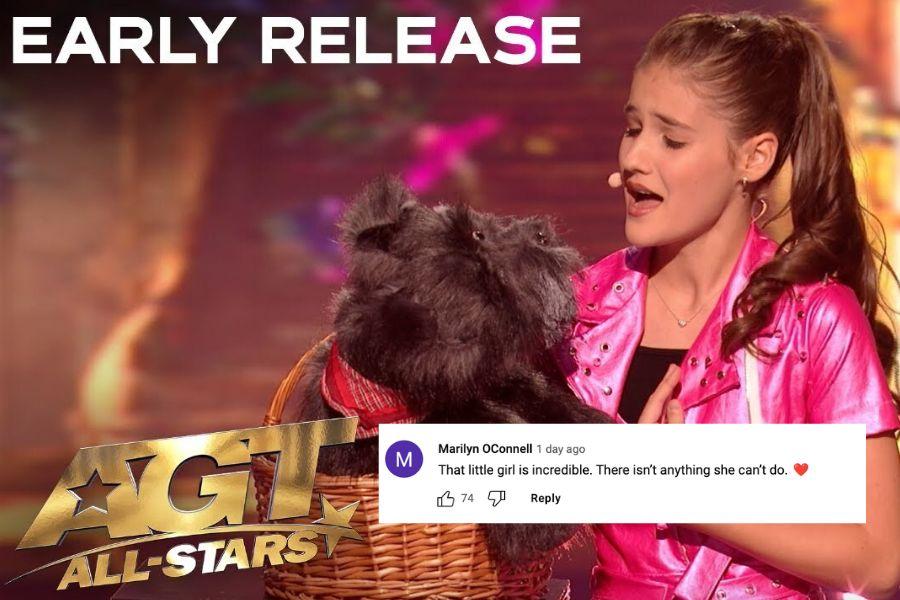
Ana-Maria Mărgean singing "You Don't Own Me" on "America's Got Talent" Photo credit: America’s Got Talent/Youtube

It’s not every day a ventriloquist act is so jaw-dropping that it has to be seen to be believed. But when it does happen, it’s usually on “America’s Got Talent.”

Ana-Maria Mărgean was only 11 years old when she first took to the stage on “Romania’s Got Talent” to show off her ventriloquism skills, an act inspired by videos of fellow ventriloquist and “America’s Got Talent” Season 2 champion Terry Fator.

Using puppets built for her by her parents, the young performer tirelessly spent her quarantine time in 2020 learning how to bring them to life, which led to her receiving a Golden Buzzer and eventually winning the entire series in Romania.

Mărgean is now 13 and a competitor on this season of “America’s Got Talent: All-Stars,” hoping to be crowned the winner and perform her own show in Vegas, just like her hero Fator.


The routine started with a hilarious bit between Mărgean and Waldo, her “rescue dog.” But it’s when she begins singing a bold and brassy version of Lesley Gore’s “You Don’t Own Me” that you know you’re witnessing something truly special.

Take a peek below. Holy moly, those high notes that Mărgean…er…I mean Waldo hit are fabulous.

The feedback from both the viewers and judges was unanimous awe.

“I mean, no wonder you won [RGT]. You are incredible, you are gorgeous, you can sing so beautifully…I love your furry friend, and it was funny, too! I love all the banter and the jokes,” applauded judge Heidi Klum.

Howie Mandel added, “I was laughing. And I cannot believe your story that you just started doing this during lockdown. Like, you don’t even have two years under your belt. That was amazing. The fact that this was something you looked up online, the fact that you were inspired by people you saw on America’s Got Talent—you are an AGT All-Star! The Superfans are gonna love you!”

Prior to her performance, Mărgean shared how winning “Romania’s Got Talent” completely changed her life, allowing her family to afford a brand new home. While her fate might still be up in the air for “AGT,” she’s already made huge strides and has racked up a lot of people rooting for her.


This article originally appeared on 1.31.23

  • Ethan Hawke shares why he didn’t get along with Robin Williams filming ‘Dead Poets Society’
    Ethan Hawke and Robin Williams acted together in "Dead Poets Society."Photo credit: Nicolas Genin (left), John Mathew Smith (right)

    Dead Poets Society was one of the most popular coming-of-age films of the late ’80s, showcasing Robin Williams’ acting range and launching several young actors into their Hollywood careers. But according to Ethan Hawke, who played the timid Todd Anderson (the student who stands on his desk first) in the film, the famous comedian didn’t make his own job easy.

    Hawke shared on The Graham Norton Show what working with Williams was like after Norton said he understood their on-set relationship to be “a bit fractious.”

    “Well, he was incredibly funny, right?” said Hawke. “And he was very relaxed and very inventive…and he would just improv constantly, all day long, and the more the crew laughed, the more he would go.”

    Despite Williams’ hilarious antics, the film wasn’t a comedy. Hawke struggled with the constant improv in light of his own acting work.

    “I really wanted to be a serious actor,” he said. “You know, I had read Stanislavski, and I had what was supposed to be in my pockets, and I really, really wanted to be in character, and I really didn’t want to laugh. And the more I didn’t laugh, the more insane he got. And he’d make fun, ‘Oh, this one doesn’t want to laugh,’ and the more smoke would come out of my ears. He didn’t understand I was trying to do a good job…so I thought he hated me, because he just constantly would lay into me.”

    After filming, Hawke went back to school thinking Williams “hated” him. Then one day, he got a phone call.

    “It was from a big Hollywood agent. This guy says, ‘I’m Robin Williams’ agent, and he says that you’re gonna be somebody, and that I should sign you.’ And I was like, really? And so he got me my first agent, who’s still my agent now.”

    Many stories of Williams’ behind-the-scenes acts of kindness have come to light after his passing, so the fact he recommended Hawke unasked isn’t too surprising. Knowing the context from Hawke’s perspective, however, makes it all the more delightful.

    Hawke spoke to Vanity Fair about his experience observing Williams and director Peter Weir interact on the Dead Poets Society set:

    “I’m watching [Weir] direct Robin Williams, not an easy thing to do, ’cause Robin was a comic genius,” Hawke said. “But dramatic acting was still new to Robin at that time. And watching that relationship like, in the room—I was four feet away while they’re talking about performance—and that was something you don’t unsee.”

    Williams taught Hawke that a script isn’t always set in stone.

    “Robin Williams didn’t do the script, and I didn’t know you could do that,” Hawke recalled. “If he had an idea, he just did it. He didn’t ask permission. And that was a new door that was opened to my brain, that you could play like that. And Peter liked it, as long as we still achieved the same goals that the script had.”

    “They had a very different way of working, but they didn’t judge one another or resist one another,” Hawke continued. “They worked with each other. That’s exciting. That’s when you get at the stuff of what great collaboration can do. You don’t have to be the same, but you don’t have to hate somebody for being different than you are. And then the collective imagination can become very, very powerful, because the movie becomes bigger than one person’s point of view. It’s containing multiple perspectives.”

    The lessons Hawke learned from watching and working with Robin Williams have followed him through more than three decades in film. It’s delightful to see how Williams’ influence lives on in many small ways the world may not be aware of. His is an incredible legacy.

  • Jim Henson interviewing with Muppets is a delightful reminder of his magical genius
    Jim Henson with some of his MuppetsPhoto credit: Public domain
    ,

    Jim Henson interviewing with Muppets is a delightful reminder of his magical genius

    Even adults would forget that his characters weren’t actually alive.

    Few individuals have had an impact on the childhoods of millions and the imaginations of people of all ages like Jim Henson. From Sesame Street to The Muppet Show to The Dark Crystal and Labyrinth, Gen Xers grew up with Henson’s magic being a familiar and comforting presence. And to this day, over three decades after his death, the characters he created are still household names.

    For those of us who were raised on Big Bird, Bert and Ernie, Kermit, and Miss Piggy, Henson’s creatures feel as real as any living, breathing performer from our childhoods. But it’s not just because we were kids when we were introduced to them. Even adults who met the Muppets found themselves transported into Henson’s imaginary world, and after seeing interviews of the puppeteer with his creatures, it’s easy to see why. 

    Watch:

    Henson didn’t even pretend to not be controlling Kermit. He didn’t bother with ventriloquism. And yet, Kermit feels truly alive and separate from the person animating him. It almost feels surreal. Or perhaps just…real. 

    Henson’s characters even convinced film crew members

    Both guests and crew members alike found themselves pulled into Henson’s world, even while fully understanding that the puppets were being controlled by people. The crew would sometimes move the boom mic to a puppet instead of the puppeteer. Directors would sometimes give stage directions directly to the Muppet instead of the human animating it. Dick Cavett, who interviewed Henson with his Muppets, said, “No matter how much you know about this, it’s completely convincing.”

    Even when a Muppet would explain the fact that the person was speaking to a puppet, it still seemed like a sentient being. Case in point:

    (This may be the one time you see Henson swear, but in context, it’s brilliantly wholesome.)

    @guygilchrist

    My old boss’s last public performance as Rowlf.🐶🙏🏻 . . #jimhenson #jimhensonscartoonist #themuppets #fyp #foryoupage

    ♬ original sound – Guy Gilchrist

    Frank Oz shared what it was like to work with Henson

    Of course, Henson didn’t work alone. Bringing his characters to life in all the ways he envisioned took the work of many people, but none were more aligned with Henson himself than his partner-in-puppetry, Frank Oz. Oz was the Miss Piggy to Henson’s Kermit, the Bert to his Ernie, the Animal to his Dr. Teeth.

    Oz started working with Henson when he was just 19 years old, and for 27 years the duo created unforgettable magic together. It wasn’t just the puppets. It was the voices, the comedic timing, the way they could make you laugh in one moment and well up with tears in the next. Their creatures entertained us but also taught us about being human, which was a truly remarkable feat. 

    Oz shared what it was like to work with Henson with Gene Shalit after Henson’s death in 1990:

    Like Fred Rogers, Jim Henson is remembered for being a distinctly decent person in addition to his creative work. He brought the ancient art of puppetry into the modern world, touching every generation in his lifetime and after in a way that remains unmatched. As the tribute song “A Boy and His Frog” by Tom Smith says:

    “They say, ‘Oh that’s foam and a wire, attached to a green velvet sleeve. Anyone can do that.’ Well, that’s true, I suppose, but who else can make them believe?” ​(Grab a tissue before listening to this song, Henson lovers. It’s a doozy.)

    How his legacy lives on

    Henson’s children, Lisa, Cheryl, Brian, John, and Heather, have carried on his work by running the Jim Henson Company and Jim Henson Foundation, performing themselves, and continuing to advocate for the art of puppetry. They’ve also kept Jim Henson’s Creature Shop running, creating puppets, animatronics, and even digital puppetry. The shop designed and built the full-size animatronic puppets for the 2023 Five Nights at Freddy’s movie and works on television, commercial, and themed projects as well.

    In 2024, renowned director Ron Howard released a documentary about Henson’s life and work, Jim Henson: Idea Man, which can be found on Disney +. 

  • Watch Colin Jost try Olympic bobsledding and gain a whole new level of respect for the sport
    Colin Jost showed bobsledding is a lot more intense than it looks.Photo credit: Flickr/greg2600 (left), Canva (right)
    , ,

    Watch Colin Jost try Olympic bobsledding and gain a whole new level of respect for the sport

    “I swear to God, I thought I was going to die. I thought my back was gonna snap in half.”

    Some Olympic sports are obviously difficult and, clearly, inherently dangerous. You can’t watch a snowboarder twirl upside down in mid-air, 17 feet above a 22-foot halfpipe wall, and not admire the heck out of the effort it takes to reach that level of courage, skill, and athleticism. Watching skiers barreling down a mountain at 60 to 80 mph with nothing but a thin suit between them and the ground, expertly avoiding obstacles as they do it, is objectively impressive to the average person.

    But the challenge of other sports isn’t as immediately appreciated. Curling may be hard, but it doesn’t look that hard.

    And bobsledding might take some level of athletic ability, but other than a 5-second run before you jump into the sled, it’s really just about momentum and steering, right? Sure, they go fast, but bobsledders sit inside a protective metal casing, so it looks more like a thrilling roller coaster ride than a physically challenging and dangerous sport, right?

    That’s what Saturday Night Live‘s Colin Jost thought. Then he tried it, and thankfully, he took us all along with him.

    In a clip from NBC Sports, Jost describes his bobsled ride in Lake Placid, New York, as “by far, the scariest experience I’ve ever had in my life.”

    First, watch his full run here:

    Jost rode along with an experienced driver and didn’t even have to do anything but feel it. And, boy, did he feel it. We can see how his body was violently jostled from the physics of flying down the track. As the driver said, astronauts take off in a space shuttle at about three Gs. In the bobsled, they did about 5 Gs, which means he was feeling five times his body weight pushing down on him.

    We can see and hear the shift from “Wow!” to “Holy ____!” as Jost’s thrill turned to terror on the track.

    “I was in no way prepared for that,” Jost said. “I truly thought my body was going to break apart. I’m not exaggerating. It was so much more intense than I expected.”

    Jost told NBC’s Mike Tirico that he was “not prepared for the level of terror of this bobsled.”

    “I swear to God, I thought I was going to die,” he said. “I thought my back was gonna snap in half. I thought my bones were gonna fly off my body and be littered all up and down the bobsled track.”

    People loved seeing an average person partake in an Olympic event, especially someone as honest about the experience as Jost was, as evidenced in the comments:

    “Now THIS is the kind of commentary I want!”

    “Huge thank you to whoever put Colin Jost in a bobsled.”

    “Can we have him do every event for a reference point?”

    “This is what we’ve been asking for – an average person participating so we can get a real account! Thank you for your service, Colin Jost!”

    “He was so horrified he couldn’t even be hilarious about it 💀”

    “He completely lost his composure, 😂 you could tell he was scared, and it did look like the fastest thing anyone would ride.”

    “You know what… his explanation really helped me understand how scary bobsledding is and now I’m more interested in watching. Keep this guy on the air. That second scream shows me he’s telling the truth 😂

    The video really does offer a whole different perspective on how difficult bobsledding actually is.

    Jost was just trying to keep his body together. Imagine having to focus and steer on top of handling those G-forces.

    Retired NFL player and popular podcaster Jason Kelce also tried out the bobsled in Park City, Utah, and had a similar “holy ____” experience. He seemed to enjoy it a little more than Jost did, perhaps more accustomed to his body taking a beating as a professional football player, but he said it was far more intense than it looked. It didn’t feel like a roller coaster, he said. The 1,400 pounds of pressure pushing him into the metal bars of the sled bruised his hips, and, at one point, it got so loud he couldn’t hear his own screams.

    Seeing how careening down an ice track in an aerodynamic sled feels really does lend a whole new level of wow to a sport that some might mistakenly see as glorified sledding. It also lends more weight to 41-year-old Elana Meyers Taylor’s monobob (single-person bobsledding) run that earned her her first Olympic gold medal in her sixth Olympic Games in Milano Cortina. She had earned three silver medals and two bronze medals, making her the most decorated U.S. female bobsledder of all time.

    Seriously, nothing but respect for the bobsledders from here on out.

  • Why chasing 1,000 rejections might be the key to your biggest dreams
    Gabrielle Carr introduces her "Year of 1,000 No's" notebookPhoto credit: TikTok
    ,

    Why chasing 1,000 rejections might be the key to your biggest dreams

    Gabriella Carr asked for 1,000 “no’s.” The universe had other plans.

    If you opened Gabriella Carr’s red notebook, you might expect to find a diary, a grocery list, or her homework. Instead, you’d find an organized, numbered list of failures.

    That’s one way to see it. Gabriella views it differently, though. To her, every entry in that notebook is a victory.

    Gabriella, a content creator and actor, is embarking on a fascinating experiment she calls “The 1,000 No’s.” Her goal: to face rejection 1,000 times in a year. While the rest of us spend our days avoiding the word “no,” Gabriella is hunting for it. She asks for opportunities she feels unqualified for. She puts herself in situations where rejection is likely.

    Something unexpected happened on her quest for failure: she started to succeed.

    In seeking “no’s,” Gabriella stumbled upon a life filled with unexpected “yeses.” Her journey offers a fresh perspective on risk and rejection, and she’s not alone in discovering the surprising power of failure.

    The notebook that changed everything

    Gabriella began her challenge in September 2025. As a creative, the sting of rejection was familiar. Casting directors passed on her self-tape auditions. Brand partners left her emails unread. The constant silence and dismissal started to take a toll on her self-worth.

    She switched up her approach. Instead of striving for a “yes” and dreading denials, she set “no” as the goal.

    rejection, tiktok, viral, no's, challenge
    This is where Gabrielle tracks her rejection journey. Photo credit: TikTok

    Grabbing a red notebook and a permanent marker, she scrawled “The 1,000 Rejections of Gabrielle Carr” on its front and began to track her journey.

    The results surprised her. Amid the rejections lay unexpected winsearned a spot in a national pageant she’d written off as a long shot and landed a role in a play.

    When Gabriella shared her rejection journey on TikTok, it resonated with hundreds of thousands of people. They recognized their own fears in her red book.

    “My daughter shared your account with me, and it inspired me to apply for my dream job! I haven’t heard back yet, but yes or no, it felt good to be so daring!” read one comment. “I need to get an internship for spring, and I’m so scared,” shared another. One viewer said that Gabriella’s courage inspired them to apply for a federal job.

    @misscuddy this challenge just gets us in side quests they took this so serious too so adorbs!#foryouu #nochallenge #rejectiontherapy #newyearsresolution ♬ original sound – Fbrl challenge creator

    Users across the Internet are following her lead. TikTok user @theplanistobefamous tracks his outrageous haggling on Facebook Marketplace. Others record similar experiments—renegotiating lease agreements, asking strangers for fashion advice, pitching themselves to major brands for sponsorships.

    Gabriella’s experiment has led her to a powerful realization: what holds us back from our greatest dreams isn’t a lack of talent or opportunity—it’s the fear of asking.

    Embracing the “no”

    Gabriella follows in the footsteps of innovators who saw fear as their sole obstacle.

    Jason Comely, a freelance IT specialist, first developed the concept of “Rejection Therapy” in 2009. After his wife left him, Jason felt isolated and hesitant to socialize. His fear of rejection had morphed into a psychological barrier, a self-imposed mental prison that prevented him from forming meaningful connections and living a free life. He recognized the trap he was in—and knew he needed to find a way to confront and overcome his fears.

    To toughen up, he modeled his training after Russian special forces. He created a game with one rule: get rejected at least once a day. Accepted requests didn’t count—he had to continue until he got a “no.” This simple but powerful game became more than a personal experiment, resonating with people worldwide and blossoming into a global movement.

    Jia Jiang took the challenge publicly as well. After a difficult rejection from an investor, he decided to try Jason Comely’s “Rejection Therapy” experiment for 100 days. Jiang began recording his quest for no’s, expecting to document a long string of awkward failures.

    On day three, he strolled into a Krispy Kreme and asked an employee to make him doughnuts shaped like Olympic rings.

    Jiang braced for laughter and a curt “no,” but the employee caught him off guard as she began to sketch a design. Fifteen minutes later, she handed him a box of Olympic ring-shaped doughnuts, free of charge. This encounter went viral, touching millions with its heartwarming display of unexpected kindness.

    In 2017, Jiang gave a TED Talk titled “What I Learned from 100 Days of Rejection,” which garnered over six million views—one of the most popular lectures released that year.

    Why rejection hurts (and how to overcome it)

    If these experiments yield such positive results, why do we remain terrified of putting ourselves out there?

    The answer lies in our biology. Psychologists have discovered that social rejection lights up the same areas of the brain as physical pain. In other words, hearing “no” triggers a reaction in your brain—the same one that activates when you slam a finger in the door or douse yourself with freezing water by accident.

    rejection, pain, evolution, biology, psychology
    Social rejection feels just like physical pain to the brain. Photo credit: Canva

    From an evolutionary perspective, this makes perfect sense. In the beginning, our ancestors relied on social groups for survival. Being a part of the tribe meant access to shared resources, protection from predators, and aid in child-rearing. Outcasts faced starvation and predators solo. Although we no longer live in small, nomadic tribes, your brain is still wired with that ancient software. It perceives modern rejections, like an unanswered text or a chilly response during a job interview, with the same primal panic as banishment from the group thousands of years ago.

    This is why Gabriella’s challenge works—it’s a form of exposure therapy.

    Exposure therapy is a well-established psychological method used to help people overcome phobias. The core idea is to gradually expose someone to the object of their fears in a safe and controlled way. For instance, if you have an intense fear of spiders, a good therapist won’t place you in a room full of tarantulas. They’ll ease you into it. The process might begin with something as simple as looking at a cartoon drawing of a spider. Once you’re comfortable with that, you might move on to realistic photos, then to a video of a spider. By the end, you could end up in the same room as one or hold a harmless spider in your hands. This logical, step-by-step approach teaches your brain that what you fear isn’t a real threat.

    Gabriella’s experiment works in a similar fashion. By seeking out small, manageable rejections—like requesting a song on the radio—she began to retrain her brain. With each mini-rejection, Gabriella’s fear of hearing “no” faded, making it easier for her to take bigger risks, like signing up for that pageant.

    Gen Z and the gamification of failure

    This trend has seen a major resurgence with Gen Z viewers at the forefront. It’s no surprise given today’s challenges. Data shows Gen Z may be the “most rejected generation” in history. By February 2025, the average job posting received 244 applications. Young people sent out hundreds of resumes—and faced a wall of silence or boilerplate automatic rejections.

    When life feels out of control, turning challenges into a game can help you regain a sense of agency. Instead of passively waiting and dreading rejections, people like Gabriella are making “no’s” the goal. This shifts everything. This powerful reframing tool protects your self-esteem and spins a helpless situation into a conquerable hurdle—you can win the game by participating in life.

    Ready to start your own rejection challenge?

    You don’t need to aim for 1,000 rejections or a “no” every day to benefit. If you want to strengthen your own “rejection muscle,” here are some simple strategies to get started.

    questions, bravery, asking, rejection, exposure
    Asking questions can be a form of bravery. Photo credit: Canva

    Start with low-stakes requests

    Begin by asking for something minuscule, like the time from a stranger. The goal is to feel that jolt of anxiety—then realize you’re okay.

    Know when to stop

    Pushing your comfort zone is healthy, but remember to stay safe. As psychologist Dr. Elisabeth Morray explains, forcing yourself into situations that feel unsafe can yield traumatic outcomes. Know your limits—the goal is growth, not distress.

    Track your data

    Take a cue from Gabriella and use a pen and paper to record your rejections. Writing them down by hand helps externalize the experience, turning an uncomfortable memory into banal data entry.

    Reframe the outcome

    Remember what Jia Jiang learned: the worst thing someone can say isn’t “no.” It’s that you never even asked. When you stay silent, you reject yourself by default. Keep in mind that with every brave request, you open the door for the universe to say “yes.”

    The beautiful truth about “no”

    We spend an obscene amount of time trying to be perfect and dodging the embarrassment of disapproval. But people like Gabriella Carr, Jia Jiang, and Jason Comely show us the vibrant, exhilarating world that awaits on the flip side of fear. Rejection is an inevitable part of being human, but there’s no shame in asking.

    Every “no” in Gabriella’s notebook marks an act of courage—an opportunity to embrace possibility over comfort. Within those possible 1,000 rejections lie the “yeses” that will shape her life: the plays, the pageants, and the moments she would have missed if she’d chosen to stay silent.

    Buy your red notebook. Approach a neighbor with the favor that’s been on your mind. Apply for the job that seems out of your league. The worst outcome? “No.” And as Gabriella has shown, hearing a “no” isn’t the end of the world—it’s proof that you were courageous enough to take the leap and try. Each attempt, no matter how disastrous, is a step forward. You’re proving to yourself that you are willing to endure uncertainty to pursue what matters to you.

  • A nail salon’s ads are so funny people are taking road trips to Canada just for a manicure
    This Canadian nail salon has people packing their bags for a manicurePhoto credit: Representative photos by Wonderlane|Flickr and Aris Leoven|Canva

    There are a lot of nail salons out there, and without word-of-mouth recommendations from people you trust, it can be impossible to know which salon to visit. Thanks to social media, many businesses can advertise their services without spending much on traditional marketing like television, billboards, and radio. Using pictures and videos of their amazing work to market can help maintain a steady flow of customers, but one Canadian nail salon is taking a slightly different approach.

    Henry Pro Nails which started in Toronto, Canada, is leaving the Internet in stitches after creating a viral ad for his nail salon. The video uses the beginnings of several viral clips, but instead of the expected ending, Henry pops in to complete the viral moment in hilarious, unexpected ways.

    HenryProNails takes viral videos and turns them into funny marketing

    It opens with a familiar viral video of a man on a stretcher being pulled by EMS when the stretcher overturns, flopping the man onto the ground. But instead of it ending with the injured man on the ground, Henry seamlessly appears, lying out on the floor of his salon and delivers his first line, “Come to my nail salon. Your nails will look beautiful.”

    nails, nail salon, red nail polish, manicure, hands
    A woman getting her nails painted. via Canva/Photos

    In another clip, a man holds his leg straight up and somehow flips himself into a split. When the camera cuts back to Henry, he’s in the splits on the floor of his nail salon promoting loyalty discounts. The ad is insanely creative, and people in the comments can’t get enough. Some are even planning a trip to Toronto just to get their nails done by the now Internet-famous top nail artist in Canada. This isn’t Henry’s first rodeo making creative ads, but this one is, without a doubt, his most popular—and effective.

    People love Henry’s videos

    “I will fly to Canada to get my nails done here just because of this hilarious video. You win this trend for sure,” one woman says.

    “Get yourself a passport and make a road trip! My bf and I are legit getting ours, and it’s only a 4 hr drive from where we are in Pennsylvania. Their prices are a lot better than other places I’ve been too,” another person says while convincing a fellow American citizen to make the trip.

    “Omg, where are you located? I would fly to get my nails done by you,” one person writes.

    “The pedicure I had at Henry’s was the best I have ever had. Unfortunately, it made all other places disappointing, and I don’t live close enough for Henry’s to be my regular spot,” someone else shares.

    In another hilarious video, Henry urges a woman not to divorce her husband for not cooking her dinner, but instead to come get her nails done so she’ll feel a lot better.

    Henry also jumped onto the “very demure, very mindful” trend on TikTok with his own take on the phrase.

    It just goes to show that creative advertising can get people to go just about anywhere, but great service is what keeps them coming back. If you’re ever in Canada and find yourself needing an emergency manicure, Henry’s Pro Nails is apparently the place to be.

    This article originally appeared two years ago. It has been updated.

  • What trends are accepted now but will be embarrassing in the future? Our readers shared 21 ideas.
    What's accepted now but will be embarrassing in the future?Photo credit: via Atypeek Dgn/Pexels, Kevin Bidwell/Pexels, Teknorat/Flickr

    We can all be sure that as society evolves, many things that seem normal today will be cringeworthy to people in the future, whether it’s our fashion, politics, civility, or our treatment of the environment.

    If we look back just 30 years ago, same-sex marriage was illegal, people routinely smoked in bars and restaurants, and it was fashionable and cool to vogue.

    So, when we look back on the world of the 2020s, there are bound to be many things that we’ll be embarrassed about in 30 years, especially when we are forced to live with the repercussions of the decisions we make today. On a lighter note, we’ll all also have clouds full of photos of ourselves wearing hairstyles and clothes that look utterly ridiculous in hindsight.

    In the summer of 2024, we asked the Upworthy community to share their thoughts by asking a big question on Facebook: “What’s something that’s accepted now that we’ll be embarrassed about in the future?” Our readers responded with funny takes on current fashion and concerns about technology use and how we treat our fellow human beings.

    Here are 21 things we accept today that we’ll probably be embarrassed about in the future

    More than a few current fashion trends will look silly in the coming years

    socks with sandals, socks, sandals, fashion, trends, cringe
    Socks and sandals. Canva Photos.

    “Yoga pants. I love them to death, but I can easily see them as the parachute pants of tomorrow.” — Deborah

    “Barn doors in your house.” — Joyce

    “Tattoos all over the body.” — Vicki

    “People wearing socks and sandals.” — Jeremy

    “Wearing pajamas in public.” — Ivy

    “Huge, over-sized false eyelashes.” — Patricia

    Hopefully, people in the future will be more considerate when using technology than we are today.

    “Walking around with your eyes locked on your phone. Or eating at a table with 4 people looking at their phone. One day, we will either fall off a cliff or realize life is what is happening off the screen.” — Elise.

    “Texting in the presence of another person.” — Kate

    texting, technology, polite, rude, trends, cringe
    Three women on their phones not paying attention to each other. Canva Photos

    We can also hope that in the near future, we will be able to solve many of today’s pressing public policy issues so that the next generation will live happier and healthier lives.

    “Lack of healthcare for everyone.” — Sharon

    “Making the planet unlivable for human beings.” — Karen

    “Spending hundreds of millions of dollars of taxpayer’s money to build a sports arena for a billionaire. Then charging the taxpayers outrageous amounts to attend events there.” — Stacy

    “How the US is systematically clawing back women’s rights to decide what they do with their bodies. It’s beyond shameful.” — Jason.

    Some people are concerned about the way students and their parents behave in modern-day America.

    “Parents trying to run schools: yelling at teachers for their child’s poor performance, yelling at principals when their child gets in trouble, book banning based on an individual’s religious ideologies, etc.” — Beth.

    “Entitled children talking back to their parents and teachers.” — Connie

    “Cry rooms at universities where students can go and work out their anxiety and cry and be upset if their professor uses words that are too difficult for them. Universities are institutes of higher learning, not institutes of babysitting. That will be an embarrassment in the future, as it is an embarrassment to me and many others now.” — Della

    cry rooms, college kids, universities, cringe, trends
    Young woman crying. Canva Photos

    In 30 years, we may be embarrassed to look back on the level of general civility in 2024.

    “Panic buying of toilet paper during the pandemic.” — Tony

    “Ageism. It’s everywhere, all the time, and no one seems to mind. No one is defined by the amount of time they’ve spent on the planet but it’s used as an identity and as a weapon (ask any teenager, 40-year-old woman, or retiree…). I can only hope that one day it will be a source of embarrassment that we were all so dismissive and judgmental.” — Rosy.

    “Human beings living on the street.” — Andrea

    “Torturous killing of animals for food.” — Mae

    ageism, elderly, trends, cringe, people, america
    An older woman looking stern. Canva Photos

    While this list may seem like a litany of complaints people have about living in the modern world, it should give us hope. If we’ve overcome past embarrassments, today’s can be fixed as well.

    This article originally appeared two years ago. It has been updated.

  • Resurfaced video of French skier’s groin incident has people giving the announcer a gold medal
    Downhill skiing is a sport rife with injuries, but not usually this kind.Photo credit: Representative photo credit: Canva

    A good commentator can make all the difference when watching sports, even when an event goes smoothly. But it’s when something goes wrong that great announcers rise to the top. There’s no better example of a great announcer in a surprise moment than when French skier Yannick Bertrand took a gate to the groin in a 2007 super-G race.

    Competitive skiers fly down runs at incredible speeds, often exceeding 60 mph. Hitting something hard at that speed would definitely hurt, but hitting something hard with a particularly sensitive part of your body would be excruciating. So when Bertrand slammed right into a gate family-jewels-first, his high-pitched scream was unsurprising. What was surprising was the perfect commentary that immediately followed.

    This is a clip you really just have to see and hear to fully appreciate:

    It’s unclear who the announcer is, even after multiple Google inquiries, which is unfortunate because that gentleman deserves a medal. The commentary gets better with each repeated viewing, with highlights like:

    “The gate the groin for Yannick Bertrand, and you could hear it. And if you’re a man, you could feel it.”

    “Oh, the Frenchman. Oh-ho, monsieurrrrrr.

    “The boys took a beating on that one.”

    “That guy needs a hug.”

    “Those are the moments that change your life if you’re a man, I tell you what.”

    “When you crash through a gate, when you do it at high rate of speed, it’s gonna hurt and it’s going to leave a mark in most cases. And in this particular case, not the area where you want to leave a mark.”

    Imagine watching a man take a hit to the privates at 60 mph and having to make impromptu commentary straddling the line between professionalism and acknowledging the universal reality of what just happened. There are certain things you can’t say on network television that you might feel compelled to say. There’s a visceral element to this scenario that could easily be taken too far in the commentary, and the inherent humor element could be seen as insensitive and offensive if not handled just right.

    The announcer nailed it. 10/10. No notes.

    The clip frequently resurfaces during the Winter Olympic Games, though the incident didn’t happen during an Olympic event. Yannick Bertrand was competing at the FIS World Cup super-G race in Kvitfjell, Norway in 2007, when the unfortunate accident occurred. Bertrand had competed at the Turin Olympics the year before, however, coming in 24th in the downhill and super-G events.

    As painful as the gate to the groin clearly as, Bertrand did not appear to suffer any damage that kept him from the sport. In fact, he continued competing in international downhill and super-G races until 2014.

    skiing, skier, downhill ski race, alpine skiing, super-g
    Alpine skiing is a notoriously dangerous sport. Photo credit: Canva

    According to a 2018 study, Alpine skiing is a notoriously dangerous sport with a reported injury rate of 36.7 per 100 World Cup athletes per season. Of course, it’s the knees and not the coin purse that are the most common casualty of ski racing, which we saw clearly in U.S. skier Lindsey Vonn’s harrowing experiences at the 2026 Olympics. Vonn was competing with a torn ACL and ended up being helicoptered off of the mountain after an ugly crash that did additional damage to her legs, requiring multiple surgeries (though what caused the crash was reportedly unrelated to her ACL tear). Still, she says she has no regrets.

    As Bertrand’s return to the slopes shows, the risk of injury doesn’t stop those who live for the thrill of victory, even when the agony of defeat hits them right in the rocks.

  • Wilco’s Jeff Tweedy surprises crowd by singing one of his band’s most beloved songs at karaoke
    Jeff Tweedy sings his own song at karaoke.Photo credit: Susan Miller Tweedy

    On a January evening at a restaurant in Mexico, El Jefe patiently waited for his name to be called by the karaoke host. When it was, he gently walked to the stage in a pink baseball hat and black, thick-rimmed glasses. As he approached, the host gave him instructions on how to use the microphone. “You’ve got to hold it up here and just don’t yell in the mic,” he said, illustrating as El Jefe humbly listened.

    He then proceeded to sing “Jesus, Etc.” almost better than its original singer, Jeff Tweedy of Wilco. There’s a reason for that: El Jefe, as it turns out, is Jeff Tweedy.

    The song is track five on Yankee Hotel Foxtrot, which was released in 2002. According to the liner notes, it was written by Tweedy and Jay Bennett, a former member of the band who passed away in 2009. Pitchfork hailed the tune as “the 61st best song of the decade,” which is high praise, especially considering how much excellent indie-rock music was coming out at the time.

    Stereogum’s Chris DeVille wrote about the album’s 20th anniversary, noting that Wilco streamed it at no charge. “A bold and uncommon move at that time, and one that probably made the album sound even more experimental for those with dial-up internet connections,” he wrote. DeVille added, “Yankee Hotel Foxtrot is THE Wilco album — the one that cemented their stature as one of the all-time great American rock bands.”

    There’s a kind of perfection to Tweedy singing his own song at karaoke, and not just because it conjures so many memories for Wilco fans. Watching Tweedy in a Clark Kent–like, plainclothed role, when most fans know he can become Superman at any given moment, is something extra special.

    Fans in the Instagram comments agreed.

    “You guys are the coolest famous non-famous people ever,” one person wrote. “How surreal. To write a song, make a record with that song (and many more) on it, and become well known in certain circles for that song and all the other songs, have that song turned into a karaoke selection because it has become that level of popularity, then sing that song like you’re an everyday schmuck just doing karaoke one night on vacation, it’s just…”

    Another person described the scene and how lovely it all was: “My heart needed this. The children playing, palm trees swaying in the neon lights, that super fun ‘Ladies’ sign, a few enthusiastic ‘woos’ and a happy, humble El Jefe. Good stuff!”

    One fan loved that Tweedy seemed to go unnoticed by the karaoke host. “My favorite part is the host showing him how to use the microphone,” they wrote. Another person replied, “And the ‘Jeffiest’ reaction of playing it totally cool, no ego, totally kind, respecting the KJ’s ‘authority.’ The least ‘Do you have any idea who I am?’ energy possible.”

    One comment summed up the many layers of coolness on display: “This is beautiful on so many levels. I always thought you ‘made it’ when your song ended up in a karaoke machine. Here it is, yet (maybe) no one knows him or the song — and that’s perfectly fine with him. For that, I’m so happy for him. What a gift of a moment that must have been: to be respected, successful and famous without the bad fame part. That’s the sweet spot. Just to put your hand in your pocket and sing your song for yourself and your family.”

    Upworthy had the honor of chatting with Tweedy’s wife, Susan, who provided a little context for the evening. It all happened following this year’s Sky Blue Sky festival, an all-inclusive vacation in Mexico featuring a musical lineup that included Dinosaur Jr., The Jayhawks, and, of course, Wilco.

    “So after Jeff’s festival, Sky Blue Sky, we stayed in the general area at a rental house for a few days to unwind,” she said. “That night we were at La Buena Vida, a restaurant that apparently does karaoke every Wednesday evening.”

    Susan noted that she and their kids egged him on: “The kids and I told Jeff he should do it! He’s never done it before, but it was all families and little kids running around, and we all thought it would be fun and funny! Our son Sammy checked to see if there were any Wilco songs available to do, and there were! We signed him up, and I think he was the last one to make it on for the night.”

    When asked whether Jeff was recognized, the answer was surprising.

    “Nobody recognized him, although I did see a post a couple days later of someone who said they were there and that they were pretty sure it was him,” she said. “But nobody said a word, and people were still talking and running around and mostly ignoring the karaoke during his whole song, just like for everybody else! It was really fun for all of us!!”

Wholesome

Teacher shares her surprisingly wholesome story of learning what ‘Netflix and chill’ means

Motherhood

Mom shares how she went from feeling alone to having a ‘huge mom village’ in just one year

People Skills

3 types of ‘effortless’ psychology-based opening lines to start a conversation with anyone

Pop Culture

Jim Henson interviewing with Muppets is a delightful reminder of his magical genius