upworthy
Add Upworthy to your Google News feed.
Google News Button
Pop Culture

Woman shares 5 questions to ask potential employers and people are taking notes

"Being in both senior leadership and directly involved in candidate recruitment, these questions are fire. 10/10 recommend."

job interview; jobs; interview advice; interview questions; tiktok

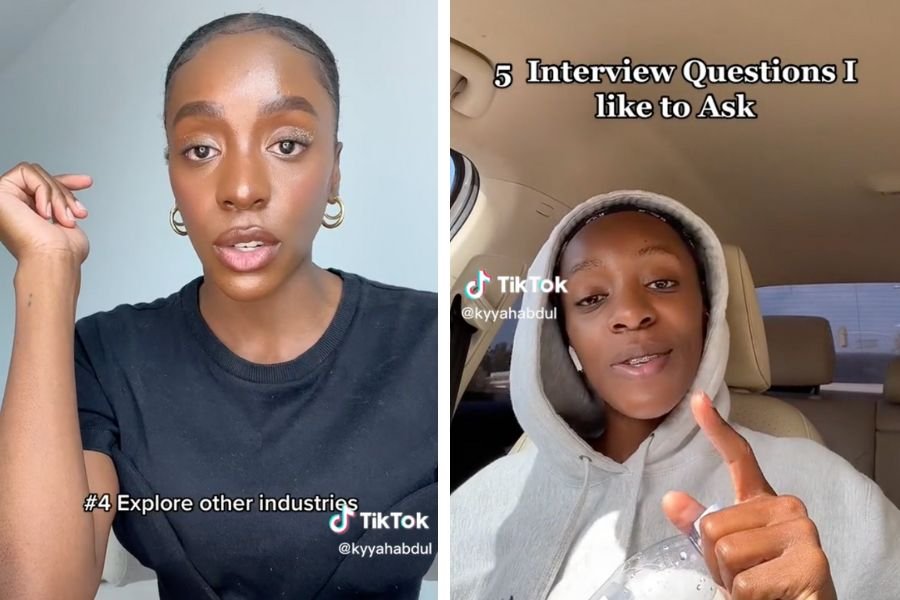
TikTok creator gives people 5 questions to ask potential employers.

You know the end of the interview where they ask, "Do you have any questions for us?" It's a dreaded question for a lot of people. Even though you know it's coming, the question still catches you off guard and you wind up asking something possibly irrelevant or nothing at all. Then the whole ride home, approximately fifteen questions pop into your head.

But don't you fret, because TikTok creator Kyyah Abdul has a list of five questions to keep tucked in your brain's pocket to close out an interview. And folks in the comments are applauding the creator's ability to figure out if the company is a fit for you and clarify any concerns the interviewer may have. Her advice was so genius that even a person who is involved in candidate recruitment chimed in saying, "Being in both senior leadership and directly involved in candidate recruitment, these questions are fire. 10/10 recommend."


The video has well over 800,000 views on TikTok and nearly 200,000 likes. In the nearly 3-minute video, Abdul is sitting in her car and explains how one of her questions always trips up interviewers, but says, "It would give me the opportunity to address any concerns they had as a result of my interview."

One of the first questions on her list is, "How do you and senior leadership respond to errors made in the workplace?"

Most people who have held more than one job have experienced being in an environment where minor mistakes were ridiculed or caused you to be micromanaged. So asking this sort of question in the interview seems like it would give you a better understanding of that company's work environment.

Some commenters have tried her methods and others are eager to continue to soak up her knowledge.

"I always incorporate your questions and am told that this was the best interview they ever had," one commenter wrote.

"This is the first interview question video I've seen NOT from a recruiter or manager. And it was actually really helpful. Thank you so much," someone else wrote.

"I used these questions during my last interview and they thought I was brilliant," another person said.

Clearly viewers think Abdul's interview hacks are invaluable. Watch the video below to hear the rest of the questions:

@kyyahabdul

A lot of people have asked me about interview questions so I am reposting my most viral interview video #interview #interviewtips #interviewquestions #interviewtipsandtrick #interviewprep

This article originally appeared on 5.26.23
Family

Naming twins is an art. Here are some twin names people say are the best they've ever heard.

With twins, all the regular pressures of having a baby are doubled, including choosing a name.

Are you in favor of rhyming twin names? Or is it too cutesy?

Having twins means double the fun, and double the pressure. It’s a fairly known rule to name twins in a way that honors their unique bond, but that can lead to overly cutesy pairings that feel more appropriate for nursery rhyme characters than actual people. Plus, it’s equally important for the names to acknowledge each twin’s individuality. Again, these are people—not a matching set of dolls. Finding the twin baby name balance is easier said than done, for sure.

Luckily, there are several ways to do this. Names can be linked by style, sound or meaning, according to the baby name website Nameberry. For example, two names that share a classic style would be Elizabeth and Edward, whereas Ione and Lionel share a similar rhythm. And Frederica and Milo seem to share nothing in common, but both mean “peaceful.”

Over on the /NameNerds subreddit, one person asked folks to share their favorite twin name pairings, and the answers did not disappoint.

One person wrote “Honestly, for me it’s hard to beat the Rugrats combo of Phillip and Lillian (Phil and Lil) 💕”

A few parents who gave their twin’s names that didn’t inherently rhyme until nicknames got involved:

"It's the perfect way! Christmas cards can be signed cutely with matching names, but when they act out you can still use their full name without getting tripped up.😂"

"The parents of a good friend of mine did this: her name is Allison and her sister is Callie. Their names don’t match on the surface, but they were Alli and Callie at home."

“Alice and Celia, because they’re anagrams! Sound super different but have a not-so-obvious implicit connection.”

This incited an avalanche of other anagram ideas: Aidan and Nadia, Lucas and Claus, Liam and Mila, Noel and Leon, Ira and Ria, Amy and May, Ira and Ari, Cole and Cleo…even Alice, Celia, and Lacie for triplets.

Others remembered name pairs that managed to sound lovely together without going into cutesy territory.

twin names, twins, babies, baby namesThese matching bunny ears though. Photo credit: Canva

“I know twin toddler boys named Charlie and Archie and they go so well together,” one person commented.

Another wrote, “Tamia and Aziza. I love how they follow the same sound pattern with the syllable endings (-uh, -ee, -uh) without being obnoxiously matchy matchy.”

Still another said, “Lucy and Logan, fraternal girl/boy twins. I think the names sound so nice together, and definitely have the same 'vibe' and even though they have the same first letter they aren't too matchy-matchy.”

Other honorable mentions included: Colton and Calista, Caitlin and Carson, Amaya and Ameera, Alora and Luella, River and Rosie, and Eleanor and Elias.

One person cast a vote for shared style names, saying, “If I had twins, I would honestly just pick two different names that I like separately. I tend to like classic names, so I’d probably pick Daniel and Benjamin for boys. For girls my two favorites right now are Valerie and Tessa. I think Val and Tess would be cute together!”

Overall though, it seems that most folks were fans of names that focused on shared meaning over shared sound. Even better if there’s a literary or movie reference thrown in there.

twin names, twins, babies, baby namesMany adult twins regret that their names are so closely linked together. Photo credit: Canva

“My mom works in insurance, so I asked her. She’s seen a lot of unique ones, but the only twins she remembers are Gwenivere [sic] and Lancelot... bonus points... little brother was Merlin,” one person recalled.

Another shared, “If I had twin girls, I would name them Ada and Hedy for Ada Lovelace and Hedy Lamarr, both very early computer/tech pioneers. Not that I’m that into tech, I just thought it was a brilliant combination.”

Other great ones: Susan and Sharon (think the original “Parent Trap”), Clementine and Cara (types of oranges), Esme and Etienne (French descent), Luna and Stella (moon and stars), Dawn and Eve, plus various plant pairings like Lily and Fern, Heather and Holly, and Juniper and Laurel.

Perhaps the cleverest name pairing goes to “Aubrey and Zoe,” since…wait for it… “they’re A to Z.”

It’s easy to see how naming twins really is a cool opportunity for parents to get creative and intentional with their baby naming. It might be a challenge, sure, but the potential reward is having the most iconic set of twins ever. Totally worth it!


This article originally appeared last year.

Joy

Neighbor sees kid 'tearing up' his driveway. People are loving the way he took action.

"This was the coolest and most heartwarming 'clickbait' I've come across thus far."

Canyon Chasers/Youtube

This is too good not to share.

Many of us had one of those neighbors growing up—the one who gave us the stink eye if we so much as looked at their perfectly mowed lawn and shooed us away if even our shadows crept onto their flower beds. There's a reason "Get off my lawn!" was a meme before memes were even a thing.

Then there are neighbors who rock. The ones who smile and wave through the window and share their fresh-baked cookies with the neighborhood kids. The folks who genuinely enjoy the vibrant energy that children bring to the block and embrace the idea of "it takes a village."

neighbors, feel good stories, positive news, community, kids, kids on bikes, neighborhood, canyon chasers May we all have neighbors like this. media4.giphy.com

When Dave, one of the guys behind Canyon Chasers, a motorcycle enthusiast website, shared a video of how he handled a kid who kept playing in his driveway when he wasn't home, it wasn't clear at first which kind of neighbor he was going to be. But then he explains how his security footage showed a preschooler riding his bike around his flat concrete driveway every evening, and how he decided to do something about it.

And what ensued was the best Anti-Get-Off-My-Lawn move that ended up pleasing more neighbors than he anticipated.

- YouTube www.youtube.com

How fun would that have been when you were a kid, seeing a chalk outline of a racetrack, made just for you, as if by magic? And how great that he made a new one each time it rained? And how delightful is it that people of all ages showed up to enjoy it?

Needless to say, there was a lot of praise for what Dave did, and many were relieved the story took an unexpected wholesome turn.

"One of the coolest things that a person can do to support the youths in his neighborhood."

"This was the coolest and most heartwarming 'clickbait' I've come across thus far."

"This is an example of how a small gesture could change a world for all to live in..."

neighbors, feel good stories, positive news, community, kids, kids on bikes, neighborhood, canyon chasers Good Neighbors Make Great Communities media0.giphy.com

Inquiring minds also wondered if the two ever met.

"I did. He's a super sweet kid," Dave wrote in the comments. "After a rain storm had washed the track away, I came out and he was drawing on my driveway with chalk. So I asked him what he was doing. He said 'I'm drawing a racetrack for you.'"

Imagine a world where all neighbors were this thoughtful and generous with their time and property. More of this, please.

This article originally appeared five years ago.

via Mattew Barra/Pexels
There's one word you can't say on a cruise ship.

There are some things you just don't say. You don't yell out "bomb!" on an airplane, make jokes about carrying weapons while going through security, or, as Michael Scott from The Office knows, loudly proclaim that a boat you're currently on is sinking.

Those are all pretty obvious examples, but sometimes etiquette and decorum are a little more subtle. If you're not experienced in the ways of the venue you're in, you might not know all the unspoken rules. And you might find out the hard way. Cruise ships, for example, have their own very specific set of rules and regulations that guests should abide by.

On December 10, 2023, Royal Caribbean’s Serenade of the Seas set sail on the Ultimate World Cruise—a 274-day global trek that visits 11 world wonders and over 60 countries.


cruise, 9-month cruise, Marc Sebastian, cruise life, vacation, titanic, unspoken rules, etiquette, cruise etiquette, royal caribbean 9 months is a very long time to be aboard a boat, even a giant cruise ship. Photo by Peter Hansen on Unsplash

This incredible trip covered the Americas, Asia Pacific, Middle East, Mediterranean and Europe with a ticket price that ranges from $53,999 to $117,599 per passenger.

With such a unique and incredible offering, it's understandable that Royal Caribbean wanted to invite plenty of influencers to help them get the word out.

Aboard the Serenade to the Seas was popular TikToker Marc Sebastian, who documented his experience throughout the journey. In one video with over 4.3 million views, he revealed what he’s learned over his first few weeks aboard the ship; the biggest was the one word you’re not allowed to say.

"So here's [what] I've learned about cruising since I've spent 18 nights on this floating retirement home with a Cheesecake Factory attached. First, number one, you're not supposed to talk about the Titanic," he says in the clip.

Titanic! It's the ultimate taboo when you're on a giant ship traversing the ocean. Even after all these years, it's still too soon to make even lighthearted comparisons or jokes.

@marcsebastianf

someone get whoopi on the line girl i have some goss for her #ultimateworldcruise #worldcruise #serenadeoftheseas #cruisetok #cruise #9monthcruise #titanic

“Who knew that? I didn’t,” Sebastian said. “I brought it up to an entire room of people having lunch that our ship is only 100 feet longer than the Titanic — when I tell you that utensils dropped. Waiters gasped. It’s dead silent.”

Sebastian was flabbergasted. "It wasn't in the... handbook," he joked. "Not that I read the handbook, clearly."

After the unexpected reaction, his cruise friend told him, “You’re not allowed to talk about the Titanic.” It makes sense.

Who wants to be reminded of the tragedy that killed around 1,500 people while sinking one of the most impressive engineering feats of the era? More experienced cruisers chimed in that they were familiar with the unique piece of etiquette.

cruise, 9-month cruise, Marc Sebastian, cruise life, vacation, titanic, unspoken rules, etiquette, cruise etiquette, royal caribbean Pro tip: Don't ask the band on board to play "My Heart Will Go On" by Celine Dion Giphy

"When I went on a cruise, my mom told me saying Titanic was equivalent to screaming ‘bomb’ at an airport," Mikayla wrote in the comments.

"It’s like saying Macbeth in a theatre, it’s an unspoken rule" another commenter added.

"I’m sorry you’re telling me you had a Harry Potter like experience saying Voldemort at Hogwarts but it was the titanic on a modern day cruise I’m cryingggg" joked another.

Later in the video covering little known cruise facts, Sebastian admits he was surprised to learn that cruise ships have godmothers and that the pools are filled with seawater.

In an update from June of 2024, Sebastian explains that he only stayed on the cruise for 18 nights. He was not booked to stay throughout the entire voyage, and for him, that was a relief.

He initially jokes that he was kicked off the boat for saving a penguin that had jumped aboard. But in the end, he admits he was more than happy to deboard early.

"I walked off that ship not a happy man," he said, saying the ship was overstimulating and stressful. In another video, he films as the ship navigates the Drake Passage, one of the most notoriously dangerous and choppy stretches of water in the world. It looks stressful indeed, to say the least.

Cruising isn't for everyone, let alone for 274 days straight! But now Sebastian knows the golden rule for his next cruise.

This story originally appeared last year. It has been updated.

Is it possible to know someone is going to die soon?

Death is a mystery in so many ways, despite the fact that we all know for sure it's going to happen. We don’t know when we will go and can't really be sure of what comes next, so whether we’re thinking about ourselves or a loved one, there’s understandably a lot of fear and uncertainty around death.

That’s why Julie McFadden's work is so important. As a palliative care nurse in the Los Angeles area, who has seen over a hundred people die, her videos shed light on the process to make us all a bit more comfortable with the inevitable. McFadden is also the author of the bestseller, “Nothing to Fear.” The nurse’s experience helping people in their final stages has given her a unique perspective on the process.

In one video, she shared how she can see the first symptoms that someone is going to die a natural death about 6 months before they finally do. In other words, she can determine that someone only has half a year left to live when most of us have no idea they have entered the final stages of life.

@hospicenursejulie

Replying to @Mariah educating yourself about scary topics will help decrease fear. ✨Nothing to Fear ✨- my book- out june 11th #hospicenursejulie #hospicenurse #caregiversoftiktok #medicaltiktok #learnontiktok #nothingtofearbook

What are the signs a person is dying at the 6-month mark?

McFadden says that people who are dying are usually placed in hospice care when the symptoms begin to appear around the 6-month mark.

"You will have very generalized symptoms. Those symptoms will usually be, one, you will be less social. So you'll be more introverted than extroverted," McFadden said. "Two, you will be sleeping a lot more. And three, you will be eating and drinking a lot less. Literally, everyone on hospice, I see this happen to."

death, dying, afterlife, hospice, signs of dying What happens when we die is one of life's great mysteries.via PIxbay/Pexels

What are the signs a person is dying at the 3-month mark?

You are going to notice more debility,” McFadden continues. “They will be staying in their house most of the time. It's going to be difficult getting up and just going to the bathroom. Again, sleeping a lot more and eating and drinking a lot less.”

What are the signs a person is dying at the 1-month mark?

Something usually begins to happen in the final month of someone’s life. They start to believe they are in contact with others they have lost. It’s like they are there to make the dying person feel comfortable with their final transition.

"Usually around the one month mark is when people will start seeing 'the unseen', they have the visioning. They'll be seeing dead relatives, dead loved ones, dead pets, old friends who have died,” McFadden said. “Again, not everyone — but many, many people will start seeing these things at around one month."

death, dying, afterlife, hospice, signs of dying Many people start to talk to people and pets who have passed when they're approaching the end of life.via PixaBay/Pexels

Angela Morrow, a registered nurse at Verywell Health, agrees that people in the final stage of life often hear from those who have passed before them. Morrow says we should refrain from correcting the patients when they share their stories of talking to people and pets who have died. "You might feel frustrated because you can't know for sure whether they're hallucinating, having a spiritual experience, or just getting confused. The uncertainty can be unsettling, but it's part of the process," Morrow writes.

At the end of the video, McFadden says that the most important factors palliative care nurses look at to determine the stage of death are eating, drinking and sleeping. “Most people, a few weeks out from death, will be sleeping more than they are awake. And they will be barely eating and barely drinking,” McFadden said.

death, dying, afterlife, hospice, signs of dying Hospice workers deal with death more than most of us do. i.giphy.com

In the end, hospice nurses “allow the body to be the guide” as they help their patients transition from life to death.

McFadden’s work has brought a lot of peace to her followers as they go through trying times. "My mom is in hospice right now and she’s currently, I think, hours or days from death. YourTikToks have helped me out tremendously," Deb wrote. "My grandma passed away in February, and she experienced all of this. this page brings me peace knowing everything she went through was natural," Jaida added.

"Thanks, Julie. I volunteer in a hospice end-of-life facility, and this helps educate the families. Your posts are wonderful," Grandma Nita wrote.

One of the things that makes death so scary is the number of unknowns surrounding the process, so it's important that McFadden shares her stories of helping people to the next side. She shows that death is a natural process and that hospice nurses are here to help make the transition as peaceful as possible.

This article originally appeared last year.

Canva Photos

Parents in the 70s through the early 2000s had unique ways of relaxing before cell phones were prevalent.

Parents are more stressed out than ever. While the fundamentals of raising kids haven't changed much over the years, the environment in which we do it has rapidly become more complex and demanding. Social media bombards us with visuals of other parents' seemingly perfect lives and influencers who are constantly trying to sway us into their way of thinking. The demands on parents to be hyper-engaged and always "on: are rising. We get dozens of emails and texts from school and daycare every week that must be read, digested, and sometimes responded to. Securing childcare for summers and school breaks takes 100 hours of planning every year.

In short, parents are, on average, working more and doing more hands-on childcare than in decades past. You don't have to have a PhD in mathematics to know that the hours in the day just don't add up. So many parents are trying to cope in any way that they can, trying anything that might help them decompress, which includes a lot of different coping mechanisms like alcohol, THC gummies and weed, and mindlessly watching Netflix until they fall asleep. They're also withdrawing socially, over or undereating, and bottling up their feelings. Overall, it's not a great recipe.

One honest mom took to social media to make a confession. In a Reddit post, she confessed that sitting and mindlessly scrolling on her phone was the only thing she had that helped her decompress, and she wasn't feeling great about it.

She also asked for some advice from older generations who didn't have all the pressure to go-go-go, and who didn't have the option of numbly flicking through Instagram to pass the time: "Older parents, how did you decompress from toddlers? I’m a single mum and sometimes scroll my phone while she plays, esp. at noisy play gyms, just to mentally/physically reset. I feel guilty."

Older folks who were parents back in the 70s, 80s, 90s, and even early 2000s chimed in with plenty of timeless advice:

1. Put the kids to bed on time. No exceptions.

parents, parenting, old school parenting, gen x parents, boomer parents, boomer grandparents, millennial parents, kids, family For older generations of parents, bedtime was non-negotiable,. Photo by Anna Hliamshyna 💙💛 on Unsplash

Universally, the one thing older parents will always tell you is that you need to get your kids to bed on time and without feeling guilty about it. Personally, I struggle with this all the time. As your kids get older, they learn how to work you and guilt you into letting them stay up later and later. And, honestly, it's pretty awesome when your kids want to hang out with you by watching a show or playing a game together late into the evening.

But mommy and daddy need time to wind down before bed, too. Older generations were definitely better at sticking to the routine without exception.

"Get them to bed ON TIME. No flexibility except in emergencies or family events. Just seeing the bed time approaching, started my unwind. Then TV and books," one user wrote.

"My kids were ALWAYS in bed by 7:00. Then it was bath time with a good book for me. I was also a single mom and the sense of peace when they were finally asleep was exquisite!" said another.

"Set routines. That's it. No flexibility when it comes to meals, bedtime, etc. You can break that routine for very special occasions such as Birthdays, Christmas, etc however the routine is the ironclad rule of the household. This is for the kids to learn structure, and for you as the parent to get time to yourself," someone agreed.

Once the kids are firmly in bed, parents agreed that a whole wide world was open to you. You could do a puzzle, take a bath, enjoy a glass of wine. Or just go to bed yourself and get that coveted extra sleep!

2. Let them play unsupervised. Feel no guilt.

parents, parenting, old school parenting, gen x parents, boomer parents, boomer grandparents, millennial parents, kids, family Kids need unsupervised play time, and so do adults. Photo by Annie Spratt on Unsplash

It's been a hot topic of debate as to why kids these days seem more anxious than previous generations. A lack of unstructured, unsupervised free play is definitely a factor. And, ironically, it's contributing to parents' stress, too.

This is definitely the making of the younger generation of millennial parents. Gen X and Baby Boomer parents had no issue with letting kids take advantage of their freedoms, and they were a lot more relaxed as a result.

"[My parents] let sleeping dogs lie so to speak. If it wasn't broke, they didn't look to fix it. If we were achieving as we should in school and not arrested as teenagers, they assumed we were doing fine and on track to get to college. Even as young kids we had enormous physical freedom to roam around the neighborhood on our own - and I grew up in Brooklyn and not an idyllic suburb. Both my parents worked and after we sat down to a home cooked meal on almost all week nights my parents essentially retreated to the living room and watched television or read and we kids also retreated," one user said.

"When my kids were little, I just let them play outside. They would ride their trikes back and forth on the sidewalk in front of the house. Usually a neighbor or two would also come out and we would visit while the kids ran around. After that, it was dinner time, maybe a little TV, and then bedtime. When they were older, we would go to the park and hang out with their friends while I chatted with the moms," said another.

3. Read. (Books, that is.)

parents, parenting, old school parenting, gen x parents, boomer parents, boomer grandparents, millennial parents, kids, family Reading instead of scrolling can make a huge difference. Photo by Marga Santoso on Unsplash

If you're getting the kids to bed at a decent hour or finding yourself with a few minutes of freedom in the middle of the day while they play outside, the older generations are begging you: Pick up a book instead of your phone.

"I had a book with me literally everywhere I went. If I had 30 seconds where total attention wasn't required, I was reading. Now I keep books on my phone so nothing's really changed except the medium," someone wrote.

"My mum used to lock herself in the toilet (as it was the only room with a lock) and read a lot of a book sat on the toilet," added another.

Reading books has tons of benefits for the brain, like making you sharper, more intelligent, and lowering stress. Screen time, on the other hand, is "empty calories" for the brain—it's easy and fun, but harmful in large amounts as it can lead to sleep issues and more anxiety, for starters.

Luckily, you can get a Kindle for pretty cheap and have easy, instant access to tons of books. The screen is easier on your eyes than a phone, and you won't get distracted by social media or texts.

4. Ask for help.

parents, parenting, old school parenting, gen x parents, boomer parents, boomer grandparents, millennial parents, kids, family Parents need more community support. Photo by Tim Mossholder on Unsplash

America has always been known as a heavily-individualistic culture. But over the years, the extended family unit has definitely suffered. A Surgeon General's advisory from 2023 shows that people communicate with family outside their immediate household far less often than in years past.

That's a shame, because older parents survived and thrived in part because they got more help. But help can take many forms, from grandparents to neighbors to friends. You might just have to learn how to ask for it:

"One more thing that probably made a big difference is grandparents. Back in the day when my kids were young, grandparents were probably a lot more available and active in the grandkids' lives than they are now. They gave us respite before we got to the point of feeling like we needed it," one user wrote.

"We collaborated with relatives or friends. get a pool of parents going, have meet ups with kids of similar age. you can then rotate with those parents if you have an appointment or just need an hour or two of sanity," said another.

"When my kids were young, we spent a lot of time with other families so the kids could go off and play together and we could have adult time. Kids could play safely outside and did so on a regular basis, mostly because parents were also outdoors more and adults who happened to be outside looked after other people's kids. Having strong communities, strong ties, made things a lot easier."

5. Zone out.

The more things change, the more they stay the same. Just because older generations didn't have smartphones and streaming doesn't mean they didn't turn their brains off every now and then.

Their advice? Stop beating yourself up, even for your less-than-ideal coping habits. This stuff is hard.

"I would strap [my kids into] their car seat, close the door, and then walk around the car to the driver's seat. That short walk around the car was my happy place. An oasis of calm. A short interlude of bliss," one commenter joked.

"I was also a single mom. Phones weren’t as prevalent when the youngest was a toddler in 2008. I believe I would zone out. It was a form of meditation in a way. I was disassociating but if I scroll and dissasosiate on the phone I feel worse. Don’t beat yourself up. Hang in there!" said another.

"Peace in engagement, in quietly watching, quietly observing, especially since time flies and when you pick up your phone it flies even faster. Which creates more guilt and anxiety. Try it. Look at the time, play on your phone, see how fast time goes. But sit and do nothing but watch, and time slows down and you can rest."

One thing older generations of parents can all agree on is that the pressure today's parents face has gotten completely out of control. The truth is, the world is different, and not all of the "old ways" still work. But it doesn't mean we can't learn anything from how things used to be.