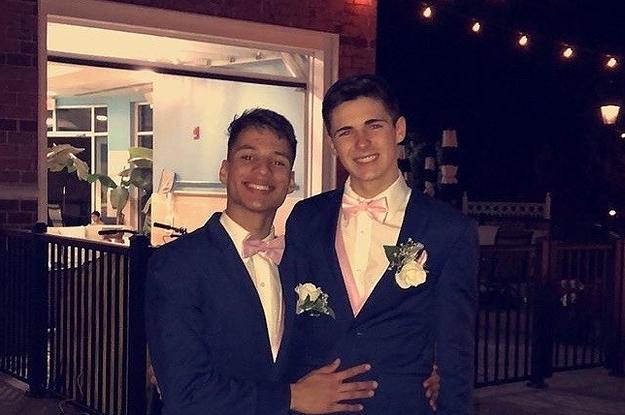
A gay teen couple is urged to kiss by ‘drunk bros’ and it’s actually a very sweet story

Not necessarily something you’d expect from a town on the Jersey Shore.

prom, lgbtq, jersey shore
Photo credit: CanvaA Jersey Shore unexpected encounter with 'drunk bros.'

Seaside Heights is a town on the Jersey Shore: a place synonymous with Snookie, The Situation, and a heaping helping of fist-pumping.

So you probably wouldn’t be judged for thinking it’s not a place of overwhelming inclusivity. In this case, though, you’d be wrong.

Let’s set the scene: It’s a spring night during prom season and deliriously happy high schoolers are sauntering down the boardwalk on their way home from a night they’ll never forget.


As couple after couple passes by one particular rooftop bar, some bros overlooking the scene are screaming at couples to kiss. And then there’s a pause.

Walking down the street is a gay couple in matching tuxedos (adorable). They’re holding hands (adorable).

But here’s the thing — as openly gay “Good Morning America” producer Mike Del Moro noted on Twitter (where he live-tweeted this occurrence), they’re doing it in a town “where — not so long ago — young men would shout the word ‘f****t’ out their car window as we’d stroll along the boardwalk.”

Del Moro, who was on the boardwalk with his mother and boyfriend, was instinctively nervous for the couple.

That makes total sense. Even in an ultra-liberal center like San Francisco, I’ve been harassed for holding hands with my husband. So in a place like Seaside Heights, Del Moro definitely had cause for concern.

What happened next, though, was a heartwarming step in the direction of progress.

Let’s let Del Moro’s tweets do the talking:

Del Moro makes it clear this occurrence doesn’t mean that “everything’s fine.”

It’s just one instance. But it is movement. And, as Del Moro notes, “it’s an encouraging moment for young LGBTQ folks out there.”

For the teens at the center of the story, the moment was worth every second.

You know how the internet works, so it won’t surprise you that the happy couple was immediately found, identified, and lauded for being out in a place where being authentically yourself can become dangerous.

They’re Theodore Vidal and Colin Beyers, boyfriends who couldn’t be more happy that things are changing in their town.

gay couple, heartwarming surprise, teens, prom
This Teen Couple Walking Home From Prom Got A Pretty Heartwarming Surprise. <a href="https://www.buzzfeednews.com/article/briannasacks/jersey-teens-prom">www.buzzfeednews.com</a>
Speaking to BuzzFeed, Vidal, who revealed that he had been bullied after he first came out, said their encounter with the strangers on the rooftop was completely unexpected. “It was so surprising that these guys were supporting us,” Vidal said. “Especially after what I’ve gone through.””It’s an area where you normally would get discriminated against and the fact that those guys cheered us on was shocking,” Beyers told BuzzFeed. “It’s one of those small victories that makes the hard times worth it.”Speaking with me over direct messages, Vidal said that all the positive attention had made him and his boyfriend feel “welcome in the world,” which is not always the case for LGBTQ youth. “It’s made such an impact on me.”This is a reminder that things are getting better in small ways every day. Admittedly, the story — however heartwarming — is still pretty problematic. Quick PSA to all dudes on roofs: Please stop screaming at people to kiss each other. Catcalling is a bad idea regardless of why you’re doing it, and there’s no reason to put undue pressure on young people of any gender to kiss each other in public. And while this moment turned out great, it could have definitely been awkward or even upsetting. That said, we shouldn’t let those imperfections take away from the fact that this story proves LGBTQ acceptance is making real strides against toxic masculinity and bigotry.Personally, I’m looking forward to the day when gay couples can walk around without being jeered at or celebrated. In the meantime, though, this feels like a step in the right direction.”It’s moments like what happened at Seaside that give me hope and make all the hardships worth it,” Beyers told me. “It’s funny, because we really didn’t do anything; all we did was be ourselves in front of some drunk people.” Hey, that kind of bravery is often more than enough.This article originally appeared on 05.14.18.
  • Woman proposes to girlfriend on hockey jumbotron in sweet ‘Wheel of Fortune’ reveal
    Photo credit: via Toronto Sceptres (used with permission)A proposal at a hockey game.

    It’s fairly common to see someone propose on the Jumbotron at a sporting event. A couple from Virginia, however, found a new way to add some drama. They turned their Jumbotron proposal into a Wheel of Fortune-style game.

    It all went down at the Coca-Cola Center in Toronto, Canada, during a Professional Women’s Hockey League matchup between the Toronto Sceptres and the New York Sirens.

    The couple, Nina Borgeson and her partner, Meg Beizer, appeared to be playing a game similar to Wheel of Fortune during a break in the hockey match, but Meg knew otherwise. The announcer asked her, “What three letters are you going to guess next?” After the traditional RSTLNE were put up on the board, she replied, “W, O, U,” making it obvious what the puzzle said.

    Nina solved the puzzle:  ‘WILL YOU MARRY ME?”

    Meg then got down on one knee and, in front of the cheering crowd, she popped the question. Meg slipped the ring on Nina’s finger, they kissed, and Nina raised her hand in celebration. 

    The couple traveled to the game from Virginia, and when Meg learned that it was Pride night, she knew it was the perfect time to ask for Nina’s hand in marriage. “This league quickly became a big part of our life and something so special to us,” Meg told Queerty. “The community is unlike any other fan base I’ve ever seen. I knew sharing it with other fans would make our proposal that much more special and memorable, and it exceeded expectations. The amount of love and support we received was something we will truly never forget.”

    PWHL games have become a popular place for LGBTQ women to propose. Back in December, at an Ottawa Charge game, two women were being interviewed when the conversation veered into unexpected territory. “I love this community, I love everything that’s been given to us,” a woman named Theresa said into the microphone, “and I can’t think of a better moment to ask Dani…” she said before dropping to one knee and proposing.

    The PWHL just completed its third regular season, during which it saw attendance and viewership expand dramatically. This season, the league expanded from six to eight teams and saw attendance eclipse the million mark for the first time. Attendance was up 28% this season, with the average game attendance rising from 7,230 in 2024-25 to 9,304. Viewership is also up on the league’s YouTube channel. This season, viewership across the U.S. and Europe increased by 77%. 

    A growing community

    The league saw an opportunity for growth after women’s hockey made headlines in Milan earlier this year, with the U.S. women’s team beating Canada for the gold medal. “We knew this moment was going to be big for us,” PWHL executive vice president of business operations Amy Scheer told The Athletic, “and felt that this could be a game changer for us.”

  • Why a common World War II experience made Americans choose toilet paper over bidets
    Photo credit: PhotosNormandie/Wikimedia Commons & CanvaAmerican soldiers in World War II and a bidet.
    ,

    Why a common World War II experience made Americans choose toilet paper over bidets

    We’ll probably switch to the metric system before bidets.

    The bidet dates back to 18th-century France and, by all accounts, is more hygienic than toilet paper and better for the environment. But, much like the metric system, Americans aren’t adapting to them anytime soon.

    In fact, a 2022 poll found that only 12% of Americans “know a lot about” bidets. Americans make up 4% of the world’s population but use 20% of its toilet paper, while 70% of the world doesn’t use toilet paper at all.

    When you look at the numbers, bidets are a much better option for the environment and for one’s pocketbook than toilet paper. According to The Process, Americans cut down 31 million trees each year for toilet paper, and it takes 37 gallons of water to produce a single roll, while each use of a bidet requires only one-eighth of a gallon.

    Bidets also do a better job of cleaning your rear end than a square of toilet paper.

    “The direct application of water for post-toilet cleansing removes residual fecal matter more effectively than toilet paper alone,” Dr. Farhan Malik, a health and wellness expert, told KTVX-TV. “This can help prevent skin irritation and inflammation in the genital area. The gentle, targeted spray of water also reduces excessive wiping and tugging, which can lead to discomfort.”

    Why haven’t Americans adopted the bidet?

    When Americans were stationed in France during World War II, many visited bordellos, a fact they probably didn’t want people back home to know. In the bordellos, sex workers and their clients used bidets to clean up before and after their encounters, so Americans came to associate bidets with naughtiness and illicit behavior. 

    toilet, bidet, bathroom
    A bidet beside a toilet. Photo credit: Mura.Ts/Unsplash

    “GIs visiting bordellos would often see bidets in the bathrooms, so they began to associate these basins with sex work,” Maria Teresa Hart writes in The Atlantic. “Given America’s puritanical past, it makes sense that, once back home, servicemen would feel squeamish about presenting these fixtures to their homeland.”

    Even before World War II, bidets were associated with contraception and abortion. “The presence of a bidet is regarded as almost a symbol of sin,” Norman Haire, a pioneering gynecologist and sexologist, said in 1936.

    Bidets make economic sense

    What’s interesting is that, even though Americans rejected bidets on moral grounds, that resistance hasn’t been overridden by economic common sense. Americans spend $11 billion on toilet paper every year, and the average person in the U.S. uses 141 rolls annually. A single bidet attachment can cost as little as a one-time fee of $35.

    toilet paper, toilet paper stash, bathroom
    A whole lot of toilet paper. Photo credit: Erik Mclean/Unsplash

    Bidets have been found to be better for your health, the environment, and your wallet, but Americans still won’t switch from paper to a little spritz of water. If the runs on TP during the COVID-19 pandemic didn’t inspire Americans to change their ways, maybe nothing will. 

    “Toilet paper is not a necessity. It is a cultural habit wearing the costume of a necessity. Seventy percent of the human population proves that every single day,” The Process reports. “A product most of the world has never needed became the first thing Americans panic-bought when crisis arrived. Not medicine. Not food. Toilet paper. That tells you something, not about cleanliness, but about how habits take root. They do not grow from logic. They grow from one small misunderstood moment, repeated across a generation, then another, until the habit feels like instinct.”

  • 77-year-old ‘hip-hop granny’ impresses and inspires with her dance moves
    Photo credit: @fiercefitnessty/TikTok Ms. Stephanie bringing it at her hip-hop class.
    ,

    77-year-old ‘hip-hop granny’ impresses and inspires with her dance moves

    Ms. Stephanie didn’t even start formal dance lessons until she was almost 30.

    Stephanie Walsh isn’t your average hip-hop dancer. At 77, “Ms. Stephanie” is still able to hold her own on the dance floor, popping and locking with people a third of her age, and she loves it. When you see her dance (and her enviable muscle tone) you might think she’d been a trained dancer all her life. But in actuality, she didn’t take any formal dance lessons until she was almost 30.

    She didn’t start dancing until she was almost 30

    Walsh told Growing Bolder, an active lifestyle brand, that she had wanted her daughter to dance when she was little, so she got her ballet lessons, which the daughter hated. Realizing that dancing was her dream and not her daughter’s, Walsh took her kiddo out of ballet and started classes herself right away. She had always loved to dance and developing her skills only led to more and more dancing.

    These days, Ms. Stephanie gets her dance moves on at Fusion Fitness, where she encourages people to “dance like EVERYONE is watching.” One video of her dancing at Fusion has gone viral multiple times, and it’s easy to see why. Check this out:

    @fiercefitnessty

    Reposting this video of Ms.Stephanie & I since it going viral again. This video will always be a vibe. One thing Ms.Stephanie and I created was magic. We dance from our hearts. My classes are always about creating a Fierce vibe for everyone to show up and show out! . #fiercefitness #dancefit #fiercefitnessty #hiphopfitness #fyp #viral

    ♬ original sound – Fierce Fitness Ty

    “Reposting this video of Ms.Stephanie & I since it going viral again,” shared @fiercefitnessty on TikTok in 2023. “This video will always be a vibe. One thing Ms.Stephanie and I created was magic. We dance from our hearts. My classes are always about creating a Fierce vibe for everyone to show up and show out!”

    It’s not just the dancing. It’s the intensity. It’s the full presence in the moment in her face and in her movements. She’s there for it, and she brings everybody with her.

    “It’s the “I’m a badass” facial expression for me! ☺️” wrote one commenter on Facebook.

    “I dislocated my shoulder just watching that    ” shared another.

    “She can throw it back like the rest of them. You go girl!” shared another.

    Dancing has kept her going through the hard times

    Walsh shared that dancing has helped her get through many difficult periods in her life.

    A few years later, Ms. Stephanie is still thriving and dancing. She even has a fan page dedicated to her on Instagram, with posts from as recently as May 2025 showing she’s still doing what she loves:

    Love it when people prove that age truly is just a number!

    This article originally appeared two years ago. It has been updated.

  • Older man on tram called a young woman “disgusting” for wearing a dress. A stranger on board had something to say about that.
    Photo credit: CanvaOld man looks disapprovingly at woman in skirt

    Renee Buckingham was on a tram in Melbourne when an older man started calling a young woman “disgusting.”

    The woman was with friends, wearing a dress. The man told her she should be embarrassed for dressing that way in public, in front of older people like him, he said. He kept going.

    She couldn’t stay quiet

    Buckingham, a Melbourne-based content creator, said she felt her heart rate climb as she watched. She doesn’t usually look for confrontation. For a moment she hesitated, worried the man might turn aggressive if she intervened.

    Then she spoke up anyway.

    “I said to him, ‘Don’t you dare speak to women like that,’” she explained in an Instagram post shared on January 19, 2026. She told him that if he felt uncomfortable looking at the woman’s outfit, that was his problem, not hers. She told him a woman’s clothing choices have nothing to do with her worth.

    He didn’t have much to say after that.

    Putting the shame on the shamer

    Buckingham posted about the incident and it spread quickly, drawing thousands of responses from people who recognized the moment, the calculation that happens in real time when you witness something wrong in a public space and have to decide whether the cost of speaking up is worth it.

    For the young woman on the tram, Buckingham had a direct message: “Never change who you are for any man.”

    Her message resonated

    The comments on her post filled with people who’d been in similar situations on both sides of it, the ones who’d been shamed, the ones who’d watched and said nothing and still thought about it, and the ones who’d spoken up and found it went differently than they feared. “Thank you for advocating for that young woman,” wrote one commenter. “We need to keep speaking up.”

    Buckingham’s point, boiled down: the discomfort belongs to the person doing the shaming, not the person being shamed.

  • Indigenous woman cries tears of joy after hairdresser discovers ‘unruly’ grey hairs
    Photo credit: CanvaIndigenous woman cries tears of joy after hairdresser discovers 'unruly' grey hairs

    Grey hair has been a concern for people since before hair dye was invented. Some people pluck them and dye them as soon as they see them growing in, while others embrace the silvery hairs. Chiara Do’wal Sehi (Sunshine) Enriquez, an Indigenous woman from the Karankawa Tribe, recently shared her excitement about learning she had grey hair.

    For a brief period of time, people were actually dyeing their hair grey prematurely. It wasn’t uncommon to meet a 20-something with “granny grey” purplish-silver hair, but the popularity faded nearly as fast as it started. But for Enriquez, grey hair isn’t a fad or something to hide. It’s a right of passage to celebrate.

    indigenous, grey hair, getting older, culture and humanity, going grey
    Indigenous woman with long braids.
    Photo Credit: Canva

    During the colonization of the Texas Gulf Coast where the Karankawa originated, the Indigenous tribe was nearly eliminated. According to the Texas State Historical Association, the Karankawa people fought to maintain their land from 1685 until 1858 from French and Spanish settlers. Due to this multi-century, on-and-off battle for their territory, the tribe’s numbers became so small that they were considered “extinct.”

    Enriquez is a descendant of the small number of Karankawa that survived. To her, living long enough to experience the growth of grey hair is a gift. The woman shares how much her “unruly” greys mean to her in a video uploaded to her Instagram page.

    indigenous, grey hair, getting older, culture and humanity, going grey
    Indigenous woman standing in sunshine.
    Photo credit: Canva

    “I got my hair styled today. I don’t get it cut. It’s a cultural belief that I was taught by my mother. We don’t cut our hair, we let it grow. We save the cut for very, very serious and important moments in our lives,” she says while sitting in her car.

    The woman explains that while she was having her hair styled, she asked the hairdresser about the texture of her hair. This is when she learned of her wiry new strands. She surprised hairdresser with her delighted response. “She said to me that it was because I had many little greys, and the unruly ones that were pushing up my other hair that weren’t grey were causing it to be a little bit frizzy.”

    Enriquez lights up and smiles while recalling the moment in her hairdresser’s chair. She reveals, “And that felt so incredible. What an honor, and I was…I’ve only ever seen my head grow one grey hair, and even when I knew I had one grey hair, I was incredibly thankful. When she saw that I was smiling and so happy, she said, ‘Oh wow, you really must come from a different culture.’”

    indigenous, grey hair, getting older, culture and humanity, going grey
    Elderly indigenous woman.
    Photo credit: Canva

    She later adds while tearing up, “I’m very happy to report that not only do I have for sure one grey hair, I have many. A plethora of grey hair. What an honor. What a fantastic gift to be lucky enough to see myself grow grey hair. That is so incredible. I am so lucky. What a life it has been. What a life it continues to be.”

    Enriquez wipes away tears as she encourages others to embrace their grey hair. Viewers were moved by her joyfully emotional response to finding out she has a head full of grey hairs pushing their way through.

    One person shares, “As a chemo patient I am always surprised when people are upset about their grey hair. I have come to see it as a privilege and dream of the day I might have greys, though my mom’s hair has never changed colors, and neither did her dads. Their hair has always stayed brown for some reason. Since my hair has begun growing again I have decided not to cut it for as long as possible. So I can say, I’ve been cancer free for this long, and show people my hair for reference.”

    Someone else writes, “This had me in tears because i’ve loss so many people and im only 30 and the day i get grey hairs i will celebrate with them!”

    Another person says, “i’m so happy to hear this expression of delight regarding your grey hair~ i am only just now getting greys & my own natural reaction was very different from my mom’s & grammom’s reactions~ i was surprised to find that i like seeing them appear~ hearing your perspective makes me think that it’s because i am not as tethered to the usa culture as they…
    so thank you for sharing your experience & offering food for thought~ & congratulations.”

    “I have been allowing my greys to come in naturally and have stopped dyeing my hair and it’s very liberating and in a society where ageism is everywhere it feels like resistance. And I love that! I have more greys than my mom. :),” someone else shares.

    indigenous, grey hair, getting older, culture and humanity, going grey
    Elderly Indigenous woman with hair covered.
    Photo credit: Canva

    “What a sacred and healthy perspective,” one person says.

    Another reveals, “I love this so much! Thank you for sharing your joy and gratitude with us. I’m getting grey and have been oscillating between feeling happy about it and feeling like I’m not sure i feel “ready” to have grey hair.”

    Enriquez says, “I’ve always been of the personal belief that humans take the longest to change the color of their foliage in observation of their reconnection with Mother Earth and the cyclicity of her seasons and transitions.” She then explains that trees change with the seasons, grass goes through a cyclical change, and even animals turn grey and calm with age. “And it has always been representative that you have lived a full life. Do you know how many people didn’t get to grow grey hair? Didn’t get to see the hair change? What a gift,” she adds.

  • Gay man learning how to say goodbye ‘like a straight man’ is pure comedy gold
    Photo credit: Canva PhotosA gay man's 30-day challenge to learn how to do things "straight" is going super viral.

    It’s no secret that there are certain mannerisms and speech patterns we often associate with being gay. The phenomenon of so-called “gay mannerisms” and voice has actually been the subject of quite a bit of scientific research. One study from 2002 found that people were able to accurately predict the sexual orientation of a speaker just by hearing their voice about 62% of the time. Researchers theorize that some, but certainly not all, gay men may adopt more feminine mannerisms and voice patterns as a form of subconscious social signaling.

    It’s much more complicated than that, though. The way gay men speak and behave is as diverse and varied as the community itself: which is to say, very.

    But one more pressing question remains: If “gay mannerisms” can be categorized and studied, can those of the heterosexual male be quantified? And, more importantly, can they be learned?

    Comedic experiment ensues

    Content creator Kai Cameron was up to the challenge. The openly gay TikTok star recently launched a tongue-in-cheek 30-day challenge where he attempts to learn how to do and say things “like a straight man.”

    On Day 1, Cameron’s brother teaches him how to sit down like a straight man. On Day 4, they move onto answering the phone. Day 7 features more advanced material: entering a party the way a straight man would. Cameron learns to sway his hips less, talk in a deeper tone of voice, and suppress any hint of enthusiasm.

    On Day 11, Cameron was ready to tackle the simple but crucial task of saying “Goodbye,” to a friend. His instructor in the clip, this time actor and filmmaker Peter Falls, demonstrates a textbook, nonchalant “Alright, see ya later,” with a barely perceptible hand-gesture-wave-kind-of-thing. Straight guys will instantly recognize it and notice Falls’ impeccable form.

    The words come easily enough for Cameron, but he gets stuck on the hand movements. “Can you do the finger thing again?” he asks, before trying it with a dramatic wave. “That’s way too much,” Falls says.

    After a little more practice, though, Cameron’s mostly got it. He confidently walks forward, chest puffed out, body stiff, and drops his voice a few octaves before muttering “See ya, man,” with a small (for him) flick of the wrist.

    Close enough!

    Viewers find the videos hilarious but revealing

    Does the video series mine humor at the expense of people who exhibit “gay mannerisms?” On the contrary: thousands of commenters say that it’s rare to see such a brilliant dissection of the straight man.

    Many noticed that so much of the demeanor comes from the eyes:

    “U just have to lose the light in your eyes,” one commenter wrote.

    “I love how the light leaves your eyes everytime and then comes right back,” said another.

    “It’s the dead eyes when channeling straight man,” another echoed.

    Other viewers went even deeper and more philosophical:

    “No whimsy, no enthusiasm, nothing,” someone said.

    “Watching [your] content has taught me a lot about what it looks like from the outside to be a straight guy. Just beat up by life. Body language which clearly indicates no one cares about you, so you stay reserved,” one commenter noted.

    “I think some cultures have done a ton of damage by brainwashing boys and men into hiding vulnerability, sensitivity or even just being themselves. That takes a psychological toll. A lot of men don’t stay reserved because no one cares but because society (other men) teach them that tough men have to keep it all in. It is not healthy for you,” another said.

    A third summed it up: “Basically just act depressed while doing all things and you got it!

    The fascinating origins of voice, body language, and mannerisms

    Cameron’s social media video series is incredible comedy and entertainment, but it’s also a brilliant educational demonstration.

    “Straight voice” isn’t just the absence of the more feminine qualities of “gay voice.” It is, itself, a learned and socially constructed behavior.

    “When men enjoy doing things that are typically associated with women or femininity such as shopping, grooming their nails, giggling, etc., they are often quickly labeled as gay or soft and are negatively evaluated by many members of society,” Ayana Ali, a clinical social worker and therapist, told AskMen.

    Even many gay men feel self-conscious about their voice and mannerisms, and may even mask them to adopt more traditionally masculine qualities in certain situations.

    It’s an incredibly complex web of social conditioning, how we’re raised, biology, sociology, culture, gender norms, and more.

    But it’s never been more hilariously deconstructed than in Cameron’s 30-day challenge.

  • Woman who moved from Ireland to Boston shares why the American dream is ‘all a lie.’
    Photo credit: via Kayleigh Donahue/TikTok and Zeeshan Kundi/PexelsKayleigh Donahue explains the differences between the U.S. and Europe.

    Living abroad is a dream many people have, whether it’s spending a summer in a foreign country or packing up their entire life to make the permanent move. In fact, according to a 2025 Harris Poll, more than half of Americans believe they could have a higher quality of life abroad, and many say they’d move if they had the means. Some estimates show that an estimated 5.5 million Americans live abroad, according to the Association of Americans Resident Overseas.

    But life is funny, and sometimes these expats come back to the United States for a variety of reasons like family or career, which gives them an extremely interesting perspective when they begin their re-entry.

    Take American-born TikTok user Kayleigh Donahue, for example. She’s going viral on the platform because of her unflinching take on why it was a mistake for her to move back to the U.S. after spending 4 years in Ireland.

    Moving to the U.S. was a step backwards

    Kayleigh moved back to the Boston area from Ireland to make more money, but that didn’t go as planned.

    Even though she got paid more, the cost of living was so much higher that she saved less money than she did in Ireland. She also missed the generous number of vacation days she got in Europe as compared to America.

    “I have been bamboozled,” she begins in the now viral clip with over 600 thousand views.

    Many people like Kayleigh move abroad, especially to European countries, for a slower way of life, better work-life balance, more opportunity for travel, or just to see something different. But America is the land of opportunity, right? For some, that promise always beckons, no matter where they go. So even though Kayleigh had an amazing life in Ireland, she wound up moving home to advance her career and make more money.

    The real cost of the American Dream

    “Basically, I really got sucked into the American Dream way of living when I was abroad, which is funny because I loved living abroad,” Kayleigh said. “But you know, making more money, that’s enticing. Good job, that’s enticing. It’s not true. It used to be. It definitely used to be. You could come here and make a ton of money, make a great life for yourself. But the younger generation today, in this country – screwed. It’s literally all a lie that is sold to you. It’s such a struggle, and the older generation doesn’t seem to see how much of a struggle it is for the younger generation here.”

    In the end, who wants to work harder for a lower quality of life?

    “Needless to say, I will most likely be moving back to Europe where 20-plus days of paid vacation a year is literally the law, and I will make less money, but somehow, you know, the cost of living is lower there and I can save more,” Kayleigh concluded the video.

    The comments support Kayleigh

    Viewers applauded Kayleigh for coming to the realization:

    “Yep, I made the same mistake. Then I realized that people and quality of life are more important than income. Enjoy life!” one wrote.

    “Get that. We moved back to US and it was horrible. We moved back to the UK. Happier now was 6 weeks off a year” said another.

    “I think there are actually very few people who derive their enjoyment and self-worth from their job. Quality of life is so much more important,” another user added.

    Kayleigh made good on her promise. As of January 2025, she now lives in Amsterdam with her Dutch husband, and they seem to be loving their life abroad.

    A Mercer survey in 2024 put Amsterdam as the sixth best city in the world for quality of life. It’s a place with rich culture, amazing public transportation, and a reasonable cost of living to earning potential ratio.

     Young Americans really aren’t asking for that much. They just want to be able to afford and enjoy their life, and they’re willing to work hard for it. America should be giving them those opportunities instead of losing more and more talented young people to other countries.

    This article originally appeared two years ago. It has been updated.

  • Man explains the counterintuitive reason Norwegians love fishnet underwear
    Photo credit: CanvaFishnet stockings have multiple purposes.

    When you think of mesh shirts and fishnet stockings, you might picture a goth, punk, or other brands of night club fashion. Most wouldn’t associate fishnet garments with hiking, skiing, or dogsledding.

    But as Michael Kristy from The Iron Snail Clothing Co. explains, fishnets are the underwear of choice for many. In particular, Norwegians who want to enjoy the great outdoors in all temperatures wear them. It may seem counterintuitive to wear something holey to stay warm, but there’s a reason it works better than most base layers.

    Kristy explains that Norwegians have been wearing fishnets under their clothes for over 100 years. And they’re not the only ones. The first people who summited Mt. Everest wore a fishnet layer under their clothing to stay warm.

    Mesh undergarments were popular around the 1950s, but they weren’t called fishnets. They were called “health vests” or “string vests” and they were touted as being “recommended by medical professionals.”

    What’s the big deal with mesh? It’s all about the air layer it creates. Wearing it under clothing serves as both an insulating layer and a moisture wicking layer.

    “It really helps regulate your overall body temperature and makes you feel a lot more comfortable when you don’t have wet, clammy clothes sticking to you at all times,” says Kristy.

    The Norwegian company Brynje manufactures mesh under layers and claims they are four to six times warmer than other base layers.

    So under other clothing, the fishnet fabric keeps you warmer. But conversely, if you get too hot, stripping down to only the mesh layer will quickly cool you down.

    In addition to plenty of punk/goth approvals, the comments included corroboration from Norwegians and others who have first-hand experience with the magic of mesh base layers:

    “Norwegian here, and proud wearer of «netting» as we call it in the military!”

    “Can confirm, most Norwegians (and neighbours) that do outdoors stuff use ullnetting/woolnet. It’s basically a cheatcode for staying warm, so I have a ton of these. The words fishnets or health/stringvests is never used. You can find very old farmers that use the word healthvest/helsetrøye, mostly people just call them ullnetting or netting if talking to outdoors people.”

    “I’m a veteran. I did training with the Norwegian army on a base north of Norway. I had so many layers and was constantly freezing my ass off. I noticed the Norwegian army guys had these fishnets as their first layer. And asked em why they all had that. He told me it was to keep them warm. Luckily i have not been in that kind of cold since. But getting those fishnet layers has been on my mind since.”

    fishnets, leggings, clothing
    Fishnet leggings add a surprising amount of warmth as an underlayer. Photo credit: Canva

    “Our guide on a glacier tour in Norway had these and told me about them, so I decided to give them a go for a recent vacation to go figure skating on wild ice in northern Sweden. I wore these nets under a merino wool baselayer and a thick Norwegian wool sweater (plus an outer synthetic hard shell to keep out the wind) and it was fantastic. Spent all day outdoors at -20°C combining intense workouts with picnic breaks and never got cold thanks to my base layer always being dry. 11/10 would recommend, I haven’t shut up about these since then.”

    “Yeah, it’s absolutely true too. I’m an avid outdoorsmen, so I’ve watched lots of tests on this. Fishnets outperform even the best wool base layers in absolutely every single category except for odor. Unless we’re talking niche applications there’s nothing better than the fishnets.”

    “I’ve been wearing mesh shirts under my normal clothes for about a year now—and without knowing this was exactly what they were used for, I found it helped me keep cool in the summer and warm in the winter. Imagine my surprise when this video teaches me I’ve been continuing a longstanding Norwegian tradition as a necessity for working in a warehouse (and for punk fashion lol).”

    With as many advancements as we’ve made, sometimes the traditional methods still work best.

    You can follow The Iron Snail on YouTube for more fun clothing facts.

Health

Blue Zone expert shares why partying all night isn’t decadent, it’s a key to longevity

Politics

76-year-old farmer refuses to leave his Godley Green land, even as 2,150 homes are built around him

Wholesome

A professor’s students gave him 152 pages of wisdom they’d learned from him. It’s a must-read.

Culture

Woman proposes to girlfriend on hockey jumbotron in sweet ‘Wheel of Fortune’ reveal