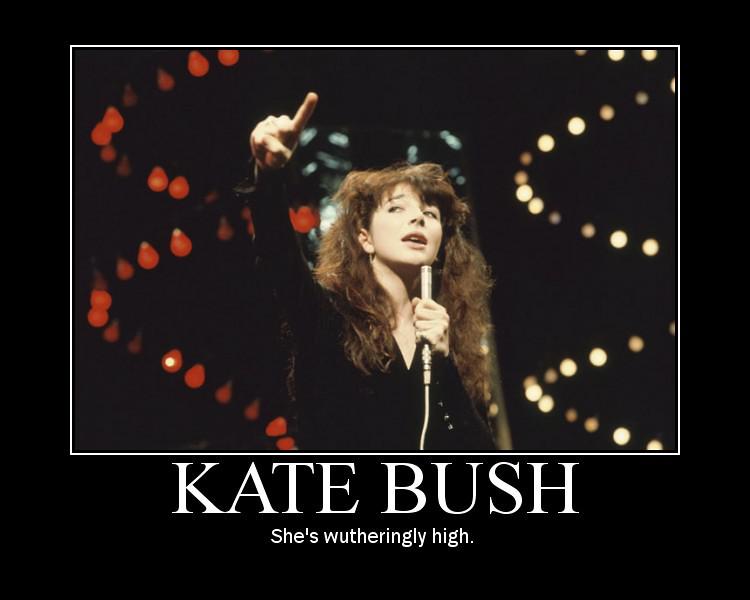
An iconic scene in ‘Stranger Things’ has made this 37-year-old Kate Bush song a number 1 hit

An iconic moment all around.

running up that hill, stranger things, kate bush
Photo credit: www.flickr.comA win for weirdos everywhere.

It’s not every day that an obscure relic from ’80s alt pop completely dominates the charts, takes over social media and becomes a Gen-Z approved cultural phenomenon more than three decades after its original release … all over the course of one weekend, no less. But Kate Bush’s “Running Up That Hill” has done it, thanks to “Stranger Things.”

The widely popular Netflix show has been bringing ’80s pop culture back into the mainstream since its premiere—particularly with things once considered very uncool, like Dungeons & Dragons. But “Running Up That Hill,” wasn’t just used to instill nostalgia or redeem something previously weird (although it does that too). The song plays a pivotal role throughout the season that audiences are responding to on an emotional level.


When a young girl named Max (played by Sadie Sink) becomes haunted by the death of her stepbrother Billy, she starts playing the song over and over again on her Walkman to process her grief.
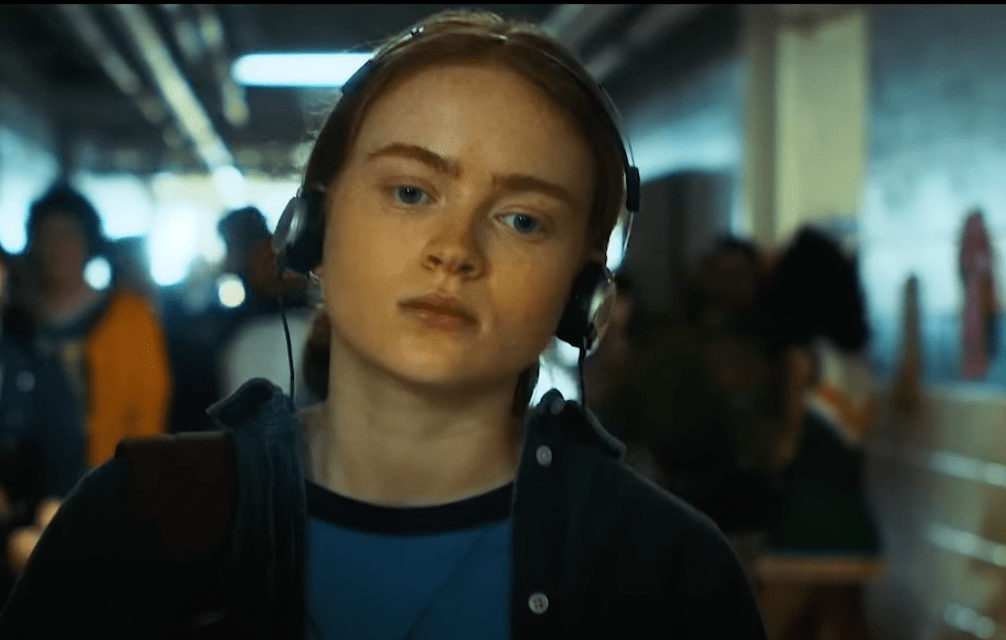
max song stranger things
The headphones might have changed. The feeling hasn't. <a href="https://www.youtube.com/watch?v=2pdkKo-Cj5Y">YouTube</a>

The lyrics “If I only could, I’d make a deal with God, and I’d get him to swap our places” seem to perfectly encapsulate what she might be feeling under her generally tough exterior, and to some extent what anyone who has faced irrevocable loss might feel.

Bargaining, attempting to postpone pain by imagining these “what if” scenarios, is a stage of grief many of us find ourselves in. Though that isn’t necessarily the song’s original meaning, it just works in this context beautifully.
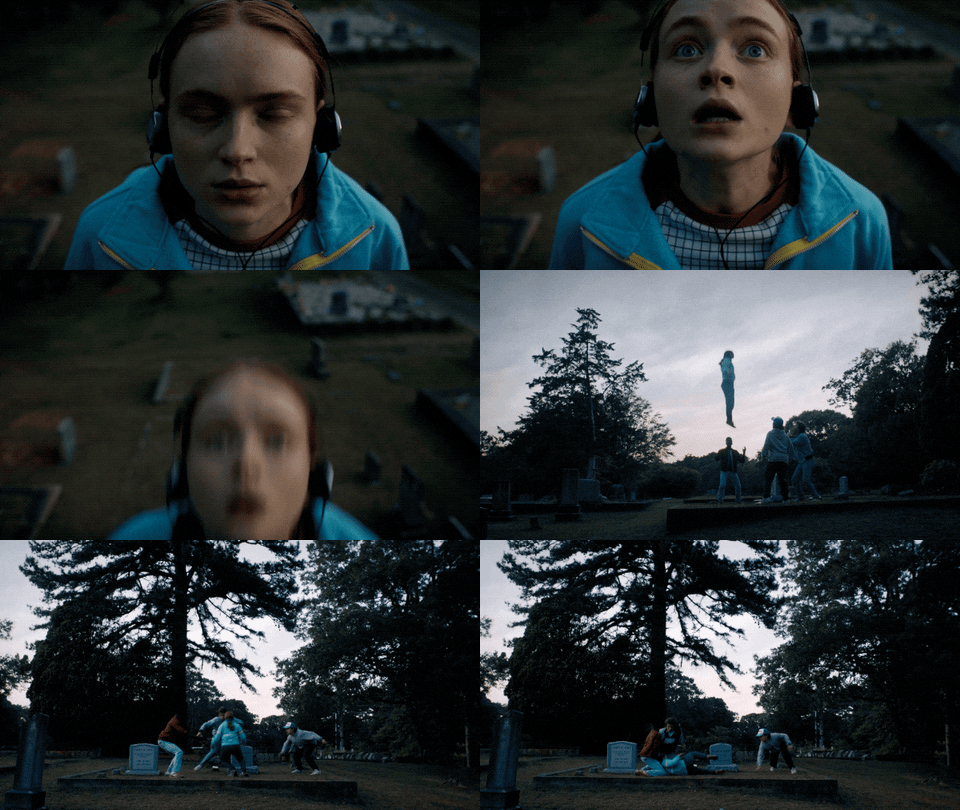
stranger things season four
When the song is over a real life resumes. <a href="https://giphy.com/gifs/netflix-stranger-things-4-st4-7wfWIcQyj2F68vmd18">Giphy</a>

Later, that song is the very thing that saves Max from the evil alternate dimension known as the Upside Down. It pulls her mind away from the darkness and back to her friends, her world and herself. I think everyone has their own “Save Me From The Upside Down” song—a tune or even a whole album that connects them back to their humanity, which is why so many viewers were touched.

Funny enough, for me that lifesaving music is Kate Bush, so this whole moment is super vindicating. Is this what being a hipster feels like?

If you have somehow never witnessed the utterly dramatic, super eclectic, whimsical-yet-bonkers music of Kate Bush, you’re in for a treat. For some, her vibe was way too out there. In fact, according to Unilad, “Running Up That Hill” was even banned from MTV for being “too weird.”

For others, like me, Kate Bush was a spiritual experience.
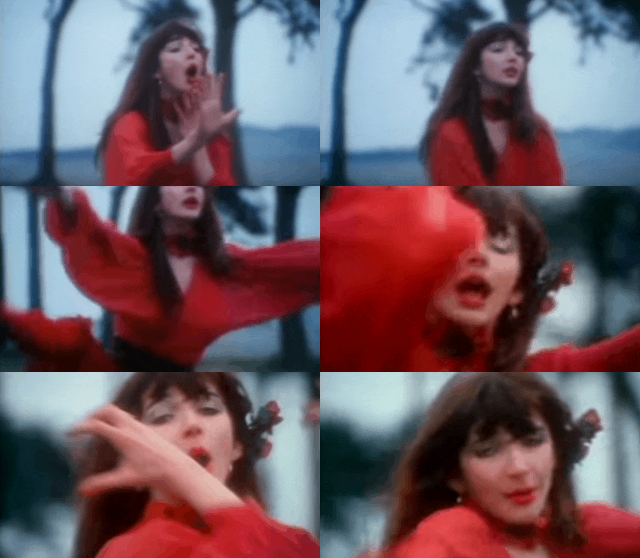
kate bush running up that hill
This was on my vision board for <em>years</em>. <a href="https://giphy.com/gifs/dance-1980s-kate-bush-RC2nV1flJMlfq">Giphy</a>

Not only did it help me escape from otherwise dreary times to fantastical realms, nothing made me feel more encouraged to embrace my own nonconformity. During my teenage years, that was everything.

Below is the original music video for “Running Up That Hill”— complete with interpretive dance moves—just to give you a taste of Kate Bush’s genius.

Since it was released in 1985, the song has been covered numerous times by artists including Tori Amos, Tiffany and Placebo. But for the most part, it has been held in reverent obscurity by only diehard fans. The latest season of “Stranger Things” not only catapulted “Running Up That Hill” to No. 1 on iTunes, it has younger generations now obsessed with all things Kate Bush.

Even the bizarre way she pours tea has gone viral on Twitter.

Is it unsettling to see an artifact from your formative years suddenly be part of the public zeitgeist? Yes, it is. But mostly it’s delightful.

“Stranger Things” is at its heart a story that celebrates outcasts. From the beginning it’s made heroes of outsiders and helped younger audiences appreciate things older generations might have once held shame in loving.
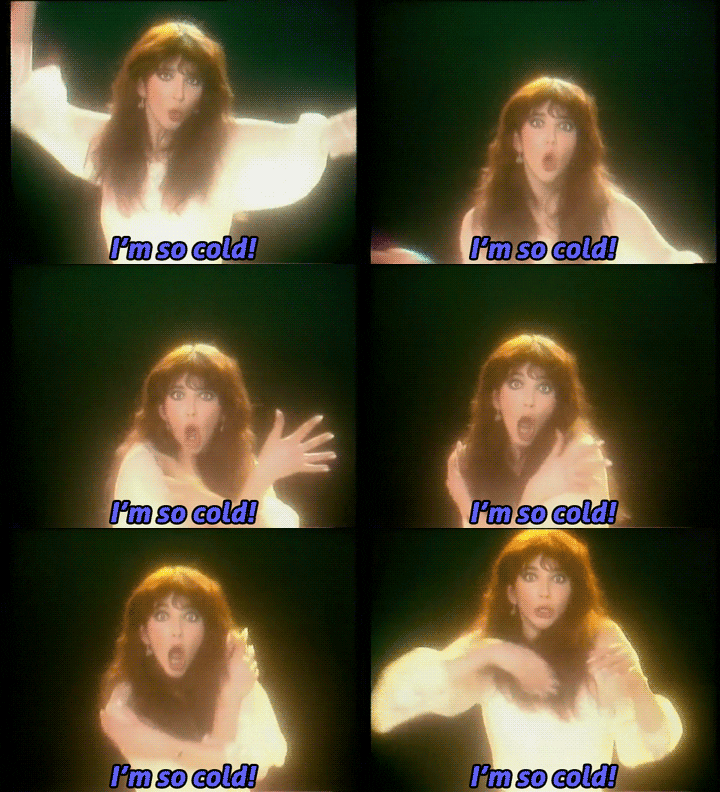
kate bush stranger things
I mean … what's not to like? <a href="https://giphy.com/gifs/cold-14oEknsVCOKSsM">Giphy</a>

Bush’s music is a flavor of uplifting weirdness the world could really use right now, and how thrilling it is to see its much-needed renaissance.

  • 20 years ago his BBC interview became a viral comedy hit. Now, he’s sharing his secret to staying calm.
    Photo credit: BBC News/YouTubeGuy Goma realizing he’s in the wrong interview, circa 2006.

    Since his accidental 15 minutes of fame in 2006, Guy Goma has been the epitome of keeping calm under pressure.

    The video—in which Goma showed up for a job interview at the BBC and was mistaken for, quite literally, another Guy (technology journalist Guy Kewney)—has gone viral time and time again, thanks in no small part to how well Goma handled the situation after being thrust into a live on-air interview.

    Now, two decades after the wholesome snafu, Goma has decided to impart some wisdom about turning a potentially catastrophic moment into one of pure grace.

    To be fair, Goma admits he wasn’t stoic the entire time

    Speaking to This Morning, Goma said his initial thoughts were, “God help me. I’m lost completely.”

    However, he remembered the words of his mother, who taught him to quietly fix a problem without embarrassing anyone.

    “My mom always says to us, ‘If you notice something, your brother made a mistake anywhere, correct the mistake first before talking to the person,’” he said.

    Not wanting to make anyone else feel uncomfortable, Goma held onto his composure. That was all the fuel he needed to carry on, answering the questions placed before him with such admirable self-possession that viewers still revisit the clip time and time again. Sure, it’s partly for a good laugh, but also because Goma’s chutzpah is undeniably inspiring.

    The hidden Zen wisdom behind all this

    Nearly all of us have experienced a situation where we felt unprepared, overwhelmed, or suddenly put on the spot (if you haven’t, your time is coming). Goma’s response offers a blueprint for surviving those moments with dignity intact. In similarly anxiety-inducing situations, we can direct our attention outside ourselves and aim to simply be of service in whatever way we can muster in the moment, rather than laser-focusing on what we’re experiencing internally. When that happens—when we forego our concept of “I,” as Buddhists say—what once felt insurmountable often suddenly shrinks to its proper size.

    There’s also something to be said for the fact that Goma never appeared bitter about the misunderstanding that made him Internet-famous. Even not getting the job he originally came to interview for, which he shared was heartbreaking at the time, didn’t ultimately defeat his spirit. Over the years, he has retained his humor and warmth, which has only deepened people’s affection for him.

    Life after becoming Internet-famous

    According to Newstalk, Goma now works with people who have learning disabilities. It might not be the job he planned for all those years ago, but it sounds like he’s found work with purpose nonetheless. He also teamed up with Elliott Gotkine, the BBC producer who put him on the air, to release their story in book form as The Wrong Guy: The Inside Story of TV’s Greatest Cock-Up.

    Though we may never find ourselves accidentally talking shop on live television, may we all handle our own unexpected blunders with that same humility and humor. Who’s to say what surprising blessings might come as a result?

  • After daughter’s death, Martin Short says he understands mental illness can be ‘terminal’
    Photo credit: Library of Congress Life (public domain)Martin Short at the Kennedy Center Honors Medallion Ceremony in 2021.

    When we talk about someone having a “terminal illness,” we generally mean an incurable, progressive disease that will eventually end someone’s life. Advanced cancer, end-stage heart disease, Alzheimer’s disease, Amyotrophic lateral sclerosis (ALS), and many other diseases are widely accepted as terminal in modern medicine.

    Most medical institutions don’t include mental illnesses in that category either, for understandable ethical reasons. But as actor Martin Short shares from firsthand experience, viewing treatment-resistant mental illness as “terminal” can help families process the loss of a loved one to suicide.

    In an interview with CBS Sunday Morning, Short compared losing his 42-year-old daughter, Katherine, to suicide in 2026 with losing his wife, Nancy, to cancer in 2010.

    “You know, it’s been a nightmare for the family,” Short said when asked what he wanted to share about Katherine’s death. “But the understanding that mental health and cancer, like my wife, are both diseases. And sometimes with diseases, they are terminal. And my daughter fought for a long time with extreme mental health, borderline personality disorder, other things, and did the best she could until she couldn’t. So Nan’s last words to me were, ‘Martin, let me go.’ And she was just saying, ‘Dad, let me go.’”

    Adding nuance to the “suicide is preventable” conversation

    Short is speaking a hard truth that goes against the unequivocal messaging that suicide is preventable. As with so many human realities, conversations about mental health and suicide require nuance. Those who have seen a loved one through every available treatment, medication, therapy, and program, only to lose them to suicide after trying everything, play an important role in that conversation.

    We understand that many deaths from cancer and heart disease are preventable, but not all are. While mental illness may not be directly comparable to those diseases, the reality is that some illnesses, both physical and mental, resist even the best and most effective treatments.

    As Sophia Laurenzi shared in her Time essay, “The Problem With Saying Suicide Is Preventable,” the blanket message that suicide can be prevented places an unfair burden on individuals and families.

    Acknowledging the complex reality of suicide prevention

    “Though well-intentioned, the truth is that not all suicides can be stopped, even with the best efforts,” Laurenzi wrote. “But right after my father’s death, everywhere I looked I read that suicide is preventable. This instilled an immediate, unconscious conviction in me of a double failure: my father, who had not done enough to save himself, and those of us who loved him most, who had not done enough, either. Collectively we could have deterred his death. But we did not.”

    This feeling of failure and guilt prompted Laurenzi to dive deeply into suicide education and advocacy. That deep dive led her to the conclusion that while suicide prevention efforts are important, so is acknowledging the complex reality that a 100% success rate on that front is not currently possible.

    “The crux of the issue with blanketing suicide as something that can be stopped is that it flattens one of the most confounding psychological, medical, and philosophical questions of being human into something simpler than its reality,” she wrote. “Perhaps one day we will be able to say that, with the right blueprint, suicide is preventable. But we do not have the knowledge, let alone the resources, to make that true now.”

    To be clear, acknowledging that suicide isn’t always preventable is not the same as saying suicide is inevitable. Most suicides are preventable, and people should absolutely exhaust all preventative measures and possibilities. Knowing typical warning signs, having access to mental health treatment, limiting access to firearms and other highly lethal methods, and following other best practices are vital to giving someone the best chance of surviving a suicidal mental illness.

    Keeping hope in the balance

    Acknowledging that mental illness can be “terminal” also doesn’t mean that people shouldn’t have hope. Many illnesses that used to be terminal diagnoses—HIV, cholera, and more—are now totally survivable thanks to advances in medicine. Just because some people’s mental illness resists all known treatments now doesn’t mean we won’t find more effective treatments in the future. Most mental illnesses, even many serious ones, are currently treatable.

    But in some cases, for some people, having all the access in the world to resources, support, and treatment may not be enough. Just as doctors can exhaust all treatments for physical illnesses, people can also exhaust all treatments for mental illnesses. That doesn’t mean anyone should ever give up hope or stop trying. It means that families and friends who did everything they could, and who knew their loved one fought as long and hard as they were able to, can find peace in understanding that their loved one who died by suicide was dealing with a terminal, treatment-resistant illness that ultimately took their life.

    Short shared that he’s gotten involved with Bring Change to Mind, an organization started by actress Glenn Close, which he said is “taking mental health out of the shadows.”

    “Not being ashamed of it, not hiding from the word ‘suicide,’ but accepting that this can be the last stage of an illness,” said Short. “That’s my approach to this.”

    Watch Short’s full interview:

  • In 2022, John Lennon’s son performed ‘Imagine’ for the first time after swearing he never would
    Photo credit: via Julian Lennon/YouTube and Wikimedia Commons John and Julian Lennon both performing "Imagine."
    ,

    In 2022, John Lennon’s son performed ‘Imagine’ for the first time after swearing he never would

    “Within this song, we’re transported to a space, where love and togetherness become our reality, if but for a moment in time.”

    In 1971, a year after the break-up of the Beatles, John Lennon released his most important piece of music, his single “Imagine.” The song is an appeal to humanity’s goodness and urges the listener to “join us” in visualizing a world without war, hunger, or greed.

    The song provides a glimmer of hope in that if we can visualize a perfect world, then maybe one day it will be achievable. Over the past 50 years, the song has become a secular hymn that can conjure hope in the aftermath of the most tragic events. The song was played by Queen at Wembley Arena the night after Lennon was murdered in December 1980. Stevie Wonder sang it at the closing ceremonies of the 1996 Olympics to honor the lives of those lost at the Centennial Olympic Park bombing. Neil Young played it at the 9/11 Tribute to Heroes concert. And who could forget the infamous celebrity singalong to “Imagine” in 2020 barely a week into the initial COVID pandemic shutdown?

    Why Julian Lennon vowed never to sing it

    “Imagine” is widely seen as Lennon’s signature song that encapsulates his artistic persona, which is no small feat given the earth-shattering effect the songs he wrote with the Beatles have had on the world.

    Given the song’s incredible power, Lennon’s son Julian vowed never to perform it in public. Julian has had success as a musician over the years, most notably with his 1984 hit, “Too Late for Goodbyes.” He’s also a philanthropist who has produced numerous documentaries.

    The war in Ukraine pushed Julian to break his vow and he performed a beautiful rendition of “Imagine” as part of Global Citizen’s social media rally, “Stand Up For Ukraine” on April 8, 2022. The campaign worked to raise money for the war-torn country, a cause Julian still adamantly supports.

    What the performance actually looked like

    During the 2022 performance, Julian was accompanied by guitarist Nuno Bettencourt, who is best known as the lead guitarist of the Boston rock band Extreme and a longtime guitarist for Rihanna’s world tours.

    “The War on Ukraine is an unimaginable tragedy… As a human, and as an artist, I felt compelled to respond in the most significant way I could,” Lennon wrote in the video’s description in 2022. “So today, for the first time ever, I publicly performed my Dad’s song, IMAGINE. Why now, after all these years? — I had always said, that the only time I would ever consider singing ‘IMAGINE’ would be if it was the ‘End of the World’…But also because his lyrics reflect our collective desire for peace worldwide.”

    Watch:

    Lennon went on to say he was influenced to sing the iconic song “because within this song, we’re transported to a space, where love and togetherness become our reality, if but for a moment in time… The song reflects the light at the end of the tunnel, that we are all hoping for…

    “As a result of the ongoing murderous violence, millions of innocent families, have been forced to leave the comfort of their homes, to seek asylum elsewhere,” Lennon concluded his message. “I’m calling on world leaders and everyone who believes in the sentiment of IMAGINE, to stand up for refugees everywhere! Please advocate and donate from the heart. #StandUpForUkraine.”

    John Lennon, Imagine, song, piano, musician
    John Lennon recording at the piano. via Wikimedia Commons

    Lennon’s decision to never play “Imagine” was a wonderful way to honor his father’s legacy by respecting the power of his song, but John would probably be proud if he knew that he sang it at a time when we all need to imagine “all the people living life in peace.”

    Julian Lennon keeps his father’s legacy alive

    Julian Lennon continues to advocate for those suffering in the world by raising awareness and offering help through his charity, The White Feather Foundation, which was established in 2007 and exists “for the Conservation of Life” and provides aid for the environment, the preservation of Indigenous cultures, and access to clean water, education, and health.

    In 2023, The White Feather Foundation launched an emergency campaign alongside World Central Kitchen to feed those in need in response to the Israel-Hamas conflict. And in early 2025, Lennon and The White Feather Foundation donated a split $10,000 to MusiCares and FireAid in response to the Los Angeles wildfires.

    Clearly in all that Lennon does to help the world and others, whether through his philanthropy or his music, he’s supporting the vision of “Imagine” and making his father proud.

    This article originally appeared four years ago. It has been updated.

  • Why don’t actors look like normal everyday people anymore?
    Photo credit: Michal Porebiak/Flickr & Georges Biard/Wikimedia CommonsJack Nicholson and Timothée Chalamet.
    ,

    Why don’t actors look like normal everyday people anymore?

    Jack Nicholson didn’t need to look perfect to sell tickets.

    There is a grittiness that seems to be missing in today’s movies. A big reason is that actors look too perfect. Before the turn of the millennium, the screen was filled with actors whose faces had character: Walter Matthau’s nose, Jack Nicholson’s wild hairline, and Sylvester Stallone’s droopy eyes and bottom lip that pulled to the side. They looked like real people, and that made them much more relatable than today’s A-listers, such as Ryan Gosling, Ryan Reynolds, and Michael B. Jordan.

    When it comes to female actors, the difference is less noticeable because women have always been held to more stringent beauty standards. But in the late ’80s, some of the biggest stars, including Meryl Streep, Sigourney Weaver, and Geena Davis, were all pretty, but their faces had character. Compare that to today’s actresses, such as Scarlett Johansson, Margot Robbie, and Zendaya.

    Archer Green, a popular YouTuber who digs deep into why movies work, took a shot at explaining why actors look so different today in a video titled “Why Aren’t Actors Ugly Anymore?” In the video, he cites three major reasons why actors today lack the relatable physical characteristics that made pre-millennium screen legends so memorable.

     1. Cosmetic surgery

    “In an article from 2021, Raquel S. Benedict likens our body to an investment in which we have to maximize our value through looking good,” Green said. “We’re reduced to a collection of features like perfect skin or a strong jawline. The body is no longer the vehicle through which we experience joy and pleasure, but a status symbol that needs to be constantly presentable to the world.”

    “For actors, this is taken to the extreme, especially for women. They can never age or show any imperfection. They need to be a bankable star, and a big part of this is looking good on camera. Pretty girls should always smile,” Green added.

    margot robbie, barbie, actors, hollywood 20206, popular actors
    Margot Robbie. Photo credit: Eva Rinaldi/Flickr

    He adds that actors these days all have perfectly straight, pearl-white teeth. He notes that earlier in his career, Tom Cruise had crooked front teeth, which made him look like a real person. Many actors today also have perfect hairlines, whereas actors such as Nicholson, Bill Murray, and Burt Reynolds had age-appropriate receding hairlines that made them look authentic.

    2. Digital cinematography

    “iPhone face. It’s hard to define, but I think it’s basically this kind of pristine look that most actors seem to have,” Green said. “It’s why some people look out of place in period pieces because they’ve got a modern haircut or their teeth are too wide. They’re striving for a kind of look that didn’t really exist before the 21st century.”

    ryan gosling, ryan gosling interview, actors, hollywood 2026, a-list,
    Ryan Gosling. Photo credit: Ralph_PH/Flickr

    “And this speaks to a kind of aesthetic that many modern movies have,” Green said. “They’re perfectly lit, the set perfectly designed, the actors in perfectly clean clothes, but this kind of perfection just makes it all look boring.”

    3. The industry is afraid to take risks

    “If you look for it, you can find interesting-looking people in modern movies,” Green said. “But this whole change in how actors and, by extension, movies in general look is a natural result of an industry that’s afraid to take risks. Movies need to make money, so they minimize anything that could theoretically make the film less successful, but in the process, remove what makes it special.”

    Ultimately, Hollywood is in the storytelling business, and one of the keys to making a story work is creating characters who are relatable and have, well, character. The movie business is in the depths of a six-year slump, and the cure for getting folks back into theaters may not be fear-based perfection, but putting people on screen who resemble the folks in the seats.

  • Nail-biting video shows a woman as she realizes a creepy man is following her
    Lacie films as the mysterious man visibly gets closer.
    ,

    Nail-biting video shows a woman as she realizes a creepy man is following her

    She was only halfway through her run when the man’s behavior forced her to stop.

    It’s no secret that even the most seemingly safe of public places can instantly turn dangerous for a woman. Is it fair? No. But is it common? Absolutely, to the point where more and more women are documenting moments of being stalked or harassed as a grim reminder to be aware of one’s surroundings.

    One of the most common and frightening experiences many women can relate to is being followed by a strange man. It’s scary because it’s difficult to tell the difference between a random passerby who just happens to be walking in your direction and someone who has malicious intentions. At least, at first. But sadly, most women have learned how to pick up on the clues.

    Lacie (@lacie_kraatz) is one of those women. In April of 2023, she was out on a run when she noticed a man in front of her displaying suspicious behavior.

    Things got especially dicey when the man somehow got behind her. That’s when she pulled out her phone and started filming, partially to prove that it wasn’t just her imagination, and also out of fear for her safety.

    Watch the harrowing encounter here:

    “Hello. I’m just making this video so that women are a little more aware of them,” she begins in the video. “See this gentleman behind me? Yeah, this is what this video’s about.”

    Here is exactly what happened on that run

    According to Lacie, the two were initially running in opposite directions. But at some point after seeing her, the man stopped in the middle of the trail and waited for her to pass so that he could follow her path from behind.

    “Now, I know what you’re thinking, ‘Why are you suspecting that he’s following you?’” Lacie continues. “Well, let me tell you. I was just walking like this, and I look up, and he’s in front of me, and he just keeps doing a ‘peek’ like this behind him, over and over again.”

    Lacie added that at one point, she even made an illegal crossing when “do not walk” sign was still up in an attempt to put some distance between herself and the man. After looking over her shoulder, she noticed that the man was visibly “speeding” to keep up.

    In case there is still any doubt, Lacie then begins to run to see if the man will follow suit. Sure enough, he does.

    Luckily the man eventually seems to give up, though he still seems to be watching her from a distance. Lacie ends up safe back home, but she didn’t even accomplish what she set out to do that afternoon.

    “I couldn’t even finish my run,” she concludes. “I only ran like a mile and a half. I wanted to do 3 miles, but no, creepy men just had to be creepy f****** men today.”

    Women in the comments had plenty to say

    Countless women empathized with Lacie in the comments section. Clearly, this was not a unique circumstance.

    “What I do when I’m being followed is act feral,” yet another person shared. “Like I’ll bark and growl really loud and flail my arms around. If you look crazy, you’re doin’ it right.”

    Another added, “Man, nothing pisses me off more than men who make me feel uncomfortable doing things that I NEED to do for my health and well-being.”

    Others tried to give their own tips for handling the situation, from finding nearby police or fire stations to using a variety of running trails to simply notifying the first visible passerby of what’s happening and asking to stand with them.

    And of course, the resounding advice was to use the public space, and modern-day technology, to one’s advantage.

    As one person wrote, “Girls we have got to normalize turning around and yelling at people following us. Let them know you know, take pictures of them, scream, make a scene.”

    What experts say you should do

    Experts say the most important thing is to stay in a populated area as long as you’re being followed. If you can pop into a store, do it. And always let a trusted friend or loved one know where you are. Giving a family member access to Find My Phone or a similar tracking app could be a lifesaver.

    It’d be nice if these kinds of unsettling interactions didn’t exist. But here we are.

    Some estimates say around 75% of women have been followed by a stranger at some point in their lives; a shocking, tragic statistic. They’re also around four times as likely to be continuously stalked compared to men. It’s not fair that women and girls have to deal with this, and that they’re forced to develop a keen instinct for when danger is present.

    At the very least, it’s good that women are speaking up more so that these situations are easier to spot early on and women can know how to navigate them in the safest way possible.

    And as for Lacie, she went on to join the US Coast Guard and regularly posts updates about her life in the military. Safe to say she has no problem taking care of herself these days.

    This article originally appeared three years ago. It has been updated.

  • 30 musicians came out of nowhere on the streets of Paris and began performing ‘Bohemian Rhapsody’
    Oh to have been there to witness it IRL.

    Just when you think you’ve heard every amazing “Bohemian Rhapsody” cover imaginable, from standout AGT performances to spontaneous crowd sing-alongs to haka renditions, this one literally comes out of nowhere. And it’s every bit as exciting, magical, profound, and inspiring as the OG.

    On the streets of Paris, window shutters open to reveal three women clad in white who begin to sing, “Is this the real life…” in a way that can only be described as heavily Disney-coded. A pianist appears seemingly out of nowhere. Then another singer from another window. And another. Then, a blonde man in a horse drawn carriage comes down and belts out “Mama, just killed a man…” so good you just know it made Freddie Mercury smile wherever he is now.

    Oh, and did we mention the 11-year-old who absolutely shreds a guitar solo??

    Meet the 30 performers who made this happen

    These are just some of the 30, yes, 30 musicians and singers that came to deliver a truly epic flash mob performance of Queen’s signature rock ballad. The performance was a celebration of the 50th anniversary of “Bohemian Rhapsody,” which Queen first released in October 1975. Really, this was something between a flash mob and immersive theatre. Wow.

    To say the clip has gone mega-viral would be an understatement. In under 24 hours, it received over 30 million views across TikTok and Instagram and has since been viewed over 600 million times. Of course, most viewers expressed more than a little FOMO.

    “Could you imagine seeing this? Like omg I’d be freaking out.”

    “This is tremendous, and I am so envious of those who witnessed it in real life.”

    “Flash mob of healing vibes ”

    “This right here is what Queen WANTED.”

    The mastermind behind the flash mob

    Perhaps it should come as no surprise that Julien Cohen, the pianist in the video and mastermind behind this epic flash mob, was able to pull off such a once-in-a-lifetime collaboration. After all, his entire social media is dedicated to outstanding duets with talented musicians…many of which have also gone viral. And, if someone invites you to come to Paris to be part of a “Bohemian Rhapsody” flash mob, are you really gonna say no?!

    Among the star-studded line up are Michael Spence, aka Mickey Callisto (lead singer) and Olly Pearson (second guitar), both of whom competed onBritain’s Got Talent. Fittingly, Callisto often got compared to the late, great Freddie Mercury by BGT judges. Pearson also played Queen’s “Don’t Stop Me Now” while on the show.

    Other performers include:

    DDKN: A French pop group consisting of sisters, Stella, Nounée, and Anouche, known for angelic harmonies. They were the first three singers.

    Sone & Coline Sicre: Made up the pop choir near the piano.

    Michaël Koné: The opera singer who belted out “I’m just a poor boy” and gave those amazing “Galileos.”

    Martin Pennec: Came out of nowhere with those drums.

    Axel Thomas & Paul Pasmanian: On the second guitar and bass guitar.

    And then there’s the operatic choir, who really help bring Cohen’s artistic vision to life (and Mercury’s, for that matter):

    Eeva Matilda

    August Chevalier

    Michel El Ghoul

    Emmanuelle Jakubek

    Dounia El Baaj

    Lisa Chaïb-Auriol

    Alessandra Rizzello

    Lou Thomas

    Céleste Lejeune

    Chuck Pariton

    Nicolae Hategan

    Olga Vojnovic

    Sara Paone

    Shadi

    Moonsy

    Tirso Ramirez

    David Lefort

    Romain Jurmande

    Why this one hits differently than the rest

    Aside from being such an auditory delight, part of what makes “Bohemian Rhapsody” so incredibly compelling is how it brings people together with connecting threads of pure, raw emotion. This group handled both those elements so well, and the result is not only a celebration of one of Queen’s most beloved works, but of humanity as a whole, how good it feels to create with one another, and to physically witness art being made. Truly, this could not have come at a better time.

    Excuse me…off to go listen to this for the 20th time.

    This article originally appeared one year ago. It has been updated.

  • Sally Field recalls Robin Williams trying (and failing) to make her laugh on ‘Mrs. Doubtfire’
    Photo credit: YoutubeSally Field and Robin Williams in Mrs. Doubtfire.

    Robin Williams was notorious for making his scene partners crack up and break character with his off-the-cuff antics. However, one costar remained eternally stone-faced: Sally Field. 

    In an interview with Stephen Colbert, Field recalls working with Williams on the set of Mrs. Doubtfire, where he would constantly try, and fail, to elicit even a polite giggle from her. 

    Much to his disappointment, “I would never laugh, ever,” quipped Field, even when “ everybody else was laughing and carrying on.”

    One might assume that a consummate professional like Field perhaps felt the constant jokes were inappropriate or overly distracting. But no. They just weren’t her cup of tea. 

    “It wasn’t funny. It just wasn’t funny,” she told Colbert while chuckling. “Robin was always trying something different to make me laugh. It was so unfunny. I can’t begin to tell you.”

    The one joke that actually made Sally Field break

    Field remained Williams’ white whale throughout the entire production, which “drove him mad.” And to really add insult to injury, Pierce Brosnan successfully made her lose it with a simple fart gag. 

    “We were sitting at a table at the restaurant, and [Brosnan] made a fart noise on his arm. And I was gone. That was it. I laughed so hard they had to redo my makeup.”

    Why their chemistry in Mrs. Doubtfire still feels so real

    Knowing their behind-the-scenes dynamic adds a whole new layer of authenticity to Mrs. Doubtfire, doesn’t it?

    In the movie, Field and Williams are a divorced couple. Miranda, portrayed by Field, constantly feels like she is having to bear all the responsibility of raising their three children while Daniel, played by Williams, seemingly never takes anything seriously. 

    That said, Williams and Field still seemed to have a genuine friendship. 

    In 2024, she told Vanity Fair that her father had passed away during filming. 

    sally field, robin williams, mrs. doubtfire
    The Mrs. Doubtfire movie poster IMDB

    “I was of course beside myself,” Field shared. “I came on the set trying with all my might to act. I wasn’t crying. Being extremely “sensitive and intuitive,” Williams picked up that something was wrong, and even made arrangements for Field to leave filming to make arrangements. 

    “Robin came over, pulled me out of the set, and asked, ‘Are you OK?’” she told Vanity Fair. When Field answered, Williams replied, “Oh my God, we need to get you out of here right now. And he made it happen—they shot around me the rest of the day.”

    So, while Williams might have never made Field chuckle, it feels safe to say that he nevertheless won her respect and admiration. 

    Field stars in the upcoming film adaptation of Remarkably Bright Creatures. While she hailed her costar Lewis Pullman as “one of the best leading men” she’s ever worked with, she didn’t say anything about him making her laugh either. Regardless, her warmth, humor, and emotional depth are just as magnetic today as they were during her unforgettable run alongside Williams.

    Watch the full interview below: 

  • Sally Field shares her favorite memory working with Robin Williams on ‘Mrs. Doubtfire’: Playing ‘Zelda’
    Photo credit: Rhododendrites/Nintendo/Dave or Atox/Eva Rinaldi via WikiMedia CommonsSally Field and Robin Williams played "The Legend of Zelda" together while filming "Mrs. Doubtfire."

    Mrs. Doubtfire has been a comedy favorite for Millennials and many other generations since 1993. The movie starred Robin Williams and Sally Field as divorced parents, with Williams dressing in drag as the older Mrs. Doubtfire to work as a nanny and spend time with his children.

    Given the wacky hijinks of the film, many fans have wondered what it must have been like for the stars when the cameras were off. It turns out they fired up a Nintendo to play The Legend of Zelda between takes.

    Field was interviewed to promote the film Remarkably Bright Creatures alongside her co-star Lewis Pullman. The interviewer, Jake Hamilton, asked Field about her favorite memory working on the set of Mrs. Doubtfire with Williams. Field answered that one of her favorite memories was Williams coming to her rented apartment to play The Legend of Zelda together.

    Playing games, making movie memories

    Williams was known to be a Zelda enthusiast. What wasn’t widely known is that Field became just as big a fan. In fact, she currently has a Nintendo Switch 2 to keep playing the games.

    “We’d play the early games of Zelda together. Zelda, the computer game, that I still play with my grandsons,” said Field. “Even when my grandsons aren’t there, I pretend they are there. I play them.”

    Field then asked her younger co-star Pullman whether he played the games. She playfully chastised him when he admitted he was missing out.

    “What the hell is the matter with you?! It’s so fun,” she said with a laugh.

    Williams’ connection to The Legend of Zelda

    The Legend of Zelda is a Nintendo video game franchise that has released 21 games in the main series. Most of the games focus on the young warrior Link as he battles monsters and solves puzzles to rescue Princess Zelda. The series has continued to produce new entries since its debut in 1986.

    Williams became a fan of the original game when it was released in North America in 1987. He enjoyed it so much that he named his daughter after the titular character. When the developers of The Legend of Zelda: Ocarina of Time released the game for the Nintendo 3DS, Nintendo had both Robin and Zelda Williams star in heartfelt commercials for the game together.

    After his death, fans of the games found a possible reference to Williams in the The Legend of Zelda: Breath of the Wild and The Legend of Zelda: Tears of the Kingdom games. While it hasn’t been confirmed by Nintendo, gaming fans believe that the non-playable character Dayto is a tribute to him because of the facial and vocal resemblance between the two.

    Video games are a medium for all ages

    Field’s connection to the The Legend of Zelda franchise reinforces how video game fandom is becoming increasingly cross-generational, with many older people picking up a controller to play with their families and on their own. In the end, you can never know what a person is into based on appearances. As many gamers just discovered with Field, you don’t know what you might have in common with someone unless you ask.

Health

Feeling lazy, unmotivated, and ashamed of it? Doctor says it could be undiagnosed ADHD.

Family

Mom realizes she’s been using the ‘heavy’ setting on her washer wrong for years—and fellow moms are shook

Culture

An errant pitch hit a Little League player in the head. His response was peak sportsmanship.

Education

Tennessee student stands up to school board with fiery speech after a member called her ‘hot’