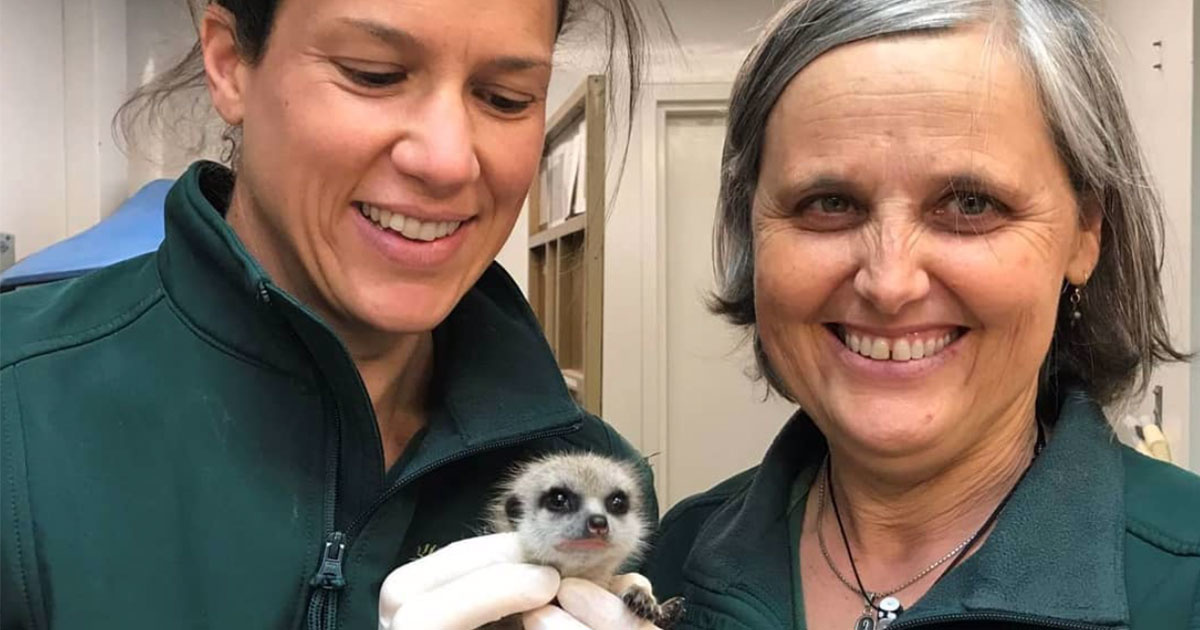
Someone stole a meerkat from the Perth Zoo because he thought it would ‘be cool as a pet’
One person fell in love with a meerkat on his trip to the zoo and actually did what most people would only joke about: he took it home with him. Less than 24 hours before a baby meerkat was officially introduced to the public, it disappeared from the Perth Zoo in Australia. After the meerkat…
One person fell in love with a meerkat on his trip to the zoo and actually did what most people would only joke about: he took it home with him.
Less than 24 hours before a baby meerkat was officially introduced to the public, it disappeared from the Perth Zoo in Australia. After the meerkat went missing, zookeepers believed it was either taken by a predator or stolen, so they began searching for it.
Two days later, the meerkat was found in Beverley, which is over 80 miles from Perth. The meerkat was taken by Jesse Ray Hooker, who thought the animal would “be cool as a pet.” He scooped up the animal from its enclosure and put it in a cooler bag, playing loud music to hide the its yelps for help. “[He thought] it was very cute indeed,” Chad Silver, Hooker’s lawyer, said. “He fell in love with it.” Technically, he’s not wrong, but it’s also not a reason to take an animal from the zoo.
Once he was returned, the zoo was worried they might have problems reintroducing him to his family. “He was very stressed and tired and hungry, just like any bub that’s been away from mum,” Senior vet Simone Vitali said when he was returned. “But after an evening of getting his favorite foods and getting a bit of warmth and a bit of quiet, he’s really bounced back quite well, so we’re quite happy with his progress so far.”
Now the meerkat is now doing just fine. “Our meerkat kit, Salama, is doing well with the rest of the meerkat mob. He is growing fast and currently weighs around 500 grams,” Perth Zoo’s executive director Wendy Attenborough told The West Australian.
Hooker was fined $4,000 for taking the animal. He also wrote an apology letter and offered to do community service at the Perth Zoo. According to Attenborough, the zoo decided they “will not be taking up his offer to do community work at Perth Zoo.” That’s probably a good call.
Now that the meerkat is back at the zoo, everyone can enjoy his cuteness — as long as you look but don’t touch.
In March 2023, after months of preparation and paperwork, Anita Omary arrived in the United States from her native Afghanistan to build a better life. Once she arrived in Connecticut, however, the experience was anything but easy.
“When I first arrived, everything felt so strange—the weather, the environment, the people,” Omary recalled. Omary had not only left behind her extended family and friends in Afghanistan, she left her career managing child protective cases and supporting refugee communities behind as well. Even more challenging, Anita was five months pregnant at the time, and because her husband was unable to obtain a travel visa, she found herself having to navigate a new language, a different culture, and an unfamiliar country entirely on her own.
“I went through a period of deep disappointment and depression, where I wasn’t able to do much for myself,” Omary said.
Then something incredible happened: Omary met a woman who would become her close friend, offering support that would change her experience as a refugee—and ultimately the trajectory of her entire life.
Understanding the journey
Like Anita Omary, tens of thousands of people come to the United States each year seeking safety from war, political violence, religious persecution, and other threats. Yet escaping danger, unfortunately, is only the first challenge. Once here, immigrant and refugee families must deal with the loss of displacement, while at the same time facing language barriers, adapting to a new culture, and sometimes even facing social stigma and anti-immigrant biases.
Welcoming immigrant and refugee neighbors strengthens the nation and benefits everyone—and according to Anita Omary, small, simple acts of human kindness can make the greatest difference in helping them feel safe, valued, and truly at home.
A warm welcome
Dee and Omary's son, Osman
Anita Omary was receiving prenatal checkups at a woman’s health center in West Haven when she met Dee, a nurse.
“She immediately recognized that I was new, and that I was struggling,” Omary said. “From that moment on, she became my support system.”
Dee started checking in on Omary throughout her pregnancy, both inside the clinic and out.
“She would call me and ask am I okay, am I eating, am I healthy,” Omary said. “She helped me with things I didn’t even realize I needed, like getting an air conditioner for my small, hot room.”
Soon, Dee was helping Omary apply for jobs and taking her on driving lessons every weekend. With her help, Omary landed a job, passed her road test on the first attempt, and even enrolled at the University of New Haven to pursue her master’s degree. Dee and Omary became like family. After Omary’s son, Osman, was born, Dee spent five days in the hospital at her side, bringing her halal food and brushing her hair in the same way Omary’s mother used to. When Omary’s postpartum pain became too great for her to lift Osman’s car seat, Dee accompanied her to his doctor’s appointments and carried the baby for her.
“Her support truly changed my life,” Omary said. “Her motivation, compassion, and support gave me hope. It gave me a sense of stability and confidence. I didn’t feel alone, because of her.”
More than that, the experience gave Omary a new resolve to help other people.
“That experience has deeply shaped the way I give back,” she said. “I want to be that source of encouragement and support for others that my friend was for me.”
Extending the welcome
Omary and Dee at the Martin Luther King, Jr. Vision Awards ceremony at the University of New Haven.
Omary is now flourishing. She currently works as a career development specialist as she continues her Master’s degree. She also, as a member of the Refugee Storytellers Collective, helps advocate for refugee and immigrant families by connecting them with resources—and teaches local communities how to best welcome newcomers.
“Welcoming new families today has many challenges,” Omary said. “One major barrier is access to English classes. Many newcomers, especially those who have just arrived, often put their names on long wait lists and for months there are no available spots.” For women with children, the lack of available childcare makes attending English classes, or working outside the home, especially difficult.
Omary stresses that sometimes small, everyday acts of kindness can make the biggest difference to immigrant and refugee families.
“Welcome is not about big gestures, but about small, consistent acts of care that remind you that you belong,” Omary said. Receiving a compliment on her dress or her son from a stranger in the grocery store was incredibly uplifting during her early days as a newcomer, and Omary remembers how even the smallest gestures of kindness gave her hope that she could thrive and build a new life here.
“I built my new life, but I didn’t do it alone,” Omary said. “Community and kindness were my greatest strengths.”
Are you in? Click here to join the Refugee Advocacy Lab and sign the #WeWillWelcome pledge and complete one small act of welcome in your community. Together, with small, meaningful steps, we can build communities where everyone feels safe.
This article is part of Upworthy’s “The Threads Between U.S.” series that highlights what we have in common thanks to the generous support from the Levi Strauss Foundation, whose grantmaking is committed to creating a culture of belonging.
It never fails: someone’s been sitting for a while and decides to stand to stretch their legs. The moment a cat owner’s knees fully extend is the exact moment their cat jumps into their seat. Often, it seems like they were pre-curled into their adorable pose before seemingly levitating onto the pre-warmed seat.
This normal kitty behavior can sometimes be irritating to cat owners, especially when they were planning to sit right back down. When there’s a cat snuggled in a chair, it can become a struggle to get them out, especially if the cat is a little stubborn. Some cats refuse to move, seemingly pressing their weight into the seat, while others grab onto the fabric with their nails in an effort to claim the chair. It’s a battle that can happen multiple times per day.
It can begin to feel like you’re in a fight for dominance with a 10-pound furball that can’t open doors without your assistance. A cat owner can successfully shoo the cat out of their chair, turn around to sit, and the cat beats them to it all over again. So what’s the deal? Are people really in a power struggle with their cats, or do cats have a logical reason for continually stealing seats from the people who feed them?
Well, some cats are being naughty and use this behavior as attention-seeking. They want their human to pick them up, pet them, or play with them. But this isn’t always the case, according to experts. There are four other reasons cats do this that have nothing to do with bad behavior.
They feel safer on surfaces above the ground
According to Cats.com, “When a cat sleeps, they are at their most vulnerable. Therefore, they like to pick nice, safe places to take their naps. Our human chairs are raised off the ground, and often are protected on three sides by the tall back and arms, so they offer more protection than a standard cat bed placed on the floor.”
The higher vantage point also allows them to have a good view of the room while they’re relaxing, so they prefer to claim the spot as their own.
Even though cats have a representation of not caring much about their human roommates, it couldn’t be further from the truth. Cats love the people in their home, which means they also love the way they smell because they trust you. Catster explains, “They begin to associate your scent with familiarity and safety, so leaving it behind on your seat is going to draw them to it.”
They’re claiming you and everything you love
Cats are territorial, so jumping into a seat after their human leaves is a sign of deep affection. They want everyone, including other animals in the home, to know that you belong to them. One way to do that is by sitting in your chair to leave their scent in your space.
According to Dr. Mark West, a veterinarian who shares content on TikTok, “When your cat looks at you, they don’t see someone who feeds them, they see their safe place, their territory, their anchor in the world. To your cat, that spot is not just somewhere to sit; it is your spot. And when they choose it, they are choosing you.” He later adds, “Your scent tells them everything is okay. They feel like they’re protected, that they’re home.”
Your seat is warm
This is probably the most logical reason someone could think of. Even as humans, we love to hop into something pre-warmed. Think about the pre-warmed towels at a spa, or hopping into the bed still warm from your partner’s body heat. It’s cozy. Cats love a cozy spot as much as their humans.
PetBook says, “The cat doesn’t know we planned to return there. Cats love warmth, and we often surround ourselves with cozy, warm blankets and pillows. Especially in winter, our seats have an almost magical attraction for the animals. But even in summer, cats seek out cozy spots without drafts.”
Humans have five main senses, of course, and there’s even strong scientific agreement about a sixth: proprioception, or the ability to sense where our limbs are in space. But new research suggests we may also have a “seventh sense.” Scientists are calling it “remote touch.”
A study out of Queen Mary University of London (QMUL) recently set out to examine how humans compare to common shorebirds like sanderlings, sandpipers, and plovers.
These birds are masters at finding prey hidden in the sand. In fact, their survival depends on it. By sticking their beaks into the sand, they use a tactile foraging system finely tuned to detect subtle vibrations and pressure changes, alerting them to food sources they can’t see, smell, or hear.
The researchers had a hunch that humans might possess a similar ability and decided to put it to the test. They buried small cubes in a container of sand and asked participants to gently move their fingers around. Volunteers were told to stop when they felt they were close to touching or finding a cube, but before actually making physical contact with it.
Surprisingly, the results showed that humans were quite adept at sensing the object’s presence before they could touch it.
“Participants were able to perceive extremely small shifts in the sand caused by the buried object,” QMUL wrote on SciTechDaily. “This level of sensitivity comes close to the theoretical physical limit for detecting mechanical reflections in granular material, where moving sand subtly changes direction or resistance when it encounters a stable surface beneath it.”
On average, the human participants in the study were about 70 percent accurate at detecting the hidden cube without actually touching it.
We’ve known for a long time that humans can be very sensitive to subtle changes in heat, pressure, and sensation.
For example, it’s been a common party trick among kids for decades. One person closes their eyes while another slowly moves a finger toward the center of their forehead. Usually, the person with their eyes closed can sense when the finger is close, even before it actually makes contact. There might be a tingling, tickling, or light buzzing feeling.
However, research from QMUL shows just how advanced our remote touch abilities really are. To add further context for how finely tuned humans’ remote touch ability is, the researchers then tested specially designed robots on the same task.
The robot, armed with tactile sensors, was able to detect the hidden cube from farther away than humans, but it was far less accurate overall, with just 40 percent precision.
The implications of this first-of-its-kind study are vast. For example, we may be able to better train robots based on what we learn about humans’ extraordinarily fine-tuned sense of touch.
“The discovery opens possibilities for designing tools and assistive technologies that extend human tactile perception,” said Zhengqi Chen, a PhD student at QMUL’s Advanced Robotics Lab. “These insights could inform the development of advanced robots capable of delicate operations, for example locating archaeological artifacts without damage, or exploring sandy or granular terrains such as Martian soil or ocean floors. More broadly, this research paves the way for touch-based systems that make hidden or hazardous exploration safer, smarter, and more effective.”
More immediately, it’s always amazing to discover new things about the human body and how it works. Our sense of touch, in particular, is incredibly complex and fascinating. Did you know that the “phantom touch illusion” can cause people to experience physical sensations when they aren’t being touched at all? Or that amputees sometimes feel phantom pain coming from a limb that no longer exists?
According to the researchers, remote touch has never been studied in humans before, and we’re truly only scratching the surface when it comes to understanding this extraordinary ability. It’s also exciting to think about what an eighth sense might one day turn out to be.
Throughout her prolific and distinguished career, biologist Lynn Margulis made several groundbreaking contributions to science that we take for granted as common knowledge today. For example, she championed James E. Lovelock’s “Gaia concept,” which posited that the Earth self-regulates to maintain conditions for life.
But by far, her most notable theory was symbiogenesis. While it was first written off as “strange” and “aesthetically pleasing” but “not compelling,” it would ultimately prevail, and completely rewrite how we viewed the origin of life itself.
In the late 1960s, Margulis wrote a paper titled “On the Origin of Mitosing Cells,” that was quite avant-garde. In it, she proposed a theory: that life evolved through organisms merging together to become inseparable.
In essence, cooperation is the driver of life, not competition and domination. This directly went against Darwin’s “survival of the fittest” principle that was considered gospel in scientific circles. Margulis’ paper was rejected by fifteen journals before getting accepted into the Journal of Theoretical Biology.
Time would be on Margulis’ side, however. By the late ‘70s and early ‘80s, research proved that the two major building blocks of plants and animals, chloroplasts and mitochondria were at one time independent bacteria. This solidified the fact that on a biological level, connection trumps autonomy for longevity. And now that fact is written in textbooks, with no real story of the adversity it overcame to get there.
While it is customary for most new scientific theories to be met with criticism, especially those that completely shift the current narrative, many have noted that sexism played a key part in Margulis’ initial lack of acceptance. On more than one occasion, she herself had hinted that women were seen as mothers and wives first, and scientists second. She recalled that while married to fellow scientist Carl Sagan that “Carl would finish his sentence, unperturbed” while she was expected to “handle all the duties of a 1950s housewife, from washing dishes to paying the household bills.”
And yet, Margulis would have other ideas that were controversial that had nothing to do with her gender. Most famously, she did not believe that AIDS was caused by HIV, and instead believed it was cause by a syphilis-causing type of bacteria, despite there already being decades of research proving otherwise. That view was seen as an endorsement of AIDS denialism, which undermined prevention and treatment effort. Then later in life, Margulis became a vocal proponent of 9/11 conspiracy theories suggesting government involvement the in Twin Towers attacks.
And yet, perhaps this is one of those “you gotta take the good with the bad” situations. Margulis’ inherent contrarian nature gave us both these unfounded, even harmful stances, in addition to entirely new paradigms that altered our understanding of life itself.
And if nothing else, it illuminated the need for science to include multiple points of view in order to unlock the truth. It seems life is, after all, about coming together.
What creatures have eight legs, nine brains, and dozens of fun and fascinating facts about them? Octopuses, of course. (Wait, is octopuses or octopi? Octopodes, perhaps?)
“However impressed or fascinated you are by octopuses, it’s honestly probably not enough,” she says. “We are severely underreacting to octopuses collectively.”
Once you see her video, it’s clear she’s not wrong.
With a hilariously understated sense of humor, Sarah shares facts like the idea that octopuses don’t have tentacles, as many of us have been led to believe, but arms instead. Tentacles have suckers only at the end, while an octopus’s arms have them from top to bottom.
“They decorate their front yards with shells and other shiny things they find in the ocean,” Sarah says, adding, “I wonder if they judge other octopuses for how they decorate their front yard. Like, is there an octopus HOA?”
Sarah points out that The Beatles’ song “Octopus’s Garden” was inspired by this delightful fact.
I’d like to be, under the sea…
Listen as 'Octopus’s Garden' evolves — from the rehearsal to the final master ? pic.twitter.com/qJItnY6PIY
Many of us know that octopuses are smart, but we may not know that they have a brain in each arm in addition to the brain in their heads, which is shaped like a donut. They can solve mazes and complete tricky tasks. And if their beak can fit through a hole, so can their whole body.
“So a fully grown giant Pacific octopus, which can literally be 30 feet long, can fit through a hole the size of a lemon,” says Sarah. “And I don’t care for that, particularly. I would never say that to an octopus’s face because, evidently, they can recognize us, which I find unsettling. Note to self: Do not be mean to an octopus.”
Because each arm has its own brain, it can operate independently, complete with its own sensory system.
“I feel like they’re smarter than us,” Sarah says. “Are we confident they’re not smarter than us? For instance, they will prank their prey. You know the joke where like old men will tap you on one shoulder, but surprise, they’re at the other shoulder? Octopus do that. If they’re hunting a shrimp, they’ll tap it on the faraway shoulder so the shrimp runs directly into them. Like, ‘gotcha!’ I don’t want octopus to do gotcha.”
On a positive note, Sarah shows some examples of exquisitely colorful octopuses, though some of the most “fancy and beautiful” ones are also highly venomous.
That may have been the end of Sarah’s video, but she wasn’t finished. There’s a part two that features blanket octopuses, the female superheroes of the sea. And that’s not even the wildest part:
A male blanket octopus is basically an inch tall and the female can grow to over six feet. The males can fit inside the pupil of the female’s eye. What?! Basically, their only job is to produce sperm, which just raises way too many questions.
Sarah also talks about the mimic octopus, which she calls “the Jafar of the ocean” because it’s basically a sorcerer (and one of them genuinely looks like Jafar from Aladdin).
That wasn’t all. Even after the second video, she still wasn’t done. Part three was every bit as fascinating, terrifying, wonderful, and chuckle-worthy as the first two (and also slightly NSFW in the most PG way possible):
The blob octopus? Who even knew? The eighth-arm situation is too much. Sarah was 100% right. We are, collectively, not reacting to octopuses nearly as strongly as we should be.
For decades, river restoration in the Northwestern United States followed a simple rule: if you saw logs in the water, take them out. Clean streams were seen as healthy streams, fast-moving water was seen as optimal, and wood was treated like a “barrier” to natural processes, particularly those of the local fish.
Now, helicopters are flying thousands of tree trunks back into rivers to undo that thinking.
In central Washington, one of the largest river restoration efforts ever attempted in the region is underway. More than 6,000 logs are being placed along roughly 38 kilometers, or 24 miles, of rivers and streams across the Yakama Reservation and surrounding ceded lands.
Nearly 40 years ago, Scott Nicolai was doing the opposite kind of work, all in the name of restoration.
“(Back then) the fish heads — what I call the fisheries folks — we stood on the banks, and we looked at the stream,” Nicolai, a Yakama Nation habitat biologist, told Oregon Public Broadcasting. “If we saw a big log jam, we thought, ‘Oh, that’s a barrier to fish. We want the stream to flow.’”
Fish find shelter for spawning in the nooks and crannies of wood. Photo credit: Canva
At the time, logs were removed in an effort to simplify the habitat. However, it soon became clear that wood provided vital “complexity,” creating sheltered pockets for salmon and bull trout to spawn and supporting algae that feed aquatic insects. Logs also slow water, spread it across floodplains, and allow it to soak into the groundwater. That water is then slowly released back into streams, helping keep them flowing and cooler during hot, dry periods.
The consequences of removing this “critical part of the system” (in addition to overgrazing, railroad construction, and splash dam logging) were made all too clear over the years as the rivers dried up and wildlife populations declined.
“We’re trying to learn from our mistakes and find a better way to manage,” said Phil Rigdon, director of the Yakama Nation Department of Natural Resources.
That’s why Nicolai is now helping lead a project for the Yakama Nation aimed at rebuilding river complexity by returning logs to their rightful place. Many of these streams are now unreachable by road, which is why helicopters are used. Logs are flown from staging areas and carefully placed at precise drop locations marked with pink and blue flagging tape.
Many of these streams are now unreachable by road, which is why helicopters are used. Photo credit: Canva
The wood comes from forest-thinning projects led by The Nature Conservancy and includes species such as Douglas fir, grand fir, and cedar. Although some of the timber could have been sold, it is instead being used as river infrastructure.
For tribal leaders, the work carries even deeper meaning. During the helicopter flights, they gathered along the Little Naches River for a ceremony and prayer.
“It was very simple: to bring what was rightfully part of this land back to us,” said former tribal chairman Jerry Meninick.
The aftermath of the original restoration project illustrates how human concepts, such as the belief in the superiority of “cleanliness,” can be limited and sometimes cause more harm than good. The miracle of nature, however, is that when left to her own devices, she can heal herself.
One of the most dangerous conditions for older adults is also one of the most surprising: Loneliness. Sometimes when we’re in the younger, busier time of our lives, it’s easy to forget—or not even realize—that our elderly friends and neighbors might be lonely. But very often, people who have long been retired, who may have already said goodbye to many of their friends or who have physical limitations that make it difficult to get out to visit people, can find themselves alone most of the time.
Feelings of loneliness can lead to depression and other health risks, and even shorten one’s lifespan. Being actively engaged in everyday life and interactions with friends, family, and community is critical to living a long and fulfilling life.
A viral social media post offers a good reminder of this fact, but in the most heartwarming way.
A poster named Dylan shared a photo of a typed letter with the caption: “I went on a vacation 2 weeks ago, and let my neighbor babysit my pets. Shortly after I got back home, I received this letter from him in the mail that made me smile and cry. I’d like to share it here.”
“Good afternoon,” the letter begins. “This letter is regarding your vacation two weeks ago and how you let me babysit Smokey, Oreo, and Jennifer. I’d just like to give you a letter of thanks.” (The letter doesn’t specify what kind of pets Smokey, Oreo and Jennifer are, but the original poster later shared that they are a German shepherd, “the crankiest little beagle you’ve seen in your life,” and a cat named Oreo.)
“As you know, I’m an old man. You don’t see me outside often anymore, as these joints aren’t as lively as they used to be. To add to that, two years ago, in the midst of the pandemic, my dad got diagnosed with stage four colon cancer. After his death, I was left alone in my home. I don’t have a wife or kids. I could go to sleep one day and never wake up again. Every day is just sitting around and wondering what I have done for this world.
Your pets are the cutest, funniest, and most troublesome (In a good way, don’t worry, they didn’t mess up my house too much!) individuals. They gave me the motivation to restart my life again. I started waking up early in the mornings. I began to take walks outside with your pets for the first time in years. Every 10 minutes, whenever I felt sad for a second, they would bark or rub against my leg and make me laugh.
The highlight of their stay was when I took them to the park. It was the longest time I’ve spend outside in a while. It didn’t just bring back pet interaction, I also met other people, started talking, and made friends with a handful of fellow human beings. I was so happy to finally be able to talk with friends again, interact with others, and feel like I’m part of the human race.
I realize I sound very existential right now, but I’m telling the truth. It’s nice knowing that I’m doing something for someone, even if it’s my neighbor.
I adopted two dogs soon after. (You may have been hearing noise from my home, pardon them!) I now take regular walks to the park with them and talk with friends I made there. Anyways, I’d just like to say: thank you so much. You brought back meaning to my life. And that’s all that matters.
Sincerely,
Robert (P.S. I think it’s time for you to mow the lawn, haha!)
People absolutely loved Robert’s letter—and Robert himself, judging from some of the comments:
“Robert is a national treasure and I take anything less to be an insult!”
“I wouldn’t just mow my lawn, but Robert’s too. Forever.”
“Robert really is the good in all of us. He must be protected at all costs.”
Some people related to Robert, having found a new zest for life after getting pets of their own. Others had seen the same phenomenon occur in their own parents or other older folks they know.
“My Grandma is 93 and losing her mobility. She loves cats but doesn’t think she can take care of one. Enter, Rent-a-Kitty! The neighbor’s cat! He comes over and they hang out and she’s tickled by his visits, but then he goes to his own house at night. It’s a pretty big win for her.”
One user was inspired to make a change in their own life: “I’m so glad no one can see me right now. Tears everywhere. I’ve been so worried that I will become that old man. This year has been such a low and trying to get out of it has been the worst. I can’t have dogs where I live but maybe a cat. I need to get my life in order and perhaps having a pet (or really anything more than a plant) will help get me there Thank you.”
Others joked that the whole letter was just an elaborate, “Midwest-nice” way to tell the poster their lawn needed attention. Some doubted the veracity of the letter, but even if it’s not real, the comments from people sharing how their elderly loved ones had been helped by neighbors sharing their pets with them show that animals really can help people who are lonely find more connection and purpose in their lives.
Pets can bring much love into our lives and, according to the American Heart Association, can also help us live longer. Interacting with dogs boosts the production of “happy hormones” such as oxytocin, serotonin, and dopamine, which reduces stress levels and provides a greater sense of well-being. Regular walking with a dog is also a great way to exercise. Plus, as Robert mentions in his letters, caring for a dog forces you out into the world where you’re more likely to interact with other dog owners or just random passersby. Those little interactions can make a world of difference.
Dog owners also have a unique advantage when overcoming a serious health problem. Dog owners who suffer from a heart attack or stroke are less likely to die than those who are not.
It’s a good reminder to check in with older folks around us and to share the joy of our pets with people who might be lonely. You never know whose life you might touch with your furry friends.
This article originally appeared three years ago. It has been updated.
142 years ago, botanist James Beal had a unique idea for how we could learn more about seeds.
Beal wanted to know just how long seeds of different kinds would remain viable in soil. Now, that might not sound like the most exciting research topic of all time, but understanding seed longevity actually plays a crucial role in agriculture, our food supply, and the preservation of biodiversity.
in 1879, Beal decided to bury 20 bottles filled with seeds in the ground. The bottles were open to allow soil and some moisture to reach the seeds, but positioned in such a way that they would not fill with water. That would allow just enough moisture for the seeds to theoretically survive without sprouting.
According to Popular Science, each bottle held 50 seeds form 21 different plant species, all mixed into sand. That’s over 1,000 seeds per bottle. Beal’s plan was to dig up a new bottle every five years and test to see if the seeds could still be successfully planted.
After running the experiment himself for several years, it was time for Beal to retire. The work was handed off in 1910 to a fellow professor, and in a few years the timeline was shifted: A new bottle would be dug up every 10 years instead of 5. Shortly after, it was extended to 20 years.
The Beal Seed Experiment is still ongoing, with the final bottle scheduled to be dug up sometime around the year 2100. The project has been handed off multiple times and, at 142 years old, is now one of the longest running active experiments of all time.
The Beal Seed Experiment is currently in the capable hands of a team of scientists at Michigan State University.
The research team most recently dug up a new bottle in 2021, a year delayed after the COVID-19 pandemic. The scientists ventured out in the dead of night so as not to expose the dug up seeds to any sunlight that may alter the experiment.
Once they’ve collected the seeds, they plant them in fresh soil and see if they will sprout. Unsurprisingly, the most resilient of seeds typically belong to weeds. Others are more fragile.
When seeds don’t sprout, the scientists don’t give up. After all, they need something to do for the next 20 years. They try a variety of groundbreaking techniques to try to revive the seeds and bring them back to life, including simulating winter with a shock of extreme cold, simulating exposure to fire smoke, and other experimental treatments they’re ready to test.
If seeds can not be revived, they are studied heavily. The scientists need to know what factors contribute to seeds that are better able to survive long periods of time dormant in the soil.
After all, the Beal Botanical Garden writes, “We may yet see that ungerminated seeds remaining from this latest germination experiment are in fact viable, and simply haven’t been exposed to the right conditions.”
Why does this unique experiment still matter, nearly 150 years later?
An article published in the Portland Press states, “Understanding the molecular basis of seed longevity provides important new genetic targets for the production of crops with enhanced resilience to changing climates.”
In other words, our food supply could, in the future, be dependent on our ability to bioengineer seeds and crops that can survive as temperatures rise and weather conditions change.
The findings from Beal’s study are also critical for maintaining healthy seed banks, which protect against catastrophic crop failures and global food crises. Knowing what factors allow a seed to be more resilient, how to make it last longer, and how to “bring it back to life” could be a matter of life or death.
What an exciting line of work and an incredible honor to be a part of the team that gets to unearth the next bottle sometime around the year 2040. There are only a few left in the ground, making the collection most likely a once-in-a-lifetime scientific opportunity.
If you’ve lived your whole life with a dog, a home has to feel pretty empty without one. Your heart has to feel like there’s something missing as well. When Jack McCrossan, originally from Scotland, moved to Bristol, England with his three friends, they were bummed out to learn that their landlord didn’t allow dogs.
So when they saw a beautiful black Sheprador (a German Sheppard Lab mix) in their neighbor’s window, they knew that had to become buddies with her. They wrote the dog’s owner, Sarah Tolman, a letter asking to arrange a play date with the dog. “If you ever need someone to walk him/her, we will gladly do so,” they wrote.
“If you ever get bored (we know you never will, but we can dream), we are more than happy to look after him/her. If you want to come over and bring him/her to brighten our day, you are more than welcome. If you want to walk past our balcony windows so we can see him/her, please do,” the letter continued.
Been saying we’d love a dog about the house but our landlord doesn’t allow pets, so my housemate posted a letter to our neighbours asking if we could walk their dog every once and a while and the response was better than we could have ever hoped for pic.twitter.com/dcMOfPk5UH — Jack McCrossan (@Jack_McCrossan) December 10, 2019
“We hope this doesn’t come too strong, but our landlord won’t allow pets, and we’ve all grown up with animals. The adult life is a struggle without one,” they wrote. “Yours sincerely, The boys from number 23,” the letter concluded.
Soon after, the boys in 23 received a response from the dog herself, Stevie Ticks, accepting the offer. However, it may have been written by her human, Sarah Tolman. In the letter, Stevie shares a bit about herself, saying she’s two years and four months old, was adopted in Cyprus, and that she’s “very friendly and full of beans.” (The boys shouldn’t worry about a gassy hound, in England, “full of beans” means lively.)
“I love meeting new people and it would be great if we can be friends. I must warn you that the price of my friendship is 5 x ball throws a day and belly scratches whenever I demand them,” the letter continued. A few days later, the boys got to meet Stevie.
“Meeting Stevie was great!” McCrossan told Buzzfeed. “She was definitely as energetic as described. We got to take her for a walk and she wouldn’t stop running!”
Tolman thought the boys’ letter was a fantastic gesture in an era where, quote often, neighbors are strangers. “In a day and age where people don’t really know or speak to their neighbors, it was really nice for them to break down that barrier,” she said. After the story went viral, she saw it as an opportunity for people to share their love of dogs with the world. “My mother and I are amazed at all the love we’ve received from around the world these past few days,” Tolman wrote as Stevie. “If you have a doggo in your life, share that love with those around you.”
A lot has changed since this story first warmed hearts around the globe. The boys have since moved away, but as of September 2024, Stevie is around 8 years old and still living her best life. Recently, she even made it to the doggie wall of fame at her local coffee shop.
In the years since this story first went viral, pet-sharing and neighbor dog borrowing have actually become more common, especially in cities where landlords restrict pets. Several platforms (like BorrowMyDoggy) and community groups now exist to pair dog owners with trusted neighbors who want occasional playtime, walks, or dog-sitting without having to own a pet. It’s a small but growing trend that reflects how deeply animal companionship is needed—even for people who can’t adopt a dog full-time. In many apartment buildings, these kinds of informal arrangements help reduce loneliness, build community, and give non-owners the emotional benefits of living with pets.
Just goes to show the power of a dog’s love…even if that dog isn’t your own.