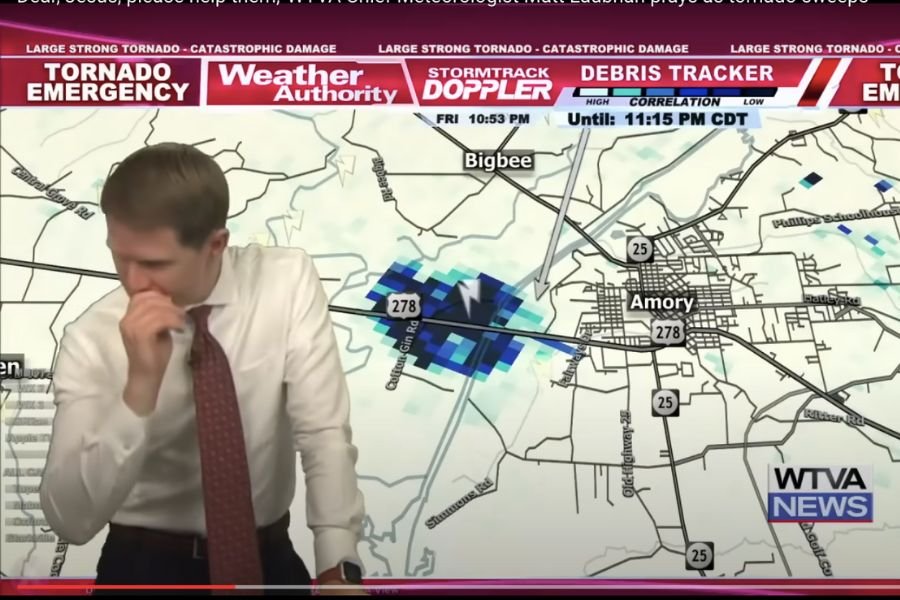
Meteorologist pauses to pray for people in the path of a deadly tornado during live report

Even non-religious people praised Matt Laubhan’s “genuine human reaction” to what he was seeing on the radar.

mississippi tornado meteorologist
Photo credit: WTVA 9 News/YouTubeMeteorologist Matt Laubhan prays for the people in the path of a deadly tornado.

Broadcasters who have to report on tragedies as they are happening have a tough job. On the one hand, they have to maintain their professionalism and inform the public of what’s happening in a factual way. On the other hand, they’re still human and sometimes humanity trumps the traditional perception of what’s “professional.”

Such was the case for WTVA meteorologist Matt Laubhan, who found himself live on the air staring at a radar scan of a deadly tornado as it moved towards the small town of Amory, Mississippi. He, more than anyone, understood the severity of the situation, and he did his best to convey that to his viewers.

“This is a strong, life-threatening tornado that’s going to move either extremely close to Amory or in through the northern part of the city of Amory.”

He added, “Y’all trust me too much,” explaining that people sometimes take his predictions of where the tornado will go as hard fact, but the reality is that tornados can change directions at any time. “So Amory, we need to be in our tornado safe place,” he said.


Just after he told people they needed to be in their shelters, a new scan came in that clearly affected him.

“North side of Amory, this is coming in,” he said. And then the reality of how strong the tornado was clearly hit. “Oh, man,” he said, leaning down on the table with his hand over his mouth. After a deep breath, he stood and said a brief prayer—”Dear Jesus, please help them. Amen.”—before continuing to explain where the tornado looked like it was going to track.

Watch the emotional moment:

Laubhan shared with CNN Business what moved him to pray on live TV.

“I can’t say that I was intending on praying,” he said. “It was kind of a situation where we knew that something extremely bad was happening, and we knew that it was possible, maybe even probable, that people were being hurt and about to die. I’m very rarely at a loss for words, and I was feeling a little bit overwhelmed, honestly. And it just kind of came out.”

He added that many people who were watching live have told him his spontaneous prayer helped them to “realize the seriousness of the situation.”

After one commenter on Twitter said that the meteorologist “should have been focused 100% on his weatherman job at that point,” others chimed in to support Laubhan’s display of compassion and humanity—including many who are not people of faith themselves.

“I’m not a believer. He’s just having a human reaction,” wrote one person. “There’s nothing else he could’ve done in that moment. Let him cope how he can. From the short clip it seems he takes his job incredibly seriously. The two seconds it took to say that are inconsequential.”

“It’s his genuine human reaction to what he knows is going to be a horrible event,” wrote another. “He’s warned people, can physically do no more, so he draws on his faith. I don’t pray, exactly, because I don’t believe in Micromanager God, but I do think positivity helps even if only the doer.”

“I’m not a believer but positive vibes are positive vibes,” wrote another. “It was well meant. Give him a break, people.”

“Not religious but I found this very touching and showing true concern for people,” shared another.

https://twitter.com/FAMman87/statuses/1640151079068237825

Resident Leah Ann Hubbard told The Independent how helpful Laubhan’s reporting was as she prepared for the tornado.

“Everybody watches him around here to find out if they need to shelter for a tornado,” she said, adding that his urgency made her think, “Hmmm, maybe we should take this seriously, maybe we should really get prepared.” She pulled out her mattress and hid in the bathtub with her two dogs.

“The last thing I heard him say was, ‘Debris is 7,000 feet in the air,’ and then the lights go off, the phone service dies, and you’re in the dark with the dogs,” she said.

Hubbard’s description of feeling helpless as the tornado raged over her town seems to reflect what Laubhan experienced as he saw the tornado bearing down on the radar.

“You know that there is a monster swirling over your house and over your town, and there’s nothing you can do. And you’re just praying for yourself and for everybody else,” she told The Independent.

As one person wrote about the tornado and Laubhan’s reaction, “There’s tornadoes and then there’s tornadoes. Some will take the roof off your house and some will take your town off the map. This was the latter. He knew in that moment that in a few minutes, that town would no longer exist.”

The town of Amory was hit hard, but the next-day footage from Rolling Fork, a few hours away from Amory, is utterly apocalyptic. The rare, long-track tornado path stretched across western Mississippi through the night of March 24, 2023, killing 25 people and injuring dozens of others.

Seeing the aftermath from this storm system, it’s clear why Matt Laubhan took a moment to pray for those in the tornado’s path. When a storm is that powerful, there’s really nothing else anyone can do, and his moment of genuine care and concern for his fellow humans was deeply appreciated.


  • The strange, forgotten reason so many movies have that ‘all characters are fictitious’ disclaimer
    Photo credit: @treehousedetectiv/Instagram, used with permissionRasputin is a notable figure in Russian history. But he made his mark on Hollywood as well.

    If you’ve ever watched an outrageously outlandish movie with the warning “All characters in this movie are fictitious…” and thought, “Well, duh,” it turns out Hollywood had a very specific (and very expensive) reason for spelling that out. It ties into not only forgotten cinema history, but Russian history as well.

    A mystic, a murder, and a very messy memoir

    In a video by Andrew Price, known for his deep dives into pop culture via @treehousedetective, we go back to the early 1900s, when Siberian peasant turned mystic power player Grigori Rasputin had already made more than a few enemies with his superstition-fueled cons. 

    movies, history, russia
    A portrait of Rasputin Wikipedia

    By 1916, a group of aristocrats led by Felix Yusupov decided enough was enough. What followed, ironically, does sound like something out of a movie script.  Cyanide-laced cakes and beverages didn’t poison him. Multiple bullets, including a headshot, did nothing. The only thing that did finally put Rasputin in his final resting place was getting tied and thrown into an icy river. All of these details came from Yusupov alone, who later published a wildly popular memoir while living in exile. Not exactly an unbiased narrator, but certainly an entertaining one.

    movies, history, russia
    Felix Yusupov and Princess Irina with their child Wikipedia

    That exile, by the way, came courtesy of the Imperial Russian Family as punishment for the assassination. That consequence was a blessing in disguise, because when the Bolsheviks later rose to power and executed members of the aristocracy, the Yusupovs were already safely out of reach. Not the worst trade-off, all things considered.

    When Hollywood got a little too inspired

    Fast forward to 1932, when MGM released Rasputin and the Empress, dramatizing the infamous killing. The studio took some liberties, like combining the group of assailants into a singular fictional character named Prince Chegodieff. Yusupov, now living in Paris, found out about the movie and tried to sue MGM for defamation of character. Considering he outright confessed to the crime in the source material, that case had no legs. 

    However, the film also added a scandalous subplot involving Yusupov’s wife, Princess Irina. In the film, her fictional counterpart is hypnotized and seduced by the titular villain. In reality, however, that never happened. And unlike her husband’s case, Irina’s lawsuit for libel had real teeth. She won a massive settlement, to the tune of what would be around three million dollars today.  

    The disclaimer that stuck

    The real kicker was MGM’s own prologue, which practically invited trouble by suggesting the characters were, in fact, based on real people. That line helped seal the studio’s fate, which prompted the company to make a change that would ripple across the entire film industry.

    From then on, studios started adding that now-familiar disclaimer distancing their stories from real individuals, just in case anything felt a little too familiar.

    So, the next time you see that “purely coincidental” message pop up before a film, remember that’s not just legal fluff. It’s a bona fide Hollywood story in its own right. 

    For even more fun tidbits, be sure to give @trehousedetectve a follow

  • 13-year-old’s unique ‘Bohemian Rhapsody’ rendition was so impressive it even wowed Queen
    Angelina Jordan performs on AGT.

    We’ve shared a lot of memorable “America’s Got Talent” auditions over the years here at Upworthy, from physics-defying dance performances to jaw-dropping magic acts to heart-wrenching singer-songwriter stories. And after watching Angelina Jordan’s “AGT: The Champions” audition, we’ve added it to the list because wow.

    Jordan came to “AGT: The Champions” in 2020 as the winner of Norway’s Got Talent, which she won in 2014 at the mere age of 8 with her impressive ability to seemingly channel Billie Holiday. For the 2020 audition, she sang Queen’s “Bohemian Rhapsody,” but a version that no one had ever heard before.

    With just a guitar, a piano, and her Amy Winehouse-esque voice, Jordan brought the fan-favorite Queen anthem down to a smooth, melancholy ballad that’s simply riveting to listen to, especially considering that Jordan was only 13 years old when she did this.

    The judges didn’t see this coming

    What this video doesn’t show is Heidi Klum hitting the Golden Buzzer faster than you can sing, “Nothing really matters to meeee.” The judges were blown away by Jordan’s performance, as were the people in the comments.

    “That’s a ONE in A BILLION voice right there. Just amazing,” wrote one commenter.

    “I am typically not a fan of songs being redone particular to such a magnitude,” shared another. “They almost always fall short of the original. But to completely rearrange a song in the manner that she has, from a legend, and then make you forget about how the original even sounded because her rendition is so good is utterly amazing.”

    “As Freddie once said, ‘Do whatever you want with my music as long as you don’t make it boring.’ I think he’d really like this,” shared another.

    Though Queen’s beloved lead vocalist Freddie Mercury is no longer with us, the band did offer words of praise for Jordan’s performance, retweeting her audition video with the comment, “Wow! What a rendition of #BohemianRhapsody.”

    Why she always performs barefoot

    “Bohemian Rhapsody” is such an iconic song, it’s hard for anyone to do a cover of it justice. But 13-year-old Angelina Jordan managed it masterfully. In bare feet, no less, which she explained in a thank you video to Heidi Klum for the Golden Buzzer honor.

    “When I was around 6 years old, I see this little girl around my age,” Jordan shared. “I gave my shoes to her because she had scars on her feet and it was really cold. So whenever I’m on the stage, I was reminded about all the children that don’t have any parents, clothes, and shoes. She’s always in my heart.” Jordan has shared that she “made a promise many years ago to a beautiful soul” to not wear shoes on stage—a promise she has kept.

    Jordan would move on to the Top 10 in “AGT: The Champions,” and though she didn’t take home the top prize, she did impress the audience with another classic rock tune, Elton John’s “Goodbye Yellow Brick Road.”

    Since her time on AGT, Angelina has been building a full career as a singer-songwriter, releasing original singles throughout 2024 and two full albums in 2025. You can follow her on YouTube and TikTok and find her growing catelog of music (including “Bohemian Rhapsody”) on Spotify.

    This article originally appeared three years ago. It has been updated.

  • Why Dwayne Johnson’s advice for new dads comes down to one simple thing: take off your shirt
    Photo credit: Harald Krichel via Wikimedia CommonsDwayne 'The Rock' Johnson at the 2025 Venice Film Festival.
    ,

    Why Dwayne Johnson’s advice for new dads comes down to one simple thing: take off your shirt

    “Take your shirt off. I need you to go skin to skin.” The Rock’s advice for new dads is simple, a little unexpected, and completely backed by science.

    When Canadian TV host Chris Van Vliet (@CVVClips) told Dwayne Johnson he was about to become a father for the first time and asked for advice, Johnson didn’t hesitate. He gave him a hug, told him his instincts were right, and then got specific.

    “Take your shirt off,” Johnson said. “I need you to go skin to skin.”

    Johnson explained that holding a newborn skin-to-skin right out of the womb builds what he described as an energetic and emotional anchor between parent and child. He’s not just talking theoretically. When his daughter Tiana was born in April 2018, he posted a photo to Instagram of himself cradling her against his bare chest, shirtless in the hospital, with a caption about how being her dad was the role he was most proud of. Days later, her mother Lauren Hashian shared her own photo doing the same.

    The practice Johnson is describing has a clinical name: kangaroo care. According to the Cleveland Clinic, skin-to-skin contact involves holding a newborn against a bare chest and has well-documented benefits for both the baby and the parent. For the baby, it helps regulate body temperature, stabilizes heart rate and breathing, supports early breastfeeding, and reduces stress. For the parent, it triggers hormonal responses that promote bonding and can reduce postpartum anxiety. The research backing it is extensive and the recommendation applies to both mothers and fathers.

    What Johnson is doing is essentially making the case for something pediatricians have been saying for years but that new dads don’t always hear directed specifically at them. Most kangaroo care conversations are aimed at mothers. Johnson’s version of the advice is pointed squarely at fathers, delivered by someone whose public identity is built on being the biggest, toughest person in the room — which probably makes it land differently.

    Van Vliet, for his part, went on to have a daughter. He hasn’t said whether he followed the advice. But the comment section on the video is full of fathers who either did and are glad they did, or didn’t and wish they had.

    “I got a bit teary-eyed during that,” one wrote. “I regret not doing the skin-to-skin with my son.”

  • How women in fake beards made one of the most iconic scenes in ‘Lord of the Rings’ history
    Photo credit: Flomuk/YoutubeWomen getting made-up in fake beards to become LOTR warriors.
    ,

    How women in fake beards made one of the most iconic scenes in ‘Lord of the Rings’ history

    The beloved fantasy franchise features more females than you might think.

    The Lord of the Rings: The Two Towers is widely regarded as the most action-packed installment of the Lord of the Rings trilogy. The Battle of Helm’s Deep alone was a juggernaut of a fight scene, wherein thousands of Riders of Rohan (the good guys) go up against the forces of Saruman’s infantry of Uruk-hai, Orcs, and Dunlendings (the bad guys). 

    And of course, valiantly fighting in disguise as a Rider of Rohan, or the Rohirrim, in the third and final installment of Lord of the Rings (i.e. Return of the King) is Eowyn (played by Miranda Otto), one of the only three female leads in the trilogy. Funny to think that Eowyn wasn’t, in fact, the only cross-dressing female in this iconic movie moment…not by a long shot. 

    The real riders behind the army

    To capture the full size and scope of the battle, Peter Jackson needed extras. Lots of them. Extras who could not only ride a horse well (they’re not called riders for no reason), but who would also, ideally, own their own horse. That significantly narrowed the availability of viable performers. Surprisingly, an overwhelmingly larger number of women fit that bill than men. So, Jackson and his team created a bit of movie magic. They gave these female riders fake beards, and voila: an army of horseback riding men. 

    A BTS story that stuck

    Major LOTR nerds might remember this story being shared in the extensive behind-the-scenes footage that came with the DVD. In it, we see the female extras getting fit (one even jokes, “I am a girl! See?!”), as well as Viggo Mortensen, aka Aragorn, coyly admitting that he may or may not have had a crush on one with a strawberry blonde beard. 

    While this kind of bonus content is, in some ways, a thing of pop culture past, this story lives on online as part of LOTR lore, occasionally resurfacing from time to time to either shock those who were unaware, or give aficionados reason to brag, “Yeah, I already knew that.” Either way, it’s always an opportunity to find newfound appreciation. It also highlights how the best kind of filmmaking often relies on practical solutions that subtly reshape what audiences think they are seeing. 

    Expanding women’s presence in Middle-earth

    In subsequent adaptations of Tolkien’s work, there have been a few measures taken, for better or worse, to add more female representation to the mix. The Hobbit franchise, for example, invented Elven warrior Tauriel, played by Evangeline Lilly. Similarly, Rings of Power centers on a young Galadriel (Morfydd Clark), and also features dwarf royalty Princess Disa, played by Sophia Nomvete. 

    Both the Lord of the Rings books and movie series are highly regarded for the way they portray masculinity and male relationships. But as we see, both in obvious and not-so-obvious ways, the women in LOTR brought to life some of the story’s most defining moments. 

    And really, even more than that, this story speaks to the collaborative nature of filmmaking. As a new rendition of Lord of the Rings is currently being created—in a time when so many vitally human aspects of filmmaking seem to be at risk—one can only hope this element stays within its DNA. 

  • ‘Wheel of Fortune’ fan conducts wild 6-year study and finds bizarre pattern with male contestants
    Photo credit: Tom Sloan/WikipediaVanna White and Pat Sajak, circa 1982

    Sure, there are several hacks Wheel of Fortune players might use to increase their odds of success—calling out common letters, using “Express Wedges,” etc. But when it comes to keeping a marriage alive post-show, there’s really only one winning strategy: compliments.

    A very specific (and very committed) investigation

    Who’s to say what prompted a man named Joey to devote six years to watching “nearly 2,000 episodes” of the hit game show to see how many of its married male contestants were “kicked to the curb” after competing. But regardless, his findings were…surprising, to say the least.

    After examining episodes that aired between 2010 and 2019, Joey discovered that male game players who didn’t use “complimentary adjectives” (think “gorgeous,” “amazing,”  “fantastic”) to describe their wives during their introductions were far more likely—3x more likely, in fact—to get divorced within five years than their honey-tongued counterparts. 

    marriage, wheel of fortune, divorce
    Image of divorce papers Photo credit: Canva

    Apparently, 15% of the hubbies who forgot to attribute some kind of heavenly descriptor to their spouse got the boot, while only 5% of the complimentary group suffered the same fate. 

    Joey saw more or less the same gap among the 185 Wheel of Fortune winners who were married men. Seven percent of the praising fellas eventually got divorced, while 17% of the tightlipped ones saw their relationship disintegrate.

    The Internet reacts: “Peak use of free will”

    It wasn’t long before this wild study went viral online. People were shocked, yes, but mostly incredibly impressed by Joey’s “investigative journalism.” 

    “Peak use of free will. It’s people like this that got us out of caves and into the future.”

    “I can appreciate weird obsessive behaviors. Love this.”

    Fellow data nerds were particularly enamored. 

    “This is a data analyst with hyperfixation. So niche, and now will giggle when i listen to the men introductions. No one will get when i say, ‘divorced 5 years!’ and if they ask.. i’ll come back to this comment!”

    “As a data analytics student i’m obsessed with this and this just opened a whole world of opportunity for me and my spare time tysm.”

    One Wheel of Fortune insider even shared, “This is wild because the WoF casting people go out of their way to prep you to say something complimentary about your spouse. I remember trying to come up with something really unique to say about my husband, but the takeaway is that I knew I HAD to use some kind of complimentary adjective. So, not doing this means you actively worked against the coaching.”

    As for Wheel of Fortune itself, the show’s verified TikTok account could only muster, “Bruh” in the comments section, along with a “mind-blown” emoji. 

    Why compliments actually matter in relationships

    marriage, wheel of fortune, divorce
    A happy, smiling older couple Photo credit: Canva

    These findings, however seemingly niche, do reflect a larger bit of general relationship wisdom. According to renowned marriage specialist John Gottman, publicly complimenting your spouse is a powerful tool to build a “culture of appreciation”, which strengthens the relationship’s emotional foundation. It demonstrates fondness, admiration, and pride in your partner, contributing to the crucial 5:1 positive-to-negative interaction ratio needed for a healthy marriage.

    In other words, it might not guarantee a jackpot, but a few kind words can go a surprisingly long way. And unlike solving a puzzle on national TV, this move can be practiced every day.

  • Nate Bargatze reveals the true story behind his legendary George Washington SNL sketch
    Photo credit: SNL/NBCNate Bergatze as George Washington on Saturday Night Live
    ,

    Nate Bargatze reveals the true story behind his legendary George Washington SNL sketch

    Nate Bargatze’s George Washington SNL sketch has become an instant classic.

    America is definitely not afraid to do its own thing, even when its own thing is pretty weird. Ever stop to think how bizarre it is that the United States is one of the only countries to not use the metric system? Or how it uses the word “football” to describe a sport that, unlike fútbol, barely uses the feet at all?

    What must our forefathers have been thinking as they were creating this brave new world? Wonder no further. All this and more is explored in a Saturday Night Live sketch that folks are hailing as an “instant classic.”

    Why the sketch went viral

    The hilarious clip takes place during the American Revolution, where George Washington rallies his troops with an impassioned speech about his future hopes for their fledgling country…all the while poking fun at America’s nonsensical measurements and language rules.

    george washington, george washington's dream, snl sketch, nate bargatze

    Like seriously, liters and milliliters for soda, wine and alcohol but gallons, pints, and quarts for milk and paint? And no “u” after “o” in words like “armor” and “color” but “glamour” is okay?

    The inherent humor in the scene is only amplified by comedian and host Nate Bargatze’s understated, deadpan delivery of Washington. Bargatze had quite a few hits during his hosting stint, including an opening monologue that acted as a mini comedy set, but this performance takes the cake.

    The fans love it

    All in all, people have been applauding the sketch, noting that it harkened back to what “SNL” does best, having fun with the simple things.

    “This skit is an instant classic. I think people will be referencing it as one of the all time best SNL skits for years.”

    “Dear SNL, whoever wrote this sketch, PLEASE let them write many many MANY more!”

    “Instantly one of my favorite SNL sketches of all time!!!”

    “I’m not lying when I say I have watched this sketch about 10 times and laughed just as hard every time.”

    “This may be my favorite sketch ever. This is absolutely brilliant.”

    The sketch was so popular, they did another one when Nate Bargatze returned to SNL in October of 2024, and it’s every bit as hilarious as the first one. Again, the comedy focused on the idiosyncrasies of America, including our names for animal food products, the way we count grades in school, and the design of our currency.

    “A real American would never want to know what’s in a hot dog, just as they will never know why our money is called the ‘dollar’…” says Bargatze as Washington. “And if you think I’m worthy, put my portrait on the front of it.”

    “And what shall be on the back, sir?” asks Kenan Thompson’s character.

    “Everything, all of it,” Washington replies. “Crazy stuff, squiggles, Latin words, a pyramid with a floating eye on top.” 

    Behind the scenes of an SNL classic

    The sketches became so popular, people wanted to know more about how the idea for them came about and what the process of creating the original sketch was like. Jesse David Fox, the host of Good One: A Podcast About Jokes, sat down with Bargatze and SNL writers Mikey Day and Streeter Seidell to talk about the origins of the sketch and what it was like to co-create it in the week leading up to the live show. It’s a fascinating insight into the SNL writing process, which is largely done within that week.

    According to Day and Seidell, Seidell had actually written a near-complete draft of the sketch the prior season, originally envisioned for a dramatic actor. It had been sitting unfinished on his computer until Bargatze was tapped to host. Bargatze was on board with playing Washington, but apparently, the sketch landed flat at the table read earlier in the week and was placed dead last in the dress rehearsal lineup. But Bargatze said he really liked the sketch, and once he was in costume and in front of a live audience for dress rehearsal, everything came together to make the magic of a classic SNL bit.

    Bargatze has become one of the biggest names in stand-up comedy, known for his clean, family-friendly routines. He was the highest-grossing touring comedian in the world in 2024. You can catch even more of Bargatze’s “SNL” episodes here and here.

    This article originally appeared three years ago. It has been updated.

  • Debunking doesn’t stop misinformation online. But researchers found ‘pre-bunking’ can.
    Photo credit: CanvaSome helpful information to fight misinformation.

    The rise of misinformation on social media has been a monumental stress test for the world’s critical thinking skills. Misinformation has had a huge influence on elections, public health and the treatment of immigrants and refugees across the world. Social media platforms have tried to combat false claims over the years by employing fact-checkers, but they haven’t been terribly effective because those who are most susceptible to misinformation don’t trust fact-checkers.

    “The word fact-checking itself has become politicized,” Cambridge University researcher Jon Roozenbeek said, according to the Associated Press. Further, studies show that when people have incorrect beliefs challenged by facts, it makes them cling to their false assumptions even harder. These platforms have also attempted to remove posts containing misinformation that violates their terms of service, but this form of content moderation is often seen as insufficient and is often applied inconsistently.

    So what actually works against misinformation?

    How do we combat dangerous misinformation online if removing false claims or debunking them hasn’t been effective enough? A 2022 study published in the journal Science Advances by a team of university researchers and Jigsaw, a division of Google, found a relatively simple solution to the problem they call “pre-bunking.”

    Pre-bunking is an easy way of inoculating people against misinformation by teaching them some basic critical thinking skills. The strategy is based on inoculation theory, a communication theory that suggests one can build resistance to persuasion by exposing people to arguments against their beliefs beforehand.

    The researchers learned that pre-bunking was effective after conducting a study on nearly 30,000 participants on YouTube.

    “Across seven high-powered preregistered studies including a field experiment on YouTube, with a total of nearly 30,000 participants, we find that watching short inoculation videos improves people’s ability to identify manipulation techniques commonly used in online misinformation, both in a laboratory setting and in a real-world environment where exposure to misinformation is common,” the recently published findings note.

    The researchers uploaded videos into YouTube ad slots that discussed different types of manipulative communication used to spread false information such as ad hominem attacks, false dichotomies, scapegoating and incoherence.

    Here’s an example of a video about false dichotomies.

    Short videos with surprisingly big results

    Researchers found that after people watched the short videos, they were significantly better at distinguishing false information than they were before. the study was so successful that Jigsaw rolled out a prebunking campaign about scapegoating in Poland, the Czech Republic and Slovakia. Since that initial campaign, prebunking’s reach has only grown. These countries are all combating a significant amount of false information about Ukrainian refugees.

    Before the 2024 EU Elections, a Jigsaw-supported campaign reached more than 120 million YouTube users across 12 countries, with studies confirming the approach improved viewers’ ability to spot manipulation tactics.

    Many people talk about “critical thinking,” but a lot of people don’t really understand what the term means. Learning about the tropes and techniques used to spread misinformation is a vital part of developing critical thinking skills. It’s not just about thinking for yourself and determining what’s true based on what your brain tells you; it’s about recognizing when messaging is being used to manipulate your brain to tell you certain things. It’s learning about logical fallacies and how they work. It’s acknowledging that we all have biases that can be preyed upon and learning how propaganda techniques are designed to do just that.

    Teaching the skill beats playing whack-a-mole

    There’s an old saying, “If you give a man a fish, he’ll eat for a day. Teach that man to fish and he’ll eat forever.” Pre-bunking does something very similar. We can either play a game of whack-a-mole where social media platforms have to suss out misinformation on a minute-by-minute basis or we can improve the general public’s ability to distinguish misinformation and avoid it themselves.

    Further, teaching people to make their own correct decisions about misinformation will be a lot more effective than pulling down content and employing fact-checks. These tactics only drive vulnerable, incredulous people toward misinformation.

    This article originally appeared four years ago. It has been updated.

  • If you struggle with small talk, a simple acronym can make it a lot less painful
    Photo credit: via Gary Barnes/PexelsSmall talk can be painful, but the FORD method can help.

    Some people enjoy small talk and are naturally good at it. For others, it feels like mental and emotional torture. There are many reasons why people are nervous about entering social situations where they have to make small talk, such as a work event, a party where they don’t know many people, or at school. Some people don’t enjoy small talk because they get frustrated talking about seemingly unimportant topics.

    At the same time, others are shy and afraid they’ll say the wrong thing or run out of topics of conversation. Psychologists suggest those who are uncomfortable knowing what to say should use the FORD method of conversation starters. It’s an acronym that’s an easy way to remember four different topics of conversation that work with just about anyone.

    According to Nicole Arzt, M.S., L.M.F.T at Social Self, the FORD acronym stands for Family, Occupation, Recreation and Dreams. Here are some examples of questions that fall under each category.

    Family

    Just about everyone has a family, so it’s a great way to ask someone to share some information about their personal lives without being too forward. Arzt suggests the following questions when making small talk:

    family, small talk, ford method
    You can ask people about their parents, kids, siblings, grandparents, cousins, aunts and uncles, or just family in general. Photo credit: Canva

    Do you have any siblings?

    How did you two meet? (if you are meeting a couple for the first time)

    How old is your child?

    How is your____ (sister, brother, mother, etc.) doing since ____ (event that happened?)

    Occupation

    Just like a family, almost everyone has a job. Or, if they do not, that can be an interesting topic as well. Here are some starter questions you can ask someone about their job.

    jobs, occupations, ford method, small talke
    You can take questions about someone’s occupation beyond simply, Photo credit: Canva

    What do you do for a living?

    How do you like working at _____?

    What’s your favorite part of your job?

    What made you interested in becoming a _____?

    Recreation

    You can learn a lot about a person after knowing how they spend their free time. It’s also an excellent way to determine if someone is like-minded and shares the same interests. Here are some questions to get the ball rolling.

    It is fun to talk about, well…fun. Photo credit: Canva

    What do you like to do for fun?

    Have you watched (or read) ______(popular show/book)?

    What are you up to this weekend?

    Dreams

    Learning someone’s hope for the future can tell you much about who they are on a deeper level. They may have just told you about their current job or how they spend their time. But, ultimately, what do they wish to do with their lives? Here’s how to ask someone about their dreams.

    Everyone has hopes and dreams. Photo credit: Canva

    Where do you hope to be working in the next few years?

    Where would you like to travel?

    What’s something you’d like to try in the future?

    Would you ever consider trying _____ (particular hobby or activity)?

    Don’t just ask questions, share your own answers

    Arzt also notes that you shouldn’t just be an interviewer. You have to talk about yourself, too. In other words, you need a mutual give-and-take. “Pay attention to someone else’s answers and think about how you can draw from your own experience to connect,” she wrote. When you’re feeling socially anxious, it can be hard to listen to the other person while also thinking about your own responses, so thinking of the FORD acronym for yourself and having something to share in each category ahead of time can be a way to avoid the dreaded awkward silence that sometimes happens during small talk.

    It can also be tricky to know how much you should be talking vs. how much you should be listening. If you’re not sure how much to say during a conversation, follow the 43:57 rule. A numbers guy at Gong.io analyzed over 25,000 sales calls with AI and found the perfect speaking-to-listening ratio. Sales soared when the salesperson talked 43% of the time and listened for 57%.

    Even though this insight is from business calls, it applies to everyday social interactions. It’s really about listening and making the other person feel special. After all, who doesn’t love feeling heard and appreciated?

    Small talk doesn’t have to be torturous, even if it’s something you don’t look forward to. With a little preparation and some genuine curiosity, it might even become enjoyable as you make new connections with people.

    This article originally appeared three years ago. It has been updated.

Wholesome

Buffalo fans come together to sing Canadian national anthem after singer’s mic cuts out

Health

Love spicy food? Research shows it could reduce your risk of death by 25%.

Family

This mom’s controversial parenting take that her kids don’t have to ‘share’ has the Internet divided

Culture

The strange, forgotten reason so many movies have that ‘all characters are fictitious’ disclaimer