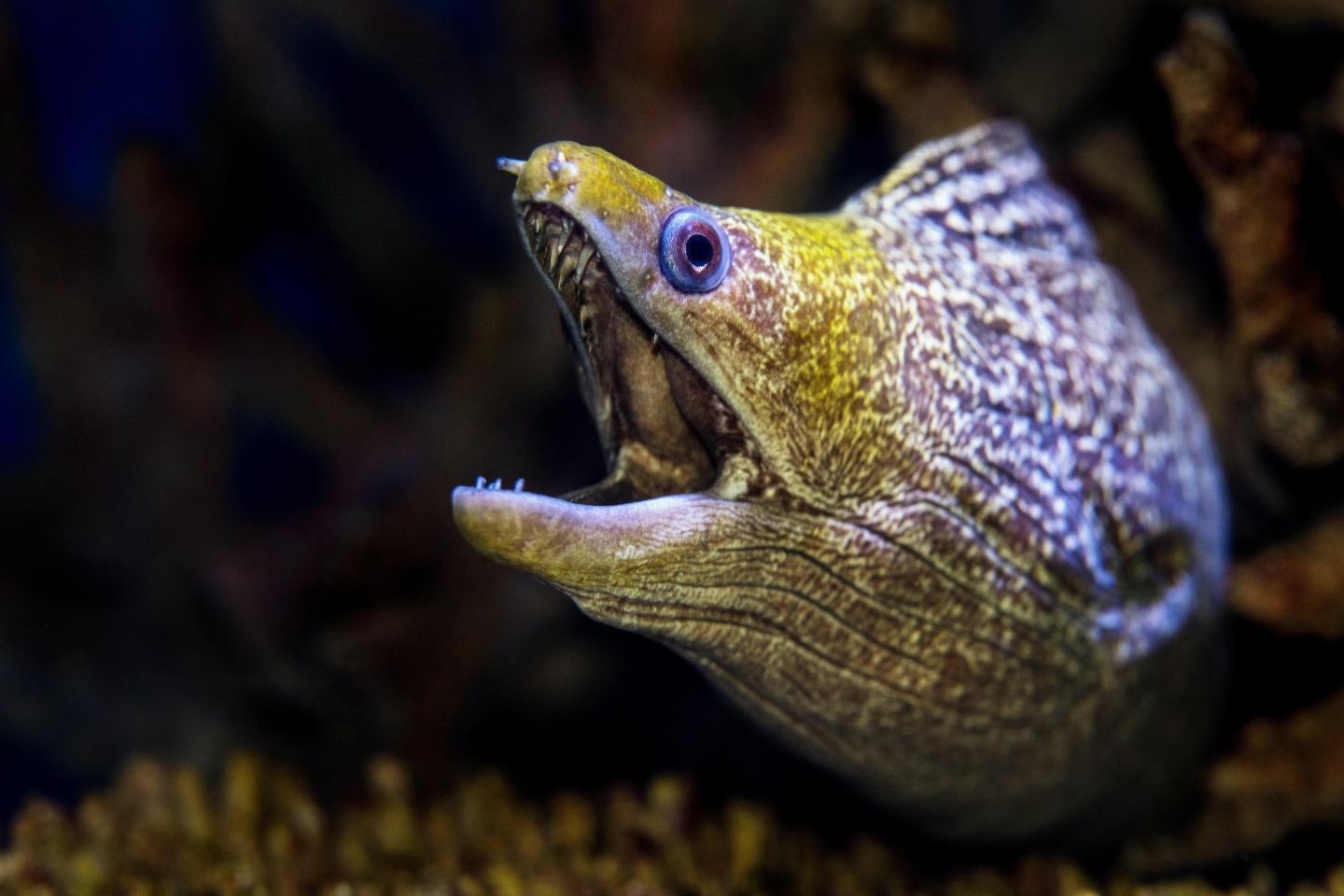
Super-rare footage of a baby moray eel (or a Leptocephalus larva, if you wanna get technical) has taken over the internet. Filmed by Barry Haythorne and Rob Rutgers of HRF U/W Productions, the video shows scuba divers coming face-to-face with the tiny creature, which is almost completely transparent.
The nearly invisible larva looks like a trail of smoke or a billowing silk ribbon as it glides through the water, with only its semiglowing face being truly discernible. Actually, let’s be honest—it’s giving the ghost dog Zero from “The Nightmare Before Christmas,” only much more hauntingly beautiful.
A small snippet was posted by Wonder of Science to Twitter, which quickly racked up 1.2 million views, but the full six-minute video can be seen on YouTube.
Obviously, being transparent and all, these guys are usually next to impossible to find, making this a pretty miraculous encounter. Even luckier that with modern technology millions of other people can see the ultra-rare sighting.
Both the Twitter and YouTube posts are filled with comments of awe, wonder and appreciation for nature’s seemingly never-ending supply of fresh surprises.
“How amazing our world is, brings a smile to my heart,” one person wrote.
“I’m feeling so happy if i look at it, such an amazing creature! It looks like a sea spirit or something,” another added.
The sea is indeed full of intriguing mystery. According to Ocean Literacy, only 5% of the world’s oceans have actually been explored and charted by humans, meaning that there is so much more to be discovered. As one person wrote in the comments, “the oceans are the last unexplored frontier of our planet and lifeforms like this shows how even the wildest imaginings of alien creatures cannot even scratch the wonder and beauty of what Earth’s biodiversity has to offer.”
A single door can open up a world of endless possibilities. For homeowners, the front door of their house is a gateway to financial stability, job security, and better health. Yet for many, that door remains closed. Due to the rising costs of housing, 1 in 3 people around the world wake up without the security of safe, affordable housing.
Since 1976, Habitat for Humanity has made it their mission to unlock and open the door to opportunity for families everywhere, and their efforts have paid off in a big way. Through their work over the past 50 years, more than 65 million people have gained access to new or improved housing, and the movement continues to gain momentum. Since 2011 alone, Habitat for Humanity has expanded access to affordable housing by a hundredfold.
A world where everyone has access to a decent home is becoming a reality, but there’s still much to do. As they celebrate 50 years of building, Habitat for Humanity is inviting people of all backgrounds and talents to be part of what comes next through Let’s Open the Door, a global campaign that builds on this momentum and encourages people everywhere to help expand access to safe, affordable housing for those who need it most. Here’s how the foundation to a better world starts with housing, and how everyone can pitch in to make it happen.
Volunteers raise a wall for the framework of a new home during the first day of building at Habitat for Humanity’s 2025 Carter Work Project.
Globally, almost 3 billion people, including 1 in 6 U.S. families, struggle with high costs and other challenges related to housing. A crisis in itself, this also creates larger problems that affect families and communities in unexpected ways. People who lack affordable, stable housing are also more likely to experience financial hardship in other areas of their lives, since a larger share of their income often goes toward rent, utilities, and frequent moves. They are also more likely to experience health problems due to chronic stress or environmental factors, such as mold. Housing insecurity also goes hand-in-hand with unstable employment, since people may need to move further from their jobs or switch jobs altogether to offset the cost of housing.
Affordable homeownership creates a stable foundation for families to thrive, reducing stress and increasing the likelihood for good health and stable employment. Habitat for Humanity builds and repairs homes with individual families, but it also strengthens entire communities as well. The MicroBuild® Initiative, for example, strengthens communities by increasing access to loans for low-income families seeking to build or repair their homes. Habitat ReStore locations provide affordable appliances and building materials to local communities, in addition to creating job and volunteer opportunities that support neighborhood growth.
Marsha and her son pose for a photo while building their future home with Southern Crescent Habitat for Humanity in Georgia.
Everyone can play a part in the fight for housing equity and the pursuit of a better world. Over the past 50 years, Habitat for Humanity has become a leader in global housing thanks to an engaged network of volunteers—but you don’t need to be skilled with a hammer to make a meaningful impact. Building an equitable future means calling on a wide range of people and talents.
Here’s how you can get involved in the global housing movement:
Speaking up on social media about the growing housing crisis
Volunteering on a Habitat for Humanity build in your local community
Travel and build with Habitat in the U.S. or in one of 60+ countries where we work around the globe
Join the Let’s Open the Door movement and, when you donate, you can create your own personalized door
Every action, big and small, drives a global movement toward a better future. A safe home unlocks opportunity for families and communities alike, but it’s volunteers and other supporters, working together with a shared vision, who can open the door for everyone.
Somewhere in southern New Jersey, in a water-filled zoo habitat, two small animals you’ve probably never thought much about are about to take their first wobbly steps into the world.
Born in mid-April 2026, they came into the world with their eyes open and alert; they were standing within hours. By their first week, they were nibbling grass alongside the adults, their tiny muzzles buried in clover as if they’d been doing it forever.
Cape May County Commissioner Vice-Director Andrew Bulakowski put it simply:
“What a wonderful joy to be blessed with additional capybara pups. Families love this exhibit, and their love will only grow with the sights of these new additions.”
They will not grow up alone. Their extended family—Budette, Marigold, and a group of older siblings from Buttercup’s October litter and Marigold’s November litter—hovers around them like a serene, fuzzy welcoming committee. They are serious about the job, too: someone always stands watch. Someone always seems ready with a nudge or a nuzzle.
Zookeepers and veterinary staff are monitoring Buttercup and her newborns closely, offering the young family regular breaks from the attention of visitors. Visitors who want a glimpse can watch from afar, on a bridge that overlooks the habitat. Patience is the price of admission to one of the sweetest scenes in the zoo.
The new capybara pups are incredibly cute. It’s difficult to look at them and not feel something inside you scream with delight. That feeling is important. In a way, it’s the entire point.
The world’s chillest giant rodent is stranger (and more important) than it looks
Capybaras (Hydrochoerus hydrochaeris) are the largest rodents on Earth. An adult can weigh up to about 146 pounds and stretch more than four feet long. That can seem intimidating on paper, but in person, capybaras carry their size with a slow, steady ease.
Their bodies are built for life between land and water, and every anatomical detail tells that story: their eyes, ears, and nostrils are positioned near the tops of their heads, so capybaras can survey their surroundings while almost entirely submerged. Their feet are partially webbed, making them powerful swimmers who can hold their breath for up to five minutes—a crucial feature when a jaguar is watching from the riverbank and the safest move is to slide under the surface and wait it out.
Capybaras eat plants. They graze on grasses and aquatic vegetation with an almost comical level of focus. It’s a pretty strict diet, though they will add fruits and tree bark when the mood strikes or the season dictates. And they don’t just look calm; they talk. Capybaras communicate with an arsenal of barks, whistles, clicks, and soft purrs that help keep their tight-knit groups coordinated and close.
How a capybara family does childcare
In the capybara world, Buttercup’s new pups don’t “belong” to her and Goomba, the father. Rather, the entire group claims them.
In the wild, capybaras don’t raise their young alone. The babies don’t rely on a single caregiver; they inherit a whole network of protection. Capybaras are profoundly social animals and live in stable groups where group bonds are maintained through constant tactile contact, mutual grooming, and scent marking. Females nurse each other’s pups. Older animals act as lookouts and babysitters, regardless of whether they share direct DNA. Scientists call this alloparenting: shared childcare built into the species’ survival.
That shared responsibility is crucial. It gives capybara pups stronger odds of survival in those first fragile months. In some field studies, more than 70% of pups raised in stable groups survive their first year, a high rate for animals so low in the food chain.
In New Jersey, Buttercup’s family follows the ancient capybara way, too. While the zoo’s visitors see a cute capybara cuddle pile, this mammalian cluster represents a finely tuned system designed to keep vulnerable animals alive.
Why wetlands depend on capybaras
In the wild, capybaras roam across much of South America and function as quiet ecosystem architects. You’ll find them in the vast Pantanal wetlands of Brazil and Bolivia; they graze in the seasonally flooded savannas of Venezuela and Colombia. Capybaras even venture into the rewilding landscapes of Argentina’s Iberá region. Basically, wherever freshwater meets grassland, capybaras tend to appear sooner or later.
As professional grazers, capybaras help maintain diverse, open wetland vegetation. When they disappear, tall grasses quickly crowd out shorter plants, and overall plant richness drops by 25% or more. Simply put, when capybaras aren’t around, plants suffer. That change is drastic and can be felt through the insects, birds, and every other creature reliant on those important plants.
Within the circle of life, as prey, capybaras also anchor South America’s food chains: they’re hunted by jaguars, anacondas, caimans, and large raptors (such as harpy eagles). They’re a major food source; a jaguar can devour dozens of capybaras in a single year. That stat sounds brutal, but if you remove capybaras from that system, the entire food chain begins to wobble.
They’re also essential, given the way capybaras move seeds as they travel and graze. Constantly nibbling and wandering, capybaras have shaped how nutrients move through the wetlands. In conservation science, animals that hold this many threads together often receive a specific label: keystone species. Pull out a keystone, and the entire system starts to crack.
Not endangered, but not untouchable
Right now, the International Union for Conservation of Nature lists capybaras as a species of “Least Concern.” But that broad label can hide a lot of trouble.
For example, the capybara’s habitat is disappearing rapidly as people drain or convert wetlands into farmland at alarming rates. Hunters target capybaras for their meat and skins, which are used to make leather. Climate change creates more intense droughts and wildfires in places like the Pantanal, the world’s largest tropical wetland. In 2020, fires burned an estimated 30% of the Pantanal biome in a single season, scorching millions of acres, as jaguars and charred caimans fled their home.
So yes, there’s real danger here, despite the capybara’s “Least Concern” conservation label. But there’s also hope.
In early 2026, Brazil expanded its Pantanal national park, adding more than 116,000 protected acres to a landscape that badly needs institutional buffers. In Argentina, a long-term rewilding effort brought jaguars back to Iberá after roughly 70 years. Those jaguars now hunt capybaras again—for the first time in living memory—restoring a predator‑prey relationship that’s essential for local ecosystems.
The picture is complicated and is always evolving, but crucially, there’s still a window for change.
What a small New Jersey zoo has to do with all of this
On a map, Cape May County Park & Zoo looks like a sweet coastal stop between beach towns. In practice, it’s part of a much larger conservation network.
The zoo is free to visit and cares for more than 550 animals across over 200 species. Cape May County Park & Zoo holds accreditation from the Association of Zoos and Aquariums (AZA), which isn’t an easy feat: it signals that a zoo meets strict standards for animal care, conservation work, and education. Fewer than 10% of licensed animal facilities in the United States achieve accreditation, for context.
Buttercup and Goomba’s family exists, in part, because those in charge decided that capybaras deserve space, resources, and long‑term planning.
Picture an excited four-year-old, hands sticky from Dippin’ Dots. She presses her face against the enclosure as Buttercup nudges her new pups towards the water’s edge. This child doesn’t know what the Pantanal is. She’s never heard of the term “keystone species.” There is no word for “alloparenting” in kindergarten. But she does know this: there’s a mother, and those little animals matter to her. They also seem to matter to the zookeepers who clean, feed, and check in on them every day.
That simple realization—that another creature’s life is important, has value—is often where the seeds of conservation are planted.
Two pups, one bigger story
Right now, Buttercup’s newest pups are exploring their habitat one cautious step at a time. They nose at the water and trail behind older siblings as they wander through the grass. When something inevitably startles them, they retreat back into their capybara family—a pile of warm bodies and damp fur—where they’ll find safety, tucked beneath the chins of adults and between their sturdy shoulders.
These tiny capybara pups are unaware of the fact that, very far away, others just like them graze the floodplains of the Pantanal and Iberá. They have no idea of their importance, no way to know that their species is the key to holding the entire wetland ecosystem together, one blade of grass at a time.
But they don’t need to know that. Humans can own that knowledge—and do something about it. That’s the power of a story like this. Two baby capybaras in a New Jersey zoo aren’t a trivial subject; it’s a doorway. You start with Buttercup and Goomba’s adorable little family, and suddenly, context floods in. “Wetlands” are no longer a concept or a word in a textbook. They’re real, faraway places where animals like the capybara live, graze, and contribute to the ecosystem.
Sometimes taking care of our beautiful home planet looks like big, broad policies tackling issues like plastic pollution and habitat destruction. And sometimes it looks like taking the time to help one tiny creature stuck in an environmental bind.
In a YouTube video that’s been viewed a whopping 20 million times, we see an example of the latter in action as some kind and compassionate divers attempt to convince an octopus to abandon the plastic cup it’s using for protection and trade it for a sturdy shell. Pall Sigurdsson has shared dozens of underwater videos on YouTube, but watching this particular video from his dive off the coast of Lembeh, Indonesia, in 2018 almost feels like watching a Pixar short film.
“We spent a whole dive and most of our air saving this octopus from what was bound to be a cruel fate,” Sigurdsson wrote in the description of the video.
“The coconut octopus, also known as veined octopus, is born with the instinct to protect itself by creating a mobile home out of coconut or clam shells. This particular individual however has been trapped by their instincts and have made a home out of a plastic cup they found underwater.”
Why a plastic cup is so dangerous for an octopus
It’s not just that the flimsy plastic cup didn’t provide the octopus adequate protection. Sigurdsson explained that a predator like an eel or a flounder would probably end up swallowing the cup with the octopus in it, likely killing both of them. Plus, even if the octopus abandoned the cup on its own, plastic simply doesn’t belong in the ocean.
“We tried for a long time to give it shells hoping that it would trade the shell,” he wrote. “Coconut octopus are famous for being very picky about which shells they keep so we had to try with many different shells before it found one to be acceptable.”
The tentacles reaching out to test the weight of each shell, the divers searching for more options to offer it, the suspense of wondering whether the octopus really would abandon its pathetic plastic pollution protection… it’s just too much.
Sigurdsson’s other underwater videos are also fun to watch. He shared one of another veined octopus who seemed to have no interest in him but became intrigued with his diver friend, Gary. The way it reaches out to touch just the tip of his finger and then shyly retreats feels like such a clear communication with no words being said.
Just how smart are octopuses?
Perhaps it is the fact that an octopus has nine brains that make them far more intelligent than anyone would have guessed before we started studying their behavior in earnest. They are known to solve puzzles, escape complicated mazes and traps, and take apart just about anything. It does make you wonder what these little guys were thinking when these divers were interacting with them. Was it curiosity? Judgment? An attempt at connection between species?
It’s funny how one small interaction in one tiny portion of the vast ocean can say so much about us, for better and for worse. Human pollution is an enormous problem and saving one little octopus won’t save the world, but it sure gives us hope and motivation to keep trying for the sake of the vast number of creatures that live in the ocean as well as our own.
Teddy, the two-toed sloth, has become a proud papa, and thanks to a video posted by the St. Augustine Alligator Farm Zoological Park, we all get to witness his adorable reunion with his newborn son. Mama sloth, aka Grizzly, gave birth to their healthy little one in February 2022, delighting more than 3,000 people on Facebook. Mama sloth was probably happy to give birth because a sloth’s gestational period is an entire year.
The video, posted to the Florida zoo’s YouTube page, shows Grizzly slowly climbing toward her mate, who is at first blissfully unaware as he continues munching on leaves. Typical dad. Teddy quickly kicks into love mode once he sees his precious cub, however. Pretty soon it’s nothing but a sweet nose nuzzle fest. Be still, my sloth-loving heart!
“Special Delivery! We have some big news to tell you: Grizzly had a baby! Grizzly and Teddy (the father) are Hoffman’s two-toed Sloths, and the family is doing well,” the St. Augustine Alligator Farm Zoological Park announced on Facebook.
How do sloths raise their young?
As with most mammals, male sloths don’t typically care for their young. Usually, a sloth mama will go it alone, spending up to six months with the little one clinging to her chest as she traverses the trees. Eventually she’ll spend time teaching the cub to climb, forage and even do the “poop dance” (yes, it’s a real thing with sloths). However, the zoo is allowing the father to be involved in the baby’s upbringing if he so chooses.
“But since that is how they’ve elected to, we felt it was really important to keep them here that way,” a zoo curator said. “Mom and baby need time to bond together, and Teddy, very smartly, decided to give them some space.” In a follow-up video, Sarah, one of the zoo’s bird and mammal curators, praised Teddy for “very smartly” knowing when to give Grizzly and baby their “much needed space.” Healthy boundaries at their finest.
Why this birth was especially remarkable
The birth of the baby sloth is also notable because of the parents’ advanced ages. At the time of the birth, 37-year-old Grizzly was one of the oldest sloths ever to give birth, and 47-year-old Teddy was one of the oldest sloths ever recorded. The birth was the couple’s fourth child. They came to St. Augustine Alligator Farm Zoological Park in 2019 from Busch Gardens Tampa Bay. The Hoffmann’s two-toed sloths can be found in tropical rainforests across Central America, Northern South America, Peru, and Brazil.
The family currently lives at an exhibit in the park known as Sloth Landing, where visitors can get up close with the animals while learning about the conservation of rainforest animals. “The Rainforest Encounter places you up close and personal with the sloths, even providing opportunities to touch these shy animals. A brief introduction will provide an overview of the species’ habitats, behaviors, and diet, and you’ll also learn about the conservation work being done at the Alligator Farm to protect sloths throughout the world,” it says on the zoo’s website.
It looks like this sloth family of three will continue cuddling away at their sanctuary, and the internet is here for it.
This article originally appeared four years ago. It has been updated.
An elephant’s trunk is more than just its defining physical trait. They use it to take in nutrition, to snorkel while swimming, to spray water or dust on their bodies for hygiene and protection, and to communicate, lifting it high to show a perceived threat, or intertwining it with another to display affection.
So you can imagine the profound loss that might have been experienced by Long’uro, the elephant calf left with only a third of his trunk after a hyena attack. And yet, his story is one of hope, not just tragedy.
A devastating start: a calf loses most of his trunk
About six years ago, the Reteti Elephant Sanctuary received a call that a gravely injured baby elephant was stuck in a nearby well, traumatized not only by the harrowing attack, but also by the abandonment of his mother.
A fight for survival that almost didn’t happen
As vets rushed to the scene, poor Long’uro’s situation looked dire. He could barely breathe and had lost a lot of blood. For a moment, euthanasia seemed to be the only option.
Yet, the team saw the calf fighting for his life and decided they wouldn’t give up hope either. So, they airlifted him to a place where they could properly care for him. He was named Long’uro, which loosely translates to “he who has been cut” in Samburu.
The caregiver who changed everything
After Long’uro underwent surgery, Mary Lengees, one of Reteti’s elephant keepers, was charged with keeping his wounds clean and managing his follow-up vet visits. But she ended up providing so much more than that. As Long’uro struggled to navigate the world without his trunk, Lengees provided constant comfort, patience, and care. Because of this, Long’uro’s spirits never dwindled, and the two developed a powerful bond.
Then, a few more baby elephants joined the nursery, providing Long’uro with his own set of friends. Pretty soon, his “joyful, boisterous” personality began to come alive, the Reteti website recalled.
Thriving against the odds
Six years later, and sweet Long’uro has figured out life on his own terms. He’s able to feed and clean himself, has grown big and strong, and is well-received in his herd. And Reteti credits him for all of it.
“His unrivalled resilience in his fight for survival pulled him through…His life represents so much…but ultimately, Long’uro’s story is one of courage.”
A story that’s still moving people today
Recently, Nature on PBS posted a video where Lengees recalled Long’uro’s story, visibly getting teary as she did. This, in turn, left thousands completely moved.
“I’m so glad that the baby was saved and there are caring people looking out for him. You can tell the woman is very emotional about it. She’s an angel! I might be on the other side of the world, but my heart breaks, and my tears fall just the same.”
“He saw she was crying and sad, remembering his story, and came over to give her snuggles. What a sweet pair.”
“What a compassionate young woman. It’s evident that she cares deeply for the elephant and his plight.”
How you can help Long’uro’s next chapter
In celebration of Long’uro’s “6-year rescueversary,” Reteti is currently trying to raise $60,000 to support his care, which will ultimately help him return to the wild along with his herd. If you’d like to contribute to this next chapter, you can do so here.
Have you ever watched a chicken lay an egg? Think hard before you answer. Many of us may instinctively say, “Of course I have!” but then realize we’ve only seen movie scenes or cartoonsdepictinghens laying eggs. Few of us have actually witnessed a real egg come out of a real hen in real life.
Even fewer of us have seen it the way the folks at @chickenwifehappylife captured it. One of their chickens hopped onto a workbench and laid her egg right on the table in front of them. No nesting-box privacy for this lady. She wanted to show the world what she goes through to lay a single egg, and frankly, she has every right.
“Girl… I promise not to complain about the price of eggs. Please take a day off, you deserve it.”
“I’d be pissed if I had to lay an egg every day.”
“We should have a moment of silence every time we crack an egg as respect. That was some work!”
The overwhelming sentiments people shared were: (1) “Wow, I have truly never watched a hen lay an egg before,” and (2) “Wow, I will never take eggs for granted again.” Some also said, “I don’t know if I want to eat eggs anymore,” rethinking their breakfast choices.
Does it hurt a chicken to lay an egg?
Watching this hen lay her egg on the workbench had people feeling for her. It’s a bit reminiscent of giving birth, especially with her bearing down and “singing the egg song” just before it popped out.
“The reason it is hard to answer this question with complete clarity is because, of course, chickens cannot tell us for sure whether they’re experiencing pain when laying eggs. There are some signs, but we have to be careful not to misread them. For example, for a long time humans (including that first century Roman writer, Columella) believed that the sound many chickens make before laying indicated pain. However, studies found that the sound was instead an “egg song,” which could have a number of explanations, including happiness and scaring off predators. Another study found that when a hen “sings” it is more likely to be associated with contentment, while cackling aligns with danger.”
Naturally, there are things that can go wrong during the egg-laying process that can make it painful. Signs that a hen is in distress while laying include wheezing, distressed squawking, not eating or drinking, isolating, hunching over, drooping, avoiding movement or activity, and slow or awkward movements. Most of the time, however, a hen will recover immediately after laying an egg and go on with life as if nothing happened.
How often do chickens lay eggs?
Hens basically lay eggs daily, but that’s a bit oversimplified.
The University of Wisconsin–Madison notes that hens ovulate, releasing an egg yolk, every 24 to 26 hours. It then takes about 26 hours for the egg white and shell to form around the yolk. As a result, hens typically lay one egg per day, but the timing shifts later each day. Once in a while, a hen will also “skip” a day or two.
Hens did not originally lay more than 300 eggs a year, however. Through centuries of selective breeding, humans have “engineered” chickens to become more prolific egg layers.
Many people have concerns about the well-being of hens used in the industrial production of eggs. Even when we try to make ethical choices about the food we consume, the details are not always clear. Labels on egg cartons, such as “organic,” “cage-free,” and “pasture-raised,” can be confusing, but Certified Humane offers an explainer that helps demystify these terms.
Whatever egg choices we make, seeing the laying process may at least give us a newfound respect and gratitude for the hens who lay them.
Science lovers got a treat recently when new research on sperm whales was quietly released. Researchers not only witnessed the birth of a baby sperm whale, but also saw elder females, including the grandmother, acting as midwives. Very few species assist with birth outside of humans, but it seems sperm whales can now join that short list.
Project CETI (Cetacean Translation Initiative) released two studies on sperm whales in journals Nature and Science respectively. Nature covers the different vocalizations of the whales during this teamwork process, while Science discusses the collaborative birthing approach by the whales.
The sperm whale’s birth was first captured via drone in July 2023. Now that the video has made its way to social media, viewers cannot get over witnessing the whales act as midwives. Typically, scientists don’t get to witness sperm whales’ behavior during birth, likely because they give birth far from shore and avoid boats during this vulnerable process.
With the increasing use of drones, however, scientists can now capture moments like this without disrupting wildlife. In the video, other whales—one identified as the grandmother—surround the birthing whale, named Rounder. Not all of the supporting whales were from the same pod as the mother, but they joined to help ensure the calf’s safe arrival.
Because whales are mammals, they can’t breathe underwater. For this reason, baby whales, also known as calves, are born tail-first. Like other mammals, newborn whales instinctively try to breathe, so exiting the birth canal headfirst could result in drowning, according to National Geographic.
Scientists have been following this pod for a while, so they’re familiar with the whales in the family. As they watched the drone footage from the boat, they were able to identify who was present. Still, the sight of this unique birthing circle shocked the scientists.
While birthing her calf, Rounder was flanked by her sister, Accra, and Atwood, an elder female. Behind the mom-to-be was her mother, Lady Oracle, her aunt Aurora, a juvenile whale named Ariel, and four other unknown female whales. The whales had dual roles: when the calf was born, the assisting whales formed a tight cluster and raised the baby out of the water so it could breathe.
They took turns holding the calf out of the water for three hours. During that time, the females that were not actively lifting the calf to the surface were fending off nosy animals. Once the baby was safe and swimming alongside its mother, the other whales began to depart.
One of the scientists, Shane Gero, told National Geographic, “All the biologists on the boat were losing their minds.” The same could be said for people coming across the video online.
One person wrote, “Women supporting women! Bring it on!”
Another person called out humans, saying, “I think they lied , who said survival of the fittest or only the strong survive. Everything in nature is about collective care. Even other animal species be helping each other. Also even when its predators they only take what they need.”
This commenter admired the teamwork, writing, “I love how whales put so much energy into each other, but it’s even more exciting that members outside of the family pod were being so helpful. I’m invested!”
“This is so frigging cool,” another person gushed. “I love how nature really wants nature to succeed. Absolutely 100% lit. Thanks for this!”
Which is why what happened on February 20, on a remote volcanic island in the Pacific Ocean feels so extraordinary.
A species that, by all accounts, should have been extinct returned home. That morning, rangers on Floreana Island in Ecuador’s Galápagos Islands set down their packs and gently placed 158 juvenile giant tortoises onto the wet ground—the first of their lineage to set foot on the island in roughly 175 years.
These animals weren’t supposed to exist. Their subspecies was declared extinct in the 1850s. The forces that wiped them out—overhunting, invasive predators, habitat destruction—are exactly the kinds that usually can’t be reversed. But this time, somehow, they have been.
First, here’s what was lost
Long ago—before whalers, settlers, feral cats, and invasive rats—Floreana Island was home to as many as 20,000 giant tortoises. These weren’t just large, slow animals living out their days in the sun. They were ecosystem engineers that carved trails through the vegetation, swallowed whole fruits and deposited seeds miles away, planting forests with every lumbering step. The island’s entire web of life depended on these tortoises.
By the time anyone thought to do something, it was too late. Or so everyone thought.
A wild tale
In 2008, scientists exploring Wolf Volcano on Isabela Island noticed something strange. Some of the tortoises had an unusual shell shape: the unique saddleback shell associated with Floreana.
They conducted DNA tests, and the results were nearly unbelievable. These tortoises carried the genetic fingerprint of the “extinct” Floreana lineage.
It turns out that centuries earlier, those same whalers who had stripped Floreana of its tortoises had occasionally offloaded live tortoises onto Isabela Island, as provisions to be retrieved later or to lighten their ships. Some of those tortoises survived, bred, and passed their genes on for nearly 200 years.
The Floreana tortoise had been hiding in plain sight the whole time.
Scientists sprang into action. They selected 23 hybrid tortoises from Wolf Volcano that showed the strongest Floreana genetic signal and brought them to a breeding center on Santa Cruz Island. Starting in 2017, they carefully bred them over generations, patiently guiding their lineage back toward its original form.
Dr. Jen Jones, chief executive of the Galápagos Conservation Trust, described the moment as “truly spine-tingling,” adding that it validated two decades of collaboration among scientists, charities, and the local community.
But wait—they didn’t just show up and release tortoises
Before a single tortoise set foot on Floreana, the island needed years of preparation.
Remember, Floreana had been overrun with invasive rats and feral cats, the same forces that drove the tortoises to extinction in the first place. They needed to go. In October 2023, the Floreana tortoise team launched a massive eradication campaign with helicopters, aerial baiting, and ground traps.
Before the baiting began, community members set up protective enclosures for their pets to prevent harm. Farmers adapted their agricultural practices to best serve the project. Locals also helped with the trapping.
The results were almost immediate. Native Galápagos rails—small birds that disappeared from the island entirely because of rat predation—have already started coming back on their own. Nature, it turns out, is extremely ready to bounce back the moment you give it a chance.
And they’re watching every step
Each of the 158 released tortoises carries a GPS tracker that pings its location every hour via satellite.
On top of that, NASA Earth observation data is overlaid to map vegetation, rainfall, and soil conditions across the island. Scientists use all of this information to build habitat models that can project ecosystem conditions decades into the future, which matters a lot when you’re dealing with an animal that can live over a century.
The plan is to release 25 to 100 more tortoises each year, with each group’s release location guided by data on where current tortoises are thriving. Slow and steady. Rather fitting, really.
This is just the beginning
The 158 tortoises are Phase One of a plan to reintroduce 12 locally extinct species to Floreana over the coming decade. Next up? The Floreana mockingbird, a fascinating species that arguably inspired Charles Darwin’s theory of evolution when he visited the island in 1835. Sadly, it now only exists on two tiny offshore islets.
After that: Darwin’s finches, Galápagos racer snakes, the lava gull (the world’s rarest gull), and, eventually, the Galápagos hawk, the apex predator whose return would signal a fully restored food chain.
Each species added to the island increases the likelihood that the next will succeed. That’s how ecosystems work. And honestly, it’s a pretty good lesson for the rest of life.
Dogs are considered invaluable police helpers for their tracking abilities. But performing CPR? That’s certainly not on anyone’s bingo card.
However, footage released on X by Madrid Municipal Police shows a dog named Poncho doing just that, or at least performing CPR in a training simulation.
In the clip, an officer pretends to faint, triggering Poncho to rush to the rescue. Wearing a harness fitted with a small blue light, Poncho quickly begins jumping on the officer’s chest with his forepaws, mimicking chest compressions. After every few jumps, he appears to check for a pulse or breath before continuing the drill.
By the end, the officer miraculously jumps up, and Poncho’s tail wags in gleeful triumph.
The Municipal Police of Madrid wrote that the “heroic” dog “did not hesitate for a moment to ‘save the life’ of the agent, practicing the #CPR in a masterful way.”
Adorable? Definitely. Effective? Eh, not so much.
As many were quick to point out in the comments, this “masterful” performance is certainly heartwarming, but it likely wouldn’t hold up in a real emergency.
While CPR, or cardiopulmonary resuscitation, can be performed using chest compressions alone (as Poncho was demonstrating), even that requires a level of precision that man’s best friend might find challenging.
As Jonathan Epstein, senior director of science and government relations for the American Red Cross, told The Washington Post in 2018, that technique involves pushing down about two inches into the patient’s chest at a rate of 100 to 120 compressions per minute until the patient regains consciousness or until someone else can take over to attempt traditional CPR or other revival methods.
That level of control is difficult even for humans who have not been properly trained, much less a creature without opposable thumbs.
Video goes viral
Still, it could be argued that Poncho revived millions of hearts after his video went viral, and he certainly received applause from his new fans.
“This is the cutest thing I’ve ever seen 🥺🥹”
“Lol 😂most ineffective compressions I’ve ever seen but ok cute.”
“Cutest, most ineffective bounces I’ve ever seen, but what a good way to go! lolol 😍”
Plus, dogs have proven themselves to be incredible creatures many times before, whether saving people from drowning or rescuing avalanche victims.
And for what it’s worth, the Madrid police department wasn’t trying to convince anyone that Poncho could perform CPR. They actually had much more wholesome intentions.
According to NBC News, the Municipal Police of Madrid hoped the video would inspire pet adoptions. The department also quoted American author Josh Billings in an X post, saying, “A dog is the only thing on earth that loves you more than you love yourself.”
So while Poncho might not have pulled off a medical miracle, he is undoubtedly a hero in our eyes.