Social skills expert shares 3 ‘magic phrases’ that make you more likable

Sometimes, we need to overcommunicate how we feel about others.

vanessa van edwards, likability, communications skills, people skills, people laughing, good advice
Vanessa Van Edwards and people at a party. Photo credit: via Press Release and Canva/Photos

A familiar misstep people make when trying to be likable is trying to impress others. They want to show they are funny, intelligent, and a great storyteller. They think being the life of the party is the road to likability. However, study after study shows that it’s a lot easier to be likable. All you have to do is show interest in others. To put it simply: If you like people, you will become more likable.

There’s a slight wrinkle in the notion that liking more people makes you more likable. Many people you like aren’t sure that you like them. The psychological phenomenon known as signal amplification bias says it best. We tend to overestimate how clearly we broadcast our feelings and intentions towards others. So, the person we like and who likes us may not know the feeling is mutual.

“We think our signals are obvious,” Vanessa Van Edwards told Steve Bartlett on the Diary of a CEO podcast. “If we like someone or if we’re having a good time, we think, ‘Oh, they for sure know it.’ They don’t.” Van Edwards is a communications expert and the author of Captivate: The Science of Succeeding with People.

To help people clearly communicate their feelings, Van Edwards suggests three “magic phrases” to show you care. Check out the video below.

Phrase 1: ‘I was just thinking of you’

“You think of a lot of people in your life all the time,” she said. “If you are thinking of someone and you can text them: ‘I was just thinking of you, how are you?’ I was just thinking of you, how’d that project go?’ was just thinking of you. It has been a while since we talked.’ You see a movie, you see a documentary, you see a matcha latte, you see a mug, you see a ceramic candle, and you’re like, ‘Ah, this made me think of you,’” Van Edwards said. “My text messages, my conversations, are full of actual moments where I was triggered to think of that person, actually,” she said, noting the importance of being genuine. “If you don’t think of someone, they’re not a person you need to have in your life.”

Phrase 2: ‘You’re always so …’

“So if you’re with someone and you’re impressed by them or they’re interesting or they’re funny, say, ‘You always make me laugh. You’re always so interesting,’ or ‘You’re always so great in interviews.’ Giving them a label that is a positive label is the best gift you can give someone, because it’s fighting that signal amplification bias,” she continued.

Phrase 3: ‘Last time we talked, you mentioned …’

“We are so honored when we get brain space—that you remembered and you’re going to bring it up,” she said. “And you specifically bring up something that they lit up with, something they were like, ‘Ah, it was great, it was exciting, it was wonderful.’”

If studies show the more you like other people, the more likable you become, Van Edwards has the next logical step in becoming more likable. She makes it clear that, due to signal amplification bias, many people you like may not even know it. When we employ her three ways to be more likeable, though, we can let people know we like them without making them feel uncomfortable, thus establishing bond to build on.

This article originally appeared last year. It has been updated.

  • 4 everyday phrases that may indicate someone is highly intelligent
    Einstein in a hoodie on a mural.Photo credit: Photo by Taton Moïse on Unsplash

    So often, we equate intelligence with standardized testing, or say, degrees or rank in a graduating class. The person who has a 4.0 GPA and high SAT score probably is pretty book-smart. And sure, various amounts of degrees do imply that most likely they’ve had a lot of education.

    But there is another measure of intelligence that is often overlooked: the ability to be wrong. A doctor named Emma Jones, MD (self-described hospice doctor and “burnout coach”) has recently gone viral on social media for a video wherein she talks about intelligence. The clip is entitled “Here’s how you know someone is highly intelligent.” In just a couple of minutes, she lays out ways you can easily spot someone who is ultra-bright.

    Quoting Oscar Wilde, she says, “Consistency is the last refuge of the unimaginative.” She then explains that he meant, “highly intelligent people know how to change their minds.”

    Here’s where the phrases of (most likely) highly intelligent people come in. She says to listen for sentences like:

    “I used to think…”

    “That’s a good point.”

    “Let me reconsider.”

    “I’ve changed my mind.”

    She adds, “Most people double down to protect their ego. But intelligent people update their beliefs. They get more curious instead of more defensive. And they ask things like ‘what am I missing?’ instead of trying to win an argument. They don’t tie their identity to being ‘right.’ And they treat being wrong like data, not humiliation.”

    She also quotes Albert Einstein, who once said, “The measure of intelligence is the ability to change.” She notes that the “real flex” is being able to have your mind changed “without shame.”

    The comments, and there are thousands in just a short amount of time, support the notion. One (somewhat sarcastically) writes, “So in other words, you’re saying that intelligence correlates with a combination of critical thinking skills and the humility to know that oneself doesn’t know everything?”

    Another jokes, “I used to say that my ‘need to be right’ is so strong that if someone shows me a better path, or shows me that my thinking is off, I will quickly recalibrate and change my mind so I can be ‘right’ again.” Jones responds to this: “That is quite a strong and intelligent reframe.”

    Another Instagrammer backs it up with a book they love, writing, “One of the best books I have ever read is called But What If We’re Wrong by Chuck Klosterman. I base most of my life on the assumption that some part of the system is built on inherently incorrect information. It makes it easier to be flexible and make connections to other information that may have otherwise been missed.”

    But, of course, admitting there’s usually room for debate and the ability to change one’s mind is just one of many signs someone is intelligent. Writer and reviewer Jordan Cooper shared his subtle signs someone might be intelligent in an article for VegOut.

    Among eight examples, his first is “talking to yourself out loud,” which I mentioned in a recent Upworthy article. He adds, “A 2012 study in the Quarterly Journal of Experimental Psychology showed that talking out loud can actually improve focus and object recognition. Why? Because verbalizing engages additional sensory channels. When you speak your thoughts aloud, you’re not just thinking—you’re hearing yourself think, which reinforces memory and decision-making. Einstein did it. So do a ton of high-performers who swear by this trick for brainstorming, debugging their code, or preparing for presentations.”

    richard pryor, intelligence, openness, being wrong
    Richard Pryor admits he was wrong. Giphy

    Other examples, some of which have also been pointed out on Upworthy over the years, are: “zoning out,” “being sensitive to noise, light or texture,” “having messy handwriting,” “swearing a lot,” and to the earlier point, “doubting your intelligence constantly.” (In other words, staying open to being wrong.)

    So, while having good grades and a plethora of degrees is excellent, always being open to learning and changing course adds a layer to any good mind.


    This article originally appeared last year. It has been updated.

  • Philosophy expert shares the 300-year-old rule to tell if someone is a good or bad person
    Johann Wolfgang von Goethe and a scene at a restaurant.Photo credit: via Canva/Photos and G.Meiners/Wikimedia Commons

    What makes a ‘good person’ is hard to quantify, but sometimes, you just know it when you see it. But that’s the problem, you can’t always see it. Have you ever met somebody new and wondered if they were a good person with a mischievous streak or a bad person who can turn on the charm and behave occasionally? Determining someone’s true moral character is important, especially if you start dating them or have a business relationship. It is crucial to get to the core of who they are and know whether they can be trusted.

    Popular TikTok philosopher and Substack writer Juan de Medeiros recently shared a great way to determine whether someone is good or bad. His rubric for judging someone’s moral character comes from a quote commonly attributed to Johann Wolfgang von Goethe, a German poet, playwright, novelist, and intellectual known for works like Faust and The Sorrows of Young Werther.

    How can you tell if someone is a good or a bad person?

    “Here’s a pretty good indicator that somebody is a bad person and vice versa, how you can spot a good one. And this goes back to a simple rule, a moral aphorism by Goethe in which he writes, ‘Never trust someone who is unkind to those who can do nothing for him,’” de Medeiros shared in a TikTok video with over 45,000 views.

    “Never trust someone who is unkind to those who can do nothing for him.” —Johann Wolfgang von Goethe

    De Medeiros then provided real-world ways to determine whether the person you have questions about is good or bad. “A bad person is unfriendly to strangers, to the elderly, to children, to service staff, to anybody they’re not trying to impress,” he said. At the same time, the good person treats people equally, no matter what they can do for him. They’re good for goodness sake, not to get anything out of it.

    “A good person carries grace within them and shares it freely with abundance. A good person treats other people as they would like to be treated as well. And it doesn’t matter who you are, it doesn’t matter what your status is, they will treat you and see you as their equal,” de Medeiros said.

    What is ‘The Waiter Rule’?

    Goethe’s quote echoes the common red/green flag test that many people have on dates. Sure, it’s important if your date is courteous and treats you well on the date, but you really want to watch how they interact with the server. The rule is often called “The Waiter Rule,” outlined by William Swanson. Swanson, the former chairman and CEO of Raytheon Company, wrote in his book, 33 Unwritten Rules of Management, “A person who is nice to you but rude to the waiter—or to others—is not a nice person.” Boxer Muhammad Ali is also known for saying something similar: “I don’t trust anyone who’s nice to me but rude to the waiter. Because they would treat me the same way if I were in that position.”

    Rudeness toward the waitstaff also indicates that the person isn’t very smart. It’s not wise to be rude to someone who is in charge of your meal for the night.

    Conversely, a good person is kind to others without looking for anything in return because they want to spread joy and believe that others deserve respect. You are what you do, not what you think or believe, and when someone treats others with goodness, it’s a clear indicator of the type of person they are.

    In the end, we are all a mixed bag of behaviors and attitudes, and even the most perfect of us has a devil on their shoulder telling them that it’s okay to occasionally get into a bit of mischief. However, when it comes down to determining someone’s core character, how they treat those who can do nothing for them says everything.


    This article originally appeared last year. It has been updated.

  • 3 types of ‘effortless’ psychology-based opening lines to start a conversation with anyone
    A teenage girl and boy having a nice chat. Photo credit: Canva/Photos

    You’re standing in line at the grocery store and you see someone cute. You’d like to strike up a conversation without it being awkward…but that feels kinda nerve-wracking, right? Or maybe you’re standing around at a party and see someone you’d like to get to know, and want to approach them in a way that doesn’t feel uncomfortable. That probably feels a little scary, too.

    The good news is that with a few easy tricks, you can improve your communication skills and feel confident approaching anyone.

    According to years of psychological research, several principles can help make striking up conversations with strangers easier. The great thing is that they all work best when approached in a casual, effortless way.

    1. Comment on the environment

    Let’s say you’re at a party in someone’s living room. You can comment on physical objects: “Gee, this guy sure has a lot of books.” Or maybe you’re at a party where everyone brought food: “The food smells great. What are you grabbing first?” You can also comment on people’s behavior: “Is it me, or is everyone really well dressed tonight?”

    This works because of the Joint Attention Effect, which says that when two people pay attention to the same thing at the same time, they create a common point of reference. This shared focus can immediately make people feel closer, even in social situations.

    man and woman, wine, social skills, conversation
    A man and woman chatting while drinking wine. Photo credit: Canva/Photos

    2. Make a playful comment

    People will usually respond when you make a playful or unexpected comment, as long as it isn’t threatening. For example, if the person you want to talk to is holding a cocktail, you might joke, “That drink looks serious.” If you’re stuck in a long line: “Do you know why we’re here? I almost forgot why we’re in line—it’s been so long.” Or if you’re at a child’s birthday party and spot another parent you’d like to talk to: “Be honest, how tired of Little Caesars’ pizza are you?”

    This works because of the Benign Violations Theory, which suggests that when someone violates a social norm in a non-threatening way, it makes people laugh and activates bonding mechanisms. It signals to your new friend that you’re playful and friendly, and when they laugh at your joke, it shows that you share similar values.

    man and woman, people laughing, sitting on couch, good company, jokes
    A man and woman laughing on a couch. Photo credit: Canva/Photos

    3. Ask their opinion

    Another effortless way to engage someone you don’t know is to ask their opinion. For example, if you’re in the produce section at the supermarket, you might ask, “Do these peaches look good to you?” Or if you’re at a party and bring up a pop culture moment most people watched: “So, was Bad Bunny great at the Super Bowl, or is he overrated?”

    This works because of what’s known as Cognitive Ease: people are more likely to respond to questions that are easy to process. Asking someone for their subjective opinion is non-threatening, and it’s easy for them to come up with an answer that makes them feel comfortable. Plus, if social media has taught us anything, it’s that everyone loves to share their opinions.

    drinks, bar, socializing, man and woman, party
    A man and a woman having drinks at a bar. Photo credit: Canva/Photos

    Next step: Pivot and ask questions

    Given that all of these strategies are psychologically designed to elicit a response, even from someone you’ve never met, you have a strong chance of sparking a conversation. The key is to widen the exchange once you get that response by asking two more questions. In fact, a Harvard University study found that one of the easiest ways to be likable is to start a conversation with a question and then follow up with two more.

    “We identify a robust and consistent relationship between question-asking and liking,” the study’s authors wrote. “People who ask more questions, particularly follow-up questions, are better liked by their conversation partners.”

    These three psychological rules show that it doesn’t take a Herculean effort to coax a stranger into having a conversation. All you have to do is make an effortless invitation by tapping into the environment you share with them, make a playful joke, or ask their opinion. Then ask a few questions, listen, and there’s a good chance you’ve made a new friend.

  • Lawyer explains why everyone should do ‘mandatory hospice volunteering’ when they turn 18
    An older women side by side with a younger woman (left) A young male hospice worker and a male patient (right)Photo credit: Canva

    In a recent, thought-provoking episode of the Impact Theory podcast with Tom Bilyeu, renowned divorce attorney and author James Sexton shared how being a hospice volunteer changed his perspective on life so drastically that he thinks it should be “mandatory” at the age of 18.

    “I think it would change your entire way of viewing the world. It did mine,” he told Bilyeu.

    Sexton recalled that while death itself wasn’t necessarily the prime source of conversation—most of his volunteer work involved doing little odds and ends for folks— its presence was still palpable. And because of that, he walked out of each visit “feeling like a samurai” as all the things he thought were “so important five minutes ago” fell to the wayside.

    Death gives us perspective on what really matters

    “Spend time with people that are dying. They don’t really…all their stuff is a great big pile of nothing. Like, all that they can talk about is the people that they love, the connections that they made, and the experiences that they had that were beautiful or painful,” he said.

    That realization became even more apparent when he learned that his own mother was terminally ill with cancer, and past the point that any doctor could help her.

    “In that moment, all of the other things that I was stressed about and worried about, the volume was turned so far down on all those things because my mom was gonna die. All that became important was how I could spend a little more time with her. How can I make sure she knows that I love her? How can I savor these wonderful things?”

    Hospice volunteering could help us navigate anti-death culture

    Developing an awareness of death during early adulthood, Sexton argued, would help people not get “distracted” by a society that constantly tries make you forget that death is inevitable. Therefore, they wouldn’t pay attention to the “meaningless shit that keeps the machine moving,” and instead focus on what really matters.

    And what really matters? Important things like kissing our spouse, for example, which Sexton reminded Bilyeu (and, conversely, all of us) is a finite number of times. You won’t know what that finite number is “until you’ve passed it,” he warned.

    hospice, hospice volunteer, impact theory, impact theory podcast, tom bilyeu, apple podcast, james sexton, death
    Photo credit: Canva

    “If you don’t keep that in your line of sight, then you’re a fool. You’re gonna think you’re gonna get to do that forever. You don’t. That’s the most beautiful thing in the world. It’s what makes that so special.”

    For Sexton, being a hospice volunteer cemented this perspective, and since then, “nothing has been the same.” It didn’t mean suddenly “living life like a monk,” but it did mean sharing his love a little more freely, and appreciating that “things have to end.”

    Between hospice volunteering and working as a divorce lawyer, Sexton has become an expert of sorts with “endings,” he noted with Bilyeu. And he argues that we must look at life through this lens because the one constant is that “everything is ending all the time,” and ignoring that fact “does a great disservice.”

    A death ritual for the modern day

    American culture generally treats death with avoidance, viewing it as a taboo topic or a medical failure rather than a natural life stage. It is highly clinical and sanitized, with many dying in hospitals away from family and loved ones. While shifting toward more home-based hospice care, US society remains heavily influenced by “death-denying” attitudes, emphasizing quick, efficient mourning. Compare that to other cultures that have consistent mourning rituals, like Mexico’s Dios De Los Muertos and Japan’s Obon. Perhaps Sexton’s hospice volunteering concept could act as something similar to these traditions…a rite of passage that doesn’t have us avoiding death, but walking alongside it.

    You can watch the full Impact Theory episode here:

  • Scientists discover method for sleeping on tough problems to solve them creatively
    A woman in a sleep mask.Photo credit: via Canva/Photos

    We spend a third of our lives asleep, and during that time, our bodies and minds are restored. But wouldn’t it be great if we could also use that time to think brilliant thoughts that help us when we wake? Imagine if, while you sleep, your mind could solve problems, come up with creative ideas, and recall long-forgotten memories.

    new study by neuroscientists at Northwestern University has taken the first step toward making this possible by training people to solve difficult puzzles in their sleep.

    The researchers conducted a sleep study with 20 participants with prior experience with lucid dreaming. Participants were given a series of tough brainteasers to work on for three minutes, with each one paired with its own musical soundtrack.

    The brainteasers were difficult enough that most went unsolved. As participants went to bed in the lab that night and entered REM sleep, researchers played the soundtracks from the unsolved puzzles to encourage them to dream about them. When participants woke up the next morning, the findings were remarkable.

    A man in a sleep study. via Canva

    What the sleep study found

    Sixty percent of the participants had dreams that referenced the specific puzzles they couldn’t solve while awake. Those who dreamed about the unsolved puzzles increased their problem-solving ability from 20% to 40%.

    Karen Konkoly, a post-doctoral researcher in Paller’s Cognitive Neuroscience Laboratory, explained the findings in a press release:

    “Even without lucidity, one dreamer asked a dream character for help solving the puzzle we were cueing. Another was cued with the ‘trees’ puzzle and woke up dreaming of walking through a forest. Another dreamer was cued with a puzzle about jungles and woke up from a dream in which she was fishing in the jungle, thinking about that puzzle. These were fascinating examples to witness because they showed how dreamers can follow instructions, and dreams can be influenced by sounds during sleep, even without lucidity.”

    The study shows incredible potential for using our dreams to solve complex problems and increase creativity.

    “My hope is that these findings will help move us towards stronger conclusions about the functions of dreaming,” Konkoly said. “If scientists can definitively say that dreams are important for problem solving, creativity, and emotion regulation, hopefully people will start to take dreams seriously as a priority for mental health and wellbeing.”

    A woman in a sleep study. via Canva

    How to lucid dream using the MILD technique

    Wouldn’t it be incredible if you could tap into the power of your dreams to solve problems or generate new ideas, as the participants did in the laboratory? Even though it may sound too good to be true, there are research-backed ways to learn how to control your dreams. One of the most popular is the MILD (Mnemonic Induction of Lucid Dreams) technique.

    Here are some steps to achieve lucidity, according to lucid dreaming instructor Daniel Love:

    Step 1: Prepare for lucidity

    Before you fall asleep, tell yourself that you will wake up and remember your dreams during each period of the night.

    Step 2: Remember your dream

    When you awaken from a dream period, do your best to recall every possible detail. Stay awake until you’ve remembered all you can.

    A lucid dream. via Canva

    Step 3: Create your intent

    As you prepare to fall back asleep, focus on the following intention: “The next time I am dreaming, I will remember to recognize that I’m dreaming.”

    Love says to think about it the same way you would think about a product you want to buy at the store.

    Step 4: See yourself as lucid

    As you focus on step three, imagine yourself back in the dream noticing that you are lucid, and rewrite the dream as if you are now in control.

    Step 5: Repeat as necessary

    Repeat steps three and four until you fall asleep. If your mind wanders from your intention, simply repeat it again.

    @inducedlucidity

    This is what I consider the most effective method to lucid dream – the mild technique #luciddreaming #luciddreams #luciddreamingtips #spirituality

    ♬ original sound – inducedlucidity
  • Married couple says the ‘3-Hour Night’ hack has totally improved their marriage
    Want out of a relationship rut? The Three hour night might be the perfect solution. Photo credit: @racheleehiggins/TikTok

    Almost every long term relationship suffers from a rut eventually. That goes especially for married partners who become parents and have the added responsibility of raising kids. Maintaining a connection is hard enough in this busy, fast-paced world. Top it off with making sure kids are awake, dressed, entertained, well fed, oh yeah, and alive…and you best believe all you have energy for at the end of the day is sitting on the couch barely making it through one episode of your favorite show on Netflix.

    And yet, we know how important it is to maintain a connection with our spouses. Many of us just don’t know how to make that happen while juggling a million other things. According to one mom, a “three-hour night” could be just the thing to tick off multiple boxes on the to-do list while rekindling romance at the same time. Talk about the ultimate marriage hack.

    bored, couple, marriage hack, man ywaning, concerned woman
    A couple that has lost their spark. via Canva/Photos

    What is the 3-Hour Night marriage hack?

    The three-hour night was something that Rachel Higgins and her husband began incorporating into their lives at the beginning of 2024. And so far, “it’s been so fun and such…a game changer for how our evenings go,” she says in a clip posted to TikTok.

    Before using the three-hour night, the evening would look a bit like this: their daughter would go to bed, they would lounge on the couch, scroll through social media, then fall asleep. Sound familiar?

    But with a three-hour night, Higgins and her husband divvy up the time before bed into three sections, each for a different focus.In the first hour, starting around 7 p.m., is what Higgins calls “productive time,” during which the couple sees to any household chores that might need to be done.

    “So, start with like a quick cleanup of the kitchen or just like things that accumulated throughout the day, and then we try to do something that either … has been being put off or cleaning the bathroom or like organizing the pantry or hall closet or something like, super random like sharpening the knives. Anything that’s productive for the household,” she explains.


    @rachelleehiggins

    if you’re stuck in a rut with your evenings try this! i saw someone do something similar to this a while ago but can’t remember who! #marriage #1sttimeparents #newyearsgoals

    ♬ original sound – Rachel Higgins

    Next, the second hour is geared towards re-establishing a physical or emotional connection in their marriage. The phones go away, and they focus only on enjoying one another.

    “So, that could be things like showering together or ‘having fun’ together, playing a game together, or just like anything that’s gonna get you guys talking and connecting or like debriefing from the day or just like talking about what you’re doing and like the plans for tomorrow or like how work’s going or whatever. So, anything that’s gonna connect and strengthen and build your marriage,” Higgins says.

    Lastly, the final hour of the night is dedicated to anything Higgins and her husband individually want to do, any sort of personal recharge activity. Since this is a judgment-free time, Higgins states that “If you just want to lie on the couch and scroll your phone and watch TikToks or whatever, like watch YouTube videos,” it’s totally acceptable.

    happy coupe, couple in bed, young married couple, man with beard, smiling woman
    A happy couple in bed. via Canva/Photos

    Higgins’ novel approach definitely interested viewers, who chimed in with their own questions. One major concern was how the heck this could be done every night. But even Higgins admits that she and her husband don’t succeed at having a three-hour night every night—they usually try for about 3-4 times a week. And honestly, even once a week could still probably be beneficial in building intimacy.

    “Such a good idea. Good for us empty nesters too! The phone scrolling is outta control!”one commenter wrote. “This is really cool. The housework is equal. The emotional connection is equal and the self care is equal. No room for resentment,” another added. “We don’t have kids yet but I love this and want to do it because the nights slip away so fast!!” a commenter added.

    Others wondered how to have a three-hour night when things randomly popped up in their schedule, like when kids won’t magically go to sleep promptly at 7pm. Higgins shares that in these cases, they tend to just shorten each phase. The point being: these can and probably should be customizable, even fun, rather than yet another rigid chore.

    Plus, a three-hour night (or whatever your version of a three-hour night may be) is a great way to remind yourself just how high a priority your relationship has in your life, no matter what else is going on at the time. Odds are you’ll probably find you do have more time for it than you previously thought.

    This article originally appeared last year.

  • CEO shares 5 things he’s ‘sick’ of hearing from his staff and people are applauding him for it
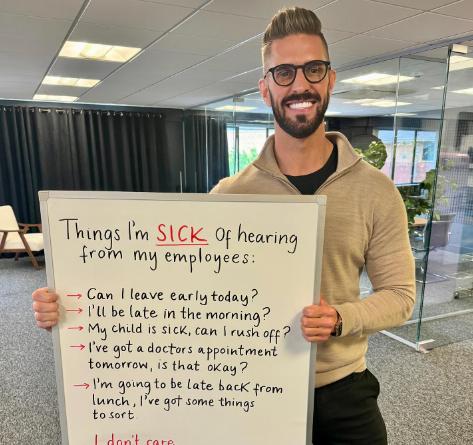
    CEO Rob Dance holds a list of things he's "sick" of hearing from his employees.Photo credit: via Rob Dance (used with permission).

    Since the COVID-19 pandemic disrupted workplaces worldwide, there has been a greater push for improved work-life balance and many companies are taking notice. The exciting thing is that when companies become more flexible, their employees become happier and more productive. It’s a win-win for all involved.

    Rob Dance, the CEO of ROCK, a technology consulting company in the UK, recently went viral for posting about his approach to work-life balance on Instagram. What, at first, appeared to be a CEO reprimanding his employees revealed a boss who knows how to get the best out of his team by treating them like adults.

    The post was of Dance holding a whiteboard that reads:

    Things I’m sick of hearing from my employees:

    – Can I leave early today

    – I’ll be late in the morning

    – My child is sick, can I rush off

    – I’ve got a doctor’s appointment tomorrow, is that okay

    – I’m going to be late back from lunch, I’ve got some things to sort.

    I don’t care.

    I hired you for a job and I fully TRUST you to get it done.

    I don’t need you to account for every single hour.

    Times have changed, and the workplace is different these days.

    People are sick of being treated like children.

    All that should matter is that everyone is happy, and that the work gets done.


    He also shared his advice for companies on how to treat their employees. “Treat your staff like adults. That’s it, that’s the big secret,” he wrote. “Give them autonomy. Respect that they have lives outside of work. Don’t gaslight them into being grateful for not being fired every day.” Because in the end, the only thing that matters is if they get the job done. “Output should always trump hours,” he concluded.

    Upworthy contacted Dance, who explained why managers still hesitate to treat their employees like adults.

    “Many bosses don’t trust their employees and keep extremely close tabs on them because of past experiences and a desire for control. They might believe that micromanaging ensures productivity and prevents issues,” he told Upworthy. “Additionally, the pressure to meet business targets can drive bosses to monitor employees obsessively, thinking it will lead to better outcomes. This approach, however, only undermines trust and destroys morale in the workplace. It creates a toxic environment where employees feel undervalued and stressed, leading to higher turnover rates and decreased overall performance. Instead of fostering a culture of accountability and growth, this behavior only promotes fear and resentment.”


    Dance says that technology has helped drive demand for improved work-life balance.

    “Mobile technology definitely started to blur the lines between one’s professional and personal life, making it tough to switch off from work,” he told Upworthy. “As a millennial leader, I’ve always valued work-life harmony for my staff, helping them to achieve both flexibility and finding purpose in their work.”

    The ROCK CEO also has advice for employees who’d like to gain their employer’s trust.

    “Always deliver quality work and aim to meet or exceed expectations. Keep communication lines open by regularly updating your manager on your progress, challenges, and successes,” he told Upworthy. “Take the initiative to go beyond basic requirements, showing your willingness to contribute more. Act with integrity by always being honest and ethical. Seek honest feedback and make tangible improvements based on it, demonstrating your commitment to growth. Finally, a big one is building positive relationships with everyone you work with, as strong connections are what help to build real trust.”

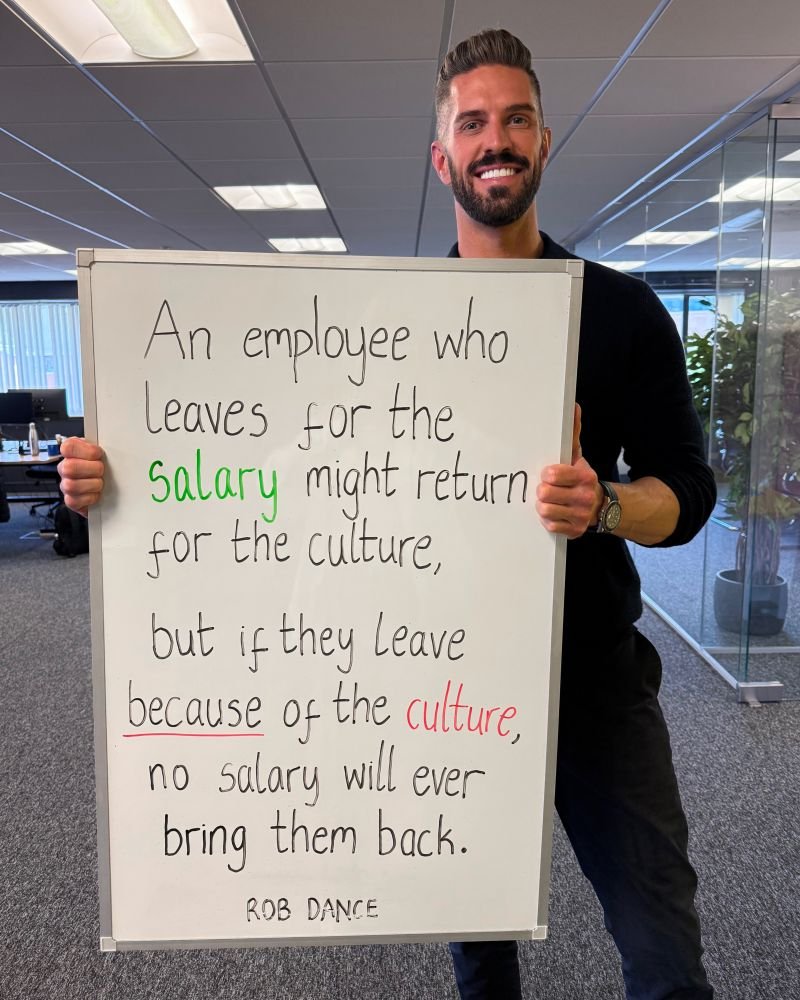
    In April 2025, Dance shared some additional wisdom that highlights the power of leaders prioritizing culture. He took a photo of himself holding a whiteboard with some more wisdom that all CEOs should take to heart: “An employee who leaves for the salary might return for the culture, but if they leave because of the culture, no salary will ever bring them back.”

    It makes you wonder, if the money was right, which previous jobs would you go back to, and which ones would you reject?


    rob dance, work-life balance, ROCK UK, bosess, pto, time off, employee complaints
    CEO Rob Dance holds up a whipe board with his culture philosophy. www.linkedin.com


    This article originally appeared last year.

  • Psychology reveals surprising personality traits of people who still write grocery lists by hand
    Phone or handwritten? The great debate ensues. Photo credit: Canva

    Are you the type of person who always writes grocery lists by hand? Perhaps on the back of a receipt, in a special notebook, or on an index card? Do you insist on this method, even though you’re the only one in the store unfurling paper like an ancient scroll while everyone has their heads down, tapping away at their phones?

    Lists are undoubtedly important. In a recent poll, research revealed that the average British adult writes an average of three to-do lists a week—which, in some cases, can add up to 9,766 lists in a lifetime. “Evidently, we all rely on lists for one aspect of life or another,” commented Shahbaz Khan from STABILO, a high-quality pen and pencil company.

    But when it comes to the actual list-making, does the method in which you create it really matter? Apparently, yes. And your choice, handwritten or digital, can say a lot about your personality.


    grocery list, grocery, lists, handwritten, handwriting
    People who write their lists by hand might be able to remember them better. Photo credit: Canva

    If you prefer handwriting, you’re likely…

    To have a mind that operates like a filing cabinet.

    In 2024, two professors at the Norwegian University of Science and Technology, Dr. Audrey L.H. Van der Meer and F.R. (Ruud) Van der Weel, found that handwriting activates more elaborate and widespread brain connectivity patterns compared to typing. They suggest that the physical act of moving your hand while writing creates spatial and temporal patterns in the brain that promote learning.

    In a similar study, Japanese researchers found that participants who wrote calendar events by hand on paper showed increased brain activity—particularly in memory regions—compared to those who recorded the same information on smartphones. The hand writers also recalled the information 25% faster than those who typed. Writing by hand triggers extra neural activity in regions tied to learning and memory. So, no matter how messy your handwriting might be, that grocery list might also be giving your memory a little work-out.

    To be naturally conscientious and understand the secret to success.

    Conscientiousness isn’t the same as self-control or self-restraint—rather, it refers to a person’s tendency to be organized, reliable, goal-directed, and self-disciplined. It’s no surprise, then, that those who score highly in conscientiousness tend to be successful: they aim for high-profile outcomes and have the ability to develop well-thought-out plans to accomplish their goals.

    Comfortable getting tactile.

    Nothing quite compares to writing with your perfect pen. (By the way, what’s yours? A Pilot G2-2? Uni-ball Vision Elite? Or perhaps something fancy, like the Squire Classic Pen from Baronfig?) It’s a complete sensory experience as your pen glides across paper. This physical connection helps create a deeper engagement with the task at hand.

    woman, child, grocery, shopping, list
    Writing your list by hand could curb impulse shopping. Photo credit: Canva

    To not buy on impulse.

    Yanliu Huang and Zhen Yang from the LeBow College of Business at Drexel University examined how handwritten shopping lists differ from digital ones. Their research showed that people who write lists on paper tend to make more planned purchases and fewer impulse buys.

    However, there are a few downsides to a handwritten grocery list…

    Let’s face it: sometimes you can’t read your own handwriting. When rushing, you might scribble illegibly, forget items, or leave the paper at home entirely. (Pro tip for forgetful hand-writers: snap a photo of your list before heading out, just in case.)

    Paper lists are also cumbersome to update on the go. Picture this—you’ve just remembered you need onions while backing out of the driveway, but now you’re scrambling for a pen. Don’t do this. Plus, paper lists make it difficult to coordinate shopping with other people.


    If you’re #DigitalForever, you’re likely…

    In a poll of 2,000 people in the United Kingdom, researchers found that when it comes to list-making, only 40% use their phones, while 63% write on notepads and 24% use sticky notes. So congrats—you’re right in the middle!

    Extremely efficient and organized.

    Your phone is a miracle list-maker: people who use digital lists value practicality over sentimentality—they appreciate the power of automatic sorting, expense tracking, and integrated coupon features. These lists can be updated instantly and accessed from almost any device, making them the most efficient, streamlined option.

    Someone who uses data to make decisions.

    Beyond expense tracking, many apps provide nutritional data, meal planning suggestions, and inventory management—helping you make smarter, healthier food choices. You’re not just shopping anymore; you’re strategically planning your nutrition.

    groceries, grocery shopping, produce, lists, shopping, nutrition
    Digital lists are perfect for collaborations. Photo credit: Canva

    Collaborating with someone in the kitchen.

    The beauty of a digital list is that it can be shared with others in real time, allowing multiple people to add items seamlessly. This eliminates miscommunications and duplicate purchases while reducing paper waste and promoting environmentally friendly habits.

    The digital life has its downsides, too…

    Taking a break from your phone can be refreshing, but keeping your grocery list there means more screen time—potentially leading to digital fatigue or distractions from notifications and other apps. There’s also the practical concern: what if your phone dies, you lose Internet connection, or your service drops out while shopping?

    Grocery shopping can be such a treat. Whether you use digital lists, handwritten scribbles, or memory tricks to track what you need, there’s no wrong approach. The “best” way to write a grocery list depends on you: your personal preferences, your lifestyle, and what works for your routine. Ask yourself, “What will make me feel the most organized and calm?” Then let your grocery list lead the way.

    This article originally appeared in June.


Culture

Mayor of Osaka visibly stunned after stranger donates $3.6 million in gold bars to fix city’s water pipes

Nostalgia

Boomers and Generation Jones share the meals and foods they miss the most from the 1960s

Generations

50 years later, the iconic ‘Sesame Street’ counting song is overwhelming Gen X with nostalgia

Parenting

62 percent of new parents say they’re lonely. England put four words on a park bench, and it’s working.