Remote learning sets kids back an average of 2 months. Here’s what Macy’s and RIF are doing to help underserved students who are falling behind.
When almost all of the nation’s schoolchildren were forced to embark upon remote learning, everyone struggled to stay afloat: families, students, and teachers. Despite the heroic efforts of educators and families, remote learning presented significant challenges for students, particularly those of lower socioeconomic status. It’s not yet clear the significant learning challenges all students faced…
When almost all of the nation’s schoolchildren were forced to embark upon remote learning, everyone struggled to stay afloat: families, students, and teachers. Despite the heroic efforts of educators and families, remote learning presented significant challenges for students, particularly those of lower socioeconomic status.
It’s not yet clear the significant learning challenges all students faced last year and the resulting impact as many students return to in person learning this Fall. Preliminary data suggests significant learning loss – particularly among children of color.
The ability to read and write is the foundation upon which an education is built, and research shows students of color and those in high-poverty communities fell even further behind during remote learning than their peers. For example, the sudden shift to remote schooling in Spring 2020 set White students back by 1-3 months in math, while students of color lost 3-5 months of learning.
This systemic inequity that has existed in the American education system for decades has disproportionately left students of color behind, and the COVID-19 school closures multiplied this challenge, impacting a generation of already at-risk youth. Disparities in access to computers, home internet connections, and direct instruction from teachers, all have played a role in this crisis since the start of the pandemic. Even prior to the pandemic, 65% of children in the U.S. were not reading at the proficient level, and 2/3 of U.S. children living in poverty don’t have a children’s book in their home.
Macy’s is a longtime partner of Reading Is Fundamental, the nation’s largest children’s literacy nonprofit organization; this year, they’re taking action to address this overwhelming problem via back-to-school shopping. Every time you shop at Macy’s in August, round up your in-store purchase to the nearest dollar up to 99 cents or donate online to help support children’s literacy. Every $4 donated purchases one book, and one hundred percent of donations go directly to literacy programs for local children.
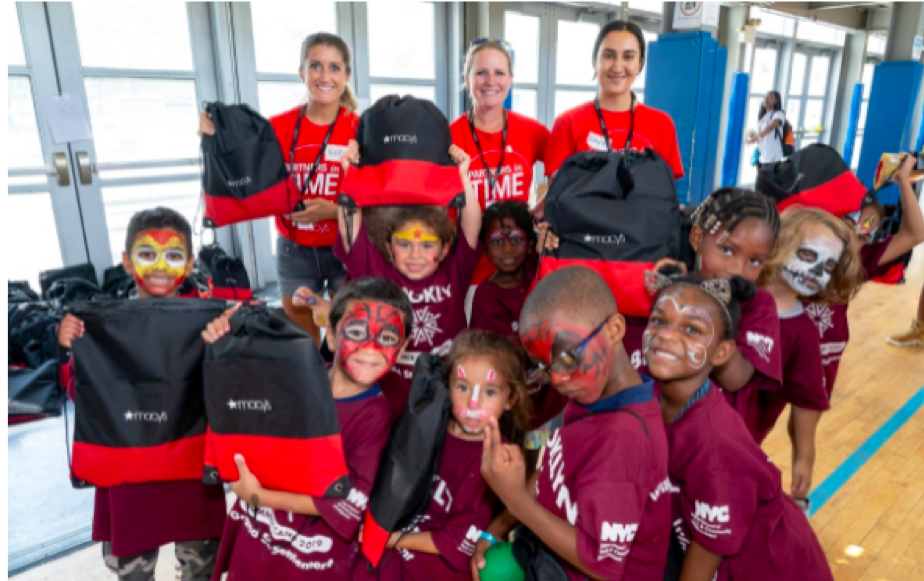
Over the past 18 years, Macy’s partnership with Reading Is Fundamental has provided more than 14 million books and thousands of supplemental reading resources to kids across the country. Your support will have a direct impact on communities across the country by funding critical literacy needs in communities that have the greatest need.
“At Robert Head Start & Early Head Start, we ordered our books from [Reading Is Fundamental] last school year and were able to distribute them to the children during a time when children really needed extra support at home while school was often closed for weeks at a time due to COVID-19. It was really wonderful to watch the children select their own book from the rich variety.
“As staff, we enjoyed seeing the children’s eyes light up as they would select the book they really wanted. It also helped us to learn about their likes and in some ways their dislikes. We were able to provide several opportunities throughout the school year in which the children were given the opportunity to select a book as we actually had enough for each child to receive three books. The grant supported by Macy’s not only helped us during a time of need when the children were spending so few days in an actual classroom, it provided the children with the beginning of their own home library,” said Brenda Laurent, the Center Manager at Regina Coeli Child Development Center in Robert, LA.
Supporting students who struggled with and fell behind due to the negative learning impacts of the pandemic will require all of us to pull together. Improved literacy not only benefits today’s children, but future generations shaping the trajectory of our country.
In a small village in Pwani, a district on Tanzania’s coast, a massive dance party is coming to a close. For the past two hours, locals have paraded through the village streets, singing and beating ngombe drums; now, in a large clearing, a woman named Sheilla motions for everyone to sit facing a large projector screen. A film premiere is about to begin.
It’s an unusual way to kick off a film about gender bias, inequality, early marriage, and other barriers that prevent girls from accessing education in Tanzania. But in Pwani and beyond, local organizations supported by Malala Fund and funded by Pura are finding creative, culturally relevant ways like this one to capture people’s interest.
The film ends and Sheilla, the Communications and Partnership Lead for Media for Development and Advocacy (MEDEA), stands in front of the crowd once again, asking the audience to reflect: What did you think about the film? How did it relate to your own experience? What can we learn?
Sheilla explains that, once the community sees the film, “It brings out conversations within themselves, reflective conversations.” The resonance and immediate action create a ripple effect of change.
MEDEA Screening Audience in Tanzania. Captured by James Roh for Pura
Across Tanzania, gender-based violence often forces adolescent girls out of the classroom. This and other barriers — including child marriage, poverty, conflict, and discrimination — prevent girls from completing their education around the world.
Sheilla and her team are using film and radio programs to address the challenges girls face in their communities. MEDEA’s ultimate goal is to affirm education as a fundamental right for everyone, and to ensure that every member of a community understands how girls’ education contributes to a stronger whole and how to be an ally for their sisters, daughters, granddaughters, friends, nieces, and girlfriends.
Sheilla’s story is one of many that inspired Heart on Fire, a new fragrance from the Pura x Malala Fund Collection that blends the warm, earthy spices of Tanzania with a playful, joyful twist. Here’s how Pura is using scent as a tool to connect the world and inspire action.
A partnership focused on local impact, on a global mission
Pura, a fragrance company that recognizes education as both freedom and a human right, has partnered with Malala Fund since 2022. In order to defend every girl’s right to access and complete 12 years of education, Malala Fund partners with local organizations in countries where the educational barriers are the greatest. They invest in locally-led solutions because they know that those who are closest to the problems are best equipped to solve and build durable solutions, like MEDEA, which works with communities to challenge discrimination against girls and change beliefs about their education.
But local initiatives can thrive and scale more powerfully with global support, which is why Pura is using their own superpower, the power of scent, to connect people around the world with the women and girls in these local communities.
The Pura x Malala Fund Collection incorporates ingredients naturally found in Tanzania, Nigeria, Pakistan, and Brazil: countries where Malala Fund operates to address systemic education barriers. Eight percent of net revenue from the Pura x Malala Fund Collection will be donated to Malala Fund directly, but beyond financial support, the Collection is also a love letter to each unique community, blending notes like lemon, jasmine, cedarwood, and clove to transport people, ignite their senses, and help them draw inspiration and hope from the global movement for girls’ education. Through scent, people can connect to the courage, joy, and tenacity of girls and local leaders, all while uniting in a shared commitment to education: the belief that supporting girls’ rights in one community benefits all of us, everywhere.
You’ve already met Sheilla. Now see how Naiara and Mama Habiba are building unique solutions to ensure every girl can learn freely and dare to dream.
Naiara Leite is reimagining what’s possible in Brazil
Julia with Odara in Brazil. Captured by Luisa Dorr for Pura
In Brazil, where pear trees and coconut plantations cover the Northeastern Coast, girls like ten-year-old Julia experience a different kind of educational barrier than girls in Tanzania. Too often, racial discrimination contributes to high dropout rates among Black, quilombola and Indigenous girls in the country.
“In the logic of Brazilian society, Black people don’t need to study,” says Naiara Leite, Executive Coordinator of Odara, a women-led organization and Malala Fund partner. Bahia, the state where Odara is based, was once one of the largest slave-receiving territories in the Americas, and because of that history, deeply-ingrained, anti-Black prejudice is still widespread. “Our role and the image constructed around us is one of manual labor,” Naiara says.
But education can change that. In 2020, with assistance from a Malala Fund grant, Odara launched its first initiative for improving school completion rates among Black, quilombola, and Indigenous girls: “Ayomidê Odara”. The young girls mentored under the program, including Julia, are known as the Ayomidês. And like the Pura x Malala Fund Collection’s Brazil: Breath of Courage scent, the Ayomidês are fierce, determined, and bursting with energy.
Ayomidês with Odara in Brazil. Captured by Luisa Dorr for Pura
Ayomidês take part in weekly educational sessions where they explore subjects like education and ethnic-racial relations. The girls are encouraged to find their own voices by producing Instagram lives, social media videos, and by participating in public panels. Already, the Ayomidês are rewriting the narrative on what’s possible for Afro-Brazilian girls to achieve. One of the earliest Ayomidês, a young woman named Debora, is now a communications intern. Another former Ayomidê, Francine, works at UNICEF, helping train the next generation of adolescent leaders. And Julia has already set her sights on becoming a math teacher or a model.
“These are generations of Black women who did not have access to a school,” Naiara says. “These are generations of Black women robbed daily of their dreams. And we’re telling them that they could be the generation in their family to write a new story.”
Mama Habiba is reframing the conversation in Nigeria
Centre for Girls' Education, Nigeria. Captured by James Roh for Pura
In Mama Habiba’s home country of Nigeria, the scents of starfruit, ylang ylang and pineapple, all incorporated into the Pura x Malala Collection’s “Nigeria: Hope for Tomorrow,” can be found throughout the vibrant markets. Like these native scents, Mama Habiba says that the Nigerian girls are also bright and passionate, but too often they are forced to leave school long before their potential fully blooms.
“Some of these schools are very far, and there is an issue of quality, too,” Mama Habiba says. “Most parents find out when their children are in school, the girls are not learning. So why allow them to continue?”
When girls drop out of secondary school, marriage is often the alternative. In Nigeria, one in three girls is married before the age of 18. When this happens, girls are unable to fulfill their potential, and their families and communities lose out on the social, health and economic benefits.
Completing secondary school delays marriage, and according to UNESCO, educated girls become women who raise healthier children, lift their families out of poverty and contribute to more peaceful, resilient communities.
Centre for Girls’ Education, Nigeria. Captured by James Roh for Pura
To encourage young girls to stay in school, the Centre for Girls’ Education, a nonprofit in Nigeria founded by Mama Habiba and supported by Malala Fund and Pura, has pioneered an initiative that’s similar to the Ayomidê workshops in Brazil: safe spaces. Here, girls meet regularly to learn literacy, numeracy, and other issues like reproductive health. These safe spaces also provide an opportunity for the girls to role-play and learn to advocate for themselves, develop their self-image, and practice conversations with others about their values, education being one of them. In safe spaces, Mama Habiba says, girls start to understand “who she is, and that she is a girl who has value. She has the right to negotiate with her parents on what she really feels or wants.”
“When girls are educated, they can unlock so many opportunities,” Mama Habiba says. “It will help the economy of the country. It will boost so many opportunities for the country. If they are given the opportunity, I think the sky is not the limit. It is the starting point for every girl.”
From parades, film screenings to safe spaces and educational programs, girls and local leaders are working hard to strengthen the quality, safety and accessibility of education and overcome systemic challenges. They are encouraging courageous behavior and reminding us all that education is freedom.
Experience the Pura x Malala Fund Collection here, and connect with the stories of real girls leading change across the globe.
Seven year-old Pastor knows that simple joys make life worthwhile. He loves visits from Santa. And he loves a good hamburger. However, unlike most kids his age, Pastor is bravely battling leukemia. After a year of doctors’ visits and painful cancer treatments, Pastor and his family needed a break. That’s when Macy’s and Make-A-Wish® stepped…
Seven year-old Pastor knows that simple joys make life worthwhile. He loves visits from Santa. And he loves a good hamburger.
However, unlike most kids his age, Pastor is bravely battling leukemia. After a year of doctors’ visits and painful cancer treatments, Pastor and his family needed a break. That’s when Macy’s and Make-A-Wish® stepped in to help lighten up Pastor’s year.
Make-A-Wish is a nonprofit that helps fulfill the wishes of children with critical illnesses. While some children wish for celebrity meetups or trips abroad, Pastor’s wish was specific and sweet: he wanted to meet Santa for a hamburger near his home in Sacramento.
To make it happen, Pastor’s local Make-A-Wish chapter reached out to its longtime partner Macy’s to arrange Santa’s journey from the North Pole to California.
Pastor arrived at the store in a white stretch limousine and was welcomed by smiling elves surrounded by hundreds of red and white balloons. Inside, Santa greeted Pastor from a silver throne inside a winter wonderland packed with oversized candy canes, golden gift boxes, and evergreens decked out in Christmas lights. Together they picked out ornaments from the Macy’s holiday display, then left the store together to visit Santa’s reindeer. After their big day, the pair feasted on burgers and hot chocolate with family and friends.
“When we heard about Pastor’s sweet wish to meet Santa, we quickly thought of our partners at Macy’s and what a wonderful tie-in to the annual Macy’s Believe letter-writing campaign,” said Michele Sanders, Vice President of Strategic Communications for Make-A-Wish. “Pastor, his entire family, and all involved were in awe of the ‘winter wonderland’ created just for him and Santa.”
“When Pastor turned to us with amazement and said, ‘You made my wish come true!’, we knew the magic that was created by the combined efforts of Macy’s and Make-A-Wish was truly amazing,” said Lorie Hennessey, chapter Vice President of Mission Delivery, the division in charge of wish fulfillment.
Make-A-Wish couldn’t spread joy to children, families, and communities without the generous support of individuals and corporate partners like Macy’s. Giving can start with something as simple as a letter to Santa: If you write a letter online at Macy’s or drop one off at a big red letterbox in-store, Macy’s will donate $1 to Make-A-Wish, up to $1 million in total.
Besides sending letters to Santa, there are even more ways to support Make-A-Wish at Macy’s during the season of giving. For every purchase of the $4 Believe Bracelet, Macy’s will donate $2 to Make-A-Wish from now through December 31. Customers can also donate online through the end of 2021 to help spread hope and happiness to children with life-changing illnesses.
Since 2003, Macy’s has donated over $137 million to Make-A-Wish. These donations have helped Make-A-Wish fulfill the dreams of more than 16,000 young people just like Pastor.
Five year-old Abi has a passion for fashion. Like many creative people her age, the self-described fashionista loves singing, dancing, and dressing up for mother-daughter photoshoots alongside her twin sister. You wouldn’t know it from her bright smile, but just last year Abi received a life-saving bone marrow transplant to treat a painful blood disorder…
Five year-old Abi has a passion for fashion. Like many creative people her age, the self-described fashionista loves singing, dancing, and dressing up for mother-daughter photoshoots alongside her twin sister.
You wouldn’t know it from her bright smile, but just last year Abi received a life-saving bone marrow transplant to treat a painful blood disorder she’s had since birth. “We were told she needed a bone marrow transplant or the alternative was for her to have a stroke at the age of three,” Abi’s mom says.
That is scary news no parent wants to hear, but Abi’s mom knew her daughter needed the treatment to survive. Despite the pain, Abi bravely received repeat bone marrow transplants over the course of a year. (Her twin sister Vivi was the generous donor!)
After the treatments, the family was connected with Make-A-Wish®, a nonprofit that spreads hope and positivity by granting wishes for young people like Abi who are fighting critical illnesses.
“I like dressing up and taking pictures with my sister,” Abi says. “I have been doing it for a long time and my mom told me that one day I will be on billboards all over the world.”
Inspired by her family’s stylish shoots, Abi wished to be on a Macy’s billboard. To fulfill that dream, Abi, Vivi, and their mom traveled to New York City earlier this year to participate in a photoshoot with the Macy’s creative team in partnership with Make-A-Wish. The two siblings posed in a series of outfits that included an animal print number with a white fuzzy vest and a festive red lace dress with black-and-white sneakers.
The event was a huge success for Abi and her family. And the billboard debuts November 29 in Prince George, Maryland this holiday season.
“I loved NYC, I really enjoyed the photoshoot. It made me soooo happy and I can’t wait to go back to New York,” Abi says.
“The effort put into our experience was phenomenal,” Abi’s mom adds. “I know the experience in New York was special and etched in the minds of the twins. They often ask when we are going back to New York for another photoshoot. Throughout the experience, we felt loved, thought about, and seen.”
Make-A-Wish couldn’t spread joy to children, families, and communities without the generous support of individuals and partners like Macy’s. Giving can start with something as simple as a letter to Santa: If you write a letter online or drop one off at a big red letterbox in-store, Macy’s will donate $1 to Make-A-Wish, up to $1 million in total.
Besides sending letters to Santa, there are even more ways to support Make-A-Wish at Macy’s during the season of giving. For every purchase of the $4 Believe Bracelet, Macy’s will donate $2 to Make-A-Wish from now through December 31. Customers can also donate onMacys.com through the end of 2021 to help spread hope and happiness to children with life-changing illnesses.
Since 2003, Macy’s has donated over $137 million to Make-A-Wish. These donations have helped Make-A-Wish fulfill the dreams of more than 16,000 young people just like Abi!
Macy’s and Girls Inc. believe that all girls deserve to be safe, supported, and valued. However, racial disparities continue to exist for young people when it comes to education levels, employment, and opportunities for growth. Add to that the gender divide, and it’s clear to see why it’s important for girls of color to have…
Macy’s and Girls Inc. believe that all girls deserve to be safe, supported, and valued. However, racial disparities continue to exist for young people when it comes to education levels, employment, and opportunities for growth. Add to that the gender divide, and it’s clear to see why it’s important for girls of color to have access to mentors who can equip them with the tools needed to navigate gender, economic, and social barriers.
Anissa Rivera is one of those mentors. Rivera is a recent Program Manager at the Long Island affiliate of Girls Inc., a nonprofit focusing on the holistic development of girls ages 5-18. The goal of the organization is to provide a safe space for girls to develop long-lasting mentoring relationships and build the skills, knowledge, and attitudes to thrive now and as adults.
Rivera spent years of her career working within the themes of self and community empowerment with young people — encouraging them to tap into their full potential. Her passion for youth development and female empowerment eventually led her to Girls Inc., where she served as an agent of positive change helping to inspire all girls to be strong, smart, and bold.
Inspiring young women from all backgrounds is why Macy’s has continued to partner with Girls Inc. for the second year in a row. The partnership will support mentoring programming that offers girls career readiness, college preparation, financial literacy, and more. Last year, Macy’s raised over $1.3M for Girls Inc. in support of this program along with their Science, Technology, Engineering, and Math (STEM) programming for more than 26,000 girls. Studies show that girls who participated are more likely than their peers to enjoy math and science, score higher on standardized math tests, and be more equipped for college and campus life.
Thanks to mentors like Rivera, girls across the country have the tools they need to excel in school and the confidence to change the world. With your help, we can give even more girls the opportunity to rise up. Throughout September 2021, customers can round up their in-store purchases or donate online to support Girls Inc. at Macys.com/MacysGives.
Did you know that girls who are encouraged to discover and develop their strengths tend to be more likely to achieve their goals? It’s true. The question, however, is how to encourage girls to develop self-confidence and grow up healthy, educated, and independent. The answer lies in Girls Inc., a national nonprofit serving girls ages…
Did you know that girls who are encouraged to discover and develop their strengths tend to be more likely to achieve their goals? It’s true. The question, however, is how to encourage girls to develop self-confidence and grow up healthy, educated, and independent.
The answer lies in Girls Inc., a national nonprofit serving girls ages 5-18 in more than 350 cities across North America. Since first forming in 1864 to serve girls and young women who were experiencing upheaval in the aftermath of the Civil War, they’ve been on a mission to inspire girls to kick butt and step into leadership roles — today and in the future.
This is why Macy’s has committed to partnering with Girls Inc. and making it easy to support their mission. In a national campaign running throughout September 2021, customers can round up their in-store purchases to the nearest dollar or donate online to support Girls Inc. and empower girls throughout the country.
Kaylin St. Victor, a senior at Brentwood High School in New York, is one of those girls. She became involved in the Long Island affiliate of Girls Inc. when she was in 9th grade, quickly becoming a role model for her peers.
Within her first year in the organization, she bravely took on speaking opportunities and participated in several summer programs focused on advocacy, leadership, and STEM (science, technology, engineering and math). “The women that I met each have a story that inspires me to become a better person than I was yesterday,” said St. Victor. She credits her time at Girls Inc. with making her stronger and more comfortable in her own skin — confidence that directly translates to high achievement in education and the workforce.
In 2020, Macy’s helped raise $1.3 million in support of their STEM and college and career readiness programming for more than 26,000 girls. In fact, according to a recent study, Girls Inc. girls are significantly more likely than their peers to enjoy math and science, to be interested in STEM careers, and to perform better on standardized math tests.
That’s huge.
The benefit to girls like Kaylin causes a positive ripple effect through communities because often, once girls finish the program with Girls Inc., they continue to give back through mentorship. Just this past fall, for example, Kaylin was awarded the 2020 Girls Inc. of Long Island Scholarship and honored at their annual gala for exemplifying the mission of the organization. Kaylin is a natural leader with goals to advance her education and to continue inspiring and empowering girls in her community, and by shopping at Macy’s, you can help other young women follow in her footsteps.
“Their Bold Future Leader meetings have prepared me for my future and taught me not to be afraid to put myself out there…I have had amazing opportunities to make new friends and have established relationships with such incredible women,” said St. Victor.
The future really is female.
Now through September 30th, 2021, as you shop at Macy’s, be sure to round up your in-store purchase to the nearest dollar and donate your extra change to support Girls Inc. — making it easier than ever before to help inspire today’s generation of girls to become tomorrow’s leaders.
This year, your back-to-school shopping can have a positive impact for local families, and all you have to do is round up at checkout. But first, let’s talk about America’s literacy problem. Did you know that two-thirds of children living in poverty do not own books? For these children, schools and local libraries are often…
This year, your back-to-school shopping can have a positive impact for local families, and all you have to do is round up at checkout. But first, let’s talk about America’s literacy problem. Did you know that two-thirds of children living in poverty do not own books?
For these children, schools and local libraries are often the only place where books are easily accessible. And what about the impact the COVID-19 pandemic has had on these under-resourced communities as children were learning remotely? The experience of a child living in an impoverished community is vastly different from the experience of other children. There has been a 27-point gap in literacy proficiency between Black students and their White counterparts for almost thirty years. The pandemic will likely only worsen these numbers.
The ability to read and write is something many of us take for granted (you’re reading this article right now!), but according to the National Assessment of Educational Progress, sixty-five percent of American 4th graders read below grade level. This sobering statistic translates to approximately 8,000 students dropping out of school every single day. Low literacy rates disproportionately affect poor, underserved areas — students drop out of school, get locked out of the job market due to a lack of education, and the cycle of poverty continues.
Simply put, inequitable access to literacy resources and support is a major part of what perpetuates a cycle of poverty that makes it difficult to succeed academically and ultimately in the workplace.
Literacy isn’t only about classroom education — it plays a vital role in transforming children into socially and civically engaged citizens. It means being able to keep up with current events, communicate effectively, pass a driving test, and understand the issues that are shaping our world. It enables us to self-advocate, understand finances, and make better decisions regarding healthcare, housing, and nutrition. The fact that twenty-five million children in the U.S. cannot read proficiently is alarming because every child deserves equitable access to books and education, and we must all come together to address this crisis and make a real change. That statistic doesn’t bode well for our future.
Macy’s wants to support creating a literate America until every child reads, which is why for the past 18 years, they’ve partnered with Reading Is Fundamental to provide more than 14 million books and thousands of supplemental literacy resources for children across the country.
Additionally, Macy’s is a founding partner of the organization’s Race, Equity, and Inclusion (REI) Initiative, which launched in fall of 2020. The purpose of this effort is clear: to provide books and literacy resources to the most marginalized, the most disenfranchised, the most at-risk youth in America, located primarily in the underserved communities of color — and use the power of books for positive impact and change, showcasing diverse books, characters and authors.
The goal is to extend all children the opportunity to reach their potential and to see themselves and a reflection of their experiences in the books they read, inspiring generations to read, learn and grow. RIF’s approach not only helps families build diverse at-home libraries, but also builds up diverse book collections at local schools so that every student has an opportunity to see themselves in the books they read and learn about others to create empathy and inclusion.
“Thank you so much for all your organization has done [during COVID]… it’s been a difficult time for schools & families. We have been able to begin a book distribution program in Athens that will continue throughout the summer. We estimate we’ve given out over 12,000 books with no end in sight. Our precious children light up when they get to choose their beautiful new books—and they are reading!” said Jennifer Walker, a Librarian at Ingleside Elementary, in Athens, TN.
So, as you’re shopping at Macy’s to prepare for the coming school year, be sure to round up your in-store purchase to the nearest dollar and donate your extra change or donate online. A $4 donation equals one book, and one hundred percent of the donations go directly to Reading Is Fundamental, leaving a direct impact by funding critical literacy needs in communities that have the greatest need.
Let’s join together to support children’s literacy until every child reads.