What do kids think a scientist "looks like" nowadays?
It's a question David Miller, a researcher and psychology doctoral candidate at Northwestern University, wanted to find out. So he started digging.
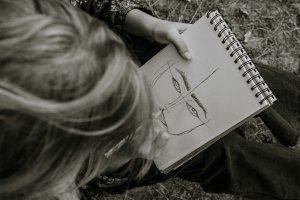
Miller and a team of researchers looked at 78 "draw-a-scientist" studies spanning the previous five decades. As the name suggests, students in kindergarten through grade 12 were asked to draw a scientist and answer some basic questions.
Some of their responses throughout the years, by the way, were quite adorable.
Image courtesy of Richard Jones and Dr. Lori Fulton at University of Hawaii at Manoa.
More important than any cuteness factor, however, was the noticeable shift in what kinds of scientists children have drawn since the 1960s.
Over the course of five decades, an increasing number of children drew scientists who were women.
Image courtesy of Richard Jones and Dr. Lori Fulton at University of Hawaii at Manoa.
These findings by Miller and his team at Northwestern, newly published in the journal Child Development, led to encouraging results for anyone hoping more girls may be taking interest — or, at the very least, may potentially see themselves — in STEM-related hobbies or careers.
The earliest study Miller analyzed took place between 1966 and 1977, when an overwhelming number of elementary-aged students drew men as scientists: Less than 1% of the nearly 5,000 drawings depicted women. More recent research, however, reflects a sharp contrast in that perception: In studies between 1985 and 2016, 28% of children, on average, drew scientists that were women.
Image courtesy of Vasilia Christidou.
The more recent drawings suggest stereotypes linking only men to science-related fields has weakened substantially over time in the U.S., researchers concluded.
"Given this change in stereotypes, girls in recent years might now develop interests in science more freely than before," Miller, the lead author of the study, said in a press release.
Image courtesy of Richard Jones and Dr. Lori Fulton at University of Hawaii at Manoa.
Clearly, there's still progress to be had.
28% is not nearly a high-enough figure. Backward ideas about who can and should become scientists are still being absorbed by kids growing up in the 21st century. Boys are still less likely to draw women scientists than girls are, the research found. And older kids are more likely to draw men than younger ones are, suggesting stereotypes may become more entrenched as kids age.
Furthermore, when it comes to skin color, the overwhelming majority of kids drew scientists interpreted as being white. Although, Miller noted to the The Atlantic, race and ethnicity were more difficult to track, given kids used various colors (or no colors) to draw their scientists throughout the years.
Still, when it comes to gender, the findings show true progress.
Image courtesy of Vasilia Christidou.
The study shows why representation matters.
"It’s optimistic that children’s stereotypes change as gender roles change in society too," Miller said. When girls see doctors, engineers, or computer scientists that are women — whether it be in their own personal lives or on TV and film screens — it can have a powerful effect.
"Children draw what they see,” Toni Schmader of the University of British Columbia at Vancouver told Nature. And when girls can see themselves as anything this world has to offer, we're making meaningful progress.


A Generation Jones teenager poses in her room.Image via Wikmedia Commons
An office kitchen.via
An angry man eating spaghetti.via 
Gif of baby being baptized
Woman gives toddler a bath Canva


An Irish woman went to the doctor for a routine eye exam. She left with bright neon green eyes.
It's not easy seeing green.
Did she get superpowers?
Going to the eye doctor can be a hassle and a pain. It's not just the routine issues and inconveniences that come along when making a doctor appointment, but sometimes the various devices being used to check your eyes' health feel invasive and uncomfortable. But at least at the end of the appointment, most of us don't look like we're turning into The Incredible Hulk. That wasn't the case for one Irish woman.
Photographer Margerita B. Wargola was just going in for a routine eye exam at the hospital but ended up leaving with her eyes a shocking, bright neon green.
At the doctor's office, the nurse practitioner was prepping Wargola for a test with a machine that Wargola had experienced before. Before the test started, Wargola presumed the nurse had dropped some saline into her eyes, as they were feeling dry. After she blinked, everything went yellow.
Wargola and the nurse initially panicked. Neither knew what was going on as Wargola suddenly had yellow vision and radioactive-looking green eyes. After the initial shock, both realized the issue: the nurse forgot to ask Wargola to remove her contact lenses before putting contrast drops in her eyes for the exam. Wargola and the nurse quickly removed the lenses from her eyes and washed them thoroughly with saline. Fortunately, Wargola's eyes were unharmed. Unfortunately, her contacts were permanently stained and she didn't bring a spare pair.
- YouTube youtube.com
Since she has poor vision, Wargola was forced to drive herself home after the eye exam wearing the neon-green contact lenses that make her look like a member of the Green Lantern Corps. She couldn't help but laugh at her predicament and recorded a video explaining it all on social media. Since then, her video has sparked a couple Reddit threads and collected a bunch of comments on Instagram:
“But the REAL question is: do you now have X-Ray vision?”
“You can just say you're a superhero.”
“I would make a few stops on the way home just to freak some people out!”
“I would have lived it up! Grab a coffee, do grocery shopping, walk around a shopping center.”
“This one would pair well with that girl who ate something with turmeric with her invisalign on and walked around Paris smiling at people with seemingly BRIGHT YELLOW TEETH.”
“I would save those for fancy special occasions! WOW!”
“Every time I'd stop I'd turn slowly and stare at the person in the car next to me.”
“Keep them. Tell people what to do. They’ll do your bidding.”
In a follow-up Instagram video, Wargola showed her followers that she was safe at home with normal eyes, showing that the damaged contact lenses were so stained that they turned the saline solution in her contacts case into a bright Gatorade yellow. She wasn't mad at the nurse and, in fact, plans on keeping the lenses to wear on St. Patrick's Day or some other special occasion.
While no harm was done and a good laugh was had, it's still best for doctors, nurses, and patients alike to double-check and ask or tell if contact lenses are being worn before each eye test. If not, there might be more than ultra-green eyes to worry about.