Here's why more people are going 'no contact' with relatives and why it's not a bad thing
The author of "Toxic Positivity" explains the trend.

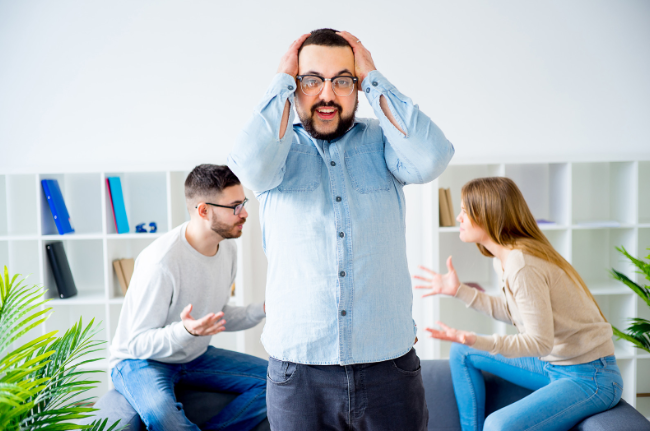
Siblings are fighting at a family event.
Over the past few years, there has been much talk about people having “no contact” or “low contact” with family members. A large study out of Cornell University found that 27% of adults over 18 have no contact with some family members.
Another study found that 11% of mothers between the ages of 65 and 75 are estranged from at least one adult child.
Clinical psychologist Joshua Coleman attributes the rise in estrangement to the "changing notions of what constitutes harmful, abusive, traumatizing or neglectful behavior," adding that the “bar for qualifying as a trauma today is much lower.”
However, Whitney Goodman, LMFT, has a much simpler explanation for why more people are vocal about going “no contact” with relatives. In a world where people have so many ways of contacting one another, one must set much stricter boundaries than before social media.
Goodman is a marriage and family therapist and the author of “Toxic Positivity,” a guide to helping people own their emotions.
@whitneygoodmanlmft #estrangement #familyestrangement #nocontact #family
“Decades ago, it was pretty easy to become estranged from a family member,” Goodman says in a video with over 75,000 views. “We didn’t even have to put all these labels on it. People didn’t have to say they were no contact, low-contact, estranged because they could just move to the other side of the country, maybe only talk to that family member once a year or see them on a holiday, and that was easy to maintain.”
Goodman adds that these days, people have so many avenues to contact estranged relatives or keep tabs on their everyday lives that it’s nearly impossible to separate from family members who want to stay in touch. Back in the ‘70s, you could move a few miles away, change your phone number, get a new job and easily slip into anonymity.
But in 2024, you can’t be passive about avoiding family members. You have to make an obvious point of going “no contact” by blocking people on social media and refusing to respond to their attempts to make contact.
“And I think this is why we see estrangement today being something that is so clearly verbalized and dictated and we have a lot of older people saying, ‘Well, we didn’t do that back then. Everyone stayed in touch,’ when, really, you probably had some family members that were actively choosing distance and estrangement, but they weren’t really calling it that because they didn’t have to,” Goodman concludes her video.
The big takeaway is that people probably had no contact with family members back in the day without being fully aware of what was happening. It’d be easy to go extremely low contact and see relatives every few years without anyone thinking anything was wrong.
“My uncle lives less than 100 miles from our hometown. Everyone acted like he wasn't estranged, but my mom had to beg him to come to my grandma's deathbed. Over a decade later, I understand him,” Kayla C. wrote in the comments. “I think the biggest difference is in the past when someone moved away, the other party could blame it on them or put a spin on it like, “Oh, she moved for her career, and she’s SO busy!” Kitty added.
TheAlgorithmbroughtmetou added a quote that sums up many people’s families: "That uncle/aunt who kept their distance from the rest of the family will start making more sense to you as you get older."
These days, people are talking more openly about estrangement, though families have always dealt with it. Today’s technology means people have to be more blunt about their feelings, but in some ways, that can be a better way of handling problems than spending years being passive-aggressive.



A Generation Jones teenager poses in her room.Image via Wikmedia Commons
An office kitchen.via
An angry man eating spaghetti.via 


An Irish woman went to the doctor for a routine eye exam. She left with bright neon green eyes.
It's not easy seeing green.
Did she get superpowers?
Going to the eye doctor can be a hassle and a pain. It's not just the routine issues and inconveniences that come along when making a doctor appointment, but sometimes the various devices being used to check your eyes' health feel invasive and uncomfortable. But at least at the end of the appointment, most of us don't look like we're turning into The Incredible Hulk. That wasn't the case for one Irish woman.
Photographer Margerita B. Wargola was just going in for a routine eye exam at the hospital but ended up leaving with her eyes a shocking, bright neon green.
At the doctor's office, the nurse practitioner was prepping Wargola for a test with a machine that Wargola had experienced before. Before the test started, Wargola presumed the nurse had dropped some saline into her eyes, as they were feeling dry. After she blinked, everything went yellow.
Wargola and the nurse initially panicked. Neither knew what was going on as Wargola suddenly had yellow vision and radioactive-looking green eyes. After the initial shock, both realized the issue: the nurse forgot to ask Wargola to remove her contact lenses before putting contrast drops in her eyes for the exam. Wargola and the nurse quickly removed the lenses from her eyes and washed them thoroughly with saline. Fortunately, Wargola's eyes were unharmed. Unfortunately, her contacts were permanently stained and she didn't bring a spare pair.
- YouTube youtube.com
Since she has poor vision, Wargola was forced to drive herself home after the eye exam wearing the neon-green contact lenses that make her look like a member of the Green Lantern Corps. She couldn't help but laugh at her predicament and recorded a video explaining it all on social media. Since then, her video has sparked a couple Reddit threads and collected a bunch of comments on Instagram:
“But the REAL question is: do you now have X-Ray vision?”
“You can just say you're a superhero.”
“I would make a few stops on the way home just to freak some people out!”
“I would have lived it up! Grab a coffee, do grocery shopping, walk around a shopping center.”
“This one would pair well with that girl who ate something with turmeric with her invisalign on and walked around Paris smiling at people with seemingly BRIGHT YELLOW TEETH.”
“I would save those for fancy special occasions! WOW!”
“Every time I'd stop I'd turn slowly and stare at the person in the car next to me.”
“Keep them. Tell people what to do. They’ll do your bidding.”
In a follow-up Instagram video, Wargola showed her followers that she was safe at home with normal eyes, showing that the damaged contact lenses were so stained that they turned the saline solution in her contacts case into a bright Gatorade yellow. She wasn't mad at the nurse and, in fact, plans on keeping the lenses to wear on St. Patrick's Day or some other special occasion.
While no harm was done and a good laugh was had, it's still best for doctors, nurses, and patients alike to double-check and ask or tell if contact lenses are being worn before each eye test. If not, there might be more than ultra-green eyes to worry about.