upworthy
Add Upworthy to your Google News feed.
Google News Button
Humor

A guy created pictures of every president as a 'cool guy with a mullet' and they deliver

All 46 got a Dog the Bounty Hunter makeover.

presidents with mullets, presidential portraits, cool presidents

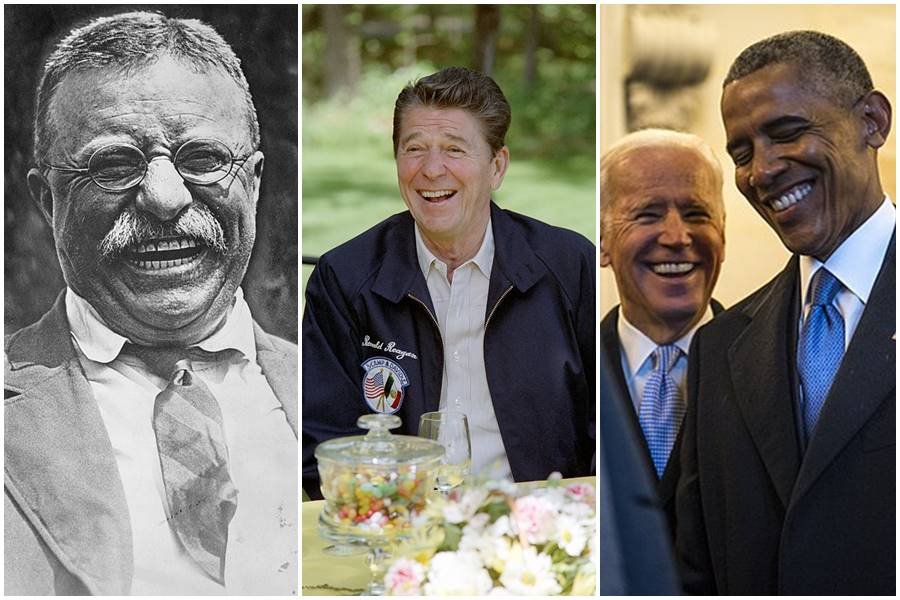
Teddy Roosevelt, Ronald Reagan, Joe Biden and Barack Obama all having a laugh.

Like it or not, we’ve recently entered the age of artificial intelligence, and although that may be scary for some, one guy in Florida thinks it’s a great way to make people laugh. Cam Harless, the host of The Mad Ones podcast, used AI to create portraits of every U.S. president looking “cool” with a mullet hairstyle, and the results are hilarious.

The mullet is a notorious hairdo known as the "business in the front, party in the back" look. It's believed that the term "mullet" was coined by the rap-punk-funk group Beastie Boys in 1994.

While cool is in the eye of the beholder, Harless seems to believe it means looking like a cross between Dog the Bounty Hunter and Kenny Powers from “Eastbound and Down.”

Harless made the photos using Midjourney, an app that creates images from textual descriptions. "I love making AI art," Harless told Newsweek. "Often I think of a prompt, create the image and choose the one that makes me laugh the most to present on Twitter and have people try and guess my prompt."

"The idea of Biden with a mullet made me laugh, so I tried to make one with him and Trump together and that led to the whole list of presidents,” he continued.

Harless made AI photos of all 46 presidents with mullets and shared them on Twitter, and the response has been tremendous. His first photo of Joe Biden with a mullet has nearly 75,000 likes and counting.

Here’s our list of the 14 best presidents with mullets. Check out Harless' thread here if you want to see all 46.

Joe Biden with an incredible blonde mane and a tailored suit. This guy takes no malarkey.

Donald Trump looking like a guy who has 35 different pairs of stonewashed jeans in his closet at Mar-a-Lago.

Barack Obama looking like he played an informant on "Starsky and Hutch" in 1976.

George H.W. Bush looking like he plays bass in Elvis's backing band at the International Hotel in Vegas in '73.

Gerald Ford looking like the last guy on Earth that you want to owe money.

"C'mon down and get a great deal at Dick Nixon's Chrysler, Dodge, Jeep and Ram, right off the I-95 in Daytona Beach."

"Who you calling Teddy? That's Theodore Roosevelt to you."

Grover Cleveland is giving off some serious steampunk vibes here.

Pray you never key Chester A. Arthur's Trans Am. If you know what's best for you.

Honest Abe? More like Honest Babe. Am I right?

Franklin Pierce looking like your favorite New Romantic singer from 1982. Eat your heart out, Adam Ant.

"Daniel Day Lewis stole my look in 'Last of the Mohicans.'" — John Tyler

Many have tried the tri-level mullet but few pulled it off as beautifully as James Madison.

Washington's mullet was like a white, fluffy cloud of freedom.

Find more cool, mulletted U.S. presidents here.


This article originally appeared three years ago.

Health

Psychologists say there are 4 types of introverts. These are the personality traits of each one.

The four types of introverts: Social, Thinking, Anxious, and Restrained.

introvert, introvers, types of introverts, introverted, introvert types, 4 introvert types

A woman sits in a chair reading a book.

Introverts can have many personality stereotypes. Many people assume they are quiet homebodies who prefer alone time, but not all introverts are the same.

Psychologist Jonathan M. Cheek, along with his colleagues Jennifer Grimes and Julie Norem at Wellesley College, presented findings in a 2011 study identifying four types of introverts: Social, Thinking, Anxious, and Restrained (STAR).


"Many people assume introversion is fixed, but introversion is on a spectrum," Chloë Bean, a somatic trauma therapist in Los Angeles, told Upworthy.

- YouTube www.youtube.com

Essentially, there is no one-size-fits-all type of introvert.

"It can shift depending on life phase, your stress level, burnout, support system, and trauma history," Bean said. "What looks like 'being introverted' is sometimes the nervous system doing it's job, protecting you especially when you're feeling overwhelmed or need to connect with yourself more."

Four types of introverts

In an interview with The Cut, Cheek explained that these introvert "types" are more like "shades," and that introverts are often a mix of each one. Here's what you need to know about each type of introvert:

introvert, introverts, being introverted, social introvert, introverts hanging out Three women sit on a blanket in the park. Photo credit: Canva

Social introverts

Bean noted that social introverts may be selective about who they connect with. They enjoy spending time with others but need downtime to recover.

"They prefer to stay home with a book or a computer, or to stick to small gatherings with close friends, as opposed to attending large parties with many strangers," Cheek explained.

How to tell if it's you:

"You may tend to lose a lot of energy when socializing in large groups even when they're fun and prefer one-on-one time," said Bean. "You may feel more regulated with one person at a time, as you can feel overstimulated with more than one person at a time."

Thinking introverts

Thinking introverts are internally rich, deep, and active but appear quiet on the outside, Bean noted. They spend a lot of time reflecting, imagining, creating, or analyzing.

"You're capable of getting lost in an internal fantasy world," Cheek said. "But it's not in a neurotic way, it's in an imaginative and creative way."

How to tell if it's you:

"You feel energized and excited by ideas but you feel exhausted when there is constant feedback and stimulation externally," Bean explained. "You need time to be with your thoughts to come to your conclusion so staying with your inner voice and process is supportive because you can get easily distracted by others' thoughts and opinions."

@onlyjayus

The 4 Types Of Introverts

Anxious introverts

Bean said that anxious introverts deal with anxiety and avoidance driven by fear, as the body anticipates rejection or not being accepted socially.

How to tell if it's you:

"You might replay conversations, dread upcoming plans and cancel them when the tension and anxiety gets too strong," Bean shared. "This is often less about your personality and more about your nervous system feeling dysregulated by thoughts about socializing."

Restrained introverts

Restrained introverts are highly observant, take time to warm up to others, and are cautious about who they spend their energy with, Bean explained.

How to tell if it's you:

"It might take you some time to feel like you can trust others and feel safe enough to speak up," Bean said. "You might also avoid being put on the spot or being the center of attention."

Malala Yousafzai, Khushal Yousafziai Pakistan, siblings, support, family
Photo credit: Used with permission from Khushal Yousafzai

Malala Yousafzai and her brother, Khushal, pose for a photo.

Malala Yousafzai most certainly has a lot of light. At the young age of 11, she began advocating for education for girls after the Taliban took over her district of Swat in Pakistan. About three years later, she—alongside two other girls—was shot in the head on a bus for her passionate, outspoken views.

She survived and went on to address the United Nations about the importance of education. According to her nonprofit's website:


"The U.N. recognized July 12 as Malala Day, in honour of her courageous advocacy and to highlight the global struggle for education. With her father, her ally and inspiration, she established Malala Fund, an organisation dedicated to giving every girl the opportunity to learn and choose her own future."

Just one year later, she became the youngest-ever recipient of the Nobel Peace Prize. She has received numerous awards, been honored by Time Magazine, and continues to inspire people around the world.

Recently, one of her younger brothers, Khushal Yousafzai, was speaking at the Oxford Scholars Program when he was asked whether he ever felt "overshadowed" by his sister's accomplishments. His answer was vulnerable, heartfelt, and lovely:

"My sister nearly died. Forget her winning the Nobel Prize. Forget her getting the limelight. I would give up my life for you to have a life. Death puts things into perspective like nothing else does."

He pauses, then says, "Why would her success take anything away from me? I'm not in my sister's shadow. I'm in my sister's light. And Rumi has this beautiful quote: 'A candle doesn't lose its light when it lights up another candle.' Actually makes the world a brighter place. It lights up the whole room."

He continues with a message about supporting the people you love:

"So guys, uplift each other. If you see your friend, uplift them. Because guess what? We all are gonna die someday. And your friends, I'm sure they mean a lot to you. And at times, there is that feeling of jealousy. You don't want to be going to their funeral and telling their parents how amazing they were. Because guess what? It's too late. So tell them while they're still alive. You don't want to live with that, so uplift people while they're still here."

Khushal speaks frequently to students about his journey. He is also a fierce advocate for education and finding the fuel to live life to its fullest. According to a biography he shared with Upworthy: "Through his educational platform, Yousafzai Academy, he mentors students about personal and academic growth, learning from setbacks, and leadership."

Many commenters on Instagram expressed heartfelt support and said they were deeply touched by his words.

"So beautiful to see his immense love for his sister shared so honestly, vulnerably, and without any hint of shame or resentment," one commenter said. "And the Rumi quote is just so perfect. ❤"

Another notes that his wisdom isn't surprising, considering his whole family is involved in activism: "This family has got all the right things going on! What a gift to the world."

This person was moved by his words, especially by the idea of uplifting people while there's still time: "Wisdom. Beautiful. Fabulous. What a family! Uplift your friends. Uplift people while they are still here. Yes!"

And this commenter deduces that the trauma his family has been through has created a thoughtful empath: "You have a high level of empathy 🙏🏽💕. Only people who have come close to death know the depth of your words and the bond you share with your sister."

crowd, unique, personality type, nonconformist
Photo Credit: Canva

A person stands out in a crowd.

So many of us have the desire to compartmentalize our personality traits into neat little boxes. "Oh, she's such an INFJ. Oh, he's such a Gemini." Some of it is rooted (well sort of) in psychology, such as the Myers-Briggs Type Indicator, based loosely on Jungian ideas. Others rely on arguably less scientific data like stars and "rising signs." Humans aren't usually that simple.

That said, there's still value in understanding one's own personality and inclinations. Here's a confession: I've taken countless personality tests because I just couldn't figure out if I was an extrovert or an introvert. Neither description quite fit, and as someone constantly trying to understand what makes me tick, this has been frustrating.


Turns out, there are other options. The term "ambivert" got popularized in the 1930s (after being coined by Edmund S. Conklin in 1923), and it refers to a person "who has features of both an introvert (someone who prefers to spend time alone) and an extrovert (someone who prefers to be with other people) in their personality."

@tedtoks

Replying to @Factura🛄 now knowing what an ambivert is, how would you describe yourself? #ambivert #introvert #extrovert #adamgrant #psychology #TEDTalk #worklife

But for those who still don't quite relate, meet the otrovert. Just recently, psychiatrist Rami Kaminski published The Gift of Not Belonging, in which he discusses his coined term to describe a whole new type of personality. In an Insta-reel captioned "What is an Otrovert?" Kaminski mentions the polarization of introverts and extroverts. "When Jung invented the terms extrovert and introvert, he saw them as two fundamental orientations of the personality. I see the otrovert in the same way. A personality trait that faces away from the group."

He continues, "Extroverts and introverts are inherently communal, while the otrovert is an outsider to the group. In itself, it is not a problem or condition, nor is it a diagnostic label. It simply means that while most people learn to develop a sense of belonging to a specific group through social conditioning, otroverts remain social but not communal."

In writer Sarjna Rai's piece, "Struggle to Fit the Mold? The 'Otrovert' Personality Explains Why" for Business Standard, they write: "Unlike introverts or extroverts, otroverts are not defined by where they draw their social energy. Instead, the concept captures people who constantly feel like outsiders, and tend to look in a different direction altogether, not necessarily aligned with the rest of the group."

While it's impossible to group people into perfect categories, Rai explains that Kaminski claims the main thing that sets otroverts apart is their "reluctance to conform to group norms."

Writer Avery White lists signs one might be an otrovert in the article "7 Signs You Might Be an Otrovert" for VegOut. Among them is preferring "high-signal conversations and low-maintenance relationships." They give this as an example: "You’ll happily spend three hours exploring one idea with one person—and then not speak for weeks without either of you taking it personally. In other words, low pressure, low expectations, high connection.

Another on the list—and this is a big one according to Kaminski—is: "You can look extroverted in public—yet feel fundamentally 'other.'" This is actually the crux of the term, and in fact, what Kaminski formed The Otherness Institute for: as their website says, "those who feel they don't belong."

The site also shares that recognizing aspects of this type in yourself and others (if it applies) will help "balance between your individuality and your function as part of the social matrix that determines your well-being. The experience of otherness in a togetherness-minded world can be emotionally bruising. Often misunderstood and misdiagnosed, otherness may lead individuals to feel strange, lonely, and unwelcome in groups. Left unidentified, otroverts' non-belonging can result in a frustrating, futile lifetime effort of trying to 'fit in.'"

Some Redditors are scrambling to figure out if they fit into this category. In the subreddit r/INTP (referencing one of the Myers-Briggs personality types), the OP asks, "Maybe I am an 'otrovert?'" Under this, they write, "Dr. Kaminski described the otrovert child as 'neurotypical, friendly, curious, well-adjusted, and often popular' yet 'they resist being pressured into group activities.'"

While this can seem inconsequential in childhood, joining the peer group "becomes critically important" in adolescence, said the psychiatrist, and teens "start to gauge their self-worth based on the group’s ranking of popularity (or unpopularity).'

"Membership in a group, no matter how lowly, is better than being an outsider," he added. "Otroverts, however, are comfortable with being outsiders and find it impossible to feel like insiders, regardless of how welcome they are.'

There are a handful of commenters who feel seen, but many push back, claiming the term could easily apply to other personality traits. One writes, "I think it's easy to resonate with this description... but as some warning noted, there aren't enough studies done about this term that people should be running to adopt it. I resonated with it after reading about it... But I have ADHD and persistent depressive disorder... both of which coincide with the descriptions of an otrovert."

Time will tell if this new term sticks, but for now, it's helping a lot of people feel more understood.

This article originally appeared last year.


hospice, hospice volunteer, impact theory, impact theory podcast, tom bilyeu, apple podcast, james sexton, death

Left: An older women side by side with a younger woman. Right: A young male hospital worker and a male patient.

In a recent, thought-provoking episode of the Impact Theory podcast with Tom Bilyeu, renowned divorce attorney and author James Sexton shared how being a hospice volunteer drastically changed his perspective on life.

"I think when you turn 18, you should have to do a year or two of mandatory hospice volunteering," Sexton said. "It changed my entire way of viewing the world."


Sexton recalled that while death itself wasn't necessarily the prime source of conversation—most of his volunteer work involved doing little odds and ends for folks—its presence was still palpable. Because of that, he walked out of each visit feeling like a "samurai," as all the things he thought were "so important five minutes ago" fell to the wayside.

"Spend time with people that are dying," he said. "All their stuff is a great big pile of nothing. Like, all that they can talk about is the people that they love, the connections that they made, the experiences that they had that were beautiful or painful."

That realization became even more apparent when he learned that his own mother was terminally ill with cancer and past the point that any doctor could help her.

"In that moment, all of the other things that I was stressed about and worried about, the volume was turned so far down on all those things because my mom was gonna die," Sexton said. "All that became important was how could I spend a little more time with her. How can I make sure she knows that I love her? How can I savor this?"

Developing an awareness of death during early adulthood, Sexton argued, would help people not get "distracted" by a society that constantly tries to make you forget that death is inevitable. Therefore, they wouldn't pay attention to the "meaningless sh*t that keeps the machine moving," and instead focus on what really matters.

And what really matters? Important things like kissing a spouse, for example, which Sexton reminded Bilyeu (and, conversely, all of us) happen a finite number of times. You won't know what that finite number is "until you've passed it," he warned.

hospice, hospice volunteer, impact theory, impact theory podcast, tom bilyeu, apple podcast, james sexton, death A couple kissing.Photo credit: Canva

"If you don't keep that in your line of sight, you're a fool," Sexton said. "You're gonna think you're gonna get to do that forever. You're gonna think you can do that all time and you don't. You will not do that forever. ... And that's the most beautiful thing in the world. It's what makes that so special."

For Sexton, being a hospice volunteer cemented this perspective, and since then, "nothing has been the same." It didn't mean suddenly "living life like a monk," but it did mean sharing his love a little more freely and appreciating that "things have to end."

Between hospice volunteering and working as a divorce lawyer, Sexton has become an expert of sorts with "endings." He argues that we must look at life through this lens because the one constant is that "everything is ending all the time," and ignoring that fact "does a tremendous disservice."

American culture generally treats death with avoidance, viewing it as a taboo topic or a medical failure rather than a natural stage of life. It is highly clinical and sanitized, with many people dying in hospitals away from family and loved ones. While shifting toward more home-based hospice care, U.S. society remains heavily influenced by "death-denying" attitudes that emphasize quick, efficient mourning. Compare that to other cultures with consistent mourning rituals, like Mexico's Día de los Muertos and Japan's Obon.

Perhaps Sexton's hospice volunteering concept could act as something similar to these traditions—a rite of passage that doesn't have us avoiding death, but walking alongside it.

You can watch the full Impact Theory episode below:

- YouTube www.youtube.com

boomer, boomers, boomer clutter, clutter, hoarding, too much stuff

A Baby Boomer stands in his cluttered garage.

Millennials with Baby Boomer parents have not been shy about airing their complaints about the older generation. Millennials have previously noted that their parents tend to hoard food—and now they're are airing their grievances about Boomer "stuff avalanche."

On Reddit, Millennials discussed their frustrations about their Boomer parents and the insane amount of junk they have in their homes that (allegedly) will one day be passed down to them to deal with. Many Millennials shared that it is a source of contention for them, and that they wish their parents would just throw things out.


"3 car garage...cannot fit a single car in there," one commented. And another stated, "I am very concerned with the amount of junk my parents are holding onto."

- YouTube www.youtube.com

A fellow peeved Millennial added, "The worst part is that our parents think this is all worth lots and lots of money. Don’t worry kids, these three sets of china I’m saving for you will be worth millions!"

Another had laid down the law: "My mom kept joking about all the 'stuff' being my inheritance. After a few times I was tired of it, I looked her dead in the face and said in the most monotone I could get. 'I will get the biggest dumpster I can, and it will all go in the trash.' She stopped making that joke, and my parents have been slowly throwing out their junk ever since."

clutter, baby boomer stuff avalance, stuff, too much stuff, decluttering A Baby Boomer garage filled with stuff.Photo credit: Canva

Why Boomers struggle to throw things away

"The Boomer generation grew up in the post-war era shaped by rationing and economic rebuilding," Daniel Glazer, clinical psychologist and co-founder of US Therapy Rooms, tells Upworthy.

He adds that the Boomer inability to let stuff go is often criticized, but when you look at the psychology of their attachment to objects, their behavior makes much more sense.

"Not so long ago, saving things was an adaptive habit. 'That might come in handy' was a common refrain in households in which replacing something was not so easy, or affordable," says Glazer. "There is also an element of emotional security that comes from the things that have surrounded us through decades of life events, or even across a lifetime."

And for many Boomers, getting rid of stuff can signify an even bigger mental battle.

"As people age, there can also be an increased awareness of mortality," says Esin Pinarli, founder and holistic psychotherapist at Eternal Wellness Counseling. "Letting go of objects can feel symbolic, almost like letting go of chapters of their life. If no one is asking about those chapters anymore, those objects become the tangible proof that those experiences mattered. So it’s not stubbornness. It’s often about attachment, meaning-making, and a fear of losing relevance or erasing parts of their story."

How to help Boomers declutter

- YouTube www.youtube.com

Starting the conversation with Boomer parents in an empathetic and understanding way may help the process go more smoothly and deepen the relationship between them and their children. Here are a few examples of conversation starters Millennials can use when talking to their Boomer parents about decluttering:

Conversation Starter #1: "I know these things mean something to you. I’d love to hear the story behind a few of them."

"This shifts the focus from getting rid of objects to honoring the meaning behind them," says Pinarli. "When a parent feels seen and understood, they’re often more open to eventually letting go. It validates that the attachment is about memory and identity, not just stuff."

Conversation Starter #2: "What would feel good for you to keep, and what feels like it’s just taking up space now?"

"This gives them agency," Pinarli explains. "Instead of telling them what to throw away, it invites them to reflect on what still feels meaningful versus what might no longer serve them. That sense of control reduces defensiveness."

Conversation Starter #3: "Would it help to go through this together so we can make sure the important things are preserved?"

"This frames decluttering as a collaborative and supportive process, not a demand," Pinarli shares. "It reassures them that their memories and legacy won’t be dismissed or erased, which can lower the emotional intensity around letting go."