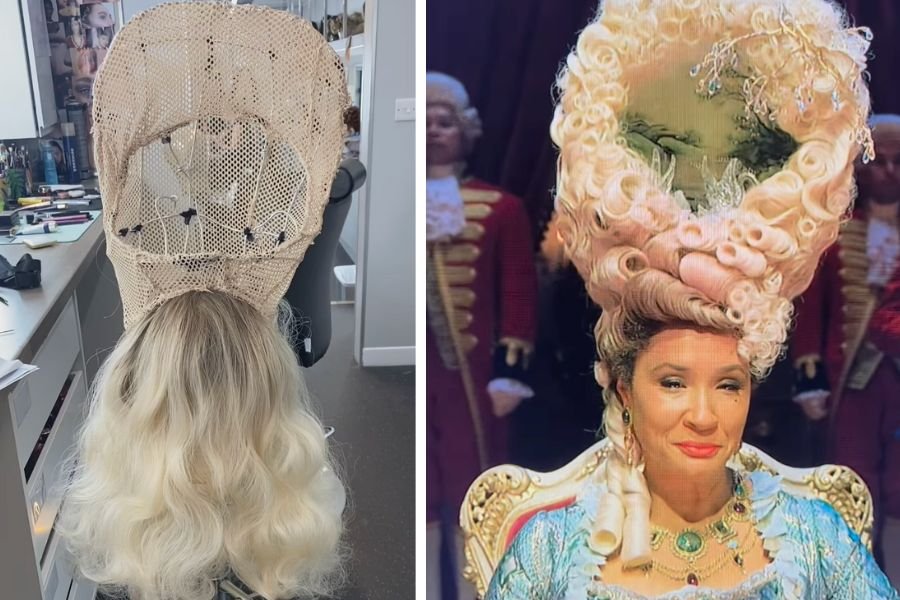
How ‘Bridgerton’ created an iconic wig that actually moves for one of its key characters

It’s a work of art that even non-“Bridgerton” fans can appreciate.

bridgerton, bridgerton wigs, queen charlotte wig, wig
"This will go down in the history of costume design."Photo credit: @emmarigby_pro/Instagram

When it comes to period pieces, the look is crucial. It requires skilled craftspeople with both meticulous attention to detail and enough creative vision to bring characters to life in a way that’s captivating and believable all at the same time. One hair out of place, one wonky blouse…and suddenly the entire story feels cheapened.

Netflix’s hit series “Bridgerton” is a brilliant example of this. The creators behind the hair, makeup and costumes have pulled off one ambitious look after another—all of which nail the story’s unique blend of lavish period romance with innovative modern sensibilities. Honestly, even if period pieces aren’t your thing, you gotta marvel at what they’ve accomplished aesthetically.One particularly talked about costume piece came from the show’s latest season: Queen Charlotte (played by Golda Resheuvel)’s jaw-dropping swan wig, which is a bona fide masterpiece that has actual moving glass swans.


If you have seen it—do not fret, dear reader. The official “Bridgerton” Instagram page posted a video starring the signature piece. Check it out below:

What kind of witchcraft is this?!…you might be thinking to yourself. But while this wig is certainly magical, it’s actually the result of smart engineering.

Emma Rigby, the magician behind Queen Charlotte’s wig, gave a little behind-the-scenes look at how it all came to be.

In a video posted to her own Instagram page, Rigby said that she initially felt “panicked” when “Bridgerton”’s hair and makeup designer Erika Okvist shared her concept. Making something that was both mechanically complex and light enough for the actor to be comfortable would be no easy feat.

But in the clip we see how with some hidden wires, a 3D printed carousel, and a hollow cage-like mold to hold everything in place, it’s actually not so impossible.

Watch, and be amazed:

Isn’t that the coolest thing ever? People were so impressed down in the comments.

“This will go down in the history of costume design. Very well done, ingenious actually,” one person wrote.

Another added, “This costume was glorious…if you guys don’t get an Emmy nomination it will be a crime ?”

“I was left speechless by this one,” said a third.

Of course, this is just one of the many, many extravagant wigs that have graced the show. Check out the video below to see the whole scope of what these folks create, and how they create it. It’s a fun watch whether you’re a diehard “Bridgerton” fan or have never seen a single episode.


  • Watch the tense moment Lucille Ball tells a host to take his hands off female audience members
    Lucille Ball was a powerhouse both on screen and off.Photo credit: CBS Television (Public Domain)
    ,

    Watch the tense moment Lucille Ball tells a host to take his hands off female audience members

    People laughed every time she told him ‘hands off,’ but she was stone cold serious.

    According to her daughter, Lucille Ball never considered herself a feminist, but there’s no question she blazed many a trail for women. A working mother in real life, she depicted issues facing housewives with her brilliant television comedy and became the first female studio head in Hollywood. She broke glass ceilings but wasn’t particularly outspoken about women’s rights. In fact, in a 1980 interview with People she said, “They can use my name for equal rights, but I don’t get out there and raise hell because I’ve been so liberated, I have nothing to squawk about.”

    Ball empowered women by example—and by speaking her mind. Carol Burnett shared a story on PBS about how Ball was unhappy with a script for her new show, but women at that time didn’t raise concerns about such things. Men could express criticism and demand changes, but women simply didn’t. Ball did—and firmly—despite being non-confrontational by nature. Later she told Burnett, “Kid, that’s when they put the ‘s’ at the end of my name.”

    Lucille Ball shuts down TV host 

    A video has been circulating on social media showing Ball’s no-nonsense way of speaking up when she felt the need to, and people are gushing over it.


    Lucille Ball, 70s, 80s, 60s, I Love Lucy, television, actress, hollywood, sexism, misogyny
    Lucille Ball was a massive star, but perhaps best known for the show ‘I Love Lucy By CBS Television – Public Domain

    In 1978, Ball participated in a Q & A session with UCLA theater arts students on the television program “America Alive!” The viral clip shows Ball repeatedly telling one of the hosts, David Sheehan, to take his hands off of female audience members when they were asking a question.

    “Will you take your hands off, David?” she says as he introduces one young woman. “Take your hands off of her,” she says again as he places his hand on the shoulder of another. “David, would you take your hands away?” she says as he places his hands on another woman in a sparkly gold dress.

    Watch:

    People laughed every time, but Ball didn’t so much as crack a smile during her clear, simple, repeated “hands off” admonitions.

    For 1978 especially, her advocacy for the women in the audience was extraordinary. Sheehan wasn’t touching these women in a lewd or sexual manner, but he was touching them in a way that he wouldn’t have touched a man who was asking a question. Most people wouldn’t have thought much of it at the time, but Lucille Ball immediately noted it and didn’t let it stand.

    Here are some of the best comments

    “I love that she didn’t even laugh when the room was. She was not joking.”

    “‘Take your hands off her, David,’ should be a sound AND a t-shirt.”

    “He kept trying. She kept telling him. Love her.”

    “Lucille Ball always reminds me of my grandma. She hated to be seen as delicate, and she hated men that would touch her even more. She would say, stone-faced, ‘Get your paws off.’”

    “The audience laughed and she said ‘ain’t nothing funny.’ Love her”

    .”This happened to me so much growing up and I noticed from very young the boys weren’t treated this way.”

    “Even then she knew how the industry was. I LOVE IT AND LOOOOVE LUCY SO MUCH.”

    A commenter on Reddit noted that Ball started her career as a chorus girl and dancer. “She knows every creepy man trick in the book”

    The wider culture of handsy TV hosts

    Television and game shows from the 70s and 80s are an incredible time capsule of the culture and norms of the era. Sheehan wasn’t the only one who tended to get a little handsy.

    It was common for male hosts to kiss female contestants. Richard Dawson, host of The Family Feud, was famous for it. Even our beloved Bob Barker of The Price Is Right often had women suggestively reach into his jacket to fish out their $100 bill.

    Richard Dawson kissing all the women in the family. YouTube

    There’s a casual lecherous-ness that famous men seemed to get away with easily at the time. For anyone to publicly challenge them on their behavior was absolutely shocking.

    Even if Sheehan was casually touching those women out of habit and not ill intent, it’s laudable that Ball made a point of making him aware of it. Unfortunately, women are still having to deal with men touching them without being invited to, but seeing Lucille Ball’s serious face while calling it out is a good reminder that women have been fighting this battle for a long time. Good for her for using her microphone and the respect afforded her to speak up for the young women in her audience.

    This article originally appeared last year.


  • Singer stuns Boy George with bold take on ‘Do You Really Want to Hurt Me’
    Boy George listens to "Do You Really Want to Hurt Me" on "The Voice Australia."Photo credit: Talent Snacks/YouTube
    ,

    Singer stuns Boy George with bold take on ‘Do You Really Want to Hurt Me’

    Sheldon Riley delivered a haunting rendition of the Culture Club hit to the pop star.

    Culture Club’s “Do You Really Want to Hurt Me” is a pop song that has stood the test of time. The hit was written by the band’s lead singer, Boy George, and topped the Billboard charts in 1982.

    It continues to resonate with younger generations. During a 2018 blind audition on Season 7 of The Voice Australia, singer Sheldon Riley performed an evocative version of the song for judge Boy George himself.

    Riley’s personal touches on the hit made a deep impact on Boy George.

    Singing to Boy George

    In the viral clip, Riley takes a few deep breaths before beginning to sing, accompanied only by a piano. “Give me time to realize my crime,” he croons, as judge Joe Jonas immediately recognizes the tune, along with Boy George.

    “I know that song,” Boy George says.

    With their ears perked, Riley continues to sing, and Boy George quickly presses the button to turn his chair. Riley immediately becomes emotional as the three remaining judges—Jonas, Delta Goodrem, and Kelly Rowland—also press their buttons.

    “I love it!” Boy George continues, as Riley keeps singing a hauntingly sad version of his major pop hit. Riley bursts into tears at the end of his performance, and Boy George sings his praises.

    “Great song!” he quips. “Obviously that song is so personal to me—it’s my own personal love story in a way. And it’s almost impossible to imagine anyone else singing it. You just added so much kind of sadness to it.”

    @cultureclubofficial

    Learn the story behind “Do You Really Want to Hurt Me” on an all new episode of #BehindTheMusic streaming now exclusively on @Paramount Plus #cultureclub #boygeorge #doyoureallywanttohurtme

    ♬ original sound – Culture Club

    Boy George quickly compliments Riley on his outfit—a purple top with large faux-fur sleeves and white ripped jeans—with Riley sharing that his look isn’t “normally accepted” by others.

    Boy George says to him, “Honey, can I just say…never, ever look for acceptance. Take me as I am—that should be your motto.”

    Later in the clip when Riley is choosing his coach, he tells Boy George, “I just want to say thank you so much. You let people like me wear what I want to wear, and put these lashes on that take thousands of years. You just inspire me so much…I’m going to go Team George!”

    The history of “Do You Really Want to Hurt Me”

    In a 2015 interview with The Guardian, Boy George said he wrote the song about his former partner, Kirk Brandon.

    “I did play the victim. That was the role I took on: ‘Oh, why are you doing this to me?’ Back in the day, I spent so much time trying to change the people I was in love with–and not trying to change myself,” he said.

    And he didn’t think it would be a hit.

    “I thought the song was too personal to be a hit and I didn’t want it to be a single. I went to Virgin and stomped my feet and sat on the stairs saying: ‘You’re going to ruin our career before we’ve even started!’, he said. “Our audience needed something to dance to, and ‘Do You Really Want to Hurt Me’ was too slow, too personal, too long. Everything about it was wrong. So its success was a big education for me: I learned that being personal was the key to touching people.”

    The song peaked at No. 2 on the Billboard charts in March 1983 and spent 25 weeks on the chart.

  • Woman says photos prove that office air changes her appearance
    Noa Donlan shows before-and-after photos.Photo credit: @noadonlan/TikTok (used with permission)
    ,

    Woman says photos prove that office air changes her appearance

    Fluorescent lights really do a number, don’t they?

    Office workers, has this happened to you? 

    It’s 9 a.m. You arrive at your desk feeling fresh, but by noon, when you catch a glimpse of yourself in the bathroom, you barely recognize yourself. And by the end of the workday…yeesh.

    That was the case for Noa Donlan, a flag-waving “corporate girly” who couldn’t help but notice the visible difference between how she looked when clocking in and even just hours later. So she decided to document it.

    In a series of now-viral videos posted to TikTok and Instagram, we see her face transform from glowing and vibrant to puffy-eyed, with dry, gray-toned skin and hair weighed down by oil.

    @noadonlan

    I leave the house feeling fine and by 12pm my skin is dry, my eyes look tired, and my hair is oily?? tell me I’m not the only one follow for realistic 9–5 POVs 💻✨ #creatorsearchinsights

    ♬ original sound – That Office Show
    @noadonlan

    There’s something in the OFFICE air💻 Follow if this is you by 1pm in the office🤍 someone mentioned this song in the comments and I can’t remember who it was so if this was you THANK YOU for the song idea 😉 #corporategirl #officelife #workhumor #9to5 #corporategirly

    ♬ original sound – Z

    Perhaps you could blame it on unforgiving bathroom lights, but Donlan has a different theory: office air.

    And apparently, she isn’t the only one who thinks it might be to blame. Her video drew a ton of comments from people sharing similar experiences.

    ​​“I look like a sick Victorian child by lunch,” lamented one viewer. 

    Plus, there are millions of videos on TikTok from others documenting the same phenomenon, many of whom film themselves in the exact same location for before-and-after shots. The most common complaints are dry skin, a shiny forehead, oily hair, and cracked lips.

    @bypresleemae

    10 hours later and my makeup is gone, my hair is frizzy, my skin is so dry, and I’m missing nails #corporategirlies #corporategirl

    ♬ Get It Sexyy (Instrumental) – Sexyy Red
    @lifewithmorgan_m

    What are we doing to rid this?? TIPS please!! #officelife #corporate #corporategirlies #officeoutfit #officeootd Credit: @Caroline Mackenzie 💝

    ♬ original sound – CLIPSTORM

    “Office air is the most fatal of them all,” another office worker said in a video with 1.2 million views.

    “No matter how good I try to make myself look in the morning, I’m going to leave the office looking like I just ran a marathon and washed my face with grease,” they said.  

    Now, is this a Severance-level work conspiracy? Probably not. (The odds are low, but never zero.)

    However, there are some potential explanations, one of which is the air in the office, which tends to be stripped of humidity thanks to the A/C blasting nonstop.

    Plus, offices without openable windows mean the skin may get less oxygen throughout the day. This, combined with dehydration, “leaves skin looking dull and fatigued,” said skin expert Fiona Brackenbury in an interview with Refinery29.

    There’s also something to be said about the effects that reduced circulation from being stationary, stress, and squinting at screens can have on our appearance, according to the Skin Elite blog.

    Prevent “office air” from damaging skin

    Thankfully, there are expert-approved ways to combat the effects of “office air,” particularly dryness.

    Dr. Catherine Chang, a plastic surgeon, recommends using a small portable humidifier at your desk, as well as a good moisturizer or hyaluronic acid that you can reapply as needed.

    @catchangmd

    If you work in an office 9-5, this is for you. “Office air” aka “work air” might be the reason your skin gets dry and make up patchy while at work. 👀 #skincare #skincaretips #beautytok #beautytips

    ♬ original sound – Dr. Catherine Chang

    She also suggests spraying hypochlorous acid, which can help with inflammation and free radical damage. She noted that it might not actually help with dryness, but can at least leave you feeling “refreshed.”

    In addition, experts recommend serums containing niacinamide, vitamin E, and/or resveratrol, which help protect against environmental damage, support collagen production, and soothe the skin.

    As for the stress portion? That’s a harder nut to crack, but it goes to show, once again, that stress management affects us in more ways than one. Short of packing it all up to live on a cruise ship, don’t forget that some form of relaxation—whether it’s taking a few deep breaths or going for a walk during your lunch break—is vital.

    So, while “office air” might not be fully researched or proven, it serves as a reminder that our work environments shape how we feel—and even how we look—throughout the day. Hopefully, it only takes a few small adjustments to help you leave the office matching the person who walked in that morning, inside and out.

  • ‘The one who’s in love always wins’: Ethan Hawke’s poetic advice on unrequited love touches millions
    Image of a sunrise (left) and Ethan Hawke (right).Photo credit: Canva & Raph_PH/Wikipedia

    During a red carpet interview leading up to the 2026 Oscars ceremony, actor Ethan Hawke was asked to speak about unrequited love, as Blue Moon, the film that earned him a Best Supporting Actor nomination, centers heavily on the theme. 

    As Hawke often does, he left viewers stunned and inspired with his thoughtful, poetic answer in a now-viral clip.  

    According to Hawke, one needn’t feel as though they’ve lost anything when romantic feelings aren’t returned, because the act of feeling itself is the true gift of being alive.

    @ameliadimz

    The one who’s in love always wins !!

    ♬ original sound – ameliadimz

    Hawke’s thoughts on unrequited love

    “The one who’s in love always wins,” the Dead Poets Society star explained. “It doesn’t matter if you get your heart broken; you’re living. When you’re feeling, you’re alive.”

    He added, “The sun doesn’t care whether the grass appreciates its rays, right? It just keeps on shining. That’s you.”

    And to top it all off, when the interviewer, Amelia Dimoldenberg, said “I love you” in response to Hawke’s inspiring words, the actor didn’t skip a beat, replying, “I love you too,” with genuine affection.

    Reactions

    The message, now seen more than 13 million times, left many marveling at how Hawke was able to deliver such “insanely beautiful” and “absolutely brilliant” words off the cuff.

    “That was just off the dome??”

    “​​He freestyled that???? no script, nothing…. such heavenly Shakespearean poetic words off the top of his head?? Wow.”

    “This man is always spitting pure poetry.”

    “Ethan Hawke is my fave modern philosopher.”

    Others couldn’t help but share that it instantly changed their mindset for the better.

    “This switched something in my brain like a full factory reset.”

    “It’s the most profound thing I’ve literally ever heard.”

    ethan hawke, love, relationships
    Two hands exchanging a paper heart Photo credit: Canva

    It’s not hard to see why the clip resonated so deeply

    Unrequited love is often framed in pop culture as something embarrassing or tragic. But here, Hawke reframed it as something beautiful and life-affirming. Loving someone, even without those feelings being reciprocated, becomes proof of openness, courage, and emotional vitality. Not a failure.

    That perspective can feel especially radical, since we are often taught to measure success by what we receive in return, whether through affection, validation, or monetary gain. But Hawke’s words gently push against that idea, suggesting that the experience of loving itself holds inherent value, regardless of the result. His take echoes a quote by C.S. Lewis that many referenced in the comments: “Love is never wasted, for its value is not based on reciprocity.”

    Moments like this are part of why Hawke has built a reputation not just as an actor, but as a thoughtful observer of the human experience. Whether through interviews, writing, or performances, he often taps into something both deeply personal and universally relatable.

    If the reaction online is any indication, this brief red carpet exchange did more than promote a film. It offered millions of viewers a small but meaningful shift in perspective, reminding them that feeling deeply is not a weakness, but a sign of being fully alive. And isn’t that, in a way, the point of it all?

  • Why didn’t people smile in old-timey photographs? Smiling meant something different back then.
    Photos of a man and woman from the 1800sPhoto credit: Public Domain

    If you’ve ever perused photographs from the 19th and early 20th century, you’ve likely noticed how serious everyone looked. If there’s a hint of a smile at all, it’s oh-so-slight. But more often than not, our ancestors looked like they were sitting for a sepia-toned mug shot or being held for ransom or something. Why didn’t people smile in photographs? Was life just so hard back then that nobody smiled? Were dour, sour expressions just the norm?

    Most often, people’s serious faces in old photographs are blamed on the long exposure time of early cameras, and that’s true. Taking a photo was not an instant event like it is now; people had to sit still for many minutes in the 1800s to have their photo taken.

    Ever try holding a smile for only one full minute? It’s surprisingly difficult and very quickly becomes unnatural. A smile is a quick reaction, not a constant state of expression. Even people we think of as “smiley” aren’t toting around full-toothed smiles for minutes on end. When you had to be still for several minutes to get your photo taken, there was just no way you were going to hold a smile for that long.

    But there are other reasons besides long exposure times that people didn’t smile in early photographs.

    mona lisa, leonardo da vinci, classic paintings, famous smiles, art
    Mona LisaPhoto credit: Public domain

    The non-smiling precedent had already been set by centuries of painted portraits

    The long exposure times for early photos may have contributed to serious facial expressions, but so did the painted portraits that came before them. Look at all of the portraits of famous people throughout history prior to cameras. Sitting to be painted took hours, so smiling was out of the question. Other than the smallest of lip curls like the Mona Lisa, people didn’t smile for painted portraits, so why would people suddenly think it normal to flash their pearly whites (which were not at all pearly white back then) for a photographed one? It simply wasn’t how it was done.

    A smirk? Sometimes. A full-on smile? Practically never.

    old photos, black and white photos, 1800s photos, no-smile photos, no smiles in photo
    Algerian immigrant to the United States. Photographed on Ellis Island. Photo credit: Augustus F. Sherman via William Williams/Wikimedia Commons

    Smiling usually indicated that you were a fool or a drunkard

    Our perceptions of smiling have changed dramatically since the 1800s. In explaining why smiling was considered taboo in portraits and early photos, art historian Nicholas Jeeves wrote in Public Domain Review:

    “Smiling also has a large number of discrete cultural and historical significances, few of them in line with our modern perceptions of it being a physical signal of warmth, enjoyment, or indeed of happiness. By the 17th century in Europe it was a well-established fact that the only people who smiled broadly, in life and in art, were the poor, the lewd, the drunk, the innocent, and the entertainment […] Showing the teeth was for the upper classes a more-or-less formal breach of etiquette.”

    drunks, classic painting, owls, malle babbe, paintings
    "Malle Babbe" by Frans HalsPhoto credit: Frans Hals via Public domain

    In other words, to the Western sensibility, smiling was seen as undignified. If a painter did put a smile on the subject of a portrait, it was a notable departure from the norm, a deliberate stylistic choice that conveyed something about the artist or the subject.

    Smiling simply didn’t work well in old portraits

    Even the artists who attempted it had less-than-ideal results. It turns out that smiling is such a lively, fleeting expression that the artistically static nature of painted portraits didn’t lend itself well to showcasing it. Paintings that did have subjects smiling made them look weird or disturbing or drunk. Simply put, painting a genuine, natural smile didn’t work well in portraits of old.

    As a result, the perception that smiling was an indication of lewdness or impropriety stuck for quite a while, even after Kodak created snapshot cameras that didn’t have the long exposure time problem. Even happy occasions had people nary a hint of joy in the photographs that documented them.

    Another reason why people didn’t smile in old photos is that dental hygiene wasn’t the same as it is today, and people may have been self-conscious about their teeth. “People had lousy teeth, if they had teeth at all, which militated against opening your mouth in social settings,” Angus Trumble, the director of the National Portrait Gallery in Canberra, Australia, and author of A Brief History of the Smile, said, according to Time.

    old photos, black and white photos, 1800s photos, no-smile photos, no smiles in photo
    Even wedding party photos didn’t appear to be joyful occasions. Photo credit: Wikimedia Commons

    Then along came movies, which may have changed the whole picture

    So how did we end up coming around to grinning ear to ear for photos? Interestingly enough, it may have been the advent of motion pictures that pushed us towards smiling being the norm.

    Photos could have captured people’s natural smiles earlier—we had the technology for taking instant photos—but culturally, smiling wasn’t widely favored for photos until the 1920s. One theory about that timing is that the explosion of movies enabled us to see emotions of all kinds playing out on screen, documenting the fleeting expressions that portraits had failed to capture. Culturally, it became normalized to capture, display and see all kinds of emotions on people’s faces. As we got more used to that, photo portraits began portraying people in a range of expression rather than trying to create a neutral image of a person’s face.

    Changing our own perceptions of old photo portraits to view them as neutral rather than grumpy or serious can help us remember that people back then were not a bunch of sourpusses, but people who experienced as wide a range of emotion as we do, including joy and mirth. Unfortunately, we just rarely get to see them in that state before the 1920s.

    This article originally appeared last year.

  • Ethan Hawke beautifully explains why AI art can’t replace imperfect human creativity
    Ethan Hawke gets philosophical about art and creativity.Photo credit: Elena Ternovaja/Wikimedia Commons

    As AI plays an increasing role in our world, questions about its appropriate use abound. There’s no doubt that technology has the potential to improve our lives dramatically. But the way we choose to use it can also impact us in ways we may not fully appreciate.

    For instance, how might AI impact our relationship with human creativity? Ethan Hawke was asked about the idea that “AI is the future of art,” and how he would argue that human creativity matters. People are loving his thoughts.

    Ethan Hawke on AI art versus reality

    “Nature is reality,” he said. “And when you get away from reality, you get lost. Human creativity is nature manifest in us. It is happening in us.”

    Then he gave an example of why AI art will never be able to replicate a piece of art created by a human.

    “AI could make an amazing portrait of the Sundance Film Festival, and it’ll be incredible,” he said. “Or my 14-year-old could color her impression of it. And the thing about my 14-year-old’s is it’s not perfect. It’s hers. It’s unique to a moment in time and a place. And it’s inimitable because it’s coming from her, and she is beautiful. And it’s not the painting; it’s the energy behind the painting.”

    “What makes a poem great is not this collection of words,” he continued. “It’s the energy behind the poem. Dance can be…you see people who can barely dance, and you can cry at the joy happening with the music. Because they’re alive right now and they won’t be forever. And when we start making things being about perfection, you’re just belittling the experience of life. You’re just totally ceding your humanity.”

    Hawke concluded, “It makes me sad, but it also makes me excited, because I don’t want to do that. I’m not going to do that.”

    So many people resonated with his response in the comments:

    “This is so beautiful and so true ~ everything he says is so profound and I’m here for this thinking…. we’ve become a weird world of social media perfection.”

    “I love how he got 🥲 talking about the imperfections created by hand from his daughter. What a beautiful way of describing creativity.”

    “Can he just write a philosophy book already? We all know we’d read it.”

    @ethanhawke always saying what the world needs to hear. Thank you sir! Thank you for defending the magic of NATURE and defending the MAGIC of humanity. More of this ENERGY and CONSCIOUSNESS ❤️❤️❤️.”

    “This feels less like an anti-AI take and more like a pro-human one.”

    AI isn’t going anywhere, time to choose the role it plays in society

    That last comment hits the nail on the head. Whether you love it, hate it, or aren’t sure how to feel about it, AI is here. The conversations we have about it, and how we consciously choose to engage with it, matter. There’s a lot to consider on that front, ethically, educationally, environmentally, and more.

    But one thing those considerations are forcing us to do is to examine the value of human creativity. Not the dollar amounts we can assign to it, but the inherent value of the energy behind an artist’s unique expression. Generative AI will never be able to replace human creativity, no matter how “perfectly” it may replicate it. The real beauty of art is the singularity of the human spirit and the unique energy an artist brings to it.

    As Hawke said, we can choose not to cede our humanity in the age of AI—and we can be excited about that choice because the beauty of human creativity is absolutely worth celebrating.

  • Pop music’s most famous phone number now connects callers to a cancer support helpline
    Jenny's number can now help cancer patients.Photo credit: TutoneJJ/YouTube & Canva

    Since the 1980s, one particular phone number has earwormed its way into pop culture’s collective memory. That number? 867-5309 (which you probably just sang in your head). Today, however, that memorable number doesn’t belong to Jenny anymore. Thanks to Tommy Tutone’s frontman, dialing it now connects cancer patients to a support group.

    Tommy Heath, the lead singer of Tommy Tutone, teamed up with the Cancer Support Community to secure the number for its free support helpline. In an exclusive interview with People, Heath shared how cancer has affected him as he’s gotten older, noting that he is dealing with “minor” skin cancer himself.

    “I have some family members who are struggling with cancer,” he told People. “I’m out on tour with a lot of bands and suddenly somebody’s not there.” 

    The song’s prank-filled past

    The song “867-5309/Jenny” reached No. 4 on the Billboard Hot 100 in 1982. However, its catchy, memorable chorus led to a wave of stories beyond music. It also sparked years of prank calls, with people asking for “Jenny” whenever they dialed the number—both during the song’s heyday in the 1980s and decades later.

    The Cancer Support Community’s hotline provides expert support from trained specialists who offer personal guidance, information, and a listening ear for cancer patients. Having such a recognizable phone number helps ensure people know exactly which number to dial for help. After learning this, Heath stepped in, wanting to give back after getting so much from the number that made him famous.

    “I need to give back to the community, the people who have supported me all these years,” he told People. “I’m going to do what I can…I’d be happy if this was an enduring legacy, and made people smile and give them hope.”

    Now, when someone dials the number using the 272 area code (or “CSC,” for “Cancer Support Community”), it connects them to a professional who can help people with cancer.

    At 78, Heath is still going strong, performing live. And yes, he still happily plays and sings “867-5309/Jenny” for the crowds that support him.

    If you need additional or specialized support in your battle against cancer, visiting the American Cancer Society’s website can help. Searching for and connecting with professionals there can provide patients with additional resources, including in-person, local support.

  • Comedian Jack Shep steals new ‘SNL UK’ scene with impeccable Princess Diana impression
    Comedian Jack Shep as Princess Diana in a "Saturday Night Live UK" sketch. Photo credit: Sky TV/YouTube

    Saturday Night Live UK debuted over the weekend on Sky TV (and Peacock in America), and already, one performer is a fan favorite.  In a skit titled “David Attenborough’s Last Supper,” the famed naturalist, played by George Fouracres, invites several of “history’s greatest Britons,” who have been resurrected thanks to his brother Richard Attenborough’s “Jurassic Park technology.”

    Naturally, the sketch featured a slew of impressive celebrity impersonations, from Freddie Mercury to Winston Churchill to Agatha Christie. But even in a sea of notable performances, it was comedian Jack Shep’s Princess Diana who really stole the show.

    Watch:

    While Shep’s Diana does speak here and there—thanking Attenborough for the invitation and reassuring Freddie Mercury that if a menu item “has an asterisk next to its name, then it comes with free rice”—most of the laugh-out-loud moments come from her coy, flirtatious glances at the camera while others are speaking. The People’s Princess has, after all, long been a queer icon. But this takes things to a whole new level.

    Reactions

    One leisurely scroll through the YouTube comments makes it clear that Shep was a fan favorite. Many are eager for Diana to become an SNL UK staple.

    @gaytimes

    Saturday Night Live UK premiered last night and we can’t stop thinking about Jack Shep’s impersonation of gay icon Princess Diana! The British version of the long-running US sketch show debuted with host Tina Fey and musical guest Wet Leg. ‘The Last Supper with David Attenborough’ saw a dinner party featuring a number of resurrected British icons, including Princess Di, Freddie Mercury and Elizabeth I 👏 #snl #princessdiana #diana #tinafey #saturdaynightlive

    ♬ original sound – GAY TIMES

    “The way he was eyeing the camera was hilarious.”

    I hope that Diana becomes a regular that randomly pops up in episodes to steal the show as she/he does here.”

    “Princess Di was to die for.”

    “I loved Princess Di but that Jack Shep impression was the funniest thing I’ve seen in ages.”

    “Hope she’s a recurring visitor…”

    “The Diana impression is an instant classic. Absolutely spot on.”

    “The star of this show is definitely the person that played Princess Diana.”

    Perhaps this comment says it best:

    “Princess Di was uniquely special in real life and this actor does do her memory justice even though it’s a silly comedy skit. I feel she might have had a good laugh about the whole thing and it’s not disrespectful at all.”

    Though Shep undoubtedly helped win favor among viewers, the overall reaction to an across-the-pond version of SNL has been mixed.

    Some things, like host Tina Fey’s opening monologue and the edgier “Weekend Update” segment, have been mostly well-received.

    However, some critics have lambasted the show as a “tepid cosplay” of its American predecessor, arguing that it copies the format without adding a unique touch. Still, even those critics seem to agree that certain elements need time to develop before the show can be fully assessed.

    One promising sign is that, much like SNL in the U.S., SNL UK can give relatively unknown comedians like Shep a chance to share their gifts with the world. That certainly seems like a win-win for everyone.

Pets

Woman shares the magical, human-like thing her dog does when she speaks

Home Life

Dad gleefully cleans his family’s bathroom with a car wash sprayer and people are inspired

Animals

Dog in Madrid leaves people stunned after performing impressive CPR drill

Wholesome

LAPD’s 90-year-old ‘Volunteer of the Year’ just happens to be Bruce Willis’ mom