Attorney argues why Louisiana law requiring the 10 Commandments in classrooms is un-American
He says that it's unconstitutional is only the beginning of the problem.

The U.S. Constitution prohibits the establishment of religion.
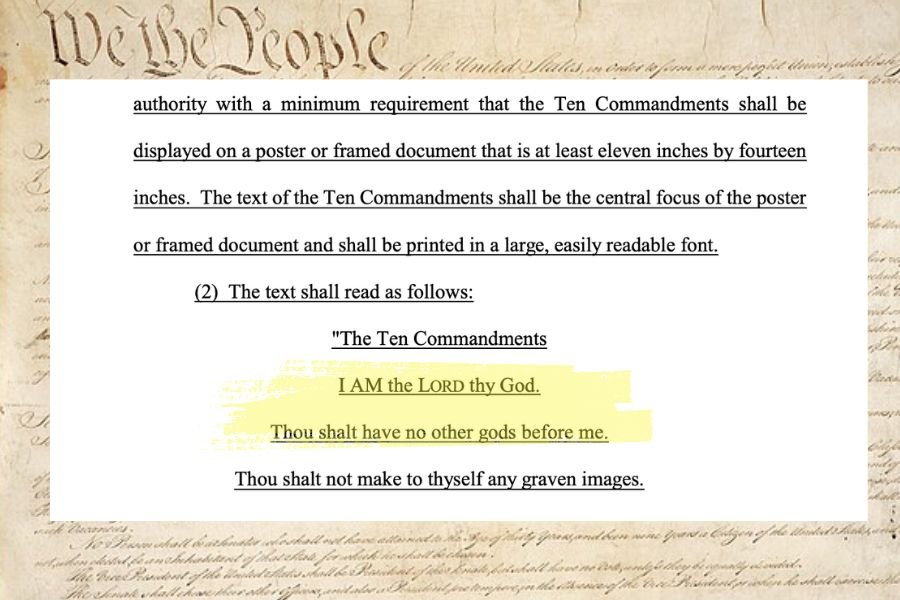
On June 19, 2024, Louisiana governor Jeff Landry signed a new law requiring that the Ten Commandments be displayed, in “large, easily readable font,” in every public school classroom from kindergarten to state-funded universities. The move prompted an outcry from Americans citing the first amendment clause that the government "shall make no law respecting an establishment of religion, or prohibiting the free exercise thereof."
Defenders of the law contend that the Ten Commandments are not solely religious in nature, and the language of the law refers to them as "foundational documents of our state and national government.” But the ACLU and other civil rights organizations immediately announced that they would fight the law in the courts. A similar law in Kentucky was struck down as unconstitutional by the U.S. Supreme Court in 1980.
Author and attorney Andrew Seidel took to X to argue why the law is not only unconstitutional, but un-American.
Seidel begins by sharing that the first commandment in the specified text that the law requires be posted in classrooms states, "I AM the Lord thy God. Thou shalt have no other gods before me."
"The point of this bill is to give the false impression that America is a Christian nation," Seidel wrote in his thread. "That's Christian Nationalism."
Seidel says that the first commandment directly conflicts with the founding principles of the United States.
"No law—and this would be a law—can tell an American to worship a god, let alone which god. Americans are free to be godless (as a growing number are), or, if they wish, to worship every god from every holy book."
He pointed to the law's sponsor, Rep. Dodie Horton, stating in her explanation of why she proposed the bill: “I'm not concerned with an atheist. I'm not concerned with a Muslim. I’m concerned with our children looking and seeing what God’s law is."
In addition to the establishment of religion as a constitutional problem, Seidel shared that the Louisiana law uses an edited version of the Ten Commandments in the text that the state specifies.
Seidel explained that there are various translations and interpretations of the Ten Commandments, and that such differences have been the basis of different schisms within Christianity itself, not to mention "as James Madison put it, the 'torrents of blood' that have been spilled, trying to impose a state-sanctioned version of religious truth."
"That's what Louisiana is doing here," Seidel wrote. "Imposing it's version of religious truth on kids in public schools. It's gross."
Seidel then explained the issue with Louisiana's editing of the King James Version of the Ten Commandments, paring it down and removing certain phrases.
"If the state can rewrite one religion’s holy book, it can rewrite yours. Louisiana does not have this power. Nor does it have the power to impose that religious edict on a captive audience of your children."
"This is the worst kind of big government conservatives claim to oppose," Seidel added. "More to the point, this is one reason we have the separation of church and state, and it’s precisely how that separation protects everyone and helps ensure the foundational value of religious freedom. It not only prevents the state from weighing in on religious disagreements, scriptural discrepancies, and theological debates, but also refuses to empower the state to force its preferred scripture or religious doctrine onto we the people."
Imagine if a state legislature with Muslim or Hindu or Buddhist-majority decided that an excerpt from one of those faith's holy books prohibiting the worship of any other deities was required to be posted in every public school classroom. The same people who are pushing for and praising this law probably wouldn't stand for it.
Opponents of the Louisiana law argue the idea that the U.S. was founded on the principles found in the Ten Commandments is negated as soon as you put the first commandment up against the first amendment. The U.S. was largely founded on the principle of religious freedom. The first amendment prohibits the government from telling the people what to believe or whom or how to worship. The first commandment specifically states whom the people must worship, and the second, third and fourth commandment specify how they should worship and there therefore incompatible as government-sanctioned messages.
Virtually no one is arguing that all of the Ten Commandments are bad. Not killing, lying or stealing are standard moral codes for the vast majority of humanity, regardless of religious background. But the others are very much asserting Judeo-Christian religious beliefs, and Seidel says for the government to require that assertion in classrooms is blatantly unconstitutional and un-American as well.
You can find Andrew Seidel's books, "The Founding Myth: Why Christian Nationalism is Un-American" and "American Crusade: How the Supreme Court Is Weaponizing Religious Freedom" on Amazon.
As a participant in the Amazon Associates affiliate program, Upworthy may earn proceeds from items purchased that are linked to this article, at no additional cost to you.



American portion sizes are colossal.
Tax shouldn't be a not-so-fun surprise at the end of your shopping trip.
A trip to the doctor shouldn't break the bank.
This totally isn't weird at all. Right?
It's a choice.
America loves extra sugar in savory foods.
Princess Odette Girl GIF by The Swan Princess
Rose GIF
sailor moon GIF
river phoenix 80s GIF 
All of this will be ours one day. Yay.
Elderly woman with white hair on phone, sharing a story about a dead person her child has never met.
Surprised elderly man in blue shirt against a yellow background.
Elderly woman in pink shirt using a smartphone on a garden swing.
TV for waking. TV for sleep.
Elderly man using a magnifying glass to read a piece of mail
Mom is totally humiliated after her kindergartner tells the teacher what she does for work
She was clearly mortified.
A mom is embarrassed by her child.
One of the great joys and stresses of parenting is that you never know what will come out of your child’s mouth. When you have young, inquisitive kids, they can say really inappropriate things to people without realizing they were being rude or possibly offensive. TikTok influencer Aurora McCausland (@auroramccausland), known for her DIY cleaning tips, recently told a funny story on the platform about how her son believes she makes a living. The problem was that she heard about it from her child's teacher.
Mom is embarrassed by her child
“The other day, I went and picked my five year old up from school and when I get to his classroom his teacher pulls me inside and says, ‘Hey, today he wanted to tell us about what Mommy does for work and said that Mommy makes videos in her bedroom but only when I'm [he’s] not at home,” McCausland recalled.
Given her body language while telling the story, McCausland was clearly mortified after hearing what her child said to his teacher. It makes it look like she may be posting videos to adult sites while her child is at school, which most people wouldn’t want their son’s teacher to know about.
The good news is that another teacher was there to clarify the young boy's comments by adding, “I think she makes TikTok videos.” The uncomfortable situation was a great invitation to chat with her son about what she does for a living. “So I have to have a conversation with my son about how he tells people what I do for work,” she finished her video.
The funny video went viral, earning over 1.7 million views on TikTok, and inspired many people to share the times when their children had funny ways of explaining their careers. The commenters were a great reminder to parents everywhere that if your child says something embarrassing, it's ok, just about everyone has been through it.
Moms share their most embarrassing moments
A lot of parents spoke up in the comments to show McCausland that she's not the only one to feel embarrassed in front of her child's teacher.
"My son told everyone that we were homeless (because we don’t own our home, we rent)," KBR wrote.
"I work in ortho.. my daughter told her teacher I steal people's knees bc she heard me talking to my husband about a knee replacement," Aingeal wrote.
"My son told a teacher we were living in our car over the summer. Camping. We went camping," Kera wrote.
"In kinder, my son thought Red Bull was alcohol and told his teacher I liked to have beer on the way to school," Ashley wrote.
My niece told her teacher her mom and dad work at the wh*re house. They work at the courthouse," Ellis wrote.
"My husband works as a table games dealer at a casino. Kindergartener, 'Daddy's a Dealer!' We now start every school year clearly stating he works at the casino," CMAC
"My son said we lived in a crack house…There’s a tiny chip in the wall from the doorknob," KNWerner wrote.
"My dad is a hospice chaplain and officiates a lot of funerals. My son and nephew were asked by their preschool teacher if their papa was retired or had a job. They told her his job was to kill people," Tiffyd wrote.
"My son said "my dad left me and I'm all alone" to a random person at the zoo. My husband was just at work," Shelby.
"I am now in my 70s. In my gradeschool, during the McCarthy era, I told my teacher my dad was a communist. He was an economist," Crackerbelly wrote.
"In Kindergarten, my daughter told her teacher that mommy drinks and drives all the time. Coffee. From Starbucks," Jessica wrote.
"Well I once told my kindergarden teacher a man climbs over our fence to visit my mom when her husband is not home... It was a handy man who came to fix gates when they were stuck," Annie wrote.
Ultimately, McCausland’s story is a fun reminder of how children see things through their own unique lens and, with total innocence, can say some of the funniest things. It’s also a great warning to parents everywhere: if you aren’t clear with your kids about what you do for a living, you may be setting yourself up for a very embarrassing misunderstanding. So, even if you think they know what you do ask them as see what they say, you could save yourself from a lot of embarrassment.
This article originally appeared last year and has been updated.