upworthy
Add Upworthy to your Google News feed.
Google News Button
Equality

A woman gave a bottled water to an unhoused Florida man and started a viral kindness 'revolution'
A woman gave a bottled water to an unhoused Florida man and started a viral kindness 'revolution'

Sometimes it can be hard to figure out what the right thing to do is. But other times it's incredibly simple.

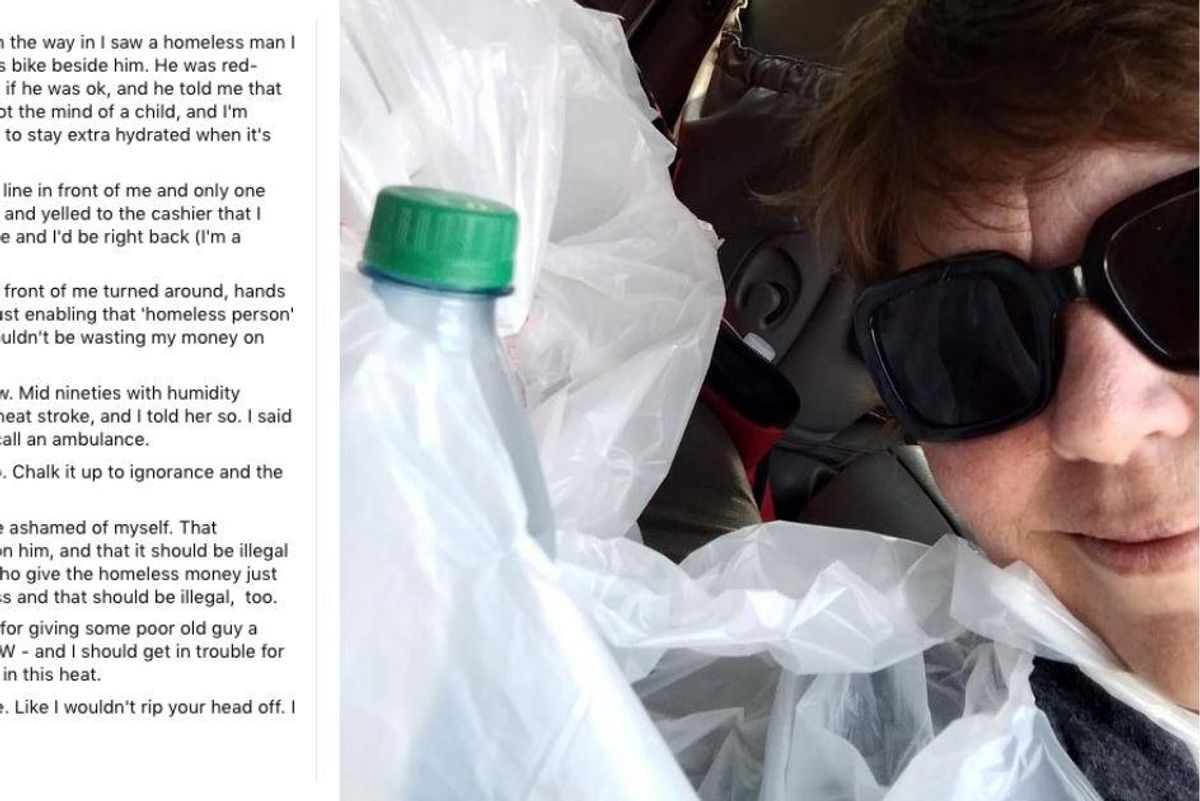
When Barbara Mack saw an unhoused man suffering in the Florida heat outside a convenience store, giving him a bottle of water was simply the right thing to do. But unfortunately, not everyone saw it that way.

Mack shared the story of a woman criticizing her for her act of kindness—and the awesome reaction of those who witnessed it all—in a Facebook post that's gone viral.

Mack wrote:


"I may have inadvertently started a revolution in the convenience store today.

I stopped to grab a water, and on the way in I saw a homeless man I know sitting in the shade with his bike beside him. He was red-faced and shaky looking. I asked if he was ok, and he told me that he was just resting. This guy's got the mind of a child, and I'm afraid he doesn't know he needs to stay extra hydrated when it's super hot outside.

There were a bunch of people in line in front of me and only one cashier, so I grabbed two waters and yelled to the cashier that I was taking one to the guy outside and I'd be right back (I'm a regular there).

When I came back in, the lady in front of me turned around, hands on hips, and told me that I was just enabling that 'homeless person' (said with a sneer) and that I shouldn't be wasting my money on him.

It's hot as hell in Florida right now. Mid nineties with humidity around 80%. It's a good day for heat stroke, and I told her so. I said I'd rather give him a water than call an ambulance.

I was gonna shrug it off. Let it go. Chalk it up to ignorance and the heat making everybody cranky.

And then she told me I should be ashamed of myself. That someone should call the police on him, and that it should be illegal to beg for money. That people who give the homeless money just encourage them to stay homeless and that should be illegal, too.

Ashamed. I should be ashamed for giving some poor old guy a water - it cost a whole dollar, BTW - and I should get in trouble for making sure he didn't stroke out in this heat.

I guess I look nice. Approachable. Like I wouldn't rip your head off. I am nice, most of the time.

But not always.

And I lost my temper.

I told her to call a cop and report me for buying shit at a convenience store.

I told her that I wasn't in the damn mood for crazy right now. That it's a hundred fucking degrees outside, and I'm hot and tired and sick to death of stupid people. That if she had an ounce of compassion in her whole body, she'd buy him a cold drink, too. That maybe she should figure out why she needs to accost complete strangers. And how's about after that, she back the fuck up outta my face and outta my business and turn back around and not say one more damn word to me.

I'm just about deaf in one ear. I try to modulate my voice. Unless I get angry.

It got pretty loud there at the end. There was dead silence in the store and then someone said loudly "For real!"

And the guy at the front of the line told the cashier to add a sandwich to his purchases for the guy outside.

The guy behind him bought an extra ice cream. The girl behind HIM got change for a twenty 'cause that guy could probably use some cash.'

Every single person in line got him something. Every one, except the now very embarrassed lady in front of me, who slunk out without saying another word.

When I got to the cashier, she didn't charge me for either of the waters, because she was going to take him one anyway. And mine was free because of the entertainment.

When I went outside, he was eating his ice cream and drinking his water with a pile of stuff all around him, a big old grin on his face. He didn't look shaky anymore.

And there, people, is the story of why I hate people. And why I love people. All in the same damned minute.

I sat in the car and drank my water and laughed with tears in my eyes, same as I'm doing now."

Mack's story has been shared more than 127,000 times, and she has also shared a follow-up post sharing a bit about herself and saying that the positive feedback she's received about the story has been "beautiful."

"I don't have a lot extra," she wrote. She lives in a small camper in an RV park and lost her earring-selling business in the pandemic. She's a sculptor as well, and she had about a dozen art shows canceled in 2020. She sells antiques and art on Etsy, works doing meal delivery, and also does some freelance writing. She knows what it's like to struggle.

"Basically, I am doing everything I can to keep myself together," she wrote. "Because I'm all over the place delivering food, I see a lot of homeless people. That could have been me on the side of the road, if I hadn't been lucky. I remember that, every day."

She also included some information about the man she helped.

"I talked to the homeless guy, and he doesn't want a picture up," she wrote. "Also, I spoke with his social worker. She told me it would be good if this emphasized that he's had 2 home placements and he just does not do well being indoors. His disability doesn't keep him from making that decision, and he does receive a small check each month, which she helps him with."

Homelessness is a complex societal issue to solve, for sure. But when the individual in front of you has a clear and immediate need, and you see a simple and immediate way to meet it, you do so. As Mack showed, it doesn't require extreme abundance. It doesn't require laws to be passed. It doesn't require professional intervention or collective political will. All it requires is keeping an eye out for our fellow humans and a compassionate heart.

Thank you, Ms. Mack, and the rest of the customers in that convenience store, for leading by example.

Gen Z; Millennials; technology; cell phones; social media; teens and technology; teens social media

Gen Z is the first generation less cognitively capable than their parents. Denmark has the solution.

Nearly every parent hopes their child will be better off than they are: smarter, more secure, and more well-adjusted. Many parents see this as a stamp of successful parenting, but something has changed for children growing up today. While younger generations are known for their empathy, their cognitive capabilities seem to be lagging behind those of previous generations for the first time in history.

Dr. Jared Cooney Horvath, a teacher turned cognitive neuroscientist who focuses on human learning, appeared before Congress to discuss concerns about cognitive development in children. In his address to the members of Congress, he says, "A sad fact that our generation has to face is this: our kids are less cognitively capable than we were at their age. Since we've been standardizing and measuring cognitive development since the late 1800s, every generation has outperformed their parents, and that's exactly what we want. We want sharper kids."


kids, intelligence, sharp kids, generations, education, cognitive abilities Student smiling in a classroom, working on a laptop.Photo credit: Canva

Horvath explains that the reason this happens is that each generation has gone to school longer than the previous generation. Gen Z is no exception to the longer duration of time spent in school, but they're the first ones who aren't meeting this normal increase in cognitive development. According to the cognitive neuroscientist, the decline is due to the introduction of screens in the classroom, which started around 2010.

"Across 80 countries, as Jean was just saying, if you look at the data, once countries adopt digital technology widely in schools, performance goes down significantly. To the point where kids who use computers about five hours per day in school for learning purposes will score over two-thirds of a standard deviation less than kids who rarely or never touch tech at school," Horvath reveals.

In most cases, the decline in performance doesn't result in better strategies. The neuroscientist shares that the standardized testing has been adjusted to accommodate lower expectations and shorter attention spans. This is an approach that educators, scientists, and researchers went to Capitol Hill to express wasn't working. But not every country is taking the approach of lowering standards to meet lowered cognitive ability. Denmark went in the opposite direction when it realized their students were slipping behind.

France24 recently interviewed educators in Denmark following their seemingly novel approach to students struggling with cognitive development. Since the beginning of the 2025/2026 school year, Denmark has not only been having students turn in their cellphones, but they've also taken tablets, laptops, and computers out of the classroom. No more digital learning for the majority of the school day. Danes went old school by bringing back physical textbooks, workbooks, and writing assignments. The results have been undeniable. Even the students can't seem to deny the success of the countrywide shift in educational approach.

"I think the biggest issue has been that, because we kind of got rid of the books and started using screens instead, that we've noticed that a lot of the kids have trouble concentrating, so it's pretty easy to swipe with three fingers over to a different screen and have a video game going, for example, in class," Copenhagen English teacher, Islam Dijab tells France24.

Now, instead of computers being part of every lesson, Denmark uses computers very sparingly and with strict supervision. One student says that it has been nice not having screen time at school because she loves to read and write. But it wasn't just the lack of attention span children were developing, they were also developing low self-esteem and poor mental health due to the amount of time spent on devices.

kids, intelligence, sharp kids, generations, education, cognitive abilities Students focused and ready to learn in the classroom.Photo credit: Canva

The data showing the negative impact of screens on teens' brains has prompted a nationwide change in Denmark that extends outside of the classroom. Afterschool activities are eliminating or extremely limiting electronic use. There is also a national No Phone Day that encourages everyone to put away their devices for the day, and Imran Rashid, a physician and digital health expert, is petitioning parliament to ban social media use for children under the age of 15. The no phone movement in Denmark is a nationwide effort that hopes to right the ship before another generation feels the effects.

discussion tips, debate, arguments, communication tips, psychology

Get conversations focused on solutions.

It can be deeply frustrating when an argument, debate, complaint, or negotiation goes off the rails. The fallout can include hurt feelings, mental exhaustion, and even damaged relationships, whether the disagreement happens in a business meeting or around the kitchen table. But one CEO and corporate communication expert suggests three questions he says can help bring a positive conclusion to almost any argument.

Steven Gaffney has worked for more than 30 years as an advisor and communicator for Fortune 500 companies, helping leaders communicate plans and negotiate deals. He said that conversations inside and outside the boardroom can be disrupted and steered toward solutions when one person asks the other party three simple questions.


- YouTube youtu.be

1. What would you suggest?

Instead of trying to convince another person of your point, it may be more fruitful to give them the opportunity to suggest a solution to the shared problem or propose the plan they prefer. This can surface an option they already support, one the two of you can agree on or negotiate further. It can also redirect the conversation toward solution-finding, or help them realize they do not have a clear alternative and may be more open to yours.

2. What would it take for you to agree?

Gaffney said that when this question is asked enough times, the conversation naturally shifts toward finding a solution. It helps clarify what the other person wants, what concerns they have with a proposal, and what they ultimately want the outcome to look like. This provides direct insight into their priorities and allows those concerns to be addressed, which can reduce resistance by helping them feel heard.

3. Can you live with it?

There are times when one or neither person gets 100 percent of what they want. That is simply part of life. Asking this question aloud can surface minor hang-ups that may be blocking an agreement or compromise by encouraging self-reflection, both for the other party and for yourself. If you can "live with it," you have reached a point of agreement. If they can live with it, that is a success as well.

The worst case is that someone cannot live with it, and that is fine. If that happens, Gaffney recommends starting the questioning over with "What would you suggest?" to move past a stopping point in the conversation and explore what other options might be available to both of you.

@collegehumor

Seriously, why can’t we just say the number out loud? #parody #comedy #sketch #collegehumor #business

Professionals chime in

Communication professionals told Upworthy that they largely agree with the themes and intent behind Gaffney's three questions.

"Gaffney's three questions provide a framework that encourages contribution and ensures commitment," said Joel Simon, attorney at Simon Perdue Law Firm. "They create a structured path from uncertainty to clarity and action. I agree these questions work because they redirect dialogue from blame or debate toward collaboration and problem-solving. Each question encourages ownership, transparency, and commitment which aligns with negotiation principles I use daily, where resolving conflicts efficiently while preserving relationships is paramount."

However, while Gaffney has a proven track record and the intent behind his questions is sound, not all of his contemporaries agree that his style of questioning is one-size-fits-all. Jennifer Martin, a communications expert and business consultant with 25 years of experience, said that while she appreciates Gaffney's direct approach, it may not be effective for everyone.

"Just like the world is not filled with only tech gurus and accountants, as leaders we have to be prepared to style-flex and communicate in the language of creatives, salespeople, people pleasers, and the just-the-facts types among others," said Martin. "This is why personality tests are so popular in business."

Communication and workplace culture expert Dallin Cooper largely agreed with the broader intent of Gaffney's questions, saying they place people in an "outcome-focused mindset" that "creates introspection." That said, he also noted that the approach is not foolproof, particularly the final question.

"The key to de-escalating a conversation is to avoid defensiveness, and if you exasperatedly ask someone 'Can you just live with it?,' that often isn't going to end well," explained Cooper. "The delivery, the tone, and the wording of a question like that can make a huge difference in making it feel non-combative."

@kyleinspires

People who practice conversations predict social outcomes 44% more accurately #socialanxiety #introvert #communication #neuroscience #brain

Like Cooper, Martin was also concerned with how the questions are asked. She suggested that, depending on the other person's personality, communicators may need to tailor their message in a way the audience can best receive. Some people respond well to direct bluntness, while others may require more finesse.

Martin recommended approaching the other party with the intention of allowing them to express their point of view, while keeping the focus on understanding what they want in order to find a solution that fits.

"As all any of us really want is to be seen, heard, respected, and considered," she said.

"One thing these questions all have in common is that they are undeniably good questions to ask yourself," concluded Cooper. "They will help you understand why you're having the conversation, whether it's worth having, and keep you focused on a solution. All great things to ask yourself. And all good things to ask someone else if you ask them at the right time, and in the right way."

Science

Helicopters dump 6,000 logs into rivers in the Pacific Northwest, fixing a decades-old mistake

Forty years ago, restoration workers thought logs were the problem. They were wrong.

river restoration, washington, river fish, restoration, Yakama Nation, indigenous land, indigenoues tribes, salmon, trout, pacific northwest

Restoration workers now see how "critical" wood is to the natural habitat.

For decades, river restoration in the Northwestern United States followed a simple rule: if you saw logs in the water, take them out. Clean streams were seen as healthy streams, fast-moving water was seen as optimal, and wood was treated like a "barrier" to natural processes, particularly those of the local fish.

Now, helicopters are flying thousands of tree trunks back into rivers to undo that thinking.


In central Washington, one of the largest river restoration efforts ever attempted in the region is underway. More than 6,000 logs are being placed along roughly 38 kilometers, or 24 miles, of rivers and streams across the Yakama Reservation and surrounding ceded lands.

Nearly 40 years ago, Scott Nicolai was doing the opposite kind of work, all in the name of restoration.

"(Back then) the fish heads — what I call the fisheries folks — we stood on the banks, and we looked at the stream," Nicolai, a Yakama Nation habitat biologist, told Oregon Public Broadcasting. "If we saw a big log jam, we thought, 'Oh, that's a barrier to fish. We want the stream to flow.'"

river restoration, washington, river fish, restoration, Yakama Nation, indigenous land, indigenoues tribes, salmon, trout, pacific northwest Fish find shelter for spawning in the nooks and crannies of wood. Photo credit: Canva

At the time, logs were removed in an effort to simplify the habitat. However, it soon became clear that wood provided vital "complexity," creating sheltered pockets for salmon and bull trout to spawn and supporting algae that feed aquatic insects. Logs also slow water, spread it across floodplains, and allow it to soak into the groundwater. That water is then slowly released back into streams, helping keep them flowing and cooler during hot, dry periods.

The consequences of removing this "critical part of the system" (in addition to overgrazing, railroad construction, and splash dam logging) were made all too clear over the years as the rivers dried up and wildlife populations declined.

"We're trying to learn from our mistakes and find a better way to manage," said Phil Rigdon, director of the Yakama Nation Department of Natural Resources.

That's why Nicolai is now helping lead a project for the Yakama Nation aimed at rebuilding river complexity by returning logs to their rightful place. Many of these streams are now unreachable by road, which is why helicopters are used. Logs are flown from staging areas and carefully placed at precise drop locations marked with pink and blue flagging tape.

river restoration, washington, river fish, restoration, Yakama Nation, indigenous land, indigenoues tribes, salmon, trout, pacific northwest Many of these streams are now unreachable by road, which is why helicopters are used.Photo credit: Canva

The wood comes from forest-thinning projects led by The Nature Conservancy and includes species such as Douglas fir, grand fir, and cedar. Although some of the timber could have been sold, it is instead being used as river infrastructure.

For tribal leaders, the work carries even deeper meaning. During the helicopter flights, they gathered along the Little Naches River for a ceremony and prayer.

river restoration, washington, river fish, restoration, Yakama Nation, indigenous land, indigenoues tribes, salmon, trout, pacific northwest Tribal leaders gathered by the Little Naches River for a ceremony and prayer.Photo credit: Canva

"It was very simple: to bring what was rightfully part of this land back to us," said former tribal chairman Jerry Meninick.

The aftermath of the original restoration project illustrates how human concepts, such as the belief in the superiority of "cleanliness," can be limited and sometimes cause more harm than good. The miracle of nature, however, is that when left to her own devices, she can heal herself.

Joy

Gen X women were asked how they reinvented their lives in middle age. Here are the 7 best responses.

"Never in my wildest punk rock dreams did I think this would be something I'd want, much less do."

Gen X, generation X, gen x women, fresh start, photography, dogs
Photo Credit: Canva

A woman takes a photo. A woman walks a dog.

It's never too late to start over, even as one enters their second and, dare we say, "third" acts of life. If something can be dreamed, it quite often can be achieved no matter how many obstacles and circumstances stand in the way. If nothing else, it certainly doesn't hurt to try.

A user on Threads named Kari Bliss (@kari.bliss) posted, "Please show me the Gen X women who hit their 40s and 50s and decided to re-invent everything. Bonus points if you have a dog, a career, a hobby you take too seriously, or opinions about wellness."


In just a couple of days, there were over a thousand likes on this post and nearly 700 comments. Gen X women were ready to share and many of their stories were beautifully hopeful. Of course, the idea of positive reinvention is unique for everyone, but just the mere fact that so many came forward to relay their inspiration was a win. So much so that the OP made a separate post to thank everyone. "The honesty, the pivots, the late starts, the second chapters… it was a gift to read. I’m really honored people showed up with their stories."

Gen X, Generation X, photography, art, fresh start, gen x women A black and white photo by Anna Mullins.Photo Credit: Anna Mullins Via Threads

Anna Mullins (@a_mullinsphotography) became a photographer. "Turned 55 and decided to fill my shoes with being a black and white photographer. A longing since I was a teenager. I’m 60 now and it was the best decision I’ve ever made. My work feeds my soul like nothing ever has. I’m working on a series called The Menopause Effect. Interviews and photography of Appalachian women who want to tell their stories. It’s been incredible."

Some people have used roaring into a new life to effect change in terms of volunteering. "Never in a million years did I think I would move to Ukraine at 50 to spend my spare time delivering trucks to front-line units. But here I am." ~ @wolfpartyofone

Hollie Rogain (@hrogin), along those lines, wanted to make a difference more locally. "Decided to run for local office in 2020. Became a mayor in 2022. Never in my wildest punk rock dreams did I think this would be something I’d want, much less do. Also, dogs."

mayor, Gen X, Generation X, fresh start, Hollie Rogin A Gen X woman becomes mayor of a town.Photo Credit: Threads, Hollie Rogin

Yet another, (@wren.artcher) on the older end of Gen X, seems to feel super seen by the question. "I think the algo (algorithm) called me to your post. Older Gen X-er here who some might say that I reinvented myself. I decided to change from a boy into a girl. That's pretty much changed everything. Oh... and I have a dog in my life. She's pretty awesome."

This Threader simply began appreciating themselves: "56th year just began… finally started living for myself unapologetically messy and magnificent. Terrified about the future but ready to conquer. Choosing myself with conviction."

One Gen X had a calling from the art world. Sandra Ebejer (@sandra_ebejer_author) writes, "I’m 50. Just started painting last year. On a whim, I submitted one of my paintings to an art gallery and last week I got to see it hanging on their walls. (No dog, but I do have a cat who follows me around like he’s a dog…)"

Gen X, Generation X, art, fresh start, art gallery, painting Sandra Ebejer's art hangs in a gallery.Photo Credit: Threads, Sandra Ebejer

Alison Corey (@fearlessforfiction) went from teaching kindergarten to writing novels, both extremely admirable careers. "Yep, that’s me! I’m 46. I was a kindergarten teacher for 15 years, then left my job after I started a blog. Now my blog is sold and I’m writing my first novel. Not sure where it’s all going to go but I get to write every day, and it’s such a joy! I love my pup, and taught myself to crochet this year."

And another (@devaney_camburn) is Madrid-bound! "I’m moving abroad in about 10 weeks. Sold my house and belongings and leaving my 20-year career. I’m anxious and scared and nervous and overwhelmed but I also know I got this."

Education

Behavior expert shares the one powerful habit that makes you more likable

You can subconsciously change how people feel about you.

woman talking, woman tells story, woman's group, coffee, conversation,

A woman sharing a positive story with her group.

There are two statements kids often make that decades of scientific research suggest are actually true: "It takes one to know one" and "If you don't have anything nice to say, don't say anything at all." The big takeaway is that the things you say about other people are often seen as a reflection of you, too.

Dr. Shadé Zahrai—an award-winning leadership strategist, Harvard-trained coach, and member of the Forbes Coaches Council—explained the phenomenon in a viral TikTok post that focuses on how to be more likable and seen as a good person by others. Her lesson, however, is a double-edged sword.


@shadezahrai

This habit makes you more likable (and a better human). #psychology #socialpsychology #socialintelligence #conversations #emotionalintelligence #leadership

How to be more likable

"Ever notice how people who speak kindly about others seem naturally likable?" Zahrai asked in the video. "There is something called the social transference phenomenon, and it is pretty fascinating. Research shows that when you describe someone's traits, people who hear unconsciously associate those same traits with you."

(Note: Research dating back to 1998 refers to this phenomenon as Spontaneous Trait Transference, or STT.)

"So when you highlight someone's optimism or compliment their trustworthiness, you're not just uplifting them, you're building your own reputation as optimistic and trustworthy," she continued. "And if you gossip or speak badly about others, those listening can't help but link those same traits back to you. Your words shape how other people see you."

woman speaking, female storyteller, audience, coffee, public speaking, A woman sharing her ideas with friends.via Canva/Photos

If you're hearing about STT for the first time, you might cringe when thinking about past gossip sessions at work or over drinks with friends. But it's also an invitation to be more mindful of how you talk about others. When you voice negative opinions out loud, they can reflect back on you. Conversely, it's the perfect excuse to start looking for the good in others and bringing it up as much as possible.

What is Spontaneous Trait Transference?

Research suggests that the human brain associates a communicator with the traits they assign to others, whether those traits are positive or negative, such as brilliant, rude, selfish, thoughtful, or trustworthy. For example, if you tell a story about your friend Stacey being disrespectful to a waiter, listeners are likely to view Stacey as rude and also associate that same trait with you, even if they know you are not typically that kind of person.

In this way, the brain can be somewhat sloppy when assigning traits. As the listener processes the story, the idea of "rude" becomes top of mind and is quickly attached not only to Stacey, but also to you, simply because of your proximity.

woman, man, beer, story, connection, man woman talking A man and woman enjoying a pitcher of beer.via Canva/Photos

"The takeaway? Authentic compliments allow you to express admiration for others, with the positive traits you cite also being attributed to you," writes Wendy L. Patrick in Psychology Today. "The opposite, of course, is true as well."

The big lessons

Talking positively about people makes you seem positive. Talking negatively about people makes you seem negative.

Spontaneous Trait Transference is a reminder that the brain often makes hasty associations that are not always rooted in reason. The good news is that, when used to your advantage, it can be a win-win. You can focus on uplifting others rather than bringing them down, which will make you more likable, too.