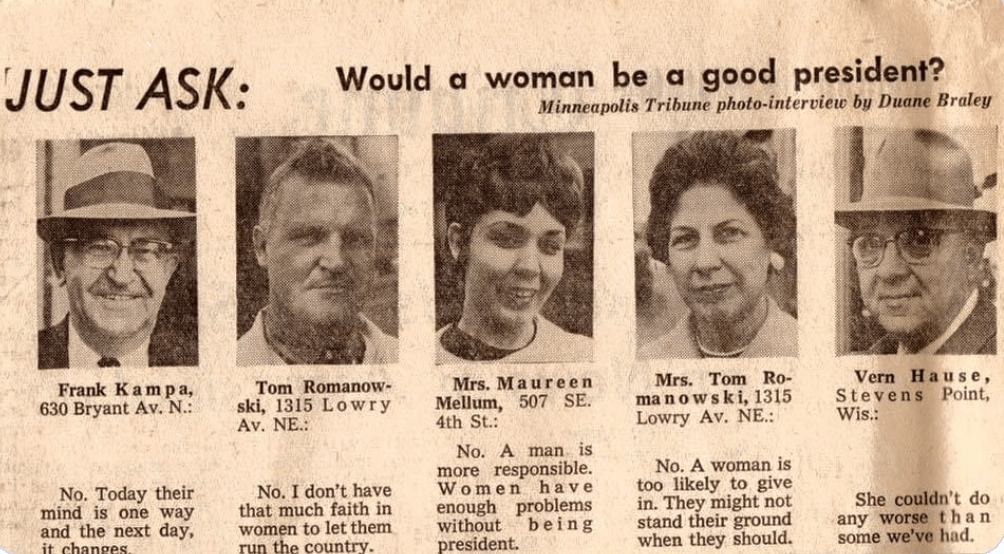
A man’s 1963 answer to whether or not a woman would make a good president rings true today
It’s 2020 and our presidential race was between an old white dude and another old white dude. That glass ceiling is still hovering over our heads. It might be cracked, but it hasn’t been shattered yet. A blast from the past photo went viral for showing us some of the attitudes that are impeded in…
It’s 2020 and our presidential race was between an old white dude and another old white dude. That glass ceiling is still hovering over our heads. It might be cracked, but it hasn’t been shattered yet. A blast from the past photo went viral for showing us some of the attitudes that are impeded in the foundation of that glass ceiling – and one skinny little crack from an unlikely source.
Twitter user @natepentz posted a photo of a 1763 Minneapolis Star Tribune article in which readers were asked, “Would a woman be a good president?”
Of the five respondents, four (including two women) gave a firm “no,” backed up by whatever weird logic they used to justify their sexism. “No. Today their mind is one way and the next day, it changes,” said Frank Kampa. “No. A man is more responsible. Women have enough problems without being president,” said Maureen Mellum.
But the lone “why not” has been getting a lot of attention now, 57 years later. Vern Hause’s answer was simple, “”She couldn’t do any worse than some we’ve had.”
The response went viral, and Hause got praise for being a low-key feminist at a time when “The Future is Female” t-shirts didn’t exist.
Vern Hause died in 1975. And simply because he chose not to voice the misogyny that was socially expected of him when asked about a woman president in 1963, five people have left flowers on his virtual grave today—45 years after his death: https://t.co/1sRSDn0Rjwhttps://t.co/2g3xWJHFG3— Ashton Pittman (@ashtonpittman) November 12, 2020
I want to know more about Vern. As a young woman in 1963, I don’t know how I would have responded. By mid 1970’s however, I had developed into someone who was pushing for opportunities for women & minorities at every opportunity. I was warned too aggressive, but I persisted.— Tricia S.? (@29Sinclair) November 11, 2020
Other Twitter users thought Hause’s response was kind of lame – that he had no faith in the government, but no faith in women either.
Hause’s response wasn’t the only response to grab attention. Some people commented on how weird Mr. and Mrs. Romanowski’s responses were. Mr. Romanowski answered, “No. I don’t have much faith in women to let them run the country.”
Mrs. Romanowski’s answer was worse, and also kinda hinted that there might be something going on in her marriage. “No. A woman is too likely to give in. They might not stand their ground when they should,” Mrs. Romanowski, who apparently doesn’t have a first name of her own, said. Maybe she was speaking out of her own experience? Although, 1963 might have been before women were allowed to have opinions.
Did Mr. Romanowski say that in front of Mrs. Romanowski! Is that why she couldn't stand her ground?— me (@PlanetaryPiggy) November 11, 2020
But as far as we’ve come since 1963, some Twitter users pointed out that not much has changed. In some ways, these responses from 1963 could be given now, although the sexism might be less overt.
From 2016 and 2020 election results, I see not much has changed. If a woman supposedly wouldn't make a good President, then don't ask nor expect us to support a man in any endeavors he pursues. Don't ask me to help you rise if I'm not good enough to stand alone. Such hypocrisy.— Political Vixen (@PoliticalVixen1) November 11, 2020
While newspapers don’t really go around asking weird questions like this anymore, in some ways, society is still asking itself that question. At least now we have plenty of people who will boldly answer, “Why is this even a question???”

In March 2023, after months of preparation and paperwork, Anita Omary arrived in the United States from her native Afghanistan to build a better life. Once she arrived in Connecticut, however, the experience was anything but easy.
“When I first arrived, everything felt so strange—the weather, the environment, the people,” Omary recalled. Omary had not only left behind her extended family and friends in Afghanistan, she left her career managing child protective cases and supporting refugee communities behind as well. Even more challenging, Anita was five months pregnant at the time, and because her husband was unable to obtain a travel visa, she found herself having to navigate a new language, a different culture, and an unfamiliar country entirely on her own.
“I went through a period of deep disappointment and depression, where I wasn’t able to do much for myself,” Omary said.
Then something incredible happened: Omary met a woman who would become her close friend, offering support that would change her experience as a refugee—and ultimately the trajectory of her entire life.
Understanding the journey
Like Anita Omary, tens of thousands of people come to the United States each year seeking safety from war, political violence, religious persecution, and other threats. Yet escaping danger, unfortunately, is only the first challenge. Once here, immigrant and refugee families must deal with the loss of displacement, while at the same time facing language barriers, adapting to a new culture, and sometimes even facing social stigma and anti-immigrant biases.
Welcoming immigrant and refugee neighbors strengthens the nation and benefits everyone—and according to Anita Omary, small, simple acts of human kindness can make the greatest difference in helping them feel safe, valued, and truly at home.
A warm welcome
Dee and Omary's son, Osman
Anita Omary was receiving prenatal checkups at a woman’s health center in West Haven when she met Dee, a nurse.
“She immediately recognized that I was new, and that I was struggling,” Omary said. “From that moment on, she became my support system.”
Dee started checking in on Omary throughout her pregnancy, both inside the clinic and out.
“She would call me and ask am I okay, am I eating, am I healthy,” Omary said. “She helped me with things I didn’t even realize I needed, like getting an air conditioner for my small, hot room.”
Soon, Dee was helping Omary apply for jobs and taking her on driving lessons every weekend. With her help, Omary landed a job, passed her road test on the first attempt, and even enrolled at the University of New Haven to pursue her master’s degree. Dee and Omary became like family. After Omary’s son, Osman, was born, Dee spent five days in the hospital at her side, bringing her halal food and brushing her hair in the same way Omary’s mother used to. When Omary’s postpartum pain became too great for her to lift Osman’s car seat, Dee accompanied her to his doctor’s appointments and carried the baby for her.
“Her support truly changed my life,” Omary said. “Her motivation, compassion, and support gave me hope. It gave me a sense of stability and confidence. I didn’t feel alone, because of her.”
More than that, the experience gave Omary a new resolve to help other people.
“That experience has deeply shaped the way I give back,” she said. “I want to be that source of encouragement and support for others that my friend was for me.”
Extending the welcome
Omary and Dee at the Martin Luther King, Jr. Vision Awards ceremony at the University of New Haven.
Omary is now flourishing. She currently works as a career development specialist as she continues her Master’s degree. She also, as a member of the Refugee Storytellers Collective, helps advocate for refugee and immigrant families by connecting them with resources—and teaches local communities how to best welcome newcomers.
“Welcoming new families today has many challenges,” Omary said. “One major barrier is access to English classes. Many newcomers, especially those who have just arrived, often put their names on long wait lists and for months there are no available spots.” For women with children, the lack of available childcare makes attending English classes, or working outside the home, especially difficult.
Omary stresses that sometimes small, everyday acts of kindness can make the biggest difference to immigrant and refugee families.
“Welcome is not about big gestures, but about small, consistent acts of care that remind you that you belong,” Omary said. Receiving a compliment on her dress or her son from a stranger in the grocery store was incredibly uplifting during her early days as a newcomer, and Omary remembers how even the smallest gestures of kindness gave her hope that she could thrive and build a new life here.
“I built my new life, but I didn’t do it alone,” Omary said. “Community and kindness were my greatest strengths.”
Are you in? Click here to join the Refugee Advocacy Lab and sign the #WeWillWelcome pledge and complete one small act of welcome in your community. Together, with small, meaningful steps, we can build communities where everyone feels safe.
This article is part of Upworthy’s “The Threads Between U.S.” series that highlights what we have in common thanks to the generous support from the Levi Strauss Foundation, whose grantmaking is committed to creating a culture of belonging.
Why is it that some people are high achievers who have a track record of success and some people never come close to accomplishing their dreams? Is it talent, luck, or how you were raised? Is it that some people are just gifted and have exceptional talents that others don’t?
The good news is, according to psychologist Angela Duckworth, the most critical factor in being a high achiever has nothing to do with talent or intelligence. It’s how long you can keep getting back up after getting hit. She calls it “grit” and, according to Duckworth’s research, it’s the common denominator in high achievers across the board, whether it’s cadets at West Point or kids in a spelling bee. Duckworth goes into depth on the topic in her book Grit: The Power of Passion and Perseverance.
What personal traits make someone successful?
“The common denominator of high achievers, no matter what they’re achieving, is this special combination of passion and perseverance for really long-term goals,” Duckworth revealed on The Mel Robbins Podcast. “And in a word, it’s grit.”
“Partly, it’s hard work, right? Partly it’s practicing what you can’t yet do, and partly it’s resilience,” she continued. “So part of perseverance is, on the really bad days, do you get up again? So, if you marry passion for long-term goals with perseverance for long-term goals well then you have this quality that I find to be the common denominator of elite achievers in every field that I’ve studied.”
When pressed to define the specific meaning of grit, Duckworth responded: “It’s these two parts, right? Passion for long-term goals, like loving something and staying in love with it. Not kind of wandering off and doing something else, and then something else again, and then something else again, but having a kind of North Star.”
For anyone who wants to achieve great things in life, grit is an attitude that one can develop for themselves that isn’t based on natural abilities or how well one was educated. Those things matter, of course, but having a gritty attitude is something someone can learn.
“I am not saying that there aren’t genes at play because every psychologist will tell you that’s also part of the story for everything and grit included,” Duckworth said. “But absolutely, how gritty we are is a function of what we know, who were around, and the places we go.”
Why grit is so important
Grit is critical for people to become highly successful because it means that you stick with the task even when confronted with barriers. In every journey of taking an idea that you love and turning it into reality there is going to be what’s known as the dark swamp of despair—a place that you must wade through to get to the other side. It takes grit and determination to make it through the times when you fear that you might fail. If it were easy, then everyone could be high achievers.
The emotional journey of creating anything great goes through the dark swap of despair. pic.twitter.com/GlwozyARIM
Grit is what keeps people practicing in their room every night as teenagers and makes them an accomplished guitar player. Grit is what makes a basketball player the first one in the gym and the last to leave so that they make the starting lineup. Grit is knocking on the next door after 12 people have just slammed their doors in your face.
The wonderful thing about Duckworth’s work is that it presents an opportunity for everyone willing to do the work. You can no longer use the fact that you may not have specialized intelligence or a God-given talent as an excuse. All you need is perseverance and passion and you have as good a shot as anyone at achieving your dreams.
This article originally appeared last year. It has been updated.
Generation X (those born between 1965-1980) grew up eating classic Americana meals. During the 1970s, comfort meals like tuna casserole and salmon roquettes were popular meals.
Gen X also grew up eating some pretty unhinged (but all the more yummy) sandwiches. These meals are steeped in childhood nostalgia.
And to this day, Gen Xers are still fond of their favorite dishes they grew up eating. Together, they discussed on Reddit their most-loved home-cooked dishes that they still whip up, starting with sloppy joes.
Here are 17 iconic Gen X comfort meals to keep in mind the next time you make dinner:
“Breakfast. We will have a ‘breakfast for dinner’ at least a couple times a month. Yum!” – fadeanddecayed, KddKc
“Pizza bread! My mom would cut Italian bread into pieces, put butter and garlic salt on them, then pour some spaghetti sauce on them, cover with mozzarella cheese, and broil for like ten or fifteen minutes. Super easy and quick to make and so tasty. I’m sure my mom loved that I was so into something that took roughly zero effort for her to make.” – hornybutired
“Grilled cheese and soup.” – reincarnateme
“Meat loaf. I use 2 pounds ground beef, replace bread crumbs with minute rice, add 1 pkg beef soup flavoring, chop an entire onion for it, and mix BBQ sauce into mixture. Oh, important: do not overmix! Place all ingredients into bowl, then mix quickly 10 or 12 swirls of a large spoon. Grease loaf pan, carefully place mixture in, pat down & bake about an hour. (Extra info: for even better flavor, mix the night before, pat into loaf pan, cover with plastic, put into fridge overnight. Remove from fridge about an hour before baking. BE SURE TO REMOVE PLASTIC WRAP! [Esp. If in Pyrex glass loaf pan])” – jehardt, AbbyM1968
“White guy tacos.” – najing_ftw
“Skillet dinner. Kielbasa, bell pepper, onion, spuds in a cast iron pan. One dish. Easy peasy.” – UnimportantOutcome67
“Chicken pot pie or chicken ala king.” – sattersnaps
“Fried catfish, greens, and red beans and rice.” – User Unknown
“Shepherds pie, technically cottage pie if it’s ground beef. Homemade enchiladas, usually made as a layered casserole instead because I don’t have time to roll them. Pork chops with mashed potatoes and veggies.” – XerTrekker
“Fried rice with chicken or pork leftovers.” – AlternativeResort181
“Hot hamburgers: hamburger patty open face on Texas toast thickness bread, cover with fries then cover that with brown gravy. Wife’s variation is hamburger patty over rice with brown gravy.” – EnricoMatassaEsq
“Stuffed peppers. I make it much more easily by cooking it all in one large frying pan ‘deconstructed’. Sauté onions garlic and ground beef, add cut up peppers, tomatoes or tomato sauce, sometimes a little spinach, then add separately cooked rice, salt and pepper and serve. It comes together pretty quickly and tastes just as good as stuffing and baking peppers in the oven.” – Affectionate-Map2583
“Macaroni and cheese with cut up hot dogs. Seriously, that’s what I ate tonight.” – Dazzling-Walrus9673
“Homemade Stroganoff casserole. Ridiculously easy to make. Ingredients:
1.25-1.5 lbs. Ground Beef 1 each of large white onion, green pepper, and red pepper 1 can mushroom pieces, drained and rinsed 12 oz. Bag of wide egg noodles 1 can cream of mushroom soup 16 oz. Sour cream Worcestershire Sauce Louisiana Hot Sauce White or Black Pepper Panko bread crumbs
To Make: Preheat oven to 360 degrees. Worcestershire, hot sauce, garlic powder, and pepper are all to taste, depending on how much flavor and punch you want it to have. Cook noodles per instructions. Drain. Peel and slice onion (not diced), core and cut peppers into strips Brown meat, onions and peppers along with liberal amount of Worcestershire; garlic, pepper, and hot sauce. Add mushrooms. Cook until meat is fully brown, onions are translucent and peppers are tender. Drain. Combine drained meat, etc. with whole can of soup, half of the sour cream. Gradually add noodles into the mix. Add sour cream as needed to maintain consistency. Add Worcestershire, hot sauce, and pepper to taste. Dump into large, deep Corning dish or whatever. Cover too with bread crumbs. Cover and bake for forty minutes.” – CynfullyDelicious
This article originally appeared last year. It has been updated.
It’s a tale as old as time: tension caused by generational differences. From Baby Boomers to the up-and-coming Gen Alpha, every generation seems to have a little bit of beef with the others—especially Gen Z.
Gen Z has claimed that Boomers are “angry”. And Gen Zers are no longer subscribing to work burnout culture that Millennials did. And now, Gen Z has decided to come for Gen X.
One brave…or naive Gen Zer decided to declare that Gen X is “the worst generation” seemingly unprompted. But a Millennial quickly put them in their place.
In a stitched video, Millennial Laura High gave a succinct cliff’s notes version of why it’s best to not speak negative thoughts on Gen X aloud.
“I love Gen X. We all love Gen X…we all love Gen X,” she said before bringing the camera close enough to whisper. “Okay here’s the thing, you do not seem to understand who Gen X is, okay? Gen X is Boomers if they knew how to turn a document into a PDF, okay. They do not Karen out. They get quiet and they get revenge.”
High then shared the secret kept by her generation: “we do not summon the latchkey kids unless it’s our literal only last resort.” She advised the unknowing Gen Zer to go to the edge of the woods to leave offerings to appease any Gen Xers that would likely be offended by the video.
Gen Z and Millennials respond
Commenters agreed with her sentiment.
“There is a reason millennials leave Gen X alone, and they learned it the hard way. My fellow Gen Z’s will learn soon… very soon,” one commenter said..
“Elder Gen Z raised by two Gen X parents. I do NOT back the younger half of Gen Z on this. I’m running into the woods on their behalf and leaving Ferris Bueller for my dad and a DQ blizzard for my mom,” another echoed.
“Last thing she will hear from the woods, Red Rover Red Rover, we call Karen Hashtag over,” said a third.
“If you’ve never played Red Rover with Gen Xers, just know you were lucky to have your head still attached to your shoulders after the game was over. There were no tears allowed and no telling your parents, they were gone anyway. In short: Gen Xers are ruthless, and it’s best not to cross them. Seriously.”
Gen X responds
A happyu00a0Gen X couple have patience for younger generations, like Gen Z. Photo credit: Canva
Thankfully, Gen Xers are also open to peace offerings (and humor). Here are a few of their suggestions:
“I will accept ding dongs (in original foil) and a VHS of ‘the last star fighter’ I will also except a mix tape if it include at mix of metal, new wave, and Yaz.”
“We will also accept any of the original Star Wars trilogy, Star Trek 2, Raiders, or Die Hard…though John Hughes films will likely will be the safest choice.”
“As an Elder Gen X (1971) I accept offerings of ice cold Boone’s Farm and those little chocolate donuts in the plastic sleeve. Laura, you’re safe. Gen Z? Run.”
“We will also allow The Neverending Story .”
Moral of the story: tread lightly Gen Z. Tread very lightly. If you hear someone clinking together empty glass Coke bottles outside your door, do not come out and play. It’s a trap.
This article originally appeared two years ago. It has been updated.
We can all be sure that as society evolves, many things that seem normal today will be cringeworthy to people in the future, whether it’s our fashion, politics, civility, or our treatment of the environment.
If we look back just 30 years ago, same-sex marriage was illegal, people routinely smoked in bars and restaurants, and it was fashionable and cool to vogue.
So, when we look back on the world of the 2020s, there are bound to be many things that we’ll be embarrassed about in 30 years, especially when we are forced to live with the repercussions of the decisions we make today. On a lighter note, we’ll all also have clouds full of photos of ourselves wearing hairstyles and clothes that look utterly ridiculous in hindsight.
In the summer of 2024, we asked the Upworthy community to share their thoughts by asking a big question on Facebook: “What’s something that’s accepted now that we’ll be embarrassed about in the future?” Our readers responded with funny takes on current fashion and concerns about technology use and how we treat our fellow human beings.
Here are 21 things we accept today that we’ll probably be embarrassed about in the future
More than a few current fashion trends will look silly in the coming years
“Yoga pants. I love them to death, but I can easily see them as the parachute pants of tomorrow.” — Deborah
“Barn doors in your house.” — Joyce
“Tattoos all over the body.” — Vicki
“People wearing socks and sandals.” — Jeremy
“Wearing pajamas in public.” — Ivy
“Huge, over-sized false eyelashes.” — Patricia
Hopefully, people in the future will be more considerate when using technology than we are today.
“Walking around with your eyes locked on your phone. Or eating at a table with 4 people looking at their phone. One day, we will either fall off a cliff or realize life is what is happening off the screen.” — Elise.
“Texting in the presence of another person.” — Kate
Three women on their phones not paying attention to each other. Canva Photos
We can also hope that in the near future, we will be able to solve many of today’s pressing public policy issues so that the next generation will live happier and healthier lives.
“Lack of healthcare for everyone.” — Sharon
“Making the planet unlivable for human beings.” — Karen
“Spending hundreds of millions of dollars of taxpayer’s money to build a sports arena for a billionaire. Then charging the taxpayers outrageous amounts to attend events there.” — Stacy
“How the US is systematically clawing back women’s rights to decide what they do with their bodies. It’s beyond shameful.” — Jason.
Some people are concerned about the way students and their parents behave in modern-day America.
“Parents trying to run schools: yelling at teachers for their child’s poor performance, yelling at principals when their child gets in trouble, book banning based on an individual’s religious ideologies, etc.” — Beth.
“Entitled children talking back to their parents and teachers.” — Connie
“Cry rooms at universities where students can go and work out their anxiety and cry and be upset if their professor uses words that are too difficult for them. Universities are institutes of higher learning, not institutes of babysitting. That will be an embarrassment in the future, as it is an embarrassment to me and many others now.” — Della
In 30 years, we may be embarrassed to look back on the level of general civility in 2024.
“Panic buying of toilet paper during the pandemic.” — Tony
“Ageism. It’s everywhere, all the time, and no one seems to mind. No one is defined by the amount of time they’ve spent on the planet but it’s used as an identity and as a weapon (ask any teenager, 40-year-old woman, or retiree…). I can only hope that one day it will be a source of embarrassment that we were all so dismissive and judgmental.” — Rosy.
While this list may seem like a litany of complaints people have about living in the modern world, it should give us hope. If we’ve overcome past embarrassments, today’s can be fixed as well.
This article originally appeared two years ago. It has been updated.
A good commentator can make all the difference when watching sports, even when an event goes smoothly. But it’s when something goes wrong that great announcers rise to the top. There’s no better example of a great announcer in a surprise moment than when French skier Yannick Bertrand took a gate to the groin in a 2007 super-G race.
Competitive skiers fly down runs at incredible speeds, often exceeding 60 mph. Hitting something hard at that speed would definitely hurt, but hitting something hard with a particularly sensitive part of your body would be excruciating. So when Bertrand slammed right into a gate family-jewels-first, his high-pitched scream was unsurprising. What was surprising was the perfect commentary that immediately followed.
This is a clip you really just have to see and hear to fully appreciate:
It’s unclear who the announcer is, even after multiple Google inquiries, which is unfortunate because that gentleman deserves a medal. The commentary gets better with each repeated viewing, with highlights like:
“The gate the groin for Yannick Bertrand, and you could hear it. And if you’re a man, you could feel it.”
“Oh, the Frenchman. Oh-ho, monsieurrrrrr.”
“The boys took a beating on that one.”
“That guy needs a hug.”
“Those are the moments that change your life if you’re a man, I tell you what.”
“When you crash through a gate, when you do it at high rate of speed, it’s gonna hurt and it’s going to leave a mark in most cases. And in this particular case, not the area where you want to leave a mark.”
It’s not the Winter Olympics without watching this clip (sound on) at least a hundred times
Imagine watching a man take a hit to the privates at 60 mph and having to make impromptu commentary straddling the line between professionalism and acknowledging the universal reality of what just happened. There are certain things you can’t say on network television that you might feel compelled to say. There’s a visceral element to this scenario that could easily be taken too far in the commentary, and the inherent humor element could be seen as insensitive and offensive if not handled just right.
The announcer nailed it. 10/10. No notes.
The clip frequently resurfaces during the Winter Olympic Games, though the incident didn’t happen during an Olympic event. Yannick Bertrand was competing at the FIS World Cup super-G race in Kvitfjell, Norway in 2007, when the unfortunate accident occurred. Bertrand had competed at the Turin Olympics the year before, however, coming in 24th in the downhill and super-G events.
As painful as the gate to the groin clearly as, Bertrand did not appear to suffer any damage that kept him from the sport. In fact, he continued competing in international downhill and super-G races until 2014.
According to a 2018 study, Alpine skiing is a notoriously dangerous sport with a reported injury rate of 36.7 per 100 World Cup athletes per season. Of course, it’s the knees and not the coin purse that are the most common casualty of ski racing, which we saw clearly in U.S. skier Lindsey Vonn’s harrowing experiences at the 2026 Olympics. Vonn was competing with a torn ACL and ended up being helicoptered off of the mountain after an ugly crash that did additional damage to her legs, requiring multiple surgeries (though what caused the crash was reportedly unrelated to her ACL tear). Still, she says she has no regrets.
As Bertrand’s return to the slopes shows, the risk of injury doesn’t stop those who live for the thrill of victory, even when the agony of defeat hits them right in the rocks.
There are times to speak up, moments when it’s best to say nothing, and opportunities be very considerate in your response. But when you’re on the receiving end of a back-handed compliment, a foolish remark, or a coworker takes you down a peg, and your emotions are up, it can be hard to have a thoughtful response. Often, we say something we shouldn’t.
How is it that some folks fly off the handle and say things they’ll later regret, while others can stay calm and remove themselves from the situation or take the high ground? One way to be less impulsive with your words is to use the “name it to tame it” neuroscience hack, originally coined by author and psychiatrist Dr. Dan Siegel. When used properly, it allows you to step back from the moment and choose the best response in a challenging situation.
When someone upsets you, the first thing to do is to go inside yourself and describe the emotion that you feel in your body. Are you angry? Are you sad? Are you afraid? Do you feel rejected? Are you disappointed? The moment you name the emotion, it will begin to subside and give you the emotional and mental room to respond to the person who caused the negative emotion, rather than impulsively reacting.
How to respond to a reactive emotion so you don’t fly off the handle:
Event happens:
1. Your body stiffens up
2. You feel an intense emotion
3. You examine the emotion and give it a name: “My body is telling me I am angry.”
4. You should feel the emotion beginning to subside
5. Choose your response instead of being impulsive
“Name it to tame it” works because, when we have a strong emotional reaction, our lizard brain kicks in, and we go into fight, flight, or freeze mode. The lizard brain is not known for giving thoughtful and strategic responses to challenging situations. When we name the emotion, our prefrontal cortex, or the thinking brain, kicks in. The thinking brain looks at the situation and says, “Alright, we don’t need to run or fight here. It’s best to give a strategic response.”
When we tune into the negative emotions by naming them, they relax because they feel heard, like when a child has hurt their knee or a loved one has real concern and you gives them undivided attention. Once the emotions are named, they are tamed. Then, you are more likely to respond to the negative person with grace and speak from the best part of yourself.
Dr. Dan Siegel, who coined the phrase “Name it to tame it,” explains the brain science behind the technique in the video below. He does a great job of explaining how it allows us to transfer our thoughts from the downstairs brain (the lizard brain) to the upstairs brain (the thinking brain), so we can calm down and respond appropriately to the situation.
When curling became an official Olympic sport in 1998, it was met with a fair amount of curiosity and confusion, at least among people outside Canada, Scotland, and the Scandinavian countries where it has long been a winter sport tradition. Without an explanation of what’s happening, curling can look downright bizarre: large stones sliding across the ice toward a target, while people vigorously sweep the ice in front of them as the person who threw the stone yells unintelligibly.
It’s not obvious what skills are required for curling just by watching, which initially led people to poke fun at the event. More recent Olympic Games, however, have seen interest in curling grow as people find the sport strangely riveting. Now, curling has reached even greater heights of popularity, as evidenced by satirical curling-at-home videos popping up on social media.
Many of them use a combo of a Roomba and a Swiffer, which works perfectly:
No one knows the exact origins of curling, but there is evidence of the sport (or something like it) being played by monks on frozen lakes and ponds in Scotland in the 16th century. Farmers would join in curling games during the winter months, and as the sport evolved through the 1800s, it became more organized. Rules were formalized, and people began traveling to watch and participate in competitions held outdoors in large Scottish cities. The Scots eventually took the sport with them to other countries, and by the 1900s, curling had transformed from a Scottish outdoor pastime into an international, mostly indoor sport.
How does curling work as a sport?
Curling is played by two teams of four, with each team aiming to get its eight stones closest to the center of a target called a “house.” Teams alternate “throwing” their stones, which really means gliding them along the ice. Sweepers brush the ice to help guide the stones, while the team captain, or “skip,” gives directions, often by yelling, to place the stones where they want them to go.
After all 16 stones are thrown, the team with a stone closest to the center of the house scores one point for each of its stones that landed inside the house. The other team does not score at all in that round, called an “end.” There are eight or 10 ends per game, depending on the event, and the team with the most points after all the ends have been played is the winner.
Here’s a visual explainer that goes through the basics:
Fun facts about curling
Tara Peterson of the USA Curling National Team shared some interesting facts about curling with Columbia Sportswear:
Modern curling stones are made of granite that comes from only two places: a quarry in Wales and an uninhabited island off the coast of Scotland called Ailsa Craig.
Curling is called curling because of the way the stone curves depending on how it’s spun, but exactly how that happens is still a bit of a scientific mystery. Curling stones actually move in the opposite direction of what the turn would normally dictate according to physics.
Despite the yelling, curling is considered a polite “gentleman’s” sport, with traditional etiquette rules observed before and after the game.
Though it may not be immediately obvious, you have to be in pretty good shape to curl. Throwing a 42-pound stone, even on ice, isn’t as easy as it looks, and the person throwing it must remain crouched close to the ground for long periods. Sweeping also requires arm strength and cardiovascular endurance.
Curling requiresu00a0more athleticism than it first appears. Photo credit: Canva
Curlers wear two different shoes, one designed for gripping the ice and the other for sliding. The slider sole is made of Teflon or stainless steel, while the grippy sole is made of rubber.
Curling is called the “roaring game,” which might sound odd, but the sound of the stones gliding over the ice is apparently much louder in person than it sounds on TV.
Every sport is more fun to watch when you actually know what you’re seeing, and curling is no exception. If you’re wondering who to watch, Canada has traditionally dominated the sport, though Sweden trails by only two medals in total Olympic curling medals. And if you’re curious how Scotland fares as the original home of the sport, its curlers compete under Great Britain’s flag.
On a January evening at a restaurant in Mexico, El Jefe patiently waited for his name to be called by the karaoke host. When it was, he gently walked to the stage in a pink baseball hat and black, thick-rimmed glasses. As he approached, the host gave him instructions on how to use the microphone. “You’ve got to hold it up here and just don’t yell in the mic,” he said, illustrating as El Jefe humbly listened.
He then proceeded to sing “Jesus, Etc.” almost better than its original singer, Jeff Tweedy of Wilco. There’s a reason for that: El Jefe, as it turns out, is Jeff Tweedy.
The song is track five on Yankee Hotel Foxtrot, which was released in 2002. According to the liner notes, it was written by Tweedy and Jay Bennett, a former member of the band who passed away in 2009. Pitchfork hailed the tune as “the 61st best song of the decade,” which is high praise, especially considering how much excellent indie-rock music was coming out at the time.
Stereogum’s Chris DeVille wrote about the album’s 20th anniversary, noting that Wilco streamed it at no charge. “A bold and uncommon move at that time, and one that probably made the album sound even more experimental for those with dial-up internet connections,” he wrote. DeVille added, “Yankee Hotel Foxtrot is THE Wilco album — the one that cemented their stature as one of the all-time great American rock bands.”
There’s a kind of perfection to Tweedy singing his own song at karaoke, and not just because it conjures so many memories for Wilco fans. Watching Tweedy in a Clark Kent–like, plainclothed role, when most fans know he can become Superman at any given moment, is something extra special.
“You guys are the coolest famous non-famous people ever,” one person wrote. “How surreal. To write a song, make a record with that song (and many more) on it, and become well known in certain circles for that song and all the other songs, have that song turned into a karaoke selection because it has become that level of popularity, then sing that song like you’re an everyday schmuck just doing karaoke one night on vacation, it’s just…”
Another person described the scene and how lovely it all was: “My heart needed this. The children playing, palm trees swaying in the neon lights, that super fun ‘Ladies’ sign, a few enthusiastic ‘woos’ and a happy, humble El Jefe. Good stuff!”
One fan loved that Tweedy seemed to go unnoticed by the karaoke host. “My favorite part is the host showing him how to use the microphone,” they wrote. Another person replied, “And the ‘Jeffiest’ reaction of playing it totally cool, no ego, totally kind, respecting the KJ’s ‘authority.’ The least ‘Do you have any idea who I am?’ energy possible.”
One comment summed up the many layers of coolness on display: “This is beautiful on so many levels. I always thought you ‘made it’ when your song ended up in a karaoke machine. Here it is, yet (maybe) no one knows him or the song — and that’s perfectly fine with him. For that, I’m so happy for him. What a gift of a moment that must have been: to be respected, successful and famous without the bad fame part. That’s the sweet spot. Just to put your hand in your pocket and sing your song for yourself and your family.”
Upworthy had the honor of chatting with Tweedy’s wife, Susan, who provided a little context for the evening. It all happened following this year’s Sky Blue Sky festival, an all-inclusive vacation in Mexico featuring a musical lineup that included Dinosaur Jr., The Jayhawks, and, of course, Wilco.
“So after Jeff’s festival, Sky Blue Sky, we stayed in the general area at a rental house for a few days to unwind,” she said. “That night we were at La Buena Vida, a restaurant that apparently does karaoke every Wednesday evening.”
Susan noted that she and their kids egged him on: “The kids and I told Jeff he should do it! He’s never done it before, but it was all families and little kids running around, and we all thought it would be fun and funny! Our son Sammy checked to see if there were any Wilco songs available to do, and there were! We signed him up, and I think he was the last one to make it on for the night.”
When asked whether Jeff was recognized, the answer was surprising.
“Nobody recognized him, although I did see a post a couple days later of someone who said they were there and that they were pretty sure it was him,” she said. “But nobody said a word, and people were still talking and running around and mostly ignoring the karaoke during his whole song, just like for everybody else! It was really fun for all of us!!”