upworthy
Add Upworthy to your Google News feed.
Google News Button
Pop Culture

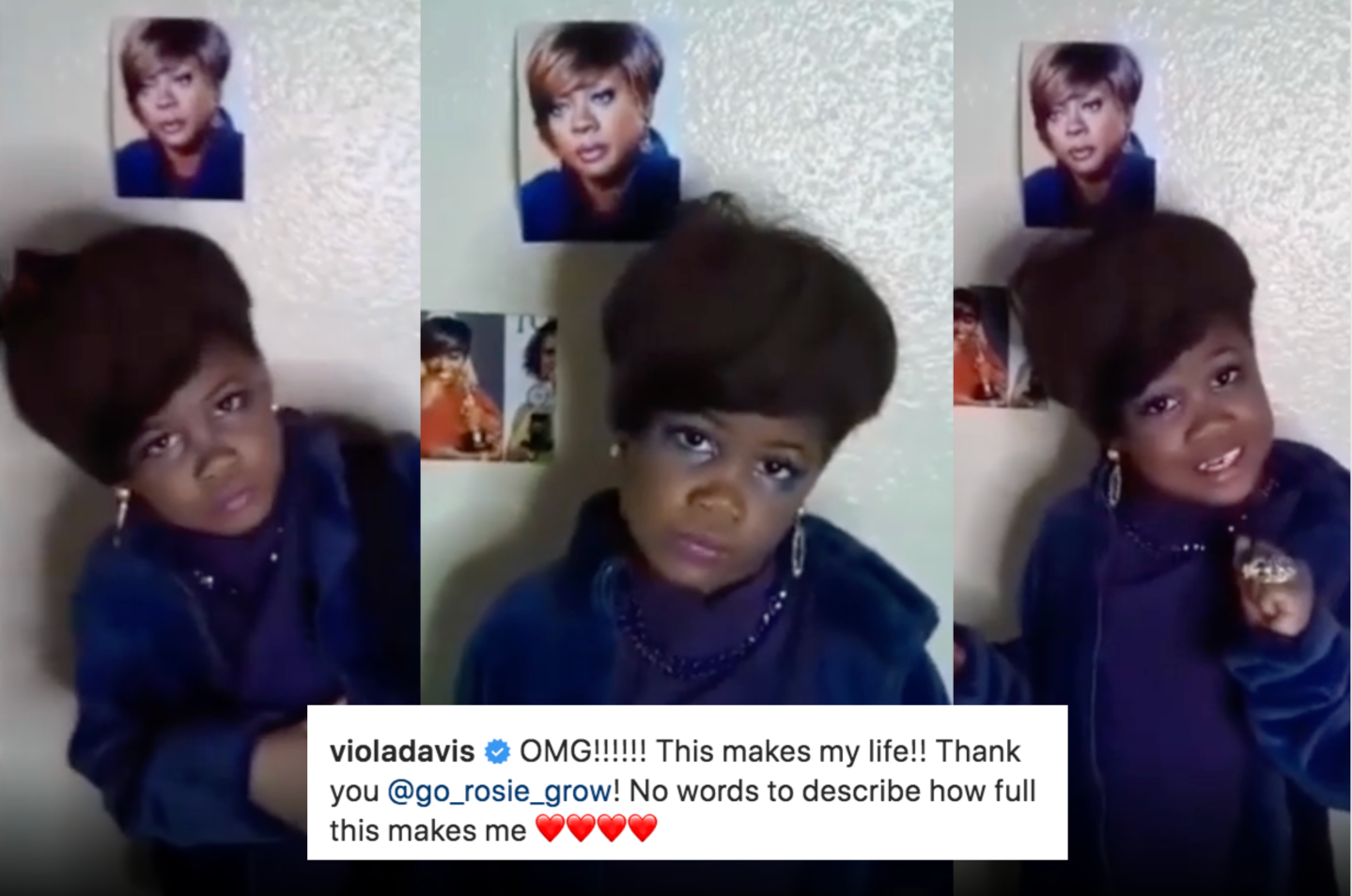
6-year-old girl absolutely slays as a tiny Viola Davis, Sha'Carri Richardson and more

little girl dresses up as viola davia

Rosie White, as Viola Davis, as Annalise Keating.

One mommy-daughter duo is winning hearts by taking dress-up to a whole new level.

Six-year-old Rosie White is going viral and making headlines for sharing the inspiring stories of Black entertainers, leaders and history makers—using spot-on costumes made by her mother Kenya White, along with her own special dash of Black girl magic.

You might have recently seen Rosie (@go_rosie_grow) boldly channeling multiaward-winning actress Viola Davis, complete with that meme-worthy “grabbing of the purse stare down” we all know and love from “How to Get Away With Murder.”

I mean, where does Davis end and White begin?! Someone give this child an Emmy!

Even Davis saw the video and reposted it. So I’m sure that’s award enough for now.


As Kenya recalls in a Scary Mommy interview, the idea behind this treasure trove of uncanny impressions came when Rosie was just 3 years old. After her daughter was given a printout about Rosa Parks in preschool, Kenya discovered that little Rosie completely memorized all of the information and could recite back what she had just read.

Inspired, Kenya grabbed a makeshift Rosa Parks costume and grabbed her phone, telling her daughter to “do it again!” And from there, a blend of history, creativity and pure joy ensued.

Since then, Rosie has created hundreds (yes, hundreds) of videos featuring prominent Black figures, and received lots of love for her fun personality and God-given talent. Scary Mommy reported that Whoopi Goldberg sent a box of books and Erykah Badu started following her.

Some of my personal favorites are when Rosie pretends to be male figures. Cause, well … little kids in fake mustaches. That’s a level of adorable that can’t be beat.

Her pop star and diva ones are quite amazing too.

*standing ovation*

For Black History Month, Rosie and Kenya are doubling down and releasing a video every Monday and Thursday. Thursdays honor Black inventors, like Sarah Boone, who improved the ironing board, George Crum, creator of the potato chip, Garret Morgan, inventor of the traffic light.

Seriously, if this child doesn’t become an actress, I hope she becomes a history teacher because I am learning so much. And having fun while doing so.

A lot of inspiration also comes from current events, like track star Sha’Carri Richardson following her unfair disqualification from the Olympic Games.

Her tiny tattoos! I can't even...

And though occasionally Rosie will delve into more serious stories, like Breonna Taylor, Kenya says that the tone is consciously celebratory.

“When I was six years old I learned about the negativity of Black history,” Kenya told Scary Mommy. “I didn’t want to teach her such darkness about Black history. Right now it’s all positivity.”

Positivity, yes. But also inspiration. Especially to young Black girls. Kenya told Good Morning America, the message behind these videos is that “you can do anything you want. You can be Kamala Harris, you can be Michelle Obama, you can be beyond those ladies. Whatever your heart desires, whatever you want to do, whether you're an artist or dancer, into politics, just be the best you you can be."

That includes GMA co-anchor Robin Robertson, who now has a “mini-me,” thanks to Rosie.

Next month is Women’s History Month, and we are all very excited to see what Rosie and Kenya come up with. Perhaps Biden’s Supreme Court nominee? We’ll have to wait and see. In the meantime, sifting through these videos is more than enough to make you, to quote The Lovin' Spoonful, “believe in magic in a young girl’s heart.”

Way to go Rosie. Following your bliss reminds us all to do the same.
the great depression; Florence Thompson; Mona Lisa of the Great Depression; Mona Lisa; the depression; depression era
Photo by Dorothea Lange via Library of Congress
The woman from the famous Great Depression photo didn't know about her fame for 40 years.

It's one of the most iconic and haunting photos of all time, up there with the likes of Hindenburg, The Falling Soldier, Burning Monk, Napalm Girl, and many others. It's called simply Migrant Mother, and it paints a better picture of the time in which it was taken than any book or interview possibly could.

Nearly everyone across the globe knows Florence Owens Thompson's face from newspapers, magazines, and history books. The young, destitute mother was the face of The Great Depression, her worried, suntanned face looking absolutely defeated as several of her children took comfort by resting on her thin frame. Thompson put a human face and emotion behind the very real struggle of the era, but she wasn't even aware of her role in helping to bring awareness to the effects of the Great Depression on families.


It turns out that Dorothea Lange, the photographer responsible for capturing the worry-stricken mother in the now-famous photo, told Thompson that the photos wouldn't be published.

Of course, they subsequently were published in the San Francisco News. At the time the photo was taken, Thompson was supposedly only taking respite at the migrant campsite with her seven children after the family car broke down near the campsite. The photo was taken in March 1936 in Nipomo, California when Lange was concluding a month's long photography excursion documenting migrant farm labor.

the great depression; Florence Thompson; Mona Lisa of the Great Depression; Mona Lisa; the depression; depression era Worried mother and children during the Great Depression era. Photo by Dorthea Lange via Library of Congress

"Migrant worker" was a term that meant something quite different than it does today. It was primarily used in the 30s to describe poverty-stricken Americans who moved from town to town harvesting the crops for farmers.

The pay was abysmal and not enough to sustain a family, but harvesting was what Thompson knew as she was born and raised in "Indian Territory," (now Oklahoma) on a farm. Her father was Choctaw and her mother was white. After the death of her husband, Thompson supported her children the best way she knew how: working long hours in the field.

"I'd hit that cotton field before daylight and stay out there until it got so dark I couldn't see," Thompson told NBC in 1979 a few years before her death.

the great depression; Florence Thompson; Mona Lisa of the Great Depression; Mona Lisa; the depression; depression era A mother reflects with her children during the Great Depression. Photo by Dorthea Lange via Library of Congress

When talking about meeting Thompson, Lange wrote in her article titled "The Assignment I'll Never Forget: Migrant Mother," which appeared in Popular Photography, Feb. 1960, "I saw and approached the hungry and desperate mother, as if drawn by a magnet. I do not remember how I explained my presence or my camera to her, but I do remember she asked me no questions. I made five exposures, working closer and closer from the same direction. I did not ask her name or her history. She told me her age, that she was thirty-two. She said that they had been living on frozen vegetables from the surrounding fields, and birds that the children killed."

Lange goes on to surmise that Thompson cooperated because on some level she knew the photos would help, though from Thompson's account she had no idea the photos would make it to print. Without her knowledge, Thompson became known as "The Dustbowl Mona Lisa," which didn't translate into money in the poor family's pocket.

In fact, according to a history buff who goes by @baewatch86 on TikTok, Thompson didn't find out she was famous until 40 years later after a journalist tracked her down in 1978 to ask how she felt about being a famous face of the depression.

@baewatch86

Florence Thompson, American Motherhood. #fyppppppppppppppppppppppp #historytok #americanhistory #migrantmother #thegreatdepression #dorthealange #womenshistory

It turns out Thompson wished her photo had never been taken since she never received any funds for her likeness being used. Baewatch explains, "because Dorothea Lange's work was funded by the federal government this photo was considered public domain and therefore Mrs. Florence and her family are not entitled to the royalties."

While the photo didn't provide direct financial compensation for Thompson, the "virality" of it helped to feed migrant farm workers. "When these photos were published, it immediately caught people's attention. The federal government sent food and other resources to those migrant camps to help the people that were there that were starving, they needed resources and this is the catalyst. This photo was the catalyst to the government intercepting and providing aid to people," Baewatch shares.

- YouTube www.youtube.com

As for Lange, Migrant Mother was not her only influential photograph of the Great Depression. She captured many moving images of farmers who had been devastated by the Dust Bowl and were forced into a migrant lifestyle.

"Broke, baby sick, and car trouble!" is just one of her many incredible photos from the same year, 1937.

She also did tremendous work covering Japanese internment in the 1940s, and was eventually inducted into the International Photography Hall of Fame and Museum and the National Women's Hall of Fame.

the great depression; Florence Thompson; Mona Lisa of the Great Depression; Mona Lisa; the depression; depression era Families on the move suffered enormous hardships during The Great Depression.Photo by Dorthea Lange via Library of Congress

Thompson did find some semblance of financial comfort later in life when she married a man named George Thompson, who would be her third husband. In total, she had 10 children. When Thompson's health declined with age, people rallied around to help pay her medical bills citing the importance of the 1936 photo in their own lives. The "Migrant Mother" passed away in 1983, just over a week after her 80th birthday. She was buried in California.

"Florence Leona Thompson, Migrant Mother. A legend of the strength of American motherhood," her gravestone reads.

swim instructor, swim lessons, boundaries, kids, teaching children
Courtesy of men_being_gentlemen and superheroswimacademy/Instagram

Swim coach Jason Siegel expertly navigated a moment with an affectionate toddler.

Any adult who works with kids in the modern era knows what a minefield physical affection can be. Even if you have the purest of intentions, accepting a hug or a kiss from a child who doesn't belong to you may not be appropriate or wise, especially if you are in a position of authority. It's hard when a kid genuinely loves you and wants to show you affection, but part of caring for kids is helping to teach them what's okay and not okay.

A perfect example of what boundary setting can look like with a young child was shared in a video showing Superhero Swim Academy instructor Jacob Siegel at the end of a swim lesson. The toddler Siegel was teaching hugged him and then went in for a kiss. The hug was expected and welcome—"Thank you, Mila. I love Mila hugs!" the coach said. But when she started to go in for a kiss, Siegel immediately pulled back, gently saying, "No, no kissy. No kissy 'cause I'm coach. You only kiss Mommy and Daddy, okay?"


The little girl looked sad and started to cry, so he quickly gave her an acceptable alternative. "Okay, hey! High five!" he said, while holding up his hand. "High five 'cause we're all done!" She calmed right down, gave him a high five, and then he moved on to clean-up time.

Siegel's expression at the end of the video says it all—he knew that was a teachable moment that could have gone another way, but he handled it with professionalism and toddler-friendly expertise.

“Moments like that are actually powerful teaching opportunities," Siegel tells Upworthy. "I want kids to know they can love and trust their coach, but also that some kinds of affection belong at home with family. It’s about helping them understand safety and respect through love.”

People appreciated the example he set, sharing supportive comments on a Reddit share of the video:

"So sweet... I sometimes have young clients who want to give kisses and it's so cute but you do have to tell them "no" because it's an important boundary to learn. Not everyone wants kisses!"

"On top of knowing not to do it to other people, it also teaches them for themselves that other people shouldn’t be just giving them kisses."

boundaries, setting boundaries, saying no, affection, appropriate behavior Jake Johnson Fox GIF by New Girl Giphy

"The kid is absolutely adorable but that coach is on another level. Creating the boundaries while keeping it cool and recording the whole thing so the parents are extremely comfortable. Dude is setting a hell of example."

"It sounds like he's got a good balance between encouraging her growth and setting appropriate boundaries. Kids can be incredibly affectionate, and it's important to gently guide them in understanding what's suitable."

"I also think it’s important for the parents’ comfort that a grown man swimming with their young girl isn’t overstepping boundaries/being predatory. From the outside looking in, it’s hard to know for sure when something is innocent or not. It’s better to just stay away from those situations as a whole."

"The little girls I used to babysit always tried to give me kisses (they were between 2-5) and I had to tell them that I’m not related to you, so you can’t kiss me. You can hi-five or hug me, but no kisses! They still give me running tackle hugs when they see me!"

A few commenters pointed out that some cultures see kissing as totally acceptable, as it's frequently used as a friendly greeting for people of all ages and genders. But even in those cultures, boundaries based on relationships and contexts are important to learn, and it's helpful when adults help teach those lessons so it doesn't all fall on the parents.

- YouTube youtu.be

In an article titled "Teaching Kids About Boundaries: Why empathy and self awareness play a major role," Child Mind Institute includes a helpful video about teaching boundaries to children, and it confirms that the coach handled things in exactly the right way. In a section entitled "Rules work both ways," the institute notes that when people model their boundaries, it's important for children to empathetically listen. "People are in charge of their own bodies," writes Rae Jacobson, author of the article and senior editor at the Child Mind Institute, "and it's not okay to touch them if they don't want you to, just like it's not okay for someone to touch [you] in a way you don't like." By calmly modeling his boundaries, the swim coach gave his young swimmer a gentle but clear message about what was and was not okay and embodied both empathy and autonomy for her in a way she can understand and mirror when she's older.

Coach Siegel has shared various videos showing how he teaches kids much more than just how to swim. Check out this video where he helps a little one emotionally regulate:

Well done, Coach. Thanks for giving us all such a fabulous example to follow. You can find more from Coach Siegel on the Superhero Swim Academy Instagram page.

This article originally appeared in January. It has been updated.

Pop Culture

In an iconic 1975 clip, a teenage Michael Jackson stuns Cher during hypnotic robot dance duet

The clip marks a turning point in Michael Jackson's iconic public persona.

jacksons, michael jackson, robot dance, Cher, 1970s TV

Cher and The Jackson 5 doing the robot dance.

One of the most distinctive aspects of Michael Jackson's mega-stardom was that he grew up almost entirely in the public eye. He began performing with his brothers at age five and remained a significant figure in American pop culture until he died in 2009.

He burst onto the scene as a child with an incredibly soulful voice. He became an electrifying performer as a teen before rocketing to superstardom at 20 with the release of his first solo album, 1979's Off the Wall. One of the pivotal moments when the public witnessed this transformation came in 1975, when 16-year-old Michael performed with his brothers, The Jackson 5, on The Cher Show.


The Jackson 5 and Cher performed a medley of the band's biggest hits, including "I Want You Back," "I'll Be There," and "Never Can Say Goodbye." But the most memorable moment came when Michael and his brothers broke into the robot dance during "Dancing Machine," and Cher did her best to keep up.

The Jackson 5 and Cher do the robot dance

It's fun watching Cher try to fall in line with the Jacksons, while Michael absolutely kills it, gyrating like an animatronic on hyperdrive during his solo.

- YouTube www.youtube.com

The Jackson 5 may have helped bring the robot dance into the public consciousness by incorporating it into performances of their 1973 hit "Dancing Machine." But it traces back to mechanical "mannequin" dances from the early days of film. In the 1960s, Robin Shields, a popular mime, performed as a robot on late-night talk shows. By the 1970s, dancers had set those moves to music on shows such as Soul Train.

- YouTube www.youtube.com

In a 2003 interview, Cher said she had to learn the moves on the fly from the Jacksons.

"Think of how hard it was for me to learn to do that, and the guys just knew how to do it. I've been working all day, and they just came on and said, 'Okay, sure, this is how you do it,'" Cher recalled. "I had a lot of fun on that show. It was a lot of work, but I had a lot of fun. You know, and I got to work with some great people."

What's also notable about the performance is that Michael's voice had changed, and he sang in a deeper register than he had as a child a few years earlier.

Things changed for Cher and the Jacksons in 1976

By the following year, things had changed for both The Jackson 5 and Cher. Cher reunited with her ex-husband, Sonny Bono, for The Sonny and Cher Show, which ran until 1977. In 1976, The Jackson 5 left Motown Records for Epic Records and changed their name to The Jacksons. Jermaine Jackson temporarily left the group to pursue a solo career, and he was replaced by his brother, Randy.

Here's The Jackson 5's complete performance on The Cher Show from March 16, 1975:

- YouTube www.youtube.com

Friendship

World-famous 'mindreader' reveals 5-second hack for remembering people's names

Hint: Your visual memory is the strongest form of memory you have. Use it.

microphone, man, mike, names, remembering names

A simple trick to memorize names just requires a little imagination.

The longer you live, the more people you meet and the more names you have to learn and try to remember. It's an ironic truth, considering how our capacity to memorize seems to dwindle the older we get, so it's handy to have some tips and tricks for remembering people's names, especially when you're meeting a bunch of new people at once.

Derren Brown is one of the most famous mentalists in the world, so he knows a thing or two about people. Mentalists are a special breed of magician who focus on tricks and illusions of the mind. They do things like hypnosis, mind-reading, and impossible predictions. There's trickery involved, of course, but mentalists are also masters at reading people and have to employ advanced memory techniques to keep track of information they learn during their shows.


- YouTube youtu.be

In an interview with Big Think, Brown revealed some of his favorite memory hacks, including his 'party trick' to never forget a person's name.

The secret is to create a link between the part of your brain that stores information, like names, and the visual part of your brain that is more easily accessed. Visual memory has also been found to be substantially stronger and more detailed than auditory and other kinds of memories, so what you want to do is get the visual part of your brain involved in remembering!

"You find a link between the person's name and something about their appearance, what they're wearing, their face, their hair, something," Brown says. "You find a link with something that they're wearing, so if they're called Mike and they've got big black hair, you think, 'Oh that's like a microphone,' so I can imagine like a big microphone walking around, or if they've got a stripy T-shirt on, you imagine a microphone with those stripes going around it.

name, memory, mentlalist, remembering names, meeting people Who Are You Name GIF by NETFLIX Giphy

"And it's the same process later on in the evening, you see them, you look at the stripes, and you go, 'Oh, that's Mike. Oh yeah, that's Mike. The hair, why am I thinking the hair is like a big microphone? Oh yes, of course, they're called Mike.'"

Microphone Mike! Any sort of alliteration based on a physical characteristic will work. Stripey Steve, Tall Tim, Green Gene. The more interesting and unique, the better you'll remember.

If this sounds a little bit like Michael Scott's mnemonic devices from The Office, well, they're not far off. He applies in a pretty strange and convoluted way: "Baldy. Your head is bald. It is hairless. It is shiny. It is reflective, like a mirror. M. Your name is Mark." But ultimately, he was on to something. If you watched the show, you know that Michael Scott never forgot a name!

michael scott, the office, names, remembering names, learning names Season 5 Nbc GIF by The Office Giphy

There is one catch with the technique: You have to actually listen and pay attention when someone tells you their name!

"So, you do have to listen, that's the first thing when they say the name," Brown says. "Normally, the very moment where someone is giving you their name, you're just caught up in a whole lot of social anxiety anyway, you don't even hear it, so you have to listen."

Using someone's name when you talk to them has tons of benefits. It conveys respect, friendliness, and intimacy. When you're on the receiving end, and someone you've just met uses your name, it just feels good! It feels like it matters to them that they met you. Just don't overdo it. Repeating someone's name every other sentence comes across as disingenuous and salesy. A good rule of thumb is to repeat their name immediately after learning it ("Nice to meet you, Jim") and upon saying goodbye. The rest of the memory work should happen in your head to avoid creeping them out!

"And then at the end [of the party] you get to go around and say goodbye to everybody by name, and everyone thinks you're very charming and clever," Brown quips.

It's definitely worth a try.

Joy

Adults share their parents' most laugh-out-loud 'gramnesia' moments, and it's so relatable

"Sometimes I wonder if my parents have ever actually met a child."

gramnesia, gramnesia moment, boomer parents, boomer grandparents, gen x parenting, millennial parenting, family, family humor

If only raising kids was this easy.

"Gramnesia" is a term coined by Gen Xers and Millennials to poke fun at the way their parents seem to suddenly forget how truly difficult it is to raise young children once they've entered their grandparent era.

This leads to some pretty perplexing memories, like zero tantrums and no issues with sugar, all of which the now-adult children don't remember, because it didn't quite happen that way.


Recently, a woman named Ally Glasgow (@allyglasgow) shared a perfect example of this sometimes mind-boggling phenomenon, explaining how she and her mom had entirely different memories of potty training.

"[My mom] said, 'All of you were potty trained by two. All four girls.' And I'm like... I just don't feel like we were... I mean maybe?" Glasgow says in a TikTok video.

An even bigger "gramnesia" moment came while Glasgow was driving her mom to the airport, when she suggested that Glasgow "instill into your kids that when they wake up, they shouldn't talk until a certain time."

Perplexed, Glasgow asked, "Mom, what do you mean they don't talk?" Her mom finally acquiesced, adding, "Maybe they could whisper."

As though any parent in all of history has ever successfully instilled a rule like that. Maybe in Victorian times, but still. Do we really want to go back to that in this instance?

Glasgow's video inspired others to share their own equally funny "gramnesia" moments in an act of lighthearted solidarity:

"My mom has completely made up an entirely different childhood in her head lmao and when I call her out she gets SO MAD."

"Sometimes I wonder if my parents have ever actually met a child."

"My son has eczema and my mom says none of her kids ever had it but I literally have had eczema my entire life 😂"

"My mom says I was speaking sentences by 9 months old. No I was not. There's no way."

"My parents both SWEAR that I was sleeping through the night at 3 weeks old and didn't need to wake up to feed or anything. So like okay you starved me???"

"My mom comments on my kids eating unhealthy as if I didn't grow up eating cereal, ramen, frozen meals, etc every single day because she didn't cook for us, like what?"

"My parents swear I was walking at 6 months old. Once I had kids I was like there is no physical way that is possible. They still swear it happened."

"My MIL had four boys and she tried to convince me that they didn't make much noise. lol okay 👌🏽"

"My mom said 'kids need routine and structure' to me once but we were homeschooled and only did school when she felt like it."

"My mom said my sisters and I never snacked 🙄"

"My mom claims we never threw tantrums. Huh?! I remember throwing tantrums 😂"

"I can't remember details from when my kids were babies…and they are currently 3. You're telling me our parents remember tiny details from 35 years ago?!"

Bottom line: "gramnesia" is very real and, apparently, very universal. But maybe, in this instance, we can give grandparents some slack. Parenting is hard no matter what generation you hail from. Who knows? Many of us might also use rose-colored glasses as a coping mechanism at some point.