19 super-specific memories that are giving people instant childhood nostalgia

Certain sensations bring up incredible memories.

1980s kids, 1980s nostalgia, 1990s nostalgia
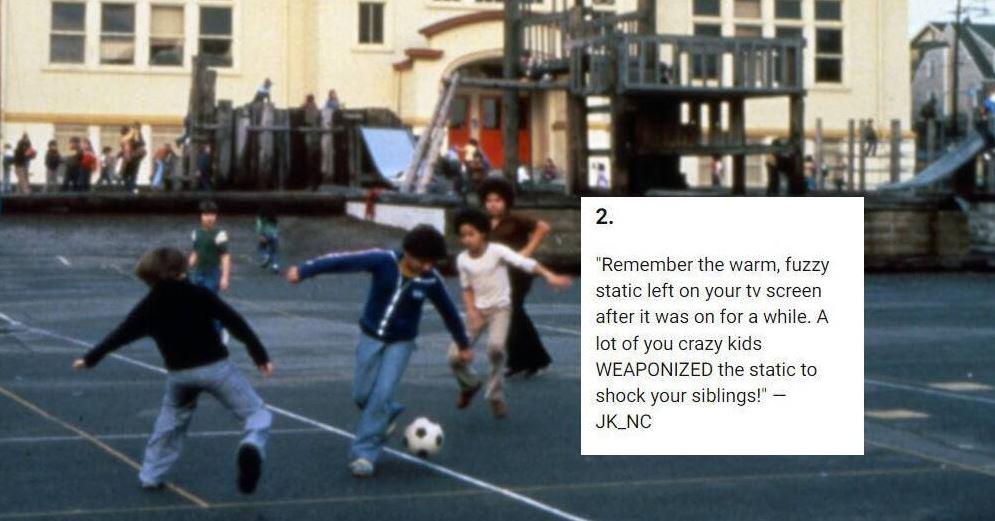
Memories of childhood get lodged in the brain, emerging when you least expect.Photo credit: via Seattle Municipal Archives/Flickr

There are certain pleasurable sights, smells, sounds and tastes that fade into the rear-view mirror as we grow from being children to adults. But on a rare occasion, we’ll come across them again and it’s like a portion of our brain that’s been hidden for years expresses itself, creating a huge jolt of joy.

It’s wonderful to experience this type of nostalgia but it often leaves a bittersweet feeling because we know there are countless more sensations that may never come into our consciousness again.

Nostalgia is fleeting and that’s a good thing because it’s best not to live in the past. But it does remind us that the wonderful feeling of freedom, creativity and fun from our childhood can still be experienced as we age.

A Reddit user by the name of agentMICHAELscarnTLM posed a question to the online forum that dredged up countless memories and experiences that many had long forgotten. He asked a simple question, “What’s something you can bring up right now to unlock some childhood nostalgia for the rest of us?”

It was a call for people to tap into the collective subconscious and bond over the shared experiences of youth. The most popular responses were the specific sensory experiences of childhood as well as memories of pop culture and businesses that are long gone.

Ready to take a trip down memory lane? Don’t stay too long, but it’s great to consider why these experiences are so memorable and still muster up warm feelings to this day.

Here are 19 of the best responses.

1. 

“An eraser that looks and smells like a very fake strawberry.” — zazzlekdazzle

2. 

“Remember the warm, fuzzy static left on your tv screen after it was on for a while. A lot of you crazy kids WEAPONIZED the static to shock your siblings!” — JK_NC

3. 

“Waking up super early on Saturday morning before the rest of the family to watch cartoons.” — helltothenoyo

4. 

“When you’d watch a vhs and it would say ‘and now your feature presentation.’” — Mickthemmouse

5. 

“Eating one of those plastic-wrapped ice pop things after a long day of playing outside in your backyard with your friends.” — onyourleft___

6. 

“Scholastic book fairs.” — zazzlekdazzle

“The distinctive newspaper-y feel of those catalogues, the smell of them. Heaven. I would agonize over what books to get, lying on my living room floor, circling my options in different colored gel pens, narrowing it down to 2-4 from a dozen in an intense battle royale between slightly blurry one-line summaries. I know my mom’s secret now. She would’ve bought me the whole damn catalogue. But she made me make my choices so that I really valued the books. I’d read them all immediately, reading all night if I had to, hiding in a tent under my covers with a flashlight I stole from the kitchen. I thought I was getting away with something. As an adult, I notice, now, that the flashlight never ran out of batteries.” — IAlbatross

7. 

“Watching ‘The Price Is Right’ when you were sick at home.” — mayhemy11

8. 

“That feeling of limitless freedom on the first day of summer vacation. That feeling of dreaded anticipation on the last day of summer vacation.” —_my_poor_brain_

9. 

“Blockbuster.” — justabll71

10. 

“The noise when picking up the phone when someone was surfing the web.” — OhAce

11. 

“The TV Guide channel. You had to sit through and watch as the channels slowly went by so we could see what was on. It blew getting distracted by the infomercial in the corner and then realizing you barely just missed what you were waiting for so had to wait for it to start all over.” — GroundbreakingOil

12. 


“Light Bright. I barely remember it myself but you’d take a charcoal-black board and poke different colored pegs through it. You plug it in to the electrical outlet and all the pegs light up creating whatever shape you made in lights.” — 90sTrapperKeeper

13. 

“You knew it was gonna be a good day when you walk into PE class and see that huge colorful parachute.” — brunettemountainlion

14. 

“Ripping handfuls of grass at recess and putting them on your friend.” — boo_boo_technician

15. 

“In 1972, a crack commando unit was sent to prison by a military court for a crime they didn’t commit. These men promptly escaped from a maximum-security stockade to the Los Angeles underground. Today, still wanted by the government they survive as soldiers of fortune. If you have a problem if no one else can help, and if you can find them….maybe you can hire The A-Team.” — Azuras_Star8

16. 

“Watching ‘Mister Rogers’ Neighborhood.’ There was something so special about the intro where he would sing Won’t You Be My Neighbor while he changed his jacket and shoes. I loved every second of it, and would watch in utter content and fascination each time as if I’d never before seen him zip his cardigan up and back down to the right spot and change his shoes with the little toss of a shoe from one hand to the other.” — Avendashar

17. 

“Somewhere between blowing on some cartridges and pressing the cartridge down and up in the NES to get it to play.” — autovices

18. 

“That feeling when you are going as high as you can go on the swings. Power? Freedom? Hard to describe.” — zazzlekadazzle

19. 

“Cap guns. But smashing the entire roll of caps at once with a hammer.” — SoulKahn90


This article originally appeared three years ago.

  • Fans boo after ‘Wheel of Fortune’ contestant gets ‘unfair’ puzzle worth $1 million
    Contestant gets a very tough 'Wheel of Fortune' puzzle.Photo credit: Wheel of Fortune/YouTube

    The usually respectful crowd at a “Wheel of Fortune” taping couldn’t hold back after they felt that a puzzle given to finalist Rob Dodson was too harsh. A big reason for their outrage (and why the puzzle was so tricky) was because $1 million was on the line.

    Before the puzzle, Dodson chose from a selection of cards that held the prize he would win for solving it. Amongst the cards was the $1 million jackpot, so, understandably, tensions were high. Did Dodson choose the million-dollar card? Will he solve the puzzle under the “What Are You Doing Category”?

    Well, things didn’t start too great.

    After the usual R, S, T, L, N, and E were put up on the board, Dodson was looking at “_ _ _ _ _ L _ N _.” He quickly guessed C, H, P and A, none of which appeared on the board. He then guessed “funneling” and “finding,” but they didn’t work.

    The final answer: “Quibbling.”

    After the solution to the puzzle was revealed, the audience began to boo because they didn’t think it was fair. It had 2 Bs in the short answer, started with a Q and was a word that isn’t used often in casual conversation. The crowd’s reaction was an excellent show of support for Dodson, who encouraged the crowd to keep going by raising his hands.

    Host Pat Sajak, 77, pushed back against the boos, jokingly asking the audience, “Who asked you?”

    So, would Dodson have won the $1 million if he guessed quibbling? Nope. The card he chose would have earned him an Infiniti car if he had guessed correctly. But all in all, it wasn’t a bad outing for Dodson, a father of 2 from Aurora, Ohio. He managed to win $33,500 against Venetia Brown ($7,550) and Jessica Huffman ($2,000).

    The tough puzzle earned a lot of boos on social media as well. X was lit up with people who thought that Dodson got cheated by being given a challenging puzzle with a word seldom used in conversation.

    Sajak’s final episode as host aired on June 7, 2024. Sajak has been the host of “Wheel” since 1981. Vanna White, his co-host since 1982, will remain with the show. “I couldn’t be happier to have shared the stage with you for all these years with one more to come,” she wrote on X after Sajak announced this would be his last season. “Cheers to you.”

    Sajak has been a beloved host on “Wheel of Fortune,” earning 19 Daytime Emmy Award nominations for Outstanding Game Show Host and winning three times. In 2019, he set a Guinness World Record for the longest career as a game show host for the same show, beating the previous record held by Bob Barker.

    Sajak has been a beloved host on “Wheel of Fortune,” earning 19 Daytime Emmy Award nominations for Outstanding Game Show Host and winning three times. In 2019, he set a Guinness World Record for the longest career as a game show host for the same show, beating the previous record held by Bob Barker.

    A familiar face replaced Sajak, Ryan Seacrest, best known for his work on “American Idol” and “Dick Clark’s Rockin’ New Year’s Eve.”

    “I can’t wait to continue the tradition of spinning the wheel and working alongside the great Vanna White,” he said after it was announced he was the new host.

    So, how did he do after taking over the coveted role of host? The first week that Seacrest took over for Sajak the ratings took a giant leap, bringing in the most viewers since 2015, making it the number one syndicated show that week. Time will tell if Seacrest can replace Sajak’s magic, but he has time; reports show that he has signed on for the gig into the 2030s.

    This article originally appeared last year.

  • Deaf filmmaker noticed ‘Sinners’ director casually signing at the Oscars. She was moved.
    "Sinners" director Ryan Coogler used American Sign Language at the Oscars.Photo credit: Greg Hernandez/Wikimedia Commons & Kevin Paul/Wikimedia Commons

    Eyes were glued to the Oscars recently. While most people were discussing red carpet looks and who won what, one woman noticed something special. Chrissy Marshall, a filmmaker who is deaf, realized that Sinners director Ryan Coogler was using American Sign Language (ASL) throughout the night.

    The Oscars are a major event that draws millions of viewers each year. But for Marshall, the March 15 ceremony became a moment of inclusion. As she watched Coogler sign, her emotions grew. The filmmaker took to social media to share her excitement with her followers.

    Ryan Coogler, ASL, Oscars, Sinners, inclusion
    Outside the Oscars. Photo credit: Greg Hernandez/Wikimedia Commons

    In her Instagram video, Marshall excitedly signs, “That’s director Ryan Coogler signing ‘I love you.’ But there’s more.”

    A brief clip of musician Ludwig Göransson saying Coogler’s name plays, prompting the Black Panther director to sign, “I love you. Thank you, brother.” Marshall then reappears to explain that Coogler was signing to people all night. As she shows more clips, her emotions build until she’s nearly in tears.

    Marshall adds, “I just learned that his wife Zinzi, is an ASL interpreter… my heart…As a Deaf filmmaker, watching them normalize sign language like that…More please!”

    Zinzi Coogler, who co-founded Proximity Media with her husband and Sev Ohanian, didn’t always plan to work in film—in fact, the career wasn’t on her radar. She attended California State University, Fresno, where she studied communicative sciences and deaf studies, according to Marie Claire. After graduating, she worked as an interpreter at the nonprofit Deaf Counseling, Advocacy & Referral Agency. Given their shared professional paths, it’s likely Ryan Coogler picked up some sign language, though it’s unclear to what extent.

    The inclusion of ASL isn’t new to the Cooglers. In 2015, Leonard Maltin hosted Ryan Coogler for his film symposium class at the USC School of Cinematic Arts. One student asked why the lead female character in Creed, played by Tessa Thompson, experiences hearing loss.

    Maltin shared, “Ryan explained that his fiancée teaches ASL (American Sign Language) and being with her has brought him into that sphere. In other words, a significant facet of the movie is drawn from reality and is not a mere bit of business.”

    It seems that ASL is integrated into the lives of the Cooglers, and they regularly incorporate it into their films. This seamless inclusion helps normalize sign language for audiences. Advocates report that the media underrepresents deaf and hard-of-hearing people, as well as ASL users.

    In a statement, the National Association of the Deaf said, “Portrayals of deaf and hard of hearing people in film, television, and theater have a significant impact on the public image of our community. There is no shortage of professional deaf and hard of hearing actors to fill these roles. … We call for increased casting of deaf and hard of hearing actors in all roles.”

    People who viewed Marshall’s post expressed gratitude for the inclusion of ASL and agreed that representation matters. One person wrote, “Inclusivity is not that hard and makes an incredibly huge impact.”

    Advocating for ASL to be taught alongside English, another commenter wrote, “Sign Language should be taught to everyone along English or the main language. Imagine if we could ALL communicate in silence as well! Like calling or texting, we should be able to switch between talking and signing!”

    Ryan Coogler, ASL, Oscars, Sinners, inclusion
    A woman using sign language. Photo credit: Canva

    Another person revealed, “His wife has Deaf family members. That’s why he learned (and there’s a lot of stories of him interpreting for Deaf/hoh people without making a big deal of it.) That’s also why there was a push for HBO to have BASL interpreted version of sinners.”

    Further in the comments, someone shared their anticipation for the next Creed movie bringing more representation to the big screen. They wrote:

    “And in his ‘CREED’ movies one of his main characters has a condition where she is losing her hearing. By CREED 3 there is the introduction of a Deaf character, Creed’s daughter. The two main characters and the daughter use sign language. This daughter seems interested in becoming a boxer…so now that CREED 4 has been announced, I predict the daughter will be the main character. This will be a movie that champions the ASL community, so keep an eye out for CREED 4.”

  • A woman found the Oscars red carpet in a dumpster and knew just what to do with it
    Paige Thalia shows off her impressive dumpster find. Photo credit: @hellopaigethalia/TikTok

    Thanks to a bit of savvy resourcefulness, some of Hollywood’s trash is now a woman’s interior decor treasure. 

    As Los Angeles-based content creator Paige Thalia shared with The New York Post, she had been walking her dog just outside the Dolby Theatre where the Oscars are held as crews were setting up for the March 15 ceremony.

    Apparently, Thalia had just moved into a nearby apartment and needed a rug “that wasn’t crazy expensive” for her living room.

    Then, inspiration struck. Why not deck out her living room with the famous red carpet? 

    @hellopaigethalia

    I’ve never wanted to turn my resume into a paper airplane more tbh

    ♬ Fame (2016 Remaster) – David Bowie

    Apparently, when Thalia first moved to Los Angeles 10 years ago, she attended a post-Oscars event at the Dolby Theatre, where she was allowed to “take home a tiny piece.” So, the dream seemed at least somewhat attainable.

    @hellopaigethalia

    I set a little personal mission of getting this 3 days ago and it actually happened omg #oscars #redcarpet #hollywood

    ♬ Long Cool Woman – MOONLGHT

    Sure enough, when she asked security if she could hop into the dumpsters to procure some pieces, they let her. In her now-viral reel, Thalia is seen with multiple large rolls.

    Later in her apartment, we see her casually vacuuming a piece of fabric that so many celebrity feet had traipsed across just hours earlier. No big deal.

    @hellopaigethalia

    I would like to thank the Academy… for this free rug

    ♬ original sound – Paige Thalia 💐

    Sadly, Thalia said that since going viral, the carpet had been moved behind a security gate, and security would not let anyone else take it.

    “I’m sorry I brought attention to it before all you guys could get some,” she said. 

    @hellopaigethalia

    Replying to @sufficientanybody sorry to announce this

    ♬ original sound – Paige Thalia 💐

    After Thalia’s video began making the rounds, several viewers criticized the apparent wastefulness of treating the red carpet as single-use.

    “I’m sorry. You’re telling me the Oscars don’t have a storage unit or something in order to reuse it??? They buy/make the carpet for ONE NIGHT and then THROW IT AWAY????? I’m shocked!!!,” one viewer wrote. 

    Another said, “I was today years old when I learned how wasteful the Oscars are…cause WHAT DO YOU MEAN THEY BUY NEW CARPET EVERY YEAR?! but I can’t use a plastic straw.. Cool.”

    Others hoped that Thalia’s story would inspire more sustainable measures in the future.

    “Maybe next year they will not just throw it away,” a commenter wrote. “Let’s hope they donate or recycle it for some other use. It is crazy wasteful thank you for the attention you process.”

    “That could make so many throw rugs for animal shelters!” someone on X added, while another wrote, “Could they not auction off sections of the carpet and donate portions of the proceeds to charity? Would make for better PR at least.”

    It would seem that Event Carpet Pros, the company that has manufactured the carpet for the Oscars for more than 20 years, as well as events on both coasts like the Golden Globes, the Primetime Emmy Awards, and the Grammy Awards, has, in fact, been recycling its carpets as of 2023. Perhaps Thalia was lucky enough to go dumpster diving in a recycling bin. After all, the video shows the dumpster belonged to recycling removal company King Environmental.

    Either way, we can probably all agree that, as one viewer wrote, walking through the streets with a random piece of the Oscars red carpet is “the most LA thing ever.”

  • A hundred years ago, everyone wore hats. In 1960, they suddenly stopped. Here’s why.
    When did everyone stop wearing hats?Photo credit: via Warmbru Curiosity/YouTube
    , , , ,

    A hundred years ago, everyone wore hats. In 1960, they suddenly stopped. Here’s why.

    Old footage from the ’50s shows men, women, and children wearing hats everywhere they go.

    It was everywhere. Men, women, and even children did it every time they left the house. If you see old newsreel footage of men in the office or on commuter trains from the advent of the motion picture camera to the early ‘60s, nearly everyone is wearing a hat. Hats were just as common for women in that era. For a woman to go out without a hat in the first half of the 20th century was akin to going out without clothes.

    The funny thing is that everyone’s headgear is so similar in the old-timey footage that it makes previous generations look like big-time conformists. Then, in the early ‘60s, everything changed, and men and women started to go out in public with their hair exposed. Why did such a big aspect of fashion seem to change overnight?

    Warmbru Curiosity investigated the question recently in a popular YouTube video. Warmbru’s channel is a lighthearted look at some of the more unusual people and events from our history and how they have influenced the world in which we live.


    Why did people stop wearing hats?

    Warmbru says fashion changed dramatically after World War II, when people in developed countries began to care less about expressing their social status. “This was especially true among the younger generation the rise of youth culture in the 1950s and 1960s emphasized rebellion against traditional norms, including formal dress codes,” the YouTuber says.

    Mad Men, Don Draper, Jon Hamm, hats, mens fashion, men's hats, 1950s
    Don Draper from AMC’s Image via

    Another big reason for the change in fashion was technology. Cars became the preferred mode of transportation for many after World War II and indoor environments became more hospitable. “People spent far less time exposed to the elements as people increasingly moved to urban areas and started using cars,” Warmbru says. “The practicality of wearing hats diminishes. Hats can be cumbersome in cars and on public transport, improvements in heating and air conditioning reduce the need for hats to provide warmth.”

    Warmbru adds that President John F. Kennedy, elected in 1960, rarely wore a hat and his decision to go bareheaded became associated with modernity. Further, in 1963, the mop-topped Beatles proudly flaunted their hatless heads as they shook them while singing, “Wooooo.” Hat-wearing among women began to decline around the same time as the restrictive and complex headgear clashed with the burgeoning women’s liberation movement.

    Kennedy, John F. Kennedy, Jackie Kennedy, hats, men, men's fashion, 1960's, 1950's

    John F. Kennedy with his family Image via Wikicommons

    The decline in hat purchases meant that manufacturers closed and the headgear became harder to come by. This reduced availability further contributed to the decline in hat-wearing. As fewer people wore hats, there became a greater demand for high-quality hair products and services. “Why spend a fortune at the hairdressers or the barbers just to cover the end result with a hat?” Warmbru asks.

    Ultimately, there were many reasons why people stopped wearing hats. It appears that it was a combination of technology, influential people such as Kennedy and The Beatles, and the overwhelming mood of change that swept most of the Western world in the 1960s. But if one thing is true about fashion, it goes in cycles. So, it seems that hats may be ready for their big comeback.


    This article originally appeared two years ago. It has been updated.

  • She was fired for taking 10 minutes to reply to emails. Then she made sure they’d regret it.
    A frustrated employee is typing on her computerPhoto credit: Canva

    She had been on the job for four months when she was pulled without warning into a meeting with her manager, HR, and legal. Effective immediately, she was fired. The reason given: she took ten minutes to respond to emails.

    “That was a bullsh*t reason,” she wrote in a post to Reddit’s r/MaliciousCompliance that has since racked up more than 19,000 upvotes. “To be honest, I was furious.”

    The job itself had never been easy. She’d been hired as a speaker coordinator for a company that planned large conferences, and from the start, as she described it to Bored Panda, there was no onboarding, no training, and no clear point of contact. “I was simply given the log-in info for a couple of different websites and told to get to work.” She was the only person in the role. All the institutional knowledge about speakers, schedules, and upcoming events lived entirely with her.

    Audience listening to a speaker at a conference. Photo credit: Canva

    Her manager spoke limited English, which made communication difficult in ways that weren’t anyone’s fault but created real problems. When she once asked her manager for a call to clarify something, the response came back: “No cranne. Self skills is a must. I am bird without head.” It took her several days to piece together that her manager was trying to say she was overwhelmed and needed her employee to be more self-sufficient.

    She adapted, figured things out, and by her own account, kept the speakers happy. Then came the meeting, the firing, and the reason that didn’t add up. Ten minutes to reply to an email. No written warning. No verbal warning. Nothing.

    During the exit interview, HR asked her to hand over her files and walk them through where things stood with an upcoming event scheduled in 17 days. She reached into her bag and pulled out her copy of the NDA she’d signed when she started.

    As she told it on Reddit, she pointed to a specific clause: as a former employer, they were now prohibited from receiving confidential information about the position under the terms of the very agreement they’d had her sign. “As per my NDA, I am not to discuss intimate details or share documents relating to this position with any employer, past or future. Since this firing was effective immediately, you are now a former employer and I am bound by my NDA.”

    A non-disclosure agreement (NDA). Photo credit: Canva

    HR pushed back. She held firm. Legal was brought in. Legal read the clause and confirmed she was correct.

    The event, by her account, was a disaster. More than half the speakers pulled out once communication broke down. Her former manager nearly lost her job over it. The employee, for her part, closed her Reddit post with the mocking subject line that had gotten her fired in the first place: “All because I ~tAKe ToO lONg tO ResPoND tO EMaILS~”

    The story resonated because it captures something many workers recognize: the particular frustration of being let go without cause, without warning, and without recourse, and the rare satisfaction of finding that the company had, in this case, handed her exactly the recourse she needed. Save your contracts. Read the fine print. Sometimes the NDA works both ways.

    This article originally appeared earlier this year.

  • Video of two brothers Irish step dancing to Beyoncé’s country hit ‘Texas Hold ‘Em’ is pure delight
    The Gardiner Brothers stepping in time to Beyoncé's "Texas Hold 'Em."Photo credit: Gardiner Brothers/TikTok (with permission)

    In early February 2024, Beyoncé rocked the music world by releasing a surprise new album of country tunes. The album, Renaissance: Act II, includes a song called “Texas Hold ‘Em,” which shot up the country charts—with a few bumps along the way—and landed Queen Bey at the No.1 spot.

    As the first Black female artist to have a song hit No. 1 on Billboard’s country music charts, Beyoncé once again proved her popularity, versatility, and ability to break barriers without missing a beat. In one fell swoop, she got people who had zero interest in country music to give it a second look, forced country music fans to broaden their own ideas about what country music looks like, prompted conversations about bending and blending musical genres and styles, and gave the Internet a crash course on the Black roots of country music.

    And she inspired the Gardiner Brothers to add yet another element to the mix—Irish step dance.

    In a TikTok that’s been viewed over 42 million times, the Gardiner Brothers don cowboy hats while they step in time to “Texas Hold ‘Em,” much to the delight of viewers everywhere.

    Watch:

    Michael and Matthew Gardiner are professional Irish-American step dancers and choreographers who have gained international fame with their award-winning performances. They’ve also built a following of millions on social media with videos like this one, where they dance to popular songs, usually in an outdoor environment.

    The melding of Irish dance with country music sung by a Black American female artist may seem unlikely, but it could be viewed merely as country music coming back to its roots. As mentioned, country music has roots in Black culture and tradition. One major staple of the country music genre, the banjo, was created by enslaved Africans and their descendants during the colonial era, according to The Smithsonian. The genre also has deep roots in the ballad tradition of the Irish, English and Scottish settlers in the Appalachian region of the U.S. Despite modern country music’s struggle to break free from “music for white people” stereotypes, it’s much more diverse than many realize or care to admit, and Queen Bey is simply following tradition.

    banjo, country music, country, roots, genre
    Man playing banjo. Canva Photos

    People are loving the blending of genres and culture that the TikTok exemplifies.

    “Never thought I’d see Irish step dancing while Beyoncé sings country,” wrote on commenter. “My life is complete. ♥️”

    “So happy Beyoncé dropped this song and exposed my timeline to diversified talent ,” wrote another.

    “Beyoncé brought the world together with this song ,” offered another person.

    “Ayeeee Irish Dancing has entered the BeyHive chatroom… WELCOME!! ” exclaimed another.

    “I don’t think I can explain how many of my interests are intersecting here,” wrote one commenter, reflecting what several others shared as well.

    The Beyoncé/Gardiner Brothers combo and the reactions to it are a good reminder that none of us fit into one box of interest or identity. We’re all an eclectic mix of tastes and styles, so we can almost always find a way to connect with others over something we enjoy. What better way to be reminded of that fact than through an unexpected mashup that blends the magic of music with the delight of dance? Truly, the arts are a powerful uniting force we should utilize more often.

    And for an extra bit of fun, the Gardiner Brothers also shared their bloopers from filming the video. Turns out stepping in the rain isn’t as easy as they make it look.


    This article originally appeared last year. It has been updated.

  • Romeo is ‘cringe’: English teacher shares what Gen Z thinks about ‘Romeo & Juliet’
    A high school teacher shares the unhinged things her students have said about 'Romeo & Juliet.'Photo credit: @miss.dugan1/Instagram

    Shakespeare is a staple of any high school English curriculum. Yet, getting young folks to actually understand, let alone appreciate, the Good Bard’s work has always been a bit of a challenge. Unless you’re teaching it to a room full of theatre kids, that is.

    Recently, a high school teacher named Molly Dugan shared some of her current students’ reactions to one of Shakespeare’s most notable works, Romeo & Juliet. Spoiler alert: they weren’t fans. Nonetheless, their remarks were comedy gold.

    High schoolers react to Romeo & Juliet

    Some of the comments reflected the same counterpoints many younger generations have had about well-received works of yesteryear (looking at you, ’90s rom-coms).

    For instance, one student said, “Romeo is hella cringe, get him off my screen.”

    Meanwhile, two other students accused him of being a “hella stalker” with “bad rizz” who just “wants the huzz,” a.k.a. a girl, a woman, or, to really make it feel dated, a “boo.”

    Folks in the comments didn’t really disagree with these points. 

    “‘Bro’s a hella stalker’ oddly accurate take😂,” one viewer wrote. 

    Another echoed, “Bro actually was a hella stalker and arguably was hella cringe.”

    Another teacher even shared, “Directed it last year. Best response: ‘where are their parents?!’”

    Distinct brand of savage high school sarcasm on full display

    “Oh, so you actually hate us,” one student said, apparently after Dugan asked the class to get their notebooks out.

    Another delivered a rather low blow, saying, “We don’t need subtitles. We’re not old.”

    But then some genuinely baffling questions left many wondering if this generation is, in fact, “cooked”:

    “Was there time back then? Like, did it exist when Romeo and Juliet were alive?”

    “Is Shakespeare a real person? Because I thought he was one of those Greek gods. So I’ve been confused.” 

    Woof. That’s…something.

    Apparently, a few other teachers have had very similar experiences

    “One year I got ‘What’s Shakespeare’s last name?’” one commented. 

    Another shared, “At the beginning of teaching the Anne Frank unit, I asked my 8th graders what they knew about her…’Isn’t she a rap star?’ 😳”

    Who knows—perhaps the kiddos would have appreciated this Gen Z–ified version of Romeo & Juliet

    Shakespeare’s work has always been a bit of a hurdle for students

    His plays were written more than 400 years ago, after all, and can sometimes feel as though they’re in an entirely different language. On top of that, Shakespeare wrote in verse, using rhythm and poetic devices that were meant to be heard onstage rather than quietly analyzed in a classroom. When those lines are lifted from the stage and dropped into a worksheet or textbook, it can take a lot more effort for students to connect with what’s actually happening in the story.

    Cultural references can also add another layer of confusion. Jokes, social norms, and expectations around love, family, and marriage were very different in Elizabethan England than they are today. Without that context, characters’ actions can seem strange, exaggerated, or downright problematic to modern readers.

    That’s part of what makes teaching Shakespeare such a unique challenge. Teachers often have to act as translators, guiding students through unfamiliar vocabulary and historical context while also trying to reveal the very human stories beneath it all.

    Once you get past the old-fashioned phrasing, the themes are surprisingly relatable

    Romeo & Juliet is about power dynamics, rivalry, and impulsive decisions that spiral out of control (and love, I guess). Those ideas are still easy to recognize, even if the characters express them in dramatically poetic language. It’s what gives Shakespeare such staying power and explains why he continues to show up in classrooms century after century, much to the bemoaning of high schoolers.

  • In 1893, a popular magazine predicted how fashion would change over the next 100 years. It is wild.
    Imagined outfits of the 1980s by a man in 1893.Photo credit: Public Domain

    If we look back over the last 100 years of fashion, we can see how much has changed. The 1920s were famous for loose, square-cut flapper dresses and pinstripe suits with wide-legged trousers. The ’50s saw fitted shirts, poodle skirts, and the “greaser” in his jeans, T-shirt, and leather jacket. The ’70s brought us bell-bottoms. The ’80s lit up with neon, and the ’90s grunge craze had us all in flannels.

    Just hold those images in your mind real quick as we make our way back to the 1890s. Victorian-era fashion was marked by corsets, bell-shaped skirts, and three-piece suits. Against that backdrop, in 1893, The Strand Magazine published predictions of what people would wear in the coming century. And, well, you just have to see it.

    The magazine feature by W. Cade Gall was called “Future Dictates of Fashion.” Gall framed his piece as a fictional story about an old man mysteriously finding a book published in 1993 called The Past Dictates of Fashion.

    Fashion, according to the made-up 1993 author of the made-up book, was governed by “immutable laws.” But according to Gall, those laws were unknown in 1893, when people thought of fashion as “a whim.” By the 1940s, however, fashion would assume “the dignity of a science.” It would even be taught in universities from the 1950s onward.

    Whatever those immutable laws of fashion were supposed to be, they must have been wild to explain the hilariously wrong predictions of what people would wear in the 20th century.

    You still have those 1920s fashion images in your head, right? Compare them to these drawings:

    Sketches of imaginary outfits from 1922, 1926, and 1929
    The 1920s predictions were a far cry from the roaring ’20s. Photo credit: Public domain

    To add to the hilarity, here’s the commentary on the skirt length in the first drawing:

    “The skirt, it is true, is short enough to alarm prim contemporary dames, and it is scarcely less assuring to find in the whole of the remaining plates only three periods when it seems to have got longer.”

    Imagine if they’d seen the knee-length flapper dresses of the actual 1920s, followed by the miniskirts of the ’60s. The sheer horror.

    The style sketches for each decade provide laugh after laugh. What in the Shakespearean Strawberry Shortcake–Bo Peep is happening here in the 1930s?

    Sketches of imaginary outfits from the 1930s
    There’s a lot going on here, and none of it looks like the actual 1930s. Photo credit: Public domain

    The 1950s weren’t much better. Apparently, there was a trend toward a court-jester look in the mid-’50s?

    Sketches of imaginary outfits from the 1950s
    The 1950s: Puritan clowns or Shakespearean court jesters? Photo credit: Public domain

    The ’70s got a couple of things closer-ish to reality, kind of. Those collars could hint at butterfly collars, perhaps? And that 1978 outfit almost looks like bell-bottoms. Can we imagine people showing up to the disco in these digs?

    Sketches of imaginary outfits from the 1970s
    At least the 1970s had bell-bottoms, sort of. Photo credit: Public domain

    How about the ’80s? Do we see acid-washed jeans? Parachute pants? A preppy sweater tied around the shoulders, perhaps? Mmm, not exactly. More like The Wizard of Oz meets Alice in Wonderland.

    Sketches of imaginary outfits from the 1980s
    Imagined outfits of the 1980s by a man in 1893.Photo credit: Public Domain

    If you look at what models wear on haute couture runways, you might see clothing that aligns somewhat with these sketches. But we certainly don’t see it in the daily wear of ordinary people.

    Imagine showing the folks in 1893 today’s kids in hoodies and jeans. Or moms in yoga pants and cropped tees. It would blow their Victorian minds.

    Of course, no one can predict the future, and Mr. Gall in 1893 didn’t have the benefit of seeing the drastic shifts in clothing that we’ve witnessed over the past several generations. It’s hard to look outside of our own experience and timeline and imagine something totally different. Could we predict the next century of fashion? Would we even dare to try?

    Perhaps someone should, if only to provide some chuckles to our descendants 100 years from now.

Wholesome

Video of young fan and baseball player opening a pack of cards together is sports at its very best

Pop Culture

Deaf filmmaker noticed ‘Sinners’ director casually signing at the Oscars. She was moved.

Animals

People are sharing the ‘creepiest’ signs of animal intelligence they’ve ever seen firsthand

Family

The 1 mistake grandparents who don’t see their grandkids enough make with their daughter-in-law