Ask almost any woman about a time a man said or did something sexually inappropriate to them, and she’ll have a story or four to tell. According to a survey NPR published last year, 81% of women report having experienced sexual harassment, with verbal harassment being the most common. (By contrast, 43% of men report being sexually harassed. Naturally harassment toward anyone of any sex or gender is not okay, but women have been putting up with this ish unchecked for centuries.)
One form of verbal sexual harassment is the all too common sexist or sexual “joke.” Ha ha ha, I’m going to say something explicit or demeaning about you and then we can all laugh about how hilarious it is. And I’ll probably get away with it because you’ll be too embarrassed to say anything, and if you do you’ll be accused of being overly sensitive. Ha! Won’t that be a hoot?
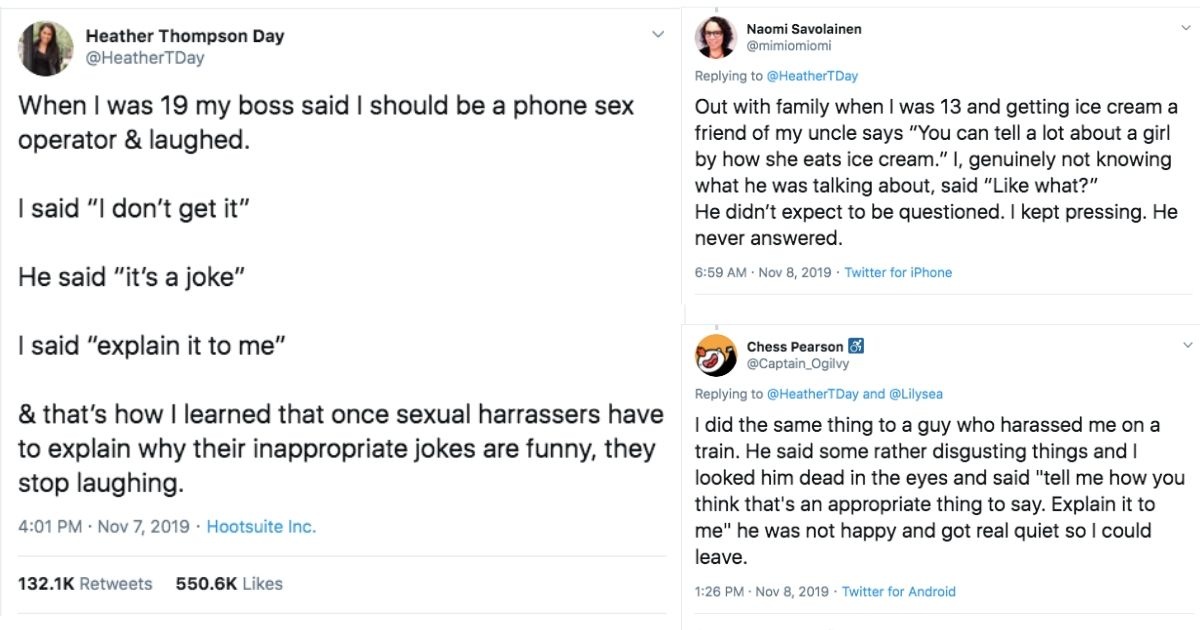
Perhaps women’s familiarity with such episodes is why writer Heather Thompson Day’s tweet about asking her male boss to explain a sexual joke to her has had such an enormous response. Day told a story of working at a radio station when she was 19 when her boss, who was in his mid-40s, made an inappropriate comment:
“When I was 19 my boss said I should be a phone sex operator & laughed.
I said ‘I don’t get it’
He said ‘it’s a joke’
I said ‘explain it to me’
& that’s how I learned that once sexual harrassers have to explain why their inappropriate jokes are funny, they stop laughing.”
When I was 19 my boss said I should be a phone sex operator & laughed.
I said “I don’t get it”
He said “it’s a joke”
I said “explain it to me”
& that’s how I learned that once sexual harrassers have to explain why their inappropriate jokes are funny, they stop laughing.
— Heather Thompson Day (@HeatherTDay) November 8, 2019
Day’s tweet has been shared more than 130K times. Other women also chimed in with similar stories of stopping sexist men in their tracks with their responses to inappropriate jokes.
My first internship was in a very professional company. We learned direct questions quickly stop inappropriate workplace comments. Direct eye contact:
1) I don't understand — explain it to me.
2) Help me to understand — repeat it.
3) Can you provide an example?
It works.— LiteFanFun (@LiteFanFun) November 9, 2019
YES! At my first full time job, my new boss called me and then made the comment that I had the voice of a phone sex operator. I responded, “I wouldn’t know. I’ve never called one.” His stammering and backpedaling still bring me joy over 20 years later.
— New Year, Same V (@scribblesnbitsV) November 10, 2019
I did the same thing to a guy who harassed me on a train. He said some rather disgusting things and I looked him dead in the eyes and said "tell me how you think that's an appropriate thing to say. Explain it to me" he was not happy and got real quiet so I could leave.
— Chess! ♿️ ?️⚧️ (@Captain_Ogilvy) November 8, 2019
What’s baffling is that some men may think that women actually might respond positively to such jokes. One woman simply responds to random harassers with “Please tell me about the last time this worked on an actual woman for you.” Works every time.
My personal favorite to dudes who try to chat me up in parking lots, etc. is to ask, “Please tell me about the last time this worked on an actual woman for you.” They IMMEDIATELY run away.
— hashtagkaren (@HashtagKaren) November 9, 2019
Of course, sometimes it takes more than just a no nonsense response to get some dudes to back off.
Was lifeguarding in college and had to watch the water while construction workers built a filming tower in the water. Kept pestering me about “mouth to mouth” and I kept answering with questions straight from the book.
— Leighann Strollo (@LeighannStrollo) November 8, 2019
RELATED: Emma Watson launches hotline that provides women legal advice on workplace sexual harassment
Sometimes it simply takes repeatedly being called out, especially if a man holds a position of power.
My boss made a joke about recognizing my mom because he probably had sex with her in college. I asked him to explain the joke, in an open office, while making direct contact with the COO, his boss. It took four more months and many incidents for him to be fired.
— Ellen Kaulig (@ekaulig) November 9, 2019
As one woman pointed out, it might take the threat of being documented to put an end to it. (Or, you know, actually documenting it can do wonders as well.)
Excellent. I was around 19 when a boss said something over the top and I replied with “I’m going to put that in my log” and he said “what log?” And I said “my harassment log. I write it all down”. And then it all just sort of stopped and I found out he didn’t sleep for 3 days ?
— Denike (@de_nike) November 9, 2019
Several men jumped into the conversation with words of support. Because of course plenty of men are bothered by sexist “jokes” as well and understand that genuine jokes can be explained without hesitation or embarrassment.
If a thing is genuinely a joke it would be easy to explain.
— dan sheppard (@ashenfaced) November 9, 2019
Men can also use a similar approach when confronting their friends, acquaintances, and colleagues when inappropriate comments or jokes come up.
In fact, Heather Thompson Day said it was her dad who originally instructed her on how to respond to men’s inappropriate comments. “Don’t laugh,” he told her. “Ask them to explain the joke. They will stop making them.” Well done, Dad.
I’m not as cool as it sounds. My dad told me when i got the job “if any men say inappropriate comments, don’t laugh. Ask them to explain the joke. They will stop making them.” So Dad’s for the win
— Heather Thompson Day (@HeatherTDay) November 8, 2019
It was also pointed out that this approach works with “jokes” that are racist, homophobic, or otherwise harmful as well. When people have to explain their prejudice and bigotry, they usually can’t.
Pro tip: this also works on race "jokes"
— Corey (@HowlFromtheCore) November 8, 2019
I've had several coworkers over the years say, "you know how THOSE people are…" expecting me to agree. So I always say, "no, how ARE they?" Please, explain your racism/bigotry/prejudice to all of us.
— Erin McCord (@erinmcfavorite) November 8, 2019
And then there’s always the next level “You remind me of someone heinous” response, which may be a bit brutal, but is sometimes necessary to drive home the point.
I had this happen with someone that thought it was cute to talk about 'coons. Once my "confusion" about racoons annoyed him, he finally dropped the N word, I gave my standard reply: You remind me of my grandfather. He liked to use that word, and he also like to rape little girls.
— Kristy (@llamalluv) November 8, 2019
People in marginalized groups have had to put up with hurtful jokes for far too long. Asking people to explain them and making them sit in the discomfort of their own filth is an excellent way to shut that garbage down.
This article originally appeared on 11.13.19