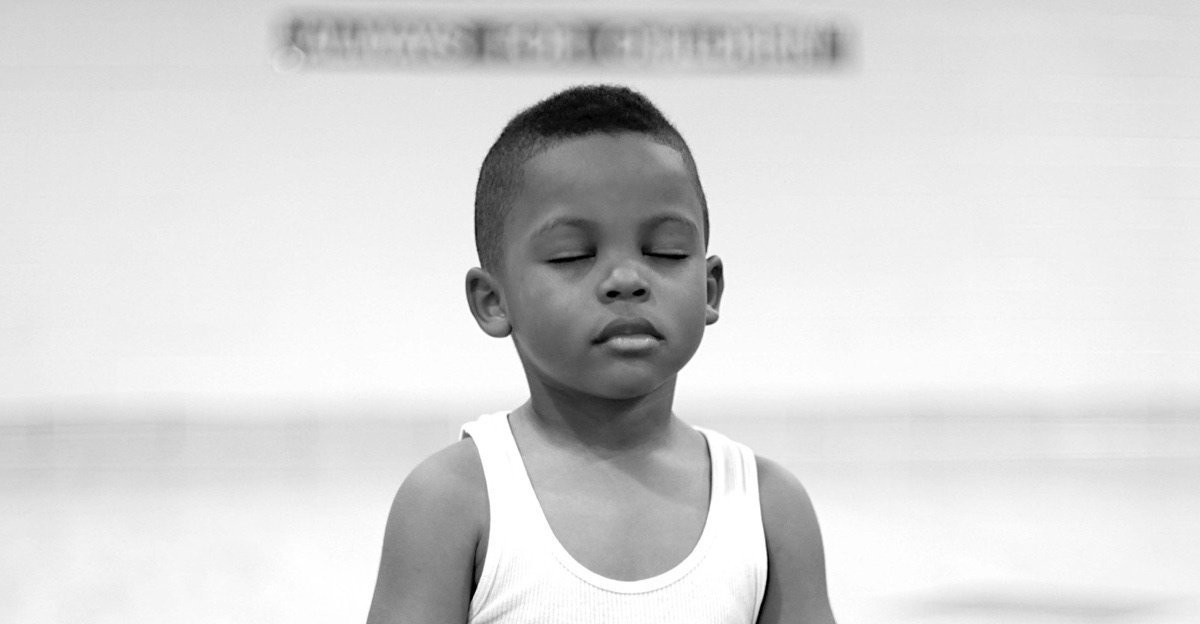
Teaching students how to self-regulate had big results.
Imagine you're working at a school and one of the kids is starting to act up. What do you do?
Traditionally, the answer would be to give the unruly kid detention or suspension.
But in my memory, detention tended to involve staring at walls, bored out of my mind, trying to either surreptitiously talk to the kids around me without getting caught or trying to read a book. If it was designed to make me think about my actions, it didn't really work. It just made everything feel stupid and unfair.
But Robert W. Coleman Elementary School has been doing something different when students act out: offering meditation.
Instead of punishing disruptive kids or sending them to the principal's office, the Baltimore school has something called the Mindful Moment Room instead.
The room looks nothing like your standard windowless detention room. Instead, it's filled with lamps, decorations, and plush purple pillows. Misbehaving kids are encouraged to sit in the room and go through practices like breathing or meditation, helping them calm down and re-center. They are also asked to talk through what happened.
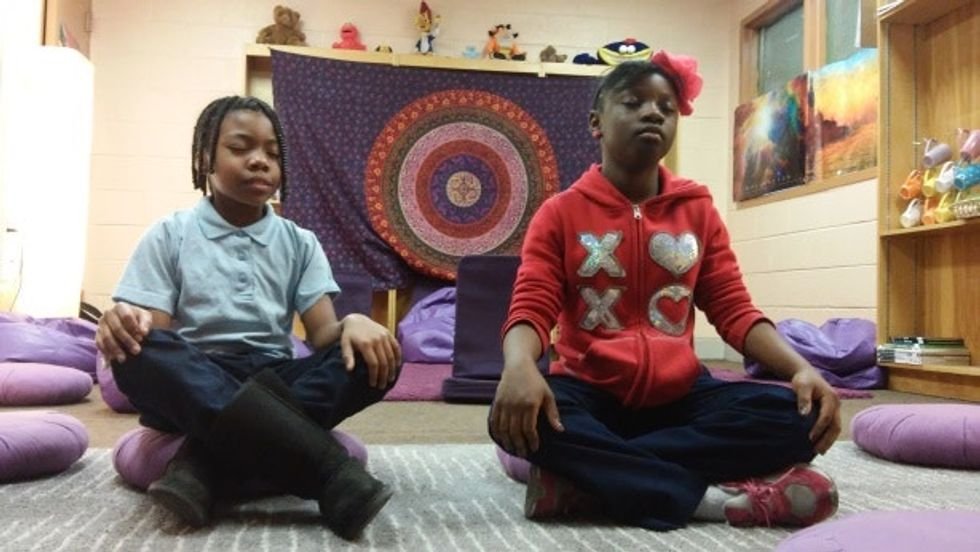
Meditation can have profoundly positive effects on the mind and body
Photo from Holistic Life Foundation, used with permission.
Meditation and mindfulness are pretty interesting, scientifically.
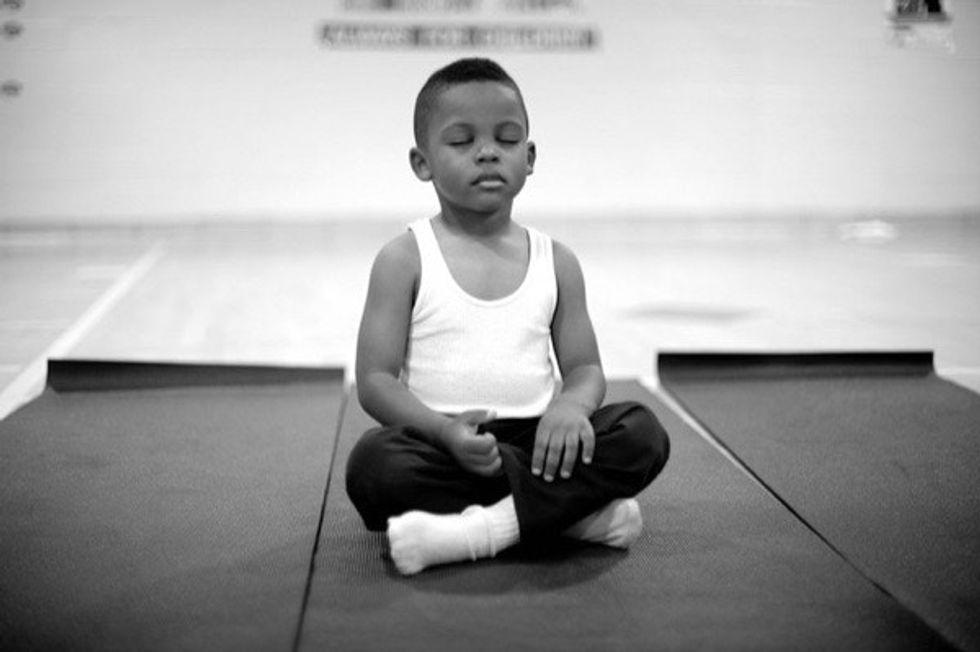
A child meditates
Photo from Holistic Life Foundation, used with permission.
Mindful meditation has been around in some form or another for thousands of years. Recently, though, science has started looking at its effects on our minds and bodies, and it's finding some interesting effects.
A 2010 study, for example, suggested that mindful meditation could give practicing soldiers a kind of mental armor against disruptive emotions, and it can improve memory too. Another suggested mindful meditation could improve a person's attention span and focus.
Individual studies should be taken with a grain of salt (results don't always carry in every single situation), but overall, science is starting to build up a really interesting picture of how awesome meditation can be. Mindfulness in particular has even become part of certain fairly successful psychotherapies.
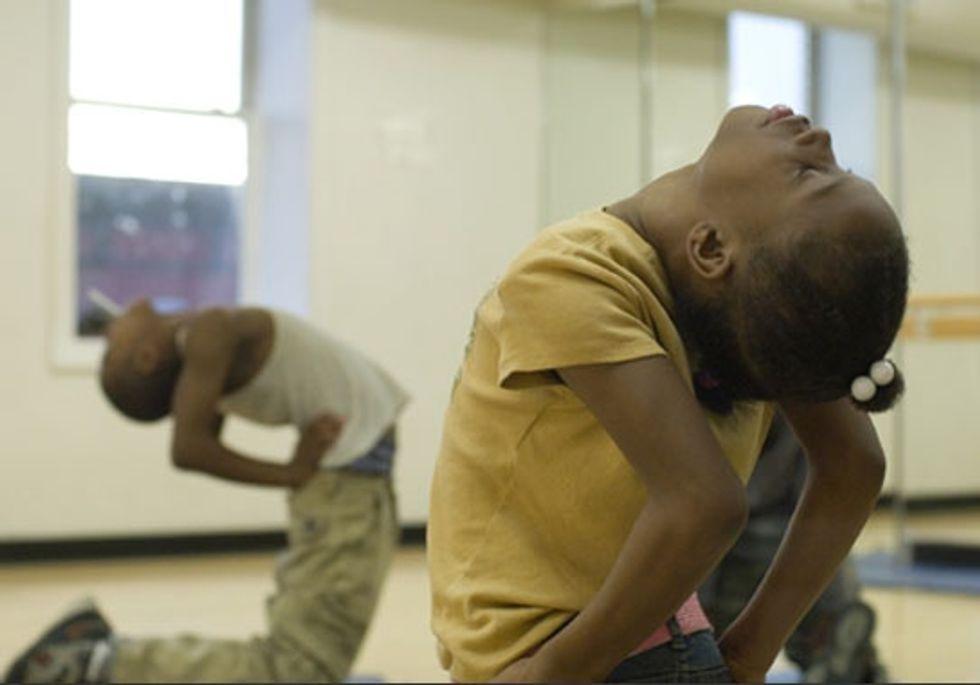
After-school yoga.
Photo from Holistic Life Foundation, used with permission.
Back at the school, the Mindful Moment Room isn't the only way Robert W. Coleman Elementary has been encouraging its kids.
The meditation room was created as a partnership with the Holistic Life Foundation, a local nonprofit that runs other programs as well. For more than 10 years the foundation has been offering the after-school program Holistic Me, where kids from pre-K through the fifth grade practice mindfulness exercises and yoga.
"It's amazing," said Kirk Philips, the Holistic Me coordinator at Robert W. Coleman. "You wouldn't think that little kids would meditate in silence. And they do."

A child meditates at the Holistic Life Foundation
Photo from Holistic Life Foundation, used with permission.
There was a Christmas party, for example, where the kids knew they were going to get presents but were still expected to do meditation first. "As a little kid, that's got to be hard to sit down and meditate when you know you're about to get a bag of gifts, and they did it! It was beautiful, we were all smiling at each other watching them," said Philips.
The kids may even be bringing that mindfulness back home with them. In the August 2016 issue of Oprah Magazine, Holistic Life Foundation co-founder Andres Gonzalez said: "We've had parents tell us, 'I came home the other day stressed out, and my daughter said, "Hey, Mom, you need to sit down. I need to teach you how to breathe.'"
The program also helps mentor and tutor the kids, as well as teach them about the environment.
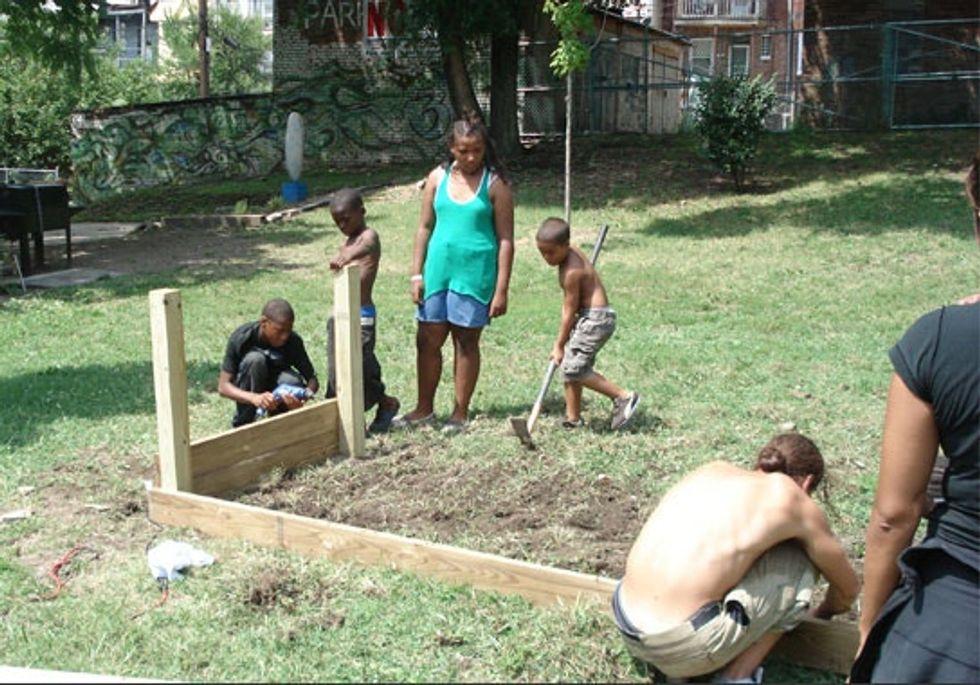
Building a vegetable garden.
Photo from Holistic Life Foundation, used with permission.
They help clean up local parks, build gardens, and visit nearby farms. Philips said they even teach kids to be co-teachers, letting them run the yoga sessions.
This isn't just happening at one school, either. Lots of schools are trying this kind of holistic thinking, and it's producing incredible results.
In the U.K., for example, the Mindfulness in Schools Project is teaching adults how to set up programs. Mindful Schools, another nonprofit, is helping to set up similar programs in the United States.
Oh, and by the way, the schools are seeing a tangible benefit from this program, too.
Philips said that at Robert W. Coleman Elementary, there were exactly zero suspensions during the 2014-15 school year and beyond. For over two decades, they've been transforming lives and schools for the better. Check out their progress on their Instagram.
This article originally appeared nine years ago.

- Frustrated mom can't believe her son was sent to 'Zoom detention' and everyone has her back ›
- Mindfulness expert shares back-to-school tips - Upworthy ›
- Zen master Shōhaku Okumura shares the meditation that's 'good for nothing' ›
- Kelly Ripa tries meditation and hilariously fails at it - Upworthy ›
- Student gets zero for not providing classroom supplies - Upworthy ›
- Mom rants about daughter's dress code violation at school - Upworthy ›
- American mom living in Japan shows her son's required school supplies - Upworthy ›
- Stressed students pretended to laugh for 40 minutes. Here's what happened. - Upworthy ›
- 5th grader makes dad proud by getting suspended for the best reason - Upworthy ›
- Parents complained about 'offensive' book, so the principal read it to the entire school - Upworthy ›
- Teacher reveals what he really thinks of his district's 4-day school week - Upworthy ›
- Maine high school sends kids who get detention on a 3 mile hike - Upworthy ›


A woman is getting angry at her coworker.via
A man with tape over his mouth.via
A husband is angry with his wife. via 
a man sitting at a desk with his head on his arms Photo by
Can a warm cup of tea help you sleep better? If you believe it, then yes. Photo by 
Three women sit on a blanket in the park. 
Two women engaging in a pleasant conversation inside a coffee shop
Two men engaging in a peaceful disagreement.
Resurfaced video of French skier's groin incident has people giving the announcer a gold medal
"The boys took a beating on that one."
Downhill skiing is a sport rife with injuries, but not usually this kind.
A good commentator can make all the difference when watching sports, even when an event goes smoothly. But it's when something goes wrong that great announcers rise to the top. There's no better example of a great announcer in a surprise moment than when French skier Yannick Bertrand took a gate to the groin in a 2007 super-G race.
Competitive skiers fly down runs at incredible speeds, often exceeding 60 mph. Hitting something hard at that speed would definitely hurt, but hitting something hard with a particularly sensitive part of your body would be excruciating. So when Bertrand slammed right into a gate family-jewels-first, his high-pitched scream was unsurprising. What was surprising was the perfect commentary that immediately followed.
This is a clip you really just have to see and hear to fully appreciate:
- YouTube youtu.be
It's unclear who the announcer is, even after multiple Google inquiries, which is unfortunate because that gentleman deserves a medal. The commentary gets better with each repeated viewing, with highlights like:
"The gate the groin for Yannick Bertrand, and you could hear it. And if you're a man, you could feel it."
"Oh, the Frenchman. Oh-ho, monsieurrrrrr."
"The boys took a beating on that one."
"That guy needs a hug."
"Those are the moments that change your life if you're a man, I tell you what."
"When you crash through a gate, when you do it at high rate of speed, it's gonna hurt and it's going to leave a mark in most cases. And in this particular case, not the area where you want to leave a mark."
Imagine watching a man take a hit to the privates at 60 mph and having to make impromptu commentary straddling the line between professionalism and acknowledging the universal reality of what just happened. There are certain things you can't say on network television that you might feel compelled to say. There's a visceral element to this scenario that could easily be taken too far in the commentary, and the inherent humor element could be seen as insensitive and offensive if not handled just right.
The announcer nailed it. 10/10. No notes.
The clip frequently resurfaces during the Winter Olympic Games, though the incident didn't happen during an Olympic event. Yannick Bertrand was competing at the FIS World Cup super-G race in Kvitfjell, Norway in 2007, when the unfortunate accident occurred. Bertrand had competed at the Turin Olympics the year before, however, coming in 24th in the downhill and super-G events.
As painful as the gate to the groin clearly as, Bertrand did not appear to suffer any damage that kept him from the sport. In fact, he continued competing in international downhill and super-G races until 2014.
According to a 2018 study, Alpine skiing is a notoriously dangerous sport with a reported injury rate of 36.7 per 100 World Cup athletes per season. Of course, it's the knees and not the coin purse that are the most common casualty of ski racing, which we saw clearly in U.S. skier Lindsey Vonn's harrowing experiences at the 2026 Olympics. Vonn was competing with a torn ACL and ended up being helicoptered off of the mountain after an ugly crash that did additional damage to her legs, requiring multiple surgeries (though what caused the crash was reportedly unrelated to her ACL tear). Still, she says she has no regrets.
As Bertrand's return to the slopes shows, the risk of injury doesn't stop those who live for the thrill of victory, even when the agony of defeat hits them right in the rocks.