upworthy

mckinnon galloway

Photo credit @mckinnongalloway (with permission)

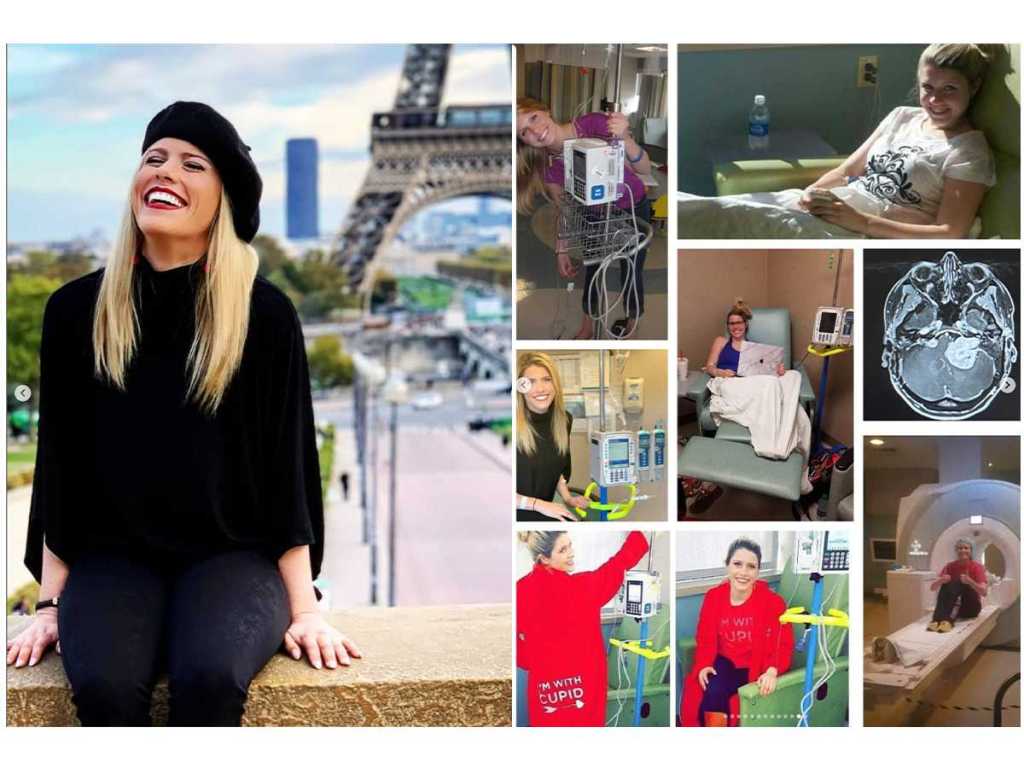
McKinnon Galloway in Paris, France and images showing some of her medical experiences.

McKinnon Galloway is a health advocate and public speaker raising awareness about neurofibromatosis (NF2), a genetic disorder causing tumors to grow on nerves. In an Instagram post, she recounts her experience navigating cancer, surgeries, and other health challenges that began when she was just 16.

At 32, she's facing chemotherapy again. Her simple, honest reflection, conveyed through a kind smile and a warm laugh, says everything about an amazing young woman. It's no surprise that a growing following is not only enamored by her, but deeply intrigued by her positive mindset and drive to serve others.

Four brain surgeries and an unbreakable spirit

In the video, Galloway takes viewers on a journey through countless doctor visits, MRIs, surgeries, chemotherapy treatments, the loss of her hearing, and even an allergic reaction to epilepsy medication that changed her personality for a year. She smiles, laughs, and shares all the uncomfortable details with incredible poise and clarity. At 31, she finally caught a break from the constant medical hoops, only to face chemotherapy again at 32. Galloway shares, "A lot of people ask me how am I so happy?" This is what she has to say in the video:

"It's not about having a pain-free life; it's about having a meaningful one. So I took all of that pain, and I turned it into purpose. So now, I help as many people as I can, as much as I can, as long as I can. Because I believe when you help others, it not only helps them, but it heals you in return."

hospital, healing perspective, kindness, service, helping people, Instagram post, transcribing device, love At the hospital, fingers crossed.Photo credit: @mckinnongalloway (with permission)

Galloway shares a powerful message

Upworthy spoke with Galloway about her journey, gaining insight into how she developed such a strong perspective while navigating a complex and unique life. Here are some of her thoughts:

What about your experiences led you to the conclusion that helping people was healing?

"Living with chronic illness and disability can make your world feel very small. So much attention goes into what you’re losing, what’s changing, and what you can’t control. When I began helping others and sharing what I was learning, offering perspective or helping however I could something in me shifted. My experiences stopped feeling like isolated pain and started feeling like purpose. Helping people didn’t fix what I was going through, but it gave my struggles somewhere to land. It reminded me that even in the middle of uncertainty, I could still create impact, and that was really healing."

Was there a specific moment or experience that served as a catalyst for finding this mindset?

"After my 3rd brain surgery, I had gone completely deaf. Being deaf in a hearing community is very isolating. We don't grow up knowing ASL or lip-reading. People who have my illness (NF2) can go deaf overnight as I did. Literally overnight. I am a tech nerd so when I lost my hearing, I turned to deaf technology. I found a transcribe device and it wasn't perfect but it was a start.

I was at a conference, and a mom came up to me and asked, 'What is that?' I said, 'well, it's how I get around.' And she said, 'I can't believe that is a thing,' and I said 'well how do you communicate with Jake?' (which was her son, who was deaf) She said, 'Well we text' and I said 'For how long?' She said, 'Well, for 10 years now.' I grabbed their phones and downloaded some transcription apps that just came on the market.

The next day she comes up to me, and she tells me that her and Jake had their first successful conversation in 10 years. Tears are just streaming down both our faces. My soul overflowed with love, fulfillment, and happiness. I have been through hell and back,and I thought I had nothing left to give. And here, because of my trials, was the reason I was able to give. I haven't stopped since."

She was able to sit down and have a nice talk with that exact mom in this Instagram post:

How do you handle moments of hopelessness or despair?

"I feel like you don't have an incurable illness with 4 unsuccessful brain surgeries, over 50 bad MRIs and 16 years of failed chemotherapy, and not have hopelessness. lol... I experience hopelessness and massive anxiety. There isn't a cure for what I have. Most time I feel hopeless is when I go through an MRI and get an outcome I don't want. I have had over 50 MRIs, and since I am still battling this, almost all of them have been outcomes that you don't want. Having large brain tumors is scary. And I don't have just brain tumors, I have 6 spinal tumors too. When you start laying out the possibilities of what can happen, it gets heavy fast.

My biggest thing is to feel what you feel, then wipe your tears, stand back up and move forward. It's not healthy to hold it in. Cry it out. I feel sometimes people get stuck with holding it in or just letting it out all the time and wallowing. I believe handling this in a healthy way is a balance. Holding it in all the time isn't a strength. That exhaustion. Yesterday I cried all day. I have an MRI coming up. So I give myself the grace to get it out but I don't give myself excuses to not move forward. Yes, I have been dealt a difficult hand, but we have ONE life. And every moment, I can, I am going to live it fully."

puppies, playfulness, honesty, small stuff, brain surgeries, spa day, brain, COVID Nothing quite like puppy love.Photo credit: @mckinnongalloway (with permission)

What do you wish more people knew about the struggle and suffering?

"I wish people had my perspective but didn't have to go through what I have gone through to get it. Because it's really beautiful. You don't waste time on the small stuff. The minor problems because you understand how short and fragile life can be. When you struggle, yes, it sucks, but it also brings perspective. I am a very happy person, but I became so much happier after I almost died. I know, sounds weird. My 3rd brain surgery turned tricky. My brain was swelling, and we didn't know what to do. I remember thinking if I ever see out of this hospital room I am going to really live. Freely and fully.

Don't sweat the small stuff, because in the end, you'll realize...it never really mattered. (Honestly, this question could be answered with this one line.)"

Can you summarize how you approach each day in a few sentences?

"Simple, I wake up and think to myself, 'It's a beautiful day to be alive!' Today I am going to enjoy as much as I can.

After my 3rd brain surgery, my eye rolled inwards. I am sitting there in a hospital bed, really sick, with brain swelling, during COVID. Oh, and completely deaf. My mom and one of my best friends walk in, and the nurses help me set up a makeshift spa day with hospital towels and wash bins for our feet. And in the hospital bed, we had a spa day with a facemask and a COVID mask over them. Hospital Soap and ICU washcloth. That is now such a core memory for me. It was the moment I realized, the day is what you make it."

MRIs, fishing, hospital bed, @mckinnongalloway, mindfulness, gratitude, optimism, hope More pictures showing the balance of finding fun and doing what it takes.Photo credit: @mckinnongalloway (with permission)

Experts agree that mindset dictates happiness

Mindfulness, gratitude, optimism, and hope are all linked to happiness. Research conducted in 2025 examined whether positive coping strategies affect life stressors. The more people relied on these skills to manage challenges, the better off they felt. These positive traits helped individuals cope more effectively, manage stress, and strengthen their mental health during complex and demanding situations.

Much like Galloway, finding purpose and meaning can help prolong life and better manage depression. A 2022 study found a direct correlation between a higher purpose and overall lifespan. A 2023 study substantiated the idea that "you have to give to receive." Community connectedness, shared vulnerability, emotional expression, and a pay-it-forward approach improved health, reduced depression, and increased physical activity. The results strongly support the idea that small acts of kindness and generosity ripple through communities and have real health benefits.

cliff jumping, psychological traits, well-being, coping strategies, life stressors, determination, spirit McKinnon showing off some cliff jumping skills.Photo credit: @mckinnongalloway (with permission)

If you'd like to follow Galloway and grab some inspiration for your own life, go to @mckinnongalloway on Instagram.