upworthy
Add Upworthy to your Google News feed.
Google News Button
Public Health

A scientist tested the air from a hand dryer and the results are wild. But there's a catch.

"Will we ever be clean?!"

hygiene, health, public health, germs, viruses, bathroom, public bathroom, toilet, hand washing, personal hygiene
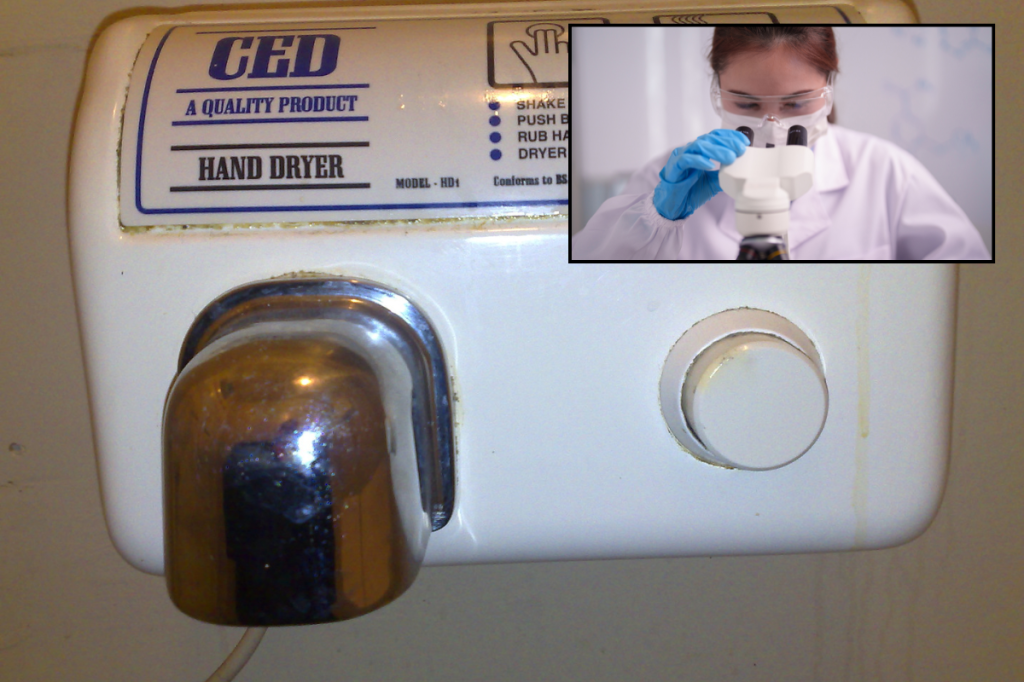
Photo Credit: Mark Hillary/Flickr & Canva

A scientist tested the air coming out of a bathroom hand dryer and, wow.

Even under the best of circumstances, public restrooms are pretty gross. Most of us like to spend as little time as possible in there, touching as few surfaces as we can manage. Then, we promptly and thoroughly wash our hands so we can get the heck out of there.

But first, we have to dry our hands. Many, if not most, public restrooms offer air hand dryers of all different makes and models. They cut back on paper waste and, unlike paper towels, they never run out and leave patrons in a lurch. But are they actually hygienic?

In 2024 a scientist from the UK, Ruth MacLaren, went viral after conducting a simple bacteria test on a public restroom hand dryer.

MacLaren is the founder of Devon Science, an organization that helps kids get involved with STEM through science parties, interactive experiments, and educational programming.

"Urghh, don't use a hand dryer," the caption read to her original video posted on TikTok. In the experiment, she placed an agar plate (a sterile petri dish filled with a jelly-like substance that collects bacteria and other particles) under the dryer as it blew air. As a control, she wafted another agar plate around in the air and let both plates sit overnight.

The next day, the results definitely...blew her away.

The petri dish that was exposed to the hand dryer grew dozens of visible clusters of bacteria, including many different varieties. The sample of regular air, on the other hand, grew nothing; indicating very little bacterial presence.

@devonscience

Urghh, don't use a hand dryer😱🦠 ----- Update: thank you for all your comments & suggestions. Totally blown away by how far this little video has reached 😮 I'm planning on doing some update videos on this experiment and will post on here, as well as on our FB & IG pages, which you are welcome to follow as well 😉 Thank you, Ruth (from Devon Science) #germs #publictoilet #bacteria #dirty #gross #justdont #scienceteacher #handwashchallenge #handdryer #science #scienceexperiments #microbiology #scienceproject #lesson #handdryer #handdryerbacteria

MacLaren's video racked up over 28 million views across social media and thousands of comments from icked-out viewers.

"This is also why we don’t use hand dryers in health settings , soap water and a disposable towel is best," one person wrote.

"I will never use one again," added another.

Several folks chimed in to add that they've never liked hand dryers, and not because of anything to do with hygiene. The incredible noise-level coming out of them has been well-documented as problematic for children or people with sensory issues.

"Me with my autism not using hand driers because the sound of them makes my brain go *stressed screeching*" a commenter wrote.

"I hate the blowers... they're loud, they're too hot, I just want paper towels & a recycling bin to put them in" said another.

To celebrate the roughly one-year anniversary of her massively viral hit, MacLaren revisited the same hand dryer and performed another test—but with a few tweaks that shed even more light on the problem.

This time she sampled the air from the bathroom (and not her workspace), and she also modified the test to see if the germs from the air blower were transferring to her hands after she had washed and dried them.

While the new sample of the bathroom air did show some bacteria, the growth had nothing on the hand dryer sample, which once again grew significant bacteria. Even more upsetting, MacLaren's before and after sampling of her hands showed quite a bit of bacteria even after washing and drying using the blower. Unfortunately, that's sort of the opposite of what we're all going for when we take the time to thoroughly wash our hands.


@devonscience

Has anything changed? Did that hand dryer get a service or clean? For its viral birthday 🎉 (28M views), I went back and retested THE hand dryer seen by so many, this time I also tested my hands before & after using it. I've identified the main bacterial species growing (they're common environmental bacteria), and they're coming from inside the machine vents (see videos on this). Please see my follow up videos on this which will answer some of your questions, i.e. are the bacteria harmful, what do these results mean, what happens next! Remember this is a quick test, not a scientific experiment, but it could be a great project for someone studying microbiology. I've tested a few different hand dryers over the last 12 months, have a look at the videos on my profile. #handdryer #bacteria #viral #germs #dirty

MacLaren is not the first or only person to discover the less-than-ideal cleanliness of air hand dryers.

While MacLaren explicitly caveats that her experiments are just casual quick-tests and not scientifically validated studies, scientific studies have in fact been performed in this area.

One study published in the Applied and Environment Microbiology Journal found that "many kinds of bacteria, including potential pathogens and spores, can be deposited on hands exposed to bathroom hand dryers and that spores could be dispersed throughout buildings and deposited on hands by hand dryers."

It's worth considering that there are many different kinds of hand dryers available in public restrooms. The one MacLaren tested in her videos is a little old-fashioned and likely not equipped with a very efficient filter. State-of-the-art hand dryers usually feature HEPA filters that are supposed to catch germs and viruses from the air so they're not re-distributed. But even more modern options, like the Dyson Airblade, have routinely failed bacterial tests.

It seems clear that old-fashioned paper towels are the more hygienic option. But, like a good scientist, MacLaren decided it was only fair to test those as well.

She was extremely surprised to learn that drying her hands with a paper towel still left quite a bit of bacteria on her hands. In fact, testing just a dry paper towel (with no contact to her exposed hands), unbelievably, showed substantial amounts of bacteria growth fresh out of the package.

The most effective test involved washing thoroughly, drying with a paper towel, and then using hand sanitizer. But, MacLaren warned, "That clearly works great ... but I'm killing my good friendly microbes as well."

@devonscience

Replying to @superjayduperPaper towel bacteria test! Loads of you asked me to do a test to see if paper towels have less bacteria compared to hand dryers. I was surprised at how many bacteria were on the paper that was from an enclosed dispenser! Anyway I've included in this test using hand sanitiser as well so you can get the complete picture. 😁 Thank you so much for all your likes, comments, shares and follows. I hope you enjoy the bacteria videos as well as our posts about making science awesome for kids in the UK, through our school programmes, community events and science parties 🧪🥳🫟 #toilet #dirty #germs #bacteria #handdryer

"Will we ever be clean?!" one commenter lamented.

"Just wash your hands after drying them. easy," joked another.

All is lost not, however. In a series of follow-up videos, MacLaren makes it clear that she's not fear-mongering about germs. The bacteria found in her testing are generally not harmful to most people.

"All of you have been asking about the kinds of bacteria on these agar plates... They're just normal environmental microbes," she says. "A lot of them are bacteria you find on your skin. But for me it was the quantity of bacteria coming out of the machine that was a bit of a shocker."

Harvard Health confirms that in scientific studies, "the vast majority of the microbes that were detected do not cause disease in healthy people." Gross? Yes. Dangerous? Probably not.

Immunocompromised folks may want to take extra precautions, however.

In the end, the most optimal course of action most experts including MacLaren agree on is to wash your hands and dry with a paper towel. All the better if you have access to a clean cloth towel. But as the tests prove, it's nearly impossible to get all the bacteria off your skin. Even if you could, you might not want to. Excessive removal of oils, microbes, and bacteria on your skin (say, from too much hand sanitizer) can cause dry, itchy skin and can worsen skin conditions like eczema.

Maybe it's time to bring back the clever, if a little unsettling, rotating hand towel devices that used to be found in public restrooms:

For now, the best strategy is still the time-tested one: Get in and out of the public restroom as fast as possible.


crowd, unique, personality type, nonconformist
Photo Credit: Canva

A person stands out in a crowd.

So many of us have the desire to compartmentalize our personality traits into neat little boxes. "Oh, she's such an INFJ. Oh, he's such a Gemini." Some of it is rooted (well sort of) in psychology, such as the Myers-Briggs Type Indicator, based loosely on Jungian ideas. Others rely on arguably less scientific data like stars and "rising signs." Humans aren't usually that simple.

That said, there's still value in understanding one's own personality and inclinations. Here's a confession: I've taken countless personality tests because I just couldn't figure out if I was an extrovert or an introvert. Neither description quite fit, and as someone constantly trying to understand what makes me tick, this has been frustrating.


Turns out, there are other options. The term "ambivert" got popularized in the 1930s (after being coined by Edmund S. Conklin in 1923), and it refers to a person "who has features of both an introvert (someone who prefers to spend time alone) and an extrovert (someone who prefers to be with other people) in their personality."

@tedtoks

Replying to @Factura🛄 now knowing what an ambivert is, how would you describe yourself? #ambivert #introvert #extrovert #adamgrant #psychology #TEDTalk #worklife

But for those who still don't quite relate, meet the otrovert. Just recently, psychiatrist Rami Kaminski published The Gift of Not Belonging, in which he discusses his coined term to describe a whole new type of personality. In an Insta-reel captioned "What is an Otrovert?" Kaminski mentions the polarization of introverts and extroverts. "When Jung invented the terms extrovert and introvert, he saw them as two fundamental orientations of the personality. I see the otrovert in the same way. A personality trait that faces away from the group."

He continues, "Extroverts and introverts are inherently communal, while the otrovert is an outsider to the group. In itself, it is not a problem or condition, nor is it a diagnostic label. It simply means that while most people learn to develop a sense of belonging to a specific group through social conditioning, otroverts remain social but not communal."

In writer Sarjna Rai's piece, "Struggle to Fit the Mold? The 'Otrovert' Personality Explains Why" for Business Standard, they write: "Unlike introverts or extroverts, otroverts are not defined by where they draw their social energy. Instead, the concept captures people who constantly feel like outsiders, and tend to look in a different direction altogether, not necessarily aligned with the rest of the group."

While it's impossible to group people into perfect categories, Rai explains that Kaminski claims the main thing that sets otroverts apart is their "reluctance to conform to group norms."

Writer Avery White lists signs one might be an otrovert in the article "7 Signs You Might Be an Otrovert" for VegOut. Among them is preferring "high-signal conversations and low-maintenance relationships." They give this as an example: "You’ll happily spend three hours exploring one idea with one person—and then not speak for weeks without either of you taking it personally. In other words, low pressure, low expectations, high connection.

Another on the list—and this is a big one according to Kaminski—is: "You can look extroverted in public—yet feel fundamentally 'other.'" This is actually the crux of the term, and in fact, what Kaminski formed The Otherness Institute for: as their website says, "those who feel they don't belong."

The site also shares that recognizing aspects of this type in yourself and others (if it applies) will help "balance between your individuality and your function as part of the social matrix that determines your well-being. The experience of otherness in a togetherness-minded world can be emotionally bruising. Often misunderstood and misdiagnosed, otherness may lead individuals to feel strange, lonely, and unwelcome in groups. Left unidentified, otroverts' non-belonging can result in a frustrating, futile lifetime effort of trying to 'fit in.'"

Some Redditors are scrambling to figure out if they fit into this category. In the subreddit r/INTP (referencing one of the Myers-Briggs personality types), the OP asks, "Maybe I am an 'otrovert?'" Under this, they write, "Dr. Kaminski described the otrovert child as 'neurotypical, friendly, curious, well-adjusted, and often popular' yet 'they resist being pressured into group activities.'"

While this can seem inconsequential in childhood, joining the peer group "becomes critically important" in adolescence, said the psychiatrist, and teens "start to gauge their self-worth based on the group’s ranking of popularity (or unpopularity).'

"Membership in a group, no matter how lowly, is better than being an outsider," he added. "Otroverts, however, are comfortable with being outsiders and find it impossible to feel like insiders, regardless of how welcome they are.'

There are a handful of commenters who feel seen, but many push back, claiming the term could easily apply to other personality traits. One writes, "I think it's easy to resonate with this description... but as some warning noted, there aren't enough studies done about this term that people should be running to adopt it. I resonated with it after reading about it... But I have ADHD and persistent depressive disorder... both of which coincide with the descriptions of an otrovert."

Time will tell if this new term sticks, but for now, it's helping a lot of people feel more understood.

This article originally appeared last year.


Internet

Cleaner shows how to affordably 'fancy up' a worn-down home, and so many people finally feel seen

"This may be the only home-related video I’ve ever seen that actually acknowledges poor people exist."

cleaning, home makeover, home renovation, low-income housing, poverty

Seeing a realistic home makeover in a lower-income family home is unusual but refreshing.

For years, home renovation and home makeover content has entertained the masses, giving people aspirational ideas and serving as fodder for people's "dream home" desires. But amidst all the quartz countertops, trendy paint colors, and affiliate decor links, a huge swath of people have felt unseen in their own homes.

The reality is that nearly a third of Americans live in low-income households, where the idea of replacing floors or furniture or even repainting a room is way beyond the budget. A lot of homes don't even look like the "before," much less the "after," of home redo content, which is why a video from Midwest Magic Cleaning showing an affordable glow-up of a real-life, worn-down home has been viewed nearly five million times.


As one commenter wrote, "This may be the only home-related video I’ve ever seen that actually acknowledges poor people exist." Using mostly what the family already had, we get to see a transformation from a depressing, cluttered space to a welcoming, tidy home, and the before and after is every bit as satisfying as anything on HGTV.

- YouTube www.youtube.com

The gentleman from Midwest Magic Cleaning perfectly diagnosed the issue with this home right out the gate, saying:

"I grew up in places that look a lot like what I'm showing you here. We didn't have much money, the place was kind of falling apart, and we didn't have the money or the time to fix it. They had bad paint jobs, broken molding, broken trim, terrible carpets, terrible floors, terrible lighting. You get close to the holidays, and you're just not sure what to do. You're embarrassed to have people over, and you know that fixing the place and painting it would do wonders, but if you had the money and time to fix it and to paint it, you wouldn't have this problem in the first place."

He started with a "move out, move in" cleaning, where he got rid of all the trash and then took everything but the basic furniture out of the room. Large furniture got moved out of the way to clean underneath it.

He then rearranged the room in a way that made it look bigger and "fancier" by putting the sofa in the center instead of along the wall. Lighting, he said, can make all the difference in a depressing room, so the first things he bought were a floor lamp and two end table lamps for the living room. When the mood of a room is depressing because of bad lighting, it inhibits motivation, which just contributes to a cycle of depression. He put up curtains as well to filter light and hide the fact that the windows had no trim.

curtains, windows, home makeover, home improvement, home Curtains can help make a space feel homey and hide bad windows and trim.Photo credit: Canva

For the kitchen, he broke the process down into three steps: 1) Get rid of all the trash. 2) While you're getting rid of trash, put away anything you can put away. And 3) Clean surfaces. He used curtains to hide open cabinets and purchased a pantry shelf for $25. All in all, he spent about $300 on curtains, curtain rods, and a few pieces of furniture, but he said he could have done the whole makeover for free by getting donated, hand-me-down curtains and other items.

The end result isn't "fancy," but it's tidy, homey, and organized. And perhaps most importantly, it's doable.
People in the comments raved about the video:

"My momma used to say...'We may be broke but we will be clean.' Clean and organized goes a long way."

cleaning, clean home, neat and tidy, vacuum, sofa Clean and tidy sets a mood.Photo credit: Canva

"I like the way you kept their home looking like their home. The change was subtle, yet not so drastic that they wouldn’t feel like they were not in the same home."

"Thank you for addressing the sad dark room = depression = no motivation = room gets dirty = depression cycle because I am going through that right now and it just feels nice to be seen and for once, to not feel like I'm just a horrible goblin."

"Dude. I’m sitting here with a negative bank account and feeling like I’m being worked to the bone at my job. My home is messy and depressing and it’s difficult for me to relax even when I have time. This is so inspiring and I can’t wait to go home and clean."

"I love this real approach. I grew up in poverty, and know all too well the depressing loop that these types of environments create. This is real motivation for people — not the typical shiny, expensive, unobtainable 'improve your home!' fluff that social media is filled with."

"The lights did SOOOOO much. As a trailer park kid, who at one point in my life had bare plywood covering a hole separating inside from outside, this was so refreshing. Poor people deserve to have nice homes too. I’m VERY blessed to not be there anymore but I will always remember what that it’s like. Thank you for your wisdom, video, and work."

lamp, lighting, light bulb, lights, home makeover Lighting makes a big difference in how your home feels.Photo credit: Canva

"I was raised as a 'lace curtain Irish' where you put up lace curtains even if you're dirt poor. It lifts your spirits and makes your home look inviting. This video is so respectful of this family and makes the home look great."

"This is how my mom used to 'fancy up' our poor when I was growing up. She saved small amounts of money each pay to buy things at yard sales or discount bins. Its amazing how a little here and there raises the spirits. I never knew how poor we actually were. I just thought she really loved beans and potatoes."

While it's fun to daydream with home improvement shows and content, seeing a real makeover of a lower-income home is truly inspiring.

dog experiments, dog tongue cleaner than humans, experiments by kids, cool science, dogs, fun science, experiments, science

A young teen boy holding a beagle.

Dogs come in a wide variety of breeds, along with their own unique personalities and needs. They can be guardians, helpful workers, loyal friends, snuggly companions, but there's one thing almost all dogs have in common: Licking.

Sure, some dogs lick way more than others, but it's rare to find a dog who never licks anyone or anything. Many dogs communicate and show affection by licking, which is sweet—if a little gross—depending on how slobbery they are. There's a common saying that dogs' mouths are cleaner than humans', which is a bit hard to believe when you see what some dogs put in their mouths, but it is true?

What does science say about dog tongues and saliva? Is a dog licking our face something we should worry about?


dog experiments, dog tongue cleaner than humans, experiments by kids, cool science, dogs, fun science, experiments, science A man being licked by a golden retreiver. Photo credit: Canva

It turns out, the answer to whether a dog's mouth is cleaner than ours isn't super straightforward.

An 8th grader named Abby tackled this question in a science experiment that won her a Young Naturalists Award from the American Museum of Natural History in 2011. Her family had gotten a dog and her mom kept telling her not to let the dog lick her face because dog mouths are full of bacteria. Instead of arguing, Abby decided to find out herself if this was true.

"I hypothesized that human tongues would be cleaner than dog tongues," she wrote. "I thought this because humans brush their teeth at least once a day. I hypothesized that dogs' tongues would be dirty because they were always licking dirty things like garbage."

After diving into the research about bacteria that live in and on humans and dogs, Abby decided she had a testable hypothesis. But this wasn't any old middle school science experiment. She applied for and got a grant to the State Hygienic Lab at the University of Iowa, where she was assigned a mentor to work with her.

You can read the nitty-gritty details of her experiment here, but it involved a lab, swabs, agar plates, and more. Here was the conclusion:

dog experiments, dog tongue cleaner than humans, experiments by kids, cool science, dogs, fun science, experiments, science A dog's tongue close-up. Photo credit: Canva

"I concluded that dog and human mouth flora are very different. (Flora means the bacteria found in a mouth or anywhere else.) The bacteria found in human mouths are more similar to another human's oral bacteria than the bacteria found in a dog's mouth.

"I also concluded that dogs' mouths are cleaner than humans' in some ways, and dirtier in other ways. Humans have more bacteria in their mouths than dogs do, based on the total number of bacteria. Most of the humans had a 'moderate' number of bacteria, and most of the dogs had 'few' bacteria. A possible explanation of this might be that dogs pant a lot, and maybe while panting, bacteria falls off their tongues along with their saliva. But dogs had more types of bacteria. The average number of different bacterial colonies in a dog's mouth was about 5.7. The average number of different bacterial colonies in a human's mouth was about 4.1. I think this is so because dogs sniff and lick a variety of things, like carpets, floors, chairs, grass, etc., so they pick up bacteria from many places."

But what about the licking of our faces? That's a bit of a subjective call, but Abby's results gave her some peace of mind:

"In conclusion, will I let my dog continue to lick me? The answer to the question is yes!" she wrote. "I will feel guiltless about letting my dog lick me because I found out that human and dog oral bacteria are different, so my dog's oral bacteria present no harm to me."

What do the experts say?

According to Colin Harvey, professor at the University of Pennsylvania’s School of Veterinary Medicine and executive secretary at the American Veterinary Dental College, comparing dogs' mouths to humans' mouth is "like comparing apples to oranges." As Abby found, the microbes in a dog's mouth are very different than those in a human's.

The American Kennel Club elaborates:

"Most of the bacteria in your dog’s mouth aren’t zoonotic, which means you probably won’t get a disease from a big old doggy kiss. There are exceptions to this. Dogs that eat a raw diet are at an increased risk of contracting salmonella, which can be spread to humans. You also probably shouldn’t share kisses with a dog that regularly raids the litter box.

In other words, kissing your dog is less risky than kissing another human, but that doesn’t mean that your dog’s mouth is necessarily cleaner than a human’s—they just have a mostly incompatible set of germs."

Keeping your dog's mouth healthy through regular teeth cleaning and dental check-ups can also help prevent issues that could potentially come from dog licks.

dog experiments, dog tongue cleaner than humans, experiments by kids, cool science, dogs, fun science, experiments, science A golden retreiver getting their teeth brushed. Photo credit: Canva

So there you have it. If your dog doesn't eat a raw diet and doesn't go snacking in the cat box (or some other equally fecal-bacteria-ridden place), their kisses are probably not going to hurt you. Guilt-free pooch smooches for the win!

This article originally appeared last year.

cathedral effect, psychology, productivity, creativity, human brain, neuroscience, art, deep thinking

Working in spaces with high ceilings may improve your ability to think creatively.

Our physical surroundings play a larger role in our behavior, emotions, and well-being than we might think. For example, if you ever feel like you're stuck in a creative rut or having trouble with critical thinking, you might want to look up at the ceiling.

Research has discovered a correlation between ceiling height in a room and our ability to think creatively. It's called the "Cathedral Effect."


When you imagine a cathedral, of course, you envision a great open space with towering ceilings far above your head. It's cavernous and spacious. In pictures, people standing in cathedrals appear incredibly tiny; almost insignificant. Therein lies the magic.

cathedral effect, psychology, productivity, creativity, human brain, neuroscience, art, deep thinking Cathedral-like libraries like the George Peabody Library in Baltimore, Maryland are popular places for creative work.By Matthew Petroff/Wikimedia Commons

Architect and designer Patricia Fierro-Newton is an expert on "neuroarchitecture," or how built environments impact the human brain. She writes, "In the 1960s, the American anthropologist Edward T. Hall explained what is known as the Cathedral Effect. The idea that a high ceiling evokes feelings of freedom and openness, fostering abstract thinking, creativity, and holistic problem-solving in individuals."

Brain scans taken of people in high-ceiling environments show activation of brain areas associated with "abstract thinking and spatial processing," along with "visuospatial exploration and mental imagery." The brain is also triggered for more "abstract and integrative thinking processes."

That's a perfect recipe for creative work, brainstorming, big-picture thinking, and clarity.

Another study measured how the ceiling height of an art gallery impacted the emotions and perceptions of the art on participants. Higher-ceiling environments elevated certain feelings like joy (and, strangely, disgust), while lower ceilings were correlated with feelings like fear and anger.

The concept was discussed on a recent episode of Huberman Labs. Neuroscientist Andrew Huberman says of the Cathedral Effect, "There's a way you can arrange your work environment, or should I say that you can place yourself into certain environments, that will allow abstract thinking, creative thinking, and indeed, expansive thinking to emerge."

- YouTube www.youtube.com

It's not just elite artists and creatives who should be aware of this effect. Normal everyday interactions can be colored by our surroundings in a very similar way.

Psychiatrist Dr. Maya Reynolds of Choice Point Health tells Upworthy that she sees the impact of this effect in her daily practice.

"Speaking from personal experience, clients also feel more comfortable opening up in rooms with higher ceilings or natural light. The space feels welcoming and they are more willing to sit with tough emotions and look at things from different angles."

You might consider the venue for your next heart-to-heart, date, or tough conversation. Could that interaction benefit from your brain feeling more open and fluid?

Inventor and author Martin Lucas, who specializes in behavior psychology and the science of decision, says "The brain is constantly reading the environment for cues about how to operate. ... There’s also an attention effect. In more expansive spaces, people tend to mentally zoom out. You notice more. You connect more. That wider attentional state is exactly the kind of soil creativity grows in."

cathedral effect, psychology, productivity, creativity, human brain, neuroscience, art, deep thinking The Sterling Memorial Library at YaleBy Nick Allen/Wikimedia Commons

Though not everyone has access to a cathedral, there are always ways of changing or tweaking our working and thinking environments.

"Go somewhere that feels mentally open. A public atrium, a gallery, a big quiet café, even outside under the sky. Give your brain the cue that it’s allowed to think bigger," says Lucas. Specifically, according to Fierro-Newton, ceilings 10 feet or higher are ideal. But there may be a tipping point—working in an actual cathedral with way too much vertical space could lead to "feelings of being ungrounded or unfocused."

But do smaller, cozier working spaces ever have their place? The experts say of course they do.

Huberman suggests lower-ceiling or more confined spaces are better suited for more detailed, analytical work. Editing, repetitive tasks, highly focused thinking. These areas of the brain are primed by a more enclosed space, which narrows your focus and the scope of your thinking.

"The real takeaway is simple and kind of beautiful," Lucas says. "Your environment is not just background. It’s part of the conversation your brain is having with itself."

likability, questions, party, cocktails social skills, cocktail party

People having fun at a cocktail party.

Many people get nervous in social situations because they don't know how to start conversations or make small talk. They overthink things to the point of social paralysis. Others miss the mark at parties or when meeting new people because they think the key to being likable is impressing others with their wit, charm, and accomplishments.

However, according to Harvard Business School research, the key to being likable is asking questions. It's better to be interested in others than to try to make them interested in you.


"In fact, among the most common complaints people make after having a conversation, such as an interview, a first date, or a work meeting, is 'I wish [s/he] had asked me more questions' and 'I can't believe [s/he] didn't ask me any questions,'" Dr. Alison Wood Brooks, a behavioral research scientist and professor, writes in Harvard Business Review’s "The Surprising Power of Questions."

Ten questions that make you more likable

On a recent appearance on The Diary of a CEO podcast with Steven Bartlett, Wood Brooks shared 10 research-based questions designed to make people more likable. The questions are based on psychologist Arthur Aron's famous 36 questions that lead to love. Aron found that when people ask each other these questions back and forth, it can make them fall for each other more quickly. Wood Brooks later modified the questions so they could be used to get to know others in social settings and help people fall "in like" with you.

wine, blonde woman, nicely dressed woman, good conversation, eye contact A woman making eye contact with a man she is speaking to.via Canva/Photos

"It's just ten questions that are of this flavor that many people, but I suspect lots of men don't ask," Wood Brooks said. "That is a great starting point. It's just the first turn, right? You have to actually listen to what the person says and ask follow-up questions to really deepen the conversation. But these are good questions. You could prep just one or two of them. You could carry two of them in your back pocket all the time as go-to topics for people."

1. What are you excited about lately?

2. What's something you're good at but don't like doing?

3. What's something you're bad at but love to do?

4. Is there something you'd like to learn more about?

5. Is there something you'd like to learn how to do?

6. What can we celebrate about you?

7. Has someone made you laugh recently? What happened?

8. What is something cute your [kid/friend/pet/partner] has been doing recently?

9. Did you grow up in a city?

10. Have you fallen in love with any new [music/books/movies/shows] lately?


questions, man holding chin, what to ask, asking, conversation, man in suit A man in a suit with questions.via Canva/Photos

Why do these questions make people more likable?

Wood Brooks' questions are effective because they're open-ended, allowing people to do what they enjoy most: talk about themselves. They also give people permission to be vulnerable, which studies show makes them more likable. Research indicates that one of the quickest ways to become more likable is to ask a question and then follow up with two more. This signals that you are genuinely interested in them. The psychological principle of reciprocal liking also supports this: we like people who like us.