upworthy
Add Upworthy to your Google News feed.
Google News Button
Humor

The way these baby orangutans are taught to fear snakes is gloriously dramatic

Our favorite story of the day!

orangutans tiktok orangutans learn to fear snakes


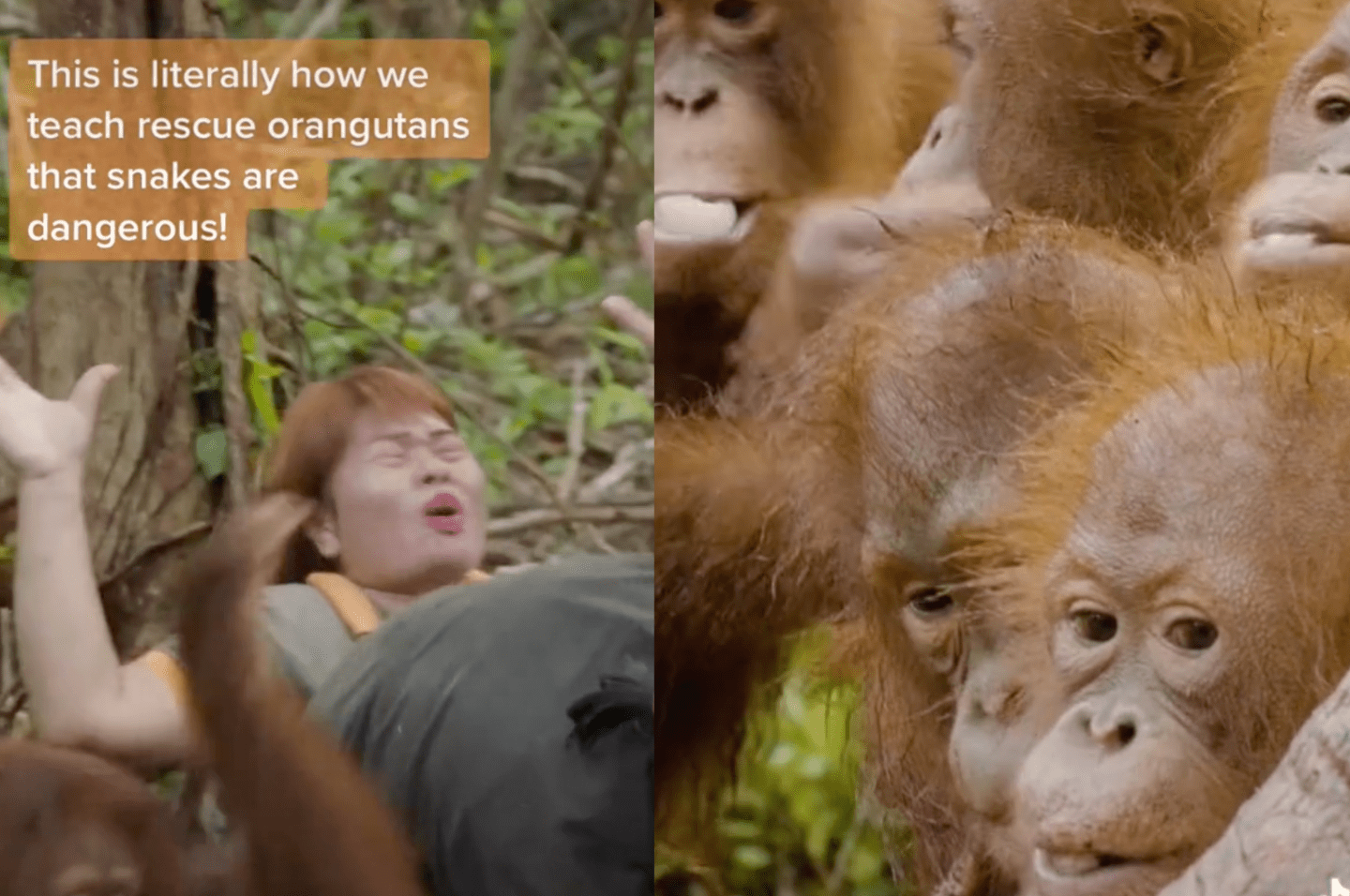
The rescue workers of Borneo Orangutan Survival are going viral for their hands-on teaching approach. As their adorable pupils learn important lessons at Jungle School, like using tools and building nests, perhaps no bit of wisdom could be quite as important as snakes = danger. So, to really drive it home, the caretakers lean into a bit of theatrics, along with a healthy dose of exposure therapy. And boy, does it work.

To be clear: No real snakes were harmed in the making of these now viral TikToks. Instead, plastic pythons get placed under branches, mimicking real life. The workers walk with the baby orangutans along the path, and BAM! Fake snake attack!


@bos_deutschland The #orangutans we #rescue need to learn that #snakes are dangerous… this is how #conservation works #animalrescue #wildliferescue #ngo ♬ original sound - BOS_deutschland

A female worker screams, flails her arms and falls to the ground. Clearly this woman has done her research. It is a performance worthy of a horror movie. The snakes might be fake, but that drama is 100% real.

Up the trees the terrified orangutans go. Traumatized? Maybe. But also more aware? Most definitely. The conservation group reassured viewers that, despite their shock, “the little guys are fine and learning.”

Snake awareness is a vital life-saving skill for orangutans, but it isn’t necessarily a natural one. According to the Smithsonian, being able to recognize snakes comes instinctively for orangutans, however fearing them is entirely learned. And without parents to teach these little ones about life threats, the workers of BOS have stepped up in the sweetest way.

And hey, it’s not all trauma, the workers are definitely having nonmalicious fun while pulling antics. In a follow-up video, a worker laughs as she sets down a tricolored fake snake on the ground near some orangutans enjoying a midday lunch.

Once the snake is spotted, the orangutans quickly flee. The ones who don’t immediately climb all huddle behind a tree, comforting each other. Seems the lesson plan is working!

Kudos to the team at BOS, who have used amazing creativity to educate these adorable creatures about important safety habits. And also educate the world about how we can be allies to the natural world.

If you’re in the mood for more Jungle School antics, you can watch even more videos here.

This article originally appeared two years ago.

Joy

People from around the globe share 15 signs that someone is obviously an American

"An Italian told me that Americans walk confidently in the wrong direction."

tourists, american tourists, us tourists, vacation, american style

Americans on vacation.

One of the fun things about traveling to different countries is that you not only get to learn about other cultures, but you also learn some things about your own. Americans who travel abroad often learn that people around the world appreciate them for being open, friendly, and good at spreading hope and optimism.

On the other hand, people in other countries can often tell when an American is coming from a mile away because they speak loudly, whether indoors or outdoors. Americans also have a very peculiar body language and are known to lean on things when they have to stand for an extended period.


A Reddit user posed a question in the AskReddit subforum to learn more about how Americans stand out abroad: What's an "obvious" sign that someone is American? The post received more than 35,000 responses, with an overwhelming number of commenters noting that Americans are all smiles and love to make small talk, something most people appreciate.

According to Redditors, here are 15 "obvious" signs that someone is American:

1. They have a unique confidence

"An Italian told me that Americans walk confidently in the wrong direction."

"Been taught to walk fast, and look worried.. People think you know what you're doing."

2. They're friendly

"I worked as a cashier in a tourist place in Paris, I always recognised Americans because they were kinda friendly to me and they always left tips."

"I guess there are worse things than friendly and generous."


3. Time = distance

"If someone asks how far away something is, an American will tell how you long it takes to get there as opposed to a physical distance."

"It actually pisses off some Americans to give a distance in miles, unless they're calculating gas mileage. In some places, you have to give with and without traffic options. I think it's more valuable info in time than in distance."

4. Grinning at strangers

"The gentle grins you give to strangers if you make eye contact with them as you pass by, at least in the Midwest. was not well received in Germany."

"I dated a European man here in the US. When we walked together, every time I made eye contact with someone on our path I would smile at them, and they would always smile back. Boyfriend was so confused at all these strangers smiling at me. Kept asking if I knew all these people. It was hilarious."


5. They like personal space

"How much personal space they give themselves. Americans like at LEAST an arm's length."

"We're conditioned to fill spaces evenly. I noticed when i worked delivery, spending lots of quality time on elevators that for every new person that enters, everybody shuffles to even things out. Similar thing plays out in social gatherings and bars. Not sure if that's universal or not, but I find it interesting. I think the size of our personal bubbles is because our spaces are generally much larger because we've got the space (heh) to build bigger buildings, sidewalks, roads etc. Might also explain why we're louder. Used to filling larger spaces with volume."

Body language expert Joe Navarro says that among Americans, the social zone for acquaintances and casual interactions is four to 12 feet, while family and close friends stand 1.5 to four feet apart. The intimate zone, for those closest to us, ranges from the skin to about 18 inches.


6. They lean

"According to the CIA, when training to be a spy, you have to unlearn how to lean. Americans tend to lean on things when standing still."

All of this is true, according to Jonna Mendez, the former chief of disguise at the CIA, who has shared some of her tips and tricks for making Americans seem more European. "So we would de-Americanize you," Mendez told NPR. "They think that we are slouchy, a little sloppy. And they think that they can almost see that in our demeanor on the street because they stand up straight. They don't lean on things."


7. They don't have an indoor voice

"I've lived in America for 25 years, and it still irritates me that instead of lowering their voices in restaurants so everyone can hear, Americans just scream over each other and make their restaurants as loud as clubs."

"For some reason, my otherwise smart and wonderful American friends will speak in the same volume, diction, and speed regardless of any outside factor unless specifically asked."

8. Dessert for breakfast

"In my homestay in London, I was told that I was 'so American' for enjoying a piece of cake for breakfast (not frosted cake, but like a nuts and dried fruit spiced coffeecake kind of thing). Apparently, that's exclusively for like a 4 pm snack, and breakfast is more of a savory meal."

"A lot of American breakfast items in my mind are desserts (pancakes, muffins, waffles, etc.). It doesn't mean I won't eat them, but it's kinda weird to do so."

9. They wear their clothes differently

"A British man once told me he knew I was American because I was wearing a baseball cap backwards."

"An Italian told me they could tell I was American because I wore my sunglasses on the top of my head when I wasn't using them."


10. Exposed soles

"While visiting Turkey, I was told that I looked American because I was sitting with one leg across the other, and the bottom of my shoe was exposed. Apparently, it's rude idk."

"In a lot of places outside of the US, showing the bottom of your shoe is rude."

11. Tactical gear

"Tactical sunglasses."

"I'm in the US, and virtually anything marketed towards men has the word 'tactical' in front of it."

12. They love small talk

"I'm from California (though a smallish town), and we wave to neighbors on our road, even if we haven't met, and start conversations in the grocery line with people if the opportunity presents itself. Also, smiling and saying hello to someone you happen to walk by and make eye contact with is quite normal. We are a social species, it would be so weird not to be friendly, even to strangers, for me, and I'm not even that social of a person."

"What really gets me to it is not that Americans do small talk constantly, but the fact that they are so good and fast at it. I mean, I say 'yeah, it's hot,' and they reply with some interesting fact or make a connection to their hometown. I feel less of myself after this. They must have some small talk class in school or some sh*t."

13. They like to point

"I've always observed my US friends like to point at stuff while walking and say what it is…. We were out walking around Amsterdam recently and they were like 'hey look it's a smoke shop'…. 'Oh look a sex shop'…. 'Oh hey, it's a prostitute' …. 'Look at the canal'…. 'Wow it's another prostitute'….. 'another canal' etc etc. It was like watching Netflix with Audio Descriptions turned on."

"You know that little voice inside your head, your internal monologue? Americans seem to monologue their thoughts."


14. Optimism and enthusiasm

"Dunno in all context, but Americans in Europe stand out with their ceaseless optimism and enthusiasm."

"I'm reminded a lot of Ted Lasso. Everyone I know (all Americans) loves the show. I wonder what kind of European fan base it has."

"Americans are so positive and have such a thirst for life. It sickens me."

15. They eat while walking

"When I lived in Europe, people said only Americans eat while walking. I'd be eating a bagel or something on the way to work or class, and multiple people asked if I was American lol."

"Jay Leno said on Top Gear, I think it was, that Americans are also the only people who eat while driving. I don't do this, but I constantly see people who do, haha, especially in LA, where people spend a lot of time in their cars."

Wheel of fortune, gameshow, tv, tv game show, puzzles, word games, word puzzles, viral videos, live tv, ryan seacrest

A woman's iconic, $50,000 puzzle solve on 'Wheel of Fortune' is going viral.

Are you still talking everyone's ear off about your last big Scrabble win? Or maybe about your great Wordle guess from the other day? You might want to take a seat and watch how a truly great puzzle solver does it.

Listen, while we all love a hilarious Wheel of Fortune fail, watching an epic win can be just as, if not more, entertaining. And that’s exactly what happened on The Wheel in early 2025 when a contestant named Traci Demus-Gamble made a winning puzzle solve so out-of-nowhere that it made host Ryan Seacrest jokingly check her for a hidden earpiece.


In a clip posted to the show’s YouTube account, Demus-Gamble waved to her husband who was standing on the sidelines before going up to the stage for her next challenge: guess a four-word “phrase.”

Wheel of fortune, gameshow, tv, tv game show, puzzles, word games, word puzzles, viral videos, live tv, ryan seacrest Step right up and take a spin on the Wheel of Fortune!Canva Photos.

Demus-Gamble wasn’t off to a great start, as only two of her given letters (“T” and “E”) made it to the board. And the odds didn’t improve much after she, admittedly “nervous,” gave the letters “M,” “C,” “D,” and “O” and only two of those letters showed up once on the board.

“Again, not too much more, but who knows, you’ve had a lot of good luck tonight,” Seacrest said. “Maybe it’ll strike you.”

Demus-Gamble had almost nothing to go off of. No category, no lucky words that were already filled in.

Then, all in under ten seconds (more like in 1.5 seconds), Demus-Gamble correctly guessed, “They go way back” like it was nothing. She was right, to the amazement of everyone watching.

Watch the incredible moment below:

- YouTube youtu.be

"How in the world did you solve that last one?" Seacrest asked.

"I just dug deep, I dug deep," Demus-Gamble said.

Yeah, you dug real deep," Seacrest replied. "Congratulations, great, great work."

The clip racked up hundreds of thousands of views on YouTube, where commenters couldn't believe their eyes:

“Now THAT was an amazing solve.”

“Wow! That was impressive!”

“I couldn't solve that one to save my life, but Demus-Gamble got it like it was nothing.”

“There's only one way to describe this to me: 😦”

"One of the most impressive bonus round solves I've seen for this season"

"I’m happy for her, that was not an easy puzzle to solve and she got it right away. So amazing! I definitely had no idea what it was and I’m pretty good solving the puzzles."

Demus-Gamble's solve was absolutely incredible, but it might fall just short of being the best of all time.

In 2020, a woman named Taya solved a lengthy five-letter phrase with just two letters given: "A Place Like No Other." Another man guessed "Championship Match" with only the letter T present.

Demus-Gamble's epic solve definitely earns her a spot in the Wheel of Fortune Hall of Fame, however.

- YouTube youtu.be

Solving word puzzles like this one might seem like pure luck, but there's definitely a strong element of skill involved. Keen watchers of the show will be familiar with patterns and will quickly be able to identify likely choices. For example, in the clip above, the first word is shown at "T_E_." It could be a lot of different words, but it's highly probable that it's "They." It takes a lot of practice and quick thinking to recognize that in just a fraction of a second.

According to her LinkedIn, Demus-Gamble has worked as an English teacher and as a self-employed author, which totally checks out.

At the end of the clip, Seacrest opened the envelope to reveal that Demus-Gamble’s puzzle solve won her $50,000, earning her a total win of $78,650. Certainly not chump change.

As for her winning strategy—Demus-Gamble assured no cheating was involved. “I just dug deep," she told Seacrest. We’ll say.

This article originally appeared last year. It has been updated.

robert frost, poet robert frost, robert frost poem, robert frost poems, writer robert frost
Images via Wikipedia

American poet Robert Frost as a young man in 1910 and again in 1949.

Poet Robert Frost created inspiring poems that are beloved around the world. Frost was known for his simple yet deep style of poetry, and, although he didn't publish his first book until he was 40, he went on to earn four Pulitzer Prizes.

He created a body of work that continues to touch people. Yet, like many great artists, Frost struggled with his mental health throughout his life. (Frost was born in 1874 and died in 1963.) William & Mary English Professor and Frost biographer Henry Hart found that many of Frost's relatives struggled with schizophrenia as well as depression.


"Throughout his life, he struggled to fit in. His education was irregular, routinely disrupted when Frost dropped out after suffering attacks of anxiety and depression that expressed themselves in various physical ailments," notes the National Endowment for the Humanities (NEH).

- YouTube www.youtube.com

Frost experienced many hardships during his life, beginning at a young age. His father William Prescott Frost, Jr., died when he was just 11 years old. His sister Jeanie would later suffer from mental illness, and died in a mental hospital.

Frost would go on to marry his high school girlfriend, Elinor White, in 1895. The couple had six children, a blessing that came with loads of tragedy.

"Four of Frost’s six children died before he did, including Carol, the son who committed suicide. Frost’s daughter Irma suffered mental problems that required hospitalization, and Elinor battled anxiety, too. She died of heart failure in 1938," according to the NEH. "Frost’s own bouts of depression brought physical and mental anguish. 'Cast your eye back over my family luck, and perhaps you will wonder if I haven’t had pretty near enough,' he lamented at one point."

- YouTube www.youtube.com

His wife Elinor was diagnosed with breast cancer in 1937, and died in 1938 from heart disease. "She had been the unspoken half of everything I ever wrote," Frost said. He would go on to live 26 more years without her.

Through these challenges, Frost developed resilience and perseverance. One of his most famous quotes describes his advice on how he pushed through:

"In three words I can sum up everything I've learned about life: it goes on."

The quote is reported to come from a September 1954 interview with journalist Ray Josephs for This Week Magazine. During the interview, Josephs asks Frost, "In all your years and all your travels, what do you think is the most important thing you’ve learned about life?"

- YouTube www.youtube.com

From there, Frost shared his wise insights.

"He paused a moment, then with the twinkle sparkling under those brambly eyebrows he replied: 'In three words, I can sum up everything I’ve learned about life. It goes on. In all the confusions of today, with all our troubles . . . with politicians and people slinging the word fear around, all of us become discouraged . . . tempted to say this is the end, the finish. But life — it goes on. It always has. It always will. Don’t forget that.'"

Frost died at age 88 in 1963 and was buried in Bennington, Vermont, next to his wife Elinor. Honest about life's struggles to the end, Frost's gravestone reads: "I had a lover's quarrel with the world."

Water harvesting, water system, growing food in the desert, agriculture, farming

Half moons allow water to be retained for agriculture and even replenish the groundwater table.

Can a farm grow in a desert without bringing in enormous amounts of water? With the right method, yes.

In 2007, the Great Green Wall initiative was launched by the African Union, with a vision of a big, beautiful wall of greenery spanning the width of Africa to keep the Sahara Desert from encroaching on the rest of the continent. Since then, there have been successes and failures, celebration and criticism, and the future of the project is tenuous. However, we can still see within it some inspiring examples of how local and global collaboration can help counter the effects of climate change.


Just a few years ago, the Sahel region at the northern edge of Senegal was a "barren wasteland" where nothing had grown for 40 years. But the United Nations World Food Programme (WFP) and local villagers teamed up to regreen the area, bringing back agriculture, improving the economy of the people who live there, and preventing the climate migration that desertification ultimately leads to.

desert, desertification, erosion, sahel region, burkina faso Severe erosion and wind drifting sand after Sahel Drought in northern Burkina FasoPhoto credit: Canva

How do you hold back the world's largest hot desert?

According to Andrew Millison, a permaculture designer and instructor at Oregon State University, the Sahara desert has expanded by about 10% in the past 100 years. The idea behind the Great Green Wall is to build a barrier of vegetation to stop that desertification, which threatens the ecosystems and economies of the Sahel—the region south of the Sahara that separates the desert from the savanna.

In a video from February of 2024, Millison shared the collaborative nature and progress of one Great Green Wall project in Senegal, including the rejuvenation of 300,000 hectares (about the equivalent of 600,000 football fields) of seemingly unusable land.

Watch:

- YouTube youtu.be

"The process started with the community-based participatory planning," WFP program policy officer Bakalilou Diaby shares in the video. "By the end of this process, it was agreed that one of the major action is the land reclamation or land recovery project."

At first, it took some time to convince the community that the regreening of the degraded landscape was even possible, but after learning about how to improve the land, "the people believe and they are convinced, and they are also committed," says Diaby.

The 'forgotten' half-moon method of harvesting water

One of the keys to this particular regreening project is using long-forgotten techniques for harvesting water. When soil is crusted and sunbaked and hard as cement, rainwater doesn't penetrate and it's impossible for plants to take root. The solution? Half-moon-shaped ditches dug in such a way that water flows into them on the straight side, with an embankment built on the rounded side to hold the water in. Each half moon is 4 meters in diameter and takes about a day for one person to dig.

Local vegetation domesticated on the Sahel thousands of years ago, such as sorghum and millet, are planted in these half-moons, rehabilitating the land and feeding the local community at the same time.

"This is nothing new—we have not invented a technology here," explains Sebastian Muller from the WFP resilience team. "The half moon technology is actually an endogenous technology to the Sahel and has been forgotten over time. We have rescued it from the past."

oasis, desert, desertification, sahel, africa An oasis in the SahelPhoto credit: Canva

Not only does capturing water in the half moons help with the immediate need to grow food and contribute to the Great Green Wall, but 10% to 15% of the water will actually soak into the ground to replenish the water table, creating a more sustainable agricultural process.

"That way we actually achieve a balance of water. So we are not depleting the water resources, but we're making sure that we keep enough water in the ground for future generations," says Muller.

Other crops such as okra and tomatoes are grown in horizontal horticulture beds, and between those ditches grow trenches with fruit trees in them.

Engaging indigenous wisdom for sustainable farming

"This is just a very first step in this pilot," adds Muller. "We'll also be using other native species that will be planting in the pits that will drive the rejuvenation of the soil and the protection of the soil as the system starts growing into abundance and producing food and life for the people here."

According to Muller, the "syntropic farming" methods being employed were developed in Brazil and are based on global indigenous practices that mimic the way natural forests grow and thrive. These natural growing dynamics make agriculture more sustainable, continually replenishing the land rather than continually depleting it—truly a testament to global collaboration carried out at the local level with local community support.

"This project was really, really interesting because the World Food Programme wanted to demonstrate how you could take the most devastated areas and turn them back into resilient, food-producing locations," says Millison. "And they specifically placed their project on a very degraded landscape that had been taken down to bare, compacted earth."

desert, desertification, sahel region, africa, sahara desert Desert "wasteland" can be cultivated with innovative methods.Photo credit: Canva

Unfortunately, it's not only a changing climate that we have to contend with. The Great Green Wall in the West African nations of Nigeria, Niger, and Burkina Faso, has been impacted by terrorism and insurgencyterrorism and insurgency. Such widespread insecurity makes doing the environmental work the project demands difficult, and in some cases, impossible.

Still, if this desertified "wasteland" can be rejuvenated so successfully, it provides hope for recovering other land that many people might write off as useless or barren. As climate change continues to alter the Earth's landscape—literally—we'll need to keep working together both locally and globally to find solutions like the Great Green Wall and support their implementation.

You can learn more about successful permaculture practices on Andrew Millison's YouTube channel.

This article originally appeared in January.


Duran Duran, Simon LeBon, 80s, 80s music, 1980s, Gen X, 80s nostalgia

A teacher challenged her student to find Duran Duran. She never expected the student to actually pull it off.

Imagine this: you're a fourth-grade language arts teacher in Dallas, and like many Gen X-ers, your obsession with Duran Duran never waned. So much so that you still have dolls of each band member in the classroom, and, according to Austin Wood's article for the Lake Highlands Advocate, even an old telephone in case (lead singer) Simon LeBon calls. This describes Miriam Osborne, a fourth-grade teacher in the Dallas area at White Rock Elementary.

One of Osborne's students, 10-year-old Ava Meyers, was getting picked up early for Christmas break because her family was heading to the U.K. for a holiday wedding. As they were saying their goodbyes in the hallway, Osborne jokingly told Meyers, "Find Duran Duran."


The search for Simon LeBon

Cut to: Ava and her family, including her mom Zahara, fly across the pond to find themselves in the Putney neighborhood of London. After a day of sightseeing, Zahara shares, "I was just Googling things to do in Putney, and the first thing that popped up was 'Simon Le Bon lives in Putney from Duran Duran.'”

duran duran, duran duran live, Simon LeBon, John Taylor, lollapoalooza chile, the reflex Duran Duran at Lollapalooza Chile in 2017.Archive Team/Wikimedia Commons


Zahara did a little sleuthing and found Simon's house, thinking a Christmas stroll past the home might be exciting. But, according to the article, Ava felt they could do better. She and "an 83-year-old relative named Nick, who apparently has courage in droves, went to the door and tried a knock. Zahara was initially hesitant but assumed Le Bon would be away on vacation, so she figured it was harmless. Le Bon’s son-in-law answered, his wife came to the door next, and following a few moments of getting pitched the idea by Nick, agreed to get her husband 'because it was Christmas.'"

LeBon was a great sport

And just like that, LeBon appeared in the doorway. He warmly greeted Ava and her family and even took pictures. "It was just crazy," Ava exclaimed.

But possibly more excited was Miriam Osborne, back in the States. She proudly shared the photo (which had been texted to her) with many of her friends and even encouraged Ava to recount the story to her classmates when they returned from the break. Wood shares, "Osborne’s connection to the band goes back to her childhood in El Paso in the ’80s. As the daughter of a Syrian immigrant, she says she had trouble fitting in and finding an identity. Some days, she and her brothers would travel across town to get records from a British record store."

Miriam explains she used her babysitting money to buy her first Duran Duran record. "And so I had been a fan, literally, for 43 years—my entire lifetime."

Osborne's love of Duran Duran and many '80s bands nostalgically connects her to a throughline for her life that she tries to impart onto the students as well. "Music is a connector, and it connected me to a world that I didn’t always fit in as a child. It helped me find people who I still love to this day, and it’s a big part of this classroom with me and the students I teach, because everybody has a story, and there’s something really incredible about hearing something and it taking you to a happy moment."

duran duran, duran duran live, Simon LeBon, John Taylor, lollapoalooza chile, the reflex Duran Duran at Egzit festival in 2012.via Jelena Ivanović/Wikimedia Commons

Even though Duran Duran got together in 1978, nearly 50 years ago, the core group of LeBon, bassist John Taylor, keyboardist Nick Rhodes, and drummer Roger Taylor is still going strong. The "Hungry Like the Wolf" band recently completed a West Coast tour of the United States and is looking forward to headlining the Beach Life festival in Redondo Beach, California, in May.

As for Ava? She's now taking guitar lessons. And perhaps one day, she can become so famous and inspirational that a teacher sends a student out to find her during Christmas vacation.

This article originally appeared last year.