The English language is bizarre, littered with inconsistent rules, surprising pronunciations and subtle quirks in phrasing that we often overlook. With that in mind, what is “is is”? For starters, it’s a pretty common grammatical pet peeve. Beyond that, it’s also a strange repetition that you might find yourself saying out loud even though you’d never write it.
Before we go any further, let’s give some examples. You might encounter “is is” in sentences like “The problem is, is that we don’t have time for dinner” or “My point is, is that rock music is best experienced on headphones.” You might read both of those sentences and think, “I’d never say that.” But read them out loud, using those commas for intentional pauses, and the concept should crystalize. (Next time you listen to your favorite podcast, keep this front of mind—it might now become your pet peeve. You’re welcome.)
You might call it the “is-is hiccup”
This isn’t just the stuff of online griping—linguists do have technical names for it. One common term is a “double copula,” and an excellent article from the website GrammarBook.com uses the way catchier and more accessible “is-is hiccup.” “Often these are statements made by sophisticated and qualified spokespersons,” their author writes, distinguishing between real examples of this verbal flub (“The fact of the matter is, is that…”) and others that are clunky and unorthodox but are technically correct (“[A] comedian from North Carolina named Andy Griffith once made America laugh with ‘What It Was, Was Football,’ his monologue about college football from a country boy’s perspective.”)
So, why do we do this anyway? In 2013, Slate‘s Alyssa Pelish spoke to linguists and presented an educated guess. At one point, they ask readers to consider the following sentence as spoken out loud: “The thing is we are all out of pickles.” They explain, “If the speaker places a definite stress on is, the rest of the sentence is likely to be followed by a pause, no? Linguists like Patrick McConvell at Australian National University and Laura Michaelis-Cummings at the University of Colorado have found that the stressed is, coupled with the break immediately after, sounds awkward to speakers’ ears, since it’s unlike the general patterns that stresses and pauses typically follow in English.” The resulting “is is,” according to Michaelis-Cummings, is something of a “workaround.”

If you say “is is,” you probably have good intentions
In other words, you’re probably using “is is” for the sake of clarity—even if some find it annoying. Speaking of which: One user created a thread about this topic in the r/grammar subreddit, and multiple people replied by theorizing about the concept. “The unnecessary ‘is’ comes from the fact that people often don’t speak grammatically, but often speak in sentence fragments, especially when they’re still figuring out what they want to say,” one Redditor suggested. “I used to have to transcribe recordings of conversations, and it really struck me just how much people tend to stammer, use filler words, or change tacks in mid-sentence.”
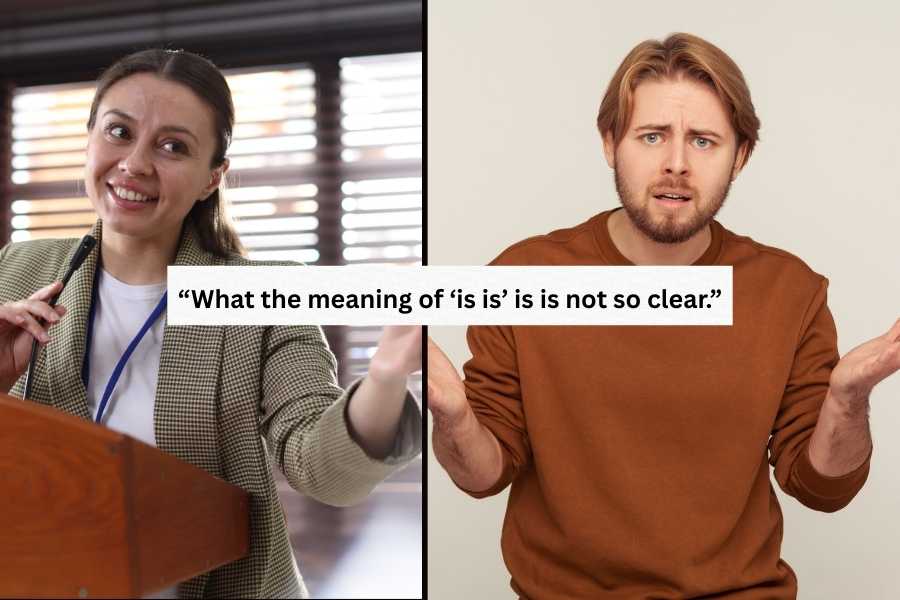
Others chimed in while also playfully using “is is.” This comment wins the thread: “What the meaning of ‘is is’ is is not so clear.” In response to one breakdown, someone replied, “This is very clear and actually helpful,” highlighting the key difference between the written and spoken word. (But as another person noted, some examples in the thread are grammatically correct, and others aren’t. Confusing stuff!)
In summary: The thing is, is that words are weird.