Anyone who has found themselves in a relationship with a narcissist knows how confusing, disorienting or downright terrifying it can be.
There are conflicting statistics on what percent of the population has Narcissistic Personality Disorder (NPD), but it ranges anywhere from 1% to 6%. The average American knows 600 people, which means we all know at least a small handful of pathological narcissists personally.
But it’s people who are in close relationships with narcissists who bear the brunt of their pathology. Whether you were raised by a narcissistic parent or fell in love with a narcissist, it’s likely you’ve been abused by someone to feed their narcissistic needs.
NPD can be particularly challenging to treat because most narcissists will nor or cannot admit that anything is wrong with them. Researchers at Washington University in St. Louis found that most narcissists are actually aware that they are narcissists, but rather than see it as a problem, they embrace it and take pride in it. (Of course.)
However, a self-aware narcissist can get help through psychotherapy, if they are willing to do it. Since most don’t see the problem, many won’t. But many or even most isn’t all, and one man is on a mission to use his Narcissistic Personality Disorder diagnosis for good.
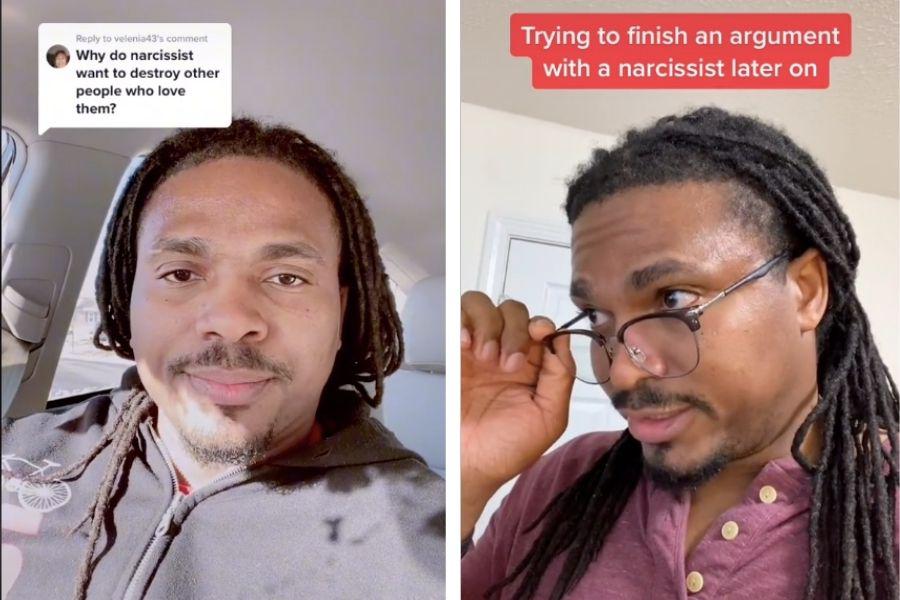
Lee Hammock has been diagnosed with NPD and has been in psychotherapy for it since 2017. He calls himself a “self-aware” narcissist and uses social media—particularly TikTok—to share insider insights into a narcissist’s brain. Hammock describes why he decided to share the ins and outs of his disorder:
“The point of these videos is to help bring awareness from the other side of the narcissistic abuse spectrum. All my videos give perspective on why many narcissists do what they do and the possible different reasons behind them. The victims and survivors get validation and the narcissists (those that are willing) get to see that you can get help and that you are not alone.”
Hammock’s videos speak for themselves. There are tons of them, and they give amazing insight into a narcissist’s perspective from the point of view of a narcissist who actually works to understand and manage his own disorder. Here’s a sampling:
Collab with @Nia Renee Narcissists like to play games with you in order to start arguments, throw you off or in order to play the hero. #narcavengers♬ original sound – Lee Hammock
He even weighed in on the Kanye West situation, not diagnosing West with NPD, but explaining how his actions are right out of the narcissistic playbook.
Hammock has been honest about the fact that that making and sharing these videos and getting likes on them actually feeds his narcissistic ego, but it’s a healthy turning of the tables on the disorder.
And it really is serving a need. If you read through the comments on Hammock’s videos, the most common response is recognition. So many people have interacted with narcissists and see those interactions in these videos, which is both validating and relieving. People who have been victims of narcissistic abuse are not alone, and Hammock helps them see that. He even helps people who might be narcissists themselves maybe—maybe—become more self-aware that their personality disorder is something that needs management.
In a small village in Pwani, a district on Tanzania’s coast, a massive dance party is coming to a close. For the past two hours, locals have paraded through the village streets, singing and beating ngombe drums; now, in a large clearing, a woman named Sheilla motions for everyone to sit facing a large projector screen. A film premiere is about to begin.
It’s an unusual way to kick off a film about gender bias, inequality, early marriage, and other barriers that prevent girls from accessing education in Tanzania. But in Pwani and beyond, local organizations supported by Malala Fund and funded by Pura are finding creative, culturally relevant ways like this one to capture people’s interest.
The film ends and Sheilla, the Communications and Partnership Lead for Media for Development and Advocacy (MEDEA), stands in front of the crowd once again, asking the audience to reflect: What did you think about the film? How did it relate to your own experience? What can we learn?
Sheilla explains that, once the community sees the film, “It brings out conversations within themselves, reflective conversations.” The resonance and immediate action create a ripple effect of change.
MEDEA Screening Audience in Tanzania. Captured by James Roh for Pura
Across Tanzania, gender-based violence often forces adolescent girls out of the classroom. This and other barriers — including child marriage, poverty, conflict, and discrimination — prevent girls from completing their education around the world.
Sheilla and her team are using film and radio programs to address the challenges girls face in their communities. MEDEA’s ultimate goal is to affirm education as a fundamental right for everyone, and to ensure that every member of a community understands how girls’ education contributes to a stronger whole and how to be an ally for their sisters, daughters, granddaughters, friends, nieces, and girlfriends.
Sheilla’s story is one of many that inspired Heart on Fire, a new fragrance from the Pura x Malala Fund Collection that blends the warm, earthy spices of Tanzania with a playful, joyful twist. Here’s how Pura is using scent as a tool to connect the world and inspire action.
A partnership focused on local impact, on a global mission
Pura, a fragrance company that recognizes education as both freedom and a human right, has partnered with Malala Fund since 2022. In order to defend every girl’s right to access and complete 12 years of education, Malala Fund partners with local organizations in countries where the educational barriers are the greatest. They invest in locally-led solutions because they know that those who are closest to the problems are best equipped to solve and build durable solutions, like MEDEA, which works with communities to challenge discrimination against girls and change beliefs about their education.
But local initiatives can thrive and scale more powerfully with global support, which is why Pura is using their own superpower, the power of scent, to connect people around the world with the women and girls in these local communities.
The Pura x Malala Fund Collection incorporates ingredients naturally found in Tanzania, Nigeria, Pakistan, and Brazil: countries where Malala Fund operates to address systemic education barriers. Eight percent of net revenue from the Pura x Malala Fund Collection will be donated to Malala Fund directly, but beyond financial support, the Collection is also a love letter to each unique community, blending notes like lemon, jasmine, cedarwood, and clove to transport people, ignite their senses, and help them draw inspiration and hope from the global movement for girls’ education. Through scent, people can connect to the courage, joy, and tenacity of girls and local leaders, all while uniting in a shared commitment to education: the belief that supporting girls’ rights in one community benefits all of us, everywhere.
You’ve already met Sheilla. Now see how Naiara and Mama Habiba are building unique solutions to ensure every girl can learn freely and dare to dream.
Naiara Leite is reimagining what’s possible in Brazil
Julia with Odara in Brazil. Captured by Luisa Dorr for Pura
In Brazil, where pear trees and coconut plantations cover the Northeastern Coast, girls like ten-year-old Julia experience a different kind of educational barrier than girls in Tanzania. Too often, racial discrimination contributes to high dropout rates among Black, quilombola and Indigenous girls in the country.
“In the logic of Brazilian society, Black people don’t need to study,” says Naiara Leite, Executive Coordinator of Odara, a women-led organization and Malala Fund partner. Bahia, the state where Odara is based, was once one of the largest slave-receiving territories in the Americas, and because of that history, deeply-ingrained, anti-Black prejudice is still widespread. “Our role and the image constructed around us is one of manual labor,” Naiara says.
But education can change that. In 2020, with assistance from a Malala Fund grant, Odara launched its first initiative for improving school completion rates among Black, quilombola, and Indigenous girls: “Ayomidê Odara”. The young girls mentored under the program, including Julia, are known as the Ayomidês. And like the Pura x Malala Fund Collection’s Brazil: Breath of Courage scent, the Ayomidês are fierce, determined, and bursting with energy.
Ayomidês with Odara in Brazil. Captured by Luisa Dorr for Pura
Ayomidês take part in weekly educational sessions where they explore subjects like education and ethnic-racial relations. The girls are encouraged to find their own voices by producing Instagram lives, social media videos, and by participating in public panels. Already, the Ayomidês are rewriting the narrative on what’s possible for Afro-Brazilian girls to achieve. One of the earliest Ayomidês, a young woman named Debora, is now a communications intern. Another former Ayomidê, Francine, works at UNICEF, helping train the next generation of adolescent leaders. And Julia has already set her sights on becoming a math teacher or a model.
“These are generations of Black women who did not have access to a school,” Naiara says. “These are generations of Black women robbed daily of their dreams. And we’re telling them that they could be the generation in their family to write a new story.”
Mama Habiba is reframing the conversation in Nigeria
Centre for Girls' Education, Nigeria. Captured by James Roh for Pura
In Mama Habiba’s home country of Nigeria, the scents of starfruit, ylang ylang and pineapple, all incorporated into the Pura x Malala Collection’s “Nigeria: Hope for Tomorrow,” can be found throughout the vibrant markets. Like these native scents, Mama Habiba says that the Nigerian girls are also bright and passionate, but too often they are forced to leave school long before their potential fully blooms.
“Some of these schools are very far, and there is an issue of quality, too,” Mama Habiba says. “Most parents find out when their children are in school, the girls are not learning. So why allow them to continue?”
When girls drop out of secondary school, marriage is often the alternative. In Nigeria, one in three girls is married before the age of 18. When this happens, girls are unable to fulfill their potential, and their families and communities lose out on the social, health and economic benefits.
Completing secondary school delays marriage, and according to UNESCO, educated girls become women who raise healthier children, lift their families out of poverty and contribute to more peaceful, resilient communities.
Centre for Girls’ Education, Nigeria. Captured by James Roh for Pura
To encourage young girls to stay in school, the Centre for Girls’ Education, a nonprofit in Nigeria founded by Mama Habiba and supported by Malala Fund and Pura, has pioneered an initiative that’s similar to the Ayomidê workshops in Brazil: safe spaces. Here, girls meet regularly to learn literacy, numeracy, and other issues like reproductive health. These safe spaces also provide an opportunity for the girls to role-play and learn to advocate for themselves, develop their self-image, and practice conversations with others about their values, education being one of them. In safe spaces, Mama Habiba says, girls start to understand “who she is, and that she is a girl who has value. She has the right to negotiate with her parents on what she really feels or wants.”
“When girls are educated, they can unlock so many opportunities,” Mama Habiba says. “It will help the economy of the country. It will boost so many opportunities for the country. If they are given the opportunity, I think the sky is not the limit. It is the starting point for every girl.”
From parades, film screenings to safe spaces and educational programs, girls and local leaders are working hard to strengthen the quality, safety and accessibility of education and overcome systemic challenges. They are encouraging courageous behavior and reminding us all that education is freedom.
Experience the Pura x Malala Fund Collection here, and connect with the stories of real girls leading change across the globe.
No one wants to be unhappy or unhealthy at any age. But as we get older, health and happiness arguably play an outsized role in our quality of life. Sketchy health habits we may have gotten away with when we were younger catch up to us later in life. And what once made us feel happy may no longer be an option as we age.
So how do we stay both happy and healthy throughout our lives?
Dr. Arthur C. Brooks, a social scientist at Harvard University and a leading researcher on happiness, has studied this question. Thanks largely to the 85-year-long Harvard Study of Adult Development, the longest-running study on happiness, we can better understand which qualities and habits are associated with being both happy and healthy as people age.
Four quadrants. Photo credit: Canva
Measuring health and happiness basically separates people into four quadrants. In an interview with Dr. Rhonda Patrick, Brooks shared that people who fall into the happy-healthy (or happy-well) quadrant tend to share seven habits in common.
The four physical habits associated with happiness and health
The first four have to do with our physical health and are ones that most of us might guess.
“Diet, exercise, smoking, and drinking,” Brooks said, adding that happy-well people are “very moderate” when it comes to substance use. “None of them were addicts, or if they had trouble with it, they quit,” he said.
Brooks shared that he smoked into his 20s and, even then, knew it was stupid. “But I still think about it every day,” he said. “I do. I love nicotine. I got addicted to it when I was 13 and quit when I was 26. And it was a relationship for me, right? But the whole point is no, because lifelong smokers have a 7 in 10 chance of dying from a smoking-related illness, and that is an unhappy way to go. You’re not going to be healthy and you’re not going to be happy dying of emphysema.”
People who age happier and healthier tend to do 7 things:
They don’t smoke, exercise regularly (but not excessively), maintain a healthy weight, and are mindful with alcohol or other substances.
As far as diet goes, Brooks said the happy-healthy people eat a “normal, healthy” diet. And for exercise, it’s really about moderation and the obvious things like walking and staying active.
“If you don’t exercise at all, you’re not happy and well,” he said. “And if you’re an exercise maniac, you actually will do some mechanical ill to your body, but actually you’re probably not happy and some compensation is going on.”
Three psychological and emotional habits associated with health and happiness
The other three habits aren’t quite as obvious.
“No. 1 is continuing to learn,” Brooks said. “And people who are life-long learners, they are healthier and they are happier. That’s usually a lot of reading, but curiosity is how that comes about. It’s just really really important.”
The next is having a technique for dealing with setbacks.
“You’ve got to get good at it,” he said. “You need skill at dealing with life’s problems. And if you don’t get good at it, you’re going to be bad when things actually crop up. And so maybe you’re good at therapy. Maybe you’re good at prayer, maybe you’re good at meditation. Maybe you’re really good at journaling. But all the happy and well people have their way to deal with it and they’re highly skilled in doing it.”
And the seventh habit, which Brooks calls “the biggie,” is simply love. “People who have the best lives, who are happy and well when they’re older, they have a strong marriage and/or close friendships,” he said. “That’s it. There’s no substitute for love. Happiness is love, full stop.”
Brooks shared other thoughts about the value in boredom and the pitfalls of social comparison in this segment, but the whole interview is filled with fascinating insights into what makes people happy and healthy.
Long-acting, reversible contraception methods like IUDs have become extremely popular in the United States and beyond. Just a few decades ago, only about 2% of women relied on them. In recent years, that figure has risen to around 17%, accounting for millions of women.
The rising popularity makes sense. IUDs can be convenient, highly effective, and can even make a woman’s period far less painful or stop it altogether. There’s just one problem: getting an IUD inserted hurts. For some people, it hurts a lot.
The pain from getting an IUD can range from mild discomfort for some people to excruciating pain for others. What’s frustrating is that medical providers haven’t historically listened to patients who say the procedure is severely painful. A 2013 study found that the average patient rated the pain of insertion at 64.8 out of 100, while providers estimated it at just 35.3—a big disconnect.
For years, women struggling in the aftermath of the procedure have been told the same infuriating refrain: “Just take ibuprofen.”
Artist brings women’s frustration to life
Emily Kampa recently debuted a striking piece of artwork built around this common source of dismissed pain among women.
The display, aptly titled “Just Take Ibuprofen,” boldly shows the actual medical instruments used in an IUD insertion in all of their horrific glory. Kampa listed them on her Instagram:
Speculum: 6.95” nose length
Single toothed tenaculum: 10”
Paracervical block (& needle): 6”
IUD insertion tube: 11”
MT cervix-holding clamp: 11”
OS finder: 8”
Cotton swab: 8”
IUD string scissors: 9.8”
Hook for IUD removal: 10”
IUD: 1.25”
After hours of research and planning, Kampa etched the instruments onto a copper plate, each one rendered life-size.
For the in-person installation at the Triton Museum of Art, Kampa placed the display on a real medical cart, with a surgical glove loosely dangling off the corner.
She wrote that she wanted viewers to experience the tools the same way she did when she first saw them at her OB-GYN’s office.
“‘Wait why are there scissors? Why is that q-tip SO large?!’” she recalled thinking. “That image stuck with me long after my own IUD experience and was the spark for this project.”
The art evokes a visceral reaction in viewers. It’s hard not to feel that taking a few Advil is a woefully inadequate response to the pain caused by these long, sharp instruments.
Photos of the display have been posted and reposted across social media, racking up thousands of likes and comments wherever they appear. Many women flocked directly to Kampa’s Instagram account to thank her for speaking out through her art:
“Thank you for this because I thought I was over reacting when I got physically sick. I [was] literally on the verge of vomiting and passing out. Cramps for days.”
“I never connected to an image so much in my life. … For the first two years (and still for a few days every month), felt like I had barbed wire inside me. I went to the doc after the first two weeks of pain and the nurses there said … the pain was normal for the first year.”
“Ibuprofen my a**! Too many of us have been gaslit, dismissed, ignored, traumatized, and even killed by medical professionals. Thank you for capturing this all-too-true experience and sharing your process”
“My cervix is shuddering. This is ART from experience”
Art has the power to elevate messages in unique and memorable ways. Thanks to women and artists like Kampa who have spoken out over the years, the culture of IUD pain management is steadily changing for the better.
“Systemic racism and bias as to how pain is experienced and who experiences it also has, unfortunately, influenced pain management considerations,” said Dr. Christopher M. Zahn, chief of clinical practice and health equity and quality at ACOG.
The new guidance recommends local anesthetics for the procedure, as well as “comprehensive pain management counseling” for patients, including offering the option of sedation or general anesthesia when possible.
These are big and necessary steps forward. Perhaps the most powerful part of this shifting conversation and culture, however, is that more women are being heard and their pain is finally being taken seriously.
Many women have a hard time doing traditional push-ups. Instead, they opt for “girl push-ups,” where the knees are placed on the ground to accommodate less upper body strength.
But what if this exercise actually took female anatomy into consideration?
That’s the question behind a viral fitness trend on TikTok where women are making one small shift to their arm placement and suddenly realizing they could do full push-ups all along.
What is a “women’s anatomy” push-up?
As explained by Kayla Lee, a women’s anatomy and biomechanics educator, women tend to have a naturally greater “carrying angle” than men, meaning their elbows angle more outward when the arm is straightened. Traditional push-ups, where the elbows are tucked in and the wrists are stacked under the shoulders, don’t always accommodate this, which can lead to difficulty with the exercise, or even joint pain.
However, turning the hands outward at about 45 degrees and placing them slightly wider than shoulder-width accommodates this anatomical difference, making the exercise more doable while also reducing wrist and elbow strain and improving stability.
The reaction
So far, the reaction has been overwhelmingly positive, with many women hailing it as a game changer.
But, regardless, the real takeaway is that there’s no one-size-fits-all approach. We should aim for good form, but it has to be a form that works with your body.
Historically speaking
It’s also worth noting that, historically, women haven’t always been taken into account in the fitness industry, or the health industry overall.
Fitness programs either drew a stark divide between men’s and women’s fitness—remember when it was unheard of for women to lift weights at all?—or neglected women’s structural differences, hormonal fluctuations, and need for pelvic floor health.
So it wouldn’t be surprising if push-ups, an exercise believed to have originated with ancient Indian warriors and later popularized by the military, were also shaped through a male-centric lens.
Thankfully, this is changing. For example, equipment manufacturers are redesigning machines with narrower grip spacing and more comfortable chest pad designs. Women are increasingly prioritizing muscle gain to help stave off osteoporosis and age-related muscle loss. There’s also greater awareness of hormonal health and pelvic floor strength, especially postpartum.
And trainers like Kayla Lee offer more female anatomy-friendly exercise alternatives—from bicep curls to dumbbell rows to lateral raises, just to name a few.
In other words, sometimes it’s not about “getting stronger” in the way we’ve been told, but about finally having the tools that work with our bodies instead of against them. If a small shift in hand placement can unlock that kind of confidence, imagine what else becomes possible when fitness truly starts including everyone.
Our understanding of ADHD has come a long way in just a few short years. Though it wasn’t even formally recognized as a medical condition until the 1960s, by the time the 90s rolled around, diagnoses and stimulant prescriptions were extremely prevalent. (Raise your hand if you grew up in the era of “Anyone who struggles in school gets Ritalin!”) Today, diagnoses and treatment are a lot more thoughtful and individualized, and there are more options for treatment and therapy including but not limited to stimulants like the well-known Ritalin. Even with all these advancements, though, we still have more to learn.
A new long-term study published in the Journal of Clinical Psychiatry has proven to be an excellent next step in getting a better understanding of the disorder, showing that a lot of what’s commonly believed or assumed about ADHD is incomplete or just flat-out wrong.
Researchers studied 483 participants who were diagnosed with ADHD in childhood and continued to assess them for a period of 16 years. The study’s authors wanted to get a sense of how ADHD symptoms might change over time.
What the researchers found surprised them. In most participants, symptoms of ADHD fluctuated greatly over the years rather than staying consistent. What surprised them even more were the environmental factors that seemed to play a role in those fluctuations.
Researchers expected that greater life demands—like more responsibility at work, a heavier workload at school, major life changes, etc.—would exacerbate ADHD symptoms. What they found was the opposite.
It makes sense that a person that struggles with inattention or hyperactivity might have more trouble focusing when they have more “going on” and more distractions to pull them in different directions. It was a huge surprise to the researchers that, actually, people’s ADHD symptoms seemed to ease up when life got hectic.
“We expected the relationship between environmental demands and ADHD symptoms to be the opposite of what we found,” study author, professor, and clinical psychologist Margaret H. Sibley explained. “We hypothesized that when life demands and responsibilities increased, this might exacerbate people’s ADHD, making it more severe. In fact, it was the opposite. The higher the demands and responsibilities one was experiencing, the milder their ADHD.”
I have a 4-year-old with ADHD and the findings totally track for me based on what I’ve witnessed in our own life.
We find it’s actually easier to be in perpetual motion sometimes (out running errands, doing activities, visiting friends and family) versus staying put too long. When we’re just relaxing at home, that’s when she tends to start bouncing off the walls! Her ADHD tendencies come out strong in these quiet periods, including what we sometimes playfully refer to as her “hoarding” dozens of coloring sheets or surrounding herself in giant piles of toys, blankets, and stuffed animals; thereby making a huge mess in the house.
Doing nothing or doing very little is not often a restful state for people with ADHD. Typically, people with ADHD experience more background noise than neurotypical brains, so a quiet, seemingly restful environment can sometimes amplify racing thoughts, negative self-talk, and impulsive behavior versus dampening it. You know how kids sometimes act out in school not because they’re not smart, but because the material is actually too easy for them and they’re bored? Something similar is at play in both of these scenarios.
Of course, as always in science, you have to be careful assuming causation from the findings.
It’s important to note that the results of the study don’t definitively prove that being busy causes a decrease in ADHD symptoms.
“This might mean that people with ADHD perform their best in more demanding environments (perhaps environments that have stronger immediate consequences, like needing to put food on the table for a family or pay rent monthly). It also might mean that people with ADHD take more on their plate when their symptoms are relatively at bay,” Sibley says. Either way, the correlation is certainly strong and worthy of more study.
In the meantime, the study’s authors think the results could be viewed in a hopeful light for people just learning to manage their ADHD. “If you’re a doctor talking with a patient who is first getting diagnosed with ADHD, it’s a huge help for that person to hear the message that, ‘You’re going to have good years and not-so-good years, but things can go really well for you if you can get the right factors in place,’” Sibley said. As a parent, I can imagine how reassuring that would have been to hear early on in our own process.
With ADHD diagnoses on the rise, more and more research is being conducted. For example, a recent long-term study out of Sweden was just published linking use of ADHD medication with a reduction in traffic crashes, general injuries, and criminal behavior. That’s a strong argument for continuing to hone in on accurate diagnoses and treatment for people who need it, as it clearly benefits society as a whole when done properly!
We’re learning more and more about what the factors that affect positive ADHD outcomes are, like what might exacerbate symptoms and what types of things can help, and we’re starting to get a clearer picture of how people can manage this challenging disorder.
Some people have quirky hobbies and interests that others might find odd, so when we asked our Upworthy audience on Facebook, “What’s something that you really enjoy that other people can’t seem to understand?” and over 1,700 people weighed in, it wasn’t too surprising. Some people shared things like housework, cleaning and laundry, which a lot of people see as chores. Others shared different puzzles or forms of art they like doing, and still others shared things like long car rides or grocery shopping.
But what was surprising was the one answer that dominated the list of responses. It came in various wordings, but by far the most common answer to the question was “silent solitude.”
A woman relaxes alone on the couch. Photo credit: Canva
Here are a few examples:
“Feeling perfectly content, when I’m all alone.”
“Being home. Alone. In silence.”
“That I enjoy being alone and my soul is at peace in the silence. I don’t need to be around others to feel content, and it takes me days to recharge from being overstimulated after having an eventful day surrounded by others.”
“Enjoying your own company. Being alone isn’t isolating oneself. It’s intentional peace and healthy… especially for deep feelers/thinkers.”
Spending time by ourselves is something some of us relish, while some of us hate being alone. Naturally, this points to the common theory of introversion vs. extraversion, but in some ways, that’s overly simplistic. Even the most peopley people among us can enjoy some quality alone time, and not all introverts see time alone as truly enjoyable. (It might be necessary for an introvert’s well-being, but not necessarily something they truly revel in.)
A man sits quietly by the water. Photo credit: Canva
Interestingly, studies have found that people who enjoy being alone are not any more or less extraverted than those who don’t, though they do tend to be less “sociable.” They are also less likely to be neurotic (tense, moody, worrying types) than the general population and more likely to be open-minded. Those characteristics are the opposite of what social norms often tell us about people who want to be alone.
“If our stereotypes about people who like being alone were true, then we should find that they are neurotic and closed-minded. In fact, just the opposite is true,” writes Bella DePaulo, PhD.
A woman lost in thought with a cup of coffee. Photo credit: Canva
There may be lots of reasons some people like to spend time by themselves while others don’t. We are naturally social creatures and need social interaction, but some of us find ourselves overstimulated by being around other people all the time. On the flip side, some people find being alone not just unenjoyable, but extremely uncomfortable, which can be a problem.
“Ideally, we should be comfortable with ourselves, alone or with others,” writes psychologist Tara Well Ph.D.. “If you are uncomfortable being alone, it means you are uncomfortable being with yourself without distraction, engagement, or affirmation from others. This can be a liability in life. If you cannot be alone, you may stay in situations or make life choices that aren’t good for you in the long run, like staying in a job or a relationship, mainly because you can’t tolerate being alone while transitioning to a better situation.”
An older woman dances alone while listening to headphones. Photo credit: Canva
Dr. Well also points out that people can make the most of their alone time, even if it’s not something they naturally enjoy. One way is to make it purposeful, setting aside a little time daily to write in a journal, meditate, go for a walk or otherwise engage your mind and body in some form of reflection. Another is to pay attention to self-judgments that might make alone time uncomfortable and challenge them with some compassionate confrontation and counteraction with positive thoughts about yourself.
Alone time can be refreshing and rewarding, especially if it’s something you naturally crave. Some people even like to take themselves out on dates or enjoy traveling by themselves. That kind of self-care can be just as important as connecting with others for our overall health and well-being. Being alone doesn’t mean being a loner and it doesn’t mean being lonely. Some of us genuinely like having quality time with ourselves, whether it makes sense to other people or not.
Glenda Bridges had none of the usual warning signs. The 83-year-old Naples, Florida, woman wasn’t obese, didn’t have diabetes, didn’t have high blood pressure. But in the span of just a few days, she had three strokes. She said that one morning she woke up and “had no balance, and my vision was blurry,” according to the Gulf Coast News.
With each stroke, her brain was sustaining more damage, and doctors at NCH (the only Joint Commission-certified comprehensive stroke center in southwest Florida) needed answers fast.
Dr. Viktoria Totoraitis, a vascular neurologist at NCH, noticed something that other doctors might have missed: all three strokes had occurred in exactly the same location in Bridges’ brain. That wasn’t typical. “Blood vessels are like highways,” Dr. Totoraitis explained, “meaning they each go to a specific territory. So when a patient has a stroke, I know what blood vessel supplies that territory.” The fact that every stroke hit the same spot pointed to a single, consistent cause rather than random clotting events.
The strokes were what neurologists call wake-up strokes, meaning Bridges had gone to sleep without symptoms and woken up with them. Research suggests that roughly one in five acute ischemic strokes falls into this category, and they’re notoriously difficult to treat because the exact time of onset is unknown, complicating eligibility for clot-busting medications.
What Dr. Totoraitis needed to know next was exactly how Bridges slept. When she asked, Bridges answered: “On my side, kind of all curled up in a fetal position.” That detail, combined with something else in Bridges’ medical history, several prior neck surgeries and significant cervical spinal arthritis, led to an imaging test with Bridges positioned the same way she slept every night. The results were clear. “When she’s sleeping and curled up like that, because she does have a lot of cervical spinal arthritis, some narrowing, she was pinching off one of her vessels.”
The fix required no surgery. Dr. Totoraitis recommended Bridges change her sleeping position and wear a soft cervical collar at night. She also clarified that the fetal position is not dangerous for people without prior neck surgeries. For Bridges, though, the combination of arthritis, surgical history, and a habitual curl was cutting off blood flow to her brain every night.
Since making that small change, Bridges has not had another stroke.
Her case is an unusual one, but it carries a useful reminder: strokes don’t always look the way we expect. The fastest way to identify one remains the F.A.S.T. method: Face drooping, Arm weakness, Speech difficulty, Time to call 911. The sooner someone gets to a hospital, the more brain tissue can be saved.
Nobody knows how many days they have on this earth, and, in a way, that makes every moment feel more valuable. Since we don’t know how much time we have, it’s best to cherish every moment on this beautifulplanet with the people we love. It’s also a good idea to stay in shape so you can enjoy the greatest longevity possible.
An interesting new study from the University at Buffalo involving 5,000 women cannot tell you the exact number of days you have left. Still, it suggests that after the age of 60, it is relatively easy to determine whether you can look forward to a long life. The study found that a two-step test—in which participants first demonstrate handgrip strength and then complete five consecutive sit-to-stand chair lifts—is a good indicator of longevity.
The study found that women with higher grip strength and faster sit-to-rise scores had a significantly lower risk of death over the next eight years. In fact, for every 15-pound increase in grip strength, mortality risk was reduced by 12%. Women who scored highest on grip strength had a 33% lower risk of death compared with those in the lowest group. For chair stands, moving from the slowest to the fastest time in six-second increments was associated with a 4% lower risk of death.
“If you don’t have enough muscle strength to get up, it is going to be hard to do aerobic activities, such as walking, which is the most commonly reported recreational activity in U.S. adults ages 65 and older,” said study lead author Michael LaMonte, PhD, a research professor of epidemiology and environmental health in UB’s School of Public Health and Health Professions.
Women 63 and up with the strongest grip had a 33% lower risk of death over eight years compared to those with the weakest grip. Grip strength predicted longevity independent of how much women moved each dayhttps://t.co/TpdCkr52lk
“Muscular strength, in many ways, enables one to move their body from one point to another, particularly when moving against gravity,” LaMonte added. “Healthy aging probably is best pursued through adequate amounts of both aerobic and muscle-strengthening physical activities. When we no longer can get out of the chair and move around, we are in trouble.”
How to improve grip strength
Grip strength has come to be seen as an “indispensable” biomarker of aging because it reflects strength in the hands, forearms, and throughout the body. Looking to improve yours? Here are five expert-based ways to boost grip strength:
Use a stress ball
Grab a tennis ball or hand gripper and squeeze as hard as you can for five to 10 seconds, then repeat for 10 to 20 reps.
Seniors can perform dead hangs from a pull-up bar while keeping their feet on the ground or on a bench for 10 to 30 seconds at a time. The goal is to build up to hanging for 60 seconds.
Functional movements
The key is to get some real-world exercise that uses your hands, such as gardening, playing a sport like bowling, or carrying heavy grocery bags.
Eat a lot of protein
Protein supports muscle function and growth, so according to Health, it’s a good idea to eat one gram of protein per pound of body weight per day.
Lift weights
Use free weights such as kettlebells, barbells, or dumbbells to challenge and strengthen your hands. “Even using soup cans or books as a form of resistance provides stimulus to skeletal muscles and could be used by individuals for whom other options are not feasible,” LaMonte said.
In recent years, women have become more open about what happens leading up to and during menopause. As a result of this public sharing, younger women are learning about a shocking possible side effect of depleted estrogen: the shrinking, and in some cases the disappearance, of the labia.
As our parents prepare us for adulthood, some things slip through the cracks. We learn about puberty, how babies are conceived, and then the conversation stops. One area with a large information-sharing gap is the process of menopause. This lack of information puts both women and the people who love them at a disadvantage. It can leave people confused and frustrated.
Perimenopause, which is the time leading up to menopause, is not a short process. Hormone levels can begin to fluctuate widely as early as a woman’s 30s. At the same time, the average age of menopause is about 51, though it can occur as late as 60, according to the American Medical Association.
The Cleveland Clinic explains that “Menopause is a point in time when a person has gone 12 consecutive months without a menstrual period.” It is a natural part of the aging process for women, but for decades, if not centuries, the menopausal experience has been shrouded in coded language and silence. Not anymore.
The habit of Millennials seeking community in online spaces is opening the blackout curtains on the taboo subject. This has led to honest conversations about what happens when women go through “the change,” and the revelation about shrinking labia is causing a bit of panic.
Labia are the outer visible anatomy of the female genitalia, consisting of the labia minora and labia majora. This tissue protects the urethra, vaginal opening, and other sensitive areas from infection and friction, Dr. Somi Javaid, OB-GYN and founder of HerMD, tellsThe Flow Space.
So the idea of losing them due to a lack of estrogen has some women calling for a timeout as they try to process this previously unheard-of information. Several of these women took to social media to seek clarity and support.
“So nobody was going to tell me that one day I could lose my coochie lips?” one woman asks in an Instagram video. “That one day, my bean could just decide to clock out for the rest of my life? Why aren’t the older women sharing with us? Why aren’t the elders sharing this with us, cause this lady got on here and said if you start your estrogen early when you first go through menopause, you can save your lips.”
“I just saw this post of this doctor lady explaining that your labia minora grows during puberty, and then you lose it in menopause,” another concerned woman says in a TikTok video. “Come again? You’re telling me…is it…where does it go? Where is it gonna…does it just…I have so many questions. Does it just…one day I’m gonna wake up, and I’m gonna have no labias? Does it slowly disappear?”
These were not the only people concerned. Video after video showed women, and some men, flabbergasted and concerned about the mystery of the disappearing labia. Commenters were equally freaked out. All of this open confusion and fear created a perfect learning opportunity. OB-GYNs, urologists, and other medical professionals took to their own platforms to ease people’s stress about the process.
“So yes, the labia can shrink around menopause, and this is because estrogen levels are dropping, and this affects the tissues. The good thing is, you can prevent it. Start vaginal estrogen really early, as soon as you start to notice any of these changes, and it improves blood flow, elasticity, and lubrication, relieves dryness and soreness.”
Can your labia change around perimenopause and menopause? Yes and no one really talks about it!!! As oestrogen levels drop during perimenopause and menopause, vulval and vaginal tissues can become thinner, drier and lose elasticity. Some women even notice their labia shrinking, which can feel worrying if you’re not expecting it. The good news? Vaginal oestrogen can help. Used early, it supports blood flow, elasticity and lubrication, and can relieve dryness, soreness and discomfort. It’s a safe, local treatment and can be used long-term. If you notice changes, you don’t have to ignore them, support exists 💛 #perimenopause#menopause#HRT#womenshealth#hormones
Doctors and nurses online continue to reassure viewers that, while it sounds scary, vaginal estrogen can prevent it. One urologist explains that after women go through menopause, their estrogen levels are lower than those of men. This drop in estrogen causes structural changes in the labia, which can also lead to adhesions and pain.
“Let’s be clear: you do not lose your labia, but the tissues do undergo significant and visible changes,” says Dr. Mary Claire Haver, a menopause specialist. She adds, “The labia minora may shrink, flatten, or adhere to adjacent tissues. The labia majora can sag or retract due to tissue thinning.” She also says that prescription estrogen is the only way to prevent the issue.