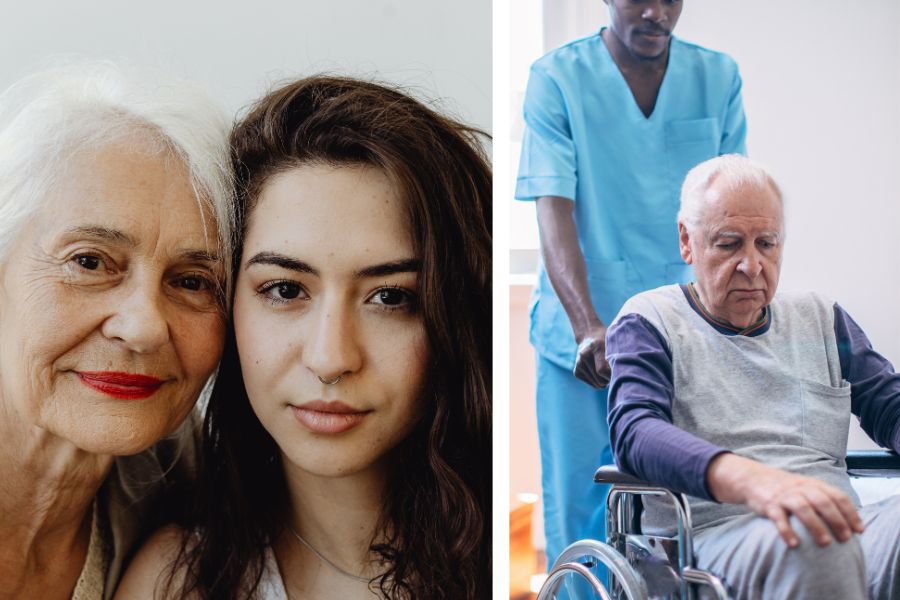
In a recent, thought-provoking episode of the Impact Theory podcast with Tom Bilyeu, renowned divorce attorney and author James Sexton shared how being a hospice volunteer changed his perspective on life so drastically that he thinks it should be “mandatory” at the age of 18.
“I think it would change your entire way of viewing the world. It did mine,” he told Bilyeu.
Sexton recalled that while death itself wasn’t necessarily the prime source of conversation—most of his volunteer work involved doing little odds and ends for folks— its presence was still palpable. And because of that, he walked out of each visit “feeling like a samurai” as all the things he thought were “so important five minutes ago” fell to the wayside.
Death gives us perspective on what really matters
“Spend time with people that are dying. They don’t really…all their stuff is a great big pile of nothing. Like, all that they can talk about is the people that they love, the connections that they made, and the experiences that they had that were beautiful or painful,” he said.
That realization became even more apparent when he learned that his own mother was terminally ill with cancer, and past the point that any doctor could help her.
“In that moment, all of the other things that I was stressed about and worried about, the volume was turned so far down on all those things because my mom was gonna die. All that became important was how I could spend a little more time with her. How can I make sure she knows that I love her? How can I savor these wonderful things?”
Hospice volunteering could help us navigate anti-death culture
Developing an awareness of death during early adulthood, Sexton argued, would help people not get “distracted” by a society that constantly tries make you forget that death is inevitable. Therefore, they wouldn’t pay attention to the “meaningless shit that keeps the machine moving,” and instead focus on what really matters.
And what really matters? Important things like kissing our spouse, for example, which Sexton reminded Bilyeu (and, conversely, all of us) is a finite number of times. You won’t know what that finite number is “until you’ve passed it,” he warned.

“If you don’t keep that in your line of sight, then you’re a fool. You’re gonna think you’re gonna get to do that forever. You don’t. That’s the most beautiful thing in the world. It’s what makes that so special.”
For Sexton, being a hospice volunteer cemented this perspective, and since then, “nothing has been the same.” It didn’t mean suddenly “living life like a monk,” but it did mean sharing his love a little more freely, and appreciating that “things have to end.”
Between hospice volunteering and working as a divorce lawyer, Sexton has become an expert of sorts with “endings,” he noted with Bilyeu. And he argues that we must look at life through this lens because the one constant is that “everything is ending all the time,” and ignoring that fact “does a great disservice.”
A death ritual for the modern day
American culture generally treats death with avoidance, viewing it as a taboo topic or a medical failure rather than a natural life stage. It is highly clinical and sanitized, with many dying in hospitals away from family and loved ones. While shifting toward more home-based hospice care, US society remains heavily influenced by “death-denying” attitudes, emphasizing quick, efficient mourning. Compare that to other cultures that have consistent mourning rituals, like Mexico’s Dios De Los Muertos and Japan’s Obon. Perhaps Sexton’s hospice volunteering concept could act as something similar to these traditions…a rite of passage that doesn’t have us avoiding death, but walking alongside it.
You can watch the full Impact Theory episode here: