upworthy
Add Upworthy to your Google News feed.
Google News Button
Education

Dialect coach expertly debunks the age-old myth that women talk more than men

It's unbelievable where this all started.

women vs men, women talk more than. men, erik singer, erik singer wired, gender differences, gender roles, gender wars
via @eriksinger/Instagram, used with permission

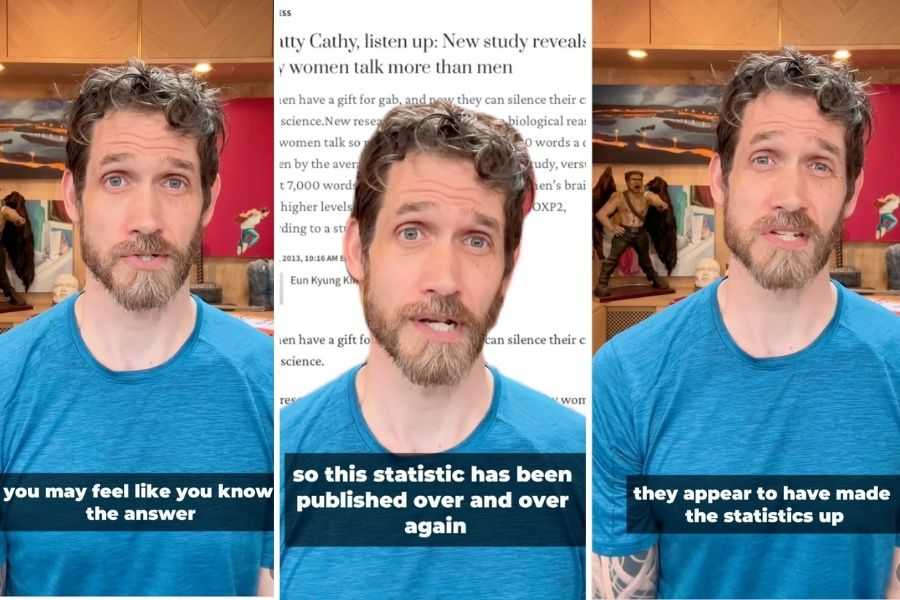
Dialect coach Erik singer debunks the myth that women talk more than men.

The stereotype that women are more talkative than men is pervasive across many cultures and generations. Professional dialect coach Erik Singer recently argued that this widely held belief doesn’t have the evidence to back it up…and he brought receipts.

It’s safe to say that Singer, who has dedicated over 20 years to deeply understanding dialects and accents, helped actors pull off career-changing accent work, and produced countless viral videos meticulously breaking down various accent mechanics, knows a thing or two about talking.

Singer's latest video took a slightly different direction than his usual content. In it, he explained how the often-cited statistic that women on average talk three times more than men (or 20,000 words a day vs. 7,000) is, essentially, “made up out of thin air.”

Originally, it came from a 2006 book titled The Female Brain, written by neuroscientist Louann Brizendine, M.D. The source for that stat was a self-help book called Talk Language: How to Use Conversation for Profit and Pleasure, which originated in Love for a Lifetime, a marriage advice book based on Christian principles, which were made up by the author, James C. Dobson. A great example of why one should always check their sources, folks.

Singer then showed an actual study from 1988 titled "Gender differences in Verbal Ability: a Meta-Analysis,” which found that the difference was only one-tenth of one standard deviation. Or, as Singer put it, “zip, nothing.”

Following that, Singer cited Deborah Tannen’s "Understanding Gender Differences in Amount of Talk: a Critical Review of Research," which showed that not only is this belief not supported, but that actual studies showed there was either no difference between men and women in the amount of talk, or that men, in fact, talked more than women.

@fox2detroitwjbk Are women or men more talkative? 🗣️ #TheNine @Deena Centofanti @MaurielleTV @RyanErmanni ♬ original sound - FOX 2 Detroit

And yet, this belief might seem like it’s true simply because it’s so deeply ingrained into our collective psyche. Just take a look at some of these proverbs that Singer effortlessly rattled off:

Irish- “Wherever there are women, there’s talking. Wherever there’s geese, there’s cackling.”

Romanian- “Where there are women and geese, there wants no noise.”

American- “When both husband and wife wear pants, it is not difficult to tell them apart. He is the one who is listening.”

Singer even noted how the word “noisy” is made from placing the word “women” three times together in a triangle in an archaic Japanese proverb.

The truth is, as Singer noted, that how often someone speaks depends far more on individual circumstances (whether a person works alone at home versus interacting with clients all day, for example) rather than gender. Breaking down unfounded tropes like these might help us all engage less in unnecessary division and start seeing things more objectively.

It certainly makes you wonder: what other stats about men vs women are completely made up?

women vs men, women talk more than. men, erik singer, erik singer wired, gender differences, gender roles, gender wars Should this automatically be considered "noisy?" Really?Photo credit: Canva

For more interesting accent and dialect content, give Singer a follow on Instagram.

ideas, homelessness, prodigy, social work, solutions
Photo credit: @ribalzebian on Instagram

Ribal Zebian is going to test a house he designed by living in it for a year.

Ribal Zebian, a student from the city of London in Ontario, Canada, already made headlines last year when he built an electric car out of wood and earned a $120,000 scholarship from it. Now, he's in the news again for something a little different. Concerned with homelessness in his hometown, Zebian got to work creating a different kind of affordable housing made from fiberglass material. In fact, he’s so confident in his idea that the 18-year-old plans on living in it for a year to test it out himself.

Currently an engineering student at Western University, Zebian was concerned by both the rising population of the unhoused in his community and the rising cost of housing overall. With that in mind, he conjured up a blueprint for a modular home that would help address both problems.


Zebian’s version of a modular home would be made of fiberglass panels and thermoplastic polyethylene terephthalate (PET) foam. He chose those materials because he believes they can make a sturdy dwelling in a short amount of time—specifically in just a single day.

“With fiberglass you can make extravagant molds, and you can replicate those,” Zebian told CTV News. “It can be duplicated. And for our roofing system, we’re not using the traditional truss method. We’re using actually an insulated core PET foam that supports the structure and structural integrity of the roof.”

Zebian also believes these homes don’t have to be purely utilitarian—they can also offer attractive design and customizable features to make them personal and appealing.

“Essentially, what I’m trying to do is bring a home to the public that could be built in one day, is affordable, and still carries some architecturally striking features,” he said to the London Free Press. “We don’t want to be bringing a house to Canadians that is just boxy and that not much thought was put into it.”

Beginning in May 2026, Zebian is putting his modular home prototype to the test by living inside of a unit for a full year with the hope of working out any and all kinks before approaching manufacturers.

“We want to see if we can make it through all four seasons- summer, winter, spring, and fall,” said Zebian. “But that’s not the only thing. When you live in something that long and use it, you can notice every single mistake and error, and you can optimize for the best experience.”

While Zebian knows that his modular homes aren't a long-term solution to either the homeless or housing crisis, he believes they could provide an inexpensive option to help people get the shelter they need until certain policies are reformed so the unhoused can find affordable permanent dwellings.

@hard.knock.gospel

What to buy for the homeless at the grocery store. 🛒 Most people get it wrong. After being there myself, these are the survival items that actually matter 💯 The 2nd to last one is about more than survival—it’s about DIGNITY. We are all one circumstance away from the same shoes 🙏 SAVE this for your next grocery run. 📌 IG@hardknockgospel Substack@ Outsiders_Anonymous #homelessness #helpingothers #kindness #payitforward #learnontiktok

Zebian’s proposal and experiment definitely inspires others to try to help, too. If you wish to lend a hand to the unhoused community in your area in the United States, but don’t know where to look, you can find a homeless shelter or charity near you through here. Whether it’s through volunteering or through a donation, you can help make a difference.

oscar wilde, smart woman, famous authors, books, oscar wilde photo, library

A woman carrying books and writer Oscar Wilde.

People are quick to point out when someone has changed their mind on a topic, whether it’s in the political world, where switching sides on an issue makes you a flip-flopper, or in our personal lives. When a friend suddenly changes their mind on an important issue, we become skeptical of their motives or whether they even have any genuine beliefs in the first place.

Are we a little too harsh on people who change their views? Don’t intelligent people change their minds when presented with new information, while those who are more interested in protecting their ego cling to incorrect ideas even more strongly?


Oscar Wilde on intelligence

Legendary author, humorist, and raconteur, Oscar Wilde, sang the praises of those who can freely change their mind in an 1885 piece on painter James McNeill Whistler in The Pall Mall Gazette of London. “Consistency is the last refuge of the unimaginative,” he famously wrote.

Dr. Emma Jones, a physician and burnout coach, elaborated on Wilde’s quote in a recent viral Instagram post. She agrees that the ability to change your mind is a hallmark of brilliance.

“Here's how you know someone is highly intelligent: It's not their degrees. It's this. It's what led Oscar Wilde to say that ‘consistency is the last refuge of the unimaginative.’ What he meant by that was that highly intelligent people know how to change their minds,” Jones says. Jones goes on to say that intellectually gifted people use phrases such as “I used to think,” or “That's a good point, let me reconsider.”


Jones adds that mental flexibility is a sign of strong character. “Most people double down to protect their ego. But intelligent people update their beliefs. They get more curious instead of more defensive,” Jones continues. “They don't tie their identity to being right. And they treat being wrong like data, not humiliation.”

Oscar Wilde had no problem with people who changed their mind

Wilde firmly believed that people should be mentally flexible and had zero issue with those who were wildly inconsistent in their views, as long as they were charming. “The well-bred contradict other people. The wise contradict themselves,” he wrote in 1894’s Phrases and Philosophies for the Use of the Young.

He’s got a point. Who's to say that we all have to carry around rigid worldviews and must be consistent 100% of the time?

Adam Grant, an organizational psychologist and author of Hidden Potential: The Science of Achieving Great Things and Think Again: The Power of Knowing What You Don't Know, also believes that being able to change your mind is a hallmark of intelligence.

“A sign of intellect is the ability to change your mind in the face of new facts. A mark of wisdom is refusing to let the fear of admitting you were wrong stop you from getting it right. The joy of learning something new eventually exceeds the pain of unlearning something old,” Grant wrote on Twitter.

Ultimately, maybe inconsistency isn’t a personal flaw but a way of adapting to a world constantly in flux. Those who lack imagination cling to their strongly-held views, while the wise continue to change. Great thinkers and psychologists agree that changing your mind shouldn’t be seen as a weakness but as a sign of a strong mind and character.

washer, washing machine setting, how to use washing machine, laundry, laundry tips
Image courtesy of @granolabarpan/Instagram (with permission)

Stay-at-home mom Catrina shares shock at learning what the 'heavy' setting on her washer means.

Knocking out loads of laundry is a feeling of accomplishment that is unmatched. Depending on what needs to be washed, washing machines offer a variety of settings for the ideal clean. But even the most seasoned laundry pros can admit that they don't fully understand how to use them properly.

One stay-at-home mom shared her funny and relatable washing machine mistake. Catrina (@granolabarpan) got the shock of a lifetime when she realized that she had been using the "heavy" setting on her washer wrong for years.


"POV: today years old when it clicks why my blankets are sopping wet!!! I thought HEAVY meant heavy items being washed," she wrote in the video's overlay.

"Heavy on my machine means heavily soiled," she went on to add in the comments. "I thought it meant the stuff I was putting in the machine was heavy in weight/pounds."

Some moms are also realizing this for the first time. "Ok.. so I am 66 years old learning this???!! I always thought that heavy meant weight also😂," one person commented. Another person wrote, "Well I was today years old when I learned what heavy meant too…😂"

Others expressed confusion with so many settings, and reminiscing on simpler times. "Wait a minute. 😂. I think I need to for once go and read the manual because I have been wondering about all of the options," another user wrote. And another chimed in, "I want my old $250 3 options hot/warm/cold on/off washer back. It didn’t die it rusted out but took 25yrs to do it. I had 5 kids, plus my ex in-laws living with me."

Washing machine settings, explained

Struggling to understand the settings on your washing machine? You're not alone.

"Knowing these settings helps avoid common laundry mistakes, such as using the heavy cycle for heavy fabric weight instead of heavy soil, which can lead to ineffective cleaning or damage over time," Vanessa Ruiz, a professional organizer at Sparkly Maid San Antonio, tells Upworthy.

These are five washing machine settings and how they work:

1. Normal/Regular Cycle
Ruiz explains that this is your typical setting for day-to-day loads such as t-shirts, jeans, sheets, and underwear.

"These laundry loads are typically washed in warm water and the setting is rinsed with medium spin speeds through agitation in order to properly clean moderately soiled garments," she says. "This cycle is safe enough to wash a variety of different fabric content with a somewhat dirty load."

2. Delicate/Gentle Cycle
Ruiz notes that the delicate cycle is created specifically for delicate fabrics—lingerie, silk, lace, or embellished clothing—that may become damaged in a normal or regular wash.

"This cycle will use moderate spin speeds through gentle agitation to thoroughly dry clean and not damage clothes too easily," says Ruiz. "This is the preferred cycle when laundry items that require extra care or are labeled 'delicate' or 'hand wash' need to be washed."

3. Heavy Duty Cycle
The heavy duty cycle is specifically for heavily soiled items like work clothes, kitchen towels, and bedding.

"This setting uses higher water temperatures, longer wash times, and powerful agitation to remove stubborn dirt and grime. It’s perfect for those tough laundry jobs, but not recommended for delicate fabrics," explains Ruiz.

- YouTube www.youtube.com

4. Bulky/Bedding Cycle
This cycle is often confused with "heavy."

"This cycle accommodates larger, heavier items that absorb a lot of water, such as comforters, pillows, and sleeping bags," says Ruiz. "It uses more water, medium spin speeds, and longer wash times to thoroughly clean bulky items without causing damage or imbalance."

5. Quick Wash
In a rush? This is the perfect setting to use.

"It is an accelerated wash cycle designed for small loads of lightly soiled clothes, usually lasting 15 to 40 minutes," says Ruiz. "It’s great for when you need clean clothes fast and can save energy compared to longer cycles."

This article originally appeared last year.

cat, apartment, note, pet owner, neighbor

A cat's noises were notable for a downstairs neighbor.

Living in close proximity to others, such as sharing walls, floors, and ceilings in an apartment building, means occasionally having to communicate when one person's noise affects another. That might look like a simple, "Hey, would you mind turning your music down?" or letting a neighbor know that stomping feet or loud voices carry farther than they might think.

It's always a bit awkward to say something to a neighbor you don't know well, which is why some people simply leave a note. But a note an apartment dweller left for their upstairs neighbor about the sounds coming from their unit took an unexpectedly charming turn.


The note reads: "Dear ____ in 201. I have to inform you of your cat. He or she runs around a lot. I can hear the pitter-patter of their feets on my ceiling. It's very cute and brings me a lot of joy when I hear it. Tell them to keep it up. [Signed] ___ (downstairs neighbor)."

Some people seemed to misinterpret the note as a sarcastic complaint rather than the sweet letter it was. (Referring to paws as "feets" should have been a clue to the tone, but it's not always easy to read intent in a note that plays on a common trope.) But most people in the comments got the intended message:

"Not gonna lie, you got me in the first half 😂 but I'm obsessed, I would've LOVED this when I lived in an apartment!"

"I was getting ready to tell you to get over yourself, but instead I'm here to tell you that you're awesome. Thanks for the smile."

"I tell my neighbor this all of the time! I think she might think I'm being passive aggressive bc I ask about her cat when I see her but genuinely, I can't have a cat bc I travel too much and I am delighted when I hear hers jetting around and getting into stuff 💕"

cat, apartment, note, pet owner, neighbor Some neighbors love the sounds of other people's pets. Photo credit: Canva

"I had three Irish tap-dancing dogs (or dogs who thought they could riverdance 🤣) living right above my head for a year. So. Loud. 😭. They chased each other back and forth all hours of the day. I never fussed about it though. I got so used to it, I was actually able to tone it out and it was like ambient sound to me 😂."

"I used to hear my neighbors cats get the zoomies and it was so cute. You could only hear it if the apartment was completely quiet but it literally was the best kind of neighbor noise."

"As a cat owner, I'd smile if I got this note. Also I can tell it's not sarcastic because you said 'feets' — a clear and friendly sign of a genuine cat lover."

"I always feel bad when my dog plays sometimes.. she likes to stomp around with her toys. I asked my downstairs neighbor if he could hear her, and he said yes, but dogs can do no wrong. He always gives her a little treat when he sees her."

dog, apartment, note, pet owner, neighbor Pembroke Welsh Corgi Dancing GIF Giphy

"During covid lockdown and during stormy weather, my neighbor would use our floor's long hallway to run their corgi up and down for exercise. I absolutely loved to hear her exuberant pitter patters. She'd only make 3 round trips before tapping out."

"I was in a second floor flat and after over a year finally met the neighbor who lived under me (identical floor plan). She and I both had dogs, but she didn't know I had one. She asked if we had kids because she could hear some running around in the hallway. I told her it was when we played with the dog and she was genuinely so happy to hear that, she hadn't minded when she assumed it was kids and said she liked hearing it and knowing there were people (or a dog) playing. It was really heartwarming."

neighbors, apartment, community, building community, meeting people Meeting neighbors is the first step in building community where you live.Photo credit: Canva

In reality, there are things about communal living that might genuinely be a bother, and there are times when it's worth saying something to our neighbors to make them aware. But we can also choose the attitude we take to hearing the sounds of life around us, whether it's kids laughing and playing or cats romping around with their little thunderpaws.

There's something quite lovely about seeing someone choose to celebrate the joy of a cat rather than be annoyed by the kitty shenanigans upstairs. Sending a note like this is sure to bring a smile to a neighbor's face, making life in the same building more pleasant for everyone.

This note is a good reminder that showing kindness to our neighbors goes a long way toward building the kind of community we all want to live in.

communication, public speaking, speaking skills, speaker, presentation

Analyzing a recording of yourself in three steps can help you be a better speaker.

Public speaking often tops people's lists of biggest fears, probably because they imagine it means giving a speech on stage in front of thousands of people. While it can mean that, public speaking can also mean giving a presentation in front of your coworkers, sharing your thoughts and opinions in a meeting, or even just telling a story to a small group of people. Public speaking is just communicating to an audience, and it's something most of us do more often than we might think.

It's also a skill we can improve, as communication expert Vinh Giang helps people do. Someone asked Giang what three tips he would give to become a "brilliant" public speaker, and he responded with super-specific advice.


"One of the most powerful things you can do is a process called 'record and review,'" he said in a YouTube video. "Simply record a 5-minute video of yourself. And you need to speak improvised. Don't look at it straightaway; you are too damn self-critical."

It's not the video itself, but how you review it the next day, that really matters.

- YouTube www.youtube.com

Giang says you should review the video in three stages, each focused on a different element of speaking:

Step 1: Analyze how you sound

Turn the volume up, press play, then set your phone face down so you don't see yourself. "Just listen," Giang said. "Audit the auditory component of your voice, known as your 'vocal image.' What do you like about it? What don't you like about it?"

Step 2: Analyze how you look

Now do the opposite. Turn the volume all the way down, press play, and watch the video. "Just look at yourself," said Giang. "How's your body language? What are your facial expressions like? Do a visual audit of your visual image."

Step 3: Analyze what you say

Lastly, transcribe your video. Make sure you leave in all of the fillers like "um" and "uh" and "like." "Bring all your non-words and filler words to the forefront of your mind," Giang said. "That's robbing you of clarity every time you talk."

communication, public speaking, speaking skills, speaker, presentation Most of us can improve our speaking skills.Photo credit: Canva

Doing those three things allows you to see the specific places where your speaking skills have room for improvement. "You basically have a mirror in front of you," said Giang. Part of what makes it hard to improve as a speaker is that we can't see ourselves doing it, and we're so inside our own heads when we speak that we have trouble even hearing ourselves. In less than one minute, Giang offered an actionable, step-by-step way to overcome those problems.

According to comments on the video, people appreciated his clear, concise advice:

"Really good advice. At root he's talking about self-awareness: Being aware of what works and what doesn't work when speaking in public. The more you are self-aware, the more control you have, and the more control you have the more confident you become, which in turn means the more impact your speaking will have on others."

"Facial expressions can be a significant impediment. I was reviewing a knowledge transfer video call with a colleague that I recorded and realized my resting face is an angry face. I'm determined to make an effort to relax my scowl and smile more."

communication, public speaking, speaking skills, speaker, facial expressions Facial expressions make a difference in how an audience feels about your speaking.Photo credit: Canva

"Also if you do this with this video its all on point - listen no video, he sounds great, good vocal image watch no video, he looks great, good visual image captions have no filler, good use of every utterance good to know that he himself uses these teachings."

"Pretty solid advice. Most of the time we fail to perceive how we look in front of people. What we think and what people actually see are often vastly different. This not only solves that but also makes you practice for more clarity."

"Such a humbling experience to watch and listen to yourself, especially if public speaking is not your strength."

Most of us have some room for improvement in our speaking skills, so this advice is helpful for a wide range of people.

You can follow Vinh Giang on YouTube for more communication tips.