
“Hi.” … “Omg, are you mad at me?”
As a Gen X mom of three Gen Z kids in their teens and 20s, there’s a lot that I’m willing to concede and even celebrate when it comes to the gap between our generations. I love Gen Z’s global consciousness, their openness about mental health, their focus on inclusivity, and their insistence on wearing comfortable shoes with formal wear. But there’s one Gen Z feature that I simply cannot abide, and that is the weaponization of basic punctuation.
“It freaks me out when you say ‘yes period’ in a text,” my high schooler told me one day. “It feels so aggressive, like I feel like I’m in trouble or something.” I stared at him incredulously as his 20-year-old sister laughed but then agreed with him. “It does! The period makes it feel like you’re mad,” she said.
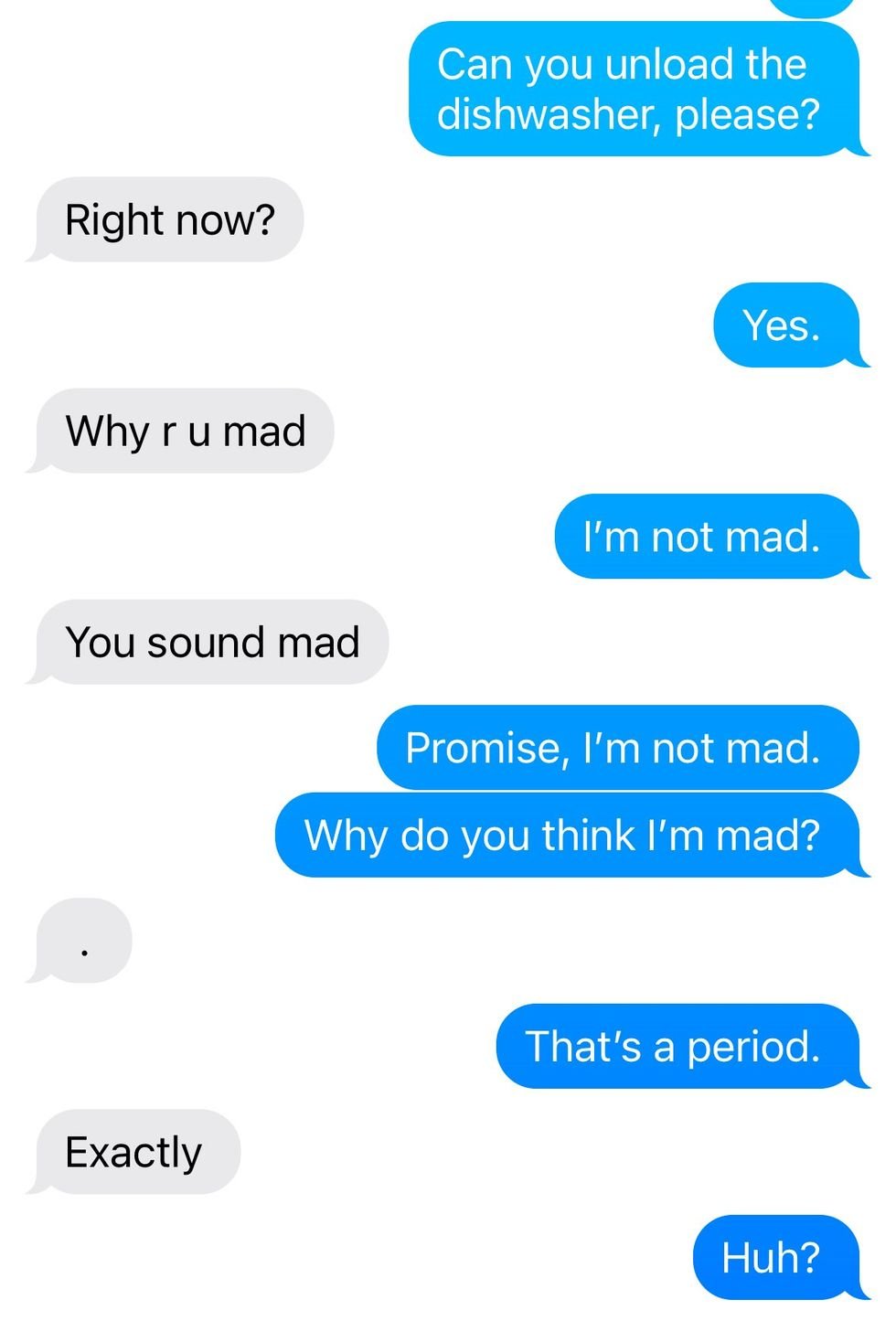
Ah yes, the period, the most benign punctuation mark of them all, is “aggressive.” Far from being a mere generational quirk, this misinterpreting of normal punctuation in text messages as aggressive or angry could result in serious communication breakdowns. Talking by text is already hard enough, and now we’re adding a layer of meaning that older folks don’t have a clue about?
The kids are serious about this, though. According to Gen Zers, pretty much any time someone puts a period at the end of a text, it means they’re mad or irritated, as if the period is being emphasized.

At the risk of sounding like a dinosaur, I’d like to point out that reading into periods in texts like this is just silly. It seems silly when the young folks do it with each other, but it’s extra silly when they do it with adults who didn’t grow up with texting and have ingrained grammatical habits that aren’t easy to shake. (And frankly, some of us don’t want to shake—I’m a former English teacher, for crying out loud. Might as well ask me to start misspelling words on purpose.)
In no reasonable world can “Yes.” be automatically viewed as aggressive. It’s just not. Neither is “Time to get off the computer.” Neither is “Got it.” Or “OK.” or “Sure.” I understand that texting conventions have evolved such that end punctuation isn’t viewed as necessary, but when did we start assigning negative intentions to very basic punctuation? A period should not be read as anything more than a matter-of-fact, neutral-toned statement, since we have other tools for conveying tone in writing—capital letters, italics, bold, exclamation points. I mean, if I wanted to be aggressive, I’d text, “HEY—it’s time to GET OFF the COMPUTER!” We also have a slew of emojis to convey tone. A period is and has always been neutral. That’s literally the entire point of a period.
I’m even willing to give Gen Z an inch on the thumbs-up emoji—they think that’s aggressive, too—only because emojis are new and their meanings are up for interpretation. But a period? Not budging. That little dot has been signaling the end of people’s thoughts for centuries. Periods can and do sometimes affect tone in subtle ways—”No, I didn’t,” hits slightly differently than “No. I didn’t.”—but their basic inclusion at the end of a thought in no way signals aggression or anger, by text or otherwise. Not on Gen X’s watch, at least. This is one generational hill I am willing to die on.
These unwritten rules of texting seem to have been concocted by Gen Z, but when? And how? Who decides these things? Is there a group of super powerful and influential young adults who put out a bat signal at some point saying that periods are symbols of aggression? If the young folks want to play the reading-into-basic-punctuation game amongst themselves, making communication much more complicated for themselves, have at it. But please don’t ascribe intent to us old fogies who’ve had “declarative statements end in periods” ingrained in us since elementary school.
Texting wasn’t always like this. When texting first became a thing, using periods in them was pretty normal. As more and more people started dropping them (and capitalization—another deep English teacher wound), I held firm to their usage, mostly out of habit and feeling like my texts were incomplete without them. As my kids got old enough to text and informed me that periods are viewed by their age group as aggressive, I reconsidered. Should I stop using them, giving in to the tyranny of Gen Z’s overthinking? Should I keep using them, embracing the fact that I’m old and set in my ways?
Ultimately, I landed on sometimes using periods in texts and sometimes not—a compromise between my own rigid grammar rules and Gen Z’s seemingly senseless texting rules. Except only using periods sometimes just confuses my kids even more, which is hilarious. Is Mom mad? Is she not? My daughter said she just has to remind herself who is texting, knowing that I—and most of my generation—simply don’t use periods aggressively.
Seriously, it’s not happening. Not now. Not ever. Period.
This article originally appeared in February. It has been updated.