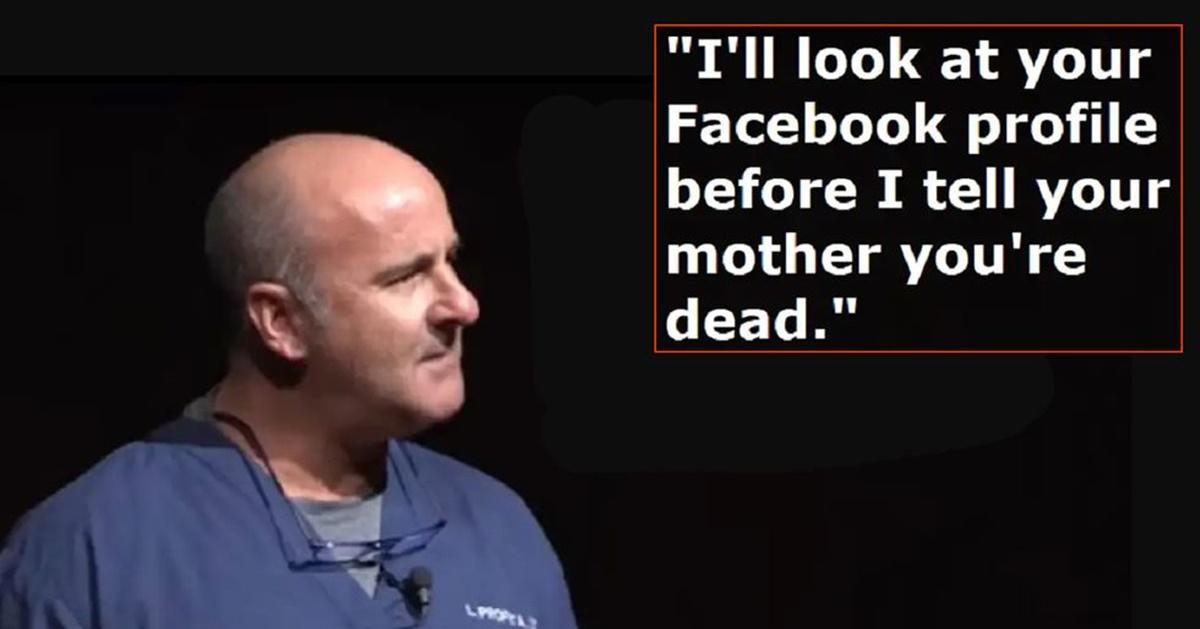
Doctor explains why he checks a dead patient's Facebook before notifying their parents
Louis M. Profeta MD explains why he looks at the social media accounts of dead patients before talking their parents.

He checks on your Facebook page.
Losing a loved one is easily the worst moment you'll face in your life. But it can also affect the doctors who have to break it to a patient's friends and family. Louis M. Profeta MD, an Emergency Physician at St. Vincent Emergency Physicians in Indianapolis, Indiana, recently took to LinkedIn to share the reason he looks at a patient's Facebook page before telling their parents they've passed.
The post, titled "I'll Look at Your Facebook Profile Before I Tell Your Mother You're Dead," has attracted thousands of likes and comments.
"It kind of keeps me human," Profeta starts. "You see, I'm about to change their lives — your mom and dad, that is. In about five minutes, they will never be the same, they will never be happy again."
"Right now, to be honest, you're just a nameless dead body that feels like a wet bag of newspapers that we have been pounding on, sticking IV lines and tubes and needles in, trying desperately to save you. There's no motion, no life, nothing to tell me you once had dreams or aspirations. I owe it to them to learn just a bit about you before I go in."
"Because right now... all I am is mad at you, for what you did to yourself and what you are about to do to them. I know nothing about you. I owe it to your mom to peek inside of your once-living world.”
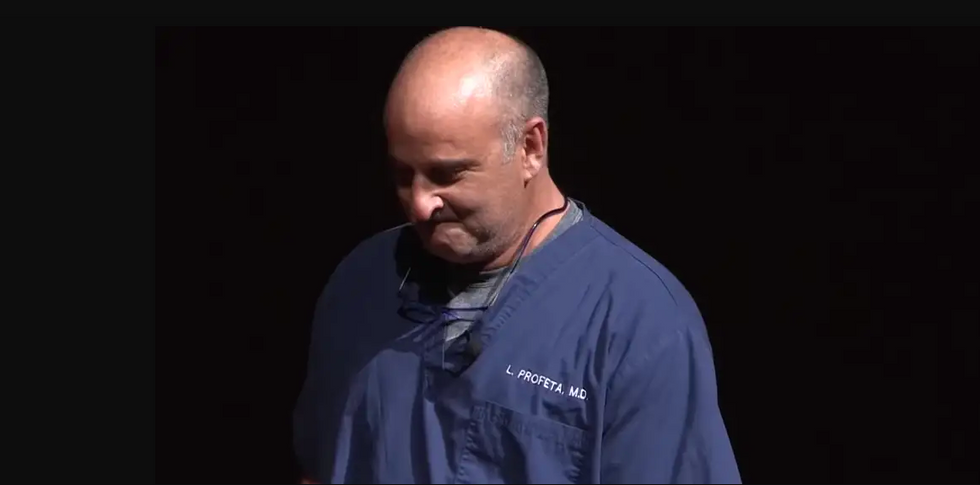
Dr. Profeta talks his experience with the death of a patient.
Photo from Tedx Talk on YouTube.
Profeta explains that the death of a patient makes him angry:
"Maybe you were texting instead of watching the road, or you were drunk when you should have Ubered. Perhaps you snorted heroin or Xanax for the first time or a line of coke, tried meth or popped a Vicodin at the campus party and did a couple shots.”
"Maybe you just rode your bike without a helmet or didn't heed your parents' warning when they asked you not to hang out with that 'friend,' or to be more cautious when coming to a four-way stop. Maybe you just gave up."
"Maybe it was just your time, but chances are... it wasn't."

The facebook app.
Photo by Brett Jordan on UnsplashProfeta goes on to explain why he checks a patient's Facebook page:
"So I pick up your faded picture of your driver's license and click on my iPhone, flip to Facebook and search your name. Chances are we'll have one mutual friend somewhere. I know a lot of people.”
"I see you wearing the same necklace and earrings that now sit in a specimen cup on the counter, the same ball cap or jacket that has been split open with trauma scissors and pulled under the backboard, the lining stained with blood. Looks like you were wearing it to the U2 concert. I heard it was great.""I see your smile, how it should be, the color of eyes when they are filled with life, your time on the beach, blowing out candles, Christmas at Grandma's; oh you have a Maltese, too. I see that. I see you standing with your mom and dad in front of the sign to your college. Good, I'll know exactly who they are when I walk into the room. It makes it that much easier for me, one less question I need to ask.”
"You're kind of lucky that you don't have to see it. Dad screaming your name over and over, mom pulling her hair out, curled up on the floor with her hand over her head as if she's trying to protect herself from unseen blows.”
"I check your Facebook page before I tell them you're dead because it reminds me that I am talking about a person, someone they love — it quiets the voice in my head that is screaming at you right now shouting: 'You mother f--ker, how could you do this to them, to people you are supposed to love!'"
This article originally appeared on June 5, 2019

- ER doctor shares why social media is a powerful tool in helping him cope with death. ›
- A doctor is using TikTok to warn kids about vaping and teach them important health topics ›
- Sisters confess everything they've done wrong since mom died - Upworthy ›
- The 3 times to avoid brushing your teeth for enamel - Upworthy ›
- Chronic congestion cleared up with medieval looking procedure - Upworthy ›
- Doctors share bizarre things about the human body they still can't explain - Upworthy ›
- A patient nominated her for a nursing award. One problem: She's a doctor. - Upworthy ›
- A doctor says there’s finally a clear winner in the morning vs. night shower debate - Upworthy ›
- Doctors and nurses share the rare times 'Dr. Google' actually got the diagnosis right - Upworthy ›
- Mom sends teen son to his first solo doctor's visit. His 'frantic' texts to her are so endearing. - Upworthy ›


A woman is getting angry at her coworker.via
A man with tape over his mouth.via
A husband is angry with his wife. via 
a man sitting at a desk with his head on his arms Photo by
Can a warm cup of tea help you sleep better? If you believe it, then yes. Photo by 
Three women sit on a blanket in the park. 
Two women engaging in a pleasant conversation inside a coffee shop
Two men engaging in a peaceful disagreement.
Resurfaced video of French skier's groin incident has people giving the announcer a gold medal
"The boys took a beating on that one."
A good commentator can make all the difference when watching sports, even when an event goes smoothly. But it's when something goes wrong that great announcers rise to the top, and there's no better example of a great announcer in a surprise moment than when French skier Yannick Bertrand took a gate to the groin in a 2007 super-G race.
Competitive skiers fly down runs at incredible speeds, often exceeding 60 mph. Hitting something hard at that speed would definitely hurt, but hitting something hard with a particularly sensitive part of your body would be excruciating. So when Bertrand slammed right into a gate family-jewels-first, his high-pitched scream was unsurprising. What was surprising was the perfect commentary that immediately followed.
This is a clip you really just have to see and hear to fully appreciate:
- YouTube youtu.be
It's unclear who the announcer is, even after multiple Google inquiries, which is unfortunate because that gentleman deserves a medal. The commentary gets better with each repeated viewing, with highlights like:
"The gate the groin for Yannick Bertrand, and you could hear it. And if you're a man, you could feel it."
"Oh, the Frenchman. Oh-ho, monsieurrrrrr."
"The boys took a beating on that one."
"That guy needs a hug."
"Those are the moments that change your life if you're a man, I tell you what."
"When you crash through a gate, when you do it at high rate of speed, it's gonna hurt and it's going to leave a mark in most cases. And in this particular case, not the area where you want to leave a mark."
Imagine watching a man take a hit to the privates at 60 mph and having to make impromptu commentary, straddling the line between professionalism and acknowledging the universally understood reality of what just happened. There are certain things you can't say on network television that you might feel compelled to say. There's a visceral element to this scenario that could easily be taken too far in the commentary, and the inherent humor element could be seen as insenstive and offensive if not handled just right.
The announcer nailed it. 10/10. No notes.
The clip frequently resurfaces during the Winter Olympic Games, though the incident didn't happen during an Olympic event. Yannick Bertrand was competing at the FIS World Cup super-G race in Kvitfjell, Norway in 2007, when the unfortunate accident occurred. Bertrand had competed at the Turin Olympics the year before, however, coming in 24th in the downhill and super-G events.
As painful as the gate to the groin clearly as, Bertrand did not appear to suffer any damage that kept him from the sport. In fact, he continued competing in international downhill and super-G races until 2014.
Alpine skiing is a notoriously dangerous sport, with a reported injury rate of 36.7 per 100 World Cup athletes per season, according to a 2018 study. Of course, it's the knees and not the coin purse that are the most common casualty of ski racing, which we saw clearly in U.S. skiier Lindsey Vonn's harrowing experiences at the 2026 Olympics. Vonn was competing with a torn ACL and ended up being helicoptered off of the mountain after an ugly crash that did additional damage to her legs, requiring multiple surgeries (though what caused the crash was reportedly unrelated to her ACL tear). Still, she says she has no regrets.
As Bertrand's return to the slopes shows, the risk of injury doesn't stop those who live for the thrill of victory, even when the agony of defeat hits them right in the rocks.