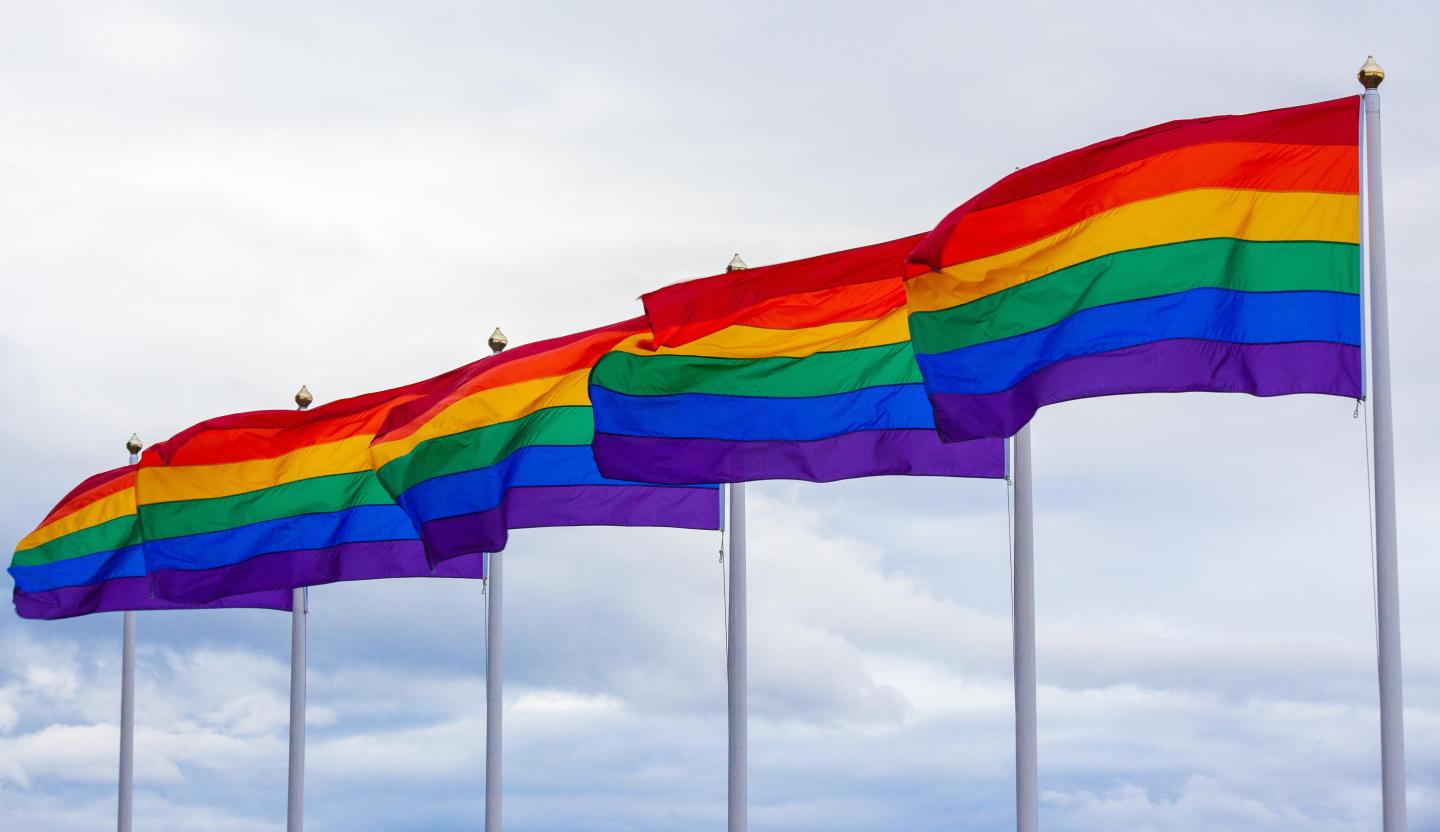
Sometimes, when we are met with unsavory behavior from others, a response is called for. But the real art is responding in a way that’s clear, strong and yet still peaceful. For an example for this, look no further than Xander’s dad, who was on the receiving end of hate from his neighbor. Rather than spewing back the same amount of vitriol, his colorful comeback had courage, wit and just the right amount of flair.
As Xander tells us in the video, the retort came after the neighbor told his dad that having two gay kids (Xander’s sister Claire is a lesbian) meant he “failed as a parent.” “So dad took a moment then replied with this…” the onscreen text reads.
Next thing you know, Xander’s dad can be seen filling his backyard with huge (like, parade level huge) rainbow pride flags. A dozen of them at least.
The video ends with the words: “No, saying things like that does.”
But rather than accept defeat—or resort to cruelty—he simply looked at the rules, only to discover that his house was actually outside the map by 2 meters (6.5 feet). So up the pride flags went! And even more this time!
Flag responses seem to run in the family. In another video, Xander explains that his neighbor (where have all the friendly ones gone?) said he couldn’t sell his house because of the small window-sized trans flag hung near the roof. So Xander got an even bigger one that covered the entire back side.
Pride Flags have long been a nonviolent way to stand up for the LGBTQ community. And yet, they still manage to whip up plenty of heated controversy, particularly at schools. The original eight colors all had a specific meaning, and only one color (pink) denoted sexuality. Meaning that the pride flag was and is just as nuanced and dynamic as the people it represents.
The flag has taken on many different forms over the years as it evolves to speak for more marginalized communities, but it remains a peaceful and artistic form of protest. One that always seems to get the message across.
In a small village in Pwani, a district on Tanzania’s coast, a massive dance party is coming to a close. For the past two hours, locals have paraded through the village streets, singing and beating ngombe drums; now, in a large clearing, a woman named Sheilla motions for everyone to sit facing a large projector screen. A film premiere is about to begin.
It’s an unusual way to kick off a film about gender bias, inequality, early marriage, and other barriers that prevent girls from accessing education in Tanzania. But in Pwani and beyond, local organizations supported by Malala Fund and funded by Pura are finding creative, culturally relevant ways like this one to capture people’s interest.
The film ends and Sheilla, the Communications and Partnership Lead for Media for Development and Advocacy (MEDEA), stands in front of the crowd once again, asking the audience to reflect: What did you think about the film? How did it relate to your own experience? What can we learn?
Sheilla explains that, once the community sees the film, “It brings out conversations within themselves, reflective conversations.” The resonance and immediate action create a ripple effect of change.
MEDEA Screening Audience in Tanzania. Captured by James Roh for Pura
Across Tanzania, gender-based violence often forces adolescent girls out of the classroom. This and other barriers — including child marriage, poverty, conflict, and discrimination — prevent girls from completing their education around the world.
Sheilla and her team are using film and radio programs to address the challenges girls face in their communities. MEDEA’s ultimate goal is to affirm education as a fundamental right for everyone, and to ensure that every member of a community understands how girls’ education contributes to a stronger whole and how to be an ally for their sisters, daughters, granddaughters, friends, nieces, and girlfriends.
Sheilla’s story is one of many that inspired Heart on Fire, a new fragrance from the Pura x Malala Fund Collection that blends the warm, earthy spices of Tanzania with a playful, joyful twist. Here’s how Pura is using scent as a tool to connect the world and inspire action.
A partnership focused on local impact, on a global mission
Pura, a fragrance company that recognizes education as both freedom and a human right, has partnered with Malala Fund since 2022. In order to defend every girl’s right to access and complete 12 years of education, Malala Fund partners with local organizations in countries where the educational barriers are the greatest. They invest in locally-led solutions because they know that those who are closest to the problems are best equipped to solve and build durable solutions, like MEDEA, which works with communities to challenge discrimination against girls and change beliefs about their education.
But local initiatives can thrive and scale more powerfully with global support, which is why Pura is using their own superpower, the power of scent, to connect people around the world with the women and girls in these local communities.
The Pura x Malala Fund Collection incorporates ingredients naturally found in Tanzania, Nigeria, Pakistan, and Brazil: countries where Malala Fund operates to address systemic education barriers. Eight percent of net revenue from the Pura x Malala Fund Collection will be donated to Malala Fund directly, but beyond financial support, the Collection is also a love letter to each unique community, blending notes like lemon, jasmine, cedarwood, and clove to transport people, ignite their senses, and help them draw inspiration and hope from the global movement for girls’ education. Through scent, people can connect to the courage, joy, and tenacity of girls and local leaders, all while uniting in a shared commitment to education: the belief that supporting girls’ rights in one community benefits all of us, everywhere.
You’ve already met Sheilla. Now see how Naiara and Mama Habiba are building unique solutions to ensure every girl can learn freely and dare to dream.
Naiara Leite is reimagining what’s possible in Brazil
Julia with Odara in Brazil. Captured by Luisa Dorr for Pura
In Brazil, where pear trees and coconut plantations cover the Northeastern Coast, girls like ten-year-old Julia experience a different kind of educational barrier than girls in Tanzania. Too often, racial discrimination contributes to high dropout rates among Black, quilombola and Indigenous girls in the country.
“In the logic of Brazilian society, Black people don’t need to study,” says Naiara Leite, Executive Coordinator of Odara, a women-led organization and Malala Fund partner. Bahia, the state where Odara is based, was once one of the largest slave-receiving territories in the Americas, and because of that history, deeply-ingrained, anti-Black prejudice is still widespread. “Our role and the image constructed around us is one of manual labor,” Naiara says.
But education can change that. In 2020, with assistance from a Malala Fund grant, Odara launched its first initiative for improving school completion rates among Black, quilombola, and Indigenous girls: “Ayomidê Odara”. The young girls mentored under the program, including Julia, are known as the Ayomidês. And like the Pura x Malala Fund Collection’s Brazil: Breath of Courage scent, the Ayomidês are fierce, determined, and bursting with energy.
Ayomidês with Odara in Brazil. Captured by Luisa Dorr for Pura
Ayomidês take part in weekly educational sessions where they explore subjects like education and ethnic-racial relations. The girls are encouraged to find their own voices by producing Instagram lives, social media videos, and by participating in public panels. Already, the Ayomidês are rewriting the narrative on what’s possible for Afro-Brazilian girls to achieve. One of the earliest Ayomidês, a young woman named Debora, is now a communications intern. Another former Ayomidê, Francine, works at UNICEF, helping train the next generation of adolescent leaders. And Julia has already set her sights on becoming a math teacher or a model.
“These are generations of Black women who did not have access to a school,” Naiara says. “These are generations of Black women robbed daily of their dreams. And we’re telling them that they could be the generation in their family to write a new story.”
Mama Habiba is reframing the conversation in Nigeria
Centre for Girls' Education, Nigeria. Captured by James Roh for Pura
In Mama Habiba’s home country of Nigeria, the scents of starfruit, ylang ylang and pineapple, all incorporated into the Pura x Malala Collection’s “Nigeria: Hope for Tomorrow,” can be found throughout the vibrant markets. Like these native scents, Mama Habiba says that the Nigerian girls are also bright and passionate, but too often they are forced to leave school long before their potential fully blooms.
“Some of these schools are very far, and there is an issue of quality, too,” Mama Habiba says. “Most parents find out when their children are in school, the girls are not learning. So why allow them to continue?”
When girls drop out of secondary school, marriage is often the alternative. In Nigeria, one in three girls is married before the age of 18. When this happens, girls are unable to fulfill their potential, and their families and communities lose out on the social, health and economic benefits.
Completing secondary school delays marriage, and according to UNESCO, educated girls become women who raise healthier children, lift their families out of poverty and contribute to more peaceful, resilient communities.
Centre for Girls’ Education, Nigeria. Captured by James Roh for Pura
To encourage young girls to stay in school, the Centre for Girls’ Education, a nonprofit in Nigeria founded by Mama Habiba and supported by Malala Fund and Pura, has pioneered an initiative that’s similar to the Ayomidê workshops in Brazil: safe spaces. Here, girls meet regularly to learn literacy, numeracy, and other issues like reproductive health. These safe spaces also provide an opportunity for the girls to role-play and learn to advocate for themselves, develop their self-image, and practice conversations with others about their values, education being one of them. In safe spaces, Mama Habiba says, girls start to understand “who she is, and that she is a girl who has value. She has the right to negotiate with her parents on what she really feels or wants.”
“When girls are educated, they can unlock so many opportunities,” Mama Habiba says. “It will help the economy of the country. It will boost so many opportunities for the country. If they are given the opportunity, I think the sky is not the limit. It is the starting point for every girl.”
From parades, film screenings to safe spaces and educational programs, girls and local leaders are working hard to strengthen the quality, safety and accessibility of education and overcome systemic challenges. They are encouraging courageous behavior and reminding us all that education is freedom.
Experience the Pura x Malala Fund Collection here, and connect with the stories of real girls leading change across the globe.
If you’re looking to move abroad from the United States, the United Kingdom seems like a natural candidate on its face. After all, moving to the UK means you’ll already speak the language, be relatively familiar with the country’s political structure, and exist within a similar pop culture and media ecosystem.
But many people who move to London or its surrounding areas are stunned to learn just how different American and British cultures can be.
Ashley Jackson recently moved from Amarillo, Texas, to South Manchester. She’s been documenting her journey acclimating to the new culture on her TikTok channel. Recently, she shared three “mortifying” experiences that almost made her rethink her new life in the UK.
In the tongue-in-cheek post, she reiterates that despite the difficulties and hilarious flops that have arisen from her new life, she’s still having a great time living in Manchester. But things were certainly touch-and-go for a while at first.
“One, I’ve had a full-on conversation with a person and I didn’t understand a lick of it. She had a very different accent I couldn’t understand,” Jackson says.
Accents and regional dialects in the UK are among the most diverse and wide-ranging in the world. In the U.S., there are subtle differences between Southern, Cajun, and Northeastern accents, for example. But that’s nothing compared to what even locals encounter in the UK. Even they sometimes have a hard time understanding more niche or obscure dialects like Glaswegian or Devonian. Most Americans are woefully unprepared for the accents they encounter there.
Issue number two for Jackson? “It hailstoned. While on a hike up a hill, it rained, hailstone, my daughter was crying. Everyone was wet, soggy, feet muddy. Quite traumatizing for all of us, but we’re still here.”
Weather in the UK can be all over the map, but one thing the region is famous for is rain and hail. Heatwaves and climate change have only contributed to hailstones becoming larger and more frequent. In another video, Jackson says acclimating to the weather in the UK has been a challenge, noting that she had to “toughen up.”
And finally, issue number three: “I was cut off by my GP (general practitioner) after the 10-minute mark. I didn’t realize there were 10-minute time slots for doctor’s appointments. Learned that one the hard way.”
One big appeal of living in the UK is the mostly free healthcare provided through the NHS. However, appointments can be hard to come by, and many doctors are strict about keeping visits under 10 minutes so they can manage their patient load. Jackson was stunned to be “cut off” in the middle of a visit, but for locals, that’s just the way it goes.
Americans moving to the UK often experience extreme culture shock. We sometimes expect the cultures to be so similar that the small differences that do exist catch us completely off guard.
The language, though fundamentally similar, can take Americans a while to pick up on. British culture is full of slang, regional dialects, and colloquialisms that can be confusing for outsiders. One American who moved there, for example, was baffled when everyone kept calling her cookies “biscuits.”
A lot of American daily conveniences either don’t exist in the UK or are far more rare. Air conditioning and garbage disposals, for example, are hard to come by. Houses and living quarters in general are much smaller than what most Americans are used to as well.
Work culture is very different in the UK as well. Citizens usually have a stronger work-life balance and a government-mandated minimum of five weeks of paid vacation.
In short, moving from America to the UK won’t necessarily be easy just because of the common language. Whether you ultimately enjoy American or British culture more is a matter of taste, but it will take some getting used to—that’s for sure.
As for Jackson, she says in her videos that even if the adjustment wasn’t easy, she loves the rain, the NHS, and the walkability of life in the UK. She just had to stick it out through a few embarrassing faux pas before she could start enjoying all the perks.
Tourists see new places with fresh eyes and fresh observations. In 2024, 72.4 million tourists visited the United States, according to the National Travel and Tourism Office. (That’s a lot of eyes seeing America in a new light.)
Tourists to the States have pointed out that Americans really do like to put ranch dressing on everything. They’ve also noted that in the U.S., squirrels seem to run rampant.
While these are insightful observations, most Americans would say they already know them to be true. On Reddit, Americans shared the shocking realizations they had about the U.S. that were only revealed to them by tourists.
As one American noted, “I’ve lived in the US my whole life. Somehow, I’ve never noticed this before.”
These are 15 eye-opening things tourists brought to Americans’ attention that truly blew their minds:
Culture
“We sure do have a lot of flags everywhere.” – myfourmoons
“American coins don’t have numbers on them. Some of the coins will say ‘One Cent’ or ‘Quarter Dollar’ but I don’t think that’s helpful if your English is not so good. And sometimes that labeling is just not in a place that easy to see on a coin.” – chocotacogato
Michael White, a former spokesman for the United States Mint, told The Gainesville Sun that the reason coins in the U.S. don’t have numbers is simple: “It is an artistic choice in the majority of instances.”
White added that certain coins in the past in the U.S. have used numerical notations, including the dime, nickel, and quarter. The article notes, “From 1809 to 1836, there was a half dollar imprinted with ’50 C.’ That was changed to ’50 cents’ for two years and then, in 1838, artistic choice deemed it should be called ‘half dollar.’”
“The gap around the stall doors in public restrooms. It’s weird, and I hate it.” – SidheRa
“Bank drive-thru lanes. I was told ‘why don’t you just get out of your car and walk in the bank?’” – JWilsn_Art
According to Wells Fargo, “motor banks” (aka drive-in and drive-thru banks) were invented in the U.S. and came into existence in the 1930s.
“That every morning, all American children from kindergarten to 12th grade, stand before the US flag (found in every classroom, ofc) and recite “the pledge of allegiance” to the country in unison, with their right hands over their hearts. Upon learning this universal American school experience, my Russian colleague said: ‘That is the most Comm*nist thing over ever heard!’” – jzzdancer2
The Pledge of Allegiance, written by Francis Bellamy, debuted in 1892, according to the American Legion. Over the years, it went through various edits until it was recognized by Congress and included in the U.S. Flag Code on June 22, 1942.
“How much daily life revolves around cars. In many cities, if you don’t drive, you basically don’t exist. It’s convenience on steroids.” – Prior_Bank7992
Mannerisms
“That Americans switch between hands when eating with silverware, cutlery, etc.” – BasilRevolutionary38
Called the “cut-and-switch” table habit, it’s described by NPR as when you “hold your fork in your left hand and cut with your right and then put down your knife so you can switch your fork to your right hand before you take a bite.”
Americans actually adapted this use of cutlery from the French. Writer Mark Vanhoenacker explained to NPR, “Americans got it from France in the 19th century even as France was giving it up, and no one knows why France gave it up. Maybe just convenience or another change of fashion.”
“We smile too much. To the point where foreigners, specifically Asians (Korean and Chinese) have pointed out that our smiles feel disingenuous and mean nothing. Really hit home, but despite that, I still smile ‘too much’.” – BMdabbleU
“How much casual socializing we do with strangers. From small talk to things people in other places consider weirdly intimate (like talking about health problems).” – Practical-Water-9209
“The lean! The fact that people from the U.S. tend to lean on things while standing, no matter how inappropriate a place or circumstance. I’ve thought about it, and I think its because the U.S. (for the most part) isn’t walkable, so we aren’t used to standing for as along as other countries.” – Lobstertales143
The Central Intelligence Agency has deemed the “American Lean” a dead giveaway that someone is an American. In 2019, Jonna Mendez, the CIA’s former chief of disguise, and Gina Haspel, former CIA director, told NPR that Europeans can easily spot Americans in a crowd.
“They think that we are slouchy, a little sloppy,” Mendez said. “And they think that they can almost see that in our demeanor on the street because they stand up straight. They don’t lean on things.”
Food
“Root beer tastes like medicine. It’s still my favorite soda but… yeah it tastes mediciney.” – TheNerdNugget
“Had a German foreign exchange student and she said ‘All American breakfast is dessert. Pancakes, donuts, Cinnabon, muffins, French toast…’ I was like yea you have a point lol.” – dom954
Words
“Apparently Americans use the word ‘awesome’ a lot. I’ve had people in other countries tease us for how we think everything is awesome lol. But to be fair, tons of things ARE awesome, and also you’re talking to me on vacation when I’m in the best mood of my life lol.” – Gold_Telephone_7192
“‘Yeah’ ‘Yeah no’ ‘Yeah right’ ‘Oh yeah’ ‘Hell yeah!’ All mean different things!” – zippy_97
It’s wonderful to go on vacation and learn all about other people’s cultures. But when you travel to another country, you also learn a lot about your own. When you’re a fish out of water, it’s easy to see the ways you stand out in a foreign environment. It’s especially noticeable when you’re an American, because your culture is known around the world.
A big way Americans stand out overseas is through their fashion. Wearing a New York Yankees cap, cargo shorts, and white New Balance sneakers may be camouflage in America, but in Paris, you stick out like peanut butter on a baguette.
To reveal the many ways Americans stand out while traveling, a Reddit user asked non-Americans a simple question: “Besides their accent, what’s one way you know a tourist is American?” The post received over 18,000 responses. Evidently, there are a lot of ways to spot an American abroad.
Here are 13 of the best responses:
1. They wait to be seated
“When visiting Paris, my wife and I learned they don’t seat you at restaurants. You just walk in and sit down at an available table. We figured it out after standing around at the entrance a few times. Then we started noticing other American tourists doing the same.”
2. They start conversations with everyone
“Saying ‘hi, how are you?’ to the barista, servers, retail workers. My country doesn’t quite have that culture so I find it really sweet.”
“I’m fascinated with Norway and remember watching a vlog from an American who had moved there. She said one of the biggest differences was the lack of politeness, because people view it as fake. I would love to live somewhere that’s more introverted than the US.”
“The absolute fearlessness of asking anyone on the street about anything.”
“This is something i still don’t understand after being in Europe for a few years. Why are people so afraid of other people just like them?”
“I’ll literally talk to anyone that wants to chat me up, never thought that was uniquely American.”
“When I went to Italy with a friend, I couldn’t figure out why everyone greeted me in English before I said a word. I don’t wear running shoes outside of the gym, I dress pretty posh, I can’t remember the last time I owned a baseball cap, and I try to have a basic grasp on the local language. How can they tell I’m American? My friend told me, ‘it’s because you’re smiling at them.’”
“It’s not so much about the fact that Americans smile, it’s how you smile. Nobody here smiles with their teeth. Maybe if they heard a really funny joke or are trying to look happy in a picture, but that’s about it. When I visited America, my family literally spent hours trying to learn how to properly smile with all your teeth showing. I still can’t do it correctly, it looks weird. I remember the first times I saw pictures from a highschool yearbook on the internet. I thought, ‘What is wrong with them? Why are they smiling so much?’ If you smile with your teeth at someone in Europe, it’s either your job, or you’re American.”
“Americans recognize other Americans in most countries because they smile at strangers on the street.”
“I live in New York, I don’t understand this smiling thing.”
Why do Americans smile so much? It’s because they come from a diverse country. A study of 32 different countries found that emotional expressiveness is correlated with diversity. When people are around others from diverse cultures, they are more likely to use a smile to build trust and cooperation.
4. Americans are very polite
“Some of yous are way more polite than expected. Whenever I hear someone say ‘ma’am’ I know they’re American. Like one time I was in Lidls and there was an American family asking someone who worked there if they sold ‘cell phones’ and when the woman said they didn’t they were all ‘oh okay, thank you for your time ma’am! Have a great day!’ which is mucb more cheery than the average Scot.”
“Yes, sir, that’s southern manners.”
“I’m gonna piggyback the Midwest in here, too. If you just walk away without putting something like this in Kansas, you might as well have slapped them.”
“Most American tourists I’ve come across are really friendly and talkative. They always seem to be genuinely stoked to be here haha.”
“Let’s put it this way: in the Eurozone, you can make a day trip of going to another country. For most of the US, getting to literally any other country is a massive ordeal with a huge price tag, so when we get to go, it’s a really special occasion that we have to make the most of because a lot of us have no idea when or if we’ll ever get to do it again.”
6. They are amazed by old things
“Girlfriend used to work on a farm and an estate in the U.K. and would often have Americans in awe of the old buildings. One once said ‘some of these buildings are older than my country.’”
“Reminds me of that old saw ‘Americans think a hundred years is a long time, Europeans think a hundred miles is a long way.’”
7. They need to find a trash can
“If you see an American in Japan, they will frantically look for public trash cans. The absence of trash receptacles is something unfounded in the US, and we become confused at the idea of having to hold it for extended periods of time.”
“EXACTLY!! Im American, went last year and i ended up having half of my backpack filled with trash until i found a trashcan, it didnt help it was mid summer so we would buy drinks from vending machines a lot, not all the vending machines had trashcans.”
“Tipping. Americans will try to tip everyone, even in countries where tipping isn’t a thing/is considered a serious insult.”
“True. I used to work in a bar in the UK, and American customers would insist on tipping me even after I declined. The relief on their faces when I took the money was hilarious.”
9. They shop late at night
“They’re looking for a store open at like 11 pm. Even if in most European countries stores close at like 7-8 pm.”
“Yeah, I’m italian but live in the US right now. One of my coworkers went to Italy on vacation and she was texting me stuff like ‘there’s no circle k here?’ Lmao.”
10. Just look at their feet
“Americans will be wearing sneakers.”
“Yep. I walked into a museum in Germany, and the woman selling tickets greeted us in English. We were dressed conservatively, and hadn’t said a word, yet she knew. I asked her how, and she said, ‘It’s your shoes.’ Indeed, I was wearing running shoes.”
Although there is no specific reason why Americans tend to wear sneakers more often than people in other countries, a major factor is car culture. When you don’t walk much, you value comfort and style over everything else. Plus, America is a country based on individuality, which breeds a culture that’s more casual than in other developed countries.
11. They take off their shoes in the airport
“I hear that us Americans can easily be spotted in the airport by the fact usually were use to taking off our shoes in TSA.”
“Dude when we landed in Japan a couple of years ago I started to take my shoes off to go through customs and I’ll never forget, one of the agents there just completely froze and looked at me like I had frogs coming out of my ears. He then motioned for me to put my shoes back on. I was very embarrassed.”
12. It’s how Americans dress
“Baseball caps, University spirit wear, cargo shorts, free t-shirts from events with ads and text all over them, and for the older Americans, they always seem to just kinda stand in the middle of everything looking around.”
“People may mock Americans for wearing shirts with ads on them but Europeans and their soccer (ahem, football) gear is just as questionable.”
“As opposed to football jerseys with ads prominently featured on the design that the wearer paid good money for.”
“For the longest time, I thought that there was a soccer team named Fly Emirates.”
“If they buy peanutbutter. It sounds very weird, but everyone who buys peanut butter where I work, turns out to be American.”
“I was desperately homesick while living in Belfast and had a quiet cry in the grocery store because I wanted it and couldn’t find it. I eventually did, made a peanut butter and jelly sandwich, and felt better. Not seeing the sun for three months was doing my head in.”
Interestingly, although Americans are stereotyped as the biggest consumers of peanut butter in the world, it’s actually much more popular in developing nations such as Burkina Faso, Myanmar, and Chad, where it is used as a nutritional supplement and an ingredient in soups and stews.
Head anywhere in the Southern United States, and you are likely to hear one distinct word: “y’all.” “Y’all,” which combines the words “you” and “all,” may be predominantly used in the South—but not for long.
Paul E. Reed, a linguist at the University of Alabama who studies Southern American English and Appalachian English, told NPR in 2025 that “it’s expanded much more outside of the South” thanks to Americans under 40. (Add it to the list of Gen Z slang.)
How “y’all” entered the English vernacular is a fascinating tale. Linguist Danny Hieber, PhD, explained the origin story of “y’all” to his TikTok followers—and it stems from a surprising language.
According to Hieber, present-day English doesn’t have a plural form of the word “you” like other languages. In Old English, there were three forms of “you”:
Thou (subject)
Thee (object)
Thine (possessive)
Hieber goes on to explain that “you” became singular thanks to French. In French, “you” translated to:
Tu (singular)
Vous (plural + polite)
“After the Norman Conquest of England in 1066, French had a huge influence on English,” he said. “So English speakers started borrowing that pattern into English and used ‘you’ to politely address one person.”
He added that over time, this became the default way to address a single person. Along those same lines, the word “be” also followed suit.
“It used to be that the verb ‘be’ was conjugated like this,” explained Hieber, with the plural use becoming “are.” “That singular verb got pulled along into the singular too, and now the conjugation of ‘be’ looks like this:”
I am / we are
Thou art / you are
He, she, it is / they are
However, it created a “gap,” and “English speakers have been trying to settle on a ‘you [plural]’ ever since,” said Hieber. Enter: y’all.
There are many theories as to how y’all infiltrated American English in the 1700s, per NPR. One theory states that it has British origins, where the words “ye” and “aw” were combined and used in the British Isles. From there, Scots-Irish immigrants brought it to Appalachia in the U.S.
The other theory is that it originated in West Africa, and when enslaved people were brought from there to the South, it began to spread. After the Great Migration, Black Americans brought the term north with them, expanding its use.
However, the term “you guys” is still commonly used in most Northern states. There are also many regional variations throughout the country, including “yinz” (used in Pittsburgh, Pennsylvania) and “youse” (used in Philadelphia, Pennsylvania).
Americans respond
Viewers had lots of opinions on Hieber’s video, including how different regions have termed the plural form of “you”—and their thoughts on y’all:
“Sorry… y’all is singular all y’all is plural.”
“In the upper Ohio Valley, we also say things like, ‘All yinz guys,’ a sort of amalgamation of Pittsburgh’s ‘yinz’ (we’re an hour away), and the Midwest ‘you guys.’”
“From CA but living in the south..I just cannot bring myself to say y’all..feels so unnatural.”
“Washington born and y’all made it into my vocab.”
NBA legend Kobe Bryant was one of the greatest competitors of his generation, and his work ethic was distilled into a single phrase: Mamba Mentality.
“You wake up every single day to get better today than you were yesterday,” Bryant said in an interview posted on Twitter (X) in 2020. “Doesn’t matter what you are—basketball player, hockey player, golf player, painter, writer… doesn’t matter.”
It was about dedication to the process, not just the results, and about obsessively preparing and outworking everyone else in the building.
Bryant described one way he placed process above everything else in a 2015 interview with Jemele Hill during BET’s Genius Talks. She asked Bryant, “How did you become one of those people who doesn’t seem to be afraid of failing?” Bryant flipped the question on its head.
Bryant didn’t believe in failure
“Seriously, what does failure mean? It doesn’t exist. It’s a figment of your imagination. What does it mean? I’m serious. I’m trying to think. How can I explain it?” he responded.
He tried to explain the concept of failure through the opposite idea—perpetual success—which he also didn’t believe exists:
“So let’s use happy endings then we can relate this to failure, why it’s not existent. Everybody talks about how everybody wants a happy ending, right? Now, let’s go through the reality of it. Let’s look at a fairy tale story. It’s like Snow White. She gets a happy ending. She finds a prince or whatever, she goes along, she lives happily ever after. Well, I call bulls**t on that because two months later, the fact is they had an argument and he’s sleeping on the couch. Right? So the point is, the story continues. … So if you fail on Monday, the only way it’s a failure on Monday is if you decide to not progress from that, right?”
Bryant added, “So to me, that’s why failure’s not existent. Because, you know, if I fail today, okay, I’m going to learn something from that failure, and I’m going to try again on Tuesday. I’m going to try again on Wednesday.”
Later in the interview, he extended this belief across disciplines, noting that even if he never achieved his ultimate dreams on the basketball court, he would take the lessons he learned there and apply them to his next endeavor—for example, business.
“But, if I don’t take that stuff and apply that someplace else, then that’s failing, which to me is the worst possible thing you could ever have is to stop and to not learn,” Bryant said.
The Mamba Mentality has a life of its own
Bryant’s thoughts on success and failure mirror the oft-repeated wisdom that it’s not the destination but the journey that truly matters. Sure, you’re going to win some games and lose others, but the most important thing is constant improvement, no matter the arena. That’s the Mamba Mentality. Although Bryant may have left us, his drive lives on in everyone he inspired to be their absolute best.
Have you ever been in a meeting where something appeared…off, but you couldn’t explain why? That subtle feeling is the Icelandic concept of intuition known as InnSæi (pronounced “in-sy-ay”).
In our hyperconnected world, we’ve grown distant from this inner wisdom. Notifications ping, feeds scroll endlessly, and information floods in from every direction, taking us far away from InnSæi.
To do so, it’s worth asking: what if you could reconnect with this lost sense? What if you could tap into this hidden intelligence to make better decisions, lower stress, and handle life’s uncertainties with more confidence?
This brings us to InnSæi. Let’s explore what it means, why it’s more relevant than ever, and how you can begin cultivating it today.
The true meaning of InnSæi
The word InnSæi combines two Icelandic roots: Inn (meaning “inside” or “inward”) and Sæi (to see, also evoking “sær,” meaning “sea”). This beautiful, poetic compound reflects three connected aspects of intuition.
A person sits in front of the ocean with their back to the camera. Photo credit: Canva
The sea within
This refers to the ongoing activity of your unconscious mind: a place of imagination, vision, and quick pattern recognition that works below conscious awareness. Neuroscientist Joel Pearson describes intuition as “the learned, productive use of unconscious information.” Your mind is constantly active, continually connecting ideas, like a steady, ever-moving current. Research shows that our brains begin processing decisions up to seven seconds before we are consciously aware of them.
To see within
Self-awareness, also known as metacognition, is like a mirror for your mind, allowing you to clearly observe your thoughts, feelings, and reactions. It helps you differentiate genuine intuition from fears, biases, or wishful thinking that can obscure judgment. Studies show that developing metacognitive skills improves emotional control and boosts decision-making. By turning your focus inward, you can block out the noise and pay attention to what truly matters in your inner world.
To see from the outside
This dimension represents an inner compass, or the natural competence to steer life’s uncertainties with inspired confidence. It focuses less on strict rules and more on staying true to your authentic values and deeper intuition. This compass provides clarity, focus, and fortitude, guiding you through the most chaotic times.
Why intuition is more important than ever
We live in an era of constant information overload. Today, an average person consumes more data in a single day than someone in the 15th century did in a lifetime. Our attention has become a limited resource, continuously pulled by content algorithms, 24-hour news cycles, and endless virtual distractions.
Three children play with a tablet. Photo credit: Canva
This nonstop flow of information can drown out your intuition. It creates a disconnect from your body, your internal signals, and the indicators that could guide you toward the right path. As Icelandic author and intuition expert Hrund Gunnsteinsdóttir notes, “We’ve outsourced our inner expertise.”
Intuition embodies more than just a desirable trait; it is a key part of innovation, creativity, and effective leadership. A 2017 study found that Nobel laureates see intuition as a key factor in their revolutionary findings. Similarly, business leaders often credit their most successful decisions, especially in uncertain or urgent situations, to their gut instincts.
Intuition is like a muscle—you can strengthen it through practice.
Try this: Take a few slow, deep breaths. Put one hand on your stomach and notice its movement with each inhale and exhale. Ask yourself what you are sensing—warmth, tension, calm, or unease. Name these feelings silently or out loud. Notice any changes as you breathe and pay attention to what your body is telling you. Do this daily to make the signals more familiar.
Ask yourself simple, honest questions: How am I feeling today?Is this decision aligned with who I am right now? Notice whether your stomach feels at ease or tense.
With regular practice, your body’s internal signals grow clearer.
2. Keep a daily journal (5-15 minutes)
Stream-of-consciousness journaling is a profoundly effective way to gain mental clarity. Letting thoughts drift freely onto paper without editing or restraint creates mental space. Research shows that handwriting improves clarity and memory more than typing.
Someone writes in their journal. Photo credit: Canva
Try this: Set a timer for 5 to 15 minutes and write without stopping. Do not analyze, censor, or judge what you write—just keep the pen moving. If you hit a blank, write “I don’t know what to write” repeatedly until another thought appears. Afterward, briefly review what you wrote and make a note of any emotions or physical sensations you notice.
Over time, you’ll begin to observe patterns: recurring fears, internal critical voices that aren’t yours, or repetitive thought loops. Building this awareness helps you distinguish between true intuition and mental chatter. As you write, pay attention to your body. Observe physical reactions to your ideas.
3. Be mindful of what captures your attention
Your focus is the gateway to intuition. It shapes your inner world and your perception of reality. Yet, we rarely notice what captures our attention during the day.
Try this: Carry a small notebook throughout your day. When something captures your attention—a phrase, a color, or a strong emotion—immediately write it down, noting the time and place. Keep this up for a week.
A woman writes in her journal. Photo credit: Canva
At the end of the week, review your notebook. Select 10 words or phrases that stand out most. Write these in a vertical list on a new page. Spend two minutes simply observing the list—do not analyze. Notice if feelings, ideas, or connections come to mind. Write down any motifs or impressions that arise.
Flow is the magical state where you forget about time and self, fully immersed in what you’re doing. Research shows that in states of flow, the brain decreases activity in executive control regions and increases activity in sensory areas, creating space for intuitive insights to surface.
A woman in a black dress holds a scarf in the wind. Photo credit: Canva
Try this: Select a task that is meaningful but slightly challenging for you. Set a timer for 60 minutes. Remove all potential distractions (phone, notifications), and consider playing only instrumental music. Focus on the task without stopping to judge or edit. Afterward, take three minutes to note how you felt and any thoughts that came to you during the session.
Gunnsteinsdóttir used this technique when developing a strategy for her work on InnSæi. She downloaded a template, set a timer, and let her vision flow onto the page. “I didn’t stop to think about what I was writing; I simply allowed what emerged to flow,” she explains. After 60 minutes, she read what she had written and made only minor tweaks.
After your flow session, reflect in your journal: Did you lose sense of time? What would you do differently next time? Did this state help you access your inner compass?
Charting your way forward
In tough times, a strong InnSæi is vital. Trusted intuition anchors you and yields richer guidance.
Begin with one small new practice: spend five minutes on intentional breathing each morning, or write a journal entry at night thinking about how your body felt that day. Keep a notebook for tracking observations that catch your attention. Schedule one 60-minute flow session each week. Track your progress in your journal and review it weekly to notice changes or patterns.
A person in a white t-shirt and colorful hat sits in front of the water with their back to the camera. Photo credit: Canva
With practice, your inner signals grow clearer. Observation becomes sharper, decisions more confident, and you handle uncertainty with ease. Your ever-present intuition is a steady guide. Will you make space to listen?
Begin now—your inner compass is prepared to guide you.
“You are not going to come home with me?” he said, audibly frustrated. When she said no, he pushed back: “But I bought you a drink.” She got up and walked away.
A TikTok user who goes by @tripptokk10 was standing nearby when this happened, already at the bar ordering his own drink. He watched the woman leave, looked at the man still standing there working through his grievance, and made a decision. He ordered two shots.
“I slide it over to him,” he explained in his TikTok video, posted December 20, 2025. They took the shots together. Then he leaned in and made his point: “So are you going to come home with me or what?”
The logic was the same. The conclusion was absurd. That was exactly the point.
In the video, filmed casually at home in a robe and bonnet, he explained what he was responding to: “This one’s for the boys who think buying a woman a drink at the bar means that she should go home with you. No, it doesn’t. She doesn’t know you.”
A man stares at a woman at a bar. Photo Credit: Canva
The same creator posted a second video about another night, different bar, same basic dynamic. This time a man had approached one of his female friends, put his hands on her shoulders without asking, and kept going despite her visibly trying to shrug him off. When she tried to walk away, he reached for her hand. The TikTok user stepped in and told him to back off.
What happened next is the part that stayed with people. The man started apologizing, directing the apology not at the woman he’d been grabbing, but at the guy who’d intervened. “You didn’t do anything to me,” the creator told him. “You were harassing her.”
The man’s response: “I respect you so much.”
He described how confused and frustrated he felt in that moment. “Go apologize to her and change your behavior,” he said in the video, “because an apology without changed behavior is just a manipulation tactic.”
That line hit harder than the shot glass moment for a lot of viewers. The dynamic he was describing, where a man harms a woman and then seeks absolution from another man rather than the person he actually hurt, is one that gets talked about in academic gender studies literature but rarely gets explained so plainly in a 60-second video in a bathrobe.
Neither incident is complicated. Nobody got arrested, nobody threw a punch, nobody did anything that required a news alert. What spread was simpler than that: one person noticed something wrong, said something proportionate, and kept his head on straight when the whole thing got weird. Apparently that’s still worth talking about.
This article originally appeared earlier this year.
It’s true that we all have the same 24 hours in a day. But it’s our own personal relationship to those 24 hours that greatly determines what that day looks like.
Time is one of those things that is both a constant in our collective reality, and yet highly subjective to the individual. It’s why one person hears “We need to be there 6:30” and translates that to “We need to be out the door in fifteen minutes,” and another person translates it as “Oh, I have plenty of time to change my clothes, walk the dogs, listen to a podcast, and clean out that junk drawer!” And of course, these two individuals will be spouses. It is universal law.
It would seem that—much like how knowing whether you’re an introvert, extrovert, or somewhere in between can help you navigate social settings—knowing your MO when it comes to time management can really help make your day flow a lot smoother.
That’s where the four “time personalities” come in.
In an article for Verywell Mind, experts Kristin Anderson, LCSW, and Dr. Ryan Sultan, explained that most of us fall somewhere on a spectrum between “very rigid” and “very flexible.” There are, of course, various factors that dictate why we might fall into a certain spot—including neurodiversity, age, and other aspects of our overall personality. But regardless, knowing the gifts and challenges of our go-to time management settings can greatly affect how we “function.”
See which one below seems to resonate the most.
The 4 Time Personalities
1. The Time Optimist
The never-ending mantra, or perhaps the “famous last words,” of this personality is “I’ve got plenty of time!” regardless of what the clock says.
Because of this, Sultan says time optimists “don’t really feel pressure under a time crunch.” They truly believe they can fit multiple tasks into a short amount of time and don’t easily account for potential delays, which leads to chronic tardiness.
“They’re ones who leave for a dinner reservation with just enough time to get there, as long as there’s no traffic and they hit every green light,” said Sultan.
Folks who consider themselves time optimists might benefit from exploring the “double it rule,” which has you automatically double the amount of time you think it’ll take to get somewhere or complete a task.
2. Time Anxious
Unlike time optimists, “time anxious” personalities feel an enormous amount of pressure, assuming “everything that can go wrong, will go wrong (e.g., traffic, delays, getting lost on the way).” Therefore, they attempt to ease this tension by showing up to things incredibly early.
Dealing with time anxiety involves many of the same tools to handle everyday anxiety, such as grounding techniques (5-4-3-2-1 technique, deep breathing), cognitive restructuring (challenging perfectionism, setting realistic goals), and structured planning (using calendars/apps, setting “worry time”). These strategies help shift focus from the future to the present, reducing the fear of wasted time. And maybe, just maybe, the time anxious can experiment with being fashionably late to low-pressure situations.
3. Time Bender
For time benders, the whole concept of time is merely subjective. Where time optimists overestimate what they can accomplish within a certain amount of time, time benders create entirely different time rules for themselves. “Being 10 minutes late basically counts as on time,” Anderson uses as an example.
These are the curious, creative souls who thrive under pressure and easily lose track of time when they reach a flow state, or bounce from inspiring task to inspiring task.
To help curb time-bending tendencies, a good option could be the “Pomodoro Technique,” which has you working in focused, 25-minute bursts followed by short breaks to maintain high energy and concentration.
“Time blindness” might sound very close to “time optimism” and “time bending,” but the former is associated with an actual inability to perceive the passage of time. That’s why Anderson and Sultan explained that this category is frequently found in those with ADHD or executive function issues.
4. Time Blind
“It’s not that these folks don’t care about being late or making other people wait,” said Anderson. “Without external reminders or cues, it’s easy for them to lose track of how long things take, which makes sticking to a schedule more challenging.”
Sultan added, “Their brains actually have a difficult time registering and processing temporal information, causing impairments in working memory, executive functioning, and temporal discounting.”
Though time blindness might be more deeply ingrained than the other three personalities, there are several proven tools that can help—from simple, tried-and-true methods like visual/audio timers (think hourglasses and analog clocks) to apps designed to help strengthen time estimation. And of course, these tools aren’t exclusively beneficial to those with bona fide time blindness. Optimists and benders can try them out as well.
Once you better understand how you uniquely navigate time, you’re better able to (a) incorporate strategies that help you work within your limitations and (b) give yourself a little grace. Perhaps that last part is most important.