upworthy
Add Upworthy to your Google News feed.
Google News Button
Heroes

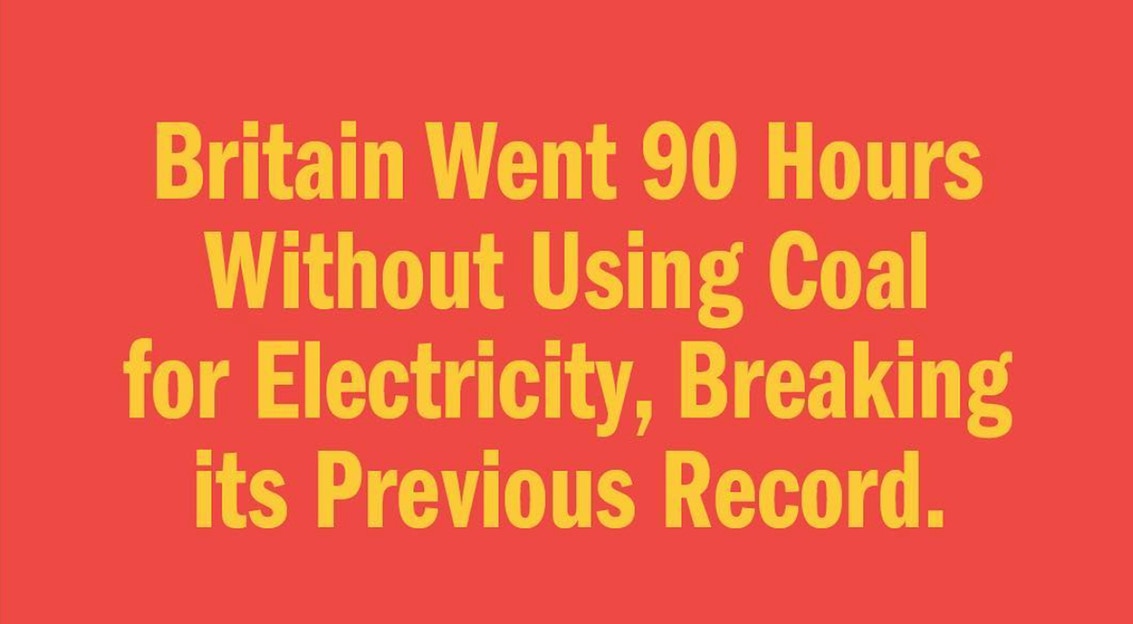
Britain went 90 hours without using coal for electricity, breaking its previous record.

Britain went 90 hours without using coal for electricity, breaking its previous record.

TheUK has just completed a full week without using coal, for the first time since the first coal-fired power station for public use was opened in London in 1882.

The National Grid Electricity System Operator (ESO) said on Twitter that at 1.24 p.m. on Wednesday, the UK had officially gone 168 hours without coal — seven days exactly.

“While this is the first time this has happened, I predict it will become the new normal,” said Fintan Slye, director of ESO, in a statement.


The new 168-hour record significantly beats the previous record for UK electricity generation without coal — which was reportedly set over Easter weekend, when the UK went 90 hours and 45 minutes without coal.

It means that overall in 2019, the UK hasgone over 1,000 hours without coal — reportedly putting the country on track to beat all of itsprevious annual records.

Coal is one of the worst contributors to carbon emissions and global warming.

BusinessSecretary Greg Clark said this was a “huge leap forward in our world-leading efforts to reduce emissions, but we’re not stopping there.

“We’re now on a path to become the first major economy to legislate for net zero emissions,” he added.

Clark was referring to the Committee on Climate Change (CCC) recommended targets for Britain, which were published last week.

The CCC, the independent adviser to the government on climate change, called on the UK to set legally-binding targets to cut carbon emissions to nearly zero by 2050, including emissions from aviation and shipping.

Hitting these targets would “stop the UK’s contribution to global warming” and would be achievable at low cost through UK domestic effort, according to the CCC.

A temperature rise of 1.5 degrees Celsius by 2100 is considered the threshold for dangerous levels of climate change and, according to the CCC, if we’re going to stay below that rise we need global greenhouse emissions to hit zero by 2070 — and carbon dioxide (CO2)emissions need to be at zero by around 2050.

“As more and more renewables come onto our energy system, weekends likethis are going to increasingly seem like the ‘new normal,’” a National Grid ESO spokesperson told the Independent, about the latest coal-free record.

“We believe that by 2025 we will be able to fully operate Great Britain’s electricity system with zero carbon,” the spokesperson added.

“The transformation of how we get the energy to heat our homes and power our work is a massive change, but the advantages it brings in terms of green energy far outweigh any challenges,” they said.

Total coal power use for Britain has fallen by almost two-thirds for thefirst months of this year, compared to the same four month period in2018, according to BusinessGreen.

There are now reportedly just six coal-fired power stations operational in the UK, which are mainly used for back up during peak demand or when supplies drop from other means.

Back in 2014, coal was the main energy source for Britain, but it is now sixth on the list —behind gas, nuclear, wind, imports, and biomass.

Britain and Canada joined forces in 2017 to launch thePowering Past Coal Alliance, which is a voluntary coalition of governments, businesses, and other organizations.

As part of this, the UK pledged to close all of its coal power stations by 2025, and Canada pledged to do the same by 2030. There are now 80 members of the coalition, reported BusinessGreen.

But concerns have been raised about the increasing reliance on gas, given that it’s also a fossil fuel — although less harmful than coal.

The2008 Climate Change Act requires greenhouse gas emissions to be reduced by 80% compared with 1990 levels by 2050.

Muna Suleiman, climate campaigner at Friends of the Earth, told the BBC: “Electricity generated by renewable sources is a key part of the fight against climate chaos so it’s time to remove all the blockers to renewable energy.”

She added: “The government must prioritize the development of sources such as solar and onshore wind.”

This article originally appeared on Global Citizen. You can read it here.
parenting, teens, raising teens, teen hangout, high school, game night for teens, activities for teens, parenthood

Amy White explains how her house became "the house" for her teens.

I grew up in "the house." In high school, my home was the designated place where my friends gathered, sometimes in big groups, sometimes just my small core squad. My three best friends spent the night there almost every Friday and/or Saturday night for four years straight. We devoured Totino's frozen pizzas by the dozen, inhaled soda, and laid waste to any snacks or leftovers that were brave enough to survive in the kitchen. Not only that, but my house was pretty small — four teenage boys took up a lot of space in the living room (the whole thing) and made a lot of noise playing video games deep into the night. It must have driven my parents and older brothers crazy. It's a wonder anyone put up with it.

Or so I thought when I was younger. When I became a parent myself, I started to understand a little more why my mom and dad were so willing to host and feed all my friends and me every single weekend. Why the outrageous grocery bill and constant chaos in the house were probably a small price to pay.


Mom explains how to make your house 'the house' where teenagers hang

One mom has perfectly encapsulated the value of turning your home into "the house" for your kids and their friends, and exactly how she did it for her family.

teens, teen house, teens hanging out, teens having fun, teenagers Teens hanging out in a living room.via Canva/Photos

Amy White shared a reel on Instagram showing her college-aged son hanging in her dining room with a group of friends playing cards. The text overlay reads "What makes your kids' high school friends want to come over, play cards & spend the night on their College Christmas Break." I think most parents can agree that we want our kids to keep coming home as long as possible! So how exactly did White pull this off?

Her explanation in the caption was spot-on.

First, White says that you have to start early. Become "the hang out house" in high school or even earlier. Then you have a better chance of holding onto the mantle into your kid's college years.


Next, be ready to stock the house with snacks and drinks, and don't make a fuss when your kid's friends have at it. "The kids knew we had food," she writes, "BUT they also knew I didn't care what they had. They knew they could eat anything in my pantry and fridge."

Third, and this is a big one, don't mistake being the "cool house" for being "the house." Some parents choose to allow their underage kids and friends to drink alcohol under their supervision, but you don't have to bend your morals and the law to lure the squad over to your place. Pizza and Coke is plenty to keep most teens happy. "We were not the house that served alcohol or even allowed the kids to bring alcohol to our house. And Guess What?? The kids still came and wanted to hang at our house!"

teens, teen house, teens hanging out, teens having fun, teenagers Teenagers eating pizza.via Canva/Photos

Fourth, always say Yes (as often as possible, anyway) when your kids want to have friends over. "They know my answer is 99% of the time YES," White writes. "You have to have your kids take the leadership of offering your home and if your home was 'open' to their friends in high school, they know it will be 'open' to their friends in college."

As a bonus tip, White pleas with parents not to worry about the mess having friends over makes. "I love a clean house and organization, BUT I would much rather have a crazy messy house for the kids where memories are made than a quiet house with nothing going on just to keep my house 'clean.'"

Should parents allow teens to drink at home?

There's an age-old debate over whether parents should allow teens to drink at home because it's better than if they do is unsupervised or keep their home dry as a bone. A recent study out of the University of Buffalo found that kids who grew up drinking at home had a greater chance of having addiction problems when they got older. "A robust relationship was found between parental permission to use alcohol during adolescence and increased alcohol use frequency and quantity, alcohol use disorder symptoms, and alcohol-related harms in young adulthood," the study says.

White writes, "It's worth being 'the house', so let go of control & get to know your kids friends." Commenters agreed.

White's video went viral to the tune of 8.5 million views and hundreds of comments. Parents shared their own experiences of what it's like being the default hang out house.

"Our house was the high school hangout for my son and friends... every weekend... I loved it!! Miss it now that they are all college graduates and have moved away. I love seeing them when they do come home for the holidays"

"A wise man once said don't be the house with the alcohol. Be the house with the food."

"Amy 1000% agree!!! My house is full of teenagers on the weekends and I love every bit of it. Even though I wake up to a kitchen that looked much different from when I left it"


teens, teen house, teens hanging out, teens having fun, teenagers Teenagers eating pizza.via Canva/Photos

"We never allowed alcohol, drugs, bad language, always respectful, and guess what, our house was always the house where the kids hung out. First my daughter, then my son. Through grade school, high school, then when my kids went out of state for college their college friends would come spend a couple weeks during the summer. I always thought of it this way, I loved knowing my kids friends and, who knows, maybe some of those kids, especially during the younger years, just maybe those kids just needed an adult to care. Anyway, it was always fun to have them here!"

"It used to crack me up when my daughter would bring over a bunch of her friends (girls and boys) in high school and instead of hanging out in the family room they all wanted to crowd into either the kitchen with me or our tiny office and happily share all the gossip with me."

Experts say that knowing your kids' friends, and their parents, can have huge benefits. Not only will it bring you the peace of mind of knowing where your kid is and who they're with when they get to those crucial high school years, it has been shown to tangibly improve kids ability to create positive relationships and problem-solve collaboratively. Plus, it can actually be really fun! Kids and teens are the funniest, silliest, most interesting people on the planet. Having a house full of them is messy and loud, but it's always a good time.

One caveat: "don’t feel bad if your house isn’t the chosen house," one commenter reminds us. "Just be happy your kid has a good group of friends and be thankful they have somewhere safe to hang out."

This article originally appeared last year.

Pop Culture

A random woman wrote this Dr Pepper jingle just for fun. It's so good that now it's a real commercial.

"I love when amazing things happen to people who dare and have good intentions."

piano, keyboards, music, jingles, Dr. Pepper, commercial advertisement
Photo Credit: Canva, www.flickr.com

A TikToker writes a Dr Pepper jingle.

When a young person with the TikTok handle @Romeosshow belted out a few bars of a made-up Dr Pepper commercial last December, they probably didn't envision that it would become a full-fledged advertisement. Or that its virality could be life-changing.

Such was the case for Romeo. The song itself is quite simple. The lyrics are: "Dr Pepper, baby. It's good and nice. Doo Doo Doo." That's it. In the chyron overlaying the close-up shot of their face while singing, they wrote, "Had to act on this before someone got sent this in a dream and steal it from me so I impulsively posted this."


@romeosshow

@Dr Pepper please get back to me with a proposition we can make thousands together. #drpepper #soda #beverage

With more than 5.5 million likes, the clip has received nearly 53,000 comments and counting. Many checked in to say they loved their voice and overall vibe. Some even offered advice if they wanted to expand on the jingle. "Second verse 'Dr. Pepper baaaabaaaay," one person wrote. "It's great with ice. Do D do.'" Another got straight to the business end of things: "I am waiting for Dr. Pepper to offer a massive contract."

Over on Instagram, @Bantrbusiness (among many other accounts) posted the same video, noting, "Yes, she got paid." The comments are equally supportive. "I love when amazing things happen to people who dare and have good intentions," one person wrote. Another shared, "This is the wholesomeness I needed today."

What amazing things were they referring to? Just nine days after Romeo's initial post, Dr Pepper's official TikTok account entered the chat. "CHECK YOUR DMS DOODOOODOO," the company exclaimed. Sure enough, they turned the tune into a banger and aired it in a commercial on January 19 during the College Football Playoff National Championship Game.

Dr Pepper commercial written by @Romeosshow www.youtube.com, Dr Pepper

From there, an avalanche of other corporations began rolling into the comment section. And while the jingle itself is ultra-catchy, it's also an excellent way for brands to score some pretty good coverage.

Popeyes, for example, wrote, "GET HER ON THE PHONE NOW." Wingstop, Tic Tac, Mentos, Hyundai, and even Denny's (among countless others) followed, each hoping to get in on the viral game.

An Instagrammer pointed out, "Jingles work. It's been decades and anyone can recognize a Mentos tune, lol."

According to an article by Ad Skate:

"The first commercial radio jingle aired on Christmas Eve, 1926, for Wheaties cereal. A barbershop quartet sang 'Have You Tried Wheaties?', repeating the brand name in a way listeners couldn't forget. The result? Sales soared, proving music could sell as well as entertain.

By the 1930s, jingles had become a staple of radio ads, giving brands a personality and making them stick in consumers' minds."

First ever jingle from Wheaties cereal. www.youtube.com, Francisco Paez

Ad Skate notes that as jingles rose in popularity, they eventually fell out of favor: "In 1998, about 12% of TV ads used original jingles; by 2011, it was just 2.6%. Even jingle powerhouses like Oscar Mayer dropped them altogether in favor of other approaches."

But they're making a comeback. According to Insider Radio:

"Jingles — those snappy, melodic hooks that stick in your brain and resurface when you least expect them — are making a comeback. A friend hums 'Ba da ba ba ba' and you instantly respond with 'I'm lovin' it,' maybe even craving a Big Mac. These catchy tunes have long been a key weapon in the advertising arsenal, embedding brands into our memories with just a few unforgettable notes."

Insider Radio adds that there's a pretty simple science to it:

"Music activates multiple areas of the brain, making it easier to recall. That's why you can still hum jingles from your childhood, even if you haven't heard them in years. This effortless recall is invaluable for brands. A well-crafted jingle doesn't just promote a product; it creates an emotional connection. When paired with nostalgia, jingles can evoke warmth and familiarity, reminding consumers of simpler times. It's a shortcut to creating brand loyalty without overloading audiences with information."

(In an article I wrote for Upworthy about earworms, I cite ways to get a song unstuck from your head if it becomes too embedded.)

As for Romeo, they're continuing to enjoy their newfound fame online. They made a follow-up video styled as a mock awards show, in which they genuinely thank Dr Pepper and all of their TikTok supporters: "THANK YOU GUYYYSSS THAT WAS AWESOME I LOVE YOU #drpepper #commercial #nationalchampionship."

@romeosshow

THANKYOU GUYYYSSS THAT WAS AWESOME I LOVE YOU #drpepper #commercial #nationalchampionship

The moment has been inspiring to jingle writers, to say the least. And just try to get this song out of your head after listening. As one commenter put it, "Well it did what it was supposed to do. It's gonna be stuck in my head all day."

Gen Z; Millennials; technology; cell phones; social media; teens and technology; teens social media

Gen Z is the first generation less cognitively capable than their parents. Denmark has the solution.

Nearly every parent hopes their child will be better off than they are: smarter, more secure, and more well-adjusted. Many parents see this as a stamp of successful parenting, but something has changed for children growing up today. While younger generations are known for their empathy, their cognitive capabilities seem to be lagging behind those of previous generations for the first time in history.

Dr. Jared Cooney Horvath, a teacher turned cognitive neuroscientist who focuses on human learning, appeared before Congress to discuss concerns about cognitive development in children. In his address to the members of Congress, he says, "A sad fact that our generation has to face is this: our kids are less cognitively capable than we were at their age. Since we've been standardizing and measuring cognitive development since the late 1800s, every generation has outperformed their parents, and that's exactly what we want. We want sharper kids."


kids, intelligence, sharp kids, generations, education, cognitive abilities Student smiling in a classroom, working on a laptop.Photo credit: Canva

Horvath explains that the reason this happens is that each generation has gone to school longer than the previous generation. Gen Z is no exception to the longer duration of time spent in school, but they're the first ones who aren't meeting this normal increase in cognitive development. According to the cognitive neuroscientist, the decline is due to the introduction of screens in the classroom, which started around 2010.

"Across 80 countries, as Jean was just saying, if you look at the data, once countries adopt digital technology widely in schools, performance goes down significantly. To the point where kids who use computers about five hours per day in school for learning purposes will score over two-thirds of a standard deviation less than kids who rarely or never touch tech at school," Horvath reveals.

In most cases, the decline in performance doesn't result in better strategies. The neuroscientist shares that the standardized testing has been adjusted to accommodate lower expectations and shorter attention spans. This is an approach that educators, scientists, and researchers went to Capitol Hill to express wasn't working. But not every country is taking the approach of lowering standards to meet lowered cognitive ability. Denmark went in the opposite direction when it realized their students were slipping behind.

France24 recently interviewed educators in Denmark following their seemingly novel approach to students struggling with cognitive development. Since the beginning of the 2025/2026 school year, Denmark has not only been having students turn in their cellphones, but they've also taken tablets, laptops, and computers out of the classroom. No more digital learning for the majority of the school day. Danes went old school by bringing back physical textbooks, workbooks, and writing assignments. The results have been undeniable. Even the students can't seem to deny the success of the countrywide shift in educational approach.

"I think the biggest issue has been that, because we kind of got rid of the books and started using screens instead, that we've noticed that a lot of the kids have trouble concentrating, so it's pretty easy to swipe with three fingers over to a different screen and have a video game going, for example, in class," Copenhagen English teacher, Islam Dijab tells France24.

Now, instead of computers being part of every lesson, Denmark uses computers very sparingly and with strict supervision. One student says that it has been nice not having screen time at school because she loves to read and write. But it wasn't just the lack of attention span children were developing, they were also developing low self-esteem and poor mental health due to the amount of time spent on devices.

kids, intelligence, sharp kids, generations, education, cognitive abilities Students focused and ready to learn in the classroom.Photo credit: Canva

The data showing the negative impact of screens on teens' brains has prompted a nationwide change in Denmark that extends outside of the classroom. Afterschool activities are eliminating or extremely limiting electronic use. There is also a national No Phone Day that encourages everyone to put away their devices for the day, and Imran Rashid, a physician and digital health expert, is petitioning parliament to ban social media use for children under the age of 15. The no phone movement in Denmark is a nationwide effort that hopes to right the ship before another generation feels the effects.

bad habits; stop bad habits; form new habits; healthy habits; break addition; phone addiction; social media addiction

Neurologist reveals 3 tricks people can do right now to break any bad habit

Nobody sets out to pick up a bad habit that will be difficult to break. This is true even if someone tries out something known to be highly addictive. Oftentimes, there's a false belief that they're the one person who has the uncanny ability to not fall victim to the addictive behavior. But a behavior doesn't have to start as addictive to become a bad habit.

Dr. Arif Khan, a pediatric neurologist, shares exactly how easy it is to pick up bad habits and the three tricks that can break them. Habits can be good or bad. Someone brushing their teeth twice a day is a habit dentists love for their patients, while spending 12 hours scrolling social media would likely be under a different category. While Khan likely isn't talking about breaking a habit that has turned into an addiction, like smoking, other habits people hope to change may respond to these science-backed tips.


bad habits; stop bad habits; form new habits; healthy habits; break addition; phone addiction; social media addiction Relaxing amidst kitchen chaos with a tablet and headphones.Photo credit: Canva

"Have you ever noticed how your day starts?" Khan asks. "You open your eyes, and your hands already know what to do. Same apps, same path to the kitchen, same routines you never actually chose. It feels automatic because, well, it is. Habits aren't a personality trait, they're neural shortcuts your brain builds to save energy."

Khan explains the process of the brain building a new habit on his YouTube channel, The Brain Project. "Once your brain creates a shortcut, it loves using it, even when that shortcut works against you," he says. Turns out brains are actually like being comfortable. They want to take the path of least resistance because it requires much less energy. If someone's brain has created a shortcut, there's no need to problem-solve or plan for the unexpected, so the brain gets to be placed on autopilot. Breaking a habit disrupts this clear, easy path.

bad habits; stop bad habits; form new habits; healthy habits; break addition; phone addiction; social media addiction Family disapproves of smoking in the park.Photo credit: Canva

"Deep inside your brain is a structure called the basal ganglia. Think of it like the autopilot system. When you repeat a behavior enough times, this part of the brain saves it as a pattern. Your brain basically goes, 'Oh, we've done this before. This is easy. Let's do it again. The crazy part, once the habit forms, the brain's decision-making regions literally quiet down. You're no longer choosing, you're just doing. This isn't a lack of willpower, this is straight up biology," Khan says before sharing the strategies to help break habits.

1. Cue Shift

"Every habit starts with a cue. A feeling, a trigger, anything like stress, boredom, loneliness, a notification on your phone. Now, most people try to change the behavior, but by the time you notice the behavior, the brain has already made the decision. The real work happens earlier. Ask yourself, what happens right before the habit?" Khan asks. "What were you feeling then? What were you avoiding then?"

Khan explains that figuring out the feeling that comes just before the behavior can help you change the pathway in the brain by interrupting the pattern. When the feeling is noticed, that's when you have time to choose a different behavior.

2. The One Step Rule

The neurologist explains, "Your brain doesn't resist change because it's lazy. It resists change when the change feels too big. The part of your brain that manages planning and discipline, the prefrontal cortex, gets tired easily. So when a task feels overwhelming, your brain defaults straight back to the old pattern. Here's the fix: Shrink the task. Not to make it easier, but to make it neurologically doable. Just one step, like read one page. Do one push-up. Write one sentence. Drink one glass of water."

He shares that your brain is looking for consistency, not perfection, and small repeated actions create dopamine in the brain. Taking the first step makes your brain believe that the habit is now possible.

bad habits; stop bad habits; form new habits; healthy habits; break addition; phone addiction; social media addiction Parent and child in a tech discussion over breakfast.Photo credit: Canva

3. The Reward Rewrite

Habits survive because they're rewarding. Even if the reward isn't something big, there's still a release of dopamine when a habit is repeated, which is probably what makes habits so difficult to break. Khan says that some rewards are subtle, like relief or a sense of control.

"To break the habit, you don't remove the reward. You tend to replace it, and after the new behavior, give your brain something meaningful. A deep breath, a moment of pride, 'I did it!' A physical gesture, like placing your hand on your chest. Here's the truth: Your old habits were built by accident. Your new ones will be built by awareness."

babies, baby names, kids, parents, parenting, names, naming babies, moms, dads, motherhood, fatherhood, family

A couple laughing and a baby crying.

Naming your baby is a really special experience that can help shape who they become, honor the legacy of close friends and family members, and carry personal meaning through symbolism. It's a hard process to get just right, and unfortunately, there are a lot of horrible ways it can go wrong.

One couple with a rather unfortunate last name recently took to social media to playfully mourn all the names they "absolutely can't" use for their impending baby.


Quince and Zach have built a following of more than three million people across Instagram and TikTok, where they share relatable, funny content about life as young parents to a two-year-old daughter, with another baby on the way.

There's just one problem for Quince and Zach, and it's their last name: Cox.

There's nothing wrong with Cox on the surface; it's a perfectly normal and respectable last name. It wasn't until the couple started brainstorming names for their soon-to-be baby girl that they realized Cox was, let's say, problematic.

In a hilarious post on Instagram, the couple recently shared a lengthy, exhaustive list of names they immediately knew would be a no-go:

  • Holden Cox
  • Anita Cox
  • Harry Cox
  • Sawyer Cox
  • Sharon Cox

Check out the fantastic, tongue-in-cheek post here:

More than 400,000 people interacted with the viral post, including thousands of comments from people eager to share their own close calls with unfortunate baby names.

"Maiden name was Dix. I'm now a Cox. I wish I was joking," wrote Shenai Cox.

"My maiden last name is cox. Definitely couldn't hyphenate with my husband. His last name is Oancea (pronounced want-cha) want-cha cox? No thank you," another user wrote.

"My last name is Muncher soooo..." wrote Amber Muncher.

There were even a few people who could only wish their parents had shown the same foresight as Quince and Zach.

Harry Wang, a commenter, wrote, "Wish my parents though like that," before adding, "It's a part of me now, gotta wear it with pride."

In any case, the public service announcement was much appreciated by all:

"As a former cox (maiden name) more people need to be this aware some Cox’s are shockingly blase out here about what they are naming their kids," someone wrote.

In part two of the post, Quince added more names to the cross-off list and revealed why she couldn't hyphenate her last name after getting married.

"I mean we could always hyphenate my maiden name 'Pullen'" she joked in the caption before officially eliminating Hugh Cox, Olive Cox, and Ophelia Cox.

You may laugh, but variations of Olive are some of the most popular names in America.

A few labor and delivery nurses even chimed in on Quince's post to voice their support, saying they wished more parents would be mindful of names that could one day humiliate their children.

There are more ways a name can go wrong than just having phallic undertones. There could be easy rhymes, embarrassing abbreviations, or even an unfortunate "first initial, last name" combination that makes emailing an unpleasant experience for a child one day. Nurses who meet babies all day, every day have seen some horror stories:

@issabelvictoria_

Baby names are so fun🥰 #nicunurse #neonatalnurse #nursesoftiktok #newgradnurse #newgradnurses #nursetok #nursingschool #nursetiktok #nursing #fyp #nurse

While there are only a handful of names that are strictly illegal in the United States—depending on the state, you may have trouble naming your baby Hitler, Santa Claus, or King—parents are urged to take precautions against names that could make life difficult for their child.

Some helpful methods include saying the name out loud (both the full and shortened versions), spelling it out, checking the initials, and watching for embarrassing nicknames, to start.