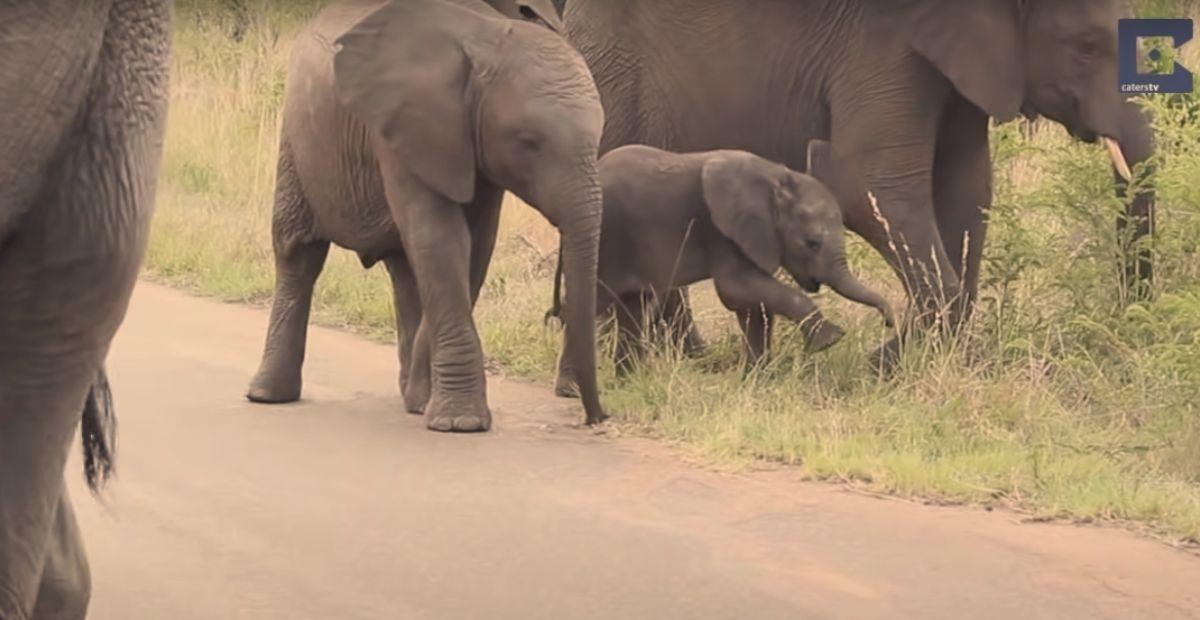
Baby elephants can’t control their trunks and it’s hilarious to see them try

Baby elephants are already adorable without having to do a thing. But watching them learn how to do things is extra adorable, and watching them learn how to use their own body is super extra adorable. Like most four-legged creatures, elephants are able to walk within hours of birth. They have to be able to…

elephants
Photo credit: Caters Clips/YouTubeWatching a baby elephant learning to wield its trunk is so darn cute.

Baby elephants are already adorable without having to do a thing. But watching them learn how to do things is extra adorable, and watching them learn how to use their own body is super extra adorable.

Like most four-legged creatures, elephants are able to walk within hours of birth. They have to be able to stand under their mother’s belly to breastfeed, and they have to be able to follow the herd as it moves around. Their trunk, however, is an entirely different story. Because they drink their mother’s milk exclusively for the first six months and still rely on her milk in addition to other foods for years afterward, they don’t have a need to use their trunk for eating right away. It takes time to learn how to wield that long dangly thing hanging from the front of their faces.


In fact, some baby elephants seem to “discover” their trunks much in the same way that human babies discover their hands and feet. Have you ever seen a baby suddenly look at their hands in amazement, moving them around with the first semblance of recognition that they are attached to their body? Watch these baby elephants doing the same thing with their trunks.

Cute Elephant Discovers Trunk

This little elephant looks like it’s trying to shake that thing off of its face. It even bops at it with its foot. You can almost see that moment of recognition when it realizes it’s actually attached and that it can move it around, however haphazardly. And then it just flings it up and down and around and around, sometimes trying to catch it in its mouth, sometimes trying to catch it with its foot. It’s so all over the place, it’s hilarious.

The ranger’s blog at South Africa’s Tintswalo Safari Lodge explains:

“At first, baby elephants don’t really know what to do with their trunks. It’s amusing to watch as the calves swing them to and fro and sometimes even step on them. They will stick their trunk in their mouth just as a human baby might suck its thumb. With more than 50,000 individual muscle units in the trunk, it’s a complex skill to learn.

By about 6 to 8 months, calves begin learning to use their trunks to eat and drink. By the time they are a year old, they can control their trunks pretty well and, like adult elephants, use their trunks for grasping, eating, drinking, bathing.”

This kiddo hasn’t quite gotten the hang of the whole eating with the trunk thing. Either that, or it’s showing off how well it can fling it around, but either way, it’s so dang cute.

Once they do learn to use them well, there’s almost nothing they can’t do with their trunks. As Katherine J. Wu writes in The Atlantic, “The trunk of an African elephant is an evolutionary marvel. Clocking in at weights well over 200 pounds, it ripples with thousands of individual muscles that help the superlong schnoz lift barbells, uproot trees, and fling bothersome lions into the air.” Wu shared that elephants can also pick up a tortilla chip—notoriously fragile—without breaking it.

“It’s a muscular multi-tool,” Georgia Tech engineer Andrew Schulz told Wu. “It pushes all of the extremes of what we understand animals to be able to do.”

Freaking amazing. All the more reason to protect our planetary home and the creatures we share it with.


  • A man who fell from his wheelchair into a lake and his little beagle saved his life
    Harry Smith was saved by his dog Sarah Jane.

    In 2022, eighty-one-year-old Harry Smith, who uses an electric wheelchair, was walking his beloved nine-year-old beagle mix, Sarah Jane, near a lake in Port St. Lucie, Florida, when the pleasant jaunt took a turn for the worse. Smith says that the left wheel of the chair “grabbed and spun me” and he wound up rolling down a grass embankment into the water. Smith can’t swim, could barely keep his head above the water, and without immediate help would have drowned.

    Sarah Jane began to bark loudly, capturing the attention of Edward Suhling, 58, who was working on a trailer with Aby “Jacob” Chacko, 49. “Sensing his owner was in trouble, his dog began to bark loudly, which alerted two bystanders across the street,” the Port St. Lucie police department wrote in a Facebook post.

    At first, Suhling thought the dog was being attacked by an alligator. Then he saw Smith’s head poking out of the water. Suhling and Chacko ran over to the pond, flagging down a police officer along the way.

    Two strangers jumped in without hesitating

    “As soon as I got here I saw the wheelchair and the dog and I recognized that’s Harry and I know he can’t walk,” Chacko said. Smith was in terror fighting for his life in the pond. “My legs don’t work,” he said. “I can’t push.”

    “The dog was splashing in the water,” Suhling said. “So we both ran over here and I jumped in the water, and my buddy grabbed his arms and I grabbed his legs and we got him up on shore.”

    After Smith was safely out of the water, the police officer administered medical attention and he was cleared to go home. Unfortunately, his wheelchair didn’t work, so the officer pushed him back to his home.

    The Port St. Lucie Police Department later called Suhling, Chacko, and Sarah Jane heroes on its Facebook page. “We are thankful for Mr. Smith’s dog and the two bystanders that helped save his life!” the police department wrote on Facebook. “And as the saying remains true…A man’s best friend is his dog.

    “She’s such a good dog,” Smith later said about Sarah Jane. “Everybody in this neighborhood loves her, they all look out for her.” After the pair made it home safely, Smith was sure to give his dog a treat. “I love her, always have, always will,” he said.

    Why dogs know when their owners are in danger

    While the dog’s heroics are pretty amazing, Sarah Jane knew that Smith was in danger and sprang into action for a couple of reasons. A lot of dogs have a strong fear of water. Not all of them love it like Labradors. If Sarah Jane was afraid of the water, she would have sensed her guardian was in serious danger.

    Secondly, a 2020 study from Arizona State University tested whether dogs will help if they think their owner is in trouble. For the study, owners called out to the dog while appearing to be trapped inside a box. The dogs often attempted to free their owners after hearing them cry for help.

    Beagles are known for being active and adventurous, but are they good swimmers? According to a vet-reviewed article at Dogster, Beagles aren’t known for their love of water, and if they can swim, it doesn’t mean that they enjoy it. They can learn how to swim, but they aren’t natural swimmers.

    The story of Sarah Jane and her guardian Harry Smith proves, once again, that we just don’t deserve dogs.

    This article originally appeared four years ago. It has been updated.

  • 8 things dog people need to know about cats before interacting with them
    Photo credit: CanvaHere's what dog people need to know about cats.

    Have you ever watched a person who has only ever had dogs try to interact with a cat? When dog-only people encounter cats, the result can be a mix of entertaining, bewildering, and, occasionally, a bit dangerous.

    Obviously, cats are not dogs, and treating a cat as if it was a dog may or may not go well for you. So, if you’re one of those dog lovers who find themselves at a loss for what to do with a cat when you’re around one, here are some things to know that may save you some scratches or humiliation.

    Ditch the high energy, embrace a sense of aloofness

    Dogs are often eager. Cats are usually aloof. With many dogs, the more excited you act, the more they’re like, “Hey, you my friend! We best buds! Let’s play and hang out!”

    dog, play, high energy
    Cats don’t react to energy the way dogs do. Photo credit: Canva

    Cats do not play like that.

    Approaching a cat with high energy puts them on edge. They might see you as a threat and become aggressive. Or they will simply “peace out” and leave the room. The best thing you can do if you want to make them comfortable is ignore them.

    Let them come to you

    If you absolutely must approach a cat (because they’re just irresistibly cute), do so very slowly. But it’s really best to just sit on the floor and wait for them to come to you. Don’t try to force it. They might ignore you completely at first, or they might immediately come right up and start rubbing on you. There’s no way to know, so just wait.

    Rubbing on you might mean ‘go ahead and pet me.’ But it might not.

    If a cat rubs up against you, that’s a good sign. If you’re new to them, it means they’re already comfortable with you. But it’s not necessarily an open invitation to pet them, either. Cats are fickle. Before you get too excited and go in for some pets…

    cat, cat behavior, leg rubs
    Cat rubs are usually a good sign. Photo credit: Canva

    Offer them your fingers

    Cats are big on smell. Before your hand touches their fur, they want to know what they’re dealing with. Try holding out a finger or two for them to sniff, preferably coming from below their head instead of above. After they’ve smelled you, they might stick around for pets, or they might not. If they do…

    Don’t pet them like a dog

    No to head pats. Yes to chin and cheek scratches. No to belly rubs unless their human gives you the green light. (Most cats will destroy your hand if you try to rub their belly, but some love it.) No to hard strokes down their back, at least at first. Cats all have different touch preferences, so gently trying around their chin, cheeks, shoulders, and back is the best way to start.

    Happy Cats Haven shared these signs to watch for that indicate a cat might not like the way you’re petting it:

    • Restlessness
    • Skin rippling
    • Ears flattening or flicking
    • Tail thumping or thrashing
    • Turning head toward the petting

    Your hands are not toys

    Playing with cats can be a blast. They are predators with excellent hunting skills, so play involves stalking, chasing, and attacking. But to save yourself some painful scratches, use a laser pointer or a cat toy on a string, not your hand. (They’re not likely to actually play with your hand anyway. And if they do, you might regret it.)

    Don’t put your face near a cat that doesn’t know you

    Even if the cat is lying perfectly contentedly next to you. Even if you’ve had some positive interactions. Not even if the owner says, “Oh, he doesn’t scratch.” The only time our generally docile cat has scratched or bit someone was when a child put their face up to his when he was curled up on a chair. This is one place where the advice for dogs goes equally for cats. Faces and unfamiliar animals don’t mix.

    Don’t try to pick it up

    Some cats are fine being picked up. Many cats are not. Most cats will not take kindly to some stranger trying to manhandle them, which is (probably) how they view you trying to pick them up. Bodily autonomy is important for our feline friends. Don’t violate it. Sit on a chair or sofa and see if they’ll climb onto your lap, but don’t pick them up to make it happen. Very few cats will respond well to that.

    cat, blinking, cat behavior
    Cats blink slowly to tell you they like you. Photo credit: Canva

    Staring a cat in the eyes can be a sign of aggression, which can stress them out. However, if you do make eye contact, try a very slow, sleepy-eyed blink or two and then look away. Slow blinks are a sign of affection.

    But honestly, not looking at them at all might make them more likely to approach you. Again, cats like aloofness.

    If a cat deigns to let you pet it, scratch it, play with it, or otherwise interact with it, you may feel like you have been specially chosen. Embrace the feeling, because that’s exactly what has happened.

  • Kitten named Duck learns to run on two legs and she looks like an adorable velociraptor
    Cat learns to run on two feet after front leg amputations.

    Babies are really adaptable, and the same can be said for baby animals. It’s likely because they just don’t know any other way of life, so they just go with what they’re given and, miraculously, make it work. Even knowing that, however, it’s still hard to imagine a kitten getting around without their front legs.

    Cats essentially use everything from their whiskers to their tails to balance, so how would one walk without two of it’s four legs? The answer is, carefully at first. Duck is a rescued kitten who, unfortunately, had to have both of her front legs completely amputated. While she was wobbly at first, she quickly adapted.

    Meet Duck, the wonder cat

    Duck’s human, Cody, shares her daily shenanigans on his Instagram page aptly named Purrasic Duck, which has amassed over half a million followers. In 2020, he told Duck’s story to The Dodo, revealing how she was rescued and how, against all odds, she developed her agile moves. If you’re having a hard time picturing a two-legged cat on the run, it looks a lot like a furry velociraptor chasing a laser pointer.

    “I ended up naming her Duck because she kinda waddled. She’d kinda take it slow, she waddled trying to figure out her balance,” Cody told The Dodo.

    Before long, Duck was off to play with her much larger dog brothers. Her pug brother even offers her a little assistance in the face cleaning area since Duck doesn’t have paws to do it herself. She returns the favor by cleaning his face too. It’s an adorable relationship, but if you want to see a furry velociraptor chase after cat toys, you’ll need to watch the video below.

    How Duck and Cody found each other

    Cody met Duck when she was found and brought into his sister’s animal clinic. “She was probably chilling in a car engine and her legs got caught up, and she survived that!” Cody can be heard saying as a voice over in the video. At first, Cody’s sister brought her over as a potential foster, but after just one day, Cody decided to keep her for himself. “When I met her, I just fell in love immediately,” he said.

    Duck has no shortage of friends to play with at home, either. In addition to her dog brothers, Cody rescues and either keeps or fosters plenty of baby animals, from chickens, turtles, and opossums to a raccoon, a squirrel, and of course, more dogs and cats. Duck also has a sister named Goose, who’s an adorable gray kitty with just one eye. Here they are hanging out together:

    Duck is thriving, and so is her family

    Today, Duck is no longer a baby and has gotten this two-legged life down pat. She’s living happily with dad Cody and her many, many, many animal siblings and friends. On her social media pages, Cody includes a useful link for other pet parents, rescuers, and fosterers with recommended products to help make the rescue and rehoming process easy for everyone. Check it out here.

    Cody has got quite the rescue menagerie going and it’s so inspiring.

    This article originally appeared three years ago. It has been updated.

  • An old male bald eagle who adopted a rock as an egg finally got his own real foster baby
    Murphy meets a rescued eaglet—his new foster baby.
    ,

    An old male bald eagle who adopted a rock as an egg finally got his own real foster baby

    Murphy became a real dad after he spent weeks nurturing his “RockBaby.”

    On March 8, 2023, a keeper at World Bird Sanctuary in St. Louis County, Missouri, noticed something odd. A male bald eagle named Murphy was guarding what appeared to be a large depression in the ground. “The spot was sparsely but carefully decorated with leaves and branches, and featured a simple rock right in the center,” the nature preserve shared on its Facebook page.

    Murphy began sitting on the rock, nudging it and becoming fiercely protective of it, as if it were an egg. People visiting the sanctuary would inquire about the bald eagle just sitting there, wondering if he was okay. The keepers finally put up a sign that read:

    “If you see an eagle lying down in the back left corner under a perch, that’s Murphy! Murphy is not hurt, sick, or otherwise in distress. He has built a nest on the ground, and is very carefully incubating a rock! We wish him the best of luck!”

    Murphy took his rock duties very seriously

    In case you’re wondering if this is unusual behavior for a 31-year-old male bald eagle, the answer is “not really, but….” Male bald eagles do share equally in nesting and baby-raising, so the paternal instinct part is normal. Murphy’s channeling of that instinct onto a rock…maybe not so much. And at 31, he’s more like a great-granddad than dad, as bald eagles usually live 20 to 30 years in the wild (though they do live longer in captivity).

    Murphy takes fatherhood seriously, though. Soon he began screaming and charging at the four other eagles in the aviary if they came anywhere near RockBaby. (That’s the official name the keepers gave Murphy’s…well, rock baby.) Naturally, the screaming and charging caused a fair amount of stress for all involved, so Murphy and RockBaby were moved to their own enclosure for everyone’s protection.

    People who saw this unfold started suggesting sanctuary staff replace Murphy’s rock with a real egg or get him a mate, but 1) Eagle eggs aren’t just lying around waiting to be given to wanna-be dads, 2) hatching a different kind of bird’s egg would be potentially dangerous for it, and 3) Murphy had two females right there in the aviary, and none of them were interested in each other. Alas, the heart cannot be forced.

    Then a real eaglet needed a dad

    However, a different opportunity presented itself in late March when an aerie with two chicks in it was blown down by high winds. One chick didn’t survive the fall, but the other was brought to World Bird Sanctuary’s Wildlife Hospital.

    A bit bruised, but otherwise healthy, the chick was given a good prognosis. Staff began feeding it while wearing a camouflage suit and holding an eagle stuffy to prevent the eaglet from imprinting on humans. What the baby really needed was a foster parent: an adult eagle who would feed and care for it.

    Murphy’s dad instincts were already in high gear,” the sanctuary wrote on April 11, “but at 31 years old, he had never raised a chick before. It’s definitely a gamble, but also the chick’s best chance.”

    Introducing an eaglet to an adult eagle isn’t as simple as dropping it in the enclosure. First, the eaglet is put into what the sanctuary refers to as a “baby jail,” which is a heated, comfy cage made of wood and wire that protects the eaglet but still allows some interaction between the birds so they can get used to one another. Once the desired bonding behavior is observed, then they try out some direct one-on-one interaction without the cage.

    On April 12, World Bird Sanctuary announced, “IT’S HAPPENING!!!!”

    The eaglet (referred to as Bald Eaglet 23-126, they don’t name foster babies at the sanctuary for superstitious reasons) was released from baby jail, and after an hour or so Murphy approached it with curiosity. Was he wondering if his RockBaby had hatched? Maybe. Would he be the nurturing dad everyone hoped he would be? It appears so.

    As the sanctuary shared:

    “This morning, Murphy got his chance to be a full parent as 23-126 left the nest to go be closer to Murphy. The food is being dropped through a blind drop tube into the nest and baby appears unable to be able to get over the lip to get back into the nest to get the chopped food. When we checked back, we found that baby was still out of the nest and all the chopped food was still in the nest. However, Murphy’s whole fish had been removed from the nest and baby had a full crop. 23-126 is not yet old enough to tear food which means MURPHY FED THE BABY!!!!”

    Murphy’s second eaglet, 24-159, was successfully released into the wild on January 31, 2026, at Audubon Center at Riverlands in West Alton, Missouri: a fitting final chapter to Murphy’s legacy.

    The comments on the update, of course, were pure gold as people became fully invested in this story and even gave the eaglet a real name—Dwayne, as in The Rock:

    “I can’t believe I’m crying over eagles!”

    “Murphy’s going to be giving a TedTalk: Manifest The Eaglet You Need In Your Life.”

    “So happy for Murphy & eaglet Dwayne (the rock Johnson).”

    “‘Rock, I am your Father.’”

    “Omg I’m crying! Murphy never gave up on his rock and now has a baby of his very own ❤️ The wonders of nature never cease. Ty, WBS, for making this possible. These two are saving each other ❤️ ❤️   .”

    Many people lamented that there is not a live cam at the facility so people could watch this pair as their relationship developed, but staff reminded everyone that the sanctuary is out in the middle of the woods and they don’t have a strong enough signal for a live stream. But WBS staff posted regular updates on social media on how Papa Murphy and “Dwayne” were doing.

    Murphy was honored on Father’s Day for his stellar fostering skills as he returned to the aviary:


    “We’d like to thank Murphy for his service and applaud his outstanding job in raising 23-126,” the sanctuary wrote. “Murphy may have had a few moments in his parenting duties where he regretted choosing to sit on that rock, but we believe that the overall experience has been very enriching for him. We know that Murphy has enriched 126’s life. Thanks to Murphy, 23-126 has grown up knowing that he is a Bald Eagle! 126 has learned so much from Murphy and, thanks to his efforts, will have a much greater chance of thriving in the wild after he is released. Happy Father’s Day Murphy, and thank you, we couldn’t have done this without you.”

    Rest in peace, Papa Murphy

    Sadly, Murphy passed away at age 33 on March 15, 2025, after suffering head trauma during a severe storm, having fostered two eaglets in his final years. He lived a long life for a bald eagle and the World Bird Sanctuary offered a beautiful tribute to this extraordinary bird.

    “His resilience, spirit, and dedication as a foster dad touched the hearts of millions of people throughout the world, leaving an especially profound impact on those fortunate enough to have worked with him. While Murphy has delighted guests along Avian Avenue for years with his distinct vocalizations and charismatic personality, it wasn’t until 2023 when he decided to incubate a rock that he gained an international following. Murphy’s transition from rock incubating to rockstar foster dad of an injured eaglet brought daily joy to thousands as we watched their journey together. As Murphy’s eaglet grew so did our love of him. Their journey together taught thousands about eagle growth and development, the bonds between eagle parents and their young, and the critical work that goes into wildlife rehabilitation. Murphy’s eaglet continued to grow strong under his watchful gaze and went on to be released back to the wild. The following year, Murphy fostered a second eaglet in need with the same dedication he gave the first. His second eaglet is still in our care, but is making good progress toward release and we expect he will be ready by mid summer.

    We could not have asked for a better ambassador and role model. We are incredibly grateful for the community that came together as a result of his heartwarming story. We are devastated by this loss and know that the community mourns with us. Murphy’s foster eaglets were the first ones our hospital received in over a decade and we learned a lot about their care and space needs from observing Murphy with them. With what we learned from this, we’ve designed a series of special aviaries to serve the specific needs of injured and orphaned raptors, including an aviary specialized for eaglets. In honor of Murphy’s legacy, we plan to name the eventual eagle fostering aviary Murphy’s Manor, so that we can continue to remember him for decades to come. Murphy will be deeply missed, but his legacy will live on in the memories of those who loved him.”

    Murphy’s second eaglet, 24-159, was successfully released into the wild on January 31, 2026, at Audubon Center at Riverlands in West Alton, Missouri: a fitting final chapter to Murphy’s legacy.

    This article originally appeared three years ago. It has been updated.

  • Crows are incredibly smart. Here’s how to make friends with one in four easy steps.
    Photo credit: via Krari The Crow/YouTubeHow to befriend a crow.
    ,

    Crows are incredibly smart. Here’s how to make friends with one in four easy steps.

    “They are loyal friends and have brought much joy into my life.”

    When it comes to keeping birds as pets, people usually think about parrots or canaries. Nobody ever considers having a crow. But research has shown that crows are incredibly clever, curious, and self-aware. They recognize the faces of people they like or don’t like, have the ability to use tools, and can even mimic human speech. Looking to experience the magic of crows yourself? A YouTube user named Alexandra from Germany made a video on how you can befriend the crows in your neighborhood in four easy steps. All it takes is “some food and some patience.”

    Over a decade ago, Alexandra made friends with a crow named Krari. Krari and her friends visit her regularly and are considered part of the family. They also bring their “little ones” to Alexandra’s house to chill as well. “They come here to get food, to play, or just hang out with me and relax,” Alexandra says in an introductory video on her YouTube page.

    How to make friends with a crow in four steps

    1. Find a pair of crows

    Crows tend to live in areas populated by humans, so chances are there are crows in your neighborhood. The best place to start is to find a pair with a fixed territory that you see on a regular basis. That way, you’re cultivating a relationship with the same animal day after day, and you can “slowly get to know each other.”

    2. Offer food

    Crows will eat just about anything, from insects to invertebrates to meat. They also enjoy nuts, worms, and vegetables. If you offer the food in the same place at the same time of day, you’ll establish a routine. Then, the crow may come by regularly to see if you have anything tasty to eat.

    3. Be mindful

    When interacting with the crow, make sure they aren’t anxious or displaying signs that they are prepared to fly away at any moment. Approach the birds with an open, indirect gaze so as not to cause alarm. Sit quietly while you wait for the bird to approach and avoid quick movements.

    4. Let the birds come to you

    This requires patience. The crow will be shy at first, but they know you better than you think. They will remember your face and your kindness. Give them a chance to observe you and earn your trust.

    One important reminder before you start

    At the end of the video, Alexandra reminds everyone that while we should make friends with crows, they are supposed to live free in the skies and not be stuck in a cage. “I hope this helps you build a relationship with these fascinating birds,” Alexandra concludes her video. “They are loyal friends and have brought much joy into my life. Please let birds have their freedom. They do not belong in homes or other forms of captivity. Thank you.”

    If you succeeded in befriending a feathered genius, tell your new crow friend we say hi!

    This article originally appeared five years ago. It has been updated.

  • This couple has the clingiest cat on Earth and people can’t get enough of his cute demands
    Chase might just be the clingiest cat ever.

    Cats are quirky. We all know this.

    Those of us who have had multiple cats throughout our lives know that some cats are quirkier than others. Maybe they like to sleep with their face in a shoe (true story). Maybe they won’t stop tearing into bags of Styrofoam packing peanuts and eating them, necessitating a shipping business to switch to cornstarch-based packaging (also true story). Maybe they can catch a crumpled-up piece of paper you toss into the air with their paws and bring it to you in their mouth like a dog playing fetch (awww, I miss that cat).

    Or maybe their unique quirk is that they have to be Velcroed to someone’s body every minute of every day. That’s Chase the cat in a nutshell: super sweet, but super clingy.

    Meet Chase, the world’s clingiest cat

    Chase belongs to Kareem and Fifi of the TikTok channel @dontstopmeowing. The couple have become Internet famous for their three very chill cats. Their “spaw day” videos showing how their cats, Chase, Skye, and Millie, get pampered went viral in 2021, and they’ve gained a huge following sharing life with their cats.

    All three are adorable, but Chase…oh, Chase is a special one. I’ve seen some clingy cats before, but nothing like this.

    Watch:

    Literally clingy, as in “won’t stop clinging to the human.” How many cats like to be carried around like a baby? Not many, I’d guess.

    When Chase wants Mommy, Chase wants Mommy.

    @dontstopmeowing

    Where did he learn to be so clingy? 😭 fyp foryou foryoupage

    ♬ original sound – Kareem & Fifi

    Of course, Chase doesn’t always want Mommy. Sometimes it’s Daddy’s turn for all the lovin’.

    Yes, they tried to train the clinginess away

    Fifi shares videos of her attempting to train the clinginess out of Chase, which are hilarious. This one has been viewed over 57 millions times.

    She even dubbed the viral audio of a toddler video “I just a baby!” That fits perfectly with Chase’s hug-happy antics.

    Oh, Chase. You’re just too much.

    And just because it’s so dang cute, check out this video of Chase meeting a baby for the first time. (Warning: Wicked adorable baby giggles incoming. Hold onto your ovaries if you have ’em.)

    Then a baby joined the family

    It’s a good thing Chase got on with the baby so well, because the couple welcomed their first (human) baby, Taj, in January 2024 and Chase certainly had a hard time adjusting.

    But today, it looks like Kareem, Fifi, Taj, Chase, Skye, and Millie are all one big happy family.

    Keep up with the family on their TikTok and YouTube.

    This article originally appeared four years ago. It has been updated.


  • No one was manning the Delta desk at the airport. So a playful passenger grabbed the intercom.
    Photo credit: CanvaAn airplane takes off as a passenger walks through the airport terminal.

    Flying is frustrating, especially lately. Flight delays are surging, costs are going through the roof, and airlines are squeezing customers to maximize their profits. It can be pretty infuriating.

    When you’re flying and run into obstacles, you have three choices: become irate and make a scene (not recommended), grin and bear it, or, if you’re really bold, have a little fun with the situation.

    Annoyed passenger makes sarcastic announcement

    One traveler passing through Los Angeles International Airport recently took matters into his own hands when he needed assistance from a Delta Air Lines employee but couldn’t find one. The Delta desk at his gate was completely empty and unmanned, and he needed help with an issue related to his flight.

    And that’s when he noticed the intercom.

    Video footage from a fellow airport traveler captures the man approaching the desk, picking up the intercom, and saying, “Hi Delta associates that aren’t paying attention, please come to 30B. You have a customer waiting. Thank you.”

    When no one comes, he grows more annoyed and even more sarcastic, activating his best pilot/flight attendant voice: “Delta, Delta, Delta. Please come to 30B. You have a customer waiting.”

    Suddenly, in the middle of his next announcement, he’s interrupted by an automated message regarding baggage information. He responds in kind: “OK, that’s fine if you want to do the baggage thing, but what about customer service? Customer service is needed at 30B. Please come and help the customer at 30B. Uh, anybody on shift? Delta, Delta, please help! 30B, thank you!”

    Intercom man is hailed as a hero

    A few of the weary passengers visible in the video get a good chuckle out of the performance, but it took social media to really give the man the props he deserves.

    “Who is he? Upgrade him,” a commenter suggested.

    “Rumor has it he’s still at 30B waiting to be helped,” joked another.

    Others were just amazed that airline workers never seem to make announcements as clearly and loudly as this random passenger did:

    “This is the clearest I’ve ever heard that mic.” (Over 81,000 people agreed with this comment, which says a lot.)

    “So those mics DO work, they just choose to mumble”

    Many viewers were quick to identify with the broader frustration:

    “TSA not getting paid, Spirit died, now delta is self serve? what is happening?”

    One commenter summed it up beautifully: “We are all this exhausted with 2026”

    In part two of the video, a pilot approaches the man. The two have a brief discussion—slightly tense, but amicable—and then the pilot leaves. “So the pilot just walked away from me,” the intercom man announces.

    Playful moment represents serious frustration

    The flying experience, in general, has had a rough couple of years.

    For starters, passengers are worried about the safety of the planes they’re flying on. Issues with Boeing planes have been publicly documented and have definitely put flyers on edge.

    Flight delays have become almost unavoidable. Equipment issues, boarding problems, and air traffic congestion have made sitting on the tarmac for hours an all-too-common nightmare.

    And for the passengers’ part, their etiquette has been far from pristine. Reports of unruly passengers and in-flight confrontations involving flyers and crew have been all over the news in recent years.

    An empty desk with no assistance for a flyer who needs customer service perfectly encapsulates what it’s like to fly in 2026. But the beauty of this story is the man’s playful, sarcastic, and yes, pointed outlet for his anger. He probably broke some airport policy, but no one got hurt or arrested, and the virality of the moment made his point perfectly.

  • A compassionate vet paused his exam to give a tiny, terrified dog some much-needed cuddles
    A scared dog clings to Dr. Kris Vine for comfort.
    ,

    A compassionate vet paused his exam to give a tiny, terrified dog some much-needed cuddles

    “To see a male vet doctor being nurturing and patient with this little fella warms my heart.”

    It’s safe to say that most veterinarians go into animal medicine because they love animals and want to help them. But in the day-to-day business of doing exams, treating various medical conditions, and helping pet owners through agonizing decisions about their companions’ end-of-life care, the pure joy of simply loving on an animal can get lost.

    But as one vet demonstrates, veterinary care sometimes means providing some personal cuddle comfort. Dr. Kris Vine, DVM, a veterinarian in Las Vegas, was captured giving a new patient, a scared Chihuahua-Dachshund mix, some affection and reassurance in the middle of his exam.

    Watch the moment that won the internet

    “My new patient was scared to get his vaccines so I had to give him some lov’n between each one,” Dr. Vine wrote. “He did good.”

    @dr.vinethevet

    my hope is to make your pet’s visit as comfortable as possible. #fypage #dog #veterinarian #doctor #pets #fypシ゚viral

    ♬ Eternal Sunshine – Woody🤠

    The doggo puts his paws up on Vine’s chest and nuzzles his little face into him, and we can see by the tail between his legs that the poor thing is terrified. But he finds comfort in Vine’s soothing strokes. “I’m not only their doctor, but their safe space as well,” Vine tells Upworthy.

    Vine’s hope is to make the animals in his care as comfortable as possible, and people are loving seeing his genuine, patient compassion for the frightened pup.

    “Perfect example of real compassion a person has inside of them both for himself and his job,” wrote one person. “So touching.”

    “Omg why can’t all vets AND groomers be like this?!!! ,” wrote another. “I dropped my last groomer cause I didn’t like the tone she used with my baby.”

    “It is good to receive love ❤️ to help get through our fears ❤️ ,” shared another.

    veterinarians, vet tech veterinary medicine, pet care, animals
    We all do better with a little comfort. Photo credit: Canva

    Why vet visits are so scary for animals

    It’s so true. Lots of animals are afraid to go to the vet, especially if they associate it with something painful or negative. Having a caring, compassionate vet who goes out of their way to provide comfort to a frightened furry friend can make a big difference in how an animal feels about vet visits.

    To be fair, vet visits can be scary. Plenty of humans have anxiety about going to the doctor even when we fully understand why we need to go. For an animal, it’s just an unfamiliar place with strange smells and harsh lighting where someone pokes and prods them without their consent. Many pets have to be put into a carrier and ride in the car to go to the vet, which may cause them stress. Vets can do a lot to ease an animal’s fears, but owners can do even more at home beforehand to prepare their pet for a vet visit.

    5 ways to make vet visits less stressful

    PetLife Animal Hospital recommends these steps to help animals feel more at ease about going to the vet:

    1. Make Car Rides Positive

    If your pet only goes in the car to visit the vet, they may associate car rides with fear. Take them on short, enjoyable rides and reward them with praise or treats afterward to help break the negative association.

    2. Turn the Carrier into a Comfort Zone

    Keep the pet carrier out at home—not just when it’s time to leave. Line it with soft blankets, place treats inside, and let your pet explore it at their own pace. This turns the carrier into a familiar, safe space.

    3. Schedule “Happy Visits”

    Stop by your local vet office or animal hospital just to say hello! Let your pet meet the team, get a treat, and leave. No needles. No exams. Just good vibes and friendly faces.

    4. Stay Calm and Confident

    Your pet looks to you for cues. If you’re calm and positive, it helps them feel safe. Use a cheerful voice, avoid rushing, and reassure them with gentle touches.

    5. Talk to Your Vet About Extra Help

    Some pets need a little more support. Ask about calming sprays, anxiety-reducing supplements, or even prescription options if needed.

    veterinarians, vet tech veterinary medicine, pet care, animals

    Vet visits can be stressful, but there are steps to make them easier for everyone. Photo credit: Canva

    Making sure our pets get the medical and emotional care they need is an important part of pet ownership. Finding a caring vet is a big part of fulfilling those responsibilities, so thanks to Dr. Vine for setting such a beautiful example.

    You can follow Dr. Vine on TikTok.

    This article originally appeared one year ago. It has been updated.

Family

Florida teacher says she’s quitting her job because of school’s ‘course recovery’ shortcut

Innovation

Man builds the ‘world’s smallest tiny house’ and somehow makes it work in 19 square feet

Identity

Winston Churchill battled his depression by staying busy, laying ‘200 bricks’ every day

Pets

8 things dog people need to know about cats before interacting with them