upworthy
Add Upworthy to your Google News feed.
Google News Button
Pop Culture

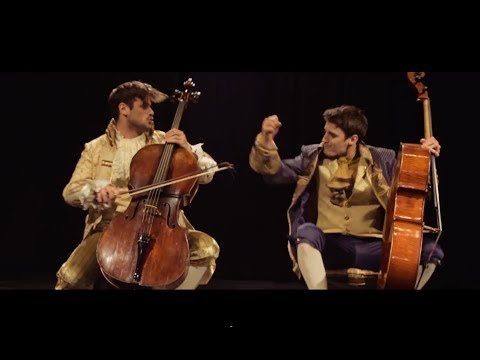
Ever seen two cellists rocking out to an AC/DC song? It's amazing how well it works.

2Cello's genre-smashing "Thunderstruck" performance has been watched 260 million times.

two cellists playing on stage

2Cellos rocks the house with "Thunderstruck."

If someone said, "Name two genres of music on the opposite ends of the spectrum," heavy metal and classical music would be a logical answer. So when you hear that an AC/DC song being played on classical instruments, it can challenge the brain a bit.

(Some folks may ask, "Is AC/DC really considered heavy metal?" By today's standards, no. Compared to thrash, black and death metal, definitely not. But AC/DC has been lumped into the heavy metal genre by everyone from MTV to Encyclopedia Britannica, despite co-founder Angus Young saying they were just a rock band. At the very least, they were metal-adjacent, so let's roll with it.)

"Thunderstruck" is one of those songs people of all ages know at least part of, thanks to its frequent use in movies and television shows. In fact, it's so ubiquitous that when two cellists transition into it from a classical piece, it's instantly recognizable.

Of course, the way they headbang and literally shred their cello bows while playing it also helps.

The cellists dressing in period garb and playing for what looks like an audience of Mozart's creates a delightful contrast in addition to it being in impressive musical performance. There's a reason the 2Cellos "Thunderstruck" video has been viewed a whopping 260 million times on YouTube.

Watch and enjoy:

People's reactions since the video debuted in 2014 have ranged from humor to incredulity to admiration for the duo's mad cello skills:

"I used to be a fan, but after hearing this masterpiece 1000 times, I'm an air conditioner now."

"When you're into rock but your parents buy you a cello."

"Can’t believe AC/DC made a cover of a song from the 1700s."

"These guys are like the ultimate form of being classically trained but the teachers never let them have any fun."

"As a fellow cellist, the skill you're witnessing is incredible."

"As a bass player, it's incredible how they can play that with so much precision. It is truly incredible, love the music."

Many people in the comments have shared that they keep coming back to watch this again and again, even years later.

Luka and Hauser, the famous Croatian cellists responsible for this genre-smashing masterpiece, just ended their musical career together in May of 2023. As Total Croatia News reported, "Luka is more of a family man now, with three children and a wife, and Hauser continues to be ambitious, full of ideas and eager to keep going, conquering the world and playing his music everywhere. Having different approaches to life, they thought it was best to take separate paths but will still remain great friends."

However, you can still enjoy their past performances together on their YouTube channel here.


This article originally appeared two years ago.

Once a refugee seeking safety in the U.S., Anita Omary is using what she learned to help others thrive.
Pictured here: Anita Omary; her son, Osman; and Omary’s close friends
True

In March 2023, after months of preparation and paperwork, Anita Omary arrived in the United States from her native Afghanistan to build a better life. Once she arrived in Connecticut, however, the experience was anything but easy.

“When I first arrived, everything felt so strange—the weather, the environment, the people,” Omary recalled. Omary had not only left behind her extended family and friends in Afghanistan, she left her career managing child protective cases and supporting refugee communities behind as well. Even more challenging, Anita was five months pregnant at the time, and because her husband was unable to obtain a travel visa, she found herself having to navigate a new language, a different culture, and an unfamiliar country entirely on her own.


“I went through a period of deep disappointment and depression, where I wasn’t able to do much for myself,” Omary said.

Then something incredible happened: Omary met a woman who would become her close friend, offering support that would change her experience as a refugee—and ultimately the trajectory of her entire life.

Understanding the journey

Like Anita Omary, tens of thousands of people come to the United States each year seeking safety from war, political violence, religious persecution, and other threats. Yet escaping danger, unfortunately, is only the first challenge. Once here, immigrant and refugee families must deal with the loss of displacement, while at the same time facing language barriers, adapting to a new culture, and sometimes even facing social stigma and anti-immigrant biases.

Welcoming immigrant and refugee neighbors strengthens the nation and benefits everyone—and according to Anita Omary, small, simple acts of human kindness can make the greatest difference in helping them feel safe, valued, and truly at home.

A warm welcome

Dee and Omary's son, Osman

Anita Omary was receiving prenatal checkups at a woman’s health center in West Haven when she met Dee, a nurse.

“She immediately recognized that I was new, and that I was struggling,” Omary said. “From that moment on, she became my support system.”

Dee started checking in on Omary throughout her pregnancy, both inside the clinic and out.

“She would call me and ask am I okay, am I eating, am I healthy,” Omary said. “She helped me with things I didn’t even realize I needed, like getting an air conditioner for my small, hot room.”

Soon, Dee was helping Omary apply for jobs and taking her on driving lessons every weekend. With her help, Omary landed a job, passed her road test on the first attempt, and even enrolled at the University of New Haven to pursue her master’s degree. Dee and Omary became like family. After Omary’s son, Osman, was born, Dee spent five days in the hospital at her side, bringing her halal food and brushing her hair in the same way Omary’s mother used to. When Omary’s postpartum pain became too great for her to lift Osman’s car seat, Dee accompanied her to his doctor’s appointments and carried the baby for her.

“Her support truly changed my life,” Omary said. “Her motivation, compassion, and support gave me hope. It gave me a sense of stability and confidence. I didn’t feel alone, because of her.”

More than that, the experience gave Omary a new resolve to help other people.

“That experience has deeply shaped the way I give back,” she said. “I want to be that source of encouragement and support for others that my friend was for me.”

Extending the welcome

Omary and Dee at the Martin Luther King, Jr. Vision Awards ceremony at the University of New Haven.

Omary is now flourishing. She currently works as a career development specialist as she continues her Master’s degree. She also, as a member of the Refugee Storytellers Collective, helps advocate for refugee and immigrant families by connecting them with resources—and teaches local communities how to best welcome newcomers.

“Welcoming new families today has many challenges,” Omary said. “One major barrier is access to English classes. Many newcomers, especially those who have just arrived, often put their names on long wait lists and for months there are no available spots.” For women with children, the lack of available childcare makes attending English classes, or working outside the home, especially difficult.

Omary stresses that sometimes small, everyday acts of kindness can make the biggest difference to immigrant and refugee families.

“Welcome is not about big gestures, but about small, consistent acts of care that remind you that you belong,” Omary said. Receiving a compliment on her dress or her son from a stranger in the grocery store was incredibly uplifting during her early days as a newcomer, and Omary remembers how even the smallest gestures of kindness gave her hope that she could thrive and build a new life here.

“I built my new life, but I didn’t do it alone,” Omary said. “Community and kindness were my greatest strengths.”

Are you in? Click here to join the Refugee Advocacy Lab and sign the #WeWillWelcome pledge and complete one small act of welcome in your community. Together, with small, meaningful steps, we can build communities where everyone feels safe.

This article is part of Upworthy’s “The Threads Between U.S.” series that highlights what we have in common thanks to the generous support from the Levi Strauss Foundation, whose grantmaking is committed to creating a culture of belonging.

Family

Mom explains the 'dishonest' Boomer parenting style that hurts adults to this day

“How did I not hear about dishonest harmony until now? This describes my family dynamic to a T."

boomer parents, parenting styles, dishonest harmony, parents, older parents, '70s and '80s parents,

“What they want is dishonest harmony rather than honest conflict.”

There are certainly many things the Boomer parents generally did right when raising their kids. Teaching them the importance of manners and respect. That actions do, in fact, have consequences. That a little manners go a long way…all of these things are truly good values to instill in kids.

But, and we are speaking in broad strokes here, being able to openly discuss difficult feelings was not one of the skills passed down by this generation. And many Gen X and Millennial kids can sadly attest to this. This is why the term “dishonest harmony” is giving many folks of this age group some relief. They finally have a term to describe the lack of emotional validation they needed throughout childhood to save face.


Psychologists define the "dishonest harmony" approach as maintaining a façade of peace and harmony at the expense of addressing underlying issues. Parents who practice disharmony prioritize appearance over authenticity and are known to avoid conflict and sweep problems under the rug.

In a video posted to TikTok, a woman named Angela Baker begins by saying, “Fellow Gen X and Millennials, let's talk about our parents and their need for dishonest harmony.”

@parkrosepermaculture

Replying to @Joe Namath #boomerparents #toxicparent #harmony #genx #millennial #badparenting #conflict #nocontact

Barker, who thankfully did not experience this phenomenon growing up, but says her husband “certainly” did, shared that when she’s tried to discuss this topic, the typical response she’d get from Boomers would be to “Stop talking about it. We don't need to hear about it. Move on. Be quiet.” And it’s this attitude that’s at the core of dishonest harmony.

What the experts say about 'dishonest harmony'

"Research supports what many therapists witness daily: families that avoid conflict tend to experience higher levels of anxiety, depression, and relational dissatisfaction," writes Dr. Rachel White, LMFT, at Restoration Psychological Services. "According to the American Association for Marriage and Family Therapy (AAMFT), families who suppress conflict are more likely to develop covert communication patterns, where body language and tone carry more weight than actual words. This leads to confusion, emotional misattunement, and a cycle of disconnection.

How 'dishonest harmony' works in families

“What that’s showing is their lack of ability to handle the distress that they feel when we talk openly about uncomfortable things,” she says. “What they want is dishonest harmony rather than honest conflict. Keep quiet about these hard issues. Suppress your pain, suppress your trauma. Definitely don't talk openly about it so that you can learn to heal and break the cycle,” she continues. “What matters most is that we have the appearance of harmony, even if there's nothing harmonious under the surface.”

baby boomers, boomer parents, boomer couple, couple 60s, grandparents, A Baby Boomer couple.via Canva/Photos


Barker concludes that this need to maintain a certain facade led to most of the toxic parenting choices of that period. “The desire of Boomer parents to have this perception that everything was sweet and hunky dory, rather than prioritizing the needs of their kids, is what drove a lot of the toxic parenting we experienced.”

Barker’s video made others feel seen

“How did I not hear about dishonest harmony until now? This describes my family dynamic to a T. And if you disrespect that illusion, you are automatically labeled as the problem. It’s frustrating,” one person wrote in the comments.

“THANK YOU SO MUCH! I'm a 49 yo biker sitting in my bedroom crying right now. You just put a name to my darkness!” added another.

baby boomers, boomer parents, boomer couple, couple 60s, grandparents, A Baby Boomer couple.via Canva/Photos


Many shared how they were refusing to repeat the cycle

One wrote, “This is EXACTLY my family dynamic. I’m the problem because I won’t remain quiet. Not anymore. Not again.”

“I love when my kids tell me what I did wrong. It gives me a chance to acknowledge and apologize. Everyone wants to be heard,” said another.

Of course, no parenting style is perfect. And all parents are working with the current ideals of the time, their own inner programming, and their inherent need to course-correct child-rearing problems of the previous generation. Gen Alpha parents will probably cringe at certain parenting styles currently considered in vogue. It’s all part of the process.

But hopefully, one thing we have learned as a collective is that true change happens when we summon the courage to have difficult conversations.

This article originally appeared last year. It has since been updated.

otter, lion, dog, golden retriever, beaver
Phtoo Credit: https://www.canva.com/photos

An otter, a lion, a golden retriever, a beaver

In the never-ending quest to understand ourselves better, or at least have just one more distraction from whatever it is we should be doing, here comes the animal personality test. And the craziest part is (at least for me), it's kind of accurate.

The truth is, these days anyone can create their own personality tests. (And they do… and I've taken them.) Which Sex and the City character are you? Who is your inner Marvel superhero? What color is your heart? (Carrie, Ant Man, and black respectively.)


But this particular animal archetype quiz, in actuality, is a model developed in the late 90s by Gary Smalley, an author with a psychology background and a PhD in counseling. Co-created by author John Trent, the two wrote a book called The Two Sides of Love: The Secret to Valuing Differences. The idea is to strike a balance between the tender, "soft" side of love and the "hard," more direct side. After taking the quiz provided in the book (and now online), one can find out if their temperament is the lion, the beaver, the otter, or the golden retriever.

Even though it was written as a love-based tool, this personality test is often mentioned in the corporate world as a way to find out how people relate in the workforce. Jasper Rose, a financial recruiting agency, shared the quiz on their website, but notes, "This model should be taken with a pinch of salt. These animal categories describe the natural leaning of your temperament. In other words, they aren’t entirely fixed, as personalities are flexible and change over time, and people are complex." (So something an otter would say.)

Without further ado, the personality test can be taken (among many places) through this Michigan State University worksheet here:

personality test, lion, beaver, otter, golden retriever Gary Smalley and John Trent's personality testPhoto Credit: Michigan State University

As with most personality tests, these questions can be tricky, as many times more than one answer will apply. For example, one question asks that you rank what best describes you from the following: "likes authority, enthusiastic, sensitive feelings, likes instructions." Another: "Takes charge, takes risks, loyal, accurate." It's possible to relate to all four statements equally, making this a flawed test.

But if you're in it for a lighthearted look at something that may vaguely describe you, here's a breakdown of the results:

THE LION

lion, personality, fierce, strong, animal A lion roams. Giphy GIF by Savage Kingdom, Nat Geo

These, according to the test, are the natural-born leaders. They are confident, take-charge, strong, and independent. From the Jasper Rose website:

"Strengths: visionary, persistent, practical, productive, initiates change and projects, communicates directly, enjoys being challenged, strong-willed, independent, decisive, leader.

Weaknesses: Insensitive/cold, sarcastic, self-sufficient, impatient, stubborn, overlooks risks, controlling at times, can be too direct."

An educational worksheet on the Community Engaged Learning website (Michigan State University) adds that lions, "are great at initiating communication, but not great at listening." They add their natural desires are "freedom, authority, variety, difficult assignments, opportunity for advancement."

THE OTTER

otter, personality, silly, cute, animal An otter is surprised. Giphy GIF by Nashville Tour Stop

These are our happy social types. "They are often energetic and enthusiastic, with a tendency to be playful and enjoy humor. Otters are generally creative and enjoy trying new things but may struggle with follow-through. They value relationships and are often empathetic and compassionate towards others."

"Strengths: Outgoing, optimistic, personable, communicator, dreamer, responsive, warm, friendly, talkative, enthusiastic, compassionate.

Weaknesses: Undisciplined, unproductive, exaggerative, egocentric, unstable, struggle with follow-through, impulsive, needs social approval, easily offended."

The Center for Relationship Education adds, "Otters find it easy to be soft on people. It is also easy for them to be soft on problems. Otters need to learn to say ‘No’ and provide the hard-side balance of healthy boundary setting."

THE BEAVER

beaver, animal, personality type, snacks, cute Beaver enjoying a snack. Giphy GIF by San Diego Zoo Wildlife Alliance

These are our go-tos for decisive, detail-oriented people who actually enjoy structure and routine. "Beavers tend to be cautious and risk-averse, preferring to follow established procedures rather than taking chances. They are also known for their analytical skills and ability to organize complex information. However, they may struggle with flexibility and creativity, and may sometimes be perceived as overly critical."

"Strengths: Analytical, thorough, decision-maker, deliberate, self-disciplined, industrious, organized, aesthetic, sacrificing.

Weaknesses: Moody, self-centered, touchy, negative, unsociable, critical, revengeful."

The educational handout adds that in terms of relationships, "Beavers are good listeners, communicate details, and are usually diplomatic."

THE GOLDEN RETRIEVER

dog, golden retriever, personality quiz, loyalty Golden Retriever adorably looks up. Giphy GIF by WoofWaggers

These are our loyal, dependable friends/lovers. "They also tend to avoid conflict and prioritize maintaining harmony in their relationships. However, they may struggle with making decisions and taking action, and may sometimes come across as passive or indifferent."

"Strengths: Calm, supportive, agreeable, easy-going, loyal, dependable, quiet, objective, diplomatic, humorous, values relationships, stable and consistent.

Weaknesses: Selfish, stingy, indirect with others, resists change, procrastinator, unmotivated, lacks initiative, indecisive, fearful, worrier, can be co-dependent."

The Center for Relationship Education notes, "Goldens’ strong tendency toward the soft-side of love can lead to issues of co-dependence and enabling. Goldens need to learn to balance their natural soft-side with some hard-side qualities."

As with most quizzes like these, most of us are a combination of traits not easily put into labeled boxes. If nothing else, it's a creative way to get people thinking about how they interact with one another in a variety of situations. (Which is totally something a golden retriever like me would say.)

This article originally appeared last year

Education

Real people share 17 red flags that expose someone trying to appear wiser than they actually are

"Actually referring to oneself as 'smart' in general is often a good indicator too."

low intelligence, low iq, iq lower, signs of low intelligence, not smart, not very smart

A man looks confused.

People who struggle with intellectual functioning, often described as having a low IQ, may also be considered to have low intelligence. Determining low intelligence is not always easy or obvious, so people on Reddit shared their thoughts on the signs that can indicate it.

One observant Redditor shared their insight, writing that a sign of low intelligence is "actually referring to oneself as 'smart' in general is often a good indicator too." The comment is an example of the Dunning–Kruger effect, first described in 1999 by psychologists David Dunning and Justin Kruger, which found that people with lower IQs tend to overestimate their intelligence, while those with higher IQs often underestimate it.


"Those with limited knowledge in a domain suffer a dual burden: Not only do they reach mistaken conclusions and make regrettable errors, but their incompetence robs them of the ability to realize it," the psychologists wrote, according to Psychology Today.

- YouTube www.youtube.com

17 signs of low intelligence, according to Redditors

"When presented with an statement that generalizes something, they will use an anecdote as a counterexample and think that it completely refutes the statement. Example: travelling in an airplane is generally safer than in a car. 'Actually that's not true, I know someone who died in an airplane crash.'" - Traditional_Rub_9828

"Refusal to learn, grow and change your views from evidence provided." - Userdataunavailable

"Confusing 'being loud' with 'being right.' The loudest person in the room is rarely the smartest." - Kernel_Slasher

"Actually referring to oneself as 'smart' in a general is often a good indicator too." - loku_gem

"Believing anything they see on social media." - Fabulous_Ady

"Lack of curiosity. Thinking they know it all." - Disastrous-Sky-8484

- YouTube www.youtube.com

"Further than a lack of curiosity is never asking questions. It was something I heard about gorilla researchers who taught them sign language that in the years of gorilla sign language communications they never had a gorilla ask a question of a human. That simple process of recognizing you don't know/have something you want, understanding someone else likely does know what you want, and asking them actually takes a lot of brain power. Some parrots and exceptionally smart dogs can hit that threshold... And some very cognitively limited humans do not." - MildGenevaSuggestion

"They get annoyed by people who act curious, too. About anything. 'Why do you care?' 'Who cares?' Idk man, it's just interesting. Why shouldn't I care?" - Belle_Juive

"Not realizing that everything has nuances." - SecretHuckleberry720

"Refusing to consider they might be wrong." - Marry_Ennaria

"Not being able to understand or engage with hypotheticals. It is a meme online but that is actually a sign of low intelligence. Individuals with IQs under 90 often struggle with conditional hypotheticals—such as 'How would you feel if you hadn't eaten dinner?'—responding with factual rebuttals like 'But I did eat dinner.'" - Emergency-Resist-730

@baxate_carter

Even more low IQ traits from a year ago

"Severe impairment in metacognition - that is, a persistent inability to recognize one's own errors in thinking, monitor one's own reasoning, or adjust beliefs/behavior even when presented with clear contradictory evidence." - DiamondCalvesFan

"Ironically, Always having an answer. There is a lot of power in saying 'I don't know'." - Loose-Cicada5473, mattacular2001

"People who mock others instead of trying to understand them. Curiosity is usually a sign of intelligence." - cutiepie_00me

"Repeating the same mistakes and blaming everyone else." - Luckypiniece

"Bragging that you haven't read a book since high school." - tiger0204

"One move chess player. This is like an analogy to how some people think and act and vote. A good chess player is thinking 3 or more moves ahead. a bad one is playing one move ahead only. When people say things like 'Why should I pay school taxes if I don't have any kids!?' they are playing one move without thinking ahead. Better schools means a more educated populace means less crimes and more economic opportunity for your area, thus it benefits everyone whether they have kids or not." - ChickenMarsala4500

baby names, dog names, golden retriever, name shame, cvs, funny, funny tiktok, funny dog videos, names
@sarahwithscrubs/TikTok, used with permission

Honestly, most of us would have reacted this way.

It started like any ordinary pharmacy errand. A Michigan woman named Sarah was waiting at CVS to pick up a prescription for her “son.” When another woman waiting in line overheard the name of her “son,” she apparently couldn’t help but let out an unsolicited opinion.

“You’ll really name your son anything, huh?” the woman said with a sigh.


The name in question? Whiskey.

baby names, dog names, golden retriever, name shame, cvs, funny, funny tiktok, funny dog videos, names At least it wasn't Bubbles. Photo credit: Canva

Now, if you’re picturing a tiny human in a onesie named after your dad’s favorite Friday-night drink, and feeling a little baffled in the process, don’t worry. So was everyone else.

Except Whiskey isn’t a little boy. He’s a red golden retriever.

Yep. Sarah’s “son” is of the four-legged variety, currently undergoing cancer treatments and racking up a pharmacy bill that could rival a small country’s GDP. She and her husband get his prescriptions filled at their local CVS because (fun fact) many human and animal meds are the same, just at different doses.

baby names, dog names, golden retriever, name shame, cvs, funny, funny tiktok, funny dog videos, names You just know there's a person named Whiskey out there getting a kick out of this. media4.giphy.com

As Sarah explained to Newsweek, this strategy saves them a few bucks, but can certainly lead to some incredible misunderstandings.

In her TikTok video, which has now been watched over 3 million times, Sarah retold this CVS name-shaming incident, and viewers collectively lost it.

@sarahwithscrubs I should’ve thrown in I was picking up his cancer meds too lol 🤭😂 #fyp #foryoupage #storytime #dogs #smallcreator ♬ original sound - sarah renee

One commenter shared, “I was shaming you too until you said dog!” Another wrote, “I mean, Whiskey is a horrible name for a child 😂 But for a dog? Okay lol.”

However, a few folks came to Sarah’s defense. One person noted, “There are women named Brandi—what’s wrong with Whiskey?” Another admitted, “in my 49 years I didn't know CVS filled pet meds!"

It’s the kind of mix-up that reminds us how funny life can be when the human and animal worlds collide. Because let’s face it: Whiskey the dog? Adorable. Whiskey the toddler? Maybe… less so. It might be a mostly unspoken rule, but a rule nonetheless.

As for what became of that misunderstanding, Sarah shared that when the other woman called Whiskey a "horrible" name for a child to grow up with that could lead to getting bullied in school, Sarah quipped back with "Well, he's a dog. So I don't think so." Upon that realization, Sarah told Newsweek that she “apologized very nicely” once she learned that Whiskey was, in fact, a dog.

As Sarah put it, the stranger “just left in a hurry, probably to think about her actions later.”

Meanwhile, TikTok is still chuckling, and celebrating one very good boy with a name that fits him perfectly.

Moral of the story: some names are meant for baby humans, like Zach or Emma. Others are for the fur babies who greet you at the door with a wagging tail and oodles of love…like Whiskey. 🐾🥃

This article originally appeared last year

arthur brooks, happiness research, arthur brooks speech, retirement happiness, older and happier

Arthur Brooks speaking.

Happiness researcher Dr. Arthur Brooks says that one of the most important things people can do as they enter the second half of their life is to focus on internal well-being rather than satisfying all of their wants. Even though this may feel like it runs counter to how many live the first half of their lives, he says it's the best way to find joy in middle age and beyond.

Brooks is a professor at Harvard University, author of From Strength to Strength and Build the Life You Want (with Oprah Winfrey), and is a lifelong student of the science of happiness. He says the key to finding it in the second half of life is recognizing when enough is enough and reducing unnecessary desires.


“What happy, successful people do in the second half of their lives is they go from adding to subtracting," Brooks says. "Mother Nature tells you that satisfaction comes from having more. More of what? More money, more power, more pleasure, more honor, more everything. More. But that's not the secret. The real formula for happiness is all the things that you have divided by the things that you want.”

@evancarmichael

The Real Formula of Happiness Speaker: Dr. Arthur Brooks Source: Dr. Arthur Brooks #motivationalquotes #motivation #inspirational #happiness #arthurbrooks

For Brooks, finding happiness later in life is an inside job: we analyze our desires and decide which ones we can cast aside. It’s a worthwhile practice, given that as we age, our ability to achieve many of our desires is compromised by the aging process.

“There's two ways for you to get greater satisfaction," Brooks continues. "There's the old, inefficient way of have more, have more, have more. Or there's the efficient, enduring way of wanting less."

How to manage your wants, according to Brooks

It's easy to tell people to manage their desires, but how do they come up with a strategy for doing so successfully? He says one way is to audit your desires by putting them to a simple litmus test.

“One helpful exercise is to list your major goals and ask: Would this still matter to me if no one else knew I achieved it? If the answer is no, it may not be a goal rooted in meaning,” he writes on LinkedIn.

Brooks also believes that we can simplify our lives by redefining what it means to be a success.

“In research on midlife satisfaction, those who reoriented their ambition from status to service, especially men, reported higher purpose and deeper relationships over time,” he adds.

- YouTube www.youtube.com

Another meaningful way we can find greater happiness is by setting some of our wants aside and being grateful for what we have. Because if you aren't grateful for the positives you have in life, they will never stick to your bones or be truly nourishing.

“Practice gratitude for what you have," Daniel Levitin, professor emeritus of psychology and neuroscience at McGill University, writes in Successful Aging. "This is motivating, alters brain chemistry toward more positive emotions, and oils the pleasure circuits of the brain."

There’s something graceful about accepting a new challenge in life as we get older: learning to have the internal strength to set aside what we truly don't need and to nurture what we do, such as our relationships, friends, and community. Brooks' perspective is a valuable tool that will keep many from being led astray as they age by chasing things they no longer need.

This article originally appeared last year

happiness, happy woman, middle age, happy middle age, smiling woman A woman who is happy with her arms spread wide. via Canva/Photos